Showing posts with label past simple. Show all posts

Tuesday, 19 March 2024

DAVID ATTENBOROUGH USED TO BE THE VOICE OF THE BBC

Today, The Fosters & The Grandma have flown to London, where they have watched some TV series about animals presented by David Attenborough, the English broadcaster and natural historian.

Before, they have studied Past Simple and Used To Be, and they have read Oscar Wilde's The Ghost of Canterville.

More info: Past Simple (Regular Verbs)

More information: Used To

Sir David Frederick Attenborough, born 8 May 1926, is an English broadcaster and natural historian. He is best known for writing and presenting, in conjunction with the BBC Natural History Unit, the nine natural history documentary series forming the Life collection that together constitute a comprehensive survey of animal and plant life on Earth.

He is a former senior manager at the BBC, having served as controller of BBC Two and director of programming for BBC Television in the 1960s and 1970s. He is the only person to have won BAFTAs for programmes in each of black and white, colour, HD, 3D and 4K.

Attenborough is widely considered a national treasure in Britain, although he himself does not like the term. In 2002 he was named among the 100 Greatest Britons following a UK-wide poll for the BBC. He is the younger brother of the director, producer and actor Richard Attenborough, and older brother of the motor executive John Attenborough.

Attenborough was born in Isleworth, Middlesex, now part of west London, and grew up in College House on the campus of the University College, Leicester, where his father, Frederick, was principal. 

During the Second World War, through a British volunteer network known as the Refugee Children's Movement, his parents also fostered two Jewish refugee girls from Europe. After leaving the Navy, Attenborough took a position editing children's science textbooks for a publishing company. He soon became disillusioned with the work and in 1950 applied for a job as a radio talk producer with the BBC. Although he was rejected for this job, his CV later attracted the interest of Mary Adams, head of the Talks department of the BBC's fledgling television service.

Attenborough's association with natural history programmes began when he produced and presented the three-part series Animal Patterns. The studio-bound programme featured animals from London Zoo, with the naturalist Julian Huxley discussing their use of camouflage, aposematism and courtship displays.

More information: BBC

Through this programme, Attenborough met Jack Lester, the curator of the zoo's reptile house, and they decided to make a series about an animal-collecting expedition. The result was Zoo Quest, first broadcast in 1954, where Attenborough became the presenter at short notice due to Lester being taken ill.

In 1957, the BBC Natural History Unit was formally established in Bristol. Attenborough was asked to join it, but declined, not wishing to move from London where he and his young family were settled. Instead, he formed his own department, the Travel and Exploration Unit, which allowed him to continue to front Zoo Quest as well as produce other documentaries, notably the Travellers' Tales and Adventure series.

In the early 1960s, Attenborough resigned from the permanent staff of the BBC to study for a postgraduate degree in social anthropology at the London School of Economics, interweaving his study with further filming.

Attenborough became the controller of BBC Two in March 1965, but had a clause inserted in his contract that would allow him to continue making programmes on an occasional basis. Later the same year he filmed elephants in Tanzania, and in 1969 he made a three-part series on the cultural history of the Indonesian island of Bali.

For the 1971 film A Blank on the Map, he joined the first Western expedition to a remote highland valley in New Guinea to seek out a lost tribe.

More information: Vox

One of his most significant decisions was to order a 13-part series on the history of Western art, to show off the quality of the new UHF colour television service that BBC Two offered. Broadcast to universal acclaim in 1969, Civilisation set the blueprint for landmark authored documentaries, which were informally known as tombstone or sledgehammer projects.

Attenborough thought that the story of evolution would be a natural subject for such a series. He shared his idea with Chris Parsons, a producer at the Natural History Unit, who came up with the title Life on Earth and returned to Bristol to start planning the series.

Attenborough harboured a strong desire to present the series himself, but this would not be possible so long as he remained in a management post.

After his resignation, Attenborough became a freelance broadcaster and immediately started work on his next project, a pre-arranged trip to Indonesia with a crew from the Natural History Unit.

It resulted in the 1973 series Eastwards with Attenborough, which was similar in tone to the earlier Zoo Quest but without the animal-collecting element. After his return, he began to work on the scripts for Life on Earth. Due to the scale of his ambition, the BBC decided to partner with an American network to secure the necessary funding. While the negotiations were proceeding, he worked on a number of other television projects. He presented a series on tribal art (The Tribal Eye, 1975) and another on the voyages of discovery (The Explorers, 1975).

He also presented a BBC children's series about cryptozoology entitled Fabulous Animals (1975), which featured mythical creatures such as the griffin and kraken. Eventually the BBC signed a co-production deal with Turner Broadcasting and Life on Earth moved into production in 1976.

More information: The Guardian

Beginning with Life on Earth in 1979, Attenborough set about creating a body of work which became a benchmark of quality in wildlife film-making and influenced a generation of documentary film-makers. The series also established many of the hallmarks of the BBC's natural history output.

By treating his subject seriously and researching the latest discoveries, Attenborough and his production team gained the trust of scientists, who responded by allowing him to feature their subjects in his programmes. In Rwanda, for example, Attenborough and his crew were granted privileged access to film Dian Fossey's research group of mountain gorillas.

The success of Life on Earth prompted the BBC to consider a follow-up, and five years later, The Living Planet was screened.

This time, Attenborough built his series around the theme of ecology, the adaptations of living things to their environment. It was another critical and commercial success, generating huge international sales for the BBC.

In 1990, The Trials of Life completed the original Life trilogy, looking at animal behaviour through the different stages of life. The series drew strong reactions from the viewing public for its sequences of killer whales hunting sea lions on a Patagonian beach and chimpanzees hunting and violently killing a colobus monkey.

In the 1990s, Attenborough continued to use the Life title for a succession of authored documentaries. In 1993, he presented Life in the Freezer, the first television series to survey the natural history of Antarctica. Although past normal retirement age, he then embarked on a number of more specialised surveys of the natural world, beginning with plants. They proved a difficult subject for his producers, who had to deliver five hours of television featuring what are essentially immobile objects. The result, The Private Life of Plants (1995), showed plants as dynamic organisms by using time-lapse photography to speed up their growth.

More information: Time

Prompted by an enthusiastic ornithologist at the BBC Natural History Unit, Attenborough then turned his attention to the animal kingdom and in particular, birds. 

As he was neither an obsessive twitcher nor a bird expert, he decided he was better qualified to make The Life of Birds (1998) on the theme of behaviour. The documentary series won a Peabody Award the following year. The order of the remaining Life series was dictated by developments in camera technology.

For The Life of Mammals (2002), low-light and infrared cameras were deployed to reveal the behaviour of nocturnal mammals.

The series contains a number of memorable two shots of Attenborough and his subjects, which included chimpanzees, a blue whale and a grizzly bear. Advances in macro photography made it possible to capture natural behaviour of very small creatures for the first time, and in 2005, Life in the Undergrowth introduced audiences to the world of invertebrates.

At this point, Attenborough realised that he had spent 20 years unconsciously assembling a collection of programmes on all the major groups of terrestrial animals and plants – only reptiles and amphibians were missing. When Life in Cold Blood was broadcast in 2008, he had the satisfaction of completing the set, brought together in a DVD encyclopaedia called Life on Land.

More information: Spiegel

Attenborough narrated every episode of Wildlife on One, a BBC One wildlife series that ran for 253 episodes between 1977 and 2005. At its peak, it drew a weekly audience of eight to ten million, and the 1987 episode Meerkats United was voted the best wildlife documentary of all time by BBC viewers.

He has also narrated over 50 episodes of Natural World, BBC Two's flagship wildlife series. Its forerunner, The World About Us, was created by Attenborough in 1969, as a vehicle for colour television. In 1997, he narrated the BBC Wildlife Specials, each focussing on a charismatic species, and screened to mark the Natural History Unit's 40th anniversary.

In October 2014, the corporation announced a trio of new one-off Attenborough documentaries as part of a raft of new natural history programmes.  

Attenborough's Paradise Birds and Attenborough's Big Birds was shown on BBC Two and Waking Giants, which follows the discovery of giant dinosaur bones in South America, aired on BBC One.

The BBC also commissioned Atlantic Productions to make a three-part, Attenborough-fronted series Great Barrier Reef in 2015. The series marked the 10th project for Attenborough and Atlantic, and saw him returning to a location he first filmed at in 1957. By the turn of the millennium, Attenborough's authored documentaries were adopting a more overtly environmentalist stance. In State of the Planet (2000), he used the latest scientific evidence and interviews with leading scientists and conservationists to assess the impact of man's activities on the natural world.

He later turned to the issues of global warming (The Truth about Climate Change, 2006) and human population growth (How Many People Can Live on Planet Earth?, 2009).

He also contributed a programme which highlighted the plight of endangered species to the BBC's Saving Planet Earth project in 2007, the 50th anniversary of the Natural History Unit.

Attenborough also forged a partnership with Sky, working on documentaries for the broadcaster's new 3D network, Sky 3D. Their first collaboration was Flying Monsters 3D, a film about pterosaurs which debuted on Christmas Day of 2010.

A second film, The Bachelor King 3D, followed a year later. His next 3D project, Conquest of the Skies, made by the team behind the BAFTA-winning David Attenborough's Natural History Museum Alive, aired on Sky 3D at Christmas 2014.

Attenborough has narrated three series of David Attenborough's Natural Curiosities for UKTV channel Watch, with the third series showing in 2015. He has also narrated A majestic celebration: Wild Karnataka, India’s first blue-chip natural history film, directed by Kalyan Varma and Amoghavarsha.

More information: World Economic Forum
 
 
It seems to me that the natural world is 
the greatest source of excitement; 
the greatest source of visual beauty; 
the greatest source of intellectual interest. 
It is the greatest source of so much in life
that makes life worth living.

David Attenborough

Wednesday, 4 October 2023

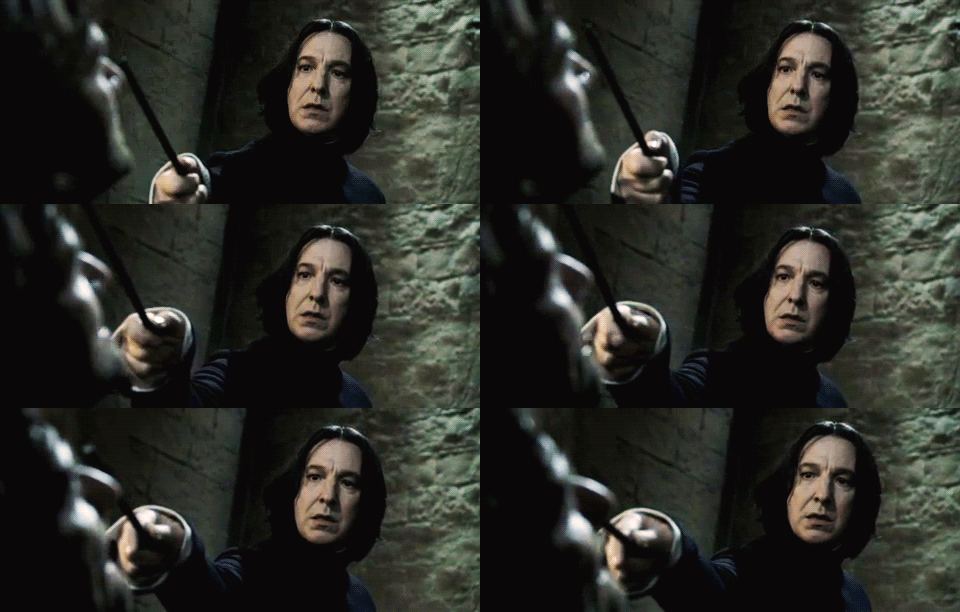
SEVERUS SNAPE, MYSTERY AND ARTS IN MAGIC

Today, The Weasleys and The Grandma have met Professor Severus Snape, who has explained to them how to defense themselves against the Dark Arts. After this meeting, the family has practised Present Perfect.

More info: Present Perfect
 

Professor Severus Snape is a half-blood wizard serving as Potions Master, Defence Against the Dark Arts professor, and Headmaster of the Hogwarts School of Witchcraft and Wizardry as well as a member of the Order of the Phoenix and a Death Eater. His double life played a extremely important role in both of the Wizarding Wars against Voldemort. 

The only child of Muggle lowlife Tobias Snape and Gobstones witch Eileen Snape, née Prince, Severus was raised in the Muggle dwelling of Spinner's End, which was in close proximity to the home of the Evans family, though in a poorer area. He met Lily and Petunia Evans when he was nine and fell deeply in love with Lily, becoming a close friend of hers.

More information: Pottermore

Severus Snape was a thin man with sallow skin, a large, hooked nose and yellow, uneven teeth. He usually dressed in flowing black robes which made him resemble an overgrown bat. He had shoulder-length, greasy black hair which framed his face in curtains, curling lips and dark, penetrating eyes that resembled tunnels. As a Death Eater, he bears the Dark Mark on his left inner forearm.

Snape was a repressed, solitary man with no friends. In his early life, he was insecure, vulnerable, and yearned to be part of something better. 

As a child, the bleak normality of working-class suburbia compounded with his neglectful Muggle father inspired in him a contempt for ordinariness. This urgent desire to be a part of something powerful and important was what drew him to Lord Voldemort's inner circle. The younger Snape had a stringy, pallid look, being round-shouldered yet angular and with a twitchy walk that recalled a spider, as well as long oily hair that jumped about his face.

More information: HP Lexicon

Snape had a strong, authoritative presence. He spoke in a soft, contained voice most of the time, except during the occasional instances when he lost his temper. Severus started at Hogwarts with Lily in 1971, where he was Sorted into Slytherin House. This put him in the same year as Lily but unfortunately for him in rival houses. Severus became the immediate enemy of James Potter and Sirius Black and was a frequent victim of their bullying. This led him to be irritable towards James's son Harry when he was a professor.
  

Snape, when young, developed a passion for the Dark Arts, which increased as his desire for revenge grew stronger. 

Snape became involved with the bullies in Slytherin House, many of whom were pure-blood supremacists. This put his friendship with Lily, a Muggle-born, under great strain until it was eventually broken in their fifth year. In an attempt to win back Lily's affections, Snape joined the Death Eaters along with a group of his fellow Slytherins.

Severus was made a member of the Slug Club presumably because of his talent at potion-making and Horace Slughorn kept a picture of him as a student, clutching his copy of Advanced Potion-Making. Despite this, Horace did not have many hopes for Severus's future, as his photograph was kept behind many others.

More information: Screen Rant

Shortly before Lily Evans was murdered by Lord Voldemort, Snape changed sides and became a member of the Order of the Phoenix and double agent during the Second Wizarding War. With tremendous difficulty, Snape prevented Lord Voldemort from learning the truth about his loyalties. 

Despite the opinions of most others including Harry during his early life, Albus Dumbledore trusted Snape for reasons that were kept between them both until their deaths. Despite Snape killing Dumbledore, it is learned that they had a special agreement for him to do so. 

When he died, it was revealed that his deep strong love for Lily Evans caused him to redeem himself, joining Dumbledore's cause for her protection from Lord Voldemort. The relationship between Dumbledore and Snape would be one of an unusually strong loyalty, so much so that Snape agreed to kill Dumbledore upon the latter's own request. Before Dumbledore's death, Snape promised to protect the students of Hogwarts from the Death Eaters, who would inevitably take control of the Ministry of Magic as well as the school. 

More information: Cinema Blend

Snape later participated in the Battle of Hogwarts but was murdered by Lord Voldemort who mistakenly believed that Snape was the master of the Elder Wand, an immensely strong and powerful wand that Voldemort deeply desired, one of the Deathly Hallows, when in reality, Harry Potter was the master of the Elder Wand, because Draco Malfoy had disarmed Dumbledore, on the night of Dumbledore's death on top of the Astronomy Tower and Harry had disarmed Draco at Malfoy Manor.

After Snape's death, Harry Potter ensured that his portrait remained at Hogwarts, honoring him as a hero, despite their significant personal differences. In addition, Harry later named his second son Albus Severus Potter in honor of Dumbledore and Severus, both an inspiration in Harry's life after the Battle of Hogwarts

Harry also was influenced by Severus' Hogwarts house, and freely admitted that Albus could choose Slytherin if he wished.

More information: Vanity Fair

Severus Snape was born 9 January, 1960 to Eileen Prince, a pure-blood witch, and Tobias Snape, a Muggle, making him a half-blood wizard. Severus, whose father was neglectful and possibly even violent, began to identify with his mother's family and created a secret nickname from his mother's maiden name, calling himself the Half-Blood Prince. His unhappy relationship with his father may have been the origin of his disdain for Muggles. It is implied that Severus was friendless and uncared for by his parents. This lack of care largely shaped Severus's bitter disposition and cruel behaviour later in his life.

Severus grew up at Spinner's End, a shabby suburb of Cokeworth. This area of town was near a dirty river and full of dilapidated houses, disused factories and broken down street lamps. Through the rest of his life, Severus continued to return there when he was not at school. The young Severus is depicted as being unwashed and wearing ill-fitting clothes that were so mismatched that it looked deliberate. As a child, Severus was neglected and his parents often fought with one another. He could not wait to leave for Hogwarts at the end of the summer.
 
More information: Slash Film

Severus attended Hogwarts School of Witchcraft and Wizardry as a student and was Sorted into Slytherin House, at that time led by Potions master Horace Slughorn. On the way to Hogwarts for his first year, Severus sat with Lily Evans on the train. While on the train they met James Potter and Sirius Black. This encounter between the three of them revolved around a disagreement regarding what Hogwarts house was the best. This hostile first encounter would set the tone for the antagonism between the three of them for the rest of his life.

According to Sirius, Severus excelled in the Dark Arts from an early age. At the age of eleven, he knew more curses and hexes than most of the seventh year students. He reportedly was friends with a gang of Slytherins who later became Death Eaters, including Avery and Mulciber. 

More information: The Telegraph

Severus was credited with creating a good number of popular spells like Levicorpus, Liberacorpus, Muffliato, and curses like Langlock, the Toenail Growth Hex, and his signature curse, Sectumsempra. Other Slytherins that Sirius mentioned as being friends with Severus included Evan Rosier and Wilkes.  

Severus also had contact with Lucius Malfoy, who was a prefect during his first year and greeted him kindly when he was Sorted into the Slytherin House. Most likely the two had good rapport at Hogwarts, which could also be a reason why Narcissa Malfoy trusted Severus to take care of Draco Malfoy and why he seemed to favour Draco during his later teaching years. Remus Lupin and Peter Pettigrew were also classmates of Severus.


Severus suffered terrible remorse when Voldemort decided that Harry Potter was the subject of the prophecy, and that Lily Evans, the woman whom he always loved, was now in danger as a result of his actions. 

He begged Voldemort to spare her in exchange for the lives of her husband and son. But, knowing that he could not leave Lily's safety in question at the hands of someone who could turn back at his word on a mere whim, and that Lily would probably defend her child to the last breath, Snape also approached Albus Dumbledore to ask him to save Lily.

More information: Independent

He pleaded with Dumbledore to hide her, along with her husband and son if he had to. Dumbledore agreed, but insisted that Severus serve him as a spy among the Death Eaters. In fact, it was Snape's request to Voldemort which allowed Lily to let herself die in order for Harry to live, when Voldemort attempted to murder him, his curse backfired and Voldemort's body was destroyed.

When Severus Snape began his teaching career at Hogwarts, he initially applied for the position of Defence Against the Dark Arts, but was rejected multiple times. 

Many students were under the impression that this was because Dumbledore feared Snape might return to his old ways if allowed to teach his favourite subject, but in reality it was because Dumbledore was aware by that point that the job had been jinxed by Voldemort. Knowing that no Defence Against the Dark Arts teacher would last longer than a year, Dumbledore instead employed Snape in the position of Potions Master and Head of Slytherin House, following the retirement of veteran Potions Master Professor Horace Slughorn. 

Though it seemed rather uncommon for someone as young as Snape to be named Head of any House at Hogwarts, it is possible that Snape was the only Slytherin teacher left at the school, or that he was placed there to keep a watchful eye on the young Slytherins, who were frequently accused of, but not without reason, joining the Death Eaters.

More information: Cosmopolitan
 
 
The Dark Arts are many, varied, 
ever-changing, and eternal. 
Fighting them is like fighting 
a many-headed monster, 
which, each time a neck is severed, 
sprouts a head even 
fiercer and cleverer than before. 
You are fighting that 
which is unfixed, mutating, indestructible.

 Severus Snape

Wednesday, 21 October 2020

'HAWAII OPERATION', A JAPANESE DECLARATION OF WAR

Today, The Stones have visited the Naval Station Pearl Harbor, a U.S. naval base adjacent to Honolulu.
 
This place enters in History when the Imperial Japanese Navy Air Service attacked it in December 7, 1941. This meant the USA formal entry into World War II.
 
Before visiting Pearl Harbor, The Stones have continued with their English course reviewing Past Simple with regular and irregular forms.

More information: Past Simple

The Attack on Pearl Harbor was a surprise military strike by the Imperial Japanese Navy Air Service upon the United States -a neutral country at the time- against the naval base at Pearl Harbor in Honolulu, Territory of Hawaii, just before 08:00, on Sunday morning, December 7, 1941.

The attack led to the United States' formal entry into World War II the next day. The Japanese military leadership referred to the attack as the Hawaii Operation and Operation AI, and as Operation Z during its planning.

Japan intended the attack as a preventive action to keep the United States Pacific Fleet from interfering with its planned military actions in Southeast Asia against overseas territories of the United Kingdom, the Netherlands, and the United States. Over the course of seven hours there were coordinated Japanese attacks on the U.S.-held Philippines, Guam, and Wake Island and on the British Empire in Malaya, Singapore, and Hong Kong.

More information: Visit Pearl Harbor

The attack commenced at 7:48 a.m. Hawaiian Time (18:18 GMT). The base was attacked by 353 Imperial Japanese aircraft -including fighters, level and dive bombers, and torpedo bombers- in two waves, launched from six aircraft carriers. 

Of the eight U.S. Navy battleships present, all were damaged, with four sunk. All but USS Arizona were later raised, and six were returned to service and went on to fight in the war.

The Japanese also sank or damaged three cruisers, three destroyers, an anti-aircraft training ship, and one minelayer. A total of 188 U.S. aircraft were destroyed; 2,403 Americans were killed and 1,178 others were wounded. 

Important base installations such as the power station, dry dock, shipyard, maintenance, and fuel and torpedo storage facilities, as well as the submarine piers and headquarters building, also home of the intelligence section, were not attacked. Japanese losses were light: 29 aircraft and five midget submarines lost, and 64 servicemen killed.

Japan announced a declaration of war on the United States later that day (December 8 in Tokyo), but the declaration was not delivered until the following day. The following day, December 8, Congress declared war on Japan. 

On December 11, Germany and Italy each declared war on the U.S., which responded with a declaration of war against Germany and Italy.

There were numerous historical precedents for the unannounced military action by Japan, but the lack of any formal warning, particularly while peace negotiations were still apparently ongoing, led President Franklin D. Roosevelt to proclaim December 7, 1941, a date which will live in infamy.

More information: Japan Today & USA Tosay

Because the attack happened without a declaration of war and without explicit warning, the attack on Pearl Harbor was later judged in the Tokyo Trials to be a war crime.

War between Japan and the United States had been a possibility that each nation had been aware of, and planned for, since the 1920s. The relationship between the two countries was cordial enough that they remained trading partners. Tensions did not seriously grow until Japan's invasion of Manchuria in 1931.

Over the next decade, Japan expanded into China, leading to the Second Sino-Japanese War in 1937. Japan spent considerable effort trying to isolate China and endeavored to secure enough independent resources to attain victory on the mainland. The Southern Operation was designed to assist these efforts.

The Japanese attack had several major aims.

First, it intended to destroy important American fleet units, thereby preventing the Pacific Fleet from interfering with Japanese conquest of the Dutch East Indies and Malaya and to enable Japan to conquer Southeast Asia without interference. 

Second, it was hoped to buy time for Japan to consolidate its position and increase its naval strength before shipbuilding authorized by the 1940 Vinson-Walsh Act erased any chance of victory.

Third, to deliver a blow to America's ability to mobilize its forces in the Pacific, battleships were chosen as the main targets, since they were the prestige ships of any navy at the time.

Finally, it was hoped that the attack would undermine American morale such that the U.S. government would drop its demands contrary to Japanese interests and would seek a compromise peace with Japan.

More information: Time & The Guardian


Yesterday, December 7, 1941
—a date which will live in infamy—
the United States of America was suddenly
and deliberately attacked by naval
and air forces of the Empire of Japan.

Franklin D. Roosevelt

Thursday, 16 July 2020

'LA COLÒNIA GÜELL', WHERE ALL THE DREAMS STARTED

The Watsons visit La Casa del Mestre, Colònia Güell
Today, The Watsons and The Grandma have visited the neighboured Colònia Güell in Santa Coloma de Cervelló.

They have spent the day visiting this incredible site and learning more things about Antoni Gaudí and his influence in this textile colony, and near it, in Sant Boi Mental Hospital, where all indicates, he started his works.

The Watsons have continued their English for Sales courses surrounded by nature in this amazing and unforgettable place, a must for Antoni Gaudí's admirers but also for everyone who likes Architecture and History. They have revised the irregular forms of the Past Simple.

More information: Past Simple-Irregular Forms

The Colònia Güell, one of the most pioneering purpose-built industrial villages of the 19th century is located in the town of Santa Coloma de Cervelló, 23 Km to the south-west of Barcelona.

Gaudí developed the architectural innovations of his later works in the church crypt, which has been designated a Unesco World Heritage Site.

The Church of Colònia Güell, in Catalan Cripta de la Colònia Güell, is an unfinished work by Antoni Gaudí. It was built as a place of worship for the people on a hillside in a manufacturing suburb in Santa Coloma de Cervelló, near Barcelona, Catalonia.

More information: Portal Gaudí

Colònia Güell was the brainchild of Count Eusebi Güell; who enlisted the help of architect Antoni Gaudí in 1898. However, work was not started until 1908, 10 years after commission. The plan for the building consisted of constructing two naves, an upper and a lower, two towers, and one forty-meter-high central dome.

In 1914, the Güell family halted construction due to the death of Count Güell. At the time, the lower nave was almost complete so between the years of 1915 and 1917, it was completed and readied for use.

The Watsons visit La Cripta, Colònia Güell
The Church is one of the seven properties Gaudí built near Barcelona that are Unesco World Heritage Sites. Collectively, these sites are known as the Works of Antoni Gaudí, and show his, exceptional creative contribution to the development of architecture and building technology in the late 19th and early 20th centuries.

At the age of 28, the Church of Colònia Güell was one of several commissions Gaudí received from Count Güell in the suburb of Santa Coloma de Cervelló.

To start the designing process of the church, Gaudí used his very unique process of gravity and rope, known as a funicular system. As seen in the planning of La Sagrada Família, Gaudí hung hemp ropes attached to lead-filled sacks from the ceiling. By doing this, it allowed him to reproduce the curves of the church at a 1:10 scale.

Gaudí also used canvas sheets to imitate the vaults and walls of the structure. By weighing down the ropes with lead-filled sacks, it allowed him to see the loads that would be exerted on the actual structure. To turn this hanging structure into his actual design, Gaudí photographed his model, flipped the image, and traced over it while adding some ornament and design. All that remains of the model for Church of Colònia Güell is an image in a book written by architect Josep Francesc Ráfols i Fontanals.

More information: Catalunya

This method of planning led to the development of a new architectural vocabulary, such as hyberbolic paraboloids and hyperboloids, which are prominent elements in many of Gaudí's designs.

The crypt portion of the church, constructed from 1908 to 1915, was the only segment of the church that was fully completed. It was built partially below ground, due to being on a hillside, and it was designed so that it would feel like it belonged in the surrounding nature. There are pillars on the exterior of the crypt, made of many bricks, while others were made of a solid block of stone. The roof of the structure has a geometric shape that is morphed by the connecting of the various pillars.

The crypt is very dimly lit, due to it being built partially underground since the structure is on a hillside. There are however, 22 lead stained glass windows in the crypt, to let in some colorful lighting.

Although it remains unfinished, the chapel is a very important aspect of the church. The designs of the chapel is similar to that of the Sagrada Família. This is a common theme seen throughout the church, since Gaudí used it in preparation for the building of the Sagrada Família. He tested many of his ideas and theories here, since Güell gave him the liberty of being as creative as possible.

The shape of the worship area was planned in extensive detail, right down to the pews. All of the furniture in the Church was designed by Gaudí himself, and have been preserved. Very few pieces of his furniture have been saved, though some examples are still seen in the Sagrada Família and private homes.

More information: The Culture Trip


Color in certain places has the great value of making
the outlines and structural planes seem more energetic.

Antoni Gaudí

Wednesday, 15 July 2020

RENNETTE RETURNS TO PARIS TO SING 'LA VIE EN ROSE'

The Watsons visit Notre-Dame Cathedral
Today, The Watsons and The Grandma have flown to Paris to spend some hours in the French capital. It has been a present for Rennette, especially, but all the family has enjoyed this travel.

During the trip from Barcelona to Paris, The Watsons have continued studying their English for Sales course. They have revised Past Simple and its regular forms.

Rennette has been very excited with the idea of visiting the capital of her country, a wonderful city that she loves. She has sung some French songs during the trip and the rest of The Watsons and The Grandma have enjoyed all of them, especially La Vie en Rose.

More information: Past Simple-Regular Verbs

La Vie en Rose is the signature song of popular French singer Édith Piaf, written in 1945, popularized in 1946, and released as a single in 1947.

The song became very popular in the US in 1950 with no fewer than seven different versions reaching the Billboard charts. These were by Tony Martin, Paul Weston, Bing Crosby, Ralph Flanagan, Victor Young, Dean Martin, and Louis Armstrong.

A version in 1977 by Grace Jones was also a successful international hit. La Vie en Rose has been covered by many other artists over the years, including a 1993 version by Donna Summer. Harry James also recorded a version in 1950. Bing Crosby recorded the song again for his 1953 album Le Bing: Song Hits of Paris.

The song's title can be translated as Life in happy hues, Life seen through happy lenses, or Life in rosy hues; its literal meaning is Life in Pink.

La Vie en Rose (May 1945) is a song by Édith Piaf, with music by Louiguy, Édith Piaf being the lyricist, but not the composer, registered with SACEM. It was probably Robert Chauvigny who finalised the music, and when Édith suggested to Marguerite Monnot that she sing the piece, the latter rejected that foolishness.

Edith Piaf
It was eventually Louiguy who accepted the authorship of the music. It was broadcast before being recorded. Piaf offered the song to Marianne Michel, who modified the lyrics slightly, changing les choses (things) for la vie life". In 1943, Piaf had performed at a nightclub/bordello called La Vie en Rose.

Initially, Piaf's peers and songwriting team didn't think the song would be successful, finding it weaker than the rest of her repertoire. Heeding their advice, the singer put the song aside, only to change her mind the next year. It was performed live in concert for the first time in 1946. It became a favorite with audiences.

La Vie en Rose was the song that made Piaf internationally famous, with its lyrics expressing the joy of finding true love and appealing to those who had survived the difficult period of World War II.

La Vie en Rose was released on a 10" single in 1947 by Columbia Records, a division of EMI, with Un refrain courait dans la rue making the B-side. It met with a warm reception and sold a million copies in the US. It was the biggest-selling single of 1948 in Italy, and the ninth biggest-selling single in Brazil in 1949.

Piaf performed the song in the 1948 French movie Neuf garçons, un cœur. The first of her albums to include La Vie en Rose was the 10" Chansons parisiennes, released in 1950. It appeared on most of Piaf's subsequent albums, and on numerous greatest hits compilations. It went on to become her signature song and her trademark hit, sitting with Milord and Non, je ne regrette rien among her best-known and most recognizable tunes. Encouraged by its success, Piaf wrote 80 more songs in her career.

English lyrics were written by Mack David and numerous versions were recorded in the US in 1950.

Louis Armstrong recorded C'est si bon and La Vie en Rose in New York City with Sy Oliver and his Orchestra on June 26, 1950 and this reached the No. 28 position in the Billboard charts.

Bing Crosby also recorded the song in French in 1953 for his album Le Bing: Song Hits of Paris.

The song received a Grammy Hall of Fame Award in 1998.

More information: French Moments


I want to make people cry even
when they don't understand my words.

Edith Piaf