Thursday, 20 January 2022

MICHAEL LEE ADAY A.K.A. MEAT LOAF, 'BAT OUT OF HELL'

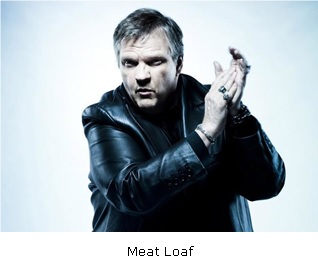
The Grandma has read some sad news about Meat Loaf, the American singer and actor who has died today.

Michael Lee Aday (born Marvin Lee Aday; September 27, 1947-January 20, 2022), known professionally as Meat Loaf, was an American singer and actor.

He was noted for his powerful, wide-ranging voice and theatrical live shows. His Bat Out of Hell trilogy -Bat Out of Hell, Bat Out of Hell II: Back into Hell, and Bat Out of Hell III: The Monster Is Loose- has sold more than 65 million albums worldwide.

The first album stayed on the charts for over nine years and more than four decades after its release still sells an estimated 200,000 copies annually, making it one of the best-selling albums in history.

After the commercial success of Bat Out of Hell and Bat Out of Hell II: Back Into Hell, and earning a Grammy Award for Best Solo Rock Vocal Performance for the song I'd Do Anything for Love, Aday nevertheless experienced some difficulty establishing a steady career within the United States. This did not stop him from becoming one of the best-selling music artists of all time, with worldwide sales of more than 100 million records.

The key to this success was his retention of iconic status and popularity in Europe, especially in Great Britain and Ireland, with him receiving the 1994 Brit Award in the United Kingdom for best-selling album and single, and he appeared in the 1997 film Spice World, and he ranked 23rd for the number of weeks spent on the UK charts in 2006. He ranks 96th on VH1's 100 Greatest Artists of Hard Rock.

Aday appeared in over 50 films and television shows, sometimes as himself or as characters resembling his stage persona. His film roles include Eddie in The Rocky Horror Picture Show (1975), and Bob Paulson in Fight Club (1999). His early stage work included dual roles in the original Broadway theatre cast of The Rocky Horror Show. He also appeared in the musical Hair, both on and Off-Broadway.

Meat Loaf died in 2022 at the age of 74 from complications of COVID-19. It was not clear if he had received a COVID-19 vaccine; however, he had spoken against compulsory vaccination and mask mandates during the COVID-19 pandemic.

More information: The Guardian

Aday was born in Dallas, Texas, on September 27, 1947, the only child of Wilma Artie (née Hukel), a school teacher and member of the Vo-di-o-do Girls gospel quartet, and Orvis Wesley Aday, a former police officer who went into business selling a homemade cough remedy with his wife and a friend under the name of the Griffin Grocery Company.

In Los Angeles, Aday formed his first band, Meat Loaf Soul, after a nickname coined by his football coach because of his weight. He was immediately offered three recording contracts, all of which he turned down.

Meat Loaf Soul's first gig was in Huntington Beach, California in 1968 at the Cave, opening for Van Morrison's band Them and Question Mark and the Mysterians. While performing their cover of the Howlin' Wolf song Smokestack Lightning, the smoke machine they used made too much smoke and the club had to be cleared out. Later, the band was the opening act at California State University, Northridge for Renaissance, Taj Mahal, and Janis Joplin.
With the publicity generated from Hair, Meat Loaf was invited to record with Motown. They suggested he do a duet with Shaun "Stoney" Murphy, who had performed with him in Hair, to which he agreed.
 
The Motown production team in charge of the album wrote and selected the songs while Meat Loaf and Stoney came in only to lay down their vocals. The album, titled Stoney & Meatloaf (with Meat Loaf spelled as one word) was completed in the summer of 1971 and released in September of that year.

In late 1973, Meat Loaf was cast in the original L.A. Roxy cast of The Rocky Horror Show, playing the parts of Eddie and Dr. Everett Scott. Two other cast members from More Than You Deserve were also part of this cast; Graham Jarvis (playing The Narrator) and Kim Milford (playing Rocky).

The success of the musical led to the filming of The Rocky Horror Picture Show in which Meat Loaf played only Eddie, a decision he said made the movie not as good as the musical.

About the same time, Meat Loaf and Steinman started work on Bat Out of Hell. Meat Loaf convinced Epic Records to shoot videos for four songs, Bat Out of Hell, Paradise by the Dashboard Light, You Took the Words Right Out of My Mouth, and Two Out of Three Ain't Bad convincing Lou Adler, the producer of Rocky Horror, to run the Paradise video as a trailer to the movie.

Steinman started to work on Bad for Good, the intended follow-up to 1977's Bat Out of Hell, in 1979. During that time, a combination of touring, drugs and exhaustion had caused Meat Loaf to lose his voice.

Following the success of Meat Loaf's touring in the 1980s, he and Steinman began work during December 1990 on the sequel to Bat Out of Hell. After two years, Bat Out of Hell II: Back into Hell was finished.

More information: The New York Times

In 2003, Meat Loaf released his album Couldn't Have Said It Better. For only the third time in his career, Meat Loaf released an album without any songs written by Steinman, not counting live bonus tracks on special edition releases.

On November 17, 2003, during a performance at London's Wembley Arena, on his Couldn't Have Said It Better tour, he collapsed of what was later diagnosed as Wolff-Parkinson-White syndrome.

In May 2009, Meat Loaf began work on the album Hang Cool Teddy Bear in the studio with Green Day's American Idiot album producer Rob Cavallo, working with such writers as Justin Hawkins, Rick Brantley, Ollie Wride, Tommy Henriksen, and Jon Bon Jovi.

In May 2011, Meat Loaf confirmed in a video on his YouTube account, that he was in the process of recording a new album called Hell in a Handbasket.

Meat Loaf's longtime collaborator Jim Steinman died on April 19, 2021, of kidney failure.

Meat Loaf died in Nashville, Tennessee, on the evening of January 20, 2022, at the age of 74 from complications of COVID-19. It was not clear if he had received a COVID-19 vaccine; however, he had spoken against compulsory vaccination and mask mandates during the COVID-19 pandemic.

More information: The Guardian


I never fit in. I am a true alternative.
And I love being the outcast.
That's my role in life, to be an outcast.

Meat Loaf

Wednesday, 19 January 2022

MEGAUPLOAD, THE ONLINE SERVICES TO FILE STORAGE

Today, The Grandma has been searching information in Internet. She has remembered Megaupload, an interesting service of storage that was shut down by the FBI on a day like today in 2012.

Megaupload Ltd was a Hong Kong-based online company established in 2005 that operated from 2005 to 2012 providing online services related to file storage and viewing.

On 19 January 2012, the United States Department of Justice seized the domain names and closed down the sites associated with Megaupload after the owners were arrested and indicted for allegedly operating as an organization dedicated to copyright infringement. Subsequently, HK$330 million (approximately US$42 million) worth of assets were frozen by the Customs and Excise Department of Hong Kong.

The company's founder, New Zealand resident Kim Dotcom, has denied any wrongdoing, and the case against Dotcom has been the subject of controversy over its legality.

In 2017, a New Zealand judge ruled that Dotcom should be extradited to the United States, but Dotcom remained at liberty in New Zealand pending the results of an appeal.

On 5 July 2018 the New Zealand court of appeal found Dotcom and three of his former colleagues were eligible to be extradited to the U.S. authorities. His lawyer said they would appeal to the New Zealand Supreme Court. The shutdown of Megaupload led to denial-of-service (DoS) attacks on a range of websites belonging to the U.S. government and copyright organizations by the Hacktivist group Anonymous.

On 19 January 2013, Megaupload was re-launched as Mega under the domain name mega.co.nz (later moved to mega.nz, and then to mega.io). The re-launch date was chosen to coincide with the one-year anniversary of Megaupload's takedown by the U.S. Federal Bureau of Investigation.

The company's registered office was on the 12th floor of the Shanghai Industrial Investment Building in Room 1204 in Wan Chai, Hong Kong.

More information: The Guardian

The company web services included Megaupload.com, a one-click hosting service; Megapix.com, an image hosting service; Megavideo.com and Megalive.com, video hosting services; and Megabox.com, a music hosting service. Other services included Megaclick, Megafund, Megakey and Megapay, all of which were advertisement and financial services. Along with this, four blogs were created including Megabest and Megaking. Two additional services -Megabackup and Megamovie- were in development before their closure.

Although incorporated in Hong Kong, the company did not operate in Hong Kong. From 2009 onward, users with Hong Kong IP addresses were banned from accessing the site. The reason for the block was never disclosed by Megaupload, but Hong Kong Customs officials have suggested that the block was an attempt to hinder law enforcement investigation.

As of 23 May 2010, access to Megaupload was intermittently blocked by the internet authorities in Saudi Arabia by their regulator Communications and Information Technology Commission.

Megavideo was also intermittently blocked in the United Arab Emirates due to pornographic content being accessible through the service.

From 9 June 2011 onward, the Malaysian government through Malaysian Communications and Multimedia Commission ordered all ISPs in Malaysia to block Megaupload and Megavideo. Some ISPs reportedly blocked all the sites on the list while other ISPs throttled connection speeds.

In July 2011, access to Megaupload and Megavideo were blocked in India for Reliance Entertainment customers, after a court order was obtained, citing illegal copies of the 2011 film Singham on file hosting sites.

On 19 January 2012, U.S. federal prosecutors in the state of Virginia shut Megaupload down and laid charges against its founder Kim Dotcom and others for allegedly breaching copyright infringement laws. 

More information: Ars Technica

For a short time after the closure of the site, users could access material via Google's web cache and The Internet Archive. One day after the indictment Google and Archive.org voluntarily removed the site mirrors to avoid the responsibility of hosting a website taken down for copyright infringement.

On 19 January 2012 the United States Department of Justice seized and shut down the file-hosting site Megaupload.com and commenced criminal cases against its owners and others. The lead prosecutor, Neil MacBride, had formerly served as Vice President, Anti-Piracy and General Counsel, of the Business Software Alliance, where he oversaw global anti-piracy enforcement and copyright policy.

On 20 January Hong Kong Customs froze more than 300 million Hong Kong dollars (US$39 million) in assets belonging to the company.

Acting upon a US Federal prosecutor's request, the New Zealand Police arrested Dotcom and three other Megaupload executives in a leased $30 million mansion at Coatesville near Auckland on Friday, 20 January 2012 (NZDT, UTC+13).

This was pursuant to a request from the U.S. Federal Bureau of Investigation that the four be extradited for racketeering and money laundering.

The raid was timed for the birthday celebration of Dotcom. Assets worth $17 million including art works and cars were seized. The four men arrested were Kim Dotcom (founder; 38 years old, from Germany), Finn Batato (CMO; 38, from Germany), Mathias Ortmann (CTO and co-founder; 40, from Germany) and Bram van der Kolk (29, from the Netherlands).

More information: Cloud Wards


If you create something,
you don't want someone else to go and profit from it;
you have your right to make a living and everything.
So I respect copyright.
What I don't respect is copyright extremism.
And I what I don't respect is a business model
that encourages piracy.

Kim Dotcom

Tuesday, 18 January 2022

HENRY MORGAN, A WELSH PRIVETEER IN THE CARIBBEAN

Today, The Grandma has been reading about an amazing figure, Henry Morgan, the Welsh privateer and Lieutenant Governor of Jamaica, who captured Panama on a day like today in 1670.

Sir Henry Morgan, in Welsh Harri Morgan, (c. 1635-25 August 1688) was a Welsh privateer, plantation owner, and, later, Lieutenant Governor of Jamaica.

From his base in Port Royal, Jamaica, he raided settlements and shipping on the Spanish Main, becoming wealthy as he did so. With the prize money from the raids he purchased three large sugar plantations on the island.

Much of Morgan's early life is unknown. He was born in Monmouthshire, but it is not known how he made his way to the West Indies, or how he began his career as a privateer.

He was probably a member of a group of raiders led by Sir Christopher Myngs in the early 1660s during the Anglo-Spanish War. Morgan became a close friend of Sir Thomas Modyford, the Governor of Jamaica. When diplomatic relations between the Kingdom of England and Spain worsened in 1667, Modyford gave Morgan a letter of marque, a licence to attack and seize Spanish vessels.

Morgan subsequently conducted successful and highly lucrative raids on Puerto Principe (now Camagüey in modern Cuba) and Porto Bello (now Portobelo in modern Panama).

In 1668, he sailed for Maracaibo and Gibraltar, both on Lake Maracaibo in modern-day Venezuela. He raided both cities and stripped them of their wealth before destroying a large Spanish squadron as he escaped.

In 1671, Morgan attacked Panama City, landing on the Caribbean coast and traversing the isthmus before he attacked the city, which was on the Pacific coast. The battle was a rout, although the privateers profited less than in other raids. To appease the Spanish, with whom the English had signed a peace treaty, Morgan was arrested and summoned to London in 1672, but was treated as a hero by the general populace and the leading figures of government and royalty including Charles II.

Morgan was appointed a Knight Bachelor in November 1674 and returned to the Colony of Jamaica shortly afterward to serve as the territory's Lieutenant Governor. He served on the Assembly of Jamaica until 1683 and on three occasions he acted as Governor of Jamaica in the absence of the post-holder.

A memoir published by Alexandre Exquemelin, a former shipmate of Morgan's, accused him of widespread torture and other offences; Morgan won a libel suit against the book's English publishers, but Exquemelin's portrayal has affected history's view of Morgan. He died in Jamaica on 25 August 1688. His life was romanticised after his death and he became the inspiration for pirate-themed works of fiction across a range of genres.

More information: ThoughtCo

Henry Morgan was born around 1635 in Wales, either in Llanrumney or Pencarn, (both in Monmouthshire, between Cardiff and Newport). The historian David Williams, writing in the Dictionary of Welsh Biography, observes that attempts to identify his parents and antecedents have all proved unsatisfactory, although his will referred to distant relations. Several sources state Morgan's father was Robert Morgan, a farmer.

Nuala Zahedieh, writing for the Oxford Dictionary of National Biography, states that details of Morgan's early life and career are uncertain, although in later life he stated that he had left school early and was much more used to the pike than the book.

It is probable that in the early 1660s Morgan was active with a group of privateers led by Sir Christopher Myngs attacking Spanish cities and settlements in the Caribbean and Central America when England was at war with Spain. It is likely that in 1663 Morgan captained one of the ships in Myngs' fleet, and took part in the attack on Santiago de Cuba and the Sack of Campeche on the Yucatán Peninsula.

In 1669 Mariana, the Queen Regent of Spain, ordered attacks on English shipping in the Caribbean. The first action took place in March 1670 when Spanish privateers attacked English trade ships.

In response Modyford commissioned Morgan to do and perform all manner of exploits, which may tend to the preservation and quiet of this island.

By December Morgan was sailing toward the Spanish Main with a fleet of over 30 English and French ships carrying a large number of privateers. Zahedieh observes that the army of privateers was the largest that had gathered in the Caribbean at the time, which was a mark of Morgan's renown.

Morgan's first action was to take the connected islands of Old Providence and Santa Catalina in December 1670. From there his fleet sailed to Chagres, the port from which ships were loaded with goods to transport back to Spain. Morgan took the town and occupied Fort San Lorenzo, which he garrisoned to protect his line of retreat.

On 9 January 1671, with his remaining men, he ascended the Chagres River and headed for Old Panama City, on the Pacific Coast. Much of the journey was on foot, through dense rainforests and swamps.

The governor of Panama had been forewarned of a potential attack, and had sent Spanish troops to attack Morgan and his men along the route. The privateers transferred to canoes to complete part of the journey, but were still able to beat off the ambushes with ease.

After three days, with the river difficult to navigate in places, and with the jungle thinning out, Morgan landed his men and travelled overland across the remaining part of the isthmus.

The privateers, including Captain Robert Searle, arrived at Old Panama City on 27 January 1671; they camped overnight before attacking the following day. They were opposed by approximately 1,200 Spanish infantry and 400 cavalry; most were inexperienced.

Morgan sent a 300-strong party of men down a ravine that led to the foot of a small hill on the Spanish right flank. As they disappeared from view, the Spanish front line thought the privateers were retreating, and the left wing broke rank and chased, followed by the remainder of the defending infantry. They were met with well-organised firing from Morgan's main force of troops. When the party came into view at the end of the ravine, they were charged by the Spanish cavalry, but organised fire destroyed the cavalry and the party attacked the flank of the main Spanish force.

In an effort to disorganise Morgan's forces, the governor of Panama released two herds of oxen and bulls onto the battlefield; scared by the noise of the gunfire, they turned and stampeded over their keepers and some of the remaining Spanish troops. The battle was a rout: the Spanish lost between 400 and 500 men, against 15 privateers killed.

Panama's governor had sworn to burn down the city if his troops lost to the privateers, and he had placed barrels of gunpowder around the largely wooden buildings. These were detonated by the captain of artillery after Morgan's victory; the resultant fires lasted until the following day.

More information: ThoughtCo

Only a few stone buildings remained standing afterwards. Much of Panama's wealth was destroyed in the conflagration, although some had been removed by ships, before the privateers arrived.

The privateers spent three weeks in Panama and plundered what they could from the ruins. Morgan's second-in-command, Captain Edward Collier, supervised the torture of some of the city's residents; Morgan's fleet surgeon, Richard Browne, later wrote that at Panama, Morgan was noble enough to the vanquished enemy.

The value of treasure Morgan collected during his expedition is disputed. Talty writes that the figures range from 140,000 to 400,000 pesos, and that owing to the large army Morgan assembled, the prize-per-man was relatively low, causing discontent.

There were accusations, particularly in Exquemelin's memoirs, that Morgan left with the majority of the plunder.

He arrived back in Port Royal on 12 March to a positive welcome from the town's inhabitants. The following month he made his official report to the governing Council of Jamaica, and received their formal thanks and congratulations.

Morgan died on 25 August 1688; Albemarle ordered a state funeral, and laid Morgan's body at King's House for the public to pay respects. An amnesty was declared so that pirates and privateers could pay their respects without fear of arrest. He was buried at Palisadoes cemetery, Port Royal, followed by a 22-gun salute from the ships moored in the harbour. Morgan was a wealthy man when he died. His personal wealth was valued at £5,263.

His will initially left his plantations and slaves to his wife, Mary Elizabeth, but because they were childless, on her death his estate was to pass to his nephews, the children of his brother-in-law Byndloss. The burial of Lady Morgan was recorded in Saint Andrew Parish, Jamaica on 3 March 1696.

More information: The Way of the Pirates


All that is needed for the publication
of a daily newspaper is ambition,
honesty and 10 million dollars.

Henry Morgan

Monday, 17 January 2022

VIRGINIA CLARA JONES, 'THE BEST YEARS OF OUR LIVES'

Today, The Grandma has been watching some classical cinema. She has chosen some films interpreted by Virginia Mayo, the American actress and dancer who died on a day like today in 2005.

Virginia Mayo (born Virginia Clara Jones; November 30, 1920-January 17, 2005) was an American actress and dancer.

She was in a series of comedy films with Danny Kaye and was Warner Brothers' biggest box-office money-maker in the late 1940s. She also co-starred in the 1946 Oscar-winning movie The Best Years of Our Lives and White Heat (1949).

Born Virginia Clara Jones in St. Louis, Missouri, she was the daughter of newspaper reporter Luke and his wife, Martha Henrietta (née Rautenstrauch) Jones. Her family had roots back to the earliest days of St Louis, including great-great-great grandfather Captain James Piggott, who founded East St. Louis, Illinois, in 1797.

Young Virginia's aunt operated an acting school in the St. Louis area, which Virginia began attending at age six. She also was tutored by a series of dancing instructors engaged by her aunt.

Jones toured the American vaudeville circuit for three years, serving as ringmaster and comedic foil for Pansy the Horse, as Mayo and his partner, Nonnie Morton, performed in a horse suit. They appeared together in some short films and were a huge hit at Billy Rose's Diamond Horseshoe nightclub in the Broadway theater district, where she was first spotted by Samuel Goldwyn.

In 1941, Jones, now known by the stage name Virginia Mayo, got another career break as she appeared on Broadway with Eddie Cantor in Banjo Eyes.

In the early 1940s, Virginia Mayo's talent and striking beauty came to the attention of movie mogul Samuel Goldwyn, who signed her to an acting contract with his company.

Goldwyn only made a few films a year and would usually loan out the actors he had under contract to other producers. Her first notable role was in Jack London (1943), which starred her future husband Michael O'Shea for producer Samuel Bronston.

Goldwyn originally planned to feature her with Danny Kaye in the film Up in Arms, but he felt she needed more experience and gave the role to Constance Dowling.

Mayo was placed in the chorus just so she could learn, but she was never officially a member of the Goldwyn Girls. Then RKO borrowed her for a support role in a musical, Seven Days Ashore (1944).

More information: Western Clippings

Mayo's first starring role came in 1944 opposite comedian Bob Hope in The Princess and the Pirate (1944), a spoof of pirate movies made by Goldwyn. It earned over $3 million at the box office.

Goldwyn then made her Danny Kaye's leading lady for the musicals Wonder Man (1945) and The Kid from Brooklyn (1946), both very popular.

Going against previous stereotype, Mayo accepted the supporting role of unsympathetic gold-digger Marie Derry in William Wyler's drama The Best Years of Our Lives (1946) for Goldwyn. Her performance drew favorable reviews from critics, as the film also became the highest-grossing film inside the US since Gone with the Wind. At the zenith of her career, Mayo was seen as the quintessential voluptuous Hollywood beauty. It was said that she looked like a pinup painting come to life. According to widely published reports from the late 1940s, the Sultan of Morocco declared her beauty to be tangible proof of the existence of God.

Warner Bros ended up taking over her contract from Goldwyn. They starred her in another film noir, Flaxy Martin (1949) with Zachary Scott, then she did a Western with Joel McCrea and director Raoul Walsh, Colorado Territory (1949), and a comedy with Ronald Reagan, The Girl from Jones Beach (1949).

Mayo received excellent reviews in another unsympathetic role, playing James Cagney's sultry and scheming wife in the gangster classic White Heat (1949), also for Walsh. Mayo admitted she was frightened by Cagney as the psychotic gunman in White Heat because he was so realistic.

Roy Del Ruth borrowed her to play opposite George Raft in Red Light (1949) and she was Milton Berle's leading lady in Always Leave Them Laughing (1949).

Mayo was top billed in the film noir Backfire (1950) and she was in a huge hit in The Flame and the Arrow (1950) as Burt Lancaster's love interest.

She co-starred again with James Cagney and a young Doris Day in The West Point Story (1950), singing and dancing with Cagney, and was Gregory Peck's leading lady in Captain Horatio Hornblower R.N. (1951), Warners most popular film of the year. She co-starred with Kirk Douglas in a Western for Walsh, Along the Great Divide (1951).

Mayo starred opposite Dennis Morgan in David Butler's Technicolor musical, Painting the Clouds with Sunshine (1951) which was a moderate success. While Mayo appeared in several musicals, using her training in dance, her voice was always dubbed.

Mayo appeared in the all-star cast of Starlift (1951) and was top billed in She's Working Her Way Through College (1952) with Reagan. She was Alan Ladd's leading lady in The Iron Mistress (1952), a popular biopic of Jim Bowie, and starred in another musical, She's Back on Broadway (1953).

Mayo appeared in the comedy-drama-action film South Sea Woman (1953) with Burt Lancaster and Chuck Connors. RKO borrowed her for a Western in 3-D, Devil's Canyon (1953), and she co-starred with Rex Harrison and George Sanders in King Richard and the Crusaders (1954).

She was top billed in The Silver Chalice (1954) opposite Pier Angeli and Paul Newman in his film debut. The film was a notorious flop.

Benedict Bogeaus gave her the lead in Pearl of the South Pacific (1955). Edmund Grainger cast her in Great Day in the Morning (1956), with Robert Stack, directed by Jacques Tourneur.

Mayo went to 20th Century Fox to play Robert Ryan's leading lady in The Proud Ones (1956) then she did Congo Crossing (1956) at Universal.

Mayo was reunited with Ladd in The Big Land (1957) made back at Warners. She played Cleopatra in the 1957 fantasy film The Story of Mankind with Vincent Price, Hedy Lamarr, Cesar Romero, Agnes Moorehead, and the Marx Brothers.

Mayo did The Tall Stranger (1957) with McCrea for Allied Artists, Fort Dobbs (1958) with Clint Walker at Warners and Westbound (1959) with Randolph Scott at Warners. Her last film of the decade was 1959's Jet Over the Atlantic with Guy Madison and George Raft.

Mayo also began guest starring on television shows such as Conflict, Wagon Train, The Loretta Young Show, and Lux Playhouse.

More information: AltFG

Mayo and her husband made a pilot for a TV series McGarry and His Mouse (1960), which was not picked up. She went to Italy to make Revolt of the Mercenaries (1961).

Mayo's film career tapered off considerably. She appeared in Young Fury (1965) with Rory Calhoun, Castle of Evil (1966), and Fort Utah (1967) with John Ireland. She also guest starred on shows such as Burke's Law, Daktari and The Outsider and appeared on stage in shows like That Certain Girl (1967) and Barefoot in the Park (1968).

Mayo continued to act on stage for the rest of her career, mostly in dinner theatre and touring shows. Productions included No, No Nanette (1972), 40 Carats (1975), Good News (1977), Move Over Mrs Markham (1980) and Butterflies Are Free (1981).

Mayo continued to occasionally appear on television in shows such as Police Story, Night Gallery, The Love Boat, Remington Steele, and Murder, She Wrote, and a dozen episodes of the soap opera Santa Barbara.

Mayo was in Fugitive Lovers (1975) and was one of several stars to make a cameo appearance in the all-star box office bomb Won Ton Ton, the Dog Who Saved Hollywood (1976). She had roles in Lanigan's Rabbi (1977), Haunted (1977), and French Quarter (1978).

Her later appearances were in Evil Spirits (1990), Midnight Witness (1993) and The Man Next Door (1997).

Mayo was one of the first to be awarded a star on the Hollywood Walk of Fame. Hers is located at 1751 Vine Street. In 1996, Mayo was honored by her hometown as she received a star on the St. Louis Walk of Fame.

In 1993, Mayo published a Christmas themed children's book entitled, Don't Forget Me, Santa Claus through Barrons Juveniles Publishers.

Mayo died of pneumonia and complications of congestive heart failure in the Los Angeles area on January 17, 2005, aged 84, at a nursing home in Thousand Oaks. Her death was reported the next day in The New York Times. She is buried next to her husband in Pierce Brothers Valley Oaks Park in Westlake Village, California.

Més informació: The New York Times


And I worked with Alan Ladd, who along
with Gregory Peck was my favorite leading man.

Virginia Mayo

Sunday, 16 January 2022

HELEN FOLASADE ADU A.K.A. SADE, THE NIGERIAN VOICE

Today, The Grandma has been listening to music. She has chosen Sade, the Nigerian-born British singer who was born on a day like today in 1959.

Helen Folasade Adu, in Yoruba Fọláṣadé Adú, born 16 January 1959, known professionally as Sade Adu or simply Sade is a Nigerian-born British singer, songwriter, and actress, known as the lead singer of her eponymous band.

One of the most successful British female artists in history, she is often recognised as an influence on contemporary music. Her influence on music was recognised in the UK with an award of the Officer of the Order of the British Empire in 2002, and was made Commander in the 2017 Birthday Honours.

Sade was born in Ibadan, Nigeria, and brought up partly in Essex, England, from the age of four. She studied at Saint Martin's School of Art in London and gained modest recognition as a fashion designer and part-time model, prior to joining the band Pride in the early 1980s.

After gaining attention as a performer, she formed the band Sade, and secured a recording contract with Epic Records in 1983. A year later the band released the album Diamond Life, which became one of the best-selling albums of the era, and the best-selling debut by a British female vocalist.

In July 1985, Sade was among the performers at the Live Aid charity concert at Wembley Stadium, and the following year she appeared in the film Absolute Beginners. Following the band's third and fourth albums, Stronger Than Pride (1988) and Love Deluxe (1992), they went on hiatus after the birth of Sade's child, while the singer experienced widespread media coverage for unsubstantiated claims of mental health and addiction problems.

After a spell of eight years without an album, the band reunited in 1999, and released Lovers Rock in 2000. The album departed from the jazz-inspired inflections of their previous work, featuring mellower sounds and pop compositions. The band then underwent another hiatus, not producing music for another ten years until the release of Soldier of Love. Following that album's release, the band entered a third period of extended hiatus, and have only released two songs Flower of the Universe for the soundtrack of Disney's A Wrinkle in Time, and The Big Unknown as part of the soundtrack for Steve McQueen's film Widows since.

More information: Sade

Helen Fọláṣadé Adu was born on 16 January 1959 in Ibadan, Oyo State, Nigeria, but is a native of Ekiti State. Her middle name, Folasade, means wealth confers a crown. Her parents are Adebisi Adu, a Nigerian lecturer in economics of Yoruba background, and Anne Hayes, an English district nurse; they met in London, married in 1955, and moved to Nigeria.

When Sade was four years old, her parents separated. Anne Hayes then returned to England, taking Sade and her elder brother Banji to live with their grandparents near Colchester, Essex.

When Sade was 11 years old, she moved to Holland-on-Sea, Essex, to live with her mother. After completing her education at Clacton County High School and Colchester Institute at the age of 18, she moved to London and studied fashion design at Saint Martin's School of Art.

The New Yorker described Sade's voice as a grainy contralto full of air that betrays a slight ache but no agony, and values even imperfect dignity over a show of pain, a deeply English quality that makes categorising the artist's voice difficult.

Her voice was described by the BBC as husky and restrained and compared to singer Billie Holiday. BBC called her songwriting sufficiently soulful and jazzy yet poppy, funky yet easy listening, to appeal to fans of all those genres.

Sade has been called a pop star. With the musicians in her band, Sade, The New Yorker wrote, created one of the most profitable catalogues in pop; the band's easy sound backing songs exploring the heavier lifting inside love: commitment, consistency, friendship. Her success has been attributed to a combination of her unique beauty, seemingly indefinable origins, and mysterious persona.

More information: The Guardian Nigeria


 Once a song's out there, it's no longer mine.
And that's the whole purpose of music: to belong to people.

Sade Adu

Saturday, 15 January 2022

HUNGA TONGA–HUNGA HAʻAPAI, VOLCANISM IN TONGA

Today, The Grandma has read terrible news about the eruption of Hunga Tonga–Hunga Haʻapai, a volcanic island in Tonga.

Hunga Tonga–Hunga Haʻapai is a volcanic island in Tonga, located about 30 km south of the submarine volcano of Fonuafoʻou and 65 km north of Tongatapu, the country's main island. The volcano is part of the highly active Tonga-Kermadec Islands volcanic arc, a subduction zone extending from New Zealand north-northeast to Fiji.

It lies about 100 km above a very active seismic zone.

The island arc is formed at the convergent boundary where the Pacific Plate subducts under the Indo-Australian Plate.

The volcano itself is a submarine volcano that breached sea level in 2009 due to a volcanic eruption and lies underwater between two islands, Hunga Tonga and Hunga Haʻapai, which are respectively the remnants of the western and northern rim of the volcano's caldera.

The caldera is roughly 150 m below sea-level, and rises 200 m from the sea-floor. The two islands, part of the Haʻapai group, are about 1.6 km apart, and each is about 2 km long and composed largely of andesite. This andesite tends to be of the basaltic type.

Hunga Tonga reaches an elevation of 149 m, while Hunga Haʻapai comes to only 128 m above sea level. Neither island is large: Hunga Tonga is roughly 390,000 m2 and Hunga Haʻapai is 650,000 m2 in size. Neither island is developed due to a lack of an acceptable anchorage, although there are large guano deposits on each island.

More information: Smithsonian Institution-Global Volcanic Program

Samples from the islands suggested a long eruptive history. One pyroclastic flow was dated to 1040-1180 CE, correlating to ash deposits found on Tongatapu, and to an unknown tropical eruption in 1108 CE that had produced 1°C of global cooling.

The caldera is believed to have been formed by this eruption. Submarine eruptions at a rocky shoal -about 3.2 km southeast of Hunga Haʻapai and 3 km south of Hunga Tonga- were reported in 1912 and 1937. Another eruption occurred from a fissure 1 km south-southeast of Hunga Haʻapai in 1988.

The islands figure in Tongan mythology as one of the few islands which were not overfished, and hence thrown down from heaven to land on earth. Tongans called them the islands which jump back and forth.

The first Europeans to see the islands were those with the Dutch explorers Willem Schouten and Jacob Le Maire in 1616. The British explorer Captain James Cook visited them several times in 1777 and learned their Tongan names.

The current extent of the island includes both the former islands of Hunga Tonga and Hunga Haʻapai. The initial 2009 eruption linked newly formed land with the larger and more westerly Hunga Haʻapai.

Hunga Tonga, in the northeast, has since become attached via a tombolo, and further sandy deposits have built up at the southern end of the connection with Hunga Haʻapai.

More information: BBC

The caldera itself has eroded rapidly in the south, originally allowing an opening of the crater to the ocean in the southeast. This has become separated from the sea by a shallow sandbar, forming a lagoon. Initially it was believed that the entire island would be eroded rapidly, but by 2017, scientists believed that the process could take decades.

On 20 December 2021 the volcano erupted again, causing a large plume that was visible from Nukuʻalofa. The Volcanic Ash Advisory Center Wellington issued an advisory to airlines. Explosions could be heard up to 170 kilometres away. The initial eruption continued until 2 am on 21 December. Activity continued, and on 25 December, satellite imagery showed that the island had increased in size.

Volcanic activity died down on 5 January before restarting on 13 January after the volcano sent an ash cloud 17 km into the atmosphere. The government subsequently issued a tsunami warning.

On 15 January, the volcano violently erupted again and was about seven times more powerful than the eruption on 20 December 2021.

There were numerous reports of loud booms across Tonga and other countries, such as Fiji and as far away as New Zealand and Australia. A boom was heard in Alaska seven hours after eruption meaning the sound wave traveled 830 mph. 

Near the eruption, the explosion damaged property, including shattered windows. A tsunami warning was issued just after 5:30 p.m. by the Tonga Meteorological Services and the tsunami flooded coastal areas in Tonga. A 1.2 m tsunami was observed in Nukuʻalofa, Tonga and a 0.61 m one in American Samoa.

It was reported on 16 January that radar surveys before and after the eruption show that most of the island has been destroyed.

More info: National Environmental Satellite Data and Information Service

Whether it is a tsunami, or whether it is a hurricane,
whether it's an earthquake
-when we see these great fatal and natural acts,
men and women of every ethnic persuasion
come together and they just want to help.

Martin Luther King III

Friday, 14 January 2022

NINA RICCI, THE ITALIAN-FRENCH FASHION DESIGNER

Today, The Grandma has received the wonderful visit of one of her closest friends, Claire Fontaine.

Claire loves design and they have been talking about Nina Ricci, the Italian-born French fashion designer who was born on a day like today in 1883.

Nina Ricci (born Maria Nielli; 1883-1970) was an Italian-born French fashion designer. She was born in Turin, Italy, and moved to France at the age of 12.

At the age of 13, she began an apprenticeship at a dressmaker's. In 1904, she married Luigi Ricci. They had one child, Robert. In 1908, she joined the House of Raffin, where she remained for decades.

She and her son Robert founded the fashion house Nina Ricci in Paris in 1932; it has been owned by the Catalan company Puig since 1998.

Nina Ricci designed gowns while her son Robert Ricci managed the business and finances. She worked with the fabrics directly on the mannequin to ensure they had shape once they were finished.

Nina Ricci designs soon became known for the refined, romantic, always feminine feeling Maria adds to all of her collections.

In 1941, Robert Ricci created an in-house perfume division.

In 1945, with the war over, designers were casting about for a way to revive the infatuation women had formerly had with haute couture, while raising money for war relief. Robert Ricci had an idea which Lucien Lelong, President of the Chambre, put into action. Over 150 mannequins from 40 Paris couturiers, including Balenciaga and Madame Gres, were dressed in the labels' best fashions and were placed in an exhibition held at the Louvre, in Paris. After a huge success in Paris it toured Europe and then the US.

In 1946, Robert created his first fragrance, Coeur Joie. In 1948, Robert came up with another fragrance, L'Air du Temps, the brand's most popular fragrance, which continues to be a top seller today. Several flight attendant uniforms were designed by the Nina Ricci brand.

More information: Nina Ricci

Nina Ricci is also a pioneer of licensing their designs before the rise of ready-to-wear. As early as 1960, they started licensing their patterns to upscale boutiques such as Chez Ninon in New York City and Betty Clemo in Hong Kong for line-to-line reproduction.

Robert chose the new head designer in 1954, the Belgian Jules-François Crahay. The designs of Crahay were highly praised.

In the early 1960s, a couturier from Melbourne Australia, Elvie Hill, secured a contract to reproduce Nina Ricci for the local Australian market. This proved to be a short-lived partnership as Australian women struggled to fit into the petite and very fitted designs from the Paris fashion house.

Crahay left Ricci in 1963 to go to Lanvin, and was immediately replaced by Gerard Pipart, who had worked at Balmain, Fath and Jean Patou prior to his new job. He continued to carry on the name of Ricci with beautiful and elegant dresses.

After Maria Ricci's death in 1970, Crahay was appointed head of the house. Robert continued to excel in perfumery and business until his death in 1988.

Massimo Giussani's family purchased the house of Nina Ricci in 1998 from Crahay. Massimo Giussani worked as a designer, but Nathalie Gervais had been the chief designer for the house for several years. She presented her last collection in Fall 2001.

In May 2002 American designer James Aguiar took over as chief designer and designed for the House of Ricci for two seasons.

More information: Business of Fashion

In 2003, Lars Nilsson took over the house of Ricci with rave reviews from critics. While his role would also involve providing creative input on the beauty side of the business, his primary task was the injection of a dose of excitement, youth and energy into the somewhat dormant fashion and accessories lines. He made a sudden redesign in early 2006, and then in September announced that Brussels-born designer Olivier Theyskens of Rochas would take over the role as head of the label.

In 2009, Theyskens was replaced by designer Peter Copping, who had worked for Louis Vuitton.

In 2015, after Peter Copping left the house, Guillaume Henry took the place of Creative director.

During a 2013 fashion show, Ricci designs were targeted by bare-breasted Femen protesters, who grabbed model Hollie-May Saker.

In August 2018, menswear designers Rushemy Botter and Lisi Herrebrugh took over as Creative Directors.

Nina Ricci's most famous perfume, L'Air du Temps, created in France in 1948, translates roughly from a French expression as the current trend. It captures the passion, love, and elegance of an emerging generation Maria and Robert Ricci headed. Robert worked with master perfumer Francis Fabron to create a scent with as much elegance as Madame Maria Ricci's clothes. Marc Lalique created the graceful twin-dove crystal bottle.

Other classic Nina Ricci perfumes have included Farouche, Capricci, Fleur de Fleurs, and Eau de Fleurs; each has had its own unique Lalique crystal pure perfume bottle. Men's fragrances have included Signoricci, Signoricci II, and Phileas. More recent perfumes have included two different fragrances, both with the name Nina, and a series of three perfumes under the name Les Belles de Ricci. Additional fragrances have been added to the line, including Ricci Ricci, Love in Paris, Premier Jour, Les Delices, Nina L'Elixir, Nina L'Eau, and Nina.

More information: Medium


I was taken to my first fashion show -Nina Ricci haute couture-
in Paris by the White Russian princess, down on her luck,
whom I was boarding with in Paris in 1963.
I was captivated by the glamour of the gilded salon,
the elegant clothes, and the audience of grand ladies.

Suzy Menkes