Thursday, 5 March 2020

THE STONES TRAVEL TO ITHACA ISLAND, ULYSSES'S HOME

Brauny Stone has suggested to travel to Ithaca
Today, The Stones have decided to travel to Ithaca, the Greek island located in the Ionian Sea, well-known by being the hometown of Ulysses.

After some discussions with Brauny, the family has chosen this wonderful place to spend some days. They want to relax and discover the amazing history of this island, one of the most mystic of the Mediterranean Sea. Because it is their first travel together, The Grandma has decided to prepare the budget and the activities planning to avoid they have too much work and they have enough time to prepare their suitcases and be ready to take their plane tomorrow afternoon. She has also gone to El Prat International Airport to prepare her private jet.

Before talking about this travel, The Stones have been talking about some aspects of English Grammar. They have studied the order of adjectives, the a/an article and the Saxon genitive. They have received great news when they have met Juan Stone, a new member of this great family.

More information: A/An Article

More information: Order of Adjectives I & II

More information: Saxon Genitive


Ithaca, Ithaki or Ithaka, in Greek Ιθάκη, Ithakē, is a Greek island located in the Ionian Sea, off the northeast coast of Kefalonia and to the west of continental Greece.

Ithaca's main island has an area of 96 square kilometres and had a population in 2011 of 3,231. It is the second-smallest of seven main Ionian Islands, after Paxi. Ithaca is a separate regional unit of the Ionian Islands region, and the only municipality of the regional unit. The capital is Vathy or Vathi.

Modern Ithaca is generally identified with Homer's Ithaca, the home of Odysseus, whose delayed return to the island is the plot of the classical Greek tale the Odyssey.

More information: Ithaca

Although the name Ithaca has remained unchanged since ancient times, written documents of different periods also refer to the island by other names, such as:

-Val di Compare (Valley of the Bestman), Piccola (Small) Cephallonia, Anticephallonia (Middle Ages until the beginning of the Venetian period)

-Ithaki nisos (Greek for island), Thrakoniso, Thakou, Thiakou (Byzantine period)

-Thiaki (Byzantine and before the Venetian period)

-Teaki (Venetian period)

-Fiaki (Ottoman period)


The island has been inhabited since the 2nd millennium BC. It may have been the capital of Cephalonia during the Mycenaean period and the capital-state of the small kingdom ruled by Odysseus

The Grandma checks her private plane
The Romans occupied the island in the 2nd century BC, and later it became part of the Byzantine Empire. The Normans ruled Ithaca in the 13th century, and after a short Turkish rule it fell into Venetian hands, Ionian Islands under Venetian rule.

Ithaca was subsequently occupied by France under the 1797 Treaty of Campo Formio. It was liberated by a joint Russo-Turkish force commanded by admirals Fyodor Ushakov and Kadir Bey in 1798 and subsequently became a part of the Septinsular Republic, which was originally established as a protectorate of the Russian Empire and Ottoman Empire. It became a French possession again in 1807, until it was taken over by the United Kingdom in 1809.

Under the 1815 Treaty of Paris, Ithaca became a state of the United States of the Ionian Islands, a protectorate of the British Empire. In 1830 the local community requested to join with the rest of the newly restored nation-state of Greece. Under the 1864 Treaty of London, Ithaca, along with the remaining six Ionian islands, was ceded to Greece as a gesture of diplomatic friendship to Greece's new Anglophile king, George I. The United Kingdom kept its privileged use of the harbour at Corfu.

More information: Suitcase

The origins of the first people to inhabit the island, which occurred during the last years of the Neolithic period (4000–3000 BC), are not clear. The traces of buildings, walls and a road from this time period prove that life existed and continued to do so during the Early Hellenic era (3000–2000 BC). In the years (2000–1500 BC) some of the population migrated to part of the island. The buildings and walls that were excavated showed the lifestyle of this period had remained primitive.

During the Mycenaean period (1600–1100 BC), Ithaca rose to the highest level of its ancient history. Mostly based on the Odyssey and oral traditions, it is believed that the island became the capital of the Ionian Kingdom-State, which included the surrounding lands, and was referred to as one of the most powerful states of that time. The Ithacans were characterized as great navigators and explorers with daring expeditions reaching further than the Mediterranean Sea.

The epic poems of Homer, the Iliad and the Odyssey, shed some light on Bronze-Age Ithaca. Those poems are generally thought to have been composed sometime in the 9th or 8th centuries BC, but may have made use of older mythological and poetic traditions; their depiction of the hero Odysseus and his rule over Ithaca and the surrounding islands and mainland preserves some memories of the political geography, customs, and society of the time.

Ithaca, Ionian Sea, Greece
After the end of the Mycenaean period Ithaca's influence diminished, and it came under the jurisdiction of the nearest large island.

During the ancient Hellenic prime (800–180 BC), independent organized life continued in the northern and southern part of the island. In the southern part, in the area of Aetos, the town Alalcomenae was founded. From this period, many objects of important historical value have been found during excavations. Among these objects are coins imprinted with the name Ithaca and the image of Odysseus which suggest that the island was self-governed.

According to the different periods, conquerors and circumstances, the population of the island kept changing. Although there is no definite numerical information until the Venetian period, it is believed that from the Mycenaean to the Byzantine period, the number of inhabitants was several thousand, who lived mainly in the northern part of Ithaca. During the Middle Ages, the population decreased due to the continuous invasions of pirates, forcing the people to establish settlements and live in the mountains.

In 1479, Ottoman forces reached the islands and many of the people fled from the island out of fear of the new Turkish settlers. Those that remained hid in the mountains to avoid the pirates who controlled the channel between Cephalonia and Ithaca and the bays of the island.

In the following five years, the Turks, Toques and Venetians laid claim to the islands diplomatically. Possession of the islands was finally taken by the Ottoman Empire from 1484 to 1499. During this period, the Venetians had strengthened into a major power with an organized fleet. The Venetians pursued their interest in the Ionian Islands, and in 1499 a war between the Venetians and the Turks began. The allied fleets of the Venetians and the Spanish besieged Ithaca, and the other islands.

More information: Visit Greece

The fleets prevailed, and from 1500 onwards the Venetians controlled the islands. According to a treaty of 1503, Ithaca, Cephalonia and Zakynthos would be ruled by the Venetians, and Lefkada by the Ottoman Empire. By then Ithaca was almost uninhabited, and the Venetians had to grant incentives to settlers from neighbouring islands and the mainland to repopulate it. During the next centuries, the island remained under Venetian control.

A few years after the French Revolution, the Ionian area came under the rule of the First French Republic (1797–1798), and the island became the honorary capital of the French département of Ithaque, comprising Cephalonia, Lefkada, and part of the mainland, the prefecture was at Argostoli on Kefalonia.

The population welcomed the French, who took care in the control of the administrative and judicial systems, but later the heavy taxation they demanded caused a feeling of indignation among the people. During this short historical period, the new ideas of system and social structure greatly influenced the inhabitants of the island.


At the end of 1798, the French were succeeded by Russia and Turkey (1798–1807), which were allies at that time. Corfu became the capital of the Ionian States, and the form of government was democratic, with a fourteen-member senate in which Ithaca had one representative.

The Ithacan fleet flourished when it was allowed to carry cargo up to the ports of the Black Sea.

Ithaca, Ionian Sea, Greece
In 1807, according to the Tilsit Treaty with Turkey, the Ionian Islands once again came under the French rule (1807–1809 AD). The French quickly began preparing to face the British fleet, which had become very powerful, by building a fort in Vathy.

In 1809 Great Britain mounted a blockade on the Ionian Islands as part of the war against Napoleon, and in September of that year they hoisted the British flag above the castle of Zakynthos. Cephalonia and Ithaca soon surrendered, and the British installed provisional governments. The treaty of Paris in 1815 recognised the United States of the Ionian Islands and decreed that it become a British protectorate. Colonel Charles Philippe de Bosset became provisional governor between 1810 and 1814.

A few years later resistance groups started to form. Although their energy in the early years was directed to supporting the Greeks in the revolution against the Turks, it soon started to turn towards the British. By 1848 the resistance movement was gaining strength and there were skirmishes with the British Army in Argostoli and Lixouri which led to some relaxation in the laws and to freedom of the press.

Union with Greece was now a declared aim, and by 1850 a growing restlessness resulted in even more skirmishes. Ithaca along with the other islands were transferred to Greece in 1864 as a gesture of goodwill when the British-backed Prince William of Denmark became King George the First of the Hellenes.

During the British protectorate period prominent citizens of Ithaki participated in the secret Philiki Etairia which was instrumental in organizing the Greek Revolution of 1821 against Turkish rule, and Greek fighters found refuge there. In addition, the participation of Ithacans during the siege of Messolongi and the naval battles against Ottoman ships at the Black Sea and the Danube was significant.

Ithaca was annexed to Greek Kingdom with the rest of the Ionian islands in 1864.

More information: Discover Greece

Ithaca lies east of the northeast coast of Cephalonia, from which it is separated by the Strait of Ithaca. The regional unit covers an area of 117.812 square kilometresand has approximately 100 kilometres of coastline. The main island stretches in the north-south direction, in length of 23 km and maximum width of 6 km. It consists of two parts, of about equal size, connected by the narrow isthmus of Aetos (Eagle), just 600 metres wide. The two parts enclose the bay of Molos, whose southern branch is the harbor of Vathy, the capital and largest settlement of the island. The second largest village is Stavros in the northern part.

Lazaretto Islet or Island of The Saviour guards the harbor. The church of The Saviour and the remains of an old gaol are located on the islet.

The capes in the island include Exogi, the westernmost, Melissa to the north, Mavronos, Agios Ilias, Schinous, Sarakiniko and Agios Ioannis, to the east, and Agiou Andreou, to the south. Bays include Afales Bay to the northwest, Frikes and Kioni Bays to the northeast, Molos Gulf to the east, and Ormos Gulf and Sarakiniko Bay to the southeast. The tallest mountain is Nirito in the northern part (806 m), followed by Merovigli (669 m) in the south.

Its largest towns are Vathy (pop. 1,920 in 2011), Perachori (343), Stavros (366), Platreithias (201), and Kioni (182). Ithaca is the only populated island in this island group.

More information: Greeka


As you set out for Ithaka
hope the voyage is a long one,
full of adventure, full of discovery.

Konstantinos Kavafis

Wednesday, 4 March 2020

THE STONES, A NEW FAMILY IN SANT BOI DE LLOBREGAT

The Grandma arrives at school
Today, The Watsons are resting at home after their travel to Denmark. The Grandma has returned to Sant Boi de Llobregat urgently because MJ has called her to start to work to another family, The Stones.

It is the first time The Grandma live with two families at time but she is very excited with the idea.

MJ and The Grandma have received the new members of the family in a new emplacement in Sant Boi de Llobregat and after a long session of bureaucracy The Grandma has been able to start to know her new family.

It has been a short time but enough to explain how to create nouns using infinitives and -ing or -er.

Tomorrow, they are going to start with their new manuals and they are going to share lots of hours of effort, knowledge and hard work with the goal of improving English and having the chance of passing an important exam.

More information: Gerunds as Nouns

English is a West Germanic language that was first spoken in early medieval England and eventually became a global lingua franca.

It is named after the Angles, one of the Germanic tribes that migrated to the area of Great Britain that later took their name, as England.

Both names derive from Anglia, a peninsula in the Baltic Sea. The language is closely related to Frisian and Low Saxon, and its vocabulary has been significantly influenced by other Germanic languages, particularly Norse (a North Germanic language), and to a greater extent by Latin and French.

English has developed over the course of more than 1,400 years. The earliest forms of English, a group of West Germanic (Ingvaeonic) dialects brought to Great Britain by Anglo-Saxon settlers in the 5th century, are collectively called Old English.

Middle English began in the late 11th century with the Norman conquest of England; this was a period in which the language was influenced by French.

Early Modern English began in the late 15th century with the introduction of the printing press to London, the printing of the King James Bible and the start of the Great Vowel Shift.

Old English
Modern English has been spreading around the world since the 17th century by the worldwide influence of the British Empire and the United States.

Through all types of printed and electronic media of these countries, English has become the leading language of international discourse and the lingua franca in many regions and professional contexts such as science, navigation and law.

English is the largest language by number of speakers, and the third most-spoken native language in the world, after Standard Chinese and Spanish. It is the most widely learned second language and is either the official language or one of the official languages in almost 60 sovereign states.

There are more people who have learned it as a second language than there are native speakers. It is estimated that there are over 2 billion speakers of English. English is the majority native language in the United States, the United Kingdom, Canada, Australia, New Zealand and the Republic of Ireland, and it is widely spoken in some areas of the Caribbean, Africa and South Asia.

More information:  English Club

It is a co-official language of the United Nations, the European Union and many other world and regional international organisations. It is the most widely spoken Germanic language, accounting for at least 70% of speakers of this Indo-European branch. English has a vast vocabulary, though counting how many words any language has is impossible. English speakers are called Anglophones.

Modern English grammar is the result of a gradual change from a typical Indo-European dependent marking pattern, with a rich inflectional morphology and relatively free word order, to a mostly analytic pattern with little inflection, a fairly fixed subject–verb–object word order and a complex syntax.

More information: Lexico

Modern English relies more on auxiliary verbs and word order for the expression of complex tenses, aspect and mood, as well as passive constructions, interrogatives and some negation. The variation among the accents and dialects of English used in different countries and regions -in terms of phonetics and phonology, and sometimes also vocabulary, idioms, grammar, and spelling-can often be understood by speakers of different dialects, but in extreme cases can lead to confusion or even mutual unintelligibility between English speakers.

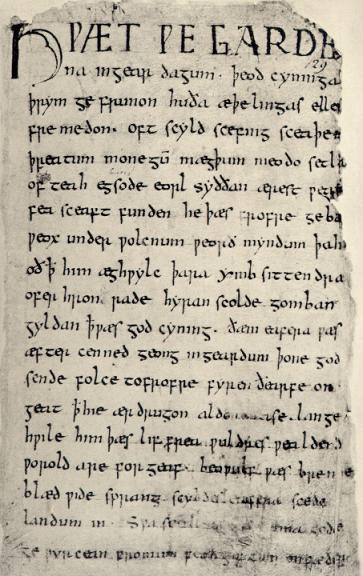
The earliest form of English is called Old English or Anglo-Saxon (c. 550–1066 CE). Old English developed from a set of North Sea Germanic dialects originally spoken along the coasts of Frisia, Lower Saxony, Jutland, and Southern Sweden by Germanic tribes known as the Angles, Saxons, and Jutes.

Beowulf Poem
From the 5th century CE, the Anglo-Saxons settled Britain as the Roman economy and administration collapsed. By the 7th century, the Germanic language of the Anglo-Saxons became dominant in Britain, replacing the languages of Roman Britain, a Celtic language, and Latin, brought to Britain by the Roman occupation. England and English (originally Ænglaland and Ænglisc) are named after the Angles.

Old English was divided into four dialects: the Anglian dialects (Mercian and Northumbrian) and the Saxon dialects, Kentish and West Saxon. Through the educational reforms of King Alfred in the 9th century and the influence of the kingdom of Wessex, the West Saxon dialect became the standard written variety.

The epic poem Beowulf is written in West Saxon, and the earliest English poem, Cædmon's Hymn, is written in Northumbrian. Modern English developed mainly from Mercian, but the Scots language developed from Northumbrian. A few short inscriptions from the early period of Old English were written using a runic script. By the 6th century, a Latin alphabet was adopted, written with half-uncial letterforms.

Old English is essentially a distinct language from Modern English and is virtually impossible for 21st-century unstudied English speakers to understand. Its grammar was similar to that of modern German, and its closest relative is Old Frisian.

More information: BBC

Nouns, adjectives, pronouns, and verbs had many more inflectional endings and forms, and word order was much freer than in Modern English. Modern English has case forms in pronouns (he, him, his) and has a few verb inflections (speak, speaks, speaking, spoke, spoken), but Old English had case endings in nouns as well, and verbs had more person and number endings.

From the 8th to the 12th century, Old English gradually transformed through language contact into Middle English. Middle English is often arbitrarily defined as beginning with the conquest of England by William the Conqueror in 1066, but it developed further in the period from 1200–1450.

The next period in the history of English was Early Modern English (1500–1700). Early Modern English was characterised by the Great Vowel Shift (1350–1700), inflectional simplification, and linguistic standardisation.

By the late 18th century, the British Empire had spread English through its colonies and geopolitical dominance. Commerce, science and technology, diplomacy, art, and formal education all contributed to English becoming the first truly global language. English also facilitated worldwide international communication.

More information: Mental Floss


Viewed freely, the English language is the accretion
and growth of every dialect, race, and range of time,
and is both the free and compacted composition of all.

Walt Whitman

Tuesday, 3 March 2020

THE WATSONS CELEBRATE GOOD NEWS WITH CARLSBERG

Arriving to Carlsberg brewery, Copenhagen
Neus Watson was found yesterday evening with symptoms of hypothermia in the Nyhavn canal in Copenhagen- the local police reported. She is fine. She is alive. This is the most wonderful news that The Watsons could receive after some hours of deep anguish.

The Grandma wanted to visit the Lego factory because she is a great fan of its products but after this news, The Watsons have decided to visit the Carlsberg factory to celebrate Neus is fine, drinking as beer as their bodies resist. At night, they are going to come back to Barcelona. They will have enough time to sleep during the flight but know it is time to celebrate life.

Carlsberg A/S is a global brewer. Founded in 1847 by J. C. Jacobsen, the company's headquarters is located in Copenhagen, Denmark. Since Jacobsen's death in 1887, the majority owner of the company has been the Carlsberg Foundation.

The company's flagship brand is Carlsberg, named after Jacobsen's son Carl. It also brews Tuborg, Kronenbourg, Somersby cider, Russia's best-selling beer Baltika, Belgian Grimbergen abbey beers, and more than 500 local beers.

The company employs around 41,000 people, primarily located in Western Europe, Eastern Europe and Asia.

Carlsberg was founded by J. C. Jacobsen, a philanthropist and avid art collector. With his fortune he amassed an art collection which is housed in the Ny Carlsberg Glyptotek in central Copenhagen. The first brew was finished on 10 November 1847, and the export of Carlsberg beer began in 1868 with the export of one barrel to Edinburgh, Scotland.

Some of the company's original logos include an elephant, after which some of its lagers are named, and the swastika, the use of which was discontinued in the 1930s because of its association with political parties in neighboring Germany. 

More information: Carlsberg

Jacobsen's son Carl opened a brewery in 1882 named Ny (New) Carlsberg forcing him to rename his brewery Gamle (Old) Carlsberg. The companies were merged and run under Carl's direction in 1906 and remained so until his death in 1914.

Jacobsen set up the Carlsberg Laboratory in 1875, which worked on scientific problems related to brewing. It featured a Department of Chemistry and a Department of Physiology. The species of yeast used to make pale lager, Saccharomyces carlsbergensis, was isolated by Emil Christian Hansen at the laboratory in 1883 and bears its name; this was shared freely by Carlsberg.

The Carlsberg Laboratory also developed the concept of pH and made advances in protein chemistry. In 1972, the Carlsberg Research Centre was established and the Carlsberg Laboratory is an independent unit of the Centre. 

In 1876, J.C. Jacobsen established the Carlsberg Foundation, run by trustees from the Royal Danish Academy of Sciences and Letters, which managed the Carlsberg Laboratory as well as supporting scientific research within the fields of natural sciences, mathematics, philosophy, the humanities and social sciences in Denmark. 

Visiting Carlsberg brewery, Copenhagen
Because of a conflict with his son Carl, Jacobsen's brewery was left to the Foundation upon his death in 1887.

The first overseas license for brewing was given to the Photos Photiades Breweries, and in 1966 Carlsberg beer was brewed for the first time outside Denmark at the Photiades breweries in Cyprus. The first brewery to be built outside Denmark was in Blantyre, Malawi in 1968.

Carlsberg merged with Tuborg breweries in 1970 forming the United Breweries AS, and merged with Tetley in 1992. Carlsberg became the sole owner of Carlsberg-Tetley in 1997.

In 2008 Carlsberg Group, together with Heineken, bought Scottish & Newcastle, the largest brewer in the UK, for £7.8bn ($15.3bn).

In 2013 the company joined leading alcohol producers as part of a producers' commitments to reducing harmful drinking.

In November 2014, Carlsberg agreed to take over Greece's third largest brewery, the Olympic Brewery, adding to its operations in the country already and effectively transforming the firm into the second biggest market player in Greece.

The old brewery in Copenhagen is open for tours. In January 2020 The Brewery Tour is closed for a complete refurbishment. it is not known when it will reopen Carlsberg website.

Carlsberg is the flagship beer brand in Carlsberg Group's portfolio of more than 500 brands. It is a 5% abv pilsner beer, 3.8% in the UK and branded as Carlsberg Danish Pilsener, with a global distribution to 140 markets. It is also known as Carlsberg Lager, Carlsberg Beer and Carlsberg Pilsner. It was first brewed in 1904, and was created by Carl Jacobsen, son of Carlsberg's founder JC Jacobsen.

More information: Visit Carlsberg

The introduction of the Carlsberg pilsner also saw the reintroduction of the Art Nouveau-style logo that has been used nearly unmodified since 1904, and later became the logo of the entire company. It was designed by Thorvald Bindesbøll.

In Denmark the beer is often known as Hof (court) due to its Royal Warrant. This nickname was adopted into the brand in 1931 but discontinued in Denmark in 1991. The term is still used in other markets such as the UK and Sweden.

In 1901, at brewer Carl Jacobsen's initiative, the Architect Professor J. L. Dahlerup created a tower resting on four elephants carved in granite from the Danish island of Bornholm. Jacobsen's inspiration was the obelisk supporting an elephant on the Piazza della Minerva in Rome. The four elephants each bear the initial of one of Carl Jacobsen's children: Theodora, Paula, Helge and Vagn. This became known as The Elephant Gate and is a landmark entrance to the brewery.

More information: Carlsberg Foundation

To the west of the gate, Carl Jacobsen's motto was inscribed: Laboremus pro Patria (Let us work for our country). Since then, the Elephant has been a famous part of the Carlsberg family, especially after the strong Elephant Beer was created in 1955 under the name Export Lager Beer featuring the Elephant label.

The Elephant is still brewed in Carlsberg Breweries in Copenhagen and exported around the world. A few markets brew their own Carlsberg Elephant beer locally according to the original recipe.

Carlsberg's tagline Probably the best lager in the world was created in 1973 by Tony Bodinetz at KMP for the UK market. It began to appear in company corporate ads around the world from the 1980s onwards until it was replaced in 2011 in most regions by new tagline That calls for a Carlsberg. The voice over for the original ad in 1983 was voiced by actor Orson Welles, his voice has been used repeatedly over the years. Welles was not expensive and he liked the advertisements, so he kept his fees to a minimum. In some countries the tagline has been adapted to Probably the best beer in the world.

More information: @Carlsberg


I don’t go to the gym or practice yoga.
And the closest thing I have to a nutritionist
is the Carlsberg Beer Company.
I just have the appetite of a pigeon.

Colin Farrell

Monday, 2 March 2020

'TO BE OR NOT TO BE', HAMLET, NEUS & YOLANDA WATSON

Yolanda at hotel & The Watsons on Nyhavn canal
The Watsons are still in Copenhagen. They have suffered a terrible day. A real tragedy has hit their hearts and they are absolutely destroyed.

On the one hand, Yolanda Watson has injured her leg and she has stayed at hotel without visiting the city, on the other hand Neus Watson has disappeared in the middle of the Nyhavn canal.

Nyhavn is a 17th-century waterfront, canal and entertainment district in Copenhagen. Stretching from Kongens Nytorv to the harbour front just south of the Royal Playhouse, it is lined by brightly coloured 17th and early 18th century townhouses and bars, cafes and restaurants. The canal harbours many historical wooden ships.

The Watsons were sailing by boat when they have realized that Neus Watson was not with them. Quickly, they have asked for help and they have phone the police that has arrived in five minutes.

After hours and hours of intense searching, Neus Watson has not appeared and the family has started to think the worst things and to live the hardest feelings. They do not want to lose their hope but they must admit news is not as good as they liked.

More information: Nice Right Now

The Watsons are a strong talk-active family. They have not got secrets, or at least they think it. They have been exposing some theories knowing that Neus is a great fan of Hans Christian Andersen's tale, The Little Mermaid.

While The Watsons were worried about Neus, Yolanda was at hotel studying some English grammar without knowing anything about this tragic disappearance. First, she has read two chapters of her new book The Secret of Oldstone Hall. Later, she has reviewed some modals verbs (Must & Should) and finally, she has been reading about the origin of European surnames and the Saxon genitive.

More information: Must-Mustn't I & II

More information: Should-Shouldn't I & II

More information: Must vs. Should

More information: Saxon Genitive

The Grandma is sad with Yolanda and Neus's news and she has thought in William Shakespeare's tragedy Hamlet because her situation is a real tragedy, it is a question of to be or not to be.

The Tragedy of Hamlet, Prince of Denmark, often shortened to Hamlet is a tragedy written by William Shakespeare sometime between 1599 and 1601. It is Shakespeare's longest play with 30,557 words.

Neus Watson
Set in Denmark, the play depicts Prince Hamlet and his revenge against his uncle, Claudius, who has murdered Hamlet's father in order to seize his throne and marry Hamlet's mother.

Hamlet is Shakespeare's longest play and is considered among the most powerful and influential works of world literature, with a story capable of seemingly endless retelling and adaptation by others.

It was one of Shakespeare's most popular works during his lifetime and still ranks among his most performed, topping the performance list of the Royal Shakespeare Company and its predecessors in Stratford-upon-Avon since 1879. It has inspired many other writers -from Johann Wolfgang von Goethe and Charles Dickens to James Joyce and Iris Murdoch- and has been described as the world's most filmed story after Cinderella.

The story of Shakespeare's Hamlet was derived from the legend of Amleth, preserved by 13th-century chronicler Saxo Grammaticus in his Gesta Danorum, as subsequently retold by the 16th-century scholar François de Belleforest.

More information: William Shakespeare

Shakespeare may also have drawn on an earlier Elizabethan play known today as the Ur-Hamlet, though some scholars believe Shakespeare wrote the Ur-Hamlet, later revising it to create the version of Hamlet we now have. He almost certainly wrote his version of the title role for his fellow actor, Richard Burbage, the leading tragedian of Shakespeare's time.

In the 400 years since its inception, the role has been performed by numerous highly acclaimed actors in each successive century.

Three different early versions of the play are extant: the First Quarto (Q1, 1603); the Second Quarto (Q2, 1604); and the First Folio (F1, 1623). Each version includes lines and entire scenes missing from the others. The play's structure and depth of characterisation have inspired much critical scrutiny.

More information: Open Source Shakespeare

One such example is the centuries-old debate about Hamlet's hesitation to kill his uncle, which some see as merely a plot device to prolong the action but which others argue is a dramatisation of the complex philosophical and ethical issues that surround cold-blooded murder, calculated revenge, and thwarted desire.

More recently, psychoanalytic critics have examined Hamlet's unconscious desires, while feminist critics have re-evaluated and attempted to rehabilitate the often-maligned characters of Ophelia and Gertrude.

Hamlet
Any dating of Hamlet must be tentative, cautions the New Cambridge editor, Phillip Edwards. The earliest date estimate relies on Hamlet's frequent allusions to Shakespeare's Julius Caesar, itself dated to mid-1599.

The latest date estimate is based on an entry, of 26 July 1602, in the Register of the Stationers' Company, indicating that Hamlet was latelie Acted by the Lo: Chamberleyne his servantes.

From the early 17th century, the play was famous for its ghost and vivid dramatisation of melancholy and insanity, leading to a procession of mad courtiers and ladies in Jacobean and Caroline drama.

Much of Hamlet's language is courtly: elaborate, witty discourse, as recommended by Baldassare Castiglione's 1528 etiquette guide, The Courtier. This work specifically advises royal retainers to amuse their masters with inventive language.

Written at a time of religious upheaval and in the wake of the English Reformation, the play is alternately Catholic or piously medieval and Protestant or consciously modern.

More information: Shakespeare On Line

Hamlet is often perceived as a philosophical character, expounding ideas that are now described as relativist, existentialist, and sceptical. For example, he expresses a subjectivistic idea when he says to Rosencrantz: there is nothing either good or bad, but thinking makes it so.

Sigmund Freud's thoughts regarding Hamlet were first published in his book The Interpretation of Dreams (1899), as a footnote to a discussion of Sophocles' tragedy, Oedipus Rex, all of which is part of his consideration of the causes of neurosis.

Freud does not offer over-all interpretations of the plays, but uses the two tragedies to illustrate and corroborate his psychological theories, which are based on his treatments of his patients and on his studies.

Hamlet is one of the most quoted works in the English language, and is often included on lists of the world's greatest literature.

More information: The New Yorker


One of the things that makes Hamlet
unique among Shakespeare's characters
is his courage to face up
to the darker elements of his personality.

Kenneth Branagh

Sunday, 1 March 2020

DEN LILLE HAVFRUE, THE GREAT SYMBOL OF KØBENHAVN

Visiting the Copenhagen sights
Today, The Watsons and The Grandma have visited some of the most interesting places in Copenhagen like the Tivoli Gardens, the Amalienborg Palace, the Rosenborg Castle and Den Lille Havfrue (The Little Mermaid).

It has been a wonderful experience. Tonight, they are going to visit The National Museum in a private visit.

Copenhagen has the essence of Vikings and the splendorous Middle Age in every corner of its streets. It is a unique experience that you must live at least once in your life but Copenhagen is also the city where lived and died Hans Christian Andersen the most popular tales writer.


The family has wanted to homage him visiting Den Lille Havfrue (The Little Mermaid) that is, probably, the most popular symbol of this amazing city.

More information: Copenhagen

The Little Mermaid, in Danish Den lille Havfrue, is a bronze statue by Edvard Eriksen, depicting a mermaid becoming human. The sculpture is displayed on a rock by the waterside at the Langelinie promenade in Copenhagen, Denmark. It is 1.25 metres tall and weighs 175 kilograms.

Based on the fairy tale of the same name by Danish author Hans Christian Andersen, the small and unimposing statue is a Copenhagen icon and has been a major tourist attraction since its unveiling in 1913.  

In recent decades it has become a popular target for defacement by vandals and political activists.

Mermaid is among iconic statues that symbolize cities; others include: Manneken Pis in Brussels, the Statue of Liberty in New York and Christ the Redeemer in Rio de Janeiro. In several cases, cities have commissioned statues for such a purpose, such as with Singapore's Merlion.


More information: Visit Copenhagen

The statue was commissioned in 1909 by Carl Jacobsen, son of the founder of Carlsberg, who had been fascinated by a ballet about the fairytale in Copenhagen's Royal Theatre and asked the ballerina, Ellen Price, to model for the statue.

The sculptor Edvard Eriksen created the bronze statue, which was unveiled on August 23, 1913. The statue's head was modelled after Price, but as the ballerina did not agree to model in the nude, the sculptor's wife, Eline Eriksen, was used for the body.

Den Lille Havfrue, The Little Mermaid
The Copenhagen City Council arranged to move the statue to Shanghai at the Danish Pavilion for the duration of the Expo 2010 (May to October), the first time it had been moved officially from its perch since it was installed almost a century earlier.

While the statue was away in Shanghai an authorised copy was displayed on a rock in the lake in Copenhagen's nearby Tivoli Gardens. Copenhagen officials have considered moving the statue several meters out into the harbour to discourage vandalism and to prevent tourists from climbing onto it, but as of May 2014 the statue remains on dry land at the water side at Langelinie.

This statue has been damaged and defaced many times since the mid-1960s for various reasons, but has been restored each time.

On April 24, 1964, the statue's head was sawn off and stolen by politically oriented artists of the Situationist movement, amongst them Jørgen Nash. The head was never recovered and a new head was produced and placed on the statue. On July 22, 1984, the right arm was sawn off and returned two days later by two young men. In 1990, an attempt to sever the statue's head left an 18 centimeters deep cut in the neck.

More information: Denmark

On January 6, 1998, the statue was decapitated again; the culprits were never found, but the head was returned anonymously to a nearby television station, and reattached on February 4. On the night of September 10, 2003, the statue was knocked off its base with explosives and later found in the harbour's waters. Holes had been blasted in the mermaid's wrist and knee.


Paint has been poured on the statue several times, including one episode in 1963 and two in March and May 2007. On March 8, 2006, a dildo was attached to the statue's hand, green paint was dumped over it, and the date March 8 were written on it. It is suspected that this vandalism was connected with International Women's Day, which is on March 8.

More information: Atlas Obscura

The statue was found drenched in red paint on May 30, 2017 with the message Danmark defend the whales of the Faroe Islands, a reference to whaling in the Faroe Islands, an autonomous country in the Kingdom of Denmark, written on the ground in front of the statue. About two weeks later, on June 14, the statue was drenched in blue and white paint. Befri Abdulle, Free Abdulle, was written in front of the statue, but it was unclear what this referred to at the time. Later, police said the writing was likely referring to Abdulle Ahmed, a Somalian refugee who has been detained in a high security unit in Denmark since 2001 due to a custody sentence. On 13 January 2020, Free Hong Kong was painted on the stone the statue is mounted on.

Visiting Den Lille Havfrue, The Little Mermaid
Although not regarded as vandalism since no damage is done to the statue, people have also repeatedly dressed it, either for fun or to make more serious statements.

In 2004, the statue was draped in a burqa in a protest against Turkey's application to join the European Union.

In May 2007, it was again found draped in Muslim dress and a head scarf. Other examples are times where a Christmas hat has been put on the head, or it has been dressed in the jerseys of the Norwegian or Swedish national football teams, especially the Danish and Swedish teams have a highly competitive rivalry.

Aside from the statue on display, which is a replica of the original, more than thirteen undamaged copies of the statue are located around the world, listed by Mermaids of Earth, including Solvang, California; Kimballton, Iowa; Piatra Neamţ, Romania; Torrejón de Ardoz (Madrid), Spain; Seoul, South Korea; and a half-sized copy in Calgary, Alberta, Canada. The grave of Danish-American entertainer Victor Borge includes a copy as well. The Copenhagen Airport also has a replica of the mermaid along with a statue of
Hans Christian Andersen.

Some statues similar to The Little Mermaid are In Sicily. The first it placed in 1962 on the seafront in Giardini Naxos, and measures about four meters high over a fountain. A second always portraying a mermaid Post on a depth of sea about 18 meters. Inside the Marine Protected Area of Plemmiro of Siracusa.


More information: Travel Triangle

A statue of The Little Mermaid looks out over Larvotto beach in Monaco. She was created, in 2000, with layers and layers of metal by Kristian Dahlgard, in hommage to the Danes who live in Monaco and for the late Prince Rainier III to mark the 50th year of his reign.

A copy of the statue forms the Danish contribution to the International Peace Gardens in Salt Lake City. The half-size replica was stolen on February 26, 2010, but was recovered on April 7 abandoned in the park.

The statue is under copyright until 2029, seventy years after the 1959 death of the creator. As of 2019, replicas can be purchased, authorized for sale by the Eriksen family.


More information: The Culture Trip

A replica was installed in Greenville, Michigan in 1994 to celebrate the town's Danish heritage, at a cost of $10,000. In 2009 the Artists Rights Society asked the town for a $3,800 licensing fee, claiming the work violated Eriksen's copyright. At about 76 cm  in height, the replica in Greenville is half the size of the original, and has a different face and larger breasts as well as other distinguishing factors. The copyright claim was later reported to have been dropped.

There are similarities between The Little Mermaid statue and the Pania of the Reef statue on the beachfront at Napier in New Zealand, and some similarities in the little mermaid and Pania tales. The 1972 statue of a female diver, titled Girl in a Wetsuit by Elek Imredy, in Vancouver, British Columbia, Canada was commissioned when, unable to obtain permission to reproduce the Copenhagen statue, Vancouver authorities selected a modern version.


But a mermaid has no tears,
and therefore she suffers so much more.

Hans Christian Andersen, The Little Mermaid