Today, The Grandma has started a new work and educational project in Sant Boi de Llobregat.MJ hascalled her to start to work with another family, TheMorgans.
MJ and The Grandma have received the new members of this new family in this amazing placeand after a long session of bureaucracy The Grandma has been able to start to know her new family.
Tomorrow,
they are going to start with their new manuals and they are going to
share lots of hours of effort, knowledge and hard work with the goal of
improving their English, having the chance of passing an important exam, and finding a job.
English is a West Germanic language that was first spoken in early medieval England and eventually became a global lingua franca.
It is named after the Angles, one of the Germanic tribes that migrated to the area of Great Britain that later took their name, as England.
Both names derive from Anglia,
a peninsula in the Baltic Sea. The language is closely related to
Frisian and Low Saxon, and its vocabulary has been significantly
influenced by other Germanic languages, particularly Norse (a North
Germanic language), and to a greater extent by Latin and French.
English has developed over the course of more than 1,400 years. The earliest forms of English, a group of West Germanic (Ingvaeonic) dialects brought to Great Britain by Anglo-Saxon settlers in the 5th century, are collectively called Old English.
Middle English
began in the late 11th century with the Norman conquest of England;
this was a period in which the language was influenced by French.
Early Modern English
began in the late 15th century with the introduction of the printing
press to London, the printing of the King James Bible and the start of
the Great Vowel Shift.
Modern English has been spreading around the world since the 17th century by
the worldwide influence of the British Empire and the United States. Through all types of printed and electronic media of these countries,
English has become the leading language of international discourse and
the lingua franca in many regions and professional contexts such as
science, navigation and law.
English is the largest language by number of speakers,
and the third most-spoken native language in the world, after Standard
Chinese and Spanish. It is the most widely learned second language and
is either the official language or one of the official languages in
almost 60 sovereign states.
There
are more people who have learned it as a second language than there are
native speakers. It is estimated that there are over 2 billion speakers
of English. English is the majority native language in the
United States, the United Kingdom, Canada, Australia, New Zealand and
the Republic of Ireland, and it is widely spoken in some areas of the
Caribbean, Africa and South Asia.
It is a co-official language of the United Nations, the European Union
and many other world and regional international organisations. It is
the most widely spoken Germanic language, accounting for at least 70% of
speakers of this Indo-European branch. English has a vast vocabulary,
though counting how many words any language has is impossible. English speakers are called Anglophones.
Modern English grammar
is the result of a gradual change from a typical Indo-European
dependent marking pattern, with a rich inflectional morphology and
relatively free word order, to a mostly analytic pattern with little
inflection, a fairly fixed subject–verb–object word order and a complex
syntax.
Modern English
relies more on auxiliary verbs and word order for the expression of
complex tenses, aspect and mood, as well as passive constructions,
interrogatives and some negation. The variation among the accents and dialects of English
used in different countries and regions -in terms of phonetics and
phonology, and sometimes also vocabulary, idioms, grammar, and
spelling-can often be understood by speakers of different dialects, but
in extreme cases can lead to confusion or even mutual unintelligibility
between English speakers.
The earliest form of English is called Old English or Anglo-Saxon (c. 550–1066 CE). Old English
developed from a set of North Sea Germanic dialects originally spoken
along the coasts of Frisia, Lower Saxony, Jutland, and Southern Sweden
by Germanic tribes known as the Angles, Saxons, and Jutes.
From the 5th century CE, the Anglo-Saxons settled Britain as the Roman economy and administration collapsed. By the 7th century, the Germanic language of the Anglo-Saxons becamedominant
in Britain, replacing the languages of Roman Britain, a Celtic
language, and Latin, brought to Britain by the Roman occupation. England
and English (originally Ænglaland and Ænglisc) are named after the Angles.
Old English was divided into four dialects:theAnglian
dialects (Mercian and Northumbrian) and the Saxon dialects, Kentish and
West Saxon. Through the educational reforms of King Alfred in the 9th
century and the influence of the kingdom of Wessex, the West Saxon
dialect became the standard written variety.
The epic poem Beowulf is written in West Saxon, and the earliest English poem, Cædmon's Hymn, is written in Northumbrian. Modern English developed mainly from Mercian, but the Scots language developed from Northumbrian. A few short inscriptions from the early period of Old English were written using a runic script. By the 6th century, a Latin alphabet was adopted, written with half-uncial letterforms.
Old English is essentially a distinct language from Modern English
and is virtually impossible for 21st-century unstudied English speakers
to understand. Its grammar was similar to that of modern German, and
its closest relative is Old Frisian.
Nouns, adjectives, pronouns, and verbs had many more inflectional endings and forms, and word order was much freer than in Modern English. ModernEnglish has case forms in pronouns (he, him, his) and has a few verb inflections (speak, speaks, speaking, spoke, spoken), but Old English had case endings in nouns as well, and verbs had more person and number endings.
From the 8th to the 12th century, Old English gradually transformed through language contact into Middle English. Middle English is often arbitrarily defined as beginning with the conquest of England by William the Conqueror in 1066, but it developed further in the period from 1200–1450.
The next period in the history of English was Early Modern English (1500–1700). Early Modern English was characterised by the Great Vowel Shift (1350–1700), inflectional simplification, and linguistic standardisation.
By the late 18th century, the British Empire had spread English through its colonies and geopolitical dominance. Commerce, science and technology, diplomacy, art, and formal education all contributed to English becoming the first truly global language. English also facilitated worldwide international communication.
Today, The Grandma has started to Sant Boi de Llobregat urgently because MJ has called her to start to work with another family, The Winsors.
MJ and The Grandma have received the new members of the family in the emplacement in Sant Boi de Llobregat and after a long session of bureaucracy The Grandma has been able to start to know her new family. Tomorrow,
they are going to start with their new manuals and they are going to
share lots of hours of effort, knowledge and hard work with the goal of
improving English and having the chance of passing an important exam.
English is a West Germanic language that was first spoken in early medieval England and eventually became a global lingua franca.
It is named after the Angles, one of the Germanic tribes that migrated to the area of Great Britain that later took their name, as England.
Both names derive from Anglia,
a peninsula in the Baltic Sea. The language is closely related to
Frisian and Low Saxon, and its vocabulary has been significantly
influenced by other Germanic languages, particularly Norse (a North
Germanic language), and to a greater extent by Latin and French.
English has developed over the course of more than 1,400 years. The earliest forms of English, a group of West Germanic (Ingvaeonic) dialects brought to Great Britain by Anglo-Saxon settlers in the 5th century, are collectively called Old English.
Middle English
began in the late 11th century with the Norman conquest of England;
this was a period in which the language was influenced by French.
Early Modern English
began in the late 15th century with the introduction of the printing
press to London, the printing of the King James Bible and the start of
the Great Vowel Shift.
Modern English has been spreading around the world since the 17th century by
the worldwide influence of the British Empire and the United States. Through all types of printed and electronic media of these countries,
English has become the leading language of international discourse and
the lingua franca in many regions and professional contexts such as
science, navigation and law.
English is the largest language by number of speakers,
and the third most-spoken native language in the world, after Standard
Chinese and Spanish. It is the most widely learned second language and
is either the official language or one of the official languages in
almost 60 sovereign states.
There
are more people who have learned it as a second language than there are
native speakers. It is estimated that there are over 2 billion speakers
of English. English is the majority native language in the
United States, the United Kingdom, Canada, Australia, New Zealand and
the Republic of Ireland, and it is widely spoken in some areas of the
Caribbean, Africa and South Asia.
It is a co-official language of the United Nations, the European Union
and many other world and regional international organisations. It is
the most widely spoken Germanic language, accounting for at least 70% of
speakers of this Indo-European branch. English has a vast vocabulary,
though counting how many words any language has is impossible. English speakers are called Anglophones.
Modern English grammar
is the result of a gradual change from a typical Indo-European
dependent marking pattern, with a rich inflectional morphology and
relatively free word order, to a mostly analytic pattern with little
inflection, a fairly fixed subject–verb–object word order and a complex
syntax.
Modern English
relies more on auxiliary verbs and word order for the expression of
complex tenses, aspect and mood, as well as passive constructions,
interrogatives and some negation. The variation among the accents and dialects of English
used in different countries and regions -in terms of phonetics and
phonology, and sometimes also vocabulary, idioms, grammar, and
spelling-can often be understood by speakers of different dialects, but
in extreme cases can lead to confusion or even mutual unintelligibility
between English speakers.
The earliest form of English is called Old English or Anglo-Saxon (c. 550–1066 CE). Old English
developed from a set of North Sea Germanic dialects originally spoken
along the coasts of Frisia, Lower Saxony, Jutland, and Southern Sweden
by Germanic tribes known as the Angles, Saxons, and Jutes.
From the 5th century CE, the Anglo-Saxons settled Britain as the Roman economy and administration collapsed. By the 7th century, the Germanic language of the Anglo-Saxons becamedominant
in Britain, replacing the languages of Roman Britain, a Celtic
language, and Latin, brought to Britain by the Roman occupation. England
and English (originally Ænglaland and Ænglisc) are named after the Angles.
Old English was divided into four dialects:theAnglian
dialects (Mercian and Northumbrian) and the Saxon dialects, Kentish and
West Saxon. Through the educational reforms of King Alfred in the 9th
century and the influence of the kingdom of Wessex, the West Saxon
dialect became the standard written variety.
The epic poem Beowulf is written in West Saxon, and the earliest English poem, Cædmon's Hymn, is written in Northumbrian. Modern English developed mainly from Mercian, but the Scots language developed from Northumbrian. A few short inscriptions from the early period of Old English were written using a runic script. By the 6th century, a Latin alphabet was adopted, written with half-uncial letterforms.
Old English is essentially a distinct language from Modern English
and is virtually impossible for 21st-century unstudied English speakers
to understand. Its grammar was similar to that of modern German, and
its closest relative is Old Frisian.
Nouns, adjectives, pronouns, and verbs had many more inflectional endings and forms, and word order was much freer than in Modern English. ModernEnglish has case forms in pronouns (he, him, his) and has a few verb inflections (speak, speaks, speaking, spoke, spoken), but Old English had case endings in nouns as well, and verbs had more person and number endings.
From the 8th to the 12th century, Old English gradually transformed through language contact into Middle English. Middle English is often arbitrarily defined as beginning with the conquest of England by William the Conqueror in 1066, but it developed further in the period from 1200–1450.
The next period in the history of English was Early Modern English (1500–1700). Early Modern English was characterised by the Great Vowel Shift (1350–1700), inflectional simplification, and linguistic standardisation.
By the late 18th century, the British Empire had spread English through its colonies and geopolitical dominance. Commerce, science and technology, diplomacy, art, and formal education all contributed to English becoming the first truly global language. English also facilitated worldwide international communication.
Today, The Grandma has started to SantBoi de Llobregat urgently because MJ has called her to start to work with another family, The Fosters.
MJ and The Grandma have received the new members of the family in the emplacement in Sant Boi de Llobregat and after a long session of bureaucracy The Grandma has been able to start to know her new family. Tomorrow,
they are going to start with their new manuals and they are going to
share lots of hours of effort, knowledge and hard work with the goal of
improving English and having the chance of passing an important exam.
English is a West Germanic language that was first spoken in early medieval England and eventually became a global lingua franca.
It is named after the Angles, one of the Germanic tribes that migrated to the area of Great Britain that later took their name, as England.
Both names derive from Anglia,
a peninsula in the Baltic Sea. The language is closely related to
Frisian and Low Saxon, and its vocabulary has been significantly
influenced by other Germanic languages, particularly Norse (a North
Germanic language), and to a greater extent by Latin and French.
English has developed over the course of more than 1,400 years. The earliest forms of English, a group of West Germanic (Ingvaeonic) dialects brought to Great Britain by Anglo-Saxon settlers in the 5th century, are collectively called Old English.
Middle English
began in the late 11th century with the Norman conquest of England;
this was a period in which the language was influenced by French.
Early Modern English
began in the late 15th century with the introduction of the printing
press to London, the printing of the King James Bible and the start of
the Great Vowel Shift.
Modern English has been spreading around the world since the 17th century by
the worldwide influence of the British Empire and the United States. Through all types of printed and electronic media of these countries,
English has become the leading language of international discourse and
the lingua franca in many regions and professional contexts such as
science, navigation and law.
English is the largest language by number of speakers,
and the third most-spoken native language in the world, after Standard
Chinese and Spanish. It is the most widely learned second language and
is either the official language or one of the official languages in
almost 60 sovereign states.
There
are more people who have learned it as a second language than there are
native speakers. It is estimated that there are over 2 billion speakers
of English. English is the majority native language in the
United States, the United Kingdom, Canada, Australia, New Zealand and
the Republic of Ireland, and it is widely spoken in some areas of the
Caribbean, Africa and South Asia.
It is a co-official language of the United Nations, the European Union
and many other world and regional international organisations. It is
the most widely spoken Germanic language, accounting for at least 70% of
speakers of this Indo-European branch. English has a vast vocabulary,
though counting how many words any language has is impossible. English speakers are called Anglophones.
Modern English grammar
is the result of a gradual change from a typical Indo-European
dependent marking pattern, with a rich inflectional morphology and
relatively free word order, to a mostly analytic pattern with little
inflection, a fairly fixed subject–verb–object word order and a complex
syntax.
Modern English
relies more on auxiliary verbs and word order for the expression of
complex tenses, aspect and mood, as well as passive constructions,
interrogatives and some negation. The variation among the accents and dialects of English
used in different countries and regions -in terms of phonetics and
phonology, and sometimes also vocabulary, idioms, grammar, and
spelling-can often be understood by speakers of different dialects, but
in extreme cases can lead to confusion or even mutual unintelligibility
between English speakers.
The earliest form of English is called Old English or Anglo-Saxon (c. 550–1066 CE). Old English
developed from a set of North Sea Germanic dialects originally spoken
along the coasts of Frisia, Lower Saxony, Jutland, and Southern Sweden
by Germanic tribes known as the Angles, Saxons, and Jutes.
From the 5th century CE, the Anglo-Saxons settled Britain as the Roman economy and administration collapsed. By the 7th century, the Germanic language of the Anglo-Saxons becamedominant
in Britain, replacing the languages of Roman Britain, a Celtic
language, and Latin, brought to Britain by the Roman occupation. England
and English (originally Ænglaland and Ænglisc) are named after the Angles.
Old English was divided into four dialects:theAnglian
dialects (Mercian and Northumbrian) and the Saxon dialects, Kentish and
West Saxon. Through the educational reforms of King Alfred in the 9th
century and the influence of the kingdom of Wessex, the West Saxon
dialect became the standard written variety.
The epic poem Beowulf is written in West Saxon, and the earliest English poem, Cædmon's Hymn, is written in Northumbrian. Modern English developed mainly from Mercian, but the Scots language developed from Northumbrian. A few short inscriptions from the early period of Old English were written using a runic script. By the 6th century, a Latin alphabet was adopted, written with half-uncial letterforms.
Old English is essentially a distinct language from Modern English
and is virtually impossible for 21st-century unstudied English speakers
to understand. Its grammar was similar to that of modern German, and
its closest relative is Old Frisian.
Nouns, adjectives, pronouns, and verbs had many more inflectional endings and forms, and word order was much freer than in Modern English. ModernEnglish has case forms in pronouns (he, him, his) and has a few verb inflections (speak, speaks, speaking, spoke, spoken), but Old English had case endings in nouns as well, and verbs had more person and number endings.
From the 8th to the 12th century, Old English gradually transformed through language contact into Middle English. Middle English is often arbitrarily defined as beginning with the conquest of England by William the Conqueror in 1066, but it developed further in the period from 1200–1450.
The next period in the history of English was Early Modern English (1500–1700). Early Modern English was characterised by the Great Vowel Shift (1350–1700), inflectional simplification, and linguistic standardisation.
By the late 18th century, the British Empire had spread English through its colonies and geopolitical dominance. Commerce, science and technology, diplomacy, art, and formal education all contributed to English becoming the first truly global language. English also facilitated worldwide international communication.
Today, The Grandma has started a new adventure with a new family, TheGrangers, in Sant Boi de Llobregat.
They are going to spend some months together learning English and preparing their new goal -the A2 Cambridge Exam.
Welcome Grangers! Roll of the dice!
Hermione Jean Granger is a fictional character in J. K. Rowling's Harry Potterseries. She first appears in the novel Harry Potter and the Philosopher's Stone (1997), on the Hogwarts express as a first year student on her way to Hogwarts.
After Harry and Ron save her from a mountain troll in the girls' restroom, she becomes best friends with them and often uses her quick wit, deft recall, and encyclopaedic knowledge to lend aid in dire situations.
Hermione is a Muggle-born Gryffindor, who becomes best friends with Harry Potter and Ron Weasley.
She was born on 19 September 1979 and she was nearly twelve when she first attended Hogwarts. She is an overachiever who excels academically and is described as a very logical,upright and good character.
Hermione's parents, two Muggle dentists, are a bit bemused by their odd daughter but quite proud of her all the same. They are well aware of the wizard world and have visited Diagon Alley with her.
Hermione is an only child whose first name is taken from a character in William Shakespeare's The Winter's Tale.
English is a West Germanic language in the Indo-European language family, with its earliest forms spoken by the inhabitants of early medieval England.
It is named after the Angles, one of the ancient Germanic peoples that migrated to the island of Great Britain. Existing on a dialect continuum with Scots and then most closely related to the Low German and Frisian languages, English is genealogically Germanic. However, its vocabulary also shows major influences from French (about 28% of Modern English words) and Latin (also about 28%), plus some grammar and a small amount of core vocabulary influenced by Old Norse (a North Germanic language). Speakers of English are called Anglophones.
The earliest forms of English, collectively known as Old English, evolved from a group of North Sea Germanic dialects brought to Great Britain by Anglo-Saxon settlers in the 5th century and further mutated by Norse-speaking Viking settlers starting in the 8th and 9th centuries.
Middle English began in the late 11th century after the Norman Conquest of England, when considerable Old French (especially Old Norman French) and Latin-derived vocabulary was incorporated into English over some three hundred years.
Early Modern English began in the late 15th century with the start of the Great Vowel Shift and the Renaissance trend of borrowing further Latin and Greek words and roots into English, concurrent with the introduction of the printing press to London. This era notably culminated in the King James Bible and the works of William Shakespeare.
Modern English grammar is the result of a gradual change from a typical Indo-European dependent-marking pattern with a rich inflectional morphology and relatively free word order to a mostly analytic pattern with little inflection and a fairly fixed subject-verb-object word order.
Modern English relies more on auxiliary verbs and word order for the expression of complex tenses, aspects and moods, as well as passiveconstructions, interrogatives, and some negation.
Today, The Watsons are resting at home after their travel to Denmark. The Grandma has returned to SantBoi de Llobregat urgently because MJ has called her to start to work to another family, The Stones.
It is the first time TheGrandma live with two families at time but she is very excited with the idea.
MJ and The Grandma have received the new members of the family in a new emplacement in Sant Boi de Llobregat and after a long session of bureaucracy The Grandma has been able to start to know her new family.
It has been a short time but enough to explain how to create nouns using infinitives and -ing or -er.
Tomorrow, they are going to start with their new manuals and they are going to share lots of hours of effort, knowledge and hard work with the goal of improving English and having the chance of passing an important exam.
English is a West Germanic language that was first spoken in early medieval England and eventually became a global lingua franca.
It is named after the Angles, one of the Germanic tribes that migrated to the area of Great Britain that later took their name, as England.
Both names derive from Anglia, a peninsula in the Baltic Sea. The language is closely related to Frisian and Low Saxon, and its vocabulary has been significantly influenced by other Germanic languages, particularly Norse (a North Germanic language), and to a greater extent by Latin and French.
English has developed over the course of more than 1,400 years. The earliest forms of English, a group of West Germanic (Ingvaeonic) dialects brought to Great Britain by Anglo-Saxon settlers in the 5th century, are collectively called Old English.
Middle English began in the late 11th century with the Norman conquest of England; this was a period in which the language was influenced by French.
Early Modern English began in the late 15th century with the introduction of the printing press to London, the printing of the King James Bible and the start of the Great Vowel Shift.
Old English
Modern English has been spreading around the world since the 17th century by
the worldwide influence of the British Empire and the United States. Through all types of printed and electronic media of these countries,
English has become the leading language of international discourse and
the lingua franca in many regions and professional contexts such as
science, navigation and law.
English is the largest language by number of speakers, and the third most-spoken native language in the world, after Standard Chinese and Spanish. It is the most widely learned second language and is either the official language or one of the official languages in almost 60 sovereign states.
There are more people who have learned it as a second language than there are native speakers. It is estimated that there are over 2 billion speakers of English. English is the majority native language in the United States, the United Kingdom, Canada, Australia, New Zealand and the Republic of Ireland, and it is widely spoken in some areas of the Caribbean, Africa and South Asia.
It is a co-official language of the United Nations, the European Union and many other world and regional international organisations. It is the most widely spoken Germanic language, accounting for at least 70% of speakers of this Indo-European branch. English has a vast vocabulary, though counting how many words any language has is impossible. English speakers are called Anglophones.
Modern English grammar is the result of a gradual change from a typical Indo-European dependent marking pattern, with a rich inflectional morphology and relatively free word order, to a mostly analytic pattern with little inflection, a fairly fixed subject–verb–object word order and a complex syntax.
Modern English relies more on auxiliary verbs and word order for the expression of complex tenses, aspect and mood, as well as passive constructions, interrogatives and some negation. The variation among the accents and dialects of English used in different countries and regions -in terms of phonetics and phonology, and sometimes also vocabulary, idioms, grammar, and spelling-can often be understood by speakers of different dialects, but in extreme cases can lead to confusion or even mutual unintelligibility between English speakers.
The earliest form of English is called Old English or Anglo-Saxon (c. 550–1066 CE). Old English developed from a set of North Sea Germanic dialects originally spoken along the coasts of Frisia, Lower Saxony, Jutland, and Southern Sweden by Germanic tribes known as the Angles, Saxons, and Jutes.
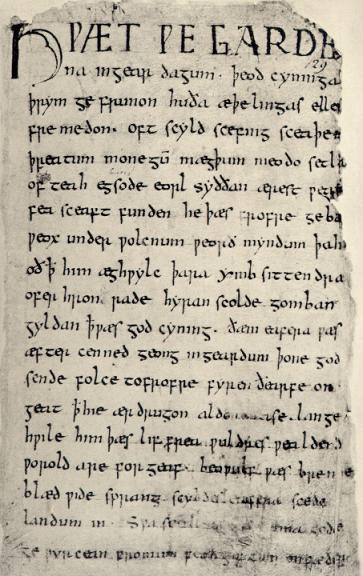
Beowulf Poem
From the 5th century CE, the Anglo-Saxons settled Britain as the Roman economy and administration collapsed. By the 7th century, the Germanic language of the Anglo-Saxons becamedominant in Britain, replacing the languages of Roman Britain, a Celtic language, and Latin, brought to Britain by the Roman occupation. England and English (originally Ænglaland and Ænglisc) are named after the Angles.
Old English was divided into four dialects:theAnglian dialects (Mercian and Northumbrian) and the Saxon dialects, Kentish and West Saxon. Through the educational reforms of King Alfred in the 9th century and the influence of the kingdom of Wessex, the West Saxon dialect became the standard written variety.
The epic poem Beowulf is written in West Saxon, and the earliest English poem, Cædmon's Hymn, is written in Northumbrian. Modern English developed mainly from Mercian, but the Scots language developed from Northumbrian. A few short inscriptions from the early period of Old English were written using a runic script. By the 6th century, a Latin alphabet was adopted, written with half-uncial letterforms.
Old English is essentially a distinct language from Modern English and is virtually impossible for 21st-century unstudied English speakers to understand. Its grammar was similar to that of modern German, and its closest relative is Old Frisian.
Nouns, adjectives, pronouns, and verbs had many more inflectional endings and forms, and word order was much freer than in Modern English. ModernEnglish has case forms in pronouns (he, him, his) and has a few verb inflections (speak, speaks, speaking, spoke, spoken), but Old English had case endings in nouns as well, and verbs had more person and number endings.
From the 8th to the 12th century, Old English gradually transformed through language contact into Middle English. Middle English is often arbitrarily defined as beginning with the conquest of England by William the Conqueror in 1066, but it developed further in the period from 1200–1450.
The next period in the history of English was Early Modern English (1500–1700). Early Modern English was characterised by the Great Vowel Shift (1350–1700), inflectional simplification, and linguistic standardisation.
By the late 18th century, the British Empire had spread English through its colonies and geopolitical dominance. Commerce, science and technology, diplomacy, art, and formal education all contributed to English becoming the first truly global language. English also facilitated worldwide international communication.