Showing posts with label Beowulf. Show all posts

Monday, 23 March 2026

THE MORGANS & THE GRANDMA, ADVENTURE IS COMING

Today, The Grandma has started a new work and educational project in Sant Boi de Llobregat. MJ has called her to start to work with another family, The Morgans.

MJ and The Grandma have received the new members of this new family in this amazing place and after a long session of bureaucracy The Grandma has been able to start to know her new family. 

Tomorrow, they are going to start with their new manuals and they are going to share lots of hours of effort, knowledge and hard work with the goal of improving their English, having the chance of passing an important exam, and finding a job.

More information: The ABC

English is a West Germanic language that was first spoken in early medieval England and eventually became a global lingua franca.

It is named after the Angles, one of the Germanic tribes that migrated to the area of Great Britain that later took their name, as England.

Both names derive from Anglia, a peninsula in the Baltic Sea. The language is closely related to Frisian and Low Saxon, and its vocabulary has been significantly influenced by other Germanic languages, particularly Norse (a North Germanic language), and to a greater extent by Latin and French.

English has developed over the course of more than 1,400 years. The earliest forms of English, a group of West Germanic (Ingvaeonic) dialects brought to Great Britain by Anglo-Saxon settlers in the 5th century, are collectively called Old English.

Middle English began in the late 11th century with the Norman conquest of England; this was a period in which the language was influenced by French.

Early Modern English began in the late 15th century with the introduction of the printing press to London, the printing of the King James Bible and the start of the Great Vowel Shift.

Modern English has been spreading around the world since the 17th century by the worldwide influence of the British Empire and the United States.

Through all types of printed and electronic media of these countries, English has become the leading language of international discourse and the lingua franca in many regions and professional contexts such as science, navigation and law.

English is the largest language by number of speakers, and the third most-spoken native language in the world, after Standard Chinese and Spanish. It is the most widely learned second language and is either the official language or one of the official languages in almost 60 sovereign states.

There are more people who have learned it as a second language than there are native speakers. It is estimated that there are over 2 billion speakers of English. English is the majority native language in the United States, the United Kingdom, Canada, Australia, New Zealand and the Republic of Ireland, and it is widely spoken in some areas of the Caribbean, Africa and South Asia.

More information:  English Club

It is a co-official language of the United Nations, the European Union and many other world and regional international organisations. It is the most widely spoken Germanic language, accounting for at least 70% of speakers of this Indo-European branch. English has a vast vocabulary, though counting how many words any language has is impossible. English speakers are called Anglophones.

Modern English grammar is the result of a gradual change from a typical Indo-European dependent marking pattern, with a rich inflectional morphology and relatively free word order, to a mostly analytic pattern with little inflection, a fairly fixed subject–verb–object word order and a complex syntax.

Modern English relies more on auxiliary verbs and word order for the expression of complex tenses, aspect and mood, as well as passive constructions, interrogatives and some negation. The variation among the accents and dialects of English used in different countries and regions -in terms of phonetics and phonology, and sometimes also vocabulary, idioms, grammar, and spelling-can often be understood by speakers of different dialects, but in extreme cases can lead to confusion or even mutual unintelligibility between English speakers.

The earliest form of English is called Old English or Anglo-Saxon (c. 550–1066 CE). Old English developed from a set of North Sea Germanic dialects originally spoken along the coasts of Frisia, Lower Saxony, Jutland, and Southern Sweden by Germanic tribes known as the Angles, Saxons, and Jutes.

From the 5th century CE, the Anglo-Saxons settled Britain as the Roman economy and administration collapsed. By the 7th century, the Germanic language of the Anglo-Saxons became dominant in Britain, replacing the languages of Roman Britain, a Celtic language, and Latin, brought to Britain by the Roman occupation. England and English (originally Ænglaland and Ænglisc) are named after the Angles.

Old English was divided into four dialects: the Anglian dialects (Mercian and Northumbrian) and the Saxon dialects, Kentish and West Saxon. Through the educational reforms of King Alfred in the 9th century and the influence of the kingdom of Wessex, the West Saxon dialect became the standard written variety.

The epic poem Beowulf is written in West Saxon, and the earliest English poem, Cædmon's Hymn, is written in Northumbrian. Modern English developed mainly from Mercian, but the Scots language developed from Northumbrian. A few short inscriptions from the early period of Old English were written using a runic script. By the 6th century, a Latin alphabet was adopted, written with half-uncial letterforms.

Old English is essentially a distinct language from Modern English and is virtually impossible for 21st-century unstudied English speakers to understand. Its grammar was similar to that of modern German, and its closest relative is Old Frisian.

More information: BBC

Nouns, adjectives, pronouns, and verbs had many more inflectional endings and forms, and word order was much freer than in Modern English. Modern English has case forms in pronouns (he, him, his) and has a few verb inflections (speak, speaks, speaking, spoke, spoken), but Old English had case endings in nouns as well, and verbs had more person and number endings.

From the 8th to the 12th century, Old English gradually transformed through language contact into Middle English. Middle English is often arbitrarily defined as beginning with the conquest of England by William the Conqueror in 1066, but it developed further in the period from 1200–1450.

The next period in the history of English was Early Modern English (1500–1700). Early Modern English was characterised by the Great Vowel Shift (1350–1700), inflectional simplification, and linguistic standardisation.

By the late 18th century, the British Empire had spread English through its colonies and geopolitical dominance. Commerce, science and technology, diplomacy, art, and formal education all contributed to English becoming the first truly global language. English also facilitated worldwide international communication.

More information: Mental Floss
 
 
 Viewed freely, the English language is the accretion
and growth of every dialect, race, and range of time,
and is both the free and compacted composition of all.

Walt Whitman

Tuesday, 21 January 2025

THE WINSORS & THE GRANDMA, ADVENTURE IS COMING

Today, The Grandma has started to Sant Boi de Llobregat urgently because MJ has called her to start to work with another family, The Winsors.

MJ and The Grandma have received the new members of the family in the emplacement in Sant Boi de Llobregat and after a long session of bureaucracy The Grandma has been able to start to know her new family. Tomorrow, they are going to start with their new manuals and they are going to share lots of hours of effort, knowledge and hard work with the goal of improving English and having the chance of passing an important exam.

More information: The ABC

English is a West Germanic language that was first spoken in early medieval England and eventually became a global lingua franca.

It is named after the Angles, one of the Germanic tribes that migrated to the area of Great Britain that later took their name, as England.

Both names derive from Anglia, a peninsula in the Baltic Sea. The language is closely related to Frisian and Low Saxon, and its vocabulary has been significantly influenced by other Germanic languages, particularly Norse (a North Germanic language), and to a greater extent by Latin and French.

English has developed over the course of more than 1,400 years. The earliest forms of English, a group of West Germanic (Ingvaeonic) dialects brought to Great Britain by Anglo-Saxon settlers in the 5th century, are collectively called Old English.

Middle English began in the late 11th century with the Norman conquest of England; this was a period in which the language was influenced by French.

Early Modern English began in the late 15th century with the introduction of the printing press to London, the printing of the King James Bible and the start of the Great Vowel Shift.


Modern English has been spreading around the world since the 17th century by the worldwide influence of the British Empire and the United States.

Through all types of printed and electronic media of these countries, English has become the leading language of international discourse and the lingua franca in many regions and professional contexts such as science, navigation and law.

English is the largest language by number of speakers, and the third most-spoken native language in the world, after Standard Chinese and Spanish. It is the most widely learned second language and is either the official language or one of the official languages in almost 60 sovereign states.

There are more people who have learned it as a second language than there are native speakers. It is estimated that there are over 2 billion speakers of English. English is the majority native language in the United States, the United Kingdom, Canada, Australia, New Zealand and the Republic of Ireland, and it is widely spoken in some areas of the Caribbean, Africa and South Asia.

More information:  English Club

It is a co-official language of the United Nations, the European Union and many other world and regional international organisations. It is the most widely spoken Germanic language, accounting for at least 70% of speakers of this Indo-European branch. English has a vast vocabulary, though counting how many words any language has is impossible. English speakers are called Anglophones.

Modern English grammar is the result of a gradual change from a typical Indo-European dependent marking pattern, with a rich inflectional morphology and relatively free word order, to a mostly analytic pattern with little inflection, a fairly fixed subject–verb–object word order and a complex syntax.

Modern English relies more on auxiliary verbs and word order for the expression of complex tenses, aspect and mood, as well as passive constructions, interrogatives and some negation. The variation among the accents and dialects of English used in different countries and regions -in terms of phonetics and phonology, and sometimes also vocabulary, idioms, grammar, and spelling-can often be understood by speakers of different dialects, but in extreme cases can lead to confusion or even mutual unintelligibility between English speakers.

The earliest form of English is called Old English or Anglo-Saxon (c. 550–1066 CE). Old English developed from a set of North Sea Germanic dialects originally spoken along the coasts of Frisia, Lower Saxony, Jutland, and Southern Sweden by Germanic tribes known as the Angles, Saxons, and Jutes.


From the 5th century CE, the Anglo-Saxons settled Britain as the Roman economy and administration collapsed. By the 7th century, the Germanic language of the Anglo-Saxons became dominant in Britain, replacing the languages of Roman Britain, a Celtic language, and Latin, brought to Britain by the Roman occupation. England and English (originally Ænglaland and Ænglisc) are named after the Angles.

Old English was divided into four dialects: the Anglian dialects (Mercian and Northumbrian) and the Saxon dialects, Kentish and West Saxon. Through the educational reforms of King Alfred in the 9th century and the influence of the kingdom of Wessex, the West Saxon dialect became the standard written variety.

The epic poem Beowulf is written in West Saxon, and the earliest English poem, Cædmon's Hymn, is written in Northumbrian. Modern English developed mainly from Mercian, but the Scots language developed from Northumbrian. A few short inscriptions from the early period of Old English were written using a runic script. By the 6th century, a Latin alphabet was adopted, written with half-uncial letterforms.

Old English is essentially a distinct language from Modern English and is virtually impossible for 21st-century unstudied English speakers to understand. Its grammar was similar to that of modern German, and its closest relative is Old Frisian.

More information: BBC

Nouns, adjectives, pronouns, and verbs had many more inflectional endings and forms, and word order was much freer than in Modern English. Modern English has case forms in pronouns (he, him, his) and has a few verb inflections (speak, speaks, speaking, spoke, spoken), but Old English had case endings in nouns as well, and verbs had more person and number endings.

From the 8th to the 12th century, Old English gradually transformed through language contact into Middle English. Middle English is often arbitrarily defined as beginning with the conquest of England by William the Conqueror in 1066, but it developed further in the period from 1200–1450.

The next period in the history of English was Early Modern English (1500–1700). Early Modern English was characterised by the Great Vowel Shift (1350–1700), inflectional simplification, and linguistic standardisation.

By the late 18th century, the British Empire had spread English through its colonies and geopolitical dominance. Commerce, science and technology, diplomacy, art, and formal education all contributed to English becoming the first truly global language. English also facilitated worldwide international communication.

More information: Mental Floss
 
 
 Viewed freely, the English language is the accretion
and growth of every dialect, race, and range of time,
and is both the free and compacted composition of all.

Walt Whitman

Wednesday, 31 January 2024

THE FOSTERS & THE GRANDMA, ADVENTURE IS COMING

Today, The Grandma has started to Sant Boi de Llobregat urgently because MJ has called her to start to work with another family, The Fosters.

MJ and The Grandma have received the new members of the family in the emplacement in Sant Boi de Llobregat and after a long session of bureaucracy The Grandma has been able to start to know her new family. Tomorrow, they are going to start with their new manuals and they are going to share lots of hours of effort, knowledge and hard work with the goal of improving English and having the chance of passing an important exam.

More information: The ABC

English is a West Germanic language that was first spoken in early medieval England and eventually became a global lingua franca.

It is named after the Angles, one of the Germanic tribes that migrated to the area of Great Britain that later took their name, as England.

Both names derive from Anglia, a peninsula in the Baltic Sea. The language is closely related to Frisian and Low Saxon, and its vocabulary has been significantly influenced by other Germanic languages, particularly Norse (a North Germanic language), and to a greater extent by Latin and French.

English has developed over the course of more than 1,400 years. The earliest forms of English, a group of West Germanic (Ingvaeonic) dialects brought to Great Britain by Anglo-Saxon settlers in the 5th century, are collectively called Old English.

Middle English began in the late 11th century with the Norman conquest of England; this was a period in which the language was influenced by French.

Early Modern English began in the late 15th century with the introduction of the printing press to London, the printing of the King James Bible and the start of the Great Vowel Shift.


Modern English has been spreading around the world since the 17th century by the worldwide influence of the British Empire and the United States.

Through all types of printed and electronic media of these countries, English has become the leading language of international discourse and the lingua franca in many regions and professional contexts such as science, navigation and law.

English is the largest language by number of speakers, and the third most-spoken native language in the world, after Standard Chinese and Spanish. It is the most widely learned second language and is either the official language or one of the official languages in almost 60 sovereign states.

There are more people who have learned it as a second language than there are native speakers. It is estimated that there are over 2 billion speakers of English. English is the majority native language in the United States, the United Kingdom, Canada, Australia, New Zealand and the Republic of Ireland, and it is widely spoken in some areas of the Caribbean, Africa and South Asia.

More information:  English Club

It is a co-official language of the United Nations, the European Union and many other world and regional international organisations. It is the most widely spoken Germanic language, accounting for at least 70% of speakers of this Indo-European branch. English has a vast vocabulary, though counting how many words any language has is impossible. English speakers are called Anglophones.

Modern English grammar is the result of a gradual change from a typical Indo-European dependent marking pattern, with a rich inflectional morphology and relatively free word order, to a mostly analytic pattern with little inflection, a fairly fixed subject–verb–object word order and a complex syntax.

Modern English relies more on auxiliary verbs and word order for the expression of complex tenses, aspect and mood, as well as passive constructions, interrogatives and some negation. The variation among the accents and dialects of English used in different countries and regions -in terms of phonetics and phonology, and sometimes also vocabulary, idioms, grammar, and spelling-can often be understood by speakers of different dialects, but in extreme cases can lead to confusion or even mutual unintelligibility between English speakers.

The earliest form of English is called Old English or Anglo-Saxon (c. 550–1066 CE). Old English developed from a set of North Sea Germanic dialects originally spoken along the coasts of Frisia, Lower Saxony, Jutland, and Southern Sweden by Germanic tribes known as the Angles, Saxons, and Jutes.


From the 5th century CE, the Anglo-Saxons settled Britain as the Roman economy and administration collapsed. By the 7th century, the Germanic language of the Anglo-Saxons became dominant in Britain, replacing the languages of Roman Britain, a Celtic language, and Latin, brought to Britain by the Roman occupation. England and English (originally Ænglaland and Ænglisc) are named after the Angles.

Old English was divided into four dialects: the Anglian dialects (Mercian and Northumbrian) and the Saxon dialects, Kentish and West Saxon. Through the educational reforms of King Alfred in the 9th century and the influence of the kingdom of Wessex, the West Saxon dialect became the standard written variety.

The epic poem Beowulf is written in West Saxon, and the earliest English poem, Cædmon's Hymn, is written in Northumbrian. Modern English developed mainly from Mercian, but the Scots language developed from Northumbrian. A few short inscriptions from the early period of Old English were written using a runic script. By the 6th century, a Latin alphabet was adopted, written with half-uncial letterforms.

Old English is essentially a distinct language from Modern English and is virtually impossible for 21st-century unstudied English speakers to understand. Its grammar was similar to that of modern German, and its closest relative is Old Frisian.

More information: BBC

Nouns, adjectives, pronouns, and verbs had many more inflectional endings and forms, and word order was much freer than in Modern English. Modern English has case forms in pronouns (he, him, his) and has a few verb inflections (speak, speaks, speaking, spoke, spoken), but Old English had case endings in nouns as well, and verbs had more person and number endings.

From the 8th to the 12th century, Old English gradually transformed through language contact into Middle English. Middle English is often arbitrarily defined as beginning with the conquest of England by William the Conqueror in 1066, but it developed further in the period from 1200–1450.

The next period in the history of English was Early Modern English (1500–1700). Early Modern English was characterised by the Great Vowel Shift (1350–1700), inflectional simplification, and linguistic standardisation.

By the late 18th century, the British Empire had spread English through its colonies and geopolitical dominance. Commerce, science and technology, diplomacy, art, and formal education all contributed to English becoming the first truly global language. English also facilitated worldwide international communication.

More information: Mental Floss
 
 
 Viewed freely, the English language is the accretion
and growth of every dialect, race, and range of time,
and is both the free and compacted composition of all.

Walt Whitman

Wednesday, 4 March 2020

THE STONES, A NEW FAMILY IN SANT BOI DE LLOBREGAT

The Grandma arrives at school
Today, The Watsons are resting at home after their travel to Denmark. The Grandma has returned to Sant Boi de Llobregat urgently because MJ has called her to start to work to another family, The Stones.

It is the first time The Grandma live with two families at time but she is very excited with the idea.

MJ and The Grandma have received the new members of the family in a new emplacement in Sant Boi de Llobregat and after a long session of bureaucracy The Grandma has been able to start to know her new family.

It has been a short time but enough to explain how to create nouns using infinitives and -ing or -er.

Tomorrow, they are going to start with their new manuals and they are going to share lots of hours of effort, knowledge and hard work with the goal of improving English and having the chance of passing an important exam.

More information: Gerunds as Nouns

English is a West Germanic language that was first spoken in early medieval England and eventually became a global lingua franca.

It is named after the Angles, one of the Germanic tribes that migrated to the area of Great Britain that later took their name, as England.

Both names derive from Anglia, a peninsula in the Baltic Sea. The language is closely related to Frisian and Low Saxon, and its vocabulary has been significantly influenced by other Germanic languages, particularly Norse (a North Germanic language), and to a greater extent by Latin and French.

English has developed over the course of more than 1,400 years. The earliest forms of English, a group of West Germanic (Ingvaeonic) dialects brought to Great Britain by Anglo-Saxon settlers in the 5th century, are collectively called Old English.

Middle English began in the late 11th century with the Norman conquest of England; this was a period in which the language was influenced by French.

Early Modern English began in the late 15th century with the introduction of the printing press to London, the printing of the King James Bible and the start of the Great Vowel Shift.

Old English
Modern English has been spreading around the world since the 17th century by the worldwide influence of the British Empire and the United States.

Through all types of printed and electronic media of these countries, English has become the leading language of international discourse and the lingua franca in many regions and professional contexts such as science, navigation and law.

English is the largest language by number of speakers, and the third most-spoken native language in the world, after Standard Chinese and Spanish. It is the most widely learned second language and is either the official language or one of the official languages in almost 60 sovereign states.

There are more people who have learned it as a second language than there are native speakers. It is estimated that there are over 2 billion speakers of English. English is the majority native language in the United States, the United Kingdom, Canada, Australia, New Zealand and the Republic of Ireland, and it is widely spoken in some areas of the Caribbean, Africa and South Asia.

More information:  English Club

It is a co-official language of the United Nations, the European Union and many other world and regional international organisations. It is the most widely spoken Germanic language, accounting for at least 70% of speakers of this Indo-European branch. English has a vast vocabulary, though counting how many words any language has is impossible. English speakers are called Anglophones.

Modern English grammar is the result of a gradual change from a typical Indo-European dependent marking pattern, with a rich inflectional morphology and relatively free word order, to a mostly analytic pattern with little inflection, a fairly fixed subject–verb–object word order and a complex syntax.

More information: Lexico

Modern English relies more on auxiliary verbs and word order for the expression of complex tenses, aspect and mood, as well as passive constructions, interrogatives and some negation. The variation among the accents and dialects of English used in different countries and regions -in terms of phonetics and phonology, and sometimes also vocabulary, idioms, grammar, and spelling-can often be understood by speakers of different dialects, but in extreme cases can lead to confusion or even mutual unintelligibility between English speakers.

The earliest form of English is called Old English or Anglo-Saxon (c. 550–1066 CE). Old English developed from a set of North Sea Germanic dialects originally spoken along the coasts of Frisia, Lower Saxony, Jutland, and Southern Sweden by Germanic tribes known as the Angles, Saxons, and Jutes.

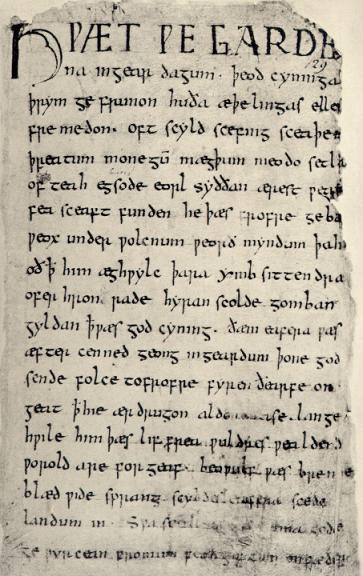
Beowulf Poem
From the 5th century CE, the Anglo-Saxons settled Britain as the Roman economy and administration collapsed. By the 7th century, the Germanic language of the Anglo-Saxons became dominant in Britain, replacing the languages of Roman Britain, a Celtic language, and Latin, brought to Britain by the Roman occupation. England and English (originally Ænglaland and Ænglisc) are named after the Angles.

Old English was divided into four dialects: the Anglian dialects (Mercian and Northumbrian) and the Saxon dialects, Kentish and West Saxon. Through the educational reforms of King Alfred in the 9th century and the influence of the kingdom of Wessex, the West Saxon dialect became the standard written variety.

The epic poem Beowulf is written in West Saxon, and the earliest English poem, Cædmon's Hymn, is written in Northumbrian. Modern English developed mainly from Mercian, but the Scots language developed from Northumbrian. A few short inscriptions from the early period of Old English were written using a runic script. By the 6th century, a Latin alphabet was adopted, written with half-uncial letterforms.

Old English is essentially a distinct language from Modern English and is virtually impossible for 21st-century unstudied English speakers to understand. Its grammar was similar to that of modern German, and its closest relative is Old Frisian.

More information: BBC

Nouns, adjectives, pronouns, and verbs had many more inflectional endings and forms, and word order was much freer than in Modern English. Modern English has case forms in pronouns (he, him, his) and has a few verb inflections (speak, speaks, speaking, spoke, spoken), but Old English had case endings in nouns as well, and verbs had more person and number endings.

From the 8th to the 12th century, Old English gradually transformed through language contact into Middle English. Middle English is often arbitrarily defined as beginning with the conquest of England by William the Conqueror in 1066, but it developed further in the period from 1200–1450.

The next period in the history of English was Early Modern English (1500–1700). Early Modern English was characterised by the Great Vowel Shift (1350–1700), inflectional simplification, and linguistic standardisation.

By the late 18th century, the British Empire had spread English through its colonies and geopolitical dominance. Commerce, science and technology, diplomacy, art, and formal education all contributed to English becoming the first truly global language. English also facilitated worldwide international communication.

More information: Mental Floss


Viewed freely, the English language is the accretion
and growth of every dialect, race, and range of time,
and is both the free and compacted composition of all.

Walt Whitman

Saturday, 21 September 2019

'THE HOBBIT' WRITTEN BY J. R. R. TOLKIEN IS PUBLISHED

The Hobbit by J. R. R. Tolkien
Today, The Grandma is at home. It is raining a lot in Barcelona. Perhaps the legend is true and the rain is a consequence of the tears of Santa Eulàlia (Saint Eulalia), the old an original patron of the city, who was changed by Mercè -the current one- some centuries ago. It is said that Santa Eulàlia cries a lot when Mercè festivity arrives because she is very sad seeing how Barcelona celebrates its festivity under the protection of another patron.

Santa Eulàlia (Aulaire, Aulazia, Olalla, Eulària) (c. 290–12 February 303), co-patron saint of Barcelona, was a 13-year-old Roman Christian virgin who suffered martyrdom in Barcelona during the persecution of Christians in the reign of emperor Diocletian, although the Sequence of Santa Eulàlia mentions the pagan king Maximian.
A dove is supposed to have flown forth from her neck following her decapitation.

Eulàlia is commemorated with statues and street names throughout Barcelona. Her body was originally interred in the church of Santa Maria de les Arenes, now Santa Maria del Mar. It was hidden in 713 during the Moorish invasion, and only recovered in 878. In 1339, it was relocated to an alabaster sarcophagus in the crypt of the newly built Cathedral of Santa Eulàlia. The festival of Santa Eulàlia is held in Barcelona for a week around her feast day on February 12.

The Grandma has decided to read about this interesting saint and about her legend because she loves myths and legends just the same day that it is celebrated the publication of one of her favourite novels -J. R. R. Tolkien's The Hobbit in 1937.

J. R. R. Tolkien was an English writer, poet, philologist, and academic, who is best known as the author of the classic high fantasy works The Hobbit, The Lord of the Rings, and The Silmarillion. He created a wonderful world of fantasy and legends that is appreciated generation after generation.

The Hobbit, or There and Back Again is a children's fantasy novel by English author J. R. R. Tolkien.

It was published on 21 September 1937 to wide critical acclaim, being nominated for the Carnegie Medal and awarded a prize from the New York Herald Tribune for best juvenile fiction. The book remains popular and is recognized as a classic in children's literature.

The Hobbit is set within Tolkien's fictional universe and follows the quest of home-loving Bilbo Baggins, the titular hobbit, to win a share of the treasure guarded by Smaug the dragon. Bilbo's journey takes him from light-hearted, rural surroundings into more sinister territory.

J. R. R. Tolkien
The story is told in the form of an episodic quest, and most chapters introduce aspecific creature or type of creature of Tolkien's geography. Bilbo gains a new level of maturity, competence, and wisdom by accepting the disreputable, romantic, fey, and adventurous sides of his nature and applying his wits and common sense.

The story reaches its climax in the Battle of Five Armies, where many of the characters and creatures from earlier chapters re-emerge to engage in conflict. Personal growth and forms of heroism are central themes of the story, along with motifs of warfare. These themes have led critics to view Tolkien's own experiences during World War I as instrumental in shaping the story.

The author's scholarly knowledge of Germanic philology and interest in mythology and fairy tales are often noted as influences.

The publisher was encouraged by the book's critical and financial success and, therefore, requested a sequel. As Tolkien's work progressed on the successor The Lord of the Rings, he made retrospective accommodations for it in The Hobbit. These few but significant changes were integrated into the second edition. Further editions followed with minor emendations, including those reflecting Tolkien's changing concept of the world into which Bilbo stumbled.

More information: The Tolkien Society

The work has never been out of print. Its ongoing legacy encompasses many adaptations for stage, screen, radio, board games, and video games. Several of these adaptations have received critical recognition on their own merits.

Bilbo Baggins, the titular protagonist, is a respectable, reserved hobbit. During his adventure, Bilbo often refers to the contents of his larder at home and wishes he had more food. Until he finds a magic ring, he is more baggage than help.

The Hobbit Illustration
Gandalf, an itinerant wizard, introduces Bilbo to a company of thirteen dwarves. During the journey the wizard disappears on side errands dimly hinted at, only to appear again at key moments in the story. Thorin Oakenshield, the proud, pompous head of the company of dwarves and heir to the destroyed dwarvish kingdom under the Lonely Mountain, makes many mistakes in his leadership, relying on Gandalf and Bilbo to get him out of trouble, but proves himself a mighty warrior. Smaug is a dragon who long ago pillaged the dwarvish kingdom of Thorin's grandfather and sleeps upon the vast treasure.

The plot involves a host of other characters of varying importance, such as the twelve other dwarves of the company; two types of elves: both puckish and more serious warrior types; Men; man-eating trolls; boulder-throwing giants; evil cave-dwelling goblins; forest-dwelling giant spiders who can speak; immense and heroic eagles who also speak; evil wolves, or Wargs, who are allied with the goblins; Elrond the sage; Gollum, a strange creature inhabiting an underground lake; Beorn, a man who can assume bear form; and Bard the Bowman, a grim but honourable archer of Lake-town.

More information: Tolkien Gateway

In the early 1930s Tolkien was pursuing an academic career at Oxford as Rawlinson and Bosworth Professor of Anglo-Saxon, with a fellowship at Pembroke College. Several of his poems had been published in magazines and small collections, including Goblin Feet and The Cat and the Fiddle: A Nursery Rhyme Undone and its Scandalous Secret Unlocked, a reworking of the nursery rhyme Hey Diddle Diddle.

His creative endeavours at this time also included letters from Father Christmas to his children -illustrated manuscripts that featured warring gnomes and goblins, and a helpful polar bear- alongside the creation of elven languages and an attendant mythology, including the Book of Lost Tales, which he had been creating since 1917. These works all saw posthumous publication.

In a 1955 letter to W. H. Auden, Tolkien recollects that he began work on The Hobbit one day early in the 1930s, when he was marking School Certificate papers. He found a blank page. Suddenly inspired, he wrote the words, In a hole in the ground there lived a hobbit.

The Hobbit Illustration
By late 1932 he had finished the story and then lent the manuscript to several friends, including C. S. Lewis and a student of Tolkien's named Elaine Griffiths.

In 1936, when Griffiths was visited in Oxford by Susan Dagnall, a staff member of the publisher George Allen & Unwin, she is reported to have either lent Dagnall the book or suggested she borrow it from Tolkien. In any event, Dagnall was impressed by it, and showed the book to Stanley Unwin, who then asked his 10-year-old son Rayner to review it. Rayner's favourable comments settled Allen & Unwin's decision to publish Tolkien's book.

The setting of The Hobbit, as described on its original dust jacket, is ancient time between the age of Faerie and the dominion of men in an unnamed fantasy world. The world is shown on the endpaper map as Western Lands westward and Wilderland as the east. Originally this world was self-contained, but as Tolkien began work on The Lord of the Rings, he decided these stories could fit into the legendarium he had been working on privately for decades. The Hobbit and The Lord of the Rings became the end of the Third Age of Middle Earth within Arda. Eventually those tales of the earlier periods became published as The Silmarillion and other posthumous works.

More information: TOR

Tolkien's portrayal of goblins in The Hobbit was particularly influenced by George MacDonald's The Princess and the Goblin. However, MacDonald influenced Tolkien more profoundly than just to shape individual characters and episodes; his works further helped Tolkien form his whole thinking on the role of fantasy within his Christian faith.

Tolkien scholar Mark T. Hooker has catalogued a lengthy series of parallels between The Hobbit and Jules Verne's Journey to the Center of the Earth. These include, among other things, a hidden runic message and a celestial alignment that direct the adventurers to the goals of their quests.

Tolkien's works show much influence from Norse mythology, reflecting his lifelong passion for those stories and his academic interest in Germanic philology.

The Hobbit is no exception to this; the work shows influences from northern European literature, myths and languages, especially from the Poetic Edda and the Prose Edda. Examples include the names of characters, such as Fili, Kili, Oin, Gloin, Bifur, Bofur, Bombur, Dori, Nori, Dwalin, Balin, Dain, Nain, Thorin Oakenshield and Gandalf (deriving from the Old Norse names Fíli, Kíli, Oin, Glói, Bivör, Bávörr, Bömburr, Dori, Nóri, Dvalinn, Bláin, Dain, Nain, Þorin Eikinskialdi and Gandálfr).

The Hobbit Illustration
But while their names are from Old Norse, the characters of the dwarves are more directly taken from fairy tales such as Snow White and Snow-White and Rose-Red as collected by the Brothers Grimm. The latter tale may also have influenced the character of Beorn.

Tolkien's use of descriptive names such as Misty Mountains and Bag End echoes the names used in Old Norse sagas. The names of the dwarf-friendly ravens, such as Roäc, are derived from Old Norse words for raven and rook, but their peaceful characters are unlike the typical carrion birds from Old Norse and Old English literature.

Tolkien is not simply skimming historical sources for effect: the juxtaposition of old and new styles of expression is seen by Shippey as one of the major themes explored in The Hobbit. Maps figure in both saga literature and The Hobbit. Several of the author's illustrations incorporate Anglo-Saxon runes, an English adaptation of the Germanic runic alphabets.

Themes from Old English literature, and specifically from Beowulf, shape the ancient world Bilbo stepped into. Tolkien, a scholar of Beowulf, counted the epic among his most valued sources for The Hobbit.

Another influence from Old English sources is the appearance of named blades of renown, adorned in runes. In using his elf-blade Bilbo finally takes his first independent heroic action. By his naming the blade Sting we see Bilbo's acceptance of the kinds of cultural and linguistic practices found in Beowulf, signifying his entrance into the ancient world in which he found himself.

This progression culminates in Bilbo stealing a cup from the dragon's hoard, rousing him to wrath -an incident directly mirroring Beowulf and an action entirely determined by traditional narrative patterns.

The Hobbit Illustration
The name of the wizard Radagast is widely recognized to be taken from the name of the Slavic deity Rodegast.

The representation of the dwarves in The Hobbit was influenced by his own selective reading of medieval texts regarding the Jewish people and their history


The dwarves' characteristics of being dispossessed of their ancient homeland at the Lonely Mountain, and living among other groups whilst retaining their own culture are all derived from the medieval image of Jews, whilst their warlike nature stems from accounts in the Hebrew Bible.

The Dwarvish calendar invented for The Hobbit reflects the Jewish calendar in beginning in late autumn. And although Tolkien denied allegory, the dwarves taking Bilbo out of his complacent existence has been seen as an eloquent metaphor for the impoverishment of Western society without Jews.

More information: The Guardian

The Hobbit takes cues from narrative models of children's literature, as shown by its omniscient narrator and characters that young children can relate to, such as the small, food-obsessed, and morally ambiguous Bilbo. The text emphasizes the relationship between time and narrative progress and it openly distinguishes safe from dangerous in its geography.

Tolkien's prose is unpretentious and straightforward, taking as given the existence of his imaginary world and describing its details in a matter-of-fact way, while often introducing the new and fantastic in an almost casual manner. This down-to-earth style, also found in later fantasy such as Richard Adams' Watership Down and Peter Beagle's The Last Unicorn, accepts readers into the fictional world, rather than cajoling or attempting to convince them of its reality. 

While The Hobbit is written in a simple, friendly language, each of its characters has a unique voice. The narrator, who occasionally interrupts the narrative flow with asides, a device common to both children's and Anglo-Saxon literature, has his own linguistic style separate from those of the main characters.

While The Hobbit has been adapted and elaborated upon in many ways, its sequel The Lord of the Rings is often claimed to be its greatest legacy.

More information: Los Angeles Times


The original 'Hobbit' was never intended to have a sequel 
-Bilbo 'remained very happy to the end of his days
and those were extraordinarily long': a sentence
I find an almost insuperable obstacle to a satisfactory link.

J. R. R. Tolkien