Showing posts with label beer. Show all posts

Tuesday, 12 October 2021

'OKTOBERFEST', BEER & CARNIVAL IN MUNICH (BAVARIA)

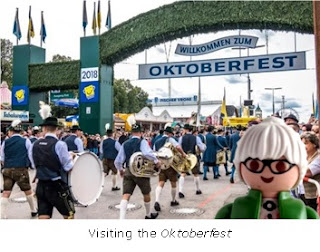
Today, The Grandma has been reading about the Oktoberfest, the beer festival first held in Munich, Bavaria, on a day like today in 1810.

The Grandma likes beer, and she loves participating in this wonderful festival.

The Oktoberfest is the world's largest Volksfest, beer festival and travelling funfair.

It is held annually in Munich, Bavaria, Germany. It is a 16- to 18-day folk festival running from mid- or late September to the first Sunday in October, with more than six million people from around the world attending the event every year. Locally, it is called d'Wiesn, after the colloquial name for the fairgrounds, Theresienwiese.

The Oktoberfest is an important part of Bavarian culture, having been held since the year 1810. Other cities across the world also hold Oktoberfest celebrations that are modelled after the original Munich event.

During the event, large quantities of Oktoberfest Beer are consumed. During the 16-day festival in 2013, for example, 7.7 million litres were served. Visitors also enjoy numerous attractions, such as amusement rides, side stalls, and games. There is also a wide variety of traditional foods available.

The Munich Oktoberfest originally took place in the 16-day period leading up to the first Sunday in October.

In 1994, this long-standing schedule was modified in response to German reunification. As such, if the first Sunday in October falls on the 1st or the 2nd, then the festival would run until 3 October (German Unity Day). Thus, the festival now runs for 17 days when the first Sunday is 2 October and 18 days when it is 1 October. In 2010, the festival lasted until the first Monday in October (4 October), to mark the event's bicentennial.

More information: Oktoberfest

Kronprinz Ludwig (1786–1868), later King Ludwig I, married Princess Therese of Saxe-Hildburghausen on 12 October 1810. The citizens of Munich were invited to attend the festivities held on the fields in front of the city gates to celebrate the royal event. The fields were named Theresienwiese, Theresa's Meadow, in honour of the Crown Princess, and have kept that name ever since, although the locals have abbreviated the name simply to Wiesn. Horse races, in the tradition of the 15th-century Scharlachrennen, Scarlet Race at Karlstor, were held on 18 October to honour the newly-weds.

It is widely believed that Andreas Michael Dall'Armi, a Major in the National Guard, proposed the idea. However, the origins of the horse races, and Oktoberfest itself, may have stemmed from proposals offered by Franz Baumgartner, a coachman and Sergeant in the National Guard. The precise origins of the festival and horse races remain a matter of controversy. However, the decision to repeat the horse races, spectacle, and celebrations in 1811 launched what is now the annual Oktoberfest tradition.

The fairground, once outside the city, was chosen due to its natural suitability. The Sendlinger Hill, today Theresienhohe, was used as a grandstand for 40,000 race spectators. The festival grounds remained undeveloped, except for the king's tent. The tastings of Traiteurs and other wine and beer took place above the visitors in the stands on the hill.

Before the race started, a performance was held in homage of the bridegroom and of the royal family in the form of a train of 16 pairs of children dressed in Wittelsbach costumes, and costumes from the nine Bavarian townships and other regions.
 
This was followed by the punishing race with 30 horses on a 3,400 meter-long racetrack, and concluded with the singing of a student choir. The first horse to cross the finish line belonged to Franz Baumgartner, one of the purported festival initiators. Horse racing champion and Minister of State Maximilian von Montgelas presented Baumgartner with his gold medal.

At the 100th anniversary of Oktoberfest in 1910, an estimated 120,000 litres of beer were consumed. Three years later, the Bräurosl was founded, which at that time was the largest pavilion to have ever been built, accommodating approximately 12,000 people.

Due to World War I, Oktoberfest was temporarily suspended from 1914 to 1918. The two years after the war, in 1919 and 1920, Oktoberfest was replaced by the so-called kleineres Herbstfest, which can be translated as smaller autumn celebration, and in 1923 and 1924 the Oktoberfest was cancelled due to hyperinflation.

During National Socialism, Oktoberfest was used as part of Nazi propaganda. In 1933, Jews were forbidden to work on the Wiesn. Two years later, Oktoberfest's 125th anniversary was celebrated with all the frills. The main event was a big parade.

The slogan proud city -cheerful country was meant to show the alleged overcoming of differences between social classes, and can be seen as an example of the regime's consolidation of power.

More information: Muenchen

In 1938, after Hitler had annexed Austria and won the Sudetenland via the Munich Agreement, Oktoberfest was renamed to Großdeutsches Volksfest, Greater German folk festival, and as a showing of strength, the Nazi regime transported people from Sudetenland to the Wiesn by the score.

During World War II, from 1939 to 1945, no Oktoberfest was celebrated. Following the war, from 1946 to 1948, Munich celebrated only the Autumn Fest. The sale of proper Oktoberfest beer -2% stronger in gravity than normal beer- was not permitted; guests could only drink normal beer.

Since its foundation, there have been 26 years in which it was declined.

Beginning in 1950, the festival has always been opened with the same traditional procedure: At noon, a 12-gun salute is followed by the tapping of the first keg of Oktoberfest beer by the Mayor of Munich with the proclamation O'zapft is!, It's tapped! in the Austro-Bavarian dialect.

To keep the Oktoberfest, and especially the beer tents, amicable for the elderly and families, the concept of the quiet Oktoberfest was developed in 2005. Until 6:00 pm, the orchestras in the tents only play brass music, for example traditional folk music. Only after that may Schlager pop or electric music be played, which had led to excessively raucous behaviour in earlier years. The music played in the afternoon is limited to 85 decibels. With these rules, the organizers of the Oktoberfest were able to curb the tumultuous party mentality and preserve the traditional beer-tent atmosphere.

The six main Munich breweries Augustiner, Hacker-Pschorr, Hofbräu, Löwenbräu, Paulaner and Spaten presented a special exclusively brewed dark beer, which was made after a historic recipe from the early 19th century.

More information: The Local

Durst wird durch Bier erst schön.

Thirst is only beautiful when accompanied by beer.

German Quote

Tuesday, 31 December 2019

ARTHUR GUINNESS, THE MOST FAMOUS IRISH BREWER

Arthur Guinness
Today, The Grandma is preparing New Year's Eve. She has invited her closest friends Claire Fontaine, Joseph de Ca'th Lon, Tonyi Tamaki, Jordi Santanyí and Tina Picotes to her home to say goodbye to 2019 and welcome 2020.

She has prepared a big dinner with local products and their favourite beer, Guinness. This Irish beer takes its name of its founder, Arthur Guinness, an Irish brewer, entrepreneur and philanthropist. On a day like today in 1759, Arthur Guinness signed a 9,000 year lease at £45 per annum and started brewing Guinness. It was the beginning of a successful business that has become in one of the most important beer trademarks around the world.

More information: Guinness

Arthur Guinness (24 September 1725-23 January 1803) was an Irish brewer and the founder of the Guinness brewery business and family. He was also an entrepreneur and philanthropist.

At 27, in 1752, Guinness's godfather Arthur Price, the Church of Ireland Archbishop of Cashel, bequeathed him £100 in his will. Guinness invested the money and in 1755 had a brewery at Leixlip, just 17 km from Dublin. In 1759, Guinness went to the city and set up his own business. He took a 9,000-year lease on the 16,000 m2 brewery at St. James's Gate from the descendants of Sir Mark Rainsford for an annual rent of £45.

Guinness's flowery red signature is still copied on every label of bottled Guinness.

Arthur Guinness's parents Richard and Elizabeth were both the children of Catholic tenant farmers in Dublin and Kildare. Richard's family were descendants of the McCartan Lords Of Kinelarty and Iveagh plus Gaelic Kings see McCartan family of County Down. Recent DNA evidence however suggests descent from the McCartans, another County Down clan, whose spiritual home of Kinelarty included the townland of Guiness near Ballynahinch, County Down.

Guinness's place and date of birth are the subject of speculation. His gravestone in Oughterard, County Kildare states clearly that he died on 23 January 1803, aged 78 years, indicating that he was born in 1724 or very early in 1725. There is no proof of the date of 28 September 1725 chosen by the Guinness company in 1991, apparently to end speculation about his birthdate. The place of birth was perhaps his mother's home at Read homestead at Ardclough, County Kildare. 

Guinness beer & brewery, St. James's Gate
In 2009 it was claimed he was born in nearby Celbridge where his parents lived in 1725 and where his father worked as an agent for the cleric Dr. Arthur Price, and may -or may not- have brewed ale for the household. In his will, Dr. Price left £100 each to his servant Arthur and his father in 1752. Starting his first brewery in Leixlip in 1755, Arthur then bought a long lease of an adjacent site from George Bryan of Philadelphia in the Province of Pennsylvania in 1756, that was developed as investment property.

In 1761 he married Olivia Whitmore in St. Mary's Church, Dublin, and they had 21 children, 10 of whom lived to adulthood. Olivia's father was William Whitmore, a grocer in Essex Street, Temple Bar, Dublin, and her mother was Mary Grattan from Drummin House, Carbury, County Kildare. Olivia also brought a dowry of £1,000.

From 1764 they lived at Beaumont House, which he had built on a 21 ha farm, which is now a part of Beaumont Convalescent Home, behind the main part of Beaumont Hospital, between Artane, Santry and Coolock in north County Dublin. His landlord was Charles Gardiner. The townland name of Kilmore was renamed by Arthur as Beaumont, meaning beautiful hill, and the later Beaumont parish copied the name.

From March 1798 he lived at Mountjoy Square in Dublin, which was then in the process of being built in the style of elegant Georgian architecture, where his landlord was Gardiner's son Luke. Three of his sons were also brewers, and his other descendants eventually included missionaries, politicians, and authors.

Guinness was a protestant Christian and pro-British Unionist. He died in Dublin and was buried in his mother's family plot at Oughterard, County Kildare in January 1803.

More information: Irish Central I & II

Guinness was a committed Unionist and strongly opposed Irish nationalism. Guinness supported Henry Grattan in the 1780s and 1790s, not least because Grattan wanted to reduce the tax on beer. He was one of the four brewers' guild representatives on Dublin Corporation from the 1760s until his death. Like Grattan, Guinness was publicly in favour of Catholic Emancipation from 1793, but he was not a supporter of the United Irishmen during the 1798 rebellion and was against Irish home-rule, leading to accusations he was spying for the British. In general, the Guinness family became Irish Unionists and Arthur Guinness accepted the system, with Arthur directly opposed to any movement toward Irish independence and wanting Ireland to remain under British control.

Guinness leased a brewery in Leixlip in 1755, brewing ale. Five years later he left his younger brother Richard in charge of that enterprise and moved on to another in St. James' Gate, Dublin, at the end of 1759.

The 9,000-year lease he signed for the brewery is presently displayed in the floor at St. James' Gate, effective from 31 December 1759.

By 1767 he was elected Master of the Dublin Corporation of Brewers. His first actual sales of porter were listed on tax (excise) data from 1778, and it seems that other Dublin brewers had experimented in brewing porter beer from the 1760s. From the 1780s his second son Arthur (1768–1855) worked at his side and eventually became the senior partner in the brewery from 1803. He commented on this in a letter of 1790:

...one of my sons is grown up to be able to assist me in this Business, or I wd not have attempted it, tho' prompted by a demand of providing for Ten Children now living out of one & twenty born to us, & more likely yet to come...

His major achievement was in expanding his brewery in 1797–99. Thereafter he brewed only porter and employed members of the Purser family, Moravians from Tewkesbury who had brewed porter in London until 1776. The Pursers became partners in the brewery for most of the 19th century.

By his death in 1803 the annual brewery output was over 20,000 barrels. Subsequently, Arthur and/or his beer was nicknamed Uncle Arthur in Dublin.

More information: Connolly Cove


I'm an early riser. I work out really hard.
I push myself; I get my job done, and at the end of the day,
there's a Guinness waiting for me.

Jason Momoa

Friday, 3 August 2018

BELGIAN BEER: UNESCO INTANGIBLE CULTURAL HERITAGE

Some Belgian beers
The Grandma is a great fan of beer. When she is in Barcelona, she likes enjoying beer in the Moritz Factory, in the centre of the city.

Today, she has decided to travel to Brussel, the capital of Belgium to drink some beer with Claire Fontaine who is spending her summer holidays in the Flemish city

Belgian beers are recognized as the best beers around the world and they have been named as Intangible Cultural Heritage of Humanity by UNESCO.

During the flight, The Grandma has studied a new lesson of her Intermediate  Language Practice manual.

More information: Making Comparisons I & II

Beer in Belgium varies from pale lager to amber ales, lambic beers, Flemish red ales, sour brown ales, strong ales and stouts. In 2016, there were approximately 224 active breweries in Belgium, including international companies, such as AB InBev, and traditional breweries including Trappist monasteries

On average, Belgians drink 84 litres of beer each year, down from around 200 each year in 1900. Most beers are bought or served in bottles, rather than cans, and almost every beer has its own branded, sometimes uniquely shaped, glass. 

The Belgian flag with beer
In 2016, UNESCO inscribed Belgian beer culture on their list of the intangible cultural heritage of humanity.

Brewing in Belgium dates back at least the 12th century. Under the Catholic Church's permission, local French and Flemish abbeys brewed and distributed beer as a fund raising method.

The relatively low-alcohol beer of that time was preferred as a sanitary option to available drinking water. What are now traditional, artisanal brewing methods evolved, under abbey supervision, in the next seven centuries.

More information: UNESCO

The Trappist monasteries that now brew beer in Belgium were occupied in the late 18th century primarily by monks fleeing the French Revolution. However, the first Trappist brewery in Belgium, Westmalle, did not start operation until 10 December 1836, almost fifty years after the Revolution. That beer was exclusively for the monks and is described as dark and sweet. The first recorded sale of beer, a brown beer, was on 1 June 1861.

In the 16th and 17th century, a beer termed crabbelaer was the most popular beer in Ghent; at the peak of its popularity, more than 50 different breweries produced more than 6 million liters a year. Other kinds of beer brewed in Ghent were klein bier, dubbel bier, clauwaert, dubbele clauwaert and dusselaer.


In Belgium, four types of fermentation methods are used for the brewing of beer, which is unique in the world.

Claire, The Grandma & the Manneken Pis, Brussel
However for good understanding of labels of Belgian beer and reference works about Belgian beer often use different terms for the fermentation methods based on archaic or traditional jargon:

-Spontaneous fermentation with beers that are unique in Europe, Lambic and the derived Faro, Gueuze and Kriek beers.

-Warm fermentation is referred to as Top or High Fermentation for Trappist beers, white beers, ale, most other special beers.

-Mixed fermentation for the type old-brown beers.

-Cool fermentation is referred to as low fermentation for Lager or Pils.

More information: UNESCO

Belgian beers have a range of colours, brewing methods, and alcohol levels. Beers brewed in Trappist monasteries are termed Trappist beers. For a beer to qualify for Trappist certification, the brewery must be in a monastery, the monks must play a role in its production and the policies and the profits from the sale must be used to support the monastery or social programs outside. Only eleven monasteries currently meet these qualifications, six of which are in Belgium, two in the Netherlands, one in Austria, one in the United States, and one in Italy

The Trappist certification
Trappist beer is a controlled term of origin: it tells where the beers come from, it is not the name of a beer style. Beyond saying they are mostly warm fermented, Trappist beers have very little in common stylistically.

The designation abbey beers, Bières d'Abbaye or Abdijbier, originally applied to any monastic or monastic-style beer. After introduction of an official Trappist beer designation by the International Trappist Association in 1997, it came to mean products similar in style or presentation to monastic beers.

In 1999, the Union of Belgian Brewers introduced a Certified Belgian Abbey Beer, Erkend Belgisch Abdijbier, logo to indicate beers brewed under license to an existing or abandoned abbey, as opposed to other abbey-branded beers which the trade markets using other implied religious connections, such as a local saint. 

The requirements for registration under the logo include the monastery having control over certain aspects of the commercial operation, and a proportion of profits going to the abbey or to its designated charities. 

More information: Belgian Smaak

Monastic orders other than the Trappists can be and are included in this arrangement. The Abbey beer logo and quality label is no longer used for beers given the name of a fictitious abbey, a vaguely monastic branding or a saint name without mentioning a specific monastery. Some brewers may produce abbey-style beers such as dubbel or tripel, using such names but will refrain from using the term Abbey beer in their branding.

What connoisseurs now recognize as Trappist breweries began operations in 1838. Several monasteries, however, maintained working breweries for 500+ years before the French regime disrupted religious life (1795–1799). Even then, some Abbey beers such as Affligem Abbey, whose name now appears on beers made by the Heineken-owned Affligem Brewery, resumed brewing from working monasteries until the occupation of most of Belgium in World War I

The Grandma and the most selected Belgian beers
Commercial Abbey beers first appeared during Belgium's World War I recovery.

Although Abbey beers do not conform to rigid brewing styles, most tend to include the most recognizable and distinctive Trappist styles of brune, Belgian brown ale, aka dubbel, strong pale ale or tripel, and blonde ale or blond

Modern abbey breweries range from microbreweries to international giants, but at least one beer writer warns against assuming that closeness of connection with a real monastery confirms a product's quality.

Belgian special beers, stronger or bottled beers, are often served in elaborate branded beer glassware. Unless the bar is out of the specific glass that goes with that beer it is more often than not served in its own glass. Most bartenders or waitresses will apologize if the beer comes in a different glass.

More information: Beer of Belgium

One of the more common types is the tulip glass. A tulip glass not only helps trap the aroma, but also aids in maintaining large heads, creating a visual and olfactory sensation. The body is bulbous, but the top flares out to form a lip which helps head retention.

A vessel similar to a champagne flute is the preferred serving vessel for Belgian lambics and fruit beers. The narrow shape helps maintain carbonation, while providing a strong aromatic front. Flute glasses display the lively carbonation, sparkling colour, and soft lacing of this distinct style.

Chalices and goblets are large, stemmed, bowl-shaped glasses mainly associated with Trappist and Abbey ales. The distinction between goblet and chalice is typically in the glass thickness. Goblets tend to be more delicate and thin, while the chalice is heavy and thick walled. Some chalices are even etched on the bottom to nucleate a stream of bubbles for maintaining a nice head.

In addition to the profusion of glasses provided by brewers, some Belgian beer cafés serve beer in their own house glassware. 

More information: Belgium Beer Tourism


He was a wise man who invented beer.

Unknown