Showing posts with label Germany. Show all posts

Tuesday, 12 October 2021

'OKTOBERFEST', BEER & CARNIVAL IN MUNICH (BAVARIA)

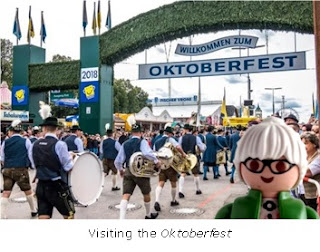
Today, The Grandma has been reading about the Oktoberfest, the beer festival first held in Munich, Bavaria, on a day like today in 1810.

The Grandma likes beer, and she loves participating in this wonderful festival.

The Oktoberfest is the world's largest Volksfest, beer festival and travelling funfair.

It is held annually in Munich, Bavaria, Germany. It is a 16- to 18-day folk festival running from mid- or late September to the first Sunday in October, with more than six million people from around the world attending the event every year. Locally, it is called d'Wiesn, after the colloquial name for the fairgrounds, Theresienwiese.

The Oktoberfest is an important part of Bavarian culture, having been held since the year 1810. Other cities across the world also hold Oktoberfest celebrations that are modelled after the original Munich event.

During the event, large quantities of Oktoberfest Beer are consumed. During the 16-day festival in 2013, for example, 7.7 million litres were served. Visitors also enjoy numerous attractions, such as amusement rides, side stalls, and games. There is also a wide variety of traditional foods available.

The Munich Oktoberfest originally took place in the 16-day period leading up to the first Sunday in October.

In 1994, this long-standing schedule was modified in response to German reunification. As such, if the first Sunday in October falls on the 1st or the 2nd, then the festival would run until 3 October (German Unity Day). Thus, the festival now runs for 17 days when the first Sunday is 2 October and 18 days when it is 1 October. In 2010, the festival lasted until the first Monday in October (4 October), to mark the event's bicentennial.

More information: Oktoberfest

Kronprinz Ludwig (1786–1868), later King Ludwig I, married Princess Therese of Saxe-Hildburghausen on 12 October 1810. The citizens of Munich were invited to attend the festivities held on the fields in front of the city gates to celebrate the royal event. The fields were named Theresienwiese, Theresa's Meadow, in honour of the Crown Princess, and have kept that name ever since, although the locals have abbreviated the name simply to Wiesn. Horse races, in the tradition of the 15th-century Scharlachrennen, Scarlet Race at Karlstor, were held on 18 October to honour the newly-weds.

It is widely believed that Andreas Michael Dall'Armi, a Major in the National Guard, proposed the idea. However, the origins of the horse races, and Oktoberfest itself, may have stemmed from proposals offered by Franz Baumgartner, a coachman and Sergeant in the National Guard. The precise origins of the festival and horse races remain a matter of controversy. However, the decision to repeat the horse races, spectacle, and celebrations in 1811 launched what is now the annual Oktoberfest tradition.

The fairground, once outside the city, was chosen due to its natural suitability. The Sendlinger Hill, today Theresienhohe, was used as a grandstand for 40,000 race spectators. The festival grounds remained undeveloped, except for the king's tent. The tastings of Traiteurs and other wine and beer took place above the visitors in the stands on the hill.

Before the race started, a performance was held in homage of the bridegroom and of the royal family in the form of a train of 16 pairs of children dressed in Wittelsbach costumes, and costumes from the nine Bavarian townships and other regions.
 
This was followed by the punishing race with 30 horses on a 3,400 meter-long racetrack, and concluded with the singing of a student choir. The first horse to cross the finish line belonged to Franz Baumgartner, one of the purported festival initiators. Horse racing champion and Minister of State Maximilian von Montgelas presented Baumgartner with his gold medal.

At the 100th anniversary of Oktoberfest in 1910, an estimated 120,000 litres of beer were consumed. Three years later, the Bräurosl was founded, which at that time was the largest pavilion to have ever been built, accommodating approximately 12,000 people.

Due to World War I, Oktoberfest was temporarily suspended from 1914 to 1918. The two years after the war, in 1919 and 1920, Oktoberfest was replaced by the so-called kleineres Herbstfest, which can be translated as smaller autumn celebration, and in 1923 and 1924 the Oktoberfest was cancelled due to hyperinflation.

During National Socialism, Oktoberfest was used as part of Nazi propaganda. In 1933, Jews were forbidden to work on the Wiesn. Two years later, Oktoberfest's 125th anniversary was celebrated with all the frills. The main event was a big parade.

The slogan proud city -cheerful country was meant to show the alleged overcoming of differences between social classes, and can be seen as an example of the regime's consolidation of power.

More information: Muenchen

In 1938, after Hitler had annexed Austria and won the Sudetenland via the Munich Agreement, Oktoberfest was renamed to Großdeutsches Volksfest, Greater German folk festival, and as a showing of strength, the Nazi regime transported people from Sudetenland to the Wiesn by the score.

During World War II, from 1939 to 1945, no Oktoberfest was celebrated. Following the war, from 1946 to 1948, Munich celebrated only the Autumn Fest. The sale of proper Oktoberfest beer -2% stronger in gravity than normal beer- was not permitted; guests could only drink normal beer.

Since its foundation, there have been 26 years in which it was declined.

Beginning in 1950, the festival has always been opened with the same traditional procedure: At noon, a 12-gun salute is followed by the tapping of the first keg of Oktoberfest beer by the Mayor of Munich with the proclamation O'zapft is!, It's tapped! in the Austro-Bavarian dialect.

To keep the Oktoberfest, and especially the beer tents, amicable for the elderly and families, the concept of the quiet Oktoberfest was developed in 2005. Until 6:00 pm, the orchestras in the tents only play brass music, for example traditional folk music. Only after that may Schlager pop or electric music be played, which had led to excessively raucous behaviour in earlier years. The music played in the afternoon is limited to 85 decibels. With these rules, the organizers of the Oktoberfest were able to curb the tumultuous party mentality and preserve the traditional beer-tent atmosphere.

The six main Munich breweries Augustiner, Hacker-Pschorr, Hofbräu, Löwenbräu, Paulaner and Spaten presented a special exclusively brewed dark beer, which was made after a historic recipe from the early 19th century.

More information: The Local

Durst wird durch Bier erst schön.

Thirst is only beautiful when accompanied by beer.

German Quote

Saturday, 14 August 2021

THE COLOGNE CATHEDRAL CONSTRUCTION IS COMPLETED

Today, The Grandma has received wonderful news from one of her closest friends, Tina Picotes, who has been visiting Germany during the last month. 

Tina loves Architecture, and they have been talking about the Cologne Cathedral, a wonderful UNESCO site and the most famous landmark in Cologne whose construction was completed on a day like today in 1880.

Cologne Cathedral, in German Kölner Dom, officially Hohe Domkirche Sankt Petrus, is a Catholic cathedral in Cologne, North Rhine-Westphalia, Germany.

It is the seat of the Archbishop of Cologne and of the administration of the Archdiocese of Cologne.

It is a renowned monument of German Catholicism and Gothic architecture and was declared a World Heritage Site in 1996.

It is Germany's most visited landmark, attracting an average of 20,000 people a day. At 157 m, the cathedral is currently the tallest twin-spired church in the world, the second-tallest church in Europe after Ulm Minster, and the third-tallest church in the world.

It is the largest Gothic church in Northern Europe and has the second-tallest spires. The towers for its two huge spires give the cathedral the largest façade of any church in the world. The choir has the largest height to width ratio, 3.6:1, of any medieval church.

More information: Kölner Dom

Construction of Cologne Cathedral began in 1248 but was halted in the years around 1560, unfinished. Work did not restart until the 1840s, and the edifice was completed to its original Medieval plan in 1880.

Cologne's medieval builders had planned a grand structure to house the reliquary of the Three Kings and fit its role as a place of worship for the Holy Roman Emperor.

Despite having been left incomplete during the medieval period, Cologne Cathedral eventually became unified as a masterpiece of exceptional intrinsic value and a powerful testimony to the strength and persistence of Christian belief in medieval and modern Europe. Only the telecommunications tower is higher than the Cathedral.

When construction began on the present Cologne Cathedral in 1248 with foundation stone, the site had already been occupied by several previous structures. The earliest may have been for grain storage and possibly was succeeded by a Roman temple built by Mercurius Augustus.

From the 4th century on, however, the site was occupied by Christian buildings, including a square edifice known as the oldest cathedral that was commissioned by Maternus, the first bishop of Cologne.

A free-standing baptistery dating back to the 7th century was located at the east end of the present cathedral, but was demolished in the 9th century to build the second cathedral.

During excavations of the present cathedral, graves were discovered in the location of the oldest portion of the building; including that of a boy that was richly adorned with grave goods and another of a woman, popularly thought to be Wisigard. Both graves are thought to be from the 6th century. Only ruins of the baptistery and the octagonal baptismal font remain today. The second church, called the Old Cathedral, was completed in 818. It was destroyed by fire on 30 April 1248, during demolition work to prepare for a new cathedral.

In 1164, the Archbishop of Cologne, Rainald of Dassel, acquired the relics of the Three Kings which the Holy Roman Emperor, Frederick Barbarossa, had taken from the Basilica of Sant'Eustorgio, Milan, Italy. The relics have great religious significance and drew pilgrims from all over Christendom. It was important to church officials that they be properly housed, and thus began a building program in the new style of Gothic architecture, based in particular on the French cathedral of Amiens.

The foundation stone was laid on 15 August 1248, by Archbishop Konrad von Hochstaden. The eastern arm was completed under the direction of Master Gerhard, was consecrated in 1322 and sealed off by a temporary wall, so it could be used as the work continued. Eighty-four misericords in the choir date from this building phase.

More information: Solo Sophie

In the mid 14th century, work on the west front commenced under Master Michael. This work ceased in 1473, leaving the south tower complete to the belfry level and crowned with a huge crane that remained in place as a landmark of the Cologne skyline for 400 years. Some work proceeded intermittently on the structure of the nave between the west front and the eastern arm, but during the 16th century this also stopped.

With the 19th century romantic enthusiasm for the Middle Ages, and spurred by the discovery of the original plan for the façade, it was decided, with the commitment of the Protestant Prussian Court, to complete the cathedral.

It was achieved by civic effort; the Central-Dombauverein, founded in 1842, raised two-thirds of the enormous costs, while the Prussian state supplied the remaining third. The state saw this as a way to improve its relations with the large number of Catholic subjects it had gained in 1815, but especially after 1871, it was regarded as a project to symbolize German nationhood.

Work resumed in 1842 to the original design of the surviving medieval plans and drawings, but utilizing more modern construction techniques, including iron roof girders. The nave was completed, and the towers were added. The bells were installed in the 1870s. The largest bell is St. Petersglocke.

The completion of Germany's largest cathedral was celebrated as a national event on 14 August 1880, 632 years after construction had begun. The celebration was attended by Emperor Wilhelm I.

With a height of 157.38 metres, it was the tallest building in the world for four years until the completion of the Washington Monument.

The cathedral suffered fourteen hits by aerial bombs during World War II. Badly damaged, it nevertheless remained standing in an otherwise completely flattened city. The twin spires were an easily recognizable navigational landmark for Allied aircraft bombing.

On 6 March 1945, an area west of the cathedral (Marzellenstrasse/Trankgasse) was the site of intense combat between American tanks of the 3rd Armored Division and a Panther Ausf. A of Panzer brigade 106 Feldherrnhalle. The Panther successfully knocked out a Sherman, killing three men, before it was destroyed by a T26E3 Pershing hours later. Footage of that battle survives. The destroyed Panther was later put on display at the base of the cathedral for the remainder of the war in Europe.

More information: Cologne Tourism

Repairs of the war damage were completed in 1956. An emergency repair to the base of the northwest tower, carried out in 1944 using poor-quality brick taken from a nearby ruined building, remained visible as a reminder of the war until 2005, when it was decided to restore the section to its original appearance.

Repair and maintenance work is constantly being carried out in one or another section of the building, which is rarely completely free of scaffolding, as wind, rain, and pollution slowly eat away at the stones.

The Dombauhütte, established to build the cathedral and keep it in repair, is said to employ the best stonemasons in the Rhineland. Half the costs of repair and maintenance are still borne by the Dombauverein.

In 1996, the cathedral was added to the UNESCO World Heritage List of culturally important sites.

In 2004, it was placed on the World Heritage in Danger list, as the only Western site in danger, due to plans to construct several high-rise buildings nearby, which would have visually impacted the site.

More information: UNESCO


A rock pile ceases to be a rock pile,
the moment a single man contemplates it,
bearing within him the image of a cathedral.

Antoine de Saint-Exupery

Friday, 28 May 2021

1937, VOLKSWAGEN (VW) IS FOUNDED IN GERMANY

Today, The Grandma has been reading about Volkswagen, the German motor vehicle manufacturer that was founded on a day like today in 1937.

Volkswagen, shortened to VW, is a German motor vehicle manufacturer founded in 1937 by the German Labour Front, known for the iconic Beetle and headquartered in Wolfsburg. It is the flagship brand of the Volkswagen Group, the largest carmaker by worldwide sales in 2016 and 2017.

The group's biggest market is in China, which delivers 40% of its sales and profits. Popular models of Volkswagen include Golf, Jetta, Passat, Atlas, and Tiguan. The German term Volk translates to people, thus Volkswagen translates to people's car.

Volkswagen was established in 1937 by the German Labour Front (Deutsche Arbeitsfront) in Berlin.

In the early 1930s, cars were a luxury -most Germans could afford nothing more elaborate than a motorcycle and only one German out of 50 owned a car.

Seeking a potential new market, some carmakers began independent people's car projects -the Mercedes 170H, BMW 3/15, Adler AutoBahn, Steyr 55, and Hanomag 1.3L, among others.

War changed production to military vehicles -the Type 82 Kübelwagen, utility vehicle, VW's most common wartime model, and the amphibious Schwimmwagen -manufactured for German forces.

The company owes its post-war existence largely to one man, wartime British Army officer Major Ivan Hirst, REME.

In April 1945, KdF-Stadt and its heavily bombed factory were captured by the Americans and subsequently handed over to the British, within whose occupation zones the town and factory fell.

From 1948, Volkswagen became an important element, symbolically and economically, of West German regeneration.

More information: Volkswagen

Heinrich Nordhoff (1899-1968), a former senior manager at Opel who had overseen civilian and military vehicle production in the 1930s and 1940s, was recruited to run the factory in 1948.

In 1949, Major Hirst left the company -now re-formed as a trust controlled by the West German government and government of the State of Lower Saxony.

The Beetle sedan or peoples' car Volkswagen is the Type 1. Apart from the introduction of the Volkswagen Type 2 commercial vehicle (van, pick-up, and camper), and the VW Karmann Ghia sports car, Nordhoff pursued the one-model policy until shortly before his death in 1968.

VW expanded its product line in 1961 with the introduction of four Type 3 models (Karmann Ghia, Notchback, Fastback, and Variant) based on the new Type 3 mechanical underpinnings. The name Squareback was used in the United States for the Variant.

While Volkswagen's range of cars soon became similar to that of other large European carmakers, the Golf has been the mainstay of the Volkswagen line-up since its introduction,  and the mechanical basis for several other cars of the company. There have been eight generations of the Volkswagen Golf, the first of which was produced from the summer of 1974 until the autumn of 1983.

In 1991, Volkswagen launched the third-generation Golf, which was European Car of the Year for 1992. The Golf Mk3 and Jetta Mk3 arrived in North America in 1993. The sedan version of the Golf was badged Vento in Europe but remained Jetta in the United States. The Scirocco and the later Corrado were both Golf-based coupés.

The sixth-generation VW Golf was launched in 2008, came runner-up to the Opel/Vauxhall Insignia in the 2009 European Car of the Year, and has spawned several cousins: VW Jetta, VW Scirocco, SEAT León, SEAT Toledo, Škoda Octavia and Audi A3 hatchback ranges, as well as a new mini-MPV, the SEAT Altea.

In 2017, Volkswagen announced plans to place a considerable focus on electric vehicles (EV), with a goal to, by 2025, launch at least 30 EV models, and have 20 to 25 percent of their total yearly sales volume (2-3 million) consist of EVs.

In September, Volkswagen CEO Matthias Müller stated that the company aimed to have electric versions of all of its vehicle models by 2030, at a cost of 20 billion euro, and 50 billion euro on acquisition of batteries.

In November 2020, Volkswagen announced that, trying to remain the world's largest carmaker in the green era, it has increased its investment in electric and self-driving cars to $86 billion over the next five years.

More information: VW


I love fast cars... and to go too fast in them.

Lara Flynn Boyle

Tuesday, 16 June 2020

CAN DÜNDAR, FREE JOURNALISM FROM GERMAN EXILE

Can Dündar
Today, The Grandma wants to talk about Can Dündar, the Turkish journalist, columnist and documentarian who lives in exile, in Germany, after Turkish government targeted him and wants to imprison him. Dündar is an example of free journalism fighting under the pressure of a dictatorship.

Can Dündar was born on a day like today in 1961 and The Grandma thinks that the best way to homage him is knowing his story and his work.

Can Dündar (born 16 June 1961) is a Turkish journalist, columnist and documentarian. Editor-in-chief of center-left Cumhuriyet newspaper until August 2016, he was arrested in November 2015 after his newspaper published footage showing the State Intelligence MİT sending weapons to Syrian Islamist fighters.

One of the best known figures in Turkish media, Dündar has written for several newspapers, produced many television programs for state-owned TRT and various private channels including CNN Türk and NTV, and published more than 20 books. Dündar is the recipient of the International Press Freedom Award by the Committee to Protect Journalists.

In 2016, Can Dündar, together with Erdem Gül, were awarded the Prize for the Freedom and Future of the Media, by the Leipzig Media Foundation, lead partner of the European Centre for Press and Media Freedom.

Since June 2016, he has lived in exile in Germany, with an arrest warrant against him in Turkey. Currently he is editor-in-chief of #ÖZGÜRÜZ, a web radio station run by the nonprofit newsroom CORRECTIV. He is also one of the 25 leading figures on the Information and Democracy Commission launched by Reporters Without Borders.

More information: DW

Dündar studied journalism at the Faculty of Political Science, Ankara University, and graduated in 1982. He continued his education at the London School of Journalism in 1986. He received his master's degree in 1988 and in 1996 earned his Ph.D. in political science from the Middle East Technical University, Ankara. Dündar's family is of paternal Circassian and maternal Albanian origin.

Dündar has contributed to various print publications, including Hürriyet (1983–1985), Nokta, Haftaya Bakış, Söz and Tempo. From October 1996 to June 1998 he moderated his own TV-Show 40 Dakika (Turkish) where he discussed current themes in Turkey. It got aired weekly on Show TV with Erbil Tuşalp and Celal Kazdağlı as the editors-in-chief. He wrote for Sabah from January 1999 to April 2000 and Milliyet from January 2000. On television, he has been involved in Yanki (1979–83) and 32. Gün (1989–95) among others, including Neden? (2009).


His work often traces Turkey’s evolution into a modern nation and provides historical and political detail regarding crucial events, debates, and conflicts. This includes profiles of historical and political figures such as Mustafa Kemal Atatürk, Ismet Inönü, Nazim Hikmet and Vehbi Koç. His screenplay for the 2008 film Mustafa depicted the founder of the Republic of Turkey as a regular man with fears, passions and human expectations, rather than a life-size hero.

Can Dündar
A longstanding columnist for Milliyet, Dündar was laid off in August 2013 for writing too sharply about the Gezi protests and the developments in Egypt, as the paper's owner Erdoğan Demirören put it.

Dündar recalled: It was said to me, ‘We do not wish to see stories that will displease the prime minister in this paper. Everything displeases them, and after they are displeased, they go after us’.

Subsequently, he turned to the center-left Cumhuriyet, and on 8 February 2015 became the newspaper's new editor-in-chief. In November, Cumhuriyet was awarded the 2015 Reporters Without Borders Prize for its independent and courageous journalism.

Shortly thereafter, Dündar and Cumhuriyet's Ankara bureau chief Erdem Gül were arrested on charges of being members of a terror organization, espionage and revealing confidential documents, facing sentences of up to life imprisonment.

The investigations had been launched in May, after the newspaper published photos depicting weapons transferred to Syria in trucks of the National Intelligence Organization, subject of the MİT trucks scandal.


More information: Vilaweb

In June 2015, Turkish President Erdoğan had publicly targeted Dündar, stating: The individual who reported this as an exclusive story will pay a heavy price for this. In prison, Dündar was denied colored pencils to draw with but made his own paint by pressing fruit in his cell, refusing the ban on color and smuggling his paintings out of prison because he wanted to prove that color can exist even in the darkest of places.

After 92 days in prison, Dündar and Gül were released on 26 February 2016 after the Supreme Court decided that their detention was an undue deprivation of liberty.

On 6 May 2016, there was an assassination attempt witnessed by multiple reporters in front of the Istanbul courthouse where Dündar had just been defending himself against charges of treason. The assailant was stopped by Dündar's wife and a member of parliament, Muharrem Erkek, before he could fire more than two shots. Dündar was unhurt, but another journalist suffered an injury in the leg. The assailant was taken into custody by plain-clothed police. On the same day, Dündar was sentenced to imprisonment for five years and 10 months for leaking secret information of the state.

Dündar moved to Germany in June 2016. In August 2016, he stepped down from his position of editor-in-chief in Cumhuriyet and announced that he would continue as a columnist in the newspaper. An arrest warrant in absentia was issued in Turkey for him on 31 October 2016.

He is married to Dilek Dündar, and the couple have one child. His father allegedly worked for the National Intelligence Organization. He lives in Berlin, Germany. He was attacked many times because of anti-government news by Turks living in Berlin.

More information: Global Freedom of Expression


 You can do everthing in Turkey but the price is very high.
You have to pay the price however.

Can Dündar

Friday, 29 May 2020

NICOLE SINGS 'EIN BIßCHEN FRIEDEN', GERMANY WINS

Nicole
Today, The Grandma has been talking with The Watsons about Nicole, the German singer who won the Eurovision Song Contest representing their country in 1982 singing Ein bißchen Frieden.

Germany has officially participated in every Eurovision Song Contest since its beginning in 1956, except in 1996 when its entry did not qualify past the audio-only pre‐selection round, and consequently was not seen in the broadcast final and does not count as one of Germany's 63 appearances. The final is broadcast in Germany on ARD flagship channel, Das Erste. Germany has won the contest twice, in 1982 and 2010.

Before talking about Dima Bilan, The Grandma has offered a new Cambridge Key English Test A2 Example to The Watsons.


Nicole Seibert, (born 25 October 1964, Saarbrücken, Germany) is a German singer. She won the Eurovision Song Contest 1982 with the song Ein bißchen Frieden, A Little Peace, which also reached the top of the UK Singles Chart.

Nicole represented West Germany at the Eurovision Song Contest 1982 where she performed the song Ein bißchen Frieden, with music by Ralph Siegel and lyrics by Bernd Meinunger and Paul Greedus.

The song won the contest and when she reprised the song after the end of the contest voting, she performed parts of the song in English, French, and Dutch along with the original German.

In 1983, she made the second place, behind the Hungarian band Neoton Família, at the World Popular Song Festival in Tokyo with the Ralph Siegel/Robert Jung song So viele Lieder sind in mir.

Nicole & Ein bißchen Frieden
Nicole was also the winner of the German Schlagerparade in 1991 with the song Ein leises Lied.

The full English version of the song A Little Peace went on to be the 500th number one single in the UK Singles Chart. Full versions in French, Dutch, Spanish, Danish, Slovene, Russian, Polish, and Hungarian with Neoton Família have also been recorded.

In October 2010, she released her album, 30 Jahre mit Leib und Seele, a best-of compilation album on her 30th anniversary.

In the BBC4 Programme Eurovision at 60 she described her emotions when she realised that Israel had awarded her the full 12 points for her song. She went on to say how much it meant to her, with our history, and was subsequently invited to Jerusalem to perform, in the midst of the conflict with Lebanon.

Ein bißchen Frieden is a song in German, written by prolific German Eurovision-writing duo Ralph Siegel and Bernd Meinunger for the Eurovision Song Contest 1982, held in Harrogate, United Kingdom.

It was performed by 17-year-old German high-school student Nicole, resulting in Germany's first win at the Eurovision Song Contest by a record margin of 61 points, setting a new record for the largest winning margin that lasted until the Eurovision Song Contest 1997. Nicole's single is still the only Eurovision entry to top the sales charts in every territory it was released in.

More information: Eurovision TV

Ein bißchen Frieden was the eighteenth and final song performed during the 1982 Eurovision Song Contest. At the close of voting, it had received 161 points, placing first in a field of 18.

The performance was unlike most other Eurovision entrants in that Nicole performed while seated on a stool, playing a white acoustic guitar and accompanied by a backing group which included a harpist. The gentle ballad describes a wish for world peace, with the lyrics sung in first person, and also describes the beauty of the natural world.

After winning the contest, Nicole performed the reprise in four different languages: German, English, French and Dutch. She decided on the spur of the moment to do this, to the bewilderment of her backing group. She later released recordings in five additional languages across Europe: Danish, Italian, Russian, and a German-English-Dutch combination and a German-English-Italian combination.

Nicole won Eurovision in 1982
It topped the charts in many countries, selling more than three million copies, and the English version was the last Eurovision winner to top the charts in the United Kingdom.

The English version also holds the honour of becoming the 500th British Number One.

The song was chosen in an internet poll conducted by the European Broadcasting Union in 2005 as one of the 14 most popular songs in the history of the Eurovision, and was one of the entrants in the Congratulations 50th anniversary concert in Copenhagen, Denmark, held in October 2005.

Although Nicole was not at the concert, it was re-enacted by dancers equipped with white guitars and a live orchestra as the original footage was shown in the background. Ein bißchen Frieden finished as the seventh most popular song in the history of the contest.

It was succeeded as German representative at the 1983 Contest by Hoffmann & Hoffmann with Rücksicht.

More information: ESC Today

In 1982 Ein bißchen Frieden was covered in Slovene, Croatian, Danish, Hungarian, Polish, and Finnish.

In 1996, the Swedish techno/folk/bluegrass band Rednex, known for their hit Cotton-Eye Joe around that time, did a cover of Ein bißchen Frieden, also played in the Eurovision Song Contest.

The song has since been rendered in English as A Little Peace recorded by Daniel O'Donnell for his 1997 album I Believe, and in Dutch as Een Beetje Vrede recorded by Kathleen Aerts for her 2009 album In Symfonie.

Monica Forsberg wrote lyrics in Swedish as En liten fågel, and the song became popular among dansband groups. It was recorded in Swedish by Stefan Borsch on his 1982 album En liten fågel as well as releasing it as a single the same year and Mats Bergmans on his 2004 album Vänd dig inte om. It was also recorded by Ingmar Nordströms on 1982 album Saxparty 9.

German techno-punk band DAF released Ein bißchen Krieg, A Bit Of War as a response to the supposed sentimentality of the song.

More information: Wiwi Blogs


Wie eine Blume am Winterbeginn
Und so wie ein Feuer im eisigen Wind
Wie eine Puppe, die keiner mehr mag
Fühl ich mich an manchem Tag
.

Just like a flower at the beginning of winter
And just like a fire in an icy wind
Just like a doll that nobody wants anymore
That's how I feel on some days.

Nicole

Thursday, 2 January 2020

THE DUQUESNE SPY RING, GERMAN ESPIONAGE IN THE US

Three of the 33 members of the Duquesne Spy Ring
Today, The Grandma has been watching TV at home. She has chosen an interesting film titled The House on Carroll Street directed by Peter Yates and with Kelly McGillis, Jeff Daniels and Mandy Patinkin.

After watching it, The Grandma has remembered a story very similar to the story explained in the movie. It is the story about The Duquesne Spy Ring, the largest espionage case in the United States history that ended in convictions by The Federal Bureau of Investigation (FBI) on a day like today in 1942.


The Duquesne Spy Ring is the largest espionage case in the United States history that ended in convictions.

A total of 33 members of a German espionage network headed by Frederick "Fritz" Joubert Duquesne were convicted after a lengthy investigation by the Federal Bureau of Investigation (FBI).

Of those indicted, 19 pleaded guilty. The remaining 14 were brought to jury trial in Federal District Court, Brooklyn, New York, on September 3, 1941; all were found guilty on December 13, 1941. On January 2, 1942, the group was sentenced to serve a total of over 300 years in prison.

The agents who formed the Duquesne Ring were placed in key jobs in the United States to get information that could be used in the event of war and to carry out acts of sabotage: one opened a restaurant and used his position to get information from his customers; another worked on an airline so that he could report Allied ships that were crossing the Atlantic Ocean; others worked as delivery people as a cover for carrying secret messages.

 More information: FBI I & II

William G. Sebold, who had been blackmailed into becoming a spy for Germany, became a double agent and helped the FBI gather evidence. For nearly two years, the FBI ran a shortwave radio station in New York for the ring. They learned what information Germany was sending its spies in the United States and controlled what was sent to Germany. Sebold's success as a counterespionage agent was demonstrated by the successful prosecution of the German agents.

Fritz Joubert Duquesne
One German spymaster later commented the ring's roundup delivered the death blow to their espionage efforts in the United States.

FBI director J. Edgar Hoover called his concerted FBI swoop on Duquesne's ring the greatest spy roundup in U.S. history. The 1945 film The House on 92nd Street was a thinly disguised version of the Duquesne Spy Ring saga of 1941. 

After the Duquesne Spy Ring convictions, Sebold was provided with a new identity and started a chicken farm in California. Impoverished and delusional, he was committed to Napa State Hospital in 1965. Diagnosed with manic-depression, he died there of a heart attack five years later at 70. His life story as a double agent was first told in the 1943 book Passport to Treason: The Inside Story of Spies in America by Alan Hynd.

Special Agent Jim Ellsworth was assigned as Sebold's handler or body man, responsible for shadowing his every move during the sixteen-month investigation.

William Gustav Friedemann was a principal witness in the Duquesne case. He began working for the FBI as a fingerprint analyst in 1935 and later became an agent after identifying a crucial fingerprint in a kidnapping case.

After World War II, he was assigned to Puerto Rico, where he pinpointed the group behind the assassination attempt on President Harry Truman. Friedemann died of cancer on August 23, 1989 in Stillwater, Oklahoma.

More information: All That's Interesting

Frederick "Fritz" Joubert Duquesne (21 September 1877-24 May 1956; sometimes Du Quesne) was a South African Boer and German soldier, big-game hunter, journalist, and a spy.

He fought on the side of the Boers in the Second Boer War and as a secret agent for Germany during both World Wars. He gathered human intelligence, led spy rings and carried out sabotage missions as a covert field asset in South Africa, Great Britain, Central and South America, and the United States. He went by many aliases, fictionalized his identity and background on multiple occasions, and operated as a conman.

As a Boer spy he was known as the Black Panther, in World War II he operated under the code name DUNN, and in FBI files he is frequently referred to as The Duke. He was captured, convicted, and escaped several prisons.

During the Second Boer War, from 1899 to 1902, Duquesne was captured and imprisoned three times by the British and once by the Portuguese, and each time he escaped. On one occasion he infiltrated the British army, became a British officer, and led an attempt to sabotage Cape Town and to assassinate the commander-in-chief Lord Kitchener, only his team was given up by an informant and all were captured and sentenced to death. After a failed attempt to escape prison in Cape Town, he was sent to prison in Bermuda, but he escaped to the United States and became an American citizen.

William G. Sebold
In World War I, he became a spy and ring leader for Germany and during this time he sabotaged British merchant ships in South America with concealed bombs and destroyed several. He sometimes purchased insurance on merchandise he shipped on the vessels he sabotaged and then filed claims for damages. He became known as the man who killed Kitchener since he claimed to have guided a German U-boat to sink HMS Hampshire on which Lord Kitchener was en route to Russia in 1916, although forensics of the ship do not support this claim.

After he was caught by federal agents in New York in 1917, he feigned paralysis for two years and cut the bars of his cell to make his escape, thereby avoiding deportation to England where he faced execution for the deaths of British sailors. In 1932, he was again captured in New York by federal agents and charged with both homicide and for being an escaped prisoner, only this time he was set free after Britain declined to pursue the wartime crimes.

The last time he was captured and imprisoned was in 1941 when he and 32 other members of the Duquesne Spy Ring were caught by William G. Sebold, a double agent with the FBI, and later convicted in the largest espionage conviction in the history of the United States.

Between wars, Duquesne served as an adviser on big game hunting to U.S. President Theodore Roosevelt, as a publicist in the movie business, as a journalist, as a fictional Australian war hero, and as head of the New Food Society in New York.

More information: Arcgis

During the Boer war he had been under orders to kill Frederick Russell Burnham, Chief of Scouts in the British Army, but in 1910 he worked with both Burnham and then Rep. Robert Broussard to lobby the U.S. Congress to fund the importation of hippopotamuses into the Louisiana bayous to solve a severe meat shortage. Duquesne often took on many identities, reinvented his past at will, attached his ancestry to aristocratic clans, granted himself military titles and medals, and spoke of many people, some fact and some fictional.

After meeting a German-American industrialist in the Midwest around 1914, Duquesne became a German spy. He was sent to Brazil as Frederick Fredericks under the disguise of doing scientific research on rubber plants. As an agent for Naval Intelligence in South America, he was assigned to disrupt commercial traffic to countries at war with Germany. Duquesne received and delivered communiques through German embassies, and he was responsible for numerous explosions on British merchant ships.

On 28 June 1941, following a two-year investigation, the FBI arrested Duquesne and 32 German spies on charges of relaying secret information on U.S. weaponry and shipping movements to Germany.

He was sentenced to 18 years in prison, with a 2-year concurrent sentence and $2,000 fine for violation of the Foreign Agents Registration Act. He began his sentence in Leavenworth Federal Penitentiary in Kansas, along with fellow German spy Hermann Lang.

In 1945, Duquesne was transferred to the Medical Center for Federal Prisoners in Springfield, Missouri, due to his failing physical and mental health. In 1954, he was released owing to ill health, having served 14 years.

Fritz Duquesne died at City Hospital on Welfare Island, now Roosevelt Island, in New York City on 24 May 1956 at the age of 78 years.

More information: Reprobate


There will always be spies.
We have to have them.

Gary Oldman

Saturday, 7 July 2018

HENRI NESTLÉ: GERMAN-SWISS SUCCESSFUL FOOD

Henri Nestlé
Today, The Grandma continues reviewing her  Intermediate Language Practice manual. Today, she has studied the past tenses with Chapters 4 and 5.

More information: Past Tenses
 
Today, she has remembered a Joseph de Ca'th Lon's story about Henri Nestlé, the founder of the international food company which is a referent in the world.

Joseph explained her the history of this enterprise and the biography of its creator, a person who also lived between two cities and two countries: Frankfurt in Germany and Glion in Switzerland.

Henri Nestlé, born Heinrich Nestle; August 10, 1814-July 7, 1890, was a German-born Swiss confectioner and the founder of Nestlé, the world's largest food and beverage company, as well as one of the main creators of condensed milk.

Heinrich Nestle was born on 10 August 1814, in Frankfurt am Main, Germany. He was the eleventh of fourteen children of Johann Ulrich Matthias Nestle and Anna-Maria Catharina Ehemant. Nestle's father, by tradition, inherited the business of his father, Johann Ulrich Nestle, and became a glazier in Töngesgasse. The later Lord Mayor of Frankfurt am Main, Gustav Edmund Nestle, was his brother.

Nestlé logo with a nest
The Nestle family has its roots in western Swabia, predominantly in boroughs of the Black Forest such as Dornstetten, Freudenstadt, Mindersbach, Nagold, and Sulz am Neckar. In the Swabian dialect, Nestle is a small bird's nest. The name Nestle also has different variations, including Nästlin, Nästlen, Nestlin, Nestlen, and Niestle.

The Nestle family tree began with three brothers, thus the three young birds in the nest being fed by their mother on the family coat of arms, from Mindersbach, called Hans, Heinrich, and Samuel Nestlin. The father of these three sons was born circa 1495. Hans, the eldest, was born in 1520 and had a son with the same name, who later became mayor of Nagold. His son Ulrich was a barber and his fifth son was the first glazier in the family. For over five generations, this profession was passed down from father to son. Additionally, the Nestles provided a number of mayors for the boroughs of Dornstetten, Freudenstadt, Nagold, and Sulz am Neckar.

More information: Henri Nestlé

Before Nestlé turned 22 in 1836, he completed a four-year apprenticeship with J. E. Stein, an owner of a pharmacy. At some stage between 1834 and 1839 he migrated for reasons unknown to Switzerland. At the end of 1839, he was officially authorized in Lausanne, Switzerland, to perform chemical experiments, make up prescriptions, and sell medicines. During this time, he changed his name to Henri Nestlé in order to adapt better to the new social conditions in French-speaking Vevey, Switzerland, where he eventually settled.

Nestlé commercial banner
In 1843, Nestlé bought into one of the region's most progressive and versatile industries at that time, the production of rapeseeds. 

He also became involved in the production of nut oils, used to fuel oil lamps, liqueurs, rum, absinthe, and vinegar

He also began manufacturing and selling carbonated mineral water and lemonade, although during the European food crisis in the 1840s, Nestlé gave up mineral water production. In 1857 he began concentrating on gas lighting and fertilizers.

More information: Nestlé's History

It is not known when Nestlé started working on the infant formula project, although by 1867 Nestlé had produced a viable powdered milk product. His interest is known to have been spurred by several factors.

Although Nestlé and his wife were childless, they were aware of the high death rate among infants. Nestlé would have been aware of Justus von Liebig's work in developing an infant formula. In addition, fresh milk was not always available in large towns and women in higher society were starting to view breast feeding as an unfashionable option.

Nestle's Food advertisement
Nestlé combined cow’s milk with grain and sugar to produce a substitute for breast milk. Moreover, he and his friend Jean Balthasar Schnetzler, a scientist in human nutrition, removed the acid and the starch in wheat flour because they were difficult for babies to digest. 

Initially called kindermehl, children flour, his product had an advantage over Liebig's soup for infants in that it was much easier to prepare, only needing to be boiled prior to feeding, and it soon proved to be a viable option for infants who were unable to breast feed. 

People quickly recognized the value of the new product and soon Farine Lactée Henri Nestlé, Henri Nestlé's Milk Flour in French, was being sold in much of Europe. By the 1870s, Nestlé's Infant Food, made with malt, cow's milk, sugar, and wheat flour, was selling in the US for $0.50 a bottle. 

Nestlé and Anna Clémentine Thérèse Ehemant were married in Frankfurt, Germany on 23 May 1860.

Nestlé sold his company in 1875 to his business associates and then lived with his family alternately in Montreux and Glion, where they helped people with small loans and publicly contributed towards improving the local infrastructure. In Glion he moved into a house later known as Villa Nestlé.

Nestlé died of a heart attack in Glion on July 7, 1890. He was buried at Territet Cemetery in Montreux.

More information: Nestlé Global


 My infant cereal has a tremendous future 
because there is no food to compare with it.

Henri Nestlé