Showing posts with label Munich. Show all posts

Friday, 14 June 2024

THE CITY OF MÜNCHEN IS FOUNDED BY HENRY THE LION

Today, The Grandma has been reading about München, the Bavarian city that was founded by Henry the Lion on a day like today in 1158.

Munich, in German München, is the capital and most populous city of the Free State of Bavaria, Germany.

With a population of 1,589,706 inhabitants as of 29 February 2024, it is the third-largest city in Germany, after Berlin and Hamburg, and thus the largest which does not constitute its own state, as well as the 11th-largest city in the European Union. The city's metropolitan region is home to about 6.2 million people and the third largest metropolitan region by GDP in the European Union.

Straddling the banks of the river Isar north of the Alps, Munich is the seat of the Bavarian administrative region of Upper Bavaria, while being the most densely populated municipality in Germany with 4,500 people per km2. Munich is the second-largest city in the Bavarian dialect area, after the Austrian capital of Vienna.

The city was first mentioned in 1158. Catholic Munich strongly resisted the Reformation and was a political point of divergence during the resulting Thirty Years' War, but remained physically untouched despite an occupation by the Protestant Swedes. Once Bavaria was established as the Kingdom of Bavaria in 1806, Munich became a major European centre of arts, architecture, culture and science.

In 1918, during the German Revolution of 1918-19, the ruling House of Wittelsbach, which had governed Bavaria since 1180, was forced to abdicate in Munich and a short-lived Bavarian Soviet Republic was declared. 

In the 1920s, Munich became home to several political factions, among them the Nazi Party. After the Nazis' rise to power, Munich was declared their Capital of the Movement. The city was heavily bombed during World War II, but has restored most of its old town and boasts nearly 30.000 buildings from before the war all over the city.

After the end of postwar American occupation in 1949, there was a great increase in population and economic power during the years of Wirtschaftswunder. The city hosted the 1972 Summer Olympics.

Today, Munich is a global centre of science, technology, finance, innovation, business, and tourism

Munich enjoys a very high standard and quality of living, reaching first in Germany and third worldwide according to the 2018 Mercer survey, and being rated the world's most liveable city by the Monocle's Quality of Life Survey 2018. Munich is consistently ranked as one of the most expensive cities in Germany in terms of real estate prices and rental costs.

In 2021, 28.8 percent of Munich's residents were foreigners, and another 17.7 percent were German citizens with a migration background from a foreign country. 

Munich's economy is based on high tech, automobiles, and the service sector, as well as IT, biotechnology, engineering, and electronics. It has one of the strongest economies of any German city and the lowest unemployment rate of all cities in Germany with more than one million inhabitants. The city houses many multinational companies, such as BMW, Siemens, Allianz SE and Munich Re. In addition, Munich is home to two research universities, and a multitude of scientific institutions.

Munich's numerous architectural and cultural attractions, sports events, exhibitions and its annual Oktoberfest, the world's largest Volksfest, attract considerable tourism.

More information: Big Boy Travel

Munich was a tiny 8th-century friar settlement, which was named zu den Munichen (to the monks). The Old High German Muniche served as the basis for the modern German city name München.

The river Isar was a prehistoric trade route and in the Bronze Age Munich was among the largest raft ports in Europe. Bronze Age settlements up to four millennia old have been discovered. Evidence of Celtic settlements from the Iron Age have been discovered in areas around Ramersdorf-Perlach.

The first medieval bridges across the river Isar were located in current city areas of Munich and Landshut. The Duke of Saxony and Bavaria Henry the Lion founded the town of Munich in his territory to control the salt trade, after having burned down the town of Föhring and its bridges over the Isar. Historians date this event at about 1158. The layout of Munich city, with five city gates and market place, resembled that of Höxter.

Henry built a new toll bridge, customs house and a coin market closer to his home somewhat upstream at a settlement around the area of modern old town Munich. This new toll bridge most likely crossed the Isar where the Museuminsel and the modern Ludwigsbrücke is now located.

More information: Germany Travel

Henry the Lion, in German Heinrich der Löwe, 1129/1131-6 August 1195, also known as Henry III, Duke of Saxony (ruled 1142-1180) and Henry XII, Duke of Bavaria (ruled 1156-1180), was a member of the Welf dynasty.

Henry was one of the most powerful German princes of his time, until the rival Hohenstaufen dynasty succeeded in isolating him and eventually deprived him of his duchies of Bavaria and Saxony during the reign of Emperor Frederick Barbarossa and of Frederick's son and successor Henry VI.

At the height of his reign, Henry ruled over a vast territory stretching from the coast of the North and Baltic seas to the Alps, and from Westphalia to Pomerania. Henry achieved this great power in part by his political and military acumen and in part through the legacies of his four grandparents.

More information: Warfare History


 Kandinsky in Munich uttered the well known words:
'Everything is permitted!'
In 1961; we still live by this heritage,
which in truth is inexhaustible.

Michel Seuphor

Tuesday, 12 October 2021

'OKTOBERFEST', BEER & CARNIVAL IN MUNICH (BAVARIA)

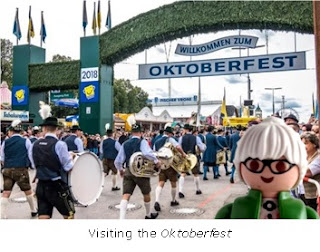
Today, The Grandma has been reading about the Oktoberfest, the beer festival first held in Munich, Bavaria, on a day like today in 1810.

The Grandma likes beer, and she loves participating in this wonderful festival.

The Oktoberfest is the world's largest Volksfest, beer festival and travelling funfair.

It is held annually in Munich, Bavaria, Germany. It is a 16- to 18-day folk festival running from mid- or late September to the first Sunday in October, with more than six million people from around the world attending the event every year. Locally, it is called d'Wiesn, after the colloquial name for the fairgrounds, Theresienwiese.

The Oktoberfest is an important part of Bavarian culture, having been held since the year 1810. Other cities across the world also hold Oktoberfest celebrations that are modelled after the original Munich event.

During the event, large quantities of Oktoberfest Beer are consumed. During the 16-day festival in 2013, for example, 7.7 million litres were served. Visitors also enjoy numerous attractions, such as amusement rides, side stalls, and games. There is also a wide variety of traditional foods available.

The Munich Oktoberfest originally took place in the 16-day period leading up to the first Sunday in October.

In 1994, this long-standing schedule was modified in response to German reunification. As such, if the first Sunday in October falls on the 1st or the 2nd, then the festival would run until 3 October (German Unity Day). Thus, the festival now runs for 17 days when the first Sunday is 2 October and 18 days when it is 1 October. In 2010, the festival lasted until the first Monday in October (4 October), to mark the event's bicentennial.

More information: Oktoberfest

Kronprinz Ludwig (1786–1868), later King Ludwig I, married Princess Therese of Saxe-Hildburghausen on 12 October 1810. The citizens of Munich were invited to attend the festivities held on the fields in front of the city gates to celebrate the royal event. The fields were named Theresienwiese, Theresa's Meadow, in honour of the Crown Princess, and have kept that name ever since, although the locals have abbreviated the name simply to Wiesn. Horse races, in the tradition of the 15th-century Scharlachrennen, Scarlet Race at Karlstor, were held on 18 October to honour the newly-weds.

It is widely believed that Andreas Michael Dall'Armi, a Major in the National Guard, proposed the idea. However, the origins of the horse races, and Oktoberfest itself, may have stemmed from proposals offered by Franz Baumgartner, a coachman and Sergeant in the National Guard. The precise origins of the festival and horse races remain a matter of controversy. However, the decision to repeat the horse races, spectacle, and celebrations in 1811 launched what is now the annual Oktoberfest tradition.

The fairground, once outside the city, was chosen due to its natural suitability. The Sendlinger Hill, today Theresienhohe, was used as a grandstand for 40,000 race spectators. The festival grounds remained undeveloped, except for the king's tent. The tastings of Traiteurs and other wine and beer took place above the visitors in the stands on the hill.

Before the race started, a performance was held in homage of the bridegroom and of the royal family in the form of a train of 16 pairs of children dressed in Wittelsbach costumes, and costumes from the nine Bavarian townships and other regions.
 
This was followed by the punishing race with 30 horses on a 3,400 meter-long racetrack, and concluded with the singing of a student choir. The first horse to cross the finish line belonged to Franz Baumgartner, one of the purported festival initiators. Horse racing champion and Minister of State Maximilian von Montgelas presented Baumgartner with his gold medal.

At the 100th anniversary of Oktoberfest in 1910, an estimated 120,000 litres of beer were consumed. Three years later, the Bräurosl was founded, which at that time was the largest pavilion to have ever been built, accommodating approximately 12,000 people.

Due to World War I, Oktoberfest was temporarily suspended from 1914 to 1918. The two years after the war, in 1919 and 1920, Oktoberfest was replaced by the so-called kleineres Herbstfest, which can be translated as smaller autumn celebration, and in 1923 and 1924 the Oktoberfest was cancelled due to hyperinflation.

During National Socialism, Oktoberfest was used as part of Nazi propaganda. In 1933, Jews were forbidden to work on the Wiesn. Two years later, Oktoberfest's 125th anniversary was celebrated with all the frills. The main event was a big parade.

The slogan proud city -cheerful country was meant to show the alleged overcoming of differences between social classes, and can be seen as an example of the regime's consolidation of power.

More information: Muenchen

In 1938, after Hitler had annexed Austria and won the Sudetenland via the Munich Agreement, Oktoberfest was renamed to Großdeutsches Volksfest, Greater German folk festival, and as a showing of strength, the Nazi regime transported people from Sudetenland to the Wiesn by the score.

During World War II, from 1939 to 1945, no Oktoberfest was celebrated. Following the war, from 1946 to 1948, Munich celebrated only the Autumn Fest. The sale of proper Oktoberfest beer -2% stronger in gravity than normal beer- was not permitted; guests could only drink normal beer.

Since its foundation, there have been 26 years in which it was declined.

Beginning in 1950, the festival has always been opened with the same traditional procedure: At noon, a 12-gun salute is followed by the tapping of the first keg of Oktoberfest beer by the Mayor of Munich with the proclamation O'zapft is!, It's tapped! in the Austro-Bavarian dialect.

To keep the Oktoberfest, and especially the beer tents, amicable for the elderly and families, the concept of the quiet Oktoberfest was developed in 2005. Until 6:00 pm, the orchestras in the tents only play brass music, for example traditional folk music. Only after that may Schlager pop or electric music be played, which had led to excessively raucous behaviour in earlier years. The music played in the afternoon is limited to 85 decibels. With these rules, the organizers of the Oktoberfest were able to curb the tumultuous party mentality and preserve the traditional beer-tent atmosphere.

The six main Munich breweries Augustiner, Hacker-Pschorr, Hofbräu, Löwenbräu, Paulaner and Spaten presented a special exclusively brewed dark beer, which was made after a historic recipe from the early 19th century.

More information: The Local

Durst wird durch Bier erst schön.

Thirst is only beautiful when accompanied by beer.

German Quote

Tuesday, 4 October 2016

POIROT & THE GRANDMA ON THE ORIENT EXPRESS

Poster of The Orient Express
Autumn is here and The Grandma has decided to go on holiday. As you know, she doesn't like crowds and this is the main reason because of she prefers travelling in this season.

She wants to stay some months travelling around Europe and Asia and she has chosen The Orient Express, the famous train. 

First of all, The Grandma has arrived to Milan where she's going to take this historic train accompanied by an old friend Hercule Poirot, a Belgian detective.

Let's go to join them in this unforgettable experience...

The Orient Express was the name of a long-distance passenger train service created in 1883 by Compagnie Internationale des Wagons-Lits (CIWL).

The original route, which first ran on October 4, 1883, was from Paris, Gare de l'Est, to Giurgiu in Romania via Munich and Vienna. At Giurgiu, passengers were ferried across the Danube to Ruse, Bulgaria, to pick up another train to Varna. They then completed their journey to Constantinople by ferry.

The route and rolling stock of The Orient Express changed many times. Several routes in the past concurrently used The Orient Express name, or slight variants thereof. Although the original Orient Express was simply a normal international railway service, the name has become synonymous with intrigue and luxury travel. The two city names most prominently associated with the Orient Express are Paris and Constantinople (Istanbul), the original endpoints of the timetabled service.


The Orient Express was a showcase of luxury and comfort at a time when travelling was still rough and dangerous. CIWL soon developed a dense network of luxury trains all over Europe, whose names are still remembered today and associated with the art of luxury travel – The Blue Train, The Golden Arrow, North Express and many more.
Schedule of The Orient Express

In 1977, The Orient Express stopped serving Istanbul. Its immediate successor, a through overnight service from Paris to Vienna, ran for the last time from Paris on Friday, June 8, 2007.

After this, the route, still called The Orient Express, was shortened to start from Strasbourg instead, occasioned by the inauguration of the LGV Est which affords much shorter travel times from Paris to Strasbourg. The new curtailed service left Strasbourg at 22:20 daily, shortly after the arrival of a TGV from Paris, and was attached at Karlsruhe to the overnight sleeper service from Amsterdam to Vienna.

On 14 December 2009, The Orient Express ceased to operate and the route disappeared from European railway timetables, reportedly a victim of high-speed trains and cut-rate airlines. The Venice-Simplon Orient Express train, a private venture by Orient-Express Hotels Ltd. using original CIWL carriages from the 1920s and 1930s, continues to run from London to Venice and to other destinations in Europe, including the original route from Paris to Istanbul.

In March 2014 Orient-Express Hotels Ltd. was renamed Belmond.


Who knows who will be on board? 
A couple of spies, for sure.  
At least one grand duke; 
a few beautiful woman, 
no doubt very rich and very troubled. 
Anything can happen and usually does 
on the Orient Express.
 
Morley Safer