Today, The Grandma has read about LouisVuitton, the French fashion designer, who was born on a day like today in 1821, and whose brand has become one of the most important presently.
Louis Vuitton (4 August 1821-27 February 1892) was a Frenchfashion designer and businessman.
He was the founder of the Louis Vuittonbrand of leather goods now owned by LVMH.Prior to this, he had been appointed as trunk-maker to Empress Eugénie de Montijo, wife of Napoleon III.
Vuitton was born to a family of artisans, carpenters, and farmers. At the age of 10, his mother, a hat-maker, died, and his father followed soon after. Following a difficult relationship with his adoptive stepmother, Vuitton left his home in Anchay in the spring of 1835, at the age of 13.
Taking odd jobs along the way, Vuitton travelled approximately 470 km to Paris. Arriving in 1837, in the midst of the Industrial Revolution, he apprenticed under Monsieur Marechal, a successful boot maker and packer. Within a few years, Vuitton gained a reputation amongst Paris' more fashionable class as one of the city's premier practitioners of the craft.
After the re-establishment of the French Empire under Napoleon III, Vuitton was hired as a personal boot maker and packer for the Empress of France. She charged him with packing the most beautiful clothes in an exquisite way. This provided Vuitton with a gateway to other elite and royal clients, who provided him with work for the rest of his career.
In 1854, at age 33, Vuitton married 17-year-old Clemence-Emilie Parriaux. Soon after, he left Marechal's shop and opened his own boot making and packing workshop in Paris. Outside his shop hung a sign that read: Securely packs the most fragile objects. Specializing in packing fashions.
In 1858, inspired by H.J. Cave & Sons of London, Vuitton introduced his revolutionary rectangular canvas boots at a time when the market had only rounded-top leather boots. The demand for Vuitton's durable, lightweight designs spurred his expansion into a larger workshop in Asnières-sur-Seine. The original pattern of the shellac embedded canvas was named Damier.
Vuitton also designed the world's first pick-proof lock. All lock patterns were safely kept at Vuitton's workrooms and registered with the owner's name in case another key was needed.
In 1871, as a result of the Franco-Prussian War, demand fell sharply, and Vuitton's workshop was in shambles. Many of his tools were stolen, and his staff were gone.
Vuitton rebuilt immediately, erecting a new shop at 1 Rue Scribe, next to a prestigious jockey club in the heart of Paris.
In 1872, Vuitton introduced a new line, featuring beige monogrammed designs with a red stripe, that would remain a signature of his brand long after his death in 1892.
Today, The Grandma is relaxing at home. She has decided to read a little about Pierre de Coubertin,the French educator and historian, founder of the International Olympic Committee and father ofthe modern Olympic Games.
Barcelona had the honour of being an Olympic City in 1992 and The Grandma wants to talk about the figure of a man who changed the idea of collective sport, a man who was died on a day like today in 1937 and whose legacy is still a great example of success.
Charles Pierre de Frédy, Baron de Coubertin (1 January 1863-2 September 1937, also known as Pierre de Coubertin and Baron de Coubertin) wasa French educator and historian, founder of theInternational Olympic Committee, and its secondpresident. He is known as the father of the modern Olympic Games.
Born into a French aristocratic family, he became an academic and studied a broad range of topics, most notably education and history. He graduated with a degree in law and public affairs from the Paris Institute of Political Studies. It was at Sciences Po that he came up with the idea of the Summer OlympicGames.
The Pierre de Coubertin medal, also known as the Coubertin medal or theTrue Spirit of Sportsmanship medal, is an award given by the International Olympic Committee to athletes who demonstrate the spirit of sportsmanship in the Olympic Games.
Pierre de Frédy was born in Paris on 1 January 1863, into an aristocratic family. He was the fourth child of Baron Charles Louis de Frédy, Baron de Coubertin and Marie–Marcelle Gigault de Crisenoy. Family tradition held that the Frédy name had first arrived in France in the early 15th century, and the first recorded title of nobility granted to the family was given by Louis XI to an ancestor, also named Pierre de Frédy, in 1477. But other branches of his family tree delved even further into French history, and the annals of both sides of his family included nobles of various stations, military leaders and associates of kings and princes of France.
The subject which he seems to have been most deeply interested in was education, and his study focused in particular on physical education and the role of sport in schooling.
In 1883, he visited England for the first time, and studied the program ofphysical education instituted under Thomas Arnold at the Rugby School. Coubertin credited these methods with leading to the expansion of British power during the 19th century and advocated their use in French institutions. The inclusion of physical education in the curriculum of French schools would become an ongoing pursuit and passion of Coubertin's.
Pierre de Coubertin
Coubertin is thought to have exaggerated the importance of sport to ThomasArnold, whom he viewed as one of the founders of athleticchivalry. The character-reforming influence of sport with which Coubertin was so impressed is more likely to have originated in the novel Tom Brown's School Days rather than exclusively in the ideas of Arnold himself.
Nonetheless, Coubertin was an enthusiast in need of a cause and he found it in England and in Thomas Arnold. Thomas Arnold, the leaderand classic model of English educators, wrote Coubertin, gavethe precise formula for the role of athletics in education. The cause was quicklywon. Playing fields sprang up all over England.
Intrigued by what he had read about English public schools, in 1883, at the age of twenty, Frédy went to Rugby and to other English schools to see for himself. He described the results in a book, L'Education enAngleterre, which was published in Paris in 1888. This hero of his book is Thomas Arnold, and on his second visit in 1886, Coubertin reflected on Arnold's influence in the chapel at Rugby School.
What Coubertin saw on the playing fields of Rugby and the other English schools he visited was how organised sport can create moral and social strength. Not only did organised games help to set the mind and body in equilibrium, it also prevented the time being wasted in other ways. First developed by the ancient Greeks, it was an approach to education that he felt the rest of the world had forgotten and to whose revival he was to dedicate the rest of his life.
As a historian and a thinker on education, Coubertin romanticised ancient Greece. Thus, when he began to develop his theory of physical education, he naturally looked to the example set by the Athenian idea of the gymnasium, a training facility that simultaneously encouraged physical and intellectual development. He saw in these gymnasia what he called a triple unity between old and young, between disciplines, and between different types of people, meaning between those whose work was theoretical and those whose work was practical. Coubertin advocated for these concepts, this triple unity, to be incorporated into schools.
But while Coubertin was certainly a romantic, and while his idealised vision of ancient Greece would lead him later to the idea of reviving the OlympicGames,his advocacy for physical education was based on practical concerns as well. He believed that men who received physical education would be better prepared to fight in wars, and better able to win conflicts like the Franco-Prussian War, in which France had been humiliated. He also saw sport as democratic, in that sports competition crossed class lines, although it did so without causing a mingling of classes, which he did not support.
Unfortunately for Coubertin, his efforts to incorporate more physical education into French schools failed. The failure of this endeavour, however, was closely followed by the development of a new idea, the revival of the ancientOlympic Games, the creation of a festival of international athleticism.
He was the referee of the first ever French championship rugby union final on 20 March 1892, between Racing Club de France and Stade Français.
Pierre de Coubertin
Coubertin is the instigator of the modern Olympic movement, a man whose vision and political skill led to the revival of the OlympicGames which had been practised in antiquity.
Coubertin idealized the OlympicGames as the ultimate ancientathleticcompetition.
Thomas Arnold, the Head Master of Rugby School, was an important influence on Coubertin's thoughts about education, but his meetings with William Penny Brookes also influenced his thinking about athletic competition to some extent. A trained physician, Brookes believed that the best way to prevent illness was through physical exercise. In 1850, he had initiated a local athletic competition that he referred to as Meetings of the Olympian Class at the Gaskell recreation ground at Much Wenlock, Shropshire.
Along with the Liverpool Athletic Club, who began holding their own OlympicFestival in the 1860s, Brookes created a National Olympian Association which aimed to encourage such local competition in cities across Britain. These efforts were largely ignored by the British sporting establishment. Brookes also maintained communication with the government and sporting advocates in Greece, seeking a revival of the Olympic Games internationally under the auspices of the Greek government. There, the philanthropist cousins Evangelos and Konstantinos Zappas had used their wealth to fund Olympics within Greece, and paid for the restoration of the Panathinaiko Stadium that was later used during the 1896 Summer Olympics.
The efforts of Brookes to encourage the internationalization of these games came to naught. However, Dr. Brookes did organize a national Olympic Games in London, at Crystal Palace, in 1866 and this was the first Olympics to resemble an Olympic Games to be held outside of Greece. But while others had created Olympic contests within their countries, and broached the idea of international competition, it was Coubertin whose work would lead to the establishment of the International Olympic Committee and the organisation of the first modern Olympic Games.
In 1888, Coubertin founded the Comité pour la Propagation des Exercises Physiques more well known as the Comité Jules Simon. Coubertin's earliest reference to the modern notion of Olympic Games criticizes the idea.
The idea for reviving the Olympic Games as an international competition came to Coubertin in 1889, apparently independently of Brookes, and he spent the following five years organizing an international meeting of athletes and sports enthusiasts that might make it happen.
Dr Brookes had organised a national Olympic Games that was held at Crystal Palace in London in 1866. In response to a newspaper appeal, Brookes wrote to Coubertin in 1890, and the two began an exchange of letters on education and sport. Although he was too old to attend the 1894 Congress, Brookes would continue to support Coubertin's efforts, most importantly by using his connections with the Greek government to seek its support in the endeavour.
While Brookes'
contribution to the revival of the Olympic Games was recognised in
Britain at the time, Coubertin in his later writings largely neglected
to mention the role the Englishman played in their development.
Pierre de Coubertin
He did mention the roles of Evangelis Zappas and his cousin Konstantinos Zappas, but drew a distinction between their founding of athletic Olympics and his own role in the creation of an international contest.
However, Coubertin together with A. Mercatis, a close friend of Konstantinos, encouraged the Greek government to utilise part of Konstantinos' legacy to fund the 1896 Athens Olympic Games separately and in addition to the legacy of Evangelis Zappas that Konstantinos had been executor of. Moreover, George Averoff was invited by the Greek government to fund the second refurbishment of the Panathinaiko Stadium that had already been fully funded by Evangelis Zappas forty years earlier.
Coubertin's advocacy for the Games centred on a number of ideals about sport. He believed that the early ancient Olympics encouraged competition among amateur rather than professional athletes, and saw value in that. The ancient practice of a sacred truce in association with the Games might have modern implications, giving the Olympics a role in promoting peace. This role was reinforced in Coubertin's mind by the tendency of athletic competition to promote understanding across cultures, thereby lessening the dangers of war. In addition, he saw the Games as important in advocating his philosophical ideal for athletic competition: that the competition itself, the struggle to overcome one's opponent, was more important than winning.
As Coubertin prepared for his Congress, he continued to develop a philosophy of the Olympic Games. While he certainly intended the Games to be a forum for competition between amateur athletes, his conception of amateurism was complex.
By 1894, the year the
Congress was held, he publicly criticised the type of amateur
competition embodied in English rowing contests, arguing that its
specific exclusion of working-class athletes was wrong. While he
believed that athletes should not be paid to be such, he did think that
compensation was in order for the time when athletes were competing and
would otherwise have been earning money.
Following the establishment of a definition for an amateur athlete at the 1894 Congress, he would continue to argue that this definition should be amended as necessary, and as late as 1909 would argue that the Olympic movement should develop its definition of amateurism gradually.
Along with the development of an Olympic philosophy, Coubertin invested time in the creation and development of a national association to coordinate athletics in France, the Union des Sociétés Françaises de Sports Athlétiques (USFSA).
In 1889, French
athletics associations had grouped together for the first time and
Coubertin founded a monthly magazine La Revue Athletique, the first
French periodical devoted exclusively to athletics and modelled on The
Athlete,an English journal established around 1862. Formed by seven
sporting societies with approximately 800 members, by 1892 the
association had expanded to 62 societies with 7,000 members.
Pierre de Coubertin
That November, at the annual meeting of the USFSA, Coubertin first publicly suggested the idea of reviving the Olympics. His speech met general applause, but little commitment to the Olympic ideal he was advocating for, perhaps because sporting associations and their members tended to focus on their own area of expertise and had little identity as sportspeople in a general sense.
This disappointing result was prelude to a number of challenges he would face in organising his international conference. In order to develop support for the conference, he began to play down its role in reviving Olympic Games and instead promoted it as a conference on amateurism in sport which, he thought, was slowly being eroded by betting and sponsorships. This led to later suggestions that participants were convinced to attend under false pretenses.
Little interest was expressed by those he spoke to during trips to the United States in 1893 and London in 1894, and an attempt to involve the Germans angered French gymnasts who did not want the Germans invited at all. Despite these challenges, the USFSA continued its planning for the games, adopting in its first program for the meeting eight articles to address, only one of which had to do with the Olympics. A later program would give the Olympics a much more prominent role in the meeting.
The congress was held on 23 June 1894 at the Sorbonne in Paris. Once there, participants divided the congress into two commissions, one on amateurism and the other on reviving the Olympics. A Greek participant, Demetrius Vikelas, was appointed to head the commission on the Olympics, and would later become the first President of the International Olympic Committee.
Along with Coubertin, C. Herbert of Britain's Amateur Athletic Association and W.M. Sloane of the United States helped lead the efforts of the commission. In its report, the commission proposed that Olympic Games be held every four years and that the program for the Games be one of modern rather than ancient sports. They also set the date and location for the first modernOlympicGames, the 1896 Summer Olympics in Athens, Greece, and the second, the 1900 Summer Olympics in Paris.
Coubertin had originally opposed the choice of Greece, as he had concerns about the ability of a weakened Greek state to host the competition, but was convinced by Vikelas to support the idea.
The commission's proposals were accepted unanimously by the congress, and the modern Olympic movement was officially born. The proposals of the other commission, on amateurism, were more contentious, but this commission also set important precedents for the Olympic Games, specifically the use of heats to narrow participants and the banning of prize money in most contests. Following the Congress, the institutions created there began to be formalized into the InternationalOlympicCommittee (IOC), with Demetrius Vikelas as its first President.
Pierre de Coubertin
The work of the IOC increasinglyfocused on the planning the 1896 AthensGames, and de Coubertin played a background role as Greek authorities took the lead in logistical organisation of the Games in Greece itself, offering technical advice such as a sketch of a design of a velodrome to be used in cycling competitions. He also took the lead in planning the program of events, although to his disappointment neither polo, football, or boxing were included in 1896. The Greek organizing committee had been informed that four foreign football teams were to participate however not one foreign football team showed up and despite Greek preparations for a football tournament it was cancelled during the Games.
The Greek authorities were frustrated that he could not provide an exact estimate of the number of attendees more than a year in advance.
In France, Coubertin's efforts to elicit interest in the Games among athletes and the press met difficulty, largely because the participation of German athletes angered French nationalists who begrudged Germany their victory in the Franco-Prussian War. Germany also threatened not to participate after rumours spread that Coubertin had sworn to keep Germany out, but following a letter to the Kaiser denying the accusation, the German National Olympic Committee decided to attend.
Coubertin himself was frustrated by the Greeks, who increasingly ignored him in their planning and who wanted to continue to hold the Games in Athens every four years, against de Coubertin's wishes. The conflict was resolved after he suggested to the King of Greece that he hold pan-Hellenic games in between Olympiads, an idea which the King accepted, although Coubertin would receive some angry correspondence even after the compromise was reached and the King did not mention him at all during the banquet held in honour of foreign athletes during the 1896 Games.
Coubertin took over the IOC presidency when Demetrius Vikelas stepped down after the Olympics in his own country. Despite the initial success, the OlympicMovement faced hard times, as the 1900 in De Coubertin's own Paris and 1904 Games were both swallowed by World's Fairs in the same cities, and received little attention. The Paris Games were not organised by Coubertin or the IOC nor were they called Olympics at that time. The St. Louis Games was hardly internationalized.
The 1906 Summer Olympics revived the momentum, and the OlympicGames have come to be regarded as the world's foremost sports competition.
Coubertin created the modern pentathlon for the 1912 Olympics, and subsequently stepped down from his IOC presidency after the 1924 Olympics in Paris, which proved much more successful than the first attempt in that city in 1900. He was succeeded as president, in 1925, by Belgian Henri de Baillet-Latour.
Years later Coubertin came out of retirement to lend his prestige to assisting Berlin to land the 1936 games. In exchange, Germany nominated him for the Nobel Peace Prize. The 1935 winner, however, was the anti-Nazi Carl von Ossietzky.
Coubertin won the gold medal for literature at the 1912 Summer Olympics for his poem Ode to Sport.
Coubertin entered his poem Ode to Sport under the pseudonym of Georges Hohrod and M. Eschbach which were the names of villages close to his wife's place of birth.
The Olympic mottoCitius, Altius, Fortius (Faster, Higher, Stronger) was proposed by Coubertin in 1894 and has been official since 1924. The motto was coined by Henri Didon OP, a friend of Coubertin, for a Paris youth gathering of 1891.
The Pierre de Coubertin medal, also known as the Coubertin medal or the True Spirit of Sportsmanship medal, is an award given by the InternationalOlympic Committee to those athletes that demonstrate the spirit of sportsmanship in the Olympic Games. This medal is considered by many athletes and spectators to be the highest award that an Olympic athlete can receive, even greater than a gold medal. The International OlympicCommittee considers it as its highest honour.
Today, The Grandma has received sad news. Olivia de Havilland, the last star of Hollywood's Golden Age died yesterday at 104.
The Grandma loves classic cinema and Oliviade Havilland was one of the most acclaimed artists thanks to her great interpretations. Perhaps, the most part of fans are going to remember Olivia de Havilland because of her role in Gone with the Wind but for TheGrandma, Olivia de Havilland will be always one of the best Lady Marian, the famous character of Robin Hood.
The Grandma thinks that the best way to pay homage to Olivia de Havilland is talking about her life and her career.
Olivia Mary de Havilland (July 1, 1916-July 25, 2020) was a French-British-American actress. The major works of her cinematic career spanned from 1935 to 1988. She appeared in 49 feature films, and was one of the leading actresses of her time. She was also one of the last surviving stars from the Golden Age of Hollywood Cinema, until her death in 2020. Her younger sister was actress Joan Fontaine.
De Havilland first came to prominence as a screen couple with Errol Flynn in adventure films such as Captain Blood (1935) and The Adventures of RobinHood (1938). One of her best-known roles is that of Melanie Hamilton in the classic film Gone with the Wind (1939), for which she received her first of five Oscar nominations, the only one for Best Supporting Actress.
De Havilland departed from ingénue roles in the 1940s and later received acclaim for her performances in Hold Back the Dawn (1941), To Each His Own (1946), The Snake Pit (1948), and The Heiress (1949), receiving nominations for Best Actress for each, winning for To Each His Own and The Heiress. She was also successful in work on stage and television.
De Havilland lived in
Paris since the 1950s, and received honors such as the National Medal of
the Arts, the Légion d'honneur, and the appointment to Dame Commander
of the Order of the British Empire.
In addition to her film career, de Havilland continued her work in the theater, appearing three times on Broadway, in Romeo and Juliet (1951), Candida (1952), and A Gift of Time (1962). She also worked in television, appearing in the successful miniseries, Roots: The Next Generations (1979), and Anastasia:The Mystery of Anna (1986), for which she received a Primetime Emmy Award nomination and won the Golden Globe Award for Best Supporting Actress in a Television Movie or Series.
During her film career, de Havilland also collected two New York Film Critics Circle Awards, the National Board of Review Award for Best Actress, and the Venice Film Festival Volpi Cup. For her contributions to the motion picture industry, she received a star on the Hollywood Walk of Fame.
Olivia Mary de Havilland
was born on July 1, 1916 in Tokyo. They moved into a large house in Tokyo, where
Lilian gave informal singing recitals. Olivia's younger sister Joan
(Joan de Beauvoir de Havilland) -later known as actress JoanFontaine-
was born fifteen months later, on October 22, 1917. Bothsisters became
citizens of the United Kingdom automatically by birthright.
Robin Hood (E. Flynn) & Gone with the Wind (V. Leigh)
Olivia was raised to appreciate the arts, beginning with ballet lessons at the age of four and piano lessons a year later.
She learned to read before she was six, and her mother, who occasionally taught drama, music, and elocution, had her reciting passages from Shakespeare to strengthen her diction.
In 1933, a teenage deHavilland made her debut in amateur theater in Alice in Wonderland, a production of the Saratoga Community Players based on the novel by Lewis Carroll. She also appeared in several school plays, including The Merchant of Venice and Hansel and Gretel.
De Havilland made her screen debut in Reinhardt's A Midsummer Night's Dream, which was filmed at Warner Bros.
Although Warner Brothers studio had assumed that the many costumed films that studios like MGM had earlier produced would never succeed during the years of the Great Depression, they nonetheless took a chance by producing Captain Blood, also 1935.
De Havilland had her first top billing in Archie Mayo's comedy Call It a Day (1937), about a middle-class English family struggling with the romantic effects of spring fever during the course of a single day.
In September 1937, de Havilland was selected by Warner Bros. studio head Jack L. Warner to play Maid Marian opposite Errol Flynn in The Adventuresof Robin Hood (1938).
In a letter to a colleague dated November 18, 1938, film producer David O. Selznick wrote, I would give anything if we had Olivia de Havilland under contract to us so that we could cast her as Melanie. The film he was preparing to shoot was Gone with the Wind, and Jack L. Warner was unwilling to lend her out for the project.
De Havilland had read the novel, and unlike most other actresses, who wanted the Scarlett O'Hara role, she wanted to play Melanie Hamilton—a character whose quiet dignity and inner strength she understood and felt she could bring to life on the screen.
De Havilland appeared in Elliott Nugent's romantic comedy The Male Animal (1942) with Henry Fonda, about an idealistic professor fighting for academic freedom while trying to hold onto his job and his wife Ellen.
Olivia de Havilland and her sister, Joan Fontaine
Around the same time, she appeared in John Huston's drama In This OurLife, also 1942, with Bette Davis.
De Havilland became anaturalized citizen of the UnitedStates on November 28, 1941, ten days before the United States entered World War II militarily, alongside the Allied Forces.
De Havilland was praised for her performance as Virginia Cunningham in Anatole Litvak's drama The SnakePit (1948), one of the first films to attempt a realistic portrayal of mental illness and an important exposé of the harsh conditions in state mental hospitals, according to film critic Philip French.
De Havilland appeared in William Wyler's period drama The Heiress (1949), the fourth in a string of critically acclaimed performances.
De Havilland returned to the screen in Michael Curtiz's Western drama TheProud Rebel (1958), a film about a former Confederate soldier (Alan Ladd) whose wife was killed in the war and whose son lost the ability to speak after witnessing the tragedy.
As film roles became more difficult to find, a common problem shared by many Hollywood veterans from her era, de Havilland began working in televisiondramas, despite her dislike of the networks' practice of breaking up story lines with commercials.
In the 1980s, her television work included an Agatha Christie television film Murder Is Easy (1982), the television drama The Royal Romance of Charles andDiana (1982) in which she played the Queen Mother, and the 1986 ABC miniseries North and South, Book II.
Her performance in the television film Anastasia: The Mystery of Anna (1986), as Dowager Empress Maria, earned her a Golden Globe Award for Best Supporting Actress in a Series, Miniseries or Television Film.
In 1988, de Havilland appeared in the HTV romantic television drama TheWoman He Loved; it was her final screen performance.
De Havilland died of natural causes in her sleep at her home in Paris, France, on July 25, 2020, at the age of 104.
Today, The Watsons and TheGrandma have flown to Paris to spend some hours in the French capital. It has been a present for Rennette,especially, but all the family has enjoyed this travel.
During the trip from Barcelona to Paris, The Watsons have continued studying their English for Sales course.They have revised PastSimple and its regular forms.
Rennette has been very excited with the idea of visiting the capital of her country, a wonderful city that she loves. She has sung some French songs during the trip and the rest of The Watsons and The Grandma have enjoyed all of them, especially La Vie en Rose.
La Vie en Roseis the signature song of popular French singer Édith Piaf, written in 1945, popularized in 1946, and released as a single in 1947.
The song became very popular in the US in 1950 with no fewer than seven different versions reaching the Billboard charts. These were by Tony Martin, Paul Weston, Bing Crosby, Ralph Flanagan, Victor Young, Dean Martin, and Louis Armstrong.
A version in 1977 by Grace Jones was also a successful international hit. La Vie en Rose has been covered by many other artists over the years, including a 1993 version by Donna Summer. Harry James also recorded a version in 1950. Bing Crosby recorded the song again for his 1953 album Le Bing: Song Hits of Paris.
The song's title can be translated as Life in happy hues, Life seen through happy lenses, or Life in rosy hues; its literal meaning is Life in Pink.
La Vie en Rose (May 1945) is a song by Édith Piaf, with music by Louiguy, Édith Piaf being the lyricist, but not the composer, registered with SACEM. It was probably Robert Chauvigny who finalised the music, and when Édith suggested to Marguerite Monnot that she sing the piece, the latter rejected that foolishness.
Edith Piaf
It was eventually Louiguy who accepted the authorship of the music. It was broadcast before being recorded. Piaf offered the song to Marianne Michel, who modified the lyrics slightly, changing les choses (things) for la vielife". In 1943, Piaf had performed at a nightclub/bordello called La Vie en Rose.
Initially, Piaf's peers and songwriting team didn't think the song would be successful, finding it weaker than the rest of her repertoire. Heeding their advice, the singer put the song aside, only to change her mind the next year. It was performed live in concert for the first time in 1946. It became a favorite with audiences.
La Vie en Rose was the song that made Piaf internationally famous, with its lyrics expressing the joy of finding true love and appealing to those who had survived the difficult period of World War II.
La Vie en Rose was released on a 10" single in 1947 by Columbia Records, a division of EMI, with Un refrain courait dans la rue making the B-side. It met with a warm reception and sold a million copies in the US. It was the biggest-selling single of 1948 in Italy, and the ninth biggest-selling single in Brazil in 1949.
Piaf performed the song in the 1948 French movie Neuf garçons, un cœur. The first of her albums to include La Vie en Rose was the 10" Chansons parisiennes, released in 1950. It appeared on most of Piaf's subsequent albums, and on numerous greatest hits compilations. It went on to become her signature song and her trademark hit, sitting with Milord and Non, je ne regrette rien among her best-known and most recognizable tunes. Encouraged by its success, Piaf wrote 80 more songs in her career.
English lyrics were written by Mack David and numerous versions were recorded in the US in 1950.
Louis Armstrong recorded C'est si bon and La Vie en Rose in New York City with Sy Oliver and his Orchestra on June 26, 1950 and this reached the No. 28 position in the Billboard charts.
Bing Crosby also recorded the song in French in 1953 for his album Le Bing:Song Hits of Paris.
The song received a Grammy Hall of Fame Award in 1998.
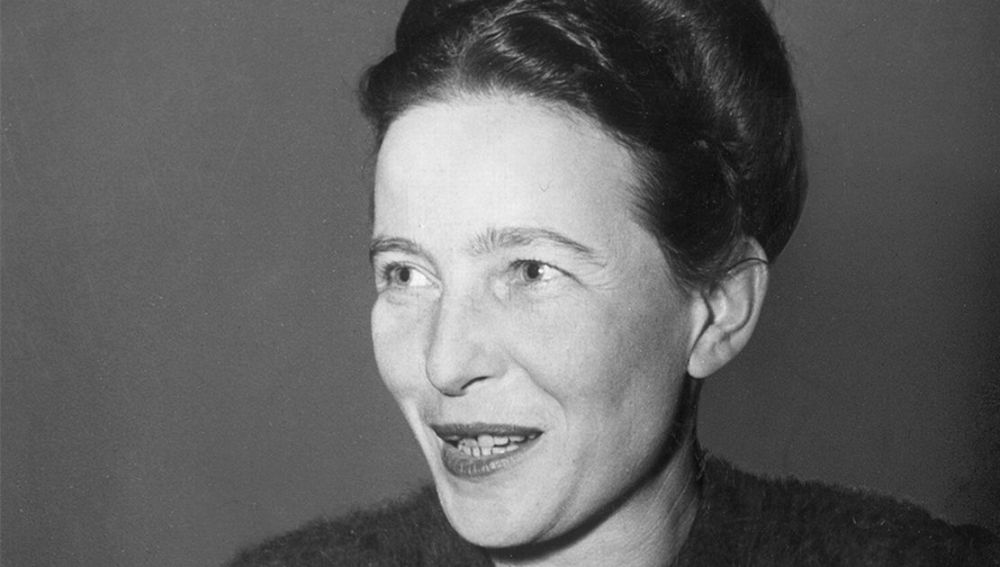
Today, The Grandma has gone to the library to search more information about Simone de Beauvoir, the French writer and existentialist philosopher.
Beauvoir was a political activist and she is a great reference thanks to her ideas about feminist and social theories. She was a controversial person.
Simone de Beauvoir was born on a day like today in 1908 and TheGrandma considers that the best homage that she can do to her is talking about her life, her ideas and her legacy.
Simone Lucie Ernestine Marie Bertrand de Beauvoir (9 January 1908-14 April 1986) was a French writer, intellectual, existentialist philosopher, political activist, feminist and social theorist.
Though she did not consider herself a philosopher, she had a significant influence on both feminist existentialism and feminist theory.
De Beauvoir wrote novels, essays, biographies, autobiography and monographs on philosophy, politics, and social issues. She was known for her 1949 treatise The Second Sex, a detailed analysis of women's oppression and a foundational tract of contemporary feminism; and for her novels, including She Came to Stay and The Mandarins. She was also known for her open, lifelong relationship with French philosopher Jean-Paul Sartre.
Simone de Beauvoir was born on 9 January 1908 into a bourgeois Parisian family in the 6th arrondissement. Her parents were Georges Bertrand de Beauvoir, a legal secretary who once aspired to be an actor, and Françoise de Beauvoir, a wealthy banker's daughter and devout Catholic. Simone's sister, Hélène, was born two years later.
The family struggled to maintain their bourgeois status after losing much of their fortune shortly after World War I, and Françoise insisted that the two daughters be sent to a prestigious convent school. De Beauvoir herself was deeply religious as a child, at one point intending to become a nun. She shed her faith in her early teens and remained an atheist for the rest of her life.
Simone de Beauvoir
De Beauvoir was intellectually precocious,fueled by her father's encouragement; he reportedly would boast, Simone thinks like a man! Because of her family's straitened circumstances, de Beauvoir could no longer rely on her dowry, and like other middle-class girls of her age, her marriage opportunities were put at risk. DeBeauvoir took this opportunity to take steps towards earning a living for herself.
After passing baccalaureate exams in mathematics and philosophy in 1925, she studied mathematics at the Institut Catholique de Paris and literature/languages at the Institut Sainte-Marie. She then studied philosophy at the Sorbonne and after completing her degree in 1928, she wrote her diplôme d'études supérieures. De Beauvoir was only the ninth woman to have received a degree from the Sorbonne at the time, due to the fact that French women had only recently been allowed to join higher education.
De Beauvoir first worked with Maurice Merleau-Ponty and Claude Lévi-Strauss, when all three completed their practice teaching requirements at the same secondary school. Although not officially enrolled, she sat in on courses at the École Normale Supérieure in preparation for the agrégation in philosophy, a highly competitive postgraduate examination which serves as a national ranking of students.
It was while studying for the agrégation that she met École Normale students Jean-Paul Sartre, Paul Nizan, and René Maheu, who gave her the lasting nickname Castor, or beaver. The jury for the agrégation narrowly awarded Sartre first place instead of de Beauvoir, who placed second and, at age 21, was the youngest person ever to pass the exam.
Writing of her youth in Memoirs of a Dutiful Daughter she said: ...my father's individualism and pagan ethical standards were in complete contrast to the rigidly moral conventionalism of my mother's teaching. This disequilibrium, which made my life a kind of endless disputation, is the main reason why I became an intellectual.
From 1929 to 1943, de Beauvoir
taught at the lycée level until she could support herself solely on the
earnings of her writings. She taught at the Lycée Montgrand in
Marseille, the Lycée Jeanne-d'Arc in Rouen, and the Lycée Molière on
Paris (1936–39).
Simone de Beauvoir & Jean-Paul Sartre
During October 1929, Jean-Paul Sartre and de Beauvoir became a couple and, after they were confronted by her father, Sartre asked her to marry him on a provisional basis: one day while they were sitting on a bench outside the Louvre, he said, Let's sign a two-year lease. Though de Beauvoir is quoted as saying, Marriage was impossible. I had no dowry, scholars point out that her ideal relationships described in The Second Sex and elsewhere bore little resemblances to the marriage standards of the day. Instead, they entered into a lifelong soul partnership, which was sexual but not exclusive, nor did it involve living together.
Sartre and de Beauvoir always read each other's work. Debate continues about the extent to which they influenced each other in their existentialist works, such as Sartre's Being and Nothingness and de Beauvoir's She Came to Stay and Phenomenology and Intent. However, recent studies of de Beauvoir's work focus on influences other than Sartre, including Hegel and Leibniz. The Neo-Hegelian revival led by Alexandre Kojève and Jean Hyppolite in the 1930s inspired a whole generation of French thinkers, including de Beauvoir and Sartre, to discover Hegel's Phenomenology of Spirit.
De Beauvoir's prominent open relationships at times overshadowed her substantial academic reputation. A scholar lecturing with de Beauvoir chastised their distinguished Harvard audience because every question asked about Sartre concerned his work, while all those asked about Beauvoir concerned her personal life.
Beginning in 1929, de Beauvoir and Jean-Paul Sartre were partners and remained so for fifty-one years, until his death in 1980.
De Beauvoir chose never to marry or set up a joint household and she never had children. This gave her the time to advance her education and engage in political causes, to write and teach, and to have lovers.
Perhaps her most famous lover was American author Nelson Algren whom she met in Chicago in 1947, and to whom she wrote across the Atlantic as my beloved husband.
Simone de Beauvoir
Algren won the National Book Award for The Man with the Golden Arm in 1950, and in 1954, de Beauvoir won France's most prestigious literary prize for TheMandarins in which Algren is the character Lewis Brogan. Algren vociferously objected to their intimacy becoming public. Years after they separated, she was buried wearing his gift of a silver ring. However, she lived with Claude Lanzmann from 1952 to 1959.
De Beauvoir was bisexual, and her relationships with young women were controversial. Former student Bianca Lamblin, originally Bianca Bienenfeld, wrote in her book Mémoires d'une jeune fille dérangée, in English Memoirs of a Disturbed Young Lady, that, while she was a student at Lycée Molière, she had been sexually exploited by her teacher de Beauvoir, who was in her 30s at the time.
In 1943, de Beauvoir was suspended from her teaching job, due to an accusation that she had seduced her 17-year-old lycée pupil Natalie Sorokine in 1939. Sorokine's parents laid formal charges against de Beauvoir for debauching a minor and as a result she had her licence to teach in France revoked.
In 1977, de Beauvoir, Sartre, Roland Barthes, Michel Foucault, Jacques Derrida and much of the era's intelligentsia signed a petition seeking to abrogate the age of consent in France.
De Beauvoir wrote popular travel diaries about time spent in the United Statesand China and published essays and fiction rigorously, especially throughout the 1950s and 1960s. She published several volumes of short stories, including The Woman Destroyed, which, like some of her other later work, deals with aging.
1980 saw the publication of When Things of the Spirit Come First, a set of short stories centred around and based upon women important to her earlier years. Though written long before the novel She Came to Stay, de Beauvoir did not at the time consider the stories worth publishing, allowing some forty years to pass before doing so.
Sartre and Merleau-Ponty had a longstanding feud, which led Merleau-Ponty to leave Les Temps Modernes. De Beauvoir sided with Sartre and ceased to associate with Merleau-Ponty. In de Beauvoir's
later years, she hosted the journal's editorial meetings in her flat
and contributed more than Sartre, whom she often had to force to offer
his opinions.
Simone de Beauvoir
De Beauvoir also wrote a four-volume autobiography, consisting of: Memoirs of a Dutiful Daughter; The Prime of Life; Force of Circumstance, sometimes published in two volumes in English translation After the War and Hard Times; and All Said and Done.
In 1964 De Beauvoir published a novella-length autobiography, A Very Easy Death, covering the time she spent visiting her ageing mother, who was dying of cancer. The novella brings up questions of ethical concerns with truth-telling in doctor-patient relationships.
In the 1970s de Beauvoir became active in France's women's liberation movement. She wrote and signed the Manifesto of the 343 in 1971, a manifesto that included a list of famous women who claimed to have had an abortion, then illegal in France. Some argue most of the women had not had abortions, including Beauvoir. Signatories were diverse as Catherine Deneuve, Delphine Seyrig, and de Beauvoir's sister Poupette. In 1974, abortion was legalised in France.
Her 1970 long essay La Vieillesse, The Coming of Age, is a rare instance of an intellectual meditation on the decline and solitude all humans experience if they do not die before about the age of 60.
In an interview with Betty Friedan, de Beauvoir said: No, we don’t believe that any woman should have this choice. No woman should be authorised to stay at home to bring up her children. Society should be totally different. Women should not have that choice, precisely because if there is such a choice, too many women will make that one. It is a way of forcing women in a certain direction.
In about 1976 de Beauvoir and Sylvie Le Bon made a trip to New York City in the United States to visit Kate Millett on her farm.
In 1981 she wrote La Cérémonie Des Adieux, A Farewell to Sartre, a painful account of Sartre's last years. In the opening of Adieux, de Beauvoir notes that it is the only major published work of hers which Sartre did not read before its publication.
She contributed the piece Feminism -alive, well, and in constant danger to the 1984 anthology Sisterhood Is Global: The International Women's Movement Anthology, edited by Robin Morgan.
After Sartre died in 1980, de Beauvoir published his letters to her with edits to spare the feelings of people in their circle who were still living. After de Beauvoir's death, Sartre's adopted daughter and literary heir Arlette Elkaïm would not let many of Sartre's letters be published in unedited form. Most of Sartre's letters available today have de Beauvoir's edits, which include a few omissions but mostly the use of pseudonyms. De Beauvoir's adopted daughter and literary heir Sylvie Le Bon, unlike Elkaïm, published de Beauvoir's unedited letters to both Sartre and Algren.
De Beauvoir died of pneumonia on 14 April 1986 in Paris, aged 78. She is buried next to Sartre at the Montparnasse Cemetery in Paris.