Showing posts with label Simone de Beauvoir. Show all posts

Sunday, 21 June 2020

JEAN-PAUL SARTRE, 'EXISTENTIALISM IS A HUMANISM'

Jean-Paul Sartre
The COVID-19 pandemic is an ongoing global pandemic of coronavirus disease that has affected millions of people around the world.

The Grandma is affected with this situation that has shown how fragile is the human condition against the nature.

When a tragedy like this occurs it is normal to think in life from a point of view of existentialism. Why have some people suffered this terrible disease and not me? How is life a lottery? How much pain is suffering my neighbours in silence? How can we help people who have suffered this disease and have got terrible consequences or how can we help those people who have lost someone?

It is very sad when you realize how only great tragedies pay the attention of the great part of the population, especially, if they are affected. Individualism is a terrible thing in our society but not now, it is a constant in our history.

The Grandma has been thinking about all these things and she has rereading L'Être et le Néant, in English Being and Nothingness, a masterpiece written by Jean-Paul Sartre that talks about existentialism and phenomenology. It is a good way to think about the past, the present, and the future of our societies and a wonderful way to homage this French philosopher who was born on a day like today in 1905.


Jean-Paul Charles Aymard Sartre (21 June 1905-15 April 1980) was a French philosopher, playwright, novelist, screenwriter, political activist, biographer, and literary critic.

He was one of the key figures in the philosophy of existentialism and phenomenology, and one of the leading figures in 20th-century French philosophy and Marxism.

His work has also influenced sociology, critical theory, post-colonial theory, and literary studies, and continues to influence these disciplines.

Sartre was also noted for his open relationship with prominent feminist and fellow existentialist philosopher and writer Simone de Beauvoir

Together, Sartre and de Beauvoir challenged the cultural and social assumptions and expectations of their upbringings, which they considered bourgeois, in both lifestyle and thought.

The conflict between oppressive, spiritually destructive conformity and an authentic way of being"became the dominant theme of Sartre's early work, a theme embodied in his principal philosophical work L'Être et le Néant, 1943. Sartre's introduction to his philosophy is his work L'existentialisme est un humanisme, 1946 originally presented as a lecture.

Jean-Paul Sartre
He was awarded the 1964 Nobel Prize in Literature despite attempting to refuse it, saying that he always declined official honours and that a writer should not allow himself to be turned into an institution.

Jean-Paul Sartre was born on 21 June 1905 in Paris as the only child of Jean-Baptiste Sartre, an officer of the French Navy, and Anne-Marie (Schweitzer). His mother was of Alsatian origin and the first cousin of Nobel Prize laureate Albert Schweitzer, whose father Louis Théophile was the younger brother of Anne-Marie's father. 

When Sartre was two years old, his father died of an illness, which he most likely contracted in Indochina. Anne-Marie moved back to her parents' house in Meudon, where she raised Sartre with help from her father Charles Schweitzer, a teacher of German who taught Sartre mathematics and introduced him to classical literature at a very early age.

When he was twelve, Sartre's mother remarried, and the family moved to La Rochelle, where he was frequently bullied, in part due to the wandering of his blind right eye, sensory exotropia.

In 1939 Sartre was drafted into the French army, where he served as a meteorologist. He was captured by German troops in 1940 in Padoux, and he spent nine months as a prisoner of war -in Nancy and finally in Stalag XIII-D, Trier, where he wrote his first theatrical piece, Barionà, fils du tonnerre, a drama concerning Christmas.

More information: BBC

It was during this period of confinement that Sartre read Martin Heidegger's Sein und Zeit, later to become a major influence on his own essay on phenomenological ontology. Because of poor health, he claimed that his poor eyesight and exotropia affected his balance, Sartre was released in April 1941. According to other sources, he escaped after a medical visit to the ophthalmologist.

After coming back to Paris in May 1941, he participated in the founding of the underground group Socialisme et Liberté with other writers Simone de Beauvoir, Maurice Merleau-Ponty, Jean-Toussaint Desanti, Dominique Desanti, Jean Kanapa, and École Normale students.

In his essay Paris under the Occupation, Sartre wrote that the correct behaviour of the Germans had entrapped too many Parisians into complicity with the occupation, accepting what was unnatural as natural.

Jean-Paul Sartre
The first period of Sartre's career, defined in large part by L'Être et le Néant (1943), gave way to a second period -when the world was perceived as split into communist and capitalist blocs- of highly publicized political involvement.

Sartre tended to glorify the Resistance after the war as the uncompromising expression of morality in action, and recalled that the résistants were a band of brothers who had enjoyed real freedom in a way that did not exist before nor after the war.

For a time in the late 1940s, Sartre described French nationalism as provincial and in a 1949 essay called for a United States of Europe.

As an anti-colonialist, Sartre took a prominent role in the struggle against French rule in Algeria, and the use of torture and concentration camps by the French in Algeria. He became an eminent supporter of the FLN in the Algerian War and was one of the signatories of the Manifeste des 121.

More information: Your Story

In 1964 Sartre renounced literature in a witty and sardonic account of the first ten years of his life, Les Mots. The book is an ironic counterblast to Marcel Proust, whose reputation had unexpectedly eclipsed that of André Gide, who had provided the model of littérature engagée for Sartre's generation. Literature, Sartre concluded, functioned ultimately as a bourgeois substitute for real commitment in the world.

In October 1964, Sartre was awarded the Nobel Prize in Literature but he declined it.

Sartre's physical condition deteriorated, partially because of the merciless pace of work and the use of amphetamine he put himself through during the writing of the Critique and a massive analytical biography of Gustave Flaubert, both of which remained unfinished.

He suffered from hypertension, and became almost completely blind in 1973. Sartre was a notorious chain smoker, which could also have contributed to the deterioration of his health.

Sartre died on 15 April 1980 in Paris from edema of the lung.

More information: Quartz


Man is condemned to be free;
because once thrown into the world,
he is responsible for everything he does.

Jean-Paul Sartre

Thursday, 9 January 2020

SIMONE DE BEAUVOIR, EXISTENTIALISM IN PHILOSOPHY

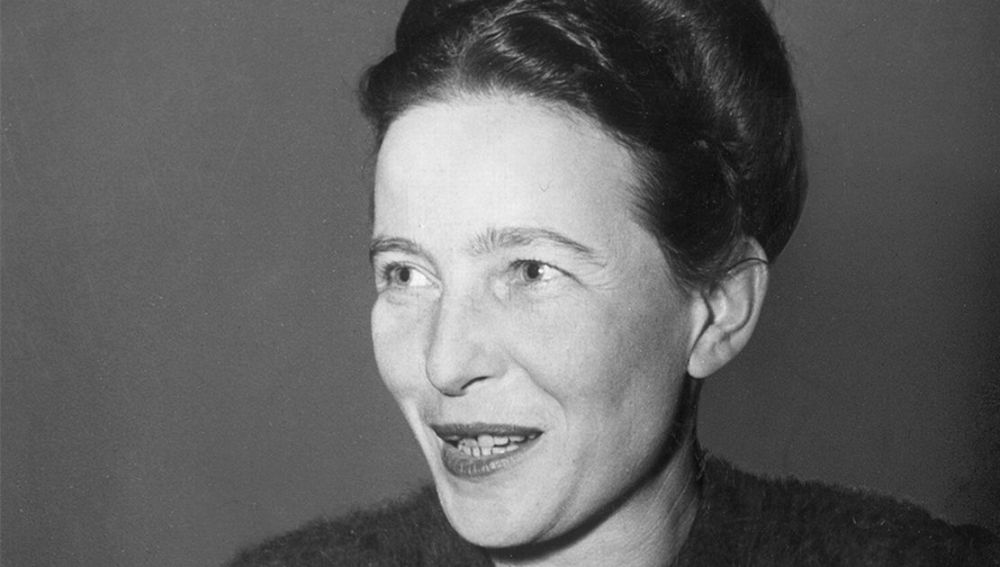
Simone de Beauvoir
Today, The Grandma has gone to the library to search more information about Simone de Beauvoir, the French writer and existentialist philosopher.

Beauvoir was a political activist and she is a great reference thanks to her ideas about feminist and social theories. She was a controversial person.

Simone de Beauvoir was born on a day like today in 1908 and The Grandma considers that the best homage that she can do to her is talking about her life, her ideas and her legacy.


Simone Lucie Ernestine Marie Bertrand de Beauvoir (9 January 1908-14 April 1986) was a French writer, intellectual, existentialist philosopher, political activist, feminist and social theorist.

Though she did not consider herself a philosopher, she had a significant influence on both feminist existentialism and feminist theory.

De Beauvoir wrote novels, essays, biographies, autobiography and monographs on philosophy, politics, and social issues. She was known for her 1949 treatise The Second Sex, a detailed analysis of women's oppression and a foundational tract of contemporary feminism; and for her novels, including She Came to Stay and The Mandarins. She was also known for her open, lifelong relationship with French philosopher Jean-Paul Sartre.

More information: The Culture Trip

Simone de Beauvoir was born on 9 January 1908 into a bourgeois Parisian family in the 6th arrondissement. Her parents were Georges Bertrand de Beauvoir, a legal secretary who once aspired to be an actor, and Françoise de Beauvoir, a wealthy banker's daughter and devout Catholic. Simone's sister, Hélène, was born two years later.

The family struggled to maintain their bourgeois status after losing much of their fortune shortly after World War I, and Françoise insisted that the two daughters be sent to a prestigious convent school. De Beauvoir herself was deeply religious as a child, at one point intending to become a nun. She shed her faith in her early teens and remained an atheist for the rest of her life.

Simone de Beauvoir
De Beauvoir was intellectually precocious, fueled by her father's encouragement; he reportedly would boast, Simone thinks like a man!

Because of her family's straitened circumstances, de Beauvoir could no longer rely on her dowry, and like other middle-class girls of her age, her marriage opportunities were put at risk. De Beauvoir took this opportunity to take steps towards earning a living for herself.

After passing baccalaureate exams in mathematics and philosophy in 1925, she studied mathematics at the Institut Catholique de Paris and literature/languages at the Institut Sainte-Marie. She then studied philosophy at the Sorbonne and after completing her degree in 1928, she wrote her diplôme d'études supérieures. De Beauvoir was only the ninth woman to have received a degree from the Sorbonne at the time, due to the fact that French women had only recently been allowed to join higher education.

De Beauvoir first worked with Maurice Merleau-Ponty and Claude Lévi-Strauss, when all three completed their practice teaching requirements at the same secondary school. Although not officially enrolled, she sat in on courses at the École Normale Supérieure in preparation for the agrégation in philosophy, a highly competitive postgraduate examination which serves as a national ranking of students.

More information: Open Culture

It was while studying for the agrégation that she met École Normale students Jean-Paul Sartre, Paul Nizan, and René Maheu, who gave her the lasting nickname Castor, or beaver. The jury for the agrégation narrowly awarded Sartre first place instead of de Beauvoir, who placed second and, at age 21, was the youngest person ever to pass the exam.

Writing of her youth in Memoirs of a Dutiful Daughter she said: ...my father's individualism and pagan ethical standards were in complete contrast to the rigidly moral conventionalism of my mother's teaching. This disequilibrium, which made my life a kind of endless disputation, is the main reason why I became an intellectual.

From 1929 to 1943, de Beauvoir taught at the lycée level until she could support herself solely on the earnings of her writings. She taught at the Lycée Montgrand in Marseille, the Lycée Jeanne-d'Arc in Rouen, and the Lycée Molière on Paris (1936–39).

Simone de Beauvoir & Jean-Paul Sartre
During October 1929, Jean-Paul Sartre and de Beauvoir became a couple and, after they were confronted by her father, Sartre asked her to marry him on a provisional basis: one day while they were sitting on a bench outside the Louvre, he said, Let's sign a two-year lease. Though de Beauvoir is quoted as saying, Marriage was impossible. I had no dowry, scholars point out that her ideal relationships described in The Second Sex and elsewhere bore little resemblances to the marriage standards of the day. Instead, they entered into a lifelong soul partnership, which was sexual but not exclusive, nor did it involve living together.

Sartre and de Beauvoir always read each other's work. Debate continues about the extent to which they influenced each other in their existentialist works, such as Sartre's Being and Nothingness and de Beauvoir's She Came to Stay and Phenomenology and Intent. However, recent studies of de Beauvoir's work focus on influences other than Sartre, including Hegel and Leibniz. The Neo-Hegelian revival led by Alexandre Kojève and Jean Hyppolite in the 1930s inspired a whole generation of French thinkers, including de Beauvoir and Sartre, to discover Hegel's Phenomenology of Spirit.

More information: The New Yorker

De Beauvoir's prominent open relationships at times overshadowed her substantial academic reputation. A scholar lecturing with de Beauvoir chastised their distinguished Harvard audience because every question asked about Sartre concerned his work, while all those asked about Beauvoir concerned her personal life.

Beginning in 1929, de Beauvoir and Jean-Paul Sartre were partners and remained so for fifty-one years, until his death in 1980.

De Beauvoir chose never to marry or set up a joint household and she never had children. This gave her the time to advance her education and engage in political causes, to write and teach, and to have lovers.

Perhaps her most famous lover was American author Nelson Algren whom she met in Chicago in 1947, and to whom she wrote across the Atlantic as my beloved husband

Simone de Beauvoir
Algren won the National Book Award for The Man with the Golden Arm in 1950, and in 1954, de Beauvoir won France's most prestigious literary prize for The Mandarins in which Algren is the character Lewis Brogan. Algren vociferously objected to their intimacy becoming public. Years after they separated, she was buried wearing his gift of a silver ring. However, she lived with Claude Lanzmann from 1952 to 1959.

De Beauvoir was bisexual, and her relationships with young women were controversial. Former student Bianca Lamblin, originally Bianca Bienenfeld, wrote in her book Mémoires d'une jeune fille dérangée, in English Memoirs of a Disturbed Young Lady, that, while she was a student at Lycée Molière, she had been sexually exploited by her teacher de Beauvoir, who was in her 30s at the time.

In 1943, de Beauvoir was suspended from her teaching job, due to an accusation that she had seduced her 17-year-old lycée pupil Natalie Sorokine in 1939. Sorokine's parents laid formal charges against de Beauvoir for debauching a minor and as a result she had her licence to teach in France revoked.

More information: Lirecrire

In 1977, de Beauvoir, Sartre, Roland Barthes, Michel Foucault, Jacques Derrida and much of the era's intelligentsia signed a petition seeking to abrogate the age of consent in France.

De Beauvoir wrote popular travel diaries about time spent in the United States and China and published essays and fiction rigorously, especially throughout the 1950s and 1960s. She published several volumes of short stories, including The Woman Destroyed, which, like some of her other later work, deals with aging.

1980 saw the publication of When Things of the Spirit Come First, a set of short stories centred around and based upon women important to her earlier years. Though written long before the novel She Came to Stay, de Beauvoir did not at the time consider the stories worth publishing, allowing some forty years to pass before doing so.

Sartre and Merleau-Ponty had a longstanding feud, which led Merleau-Ponty to leave Les Temps Modernes. De Beauvoir sided with Sartre and ceased to associate with Merleau-Ponty. In de Beauvoir's later years, she hosted the journal's editorial meetings in her flat and contributed more than Sartre, whom she often had to force to offer his opinions.

Simone de Beauvoir
De Beauvoir also wrote a four-volume autobiography, consisting of: Memoirs of a Dutiful Daughter; The Prime of Life; Force of Circumstance, sometimes published in two volumes in English translation After the War and Hard Times; and All Said and Done.

In 1964 De Beauvoir published a novella-length autobiography, A Very Easy Death, covering the time she spent visiting her ageing mother, who was dying of cancer. The novella brings up questions of ethical concerns with truth-telling in doctor-patient relationships.

In the 1970s de Beauvoir became active in France's women's liberation movement. She wrote and signed the Manifesto of the 343 in 1971, a manifesto that included a list of famous women who claimed to have had an abortion, then illegal in France. Some argue most of the women had not had abortions, including Beauvoir. Signatories were diverse as Catherine Deneuve, Delphine Seyrig, and de Beauvoir's sister Poupette. In 1974, abortion was legalised in France.

Her 1970 long essay La Vieillesse, The Coming of Age, is a rare instance of an intellectual meditation on the decline and solitude all humans experience if they do not die before about the age of 60.

In an interview with Betty Friedan, de Beauvoir said: No, we don’t believe that any woman should have this choice. No woman should be authorised to stay at home to bring up her children. Society should be totally different. Women should not have that choice, precisely because if there is such a choice, too many women will make that one. It is a way of forcing women in a certain direction.

More information: The Guardian

In about 1976 de Beauvoir and Sylvie Le Bon made a trip to New York City in the United States to visit Kate Millett on her farm.

In 1981 she wrote La Cérémonie Des Adieux, A Farewell to Sartre, a painful account of Sartre's last years. In the opening of Adieux, de Beauvoir notes that it is the only major published work of hers which Sartre did not read before its publication.

She contributed the piece Feminism -alive, well, and in constant danger to the 1984 anthology Sisterhood Is Global: The International Women's Movement Anthology, edited by Robin Morgan.

After Sartre died in 1980, de Beauvoir published his letters to her with edits to spare the feelings of people in their circle who were still living. After de Beauvoir's death, Sartre's adopted daughter and literary heir Arlette Elkaïm would not let many of Sartre's letters be published in unedited form. Most of Sartre's letters available today have de Beauvoir's edits, which include a few omissions but mostly the use of pseudonyms. De Beauvoir's adopted daughter and literary heir Sylvie Le Bon, unlike Elkaïm, published de Beauvoir's unedited letters to both Sartre and Algren.

De Beauvoir died of pneumonia on 14 April 1986 in Paris, aged 78. She is buried next to Sartre at the Montparnasse Cemetery in Paris.


I wish that every human life
might be pure transparent freedom.

Simone de Beauvoir