Today, The Grandma has received news from Mayte, one of her closest friends.
Mayte has visited Miravet in LaRibera d'Ebre, and she has shared her memories and photos with TheGrandma.
Miravet is a municipality in the comarca of Ribera d'Ebre in Catalonia.
The village and the castle was founded by the Moors and rebuilt by the Knights Templar and transformed into a fortress-monastery, after the conquest of 1153.
It is considered to be the largest fortified complex in Catalonia, and one of the best examples of Romanesque, religious and military, architecture of the Templar order in the whole Western world.
The Poor Fellow-Soldiers of Christ and of the Temple of Solomon, in Latin Pauperes commilitones Christi Templique Salomonici, also known as the Order of Solomon's Temple, the Knights Templar, or simply the Templars, was a Catholic military order, one of the most wealthy and popular of the Western Christian military orders.
They were founded in 1119, headquartered on the Temple Mount in Jerusalem, and existed for nearly two centuries during the Middle Ages.
Officially endorsed by the Roman Catholic Church by such decrees as the papal bull Omne datum optimum of Pope Innocent II, the Templars became a favored charity throughout Christendom and grew rapidly in membership and power. Templar knights, in their distinctive white mantles with a red cross, were amongst the most skilled fighting units of the Crusades.
They were prominent in Christian finance; non-combatant members of the order, who made up as much as 90% of their members, managed a large economic infrastructure throughout Christendom.
They developed innovative financial techniques that were an early form of banking, building a network of nearly 1,000 commanderies and fortifications across Europe and the Holy Land, and arguably forming the world's first multinational corporation.
The Templars were closely tied to the Crusades; when the Holy Land was lost, support for the order faded. Rumours about the Templars' secret initiation ceremony created distrust, and King Philip IV of France, while being deeply in debt to the order, used this distrust to take advantage of the situation.
In 1307, he pressured Pope Clement to have many of the order's members in France arrested, tortured into giving false confessions, and then burned at the stake. Under further pressure, Pope Clement V disbanded the order in 1312. The abrupt disappearance of a major part of the European infrastructure gave rise to speculation and legends, which have kept the Templar name alive into the present day.
In times of war, as in life, surround yourself with people of value, virtue and high morals, because it's always better to lose, perish and vanish in glory than to live in shame.
Today it's a cold and rainy day and The Grandma has decided to go to the library to spend some hours reading something interesting. She has chosen the biography of Pope Clement V because she's very interested in his participation against the order of the Knights Templar.
The Grandma and her friends are fans of the KnightsTemplar history and they have visited lots of places where this Order lived some centuries ago.
Before going to the library, The Grandma has studied a new lesson of her Elementary Language Practice manual (Grammar 20).
Pope Clement V (1264-1314), born Raymond Bertrand de Got and also occasionally spelled de Guoth and de Goth, was Pope from 5 June 1305 to his death in 1314. He is remembered for suppressing the order of the Knights Templar and allowing the execution of many of its members, and as the Pope who moved the Papacy from Rome to Avignon, ushering in the period known as the Avignon Papacy.
Born in Villandraut, Aquitaine, as the son of Bérard, Lord of Villandraut, Bertrand became canon and sacristan of the Cathedral of Saint-André in Bordeaux, then vicar-general to his brother Bérard de Got, the Archbishop of Lyon, who in 1294 was created Cardinal-Bishop of Albano. He was then made Bishop of St-Bertrand-de-Comminges, the cathedral church of which he was responsible for greatly enlarging and embellishing, and chaplain to Pope Boniface VIII, who made him Archbishop of Bordeaux in 1297.
First castle of the Knights Templar, Soure, Coimbra
In 1305, the new PopeClement V, based in Avignon, France, sent letters to both the Templar Grand Master Jacques de Molay andthe Hospitaller Grand Master Fulk de Villaret to discuss the possibility of merging the two orders.
Neither was amenable to the idea, but Pope Clement persisted, and in 1306 he invited both Grand Masters to France to discuss the matter. De Molay arrived first in early 1307, but de Villaret was delayed for several months. While waiting, De Molay and Clement discussed criminal charges that had been made two years earlier by an ousted Templar and were being discussed by King Philip IV of France and his ministers. It was generally agreed that the charges were false, but Clement sent the king a written request for assistance in the investigation.
According to some historians, King Philip, who was already deeply in debt to the Templars from his war with the English, decided to seize upon the rumours for his own purposes. He began pressuring the church to take action against the order, as a way of freeing himself from his debts.
Early in 1306, Clement V explained away those features of the Papal bull Clericis Laicos that might seem to apply to the king of France and essentially withdrew Unam Sanctam, the bull of Boniface VIII that asserted papal supremacy over secular rulers and threatened Philip's political plans, a radical change in papal policy.
On Friday, 13 October 1307, hundreds of the Knights Templar were arrested in France, an action apparently motivated financially and undertaken by the efficient royal bureaucracy to increase the prestige of the crown. PhilipIV was the force behind this move, but it has also embellished the historical reputation of Clement V. From the very day of Clement V's coronation, the king charged the Templars with usury, credit inflation, fraud, heresy, sodomy, immorality, and abuses, and the scruples of the Pope were heightened by a growing sense that the burgeoning French State might not wait for the Church, but would proceed independently.
Chastel Pelerin, Haifa, Israel
Pastoralis praeeminentiaewas a papal bull issued by Pope Clement V on 22November 1307 to all Christian monarchs. Itordered the arrest of all Knights Templar and to seize their properties on behalf of the church.
Clement was forced to support the campaign against the Templars by Philip IV of France, who owed them a great deal of money and had initiated the first arrests against the Templars on 13 October 1307.
Despite the papal request, not all the monarchs complied immediately, most notably, Edward II of England who at first refused to believe the allegations, but later carried out the order.
Following the arrests, a period of trials was sanctioned against the Templars,enforced by torture and pain-induced confessions.
Pope Clement called for papal hearings to determine the Templars' guilt or innocence, and once freed of the Inquisitors' torture, many Templars
recanted their confessions. Some had sufficient legal experience to
defend themselves in the trials, but in 1310, having appointed the
archbishop of Sens, Philippe de Marigny, to lead the investigation, Philip blocked this attempt, using the previously forced confessions to have dozens of Templars burned at the stake in Paris.
With Philip threatening military action unless the pope complied with his wishes, Pope Clement finally agreed to disband the order, citing the public scandal that had been generated by the confessions. At the Council of Vienne in 1312, he issued a series of papal bulls, including Vox in excelso, which officially dissolved the order, and Ad providam, which turned over most Templar assets to the Hospitallers.
As for the leaders of the order, the elderly Grand Master Jacques de Molay,who had confessed under torture, retracted his confession. Geoffroi de Charney, Preceptor of Normandy, also retracted his confession and insisted on his innocence. Both men were declared guilty of being relapsed heretics, and they were sentenced to burn alive at the stake in Paris on 18 March 1314.
Comanda de Barbens, Pla de l'Urgell, Lleida
De Molay reportedly remained defiant to the end, asking to be tied in such a way that he could face the Notre Dame Cathedral and hold his hands together in prayer.
According to legend, he called out from the flames that both Pope Clement and King Philip would soon meet him before God. His actual words were recorded on the parchment as follows : Dieu sait qui a tort et a péché. Il va bientot arriver malheur à ceux qui nous ont condamnés à mort, God knows who is wrong and has sinned. Soon a calamity will occur to those who have condemned us to death". Pope Clement died only a month later, and King Philip died in a hunting accident before the end of the year.
The remaining Templars around Europe were either arrested and tried under the Papal investigation, with virtually none convicted, absorbed into other Catholic military orders such as the Knights Hospitaller, or pensioned off and allowed to live out their days peacefully. By papal decree, the property of the Templars was transferred to the Knights Hospitaller except in the Kingdoms of Castile, Aragon, and Portugal.
Portugal was the first country in Europe where they had settled, occurring only two or three years after their foundation in Jerusalem and even having presence during Portugal's conception.
With the protection of thePortuguese king, Denis I, who refused to pursue and persecute the former knights as had occurred in all other sovereign states under the influence of the Catholic Church, in effect , causing the dissolution of the Templars by the rival order.
Templar organizations simply changed their name, from Knights Templar to the renown Order of Christ and also a parallel Supreme Order of Christ of the Holy See in which both are considered the successors.
In pursuance of the king's wishes, Clement V in 1311 summoned the Council of Vienne, which refused to convict the Templars of heresy. The Pope abolished the order anyway, as the Templars seemed to be in bad repute and had outlived their usefulness as papal bankers and protectors of pilgrims in the East. Their French estates were granted to the Knights Hospitallers, but Philip IV held them until his death and expropriated the Templars' bank outright.
Claire Fontaine and her friends are visiting Tortosa.They took a boat in Miravet and have sailed along the Ebre river from one Templar town to another.
Tortosa is a mix of different cultures (Roman, Arabian, Jewish and Templar) which appreciated its geostrategic position and its local development and became the city in one of the most important places during all the centuries. Today, the city is the capital of the Baix Ebre and one of the most important cities in the south of Catalonia.
Tina Picotes has joined them in Tortosa to enjoy the city and discover lots of interesting stories about its past and its present.
During the travel from Miravet to Tortosa by boat, The Grandma has studied a new lesson of her First Certificate Language Practice manual (Vocabulary 13).
Tortosa is the capital of the comarca of Baix Ebre, in Catalonia. Tortosa is located at 12 metres above sea level, by the Ebre river, protected on its northern side by the mountains of the Cardó Massif, of which Buinaca, one of the highest peaks, is located within Tortosa's municipal boundary.
Before Tortosa, across the river, rise the massive Ports de Tortosa-Beseit mountains. The area around Mont Caro and other high summits are often covered with snow in the winter.
Joseph de Ca'th Lon visits the Museum of Tortosa
Tortosa, from Latin Dertusa or Dertosa and via Arabic Turtūshah, is probably identical to the ancient Hibera, capital of Ilercavonia. This may be the ancient settlement the remains of which have been found on the hill named Castell de la Suda.
In Roman times, the town adopted the name Dertosa. After more than 400 years of Muslim rule, the city was conquered by the Count Ramon Berenguer IV of Barcelona in 1148, as part of the Second Crusade.
Because of the crusading appeal made by Pope Eugene III and his representative Nicholas Brakespear, the future Pope Hadrian IV, the siege received the aid of crusaders from multiple nationalities Genovese, Anglo-Normans, Normans, Southern-French, Germans, Flemish and Dutch, who were on their way to the Holy Land. The siege of Tortosa was narrated by the Genovese chronicler and diplomat Caffaro.
After its conquest, the city and its territory were divided among the victors, with multiple lands being granted to foreign crusaders and to the military and religious orders.
Formerly there was a railway line between Tortosa and Alcanyís, opening a communication gate between this region and Aragon. Construction work began in 1891, but it was haphazard and the first trains between Alcanyís and Tortosa began only in 1942.
The Grandma visits the Jewish Quarter
Tortosa Renaissance Festival. Over 3,000 citizens in period costumes and 60 shows a day with over 500 actors transport us to the Tortosa of 500 years ago. In the second half of July, Tortosa celebrates the Renaissance Festival.
Under the title the Splendour of a 16th Century City, the Festival commemorates, through a wide range of cultural and recreational activities, the historical period of the 16th century, one of the most interesting periods in our city's existence.
Tortosa has amazing places to visit like the Castle of Sant Joan or Suda, which commans the city from a 59-metre-high hill. Though the Romans were the first to fortify the place, the current structure dates to Muslim Caliph Abd ar-Rahman III.
After the conquest by Ramon Berenguer IV, Count of Barcelona, in 1148, it became a residence of the Montcada and the Knights Templar, and from the 13th century it became a royal mansion; and the Cathedral, begun in 1347 and consecrated in 1597.
Today, The Grandma is in València. She has gone to participate in the events of the Valencian National Day, October9 a commemoration of the day when Jaume I conquered the city and founded the ValencianKingdom. She is in the city with Miquel and Lluïsa, her Valencian friends and they are ready to enjoy Valencian culture, especially something that The Grandma loves, the Muixerangues.
During the travel by train, TheGrandma has studied a new lesson of her First Certificate Language Practice manual (Vocabulary 6).
James I the Conqueror, in Catalan Jaume el Conqueridor, in Aragonese Chaime lo Conqueridor, and in Occitan Jacme lo Conquistaire (2 February 1208-27 July 1276) was King of Aragon, Count of Barcelona, and Lord of Montpellier from 1213 to 1276; King of Majorca from 1231 to 1276; and Valencia from 1238 to 1276. His long reign, the longest of any Iberian monarch, saw the expansion of the House of Aragon and House of Barcelona in three directions: Languedoc to the north, the Balearic Islands to the southeast, and Valencia to the south.
By a treaty with Louis IX of France, he wrested the county of Barcelona from nominal French suzerainty and integrated it into his crown. He renounced northward expansion and taking back the once Catalan territories in Occitania and vassal counties loyal to the County of Barcelona, lands that were lost by his father Peter II of Aragon in the Battle of Muret during the AlbigensianCrusade and annexed by the Kingdom of France, and then decided to turn south.
Jaume I accepts to conquer Valencia
One of the main reasons for this formal renunciation of most of the once Catalanterritories in Languedoc and Occitania and any expansion into them is the fact that he was raised by the Knights Templar crusaders, who had defeated his father fighting for the Pope alongside the French, so it was effectively forbidden for him to try to maintain the traditional influence of the Count of Barcelona that previously existed in Occitania and Languedoc.
As a legislator and organiser, he occupies a high place among the European kings. Jaume compiled the Llibre del Consolat de Mar, which governed maritime trade and helped establish Catalan-Aragonese supremacy in the western Mediterranean. He was an important figure in the development of the Catalanlanguage, sponsoring Catalan literature and writing a quasi-autobiographical chronicle of his reign: the Llibre dels Fets.
Jaume was born at Montpellier as the only son of Peter II of Aragon and Marie of Montpellier. As a child, Jaume was made a pawn in the power politics of Provence, where his father was engaged in struggles helping the Cathar heretics of Albi against the Albigensian Crusaders led by Simon IV de Montfort, Earl of Leicester, who were trying to exterminate them.
Peter endeavoured to placate the northern crusaders by arranging a marriage between his son James and Simon's daughter, when the former was only two years old. He entrusted the boy to be educated in Montfort's care in 1211, but was soon forced to take up arms against him, dying at the Battle of Muret on 12 September 1213. Montfort would willingly have used Jaume as a means of extending his own power had not the Catalan-Aragonese appealed to Pope Innocent III, who insisted that Montfort surrender him. Jaume was handed over to the papal legate Peter of Benevento at Carcassonne in May or June 1214.
Castle of Montso, Aragon
Jaume was then sent to Montsó, where he was entrusted to the care of Guillem de Montredó, the head of the Knights Templar in Provence. The kingdom was given over to confusion until, in 1217, the Templars and some of the more loyal nobles brought the young king to Zaragoza.
Jaume built and consecrated the Cathedral of Lleida,which was constructed in a style transitional between Romanesque and Gothic with little influence from Moorish styles.
Jaume was a patron of the University of Montpellier, which owed much of its development to his impetus. He also founded a studium at Valencia in 1245 and received privileges for it from Pope Innocent IV, but it did not develop as splendidly. In 1263, Jaume presided over a debate in Barcelona between the Jewish rabbi Nahmanides and Pablo Christiani, a prominent converso.
Jaume was the first great sponsor and patron of vernacular Catalan literature. Indeed, he may himself be called the first of the Catalan prose writers.
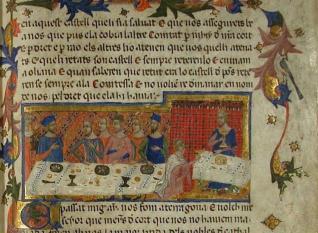
Jaume wrote or dictated at various stages a chronicle of his own life in Catalan, Llibre dels Fets, the first autobiography by a Christian king. As well as being a fine example of autobiography, the Book of Deeds expresses concepts of the power and purpose of monarchy, examples of loyalty and treachery in the feudal order, and medieval military tactics. More controversially, some historians have looked at these writings as a source of Catalan identity, separate from that of Occitania and Rome.
Llibre dels Fets, the autobiography of Jaume I
Jaume also wrote the Libre de la Saviesa or Book of Wisdom. The book contains proverbs from various authors, reaching from the time of King Solomon to nearly his own time with Albertus Magnus.
It even contains maxims from the medieval Arabphilosophers and from the Apophthegmata Philosophorum of Honein ben Ishak, which was probably translated at Barcelona during his reign. A Hebrew translator by the name of Jehuda was employed at Jaume's court during this period.
Though Jaume was himself a prose writer and sponsored mostly prose works, he had an appreciation of verse. In consequence of the Albigensian Crusade, many troubadours were forced to flee southern France and many found refuge in Catalonia and Aragon.
On 5 September 1229, the troops from Aragon, consisting of 155 ships, 1,500 horsemen and 15,000 soldiers, set sail from Tarragona, Salou, and Cambrils to conquer Majorca from Abú Yahya, the semi-independent Almohad governor of the island. Although a group of Aragonese knights took part in the campaign because of their obligations to the king, the conquest of Majorca was mainly a Catalan undertaking, and Catalans would later make up the majority of Majorca's settlers.
Jaume conquered Majorca on 31 December 1229, and Menorca (1232) and Ibiza (1235) were later acquired during the reconquest.
Valencia capitulated to Catalan-Aragonese rule on 28 September 1238, following an extensive campaign that included the Siege of Burriana and the decisive Battle of the Puig, where the Aragonese commander, Bernardo Guillermo de Entenza, who was also the king's cousin, died from wounds received in action. Chroniclers say he used gunpowder in the siege of Museros castle. Finally, in October 9, Jaume entered in the city of Valencia and founded the Valencian Kingdom.
.jpg)