Showing posts with label Llibre dels Fets. Show all posts

Sunday, 27 July 2025

JAUME I, THE COUNT & KING OF CATALAN COUNTRIES

Today, The Grandma has been reading El Llibre dels fets, an amazing chronicle about Jaume I, one of the most important figures of European history who dies on a day like today in 1276.

James I the Conqueror, in Catalan Jaume el Conqueridor; in Aragonese Chaime I o Conqueridor, (2 February 1208-27 July 1276) was Count of Barcelona, King of Aragon, and Lord of Montpellier from 1213 to 1276; King of Majorca from 1231 to 1276; and King of Valencia from 1238 to 1276.

His long reign of 62 years is not only the longest of any Iberian monarch, but one of the longest monarchical reigns in history, ahead of Hirohito but remaining behind Queen Elizabeth II, Queen Victoria, and Ferdinand I of the Two Sicilies.

King James I saw the expansion of the Crown of Aragon in three directions: Languedoc to the north, the Balearic Islands to the southeast, and Valencia to the south. By a treaty with Louis IX of France, he achieved the renunciation of any possible claim of French suzerainty over the County of Barcelona and the other Catalan counties, while he renounced northward expansion and taking back the once Catalan territories in Occitania and vassal counties loyal to the County of Barcelona, lands that were lost by his father Peter II of Aragon in the Battle of Muret during the Albigensian Crusade and annexed by the Kingdom of France, and then decided to turn south.

His great part in the Reconquista was similar in Mediterranean Spain to that of his contemporary Ferdinand III of Castile in Andalusia. One of the main reasons for this formal renunciation of most of the once Catalan territories in Languedoc and Occitania, and any expansion into them, is that he was raised by the Knights Templar Crusaders, who had defeated his father, who was fighting for the Pope alongside the French. It was thus effectively forbidden for him to try to maintain the traditional influence of the Count of Barcelona that previously existed in Occitania and Languedoc.

As a legislator and organiser, he occupies a high place among the European kings

King James I compiled the Llibre del Consolat de Mar, which governed maritime trade and helped establish Aragonese supremacy in the western Mediterranean. He was an important figure in the development of the Catalan language, sponsoring Catalan literature and writing a quasi-autobiographical chronicle of his reign: the Llibre dels fets.

James was born at Montpellier as the only son of Peter II of Aragon and Marie of Montpellier. As a child, James was made a pawn in the power politics of Provence, where his father was engaged in struggles helping the Cathar heretics of Albi against the Albigensian Crusade led by Simon IV de Montfort, Earl of Leicester, who were trying to exterminate them. Peter endeavoured to placate the northern Crusaders by arranging a marriage between his two-year-old son James and Simon's daughter, Amicie de Montfort.

He entrusted the boy to be educated in Montfort's care in 1211, but was soon forced to take up arms against him, dying at the Battle of Muret on 12 September 1213. Montfort would willingly have used James as a means of extending his own power had not the Aragonese appealed to Pope Innocent III, who insisted that Montfort surrender him. James was handed over to the papal legate Peter of Benevento at Carcassonne in May or June 1214.

James was then sent to Monzón, where he was entrusted to the care of Guillem de Montredó, the head of the Knights Templar in Aragon and Provence; the regency meanwhile fell to his great-uncle Sancho, Count of Roussillon, and his son, the king's cousin, Nuño. The kingdom was given over to confusion until, in 1217, the Templars and some of the more loyal nobles brought the young king to Zaragoza.

In 1221, he was married to Eleanor, daughter of Alfonso VIII of Castile. The next six years of his reign were full of rebellions on the part of the nobles. By the Peace of Alcalá of 31 March 1227, the nobles and the king came to terms.

In 1228, James faced the sternest opposition yet from a vassal. Guerau IV de Cabrera occupied the County of Urgell in opposition to Aurembiax, the heiress of Ermengol VIII, who had died without sons in 1208. Although Aurembiax's mother, Elvira, had made herself a protégée of James's father, upon her death in 1220 Guerau occupied the county and displaced Aurembiax, claiming that a woman could not inherit.

James intervened on behalf of Aurembiax, to whom he owed protection. He bought Guerau off and allowed Aurembiax to reclaim her territory, which she did at Lleida, probably also becoming one of James' earliest mistresses. She surrendered Lleida to James and agreed to hold Urgell in fief for him. On her death in 1231, James exchanged the Balearic Islands for Urgell with her widower, Peter of Portugal.

James built and consecrated the Cathedral of Lleida, which was constructed in a style transitional between Romanesque and Gothic with little influence from Moorish styles.

James was a patron of the University of Montpellier, which owed much of its development to his impetus. He also founded a studium at Valencia in 1245 and received privileges for it from Pope Innocent IV, but it did not develop as splendidly.

In 1263, James presided over a debate in Barcelona between the Jewish rabbi Nahmanides and Pablo Christiani, a prominent converso.

James was the first great sponsor and patron of vernacular Catalan literature. Indeed, he may himself be called the first of the Catalan prose writers. James wrote or dictated at various stages a chronicle of his own life in Catalan, Llibre dels fets, the first autobiography by a Christian king. As well as being a fine example of autobiography, the Book of Deeds expresses concepts of the power and purpose of monarchy, examples of loyalty and treachery in the feudal order, and medieval military tactics. 

James also wrote the Libre de la Saviesa or Book of Wisdom. The book contains proverbs from various authors, reaching from the time of King Solomon to nearly his own time with Albertus Magnus. It even contains maxims from the medieval Arab philosophers and from the Apophthegmata Philosophorum of Honein ben Ishak, which was probably translated at Barcelona during his reign. A Hebrew translator by the name of Jehuda was employed at James's court during this period.

Though James was himself a prose writer and sponsored mostly prose works, he had an appreciation of verse. In consequence of the Albigensian Crusade, many troubadours were forced to flee southern France and many found refuge in Aragon. Notwithstanding his early patronage of poetry, by the influence of his confessor Ramon de Penyafort, James brought the Inquisition into his realm in 1233 to prevent any vernacular translation of the Bible.

In 1276, the king fell very ill at Alzira and resigned his crown, intending to retire to the monastery of Poblet, but he died at Valencia on 27 July.

More information: 'Libre dels Feyts', Discovering a Catalan Chronicle


Certa cosa és que el nostre naixement se féu per vertut de Déu,
car no·s volien bé nostre pare ni nostra mare, e sí fo volentat de
Déu que nasquem en aquest món...

It is true that our birth was by the grace of God,
because the father and mother did not have a good relationship,
and yes, it was God's will that we come into this world...

Llibre dels Feyts/Book of Deeds 

Tuesday, 27 July 2021

'LIBRE DELS FEYTS', DISCOVERING A CATALAN CHRONICLE

Today, The Grandma has been relaxing at home. She has decide to reread one of the greatest treasures of Medieval Literature, the Llibre dels fets, the autobiographical chronicle of Jaume I (James I), count of Barcelona and king of Aragon.

She has decided to chose this masterpiece to remember the figure of Jaume I, who died on a day like today in 1276.

The Llibre dels fets, originally spelled Libre dels feyts, literally in English Book of Deeds, is the autobiographical chronicle of the reign of James I of Aragon (1213–1276).

It is written in Old Catalan in the first person and is the first chronologically of the four works classified as The Four Great Catalan Chronicles, all belonging to the early medieval Crown of Aragon, and its first royal dynasty, the House of Barcelona.

James I inherited as a child the titles of King of Aragon, Count of Barcelona, and Lord of Montpellier, but also became by conquest King of Majorca and King of Valencia. James emphasizes in his chronicles his conquest of Majorca (1229) and of Valencia (1238).

James I of Aragon dedicates a couple of chapters to his mother Maria of Montpellier and his father Peter II of Aragon, called Peter the Catholic, who had been given the title of Rex Catholicissimus by the Pope after the Battle of Las Navas de Tolosa in which he helped Alfonso VIII of Castile fight against the Moors, one year before his death.

Peter II of Aragon died defending his vassal lords of Occitania, who were accused of allowing the Cathar heresy to proliferate in their counties. He was killed in the Battle of Muret, fighting against the Crusader troops commanded by Simon de Montfort. Though the text of the Llibre dels fets was dictated and edited by James I, the actual writing was done by scribes, not James himself; it is written is colloquial language, representing the native tongue as spoken, and its style is direct.

Download Libre dels Feyts/Llibre dels fets

Islands held by the Muslim Almohads, and his consequent founding of the Kingdom of Majorca, probably inspired him to start the dictation of his chronicles, he was having had an active part in the Reconquista of the Iberian Peninsula, in the context of Europe's medieval Christian Crusades. The Llibre dels fets narrative ends with James' death in 1276. Though the original is lost, many ancient copies of the codex have survived.

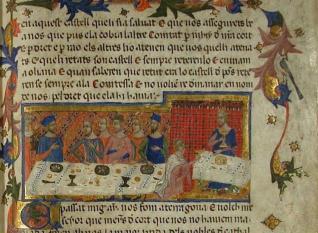
The oldest extant manuscript written in the original Catalan language, a copy dating to 1343, was commissioned by the abbot of the Poblet Monastery. 

An older manuscript dating to 1313, the Cronice Illustrissimi Regis Aragonum, was the version translated into Latin from the Catalan original Llibre dels Feyts del Rei en Jacme.

The Latin translation is signed by the Dominican friar Pere Marsili, who was ordered by James II of Aragon (James I's grandson) to honour his grandfather's memory by promulgating his words in the internationally used Latin language.

As the title itself indicates, more than a bare chronicle, the Llibre dels fets is in fact a Book of Deeds. Studies conducted in the 1980s concluded that this medieval manuscript is of an undefined literary style, since it was dictated entirely orally.

James I of Aragon, a cultivated man, dictated the entire book to royal scribes, who at that point in history commonly performed the labour of actually writing the king's words with pen on paper. Its style is informal and colloquial.

The principal characteristics of James' style are:

-Religious Feeling

-The love of the King for his realms

-Direct participation in the events described

-Military and heroic spirit

-Popular and improvised language

In the Llibre del Fets, James I of Aragon describes his life and his most important actions, such as the conquest of the Muslim-held Valencia and Majorca. 

The narrative begins with his birth in 1203 and ends with his death in 1276. The prologue and epilogue are written in a different style, more erudite and perfectionist than the rest of the text, and presumably written after his death.

In the Latin translation of 1313 by Pere Marsili, the friar informs his readers that he has translated chapters from the manuscripts then kept in the royal archives, indicating that the texts of the chronicles already existed and that they were written in the vulgar language, i.e., not in Latin, but in Catalan.

The oldest preserved copy of the manuscript in the Catalan language is the copy ordered in 1343, more than 60 years after James' death, by the Abbot of the Poblet Monastery.

The text of the Catalan manuscript is nearly identical to that of the Latin translation, but the Catalan version cannot be a copy of the Latin version, as the Catalan one is written in the first person, mainly using the majestic plural we, and only a few times the singular I, while the Latin version is written in the third person, using the first person in only a few quotes. This fact makes it improbable that the Catalan manuscript comes from the Latin version.

The internal structure of both versions seems to indicate two moments in time: the first part may have been dictated around 1240, shortly after James' conquest of Valencia. The facts before 1228 are explained in a brief, imprecise way even with significant errors, while from then on, the narrative shows greater detail and precision.

The supposed second part might have been dictated around 1274, and has a similar structure; the facts from 1242-1265 are condensed in a few pages, while the later years are again explicated in great detail. The prologue and the section that describes his illness and death were probably written or dictated by someone in James' trust. The Catalan copy of 1343 and the Latin translation of 1313 have left posterity the same content.

A didactic and justifying intention is largely reflected throughout the chronicle as a religious impulse, indicating that James I believed the execution of the work was guided by divine providence. The king, who normally desired to appear as an epic hero, not only recounts military and political history in the narrative, but also frequently mentions small details of his daily life, as well as some of his most intimate thoughts.

A popular and vivid language full of proverbs and colloquial expressions is used in the chronicles, which also quote foreign personages speaking other languages such as Aragonese, Galician-Portuguese (used by the Crown of Castile), Arabic or Old French.

Five codices of the text from the 14th century and two from the 15th are preserved, all based on a translation of the original Catalan text into Latin by the Dominican friar Pere Marsili at the order of King James' grandson, his namesake James II of Aragon.

The official delivery of the Cronice Illustrissimi Regis Aragonum domini Jacobi victorissimi principis was made on 2 June 1314 at the Church of the Friars Preachers, església dels frares predicadors, of Valencia.

More information: History Extra

Six official copies of the Latin translation by Pere Marsili exist. Four dating from the 14th century, conserved respectively in the National Library of Catalonia, the Archives of the Kingdom of Majorca, the Archives of the Cathedral of Palma de Majorca and the University of Barcelona's Library. A copy from the 17th century is kept at the Archives of the Crown of Aragon and another from the 19th in the Real Academia de la Historia of Spain.

Dated to 1343, the oldest surviving codex in the original Catalan language is the copy ordered by Ponç de Copons, the abbot of the Poblet Monastery.

This copy from the Poblet Monastery was made from an original manuscript owned by the Royal Chancellery. On 11 November 1343, King Peter IV of Aragon sent a letter to the abbot of the Poblet Monastery demanding the return of the original codex.

In 1585 King Philip II of Spain visited the Poblet Monastery and ordered a copy of the chronicle for the Royal Library of San Lorenzo de El Escorial, Madrid.

The second Catalan codex manuscript source, dating to 1380, comes directly from the Royal Chancellery of King Peter IV of Aragon, and must be a direct copy of the original, as the king himself commanded Johan de Barbastro to make it.

A relevant fact about this copy is that Johan de Barbastro used an official codex from the Royal Chancellerie, now disappeared. King Pere IV the Ceremonious ordered three copies: one for Majorca, one for Barcelona and another for Valencia. Only the Majorcan copy has survived, and is now preserved in the National Library of Catalonia.

This first printed edition was ordered and paid for by the Jury of the city of Valencia in 1557. Made in a period of historical inquiries, once the print was finished, a copy was sent to Madrid to King Philip II of Spain, known by the Catalans as Philip II of Castile, from the House of Habsburg, who had also been very interested in the manuscript codex kept in the Poblet Monastery.

Other manuscripts have survived, all copies of the one made for the Poblet Monastery in 1343. There is one relevant codex between them conserved in the library of the University of Barcelona made by student Jaume Ferrera by order of his master, Prior Jaume Ramon Vila, who added a prologue, which is its singular feature.

The Prior explains the reason he ordered the present copy of the Llibre dels fets, was to deny the forgery issues that Castilian historians were throwing at Catalans. He indicates as well that the illustrations are faithful copies of the manuscript dated 1343 from the Poblet Monastery.

The other relevant feature of this codex is the second original illustration that did not survive from the Poblet manuscript. In this picture the Mayor of the Palace, Hugh de Forcalquier, and Blasco de Alagón are kneeling before James I.

More information: Royal Monastery of Santa Maria de Poblet


 Aquest es lo començament del prolech sobre el libre que feu el rey en Jacme per la gracia de Deu rey de Arago e de Mallorches e de Valencia,
comte de Barchinona e d'Urgell e senyor de Muntpesler
de tots los fets e de les gracies que Nostre Senyor li féu en la sua vida.
 
This is the beginning of the prologue about the book that King James made, by Holy Grace, King of Aragon, of Majorca and Valentia,
Count of Barcelona and Count of Urgell, and Lord of Montpellier,
of all his deeds and gifts, our Lord gave to him in his lifetime.
 
Libre dels Feyts

Tuesday, 9 October 2018

OCTOBER, 9 1238, JAUME I & THE KINGDOM OF VALÈNCIA

Jaume I conquers Valencia, 1238
Today, The Grandma is in València. She has gone to participate in the events of the Valencian National Day, October 9 a commemoration of the day when Jaume I conquered the city and founded the Valencian Kingdom.  

She is in the city with Miquel and Lluïsa, her Valencian friends and they are ready to enjoy Valencian culture, especially something that The Grandma loves, the Muixerangues.

During the travel by train, The Grandma has studied a new lesson of her First Certificate Language Practice manual (Vocabulary 6).

 More information: Vehicles and Transport

James I the Conqueror, in Catalan Jaume el Conqueridor, in Aragonese Chaime lo Conqueridor, and in Occitan Jacme lo Conquistaire (2 February 1208-27 July 1276) was King of Aragon, Count of Barcelona, and Lord of Montpellier from 1213 to 1276; King of Majorca from 1231 to 1276; and Valencia from 1238 to 1276. His long reign, the longest of any Iberian monarch, saw the expansion of the House of Aragon and House of Barcelona in three directions: Languedoc to the north, the Balearic Islands to the southeast, and Valencia to the south.

By a treaty with Louis IX of France, he wrested the county of Barcelona from nominal French suzerainty and integrated it into his crown. He renounced northward expansion and taking back the once Catalan territories in Occitania and vassal counties loyal to the County of Barcelona, lands that were lost by his father Peter II of Aragon in the Battle of Muret during the Albigensian Crusade and annexed by the Kingdom of France, and then decided to turn south. 

Jaume I accepts to conquer Valencia
One of the main reasons for this formal renunciation of most of the once Catalan territories in Languedoc and Occitania and any expansion into them is the fact that he was raised by the Knights Templar crusaders, who had defeated his father fighting for the Pope alongside the French, so it was effectively forbidden for him to try to maintain the traditional influence of the Count of Barcelona that previously existed in Occitania and Languedoc.

As a legislator and organiser, he occupies a high place among the European kings. Jaume compiled the Llibre del Consolat de Mar, which governed maritime trade and helped establish Catalan-Aragonese supremacy in the western Mediterranean. He was an important figure in the development of the Catalan language, sponsoring Catalan literature and writing a quasi-autobiographical chronicle of his reign: the Llibre dels Fets

Jaume was born at Montpellier as the only son of Peter II of Aragon and Marie of Montpellier. As a child, Jaume was made a pawn in the power politics of Provence, where his father was engaged in struggles helping the Cathar heretics of Albi against the Albigensian Crusaders led by Simon IV de Montfort, Earl of Leicester, who were trying to exterminate them.

More information: Cathar

Peter endeavoured to placate the northern crusaders by arranging a marriage between his son James and Simon's daughter, when the former was only two years old. He entrusted the boy to be educated in Montfort's care in 1211, but was soon forced to take up arms against him, dying at the Battle of Muret on 12 September 1213.

Montfort would willingly have used Jaume as a means of extending his own power had not the Catalan-Aragonese appealed to Pope Innocent III, who insisted that Montfort surrender him. Jaume was handed over to the papal legate Peter of Benevento at Carcassonne in May or June 1214.

Castle of Montso, Aragon
Jaume was then sent to Montsó, where he was entrusted to the care of Guillem de Montredó, the head of the Knights Templar in Provence

The kingdom was given over to confusion until, in 1217, the Templars and some of the more loyal nobles brought the young king to Zaragoza.

Jaume built and consecrated the Cathedral of Lleida, which was constructed in a style transitional between Romanesque and Gothic with little influence from Moorish styles.

Jaume was a patron of the University of Montpellier, which owed much of its development to his impetus. He also founded a studium at Valencia in 1245 and received privileges for it from Pope Innocent IV, but it did not develop as splendidly. In 1263, Jaume presided over a debate in Barcelona between the Jewish rabbi Nahmanides and Pablo Christiani, a prominent converso.

More information: Turó Seu Vella

Jaume was the first great sponsor and patron of vernacular Catalan literature. Indeed, he may himself be called the first of the Catalan prose writers.

Jaume wrote or dictated at various stages a chronicle of his own life in Catalan, Llibre dels Fets, the first autobiography by a Christian king. As well as being a fine example of autobiography, the Book of Deeds expresses concepts of the power and purpose of monarchy, examples of loyalty and treachery in the feudal order, and medieval military tactics. More controversially, some historians have looked at these writings as a source of Catalan identity, separate from that of Occitania and Rome.

Llibre dels Fets, the autobiography of Jaume I
Jaume also wrote the Libre de la Saviesa or Book of Wisdom. The book contains proverbs from various authors, reaching from the time of King Solomon to nearly his own time with Albertus Magnus.

It even contains maxims from the medieval Arab philosophers and from the Apophthegmata Philosophorum of Honein ben Ishak, which was probably translated at Barcelona during his reign. A Hebrew translator by the name of Jehuda was employed at Jaume's court during this period.

Though Jaume was himself a prose writer and sponsored mostly prose works, he had an appreciation of verse. In consequence of the Albigensian Crusade, many troubadours were forced to flee southern France and many found refuge in Catalonia and Aragon

On 5 September 1229, the troops from Aragon, consisting of 155 ships, 1,500 horsemen and 15,000 soldiers, set sail from Tarragona, Salou, and Cambrils to conquer Majorca from Abú Yahya, the semi-independent Almohad governor of the island. Although a group of Aragonese knights took part in the campaign because of their obligations to the king, the conquest of Majorca was mainly a Catalan undertaking, and Catalans would later make up the majority of Majorca's settlers.

Jaume conquered Majorca on 31 December 1229, and Menorca (1232) and Ibiza (1235) were later acquired during the reconquest.

Valencia capitulated to Catalan-Aragonese rule on 28 September 1238, following an extensive campaign that included the Siege of Burriana and the decisive Battle of the Puig, where the Aragonese commander, Bernardo Guillermo de Entenza, who was also the king's cousin, died from wounds received in action. Chroniclers say he used gunpowder in the siege of Museros castle. Finally, in October 9, Jaume entered in the city of Valencia and founded the Valencian Kingdom.

More information: UNESCO


The air is moving for freedom
and the west wind will turn to the east.

The Song of the Muixeranga