Monday, 18 November 2019

ENJOY A NEW COURSE: INTRODUCTION TO LOGISTICS (I)

The Grandma arrives to Sant Boi by public bus
WHEN?

Today, The Grandma has started a new course of Logistics in Sant Boi de Llobregat. It is always a pleasure to return to this beautiful city because she has great memories of it and its people.


The main reason of her returning has been to start a new course of Logistics. Sant Boi is placed in the Llobregat Delta and it is an important enclave near Barcelona Port and International Airport, two essential logistic areas.

Sant Boi is a city with an ancient history and an important and essential presence in the history of its neighbour Barcelona, all the Catalan countries particularly and the European southern cultures generally. It is very important to know the origins of the place that you are visiting because every place has a particular idiosyncracy that explains the character of its population and the historical events occurred there. The Grandma has explained a story about The Capuchin in Sant Boi.


WHO?

The Grandma has met their new partners -David, Fabio, Jéssica, Joan, Margot, Ricard and Víctor- and she has spent a wonderful day learning new concepts and methods with them thanks to their new Oxford Manuals about English for Logistics.

WHERE?

Today, they have been talking about the main concept of logistics and the importance of Barcelona in the logistics routes of European Union thanks to the Mediterranean Corridor (still unfinished and without an end-date) and the strategical situation of the city and its Metropolitan Area inside the Blue/Yellow Bananas, an economic and social term defined by Roger Brunet.


The Blue Banana (also known as the European Megalopolis or the Liverpool–Milan Axis) is a discontinuous corridor of urbanisation spreading over Western and Central Europe, with a population of around 111 million. The concept was developed in 1989 by RECLUS, a group of French geographers managed by Roger Brunet.

The French geographer Roger Brunet, who observed a division between active and passive spaces, developed the concept of a West European backbone in 1989. He made reference to an urban corridor of industry and services stretching from northern England to northern Italy.

The name Blue Banana was dually coined by Jacques Chérèque, and an artist adding a graphic to an article by Josette Alia in Le Nouvel Observateur. The color blue referred to either the color of the flag of the European Community, or the blue collars of the factory workers in the region.

The Grandma & her new partners
Brunet saw the European Backbone as the development of historical precedents, e.g. trade routes, or as the consequence of an accumulation of industrial capital. In his analysis, Brunet excluded the Paris urban area and other French conurbations because of French economic insularity. His aim was a greater economic integration in Europe, but he felt that France had lost this connection by the 17th century as a result of its persecution of Huguenots and centralisation in Paris. Later versions do, however, include Paris.

In 1991, in the context of a study on behalf of the European Commission in support of its Regional Policy, researchers criticized the idea of the Blue Banana as a desirable formation, but not its empirical reality, identifying it as the result of regional competition in Europe. 

Furthermore, their diagram of the Blue Banana had more of a curve, still including Northern Italy, but ending at Barcelona. It also included Paris, and had the Anglo-Scottish border as its northern stem.

A study of the history of the Blue Banana as a concept refers to the Commission's study as a mistaken rejection of the Blue Banana from Brunet's original conception. From the research on the Commission's behalf, the Blue Banana represented a developed core at the expense of the periphery, whereas Brunet empirically viewed the Blue Banana as a region of development at Paris's periphery, beyond the French borders.

It stretches approximately from North Wales across Greater London to the Benelux states and along the German Rhineland, Southern Germany, Alsace in France in the west and Switzerland to Northern Italy in the south.

More information: Ski Rise Cities

WHAT?

Logistics is a fundamental part of supply chain management. It consists of the organisation and management of flows of goods related to purchasing, production, warehousing, distribution and the disposal, reuse and exchange of products, as well as the provision of added value services.

These days, enterprises often outsource their logistics activities to third party logistics providers and it is estimated that long-term contractual relationships, contract logistics, constitute 16% of total global logistics, while express/courier/parcel service are key to the e-commerce delivery business.

A recent study on the EU logistics market estimated that the logistics operations (excluding in-house operations) amount to €878 billion (2012) in the EU. According to the World Bank Connected to Compete logistics performance index, the EU logistics sector performs well on a global level, the global top largest logistics service providers are all based in Europe; six countries out of the global top-10 logistic performers are EU Member States. However, the performance varies across the Member States. While Germany has the world's highest ranking, the EU average is 3.56 (out of 5), with US at 3.92 and Japan at 3.91.

The Communication on the Freight Transport Logistics Action Plan 2007 established a list of activities to improve the framework for transport logistics operations in the EU. Discussions with stakeholders and the Logistics Conference 2013 identified that in the EU logistics costs represent about 10-15% of the final value of products. It is estimated that about half of these costs could be saved if obstacles were removed. These obstacles are in particular high administrative burden and inefficient transport chains, lack of transport infrastructure and the non-completion of the internal transport market.


Areas specifically targeted are therefore:

-Administrative burden and in particular customs procedures continue to be raised by industry as one of the main barriers for cross-border transport -in particular for efficient and fast logistics. Digitalisation can facilitate administrative procedures through the establishment of so–called single windows and the implementation of the 'reporting-only-once' principle. These issues will be addressed in the recently launched Digital Transport and Logistics Forum (DTLF) .

David is filling a pallet with wood pieces
-As regards infrastructure, the new TEN-T framework has tripled its budget and focuses on transhipment facilities, missing links and the creation of a network of multimodal transport corridors allowing large volumes of freight to be moved efficiently.

-Transport services do not perform equally well in all modes and in all parts of the EU. Open and competitive markets tend to provide better and cheaper services and hence the completion of the Single European Transport Area remains a policy objective.

-The internalisation of external costs of all transport modes is a key topic. High negative externalities are also due to current transport patterns, where road is predominant with 70% of activity and more than 70% of the total negative externalities. The harmonisation of carbon footprint measurement will enable benchmarking of transport services as regards their environmental sustainability, while streamlining business processes and operations.

More information: Catalonia Logistics

Logistics supply chains cross from mode to mode. Advanced information and communication technologies contribute towards co-modality by improving infrastructure, traffic and fleet management and facilitating a better tracking and tracing of goods across the transport networks. For several ITS systems freight transport has become a pioneer market due to its smaller size and more consolidated organisation and ownership.

ITS technologies are essential for the introduction of eFreight , whereby en route information on the location and condition of transported goods (especially for dangerous goods and live animals) is made available online in a secure way. In the future this may lead to a concept of intelligent cargo, meaning that goods become self-, context- and location-aware as well as connected to a wide range of information services.

e-Freight also includes the vision of a paper-free, electronic flow of information associated to the physical flow of goods. A deployment strategy for ITS, incorporating navigation systems, digital tachographs and tolling systems, can contribute to change in the logistics chain.

The road mode is a principal mode for freight transport, both for bulk and manufactured goods. For Green Freight Corridors the combination of alternative fuel vehicles and intelligent transport systems for long-distance and multi-modal traffic will be important.

 More information: eFreight

To promote innovation, the Freight Transport Logistics Action Plan encourages the use of information and communication technologies in freight transport. It outlines the vision of paperless information flows accompanying the physical shipment of goods. It will also help make traffic management more efficient by promoting intelligent transport systems as well as facilitate the roll-out of innovative services. Emerging technologies such as Radio Frequency Identification (RFID) and the possibilities offered by satellite services will revolutionise freight transport.

Core services include tracking and tracing (especially dangerous goods and animal transports), fleet management, intelligent truck parking and remote freight information.


Logistics is a great maze if you are a starter in this materia. For this reason, The Grandma and her partners have decided to review their English Grammar and Vocabulary to help to improve their new logistic knowledge.

To do it, they have been playing Scattergories and Password; and they have been describing objects, people and places to practise their skills in vocabulary, especially adjectives and their syntactic order in the sentence.

Play on line: Password & Scattergories-I & II

More information: Order of Adjectives


Being in the consumer business helps us groom talent
in areas like marketing, finance and logistics.
We can benchmark our outsourcing business
to our consumer business and its best practices.

Azim Premji

Sunday, 17 November 2019

AUGUSTE RODIN, PROGENITOR OF MODERN SCULPTURE

François Auguste René Rodin
The Grandma has been gone to the library to search more information about Auguste Rodin, the French sculptor who is considered the progenitor of modern sculptor and died on a day like today in 1917.

The Grandma loves sculpture and studying Rodin is something very special. She has remembered one of her first visits to  Paris when she visited the Musée Rodin and could appreciate the works of this French genius face to face.

Before going to the library, The Grandma has read the last chapter of Katherine Mansfield's The Garden Party and Other Stories.

François Auguste René Rodin (12 November 1840-17 November 1917) was a French sculptor.

Although Rodin is generally considered the progenitor of modern sculpture, he did not set out to rebel against the past. He was schooled traditionally, took a craftsman-like approach to his work, and desired academic recognition, although he was never accepted into Paris's foremost school of art.

Rodin possessed a unique ability to model a complex, turbulent, deeply pocketed surface in clay. Many of his most notable sculptures were criticized during his lifetime. They clashed with predominant figurative sculpture traditions, in which works were decorative, formulaic, or highly thematic. 

Rodin's most original work departed from traditional themes of mythology and allegory, modeled the human body with realism, and celebrated individual character and physicality. Rodin was sensitive to the controversy surrounding his work, but refused to change his style. Successive works brought increasing favor from the government and the artistic community.

More information: Musée Rodin

From the unexpected realism of his first major figure -inspired by his 1875 trip to Italy- to the unconventional memorials whose commissions he later sought, Rodin's reputation grew, and he became the preeminent French sculptor of his time.

By 1900, he was a world-renowned artist. Wealthy private clients sought Rodin's work after his World's Fair exhibit, and he kept company with a variety of high-profile intellectuals and artists. His students included Antoine Bourdelle, Camille Claudel, Constantin Brâncuși, and Charles Despiau. He married his lifelong companion, Rose Beuret, in the last year of both their lives. His sculptures suffered a decline in popularity after his death in 1917, but within a few decades, his legacy solidified. Rodin remains one of the few sculptors widely known outside the visual arts community.

The Gates of Hell, Paris
Rodin was born in 1840 into a working-class family in Paris, the second child of Marie Cheffer and Jean-Baptiste Rodin, who was a police department clerk. He was largely self-educated, and began to draw at age 10. Between ages 14 and 17, he attended the Petite École, a school specializing in art and mathematics where he studied drawing and painting. His drawing teacher Horace Lecoq de Boisbaudran believed in first developing the personality of his students so that they observed with their own eyes and drew from their recollections, and Rodin expressed appreciation for his teacher much later in life. It was at Petite École that he met Jules Dalou and Alphonse Legros.

In 1857, Rodin submitted a clay model of a companion to the École des Beaux-Arts in an attempt to win entrance; he did not succeed, and two further applications were also denied. Entrance requirements were not particularly high at the Grande École, so the rejections were considerable setbacks. Rodin's inability to gain entrance may have been due to the judges' Neoclassical tastes, while Rodin had been schooled in light, 18th-century sculpture. He left the Petite École in 1857 and earned a living as a craftsman and ornamenter for most of the next two decades, producing decorative objects and architectural embellishments.

In 1864, Rodin began to live with a young seamstress named Rose Beuret, with whom he stayed for the rest of his life, with varying commitment. The couple had a son named Auguste-Eugène Beuret (1866–1934). That year, Rodin offered his first sculpture for exhibition and entered the studio of Albert-Ernest Carrier-Belleuse, a successful mass producer of objets d'art.

More information: The Art Story

Rodin planned to stay in Belgium a few months, but he spent the next six years outside of France. It was a pivotal time in his life. He had acquired skill and experience as a craftsman, but no one had yet seen his art, which sat in his workshop since he could not afford castings. Having saved enough money to travel, Rodin visited Italy for two months in 1875, where he was drawn to the work of Donatello and Michelangelo. Their work had a profound effect on his artistic direction. 

Rose Beuret and Rodin returned to Paris in 1877. Rodin earned his living collaborating with more established sculptors on public commissions, primarily memorials and neo-baroque architectural pieces in the style of Carpeaux. In competitions for commissions he submitted models of Denis Diderot, Jean-Jacques Rousseau, and Lazare Carnot, all to no avail. On his own time, he worked on studies leading to the creation of his next important work, St. John the Baptist Preaching.

More information: Widewalls

In 1880, Carrier-Belleuse –now art director of the Sèvres national porcelain factory– offered Rodin a part-time position as a designer. The offer was in part a gesture of reconciliation, and Rodin accepted. That part of Rodin which appreciated 18th-century tastes was aroused, and he immersed himself in designs for vases and table ornaments that brought the factory renown across Europe.

The artistic community appreciated his work in this vein, and Rodin was invited to Paris Salons by such friends as writer Léon Cladel. During his early appearances at these social events, Rodin seemed shy; in his later years, as his fame grew, he displayed the loquaciousness and temperament for which he is better known.

French statesman Leon Gambetta expressed a desire to meet Rodin, and the sculptor impressed him when they met at a salon. Gambetta spoke of Rodin in turn to several government ministers, likely including Edmund Turquet, the Undersecretary of the Ministry of Fine Arts, whom Rodin eventually met.

The Thinker, Paris
Rodin's relationship with Turquet was rewarding: through him, he won the 1880 commission to create a portal for a planned museum of decorative arts.

Rodin dedicated much of the next four decades to his elaborate Gates of Hell, an unfinished portal for a museum that was never built. Many of the portal's figures became sculptures in themselves, including Rodin's most famous, The Thinker and The Kiss. With the museum commission came a free studio, granting Rodin a new level of artistic freedom. Soon, he stopped working at the porcelain factory; his income came from private commissions.

In 1883, Rodin agreed to supervise a course for sculptor Alfred Boucher in his absence, where he met the 18-year-old Camille Claudel. The two formed a passionate but stormy relationship and influenced each other artistically. Claudel inspired Rodin as a model for many of his figures, and she was a talented sculptor, assisting him on commissions as well as creating her own works. Her Bust of Rodin was displayed to critical acclaim at the 1892 Salon.
Claudel and Rodin parted in 1898.

Although busy with The Gates of Hell, Rodin won other commissions. He pursued an opportunity to create a historical monument for the town of Calais. For a monument to French author Honoré de Balzac, Rodin was chosen in 1891. His execution of both sculptures clashed with traditional tastes, and met with varying degrees of disapproval from the organizations that sponsored the commissions. Still, Rodin was gaining support from diverse sources that propelled him toward fame.

Rodin was a naturalist, less concerned with monumental expression than with character and emotion. Departing with centuries of tradition, he turned away from the idealism of the Greeks, and the decorative beauty of the Baroque and neo-Baroque movements. His sculpture emphasized the individual and the concreteness of flesh, and suggested emotion through detailed, textured surfaces, and the interplay of light and shadow. To a greater degree than his contemporaries, Rodin believed that an individual's character was revealed by his physical features.

More information: My Modern Net

Rodin's talent for surface modeling allowed him to let every part of the body speak for the whole. The male's passion in The Thinker is suggested by the grip of his toes on the rock, the rigidness of his back, and the differentiation of his hands.

Sculptural fragments to Rodin were autonomous works, and he considered them the essence of his artistic statement. His fragments -perhaps lacking arms, legs, or a head-  took sculpture further from its traditional role of portraying likenesses, and into a realm where forms existed for their own sake. Notable examples are The Walking Man, Meditation without Arms, and Iris, Messenger of the Gods.

Instead of copying traditional academic postures, Rodin preferred his models to move naturally around his studio, despite their nakedness. The sculptor often made quick sketches in clay that were later fine-tuned, cast in plaster, and cast in bronze or carved from marble. Rodin's focus was on the handling of clay.

Rodin willed to the French state his studio and the right to make casts from his plasters. Because he encouraged the edition of his sculpted work, Rodin's sculptures are represented in many public and private collections.

The Musée Rodin was founded in 1916 and opened in 1919 at the Hôtel Biron, where Rodin had lived, and it holds the largest Rodin collection, with more than 6,000 sculptures and 7,000 works on paper. The French order Légion d'honneur made him a Commander, and he received an honorary doctorate from the University of Oxford.

More information: Artsy


What makes my Thinker think is that he thinks not only with his brain,
with his knitted brow, his distended nostrils and compressed lips,
but with every muscle of his arms, back, and legs,
with his clenched fist and gripping toes.

Auguste Rodin

Saturday, 16 November 2019

NOVEMBER 16, 1945, UNESCO IS FOUNDED IN LONDON, UK

UNESCO Logo
Today, The Grandma has gone to listen to a conference in UNESCOCAT Centre in Barcelona to celebrate that UNESCO was created on a day like today in 1945. It has been an interesting meeting where The Grandma has discovered which are the UNESCO future plans for Education. 

The Grandma is a member of this organization and she is always very interested in all the proposals that they offer to improve our education and protect our intangible culture. UNESCO has a great influence in protecting world heritage and The Grandma remembers with a lot of emotion when Antoni Gaudí's works, el Cant de la Sibil·la (the Song of Sibyl) and Castells (Human Towers) were declared Intangible Cultural Heritage, because it was a great recognition to her culture and the security that someone was going to protect and promote them.

Before going to UNESCOCAT, The Grandma has read a new chapter of Katherine Mansfield's The Garden Party and Other Stories.

The United Nations Educational, Scientific and Cultural Organization is a specialized agency of the United Nations (UN) based in Paris, France.

Its declared purpose is to contribute to promoting international collaboration in education, sciences, and culture in order to increase universal respect for justice, the rule of law, and human rights along with fundamental freedom proclaimed in the United Nations Charter. It is the successor of the League of Nations' International Committee on Intellectual Cooperation.

UNESCO has 193 member states and 11 associate members. Most of its field offices are cluster offices covering three or more countries; national and regional offices also exist.

More information: UNESCO

UNESCO pursues its objectives through five major programs: education, natural sciences, social/human sciences, culture and communication/information. Projects sponsored by UNESCO include literacy, technical, and teacher-training programs, international science programs, the promotion of independent media and freedom of the press, regional and cultural history projects, the promotion of cultural diversity, translations of world literature, international cooperation agreements to secure the world's cultural and natural heritage (World Heritage Sites) and to preserve human rights, and attempts to bridge the worldwide digital divide. It is also a member of the United Nations Development Group.

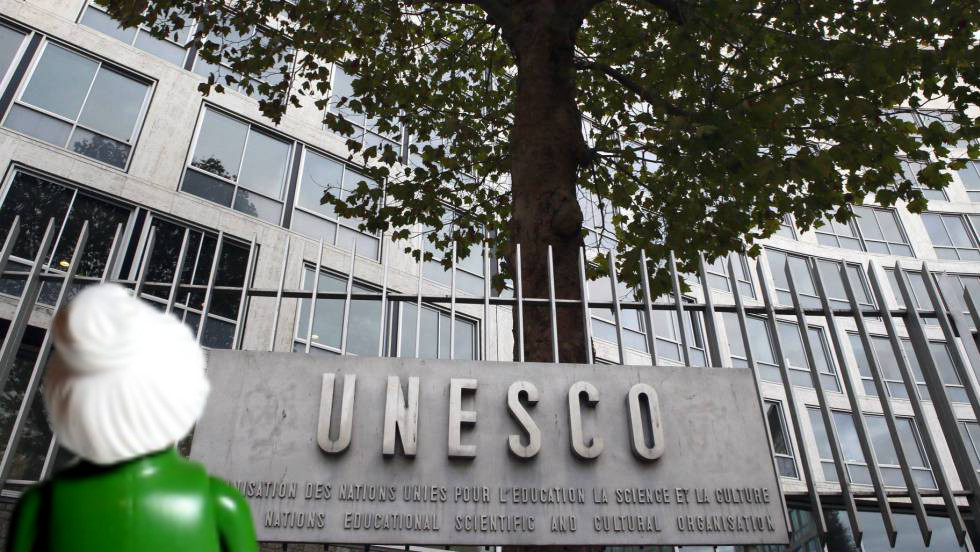
The Grandma visited UNESCO HQ in Paris
UNESCO's aim is to contribute to the building of peace, the eradication of poverty, sustainable development and intercultural dialogue through education, the sciences, culture, communication and information. Other priorities of the organization include attaining quality Education For All and lifelong learning, addressing emerging social and ethical challenges, fostering cultural diversity, a culture of peace and building inclusive knowledge societies through information and communication.

The broad goals and objectives of the international community -as set out in the internationally agreed development goals, including the Millennium Development Goals (MDGs) -underpin all UNESCO strategies and activities.

UNESCO and its mandate for international cooperation can be traced back to a League of Nations resolution on 21 September 1921, to elect a Commission to study feasibility. This new body, the International Committee on Intellectual Cooperation (ICIC) was indeed created in 1922. On 18 December 1925, the International Bureau of Education (IBE) began work as a non-governmental organization in the service of international educational development. However, the onset of World War II largely interrupted the work of these predecessor organizations.

More information: ThoughtCo

After the signing of the Atlantic Charter and the Declaration of the United Nations, the Conference of Allied Ministers of Education (CAME) began meetings in London which continued from 16 November 1942 to 5 December 1945.

On 30 October 1943, the necessity for an international organization was expressed in the Moscow Declaration, agreed upon by China, the United Kingdom, the United States and the USSR. This was followed by the Dumbarton Oaks Conference proposals of 9 October 1944. Upon the proposal of CAME and in accordance with the recommendations of the United Nations Conference on International Organization (UNCIO), held in San Francisco in April-June 1945, a United Nations Conference for the establishment of an educational and cultural organization (ECO/CONF) was convened in London 1-16 November 1945 with 44 governments represented.

The idea of UNESCO was largely developed by Rab Butler, the Minister of Education for the United Kingdom, who had a great deal of influence in its development. At the ECO/CONF, the Constitution of UNESCO was introduced and signed by 37 countries, and a Preparatory Commission was established. The Preparatory Commission operated between 16 November 1945, and 4 November 1946 -the date when UNESCO's Constitution came into force with the deposit of the twentieth ratification by a member state.

United Nations HQ, Geneva, Switzerland
The first General Conference took place from 19 November to 10 December 1946, and elected Dr. Julian Huxley to Director-General. The Constitution was amended in November 1954 when the General Conference resolved that members of the Executive Board would be representatives of the governments of the States of which they are nationals and would not, as before, act in their personal capacity. This change in governance distinguished UNESCO from its predecessor, the ICIC, in how member states would work together in the organization's fields of competence. As member states worked together over time to realize UNESCO's mandate, political and historical factors have shaped the organization's operations in particular during the Cold War, the decolonization process, and the dissolution of the USSR.

Among the major achievements of the organization is its work against racism, for example through influential statements on race starting with a declaration of anthropologists, among them was Claude Lévi-Strauss, and other scientists in 1950 and concluding with the 1978 Declaration on Race and Racial Prejudice. In 1956, the Republic of South Africa withdrew from UNESCO saying that some of the organization's publications amounted to interference in the country's racial problems. South Africa rejoined the organization in 1994 under the leadership of Nelson Mandela.

More information: Aalborg University

UNESCO's early work in the field of education included the pilot project on fundamental education in the Marbial Valley, Haiti, started in 1947. This project was followed by expert missions to other countries, including, for example, a mission to Afghanistan in 1949. In 1948, UNESCO recommended that Member States should make free primary education compulsory and universal. In 1990, the World Conference on Education for All, in Jomtien, Thailand, launched a global movement to provide basic education for all children, youths and adults. Ten years later, the 2000 World Education Forum held in Dakar, Senegal, led member governments to commit to achieving basic education for all by 2015.

UNESCO's early activities in culture included, for example, the Nubia Campaign, launched in 1960. The purpose of the campaign was to move the Great Temple of Abu Simbel to keep it from being swamped by the Nile after construction of the Aswan Dam.

During the 20-year campaign, 22 monuments and architectural complexes were relocated. This was the first and largest in a series of campaigns including Mohenjo-daro (Pakistan), Fes (Morocco), Kathmandu (Nepal), Borobudur (Indonesia) and the Acropolis (Greece). The organization's work on heritage led to the adoption, in 1972, of the Convention concerning the Protection of the World Cultural and Natural Heritage.

The Sagrada Família & Castells, UNESCO heritages
The World Heritage Committee was established in 1976 and the first sites inscribed on the World Heritage List in 1978. Since then important legal instruments on cultural heritage and diversity have been adopted by UNESCO member states in 2003 (Convention for the Safeguarding of the Intangible Cultural Heritage) and 2005 (Convention on the Protection and Promotion of the Diversity of Cultural Expressions).

An intergovernmental meeting of UNESCO in Paris in December 1951 led to the creation of the European Council for Nuclear Research, which was responsible for establishing the European Organization for Nuclear Research (CERN) later on, in 1954.

Arid Zone
programming, 1948-1966, is another example of an early major UNESCO project in the field of natural sciences. In 1968, UNESCO organized the first intergovernmental conference aimed at reconciling the environment and development, a problem which continues to be addressed in the field of sustainable development. The main outcome of the 1968 conference was the creation of UNESCO's Man and the Biosphere Programme.

More information: Heritage Helpers

In the field of communication, the free flow of ideas by word and image has been in UNESCO's constitution from its beginnings, following the experience of the Second World War when control of information was a factor in indoctrinating populations for aggression. In the years immediately following World War II, efforts were concentrated on reconstruction and on the identification of needs for means of mass communication around the world.

UNESCO started organizing training and education for journalists in the 1950s. In response to calls for a New World Information and Communication Order in the late 1970s, UNESCO established the International Commission for the Study of Communication Problems, which produced the 1980 MacBride report, named after the Chair of the Commission, the Nobel Peace Prize laureate Seán MacBride. The same year, UNESCO created the International Programme for the Development of Communication (IPDC), a multilateral forum designed to promote media development in developing countries.

In 1991, UNESCO's General Conference endorsed the Windhoek Declaration on media independence and pluralism, which led the UN General Assembly to declare the date of its adoption, 3 May, as World Press Freedom Day.

Since 1997, UNESCO has awarded the UNESCO/Guillermo Cano World Press Freedom Prize every 3 May. In the lead up to the World Summit on the Information Society in 2003 (Geneva) and 2005 (Tunis), UNESCO introduced the Information for All Programme. UNESCO admitted Palestine as a member in 2011.

More information: Durham World Heritage Site


I never dreamed I would be a Goodwill Ambassador, and for UNESCO.
Perfect organization. It is apolitical and it's about education,
science and culture. I mean that is what I live.
That is what UNESCO is really about; it's all about bringing
human beings together with one common goal,
 which is to move human kind forward.
 
Herbie Hancock

Friday, 15 November 2019

MAYTE VISITED BURANO IN THE VENETIAN LAGOON

Mayte in Burano, Veneto
Today, The Grandma has been watching news on TV. She has been astonished about the last flood in Venice, a normal phenomenon called 'Aqua Alta' that has surprised the lagoon with an unusual force. 

Climate change is a reality and although our planet has suffered other extinctions in the past, this is different because is not provoked by a natural phenomenon but a human influence.

The Grandma has phoned Mayte, who was visiting Burano, next to Venice, last summer and they have been talking about Burano and the Venetian Lagoon, a beautiful place that we must protect and take care of it if we do not want that it disappears under the Adriatic Sea.

Before talking with Mayte, The Grandma has read a new chapter of Katherine Mansfield's The Garden Party and Other Stories.

Burano is an island in the Venetian Lagoon near Torcello at the northern end of the Lagoon, known for its lace work and brightly coloured homes. The primary economy is tourism.

Burano is 7 kilometres from Venice, a 40-minute trip from St. Mark's Square by a Venetian water bus, vaporetto.

The island is linked to Mazzorbo by a bridge. The current population of Burano is about 2,800. Originally, there were five islands and a fourth canal that was filled to become via e piazza Baldassare Galuppi, joining the former islands of San Martino Destra and San Martino Sinistra.

Burano has historically been subdivided into five sestieri, much like Venice. They correspond to the five original islands.

Burano has a high population density, calculated at more than 13,000 per square kilometer, or more than twenty times the density of neighboring Mazzorbo. It is almost entirely covered by residential buildings, with few small green areas.

More information: Isola di Burano

The island was probably settled by the Romans, and in the 6th century was occupied by people from Altino, who named it for one of the gates of their former city. Two stories are attributed to how the city obtained its name. One is that it was initially founded by the Buriana family, and another is that the first settlers of Burano came from the small island of Buranello, about 8 kilometres to the south.

Although the island soon became a thriving settlement, it was administered from Torcello and had none of the privileges of that island or of Murano. It rose in importance only in the 16th century, when women on the island began making lace with needles, being introduced to such a trade via Venetian-ruled Cyprus.

More information: Trip Savvy

When Leonardo da Vinci visited in 1481, he visited the small town of Pano Lefkara and purchased a cloth for the main altar of the Duomo di Milano. The lace was soon exported across Europe, but trade began to decline in the 18th century and the industry did not revive until 1872, when a school of lacemaking was opened. Lacemaking on the island boomed again, but few now make lace in the traditional manner as it is extremely time-consuming and therefore expensive.

Burano is also known for its small, brightly painted houses, which are popular with artists. The colours of the houses follow a specific system, originating from the golden age of its development. If someone wishes to paint their home, one must send a request to the government, who will respond by making notice of the certain colours permitted for that lot.

Other attractions include the Church of San Martino, with a leaning campanile and a painting by Giambattista Tiepolo (Crufixion, 1727), the Oratorio di Santa Barbara and the Museum and School of Lacemaking.

More information: The Local


Climate change is happening, humans are causing it,
and I think this is perhaps the most serious
environmental issue facing us.

Bill Nye

Thursday, 14 November 2019

HERMAN MELVILLE'S MOBY-DICK IS PUBLISHED IN THE US

Herman Melville
The Grandma loves Literature, and it is very difficult for her to choose only one work as her favourite, but she always remembers the first time he watched Gregory Peck in a film called Moby-Dick.

She was as astonished with that performance of Peck as Captain Ahab, a man who was obsessed to hunt a white whale, that she run to the library to search the book that had inspired this classic film. Then, she discovered Moby-Dick, a masterpiece written by Herman Melville that talks about impossible dreams that become obsessions. Since that moment, Moby-Dick is, without any kind of doubt, one of The Grandma's favourite novels.

Moby-Dick was published in the USA on a day like today in 1857 and The Grandma has wanted to remember this event, sharing her opinions and feelings about this novels with Jordi Santanyí, her closer friend and great writer.

Before talking about Moby-Dick, The Grandma has read a new chapter of Katherine Mansfield's The Garden Party and Other Stories.

Moby-Dick; or, The Whale is an 1851 novel by American writer Herman Melville.

The book is sailor Ishmael's narrative of the obsessive quest of Ahab, captain of the whaling ship Pequod, for revenge on Moby Dick, the giant white sperm whale that on the ship's previous voyage bit off Ahab's leg at the knee.

A contribution to the literature of the American Renaissance, the work's genre classifications range from late Romantic to early Symbolist.

More information: Good News Network

Moby-Dick was published to mixed reviews, was a commercial failure, and was out of print at the time of the author's death in 1891. Its reputation as a Great American Novel was established only in the 20th century, after the centennial of its author's birth. William Faulkner said he wished he had written the book himself, and D. H. Lawrence called it one of the strangest and most wonderful books in the world and the greatest book of the sea ever written. Its opening sentence, Call me Ishmael, is among world literature's most famous.

Moby-Dick; or, The Whale, 1851
Melville began writing Moby-Dick in February 1850, and finished 18 months later, a year longer than he had anticipated. Writing was interrupted by his meeting Nathaniel Hawthorne in August 1850, and by the creation of the Mosses from an Old Manse essay as a result of that friendship. The book is dedicated to Hawthorne, in token of my admiration for his genius.

The basis for the work is Melville's 1841 whaling voyage aboard the Acushnet. The novel also draws on whaling literature, and on literary inspirations such as Shakespeare and the Bible. The white whale is modelled on the notoriously hard-to-catch albino whale Mocha Dick, and the book's ending is based on the sinking of the whale ship Essex in 1820.

The detailed and realistic descriptions of whale hunting and of extracting whale oil, as well as life aboard ship among a culturally diverse crew, are mixed with exploration of class and social status, good and evil, and the existence of God.

In addition to narrative prose, Melville uses styles and literary devices ranging from songs, poetry, and catalogues to Shakespearean stage directions, soliloquies, and asides.

More information: Smithsonian

In October 1851, the chapter The Town Ho's Story was published in Harper's New Monthly Magazine. The same month, the whole book was first published (in three volumes) as The Whale in London, and under its definitive title in a single-volume edition in New York in November. There are hundreds of differences between the two editions, most slight, but some important and illuminating.

The London publisher, Richard Bentley, censored or changed sensitive passages; Melville made revisions as well, including a last-minute change to the title for the New York edition. The whale, however, appears in the text of both editions as Moby Dick, without the hyphen. One factor that led British reviewers to scorn the book was that it seemed to be told by a narrator who perished with the ship: the British edition lacked the Epilogue, which recounts Ishmael's survival. About 3,200 copies were sold during the author's life.

First chapter of Moby-Dick, Call me Ishmael
Ishmael is the narrator, shaping his story with use of many different genres including sermons, stage plays, soliloquies, and emblematical readings. Repeatedly, Ishmael refers to his writing of the book: But how can I hope to explain myself here; and yet, in some dim, random way, explain myself I must, else all these chapters might be naught.

One of the most distinctive features of the book is the variety of genres. Bezanson mentions sermons, dreams, travel account, autobiography, Elizabethan plays, and epic poetry. He calls Ishmael's explanatory footnotes to establish the documentary genre a Nabokovian touch.

A significant structural device is the series of nine meetings (gams) between the Pequod and other ships. These meetings are important in three ways. First, their placement in the narrative. The initial two meetings and the last two are both close to each other. The central group of five gams are separated by about 12 chapters, more or less.

The novel has also been read as being critical of the contemporary literary and philosophical movement Transcendentalism, attacking the thought of leading Transcendentalist Ralph Waldo Emerson in particular. The life and death of Ahab has been read as an attack on Emerson's philosophy of self-reliance, for one, in its destructive potential and potential justification for egoism.

More information: Mental Floss

An incomplete inventory of the language of Moby-Dick by editors Bryant and Springer includes nautical, biblical, Homeric, Shakespearean, Miltonic, cetological influences, and his style is alliterative, fanciful, colloquial, archaic, and unceasingly allusive: Melville tests and exhausts the possibilities of grammar, quotes from a range of well-known or obscure sources, and swings from calm prose to high rhetoric, technical exposition, seaman's slang, mystic speculation, or wild prophetic archaism.

Many words that make up the vocabulary of Moby-Dick are Melville's own coinages, as if the English vocabulary were too limited for the complex things Melville had to express. Perhaps the most striking example is the use of verbal nouns, mostly plural, such as allurings, coincidings, and leewardings.

Moby-Dick, the white whale
Equally abundant are unfamiliar adjectives and adverbs, including participial adjectives such as officered, omnitooled, and uncatastrophied; participial adverbs such as intermixingly, postponedly, and uninterpenetratingly; rarities such as the adjectives unsmoothable, spermy, and leviathanic, and adverbs such as sultanically, Spanishly, and Venetianly; and adjectival compounds ranging from odd to magnificent, such as the message-carrying air, the circus-running sun, and teeth-tiered sharks. It is rarer for Melville to create his own verbs from nouns, but he does this.

It is cleat the influence of Shakespeare on the book, specially the influence of King Lear and Macbeth.

More information: National Geographic

Moby-Dick is based on Melville's experience on the whaler Acushnet, however even the book's most factual accounts of whaling are not straight autobiography. On December 30, 1840, he signed on as a green hand for the maiden voyage of the Acushnet, planned to last for 52 months. Its owner, Melvin O. Bradford, resembled Bildad, who signed on Ishmael, in that he was a Quaker: on several instances when he signed documents, he erased the word swear and replaced it with affirm. But the shareholders of the Acushnet were relatively wealthy, whereas the owners of the Pequod included poor widows and orphaned children. Its captain was Valentine Pease, Jr., who was 43 years old at the start of the voyage.

The reception of The Whale in Britain and of Moby-Dick in the United States differed in two ways. First, British literary criticism was more sophisticated and developed than in the still young republic, with British reviewing done by cadres of brilliant literary people who were experienced critics and trenchant prose stylists, while the United States had only a handful of reviewers capable enough to be called critics, and American editors and reviewers habitually echoed British opinion. American reviewing was mostly delegated to newspaper staffers or else by amateur contributors more noted for religious piety than critical acumen. Second, the differences between the two editions caused two distinct critical receptions.


To produce a mighty book, you must choose a mighty theme.
No great and enduring volume can ever be written on the flea,
though many there be that have tried it.

Herman Melville