Showing posts with label theory of relativity. Show all posts

Thursday, 26 September 2024

ALBERT EINSTEIN & RELATIVITY IN 'ANNUS MIRABILIS'

Today, The Grandma has been reading Albert Einstein's The annus mirabilis papers, on of the great contributions to the foundation of modern physics, whose third part was published on a day like today in 1905.

The annus mirabilis papers (from Latin annus mīrābilis) are the four papers that Albert Einstein published in Annalen der Physik, a scientific journal, in 1905; 119 years ago. 

These four papers were major contributions to the foundation of modern physics.

They revolutionized science's understanding of the fundamental concepts of space, time, mass, and energy. Because Einstein published all four of these papers in a single year, 1905 is called his annus mirabilis (miracle year).

The first paper explained the photoelectric effect; The second paper explained Brownian motion, the third paper introduced Einstein's theory of special relativity, and the fourth, a consequence of the theory of special relativity, developed the principle of mass–energy equivalence.

These four papers, together with quantum mechanics and Einstein's later theory of general relativity, are the foundation of modern physics.

Einstein's Zur Elektrodynamik bewegter Körper (On the Electrodynamics of Moving Bodies), his third paper that year, was received on 30 June and published 26 September. It reconciles Maxwell's equations for electricity and magnetism with the laws of mechanics by introducing major changes to mechanics close to the speed of light. This later became known as Einstein's special theory of relativity.

The paper mentions the names of only five other scientists: Isaac Newton, James Clerk Maxwell, Heinrich Hertz, Christian Doppler, and Hendrik Lorentz. It does not have any references to any other publications. Many of the ideas had already been published by others, as detailed in history of special relativity and relativity priority dispute. However, Einstein's paper introduces a theory of time, distance, mass, and energy that was consistent with electromagnetism, but omitted the force of gravity.

At the time, it was known that Maxwell's equations, when applied to moving bodies, led to asymmetries (moving magnet and conductor problem), and that it had not been possible to discover any motion of the Earth relative to the 'light medium'. 

Einstein puts forward two postulates to explain these observations. First, he applies the principle of relativity, which states that the laws of physics remain the same for any non-accelerating frame of reference (called an inertial reference frame), to the laws of electrodynamics and optics as well as mechanics. In the second postulate, Einstein proposes that the speed of light has the same value in all frames of reference, independent of the state of motion of the emitting body.

Special relativity is thus consistent with the result of the Michelson-Morley experiment, which had not detected a medium of conductance (or aether) for light waves unlike other known waves that require a medium (such as water or air), and which had been crucial for the development of the Lorentz transformations and the principle of relativity.

The speed of light is fixed, and thus not relative to the movement of the observer. This was impossible under Newtonian classical mechanics.

It had previously been proposed, by George FitzGerald in 1889 and by Lorentz in 1892, independently of each other, that the Michelson-Morley result could be accounted for if moving bodies were contracted in the direction of their motion. Some of the paper's core equations, the Lorentz transforms, had been published by Joseph Larmor (1897, 1900), Hendrik Lorentz (1895, 1899, 1904) and Henri Poincaré (1905), in a development of Lorentz's 1904 paper. Einstein's presentation differed from the explanations given by FitzGerald, Larmor, and Lorentz, but was similar in many respects to the formulation by Poincaré (1905).

His explanation arises from two axioms. The first is Galileo's idea that the laws of nature should be the same for all observers that move with constant speed relative to each other.

The theory, now called the special theory of relativity, distinguishes it from his later general theory of relativity, which considers all observers to be equivalent. 

Acknowledging the role of Max Planck in the early dissemination of his ideas, Einstein wrote in 1913 The attention that this theory so quickly received from colleagues is surely to be ascribed in large part to the resoluteness and warmth with which he [Planck] intervened for this theory.

In addition, the spacetime formulation by Hermann Minkowski in 1907 was influential in gaining widespread acceptance. Also, and most importantly, the theory was supported by an ever-increasing body of confirmatory experimental evidence.

More information: Archive

If you can't explain it simply, 
you don't understand it well enough.
 
Albert Einstein

Tuesday, 14 March 2017

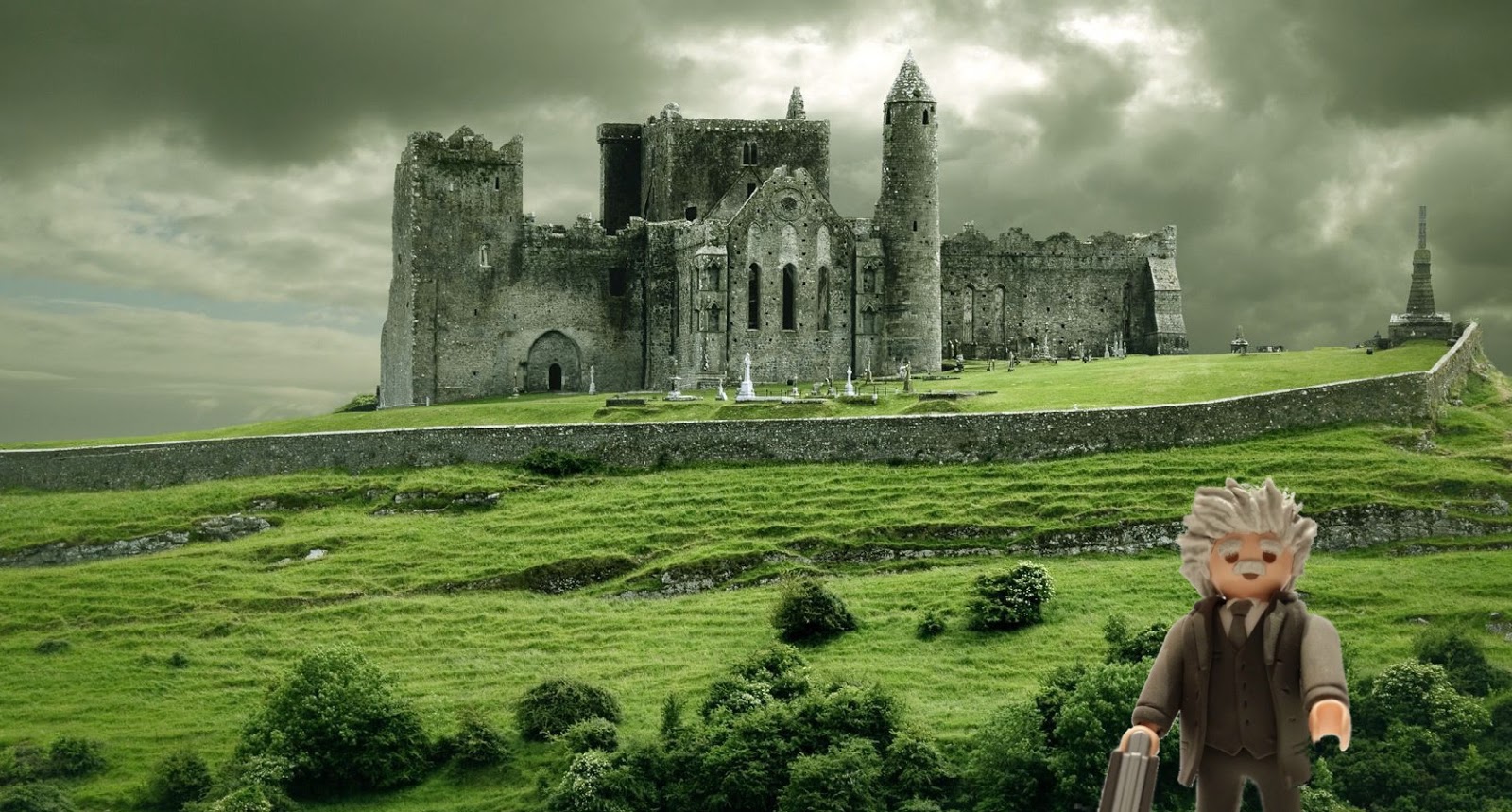
ALBERT EINSTEIN'S HIDDEN STORY IN IRELAND

Albert Einstein in Ireland
Albert Einstein (14 March 1879-18 April 1955) was a German-born theoretical physicist. He developed the theory of relativity, one of the two pillars of modern physics, alongside quantum mechanics. Einstein's work is also known for its influence on the philosophy of science. Einstein is best known in popular culture for his mass, energy equivalence formula E = mc2, which has been dubbed the world's most famous equation. He received the 1921 Nobel Prize in Physics for his services to theoretical physics, and especially for his discovery of the law of the photoelectric effect, a pivotal step in the evolution of quantum theory.

More information: The Journal

Ireland has a proud history of neutrality and it is perhaps for this reason much of the details of Albert Einstein’s 1941 visit to Ireland has been erased from the history books.

What was to be but a short two day visit lasted three months and resulted in the construction of Ireland’s first and only nuclear bomb. Now, The Grandma brings you the true story of Einstein’s visit to these shores and the weapon of mass destruction he built for us.

The world's most famous equation
Famed for his passion for pacifism, Einstein was compelled to visit Ireland and see its neutrality first hand while en route to a series of lectures he was to give at Oxford University in England.

The Taoiseach of the day Eamon de Valera learned of Einstein’s passage to Ireland and invited him to an evening of conversation and conviviality in Dublin.

De Valera laid on a most impressive feast for his guest considering the lack of quality produce available in Ireland during wartime which Einstein greatly appreciated. They toured Dublin’s great whorehouses, not to partake in such practices, but having become wearied by the carrying around loose change all evening they decided to divest themselves of it while helping the local economy.

More information: The Irish Times

The Taoiseach made several requests of Einstein that evening, asking the great physicist to look into creating the most aerodynamically perfect hurley, which he would then send only to the Clare senior hurling team but Einstein declined.


Albert Einstein
After a detour into a noted and infamous opium emporium Einstein claimed to have witnessed visions of great cataclysmic horrors brought forth by war, de Valera too saw troubling sites in his hallucinations; a capital city obsessed with decent lattes and pulled pork.

Truly frightened of what he thought would be a Nazi reign of hipster culture de Valera struck Einstein in the head with an aerodynamically inferior hurley, knocking him out cold.

Einstein would wake in chains in a room de Valera had nicknamed An Dearg Seomra. It was here DeValera made demands of Einstein to create the basis of a foolproof defence against the Nazis: the atomic bomb.

The world famous physicist was forced to work around the clock for days on end until he completed a bomb of terrifying capabilities surviving only on a diet of chomp bars and Guinness.

Albert Einstein
Upon completion of the device Einstein was liberated and carried on his travels to Oxford, leaving de Valera in charge of the bomb along with its security code. In an act of defiance Einstein instituted a code that would irk de Valera: Michael Collins is da best.

The bomb as you may know remained unused as Hitler and his regime were ultimately defeated, but curiously de Valera had stated he would only use the bomb in the event of the Nazis occupying England as it would have hit two birds with one stone.

Subsequent political generations have kept these events as secretive as possible, but when some newspapers began sniffing around the story in the late 90s the Government of the day decided it was best to hide the bomb from public view.

The exact location of the warhead is not known, but it is probably not a coincidence that after quelling the story in the papers they would announce the construction of the Spire the following day.


More information: Biography.com


Try not to become a man of success, 
but rather try to become a man of value.
Albert Einstein