Today, The Grandma has been repairing one of the faucets in her house using a very curious material, Teflon.
This Teflon reminded her of HenriMoissan,the first French Nobel Prizewinner in Chemistry, who first isolatedfluorineon a day like today in 1886.
Fluorine is a relatively new element in human applications. In ancient times, only minor uses of fluorine-containingminerals existed. The industrial use of fluorite, fluorine's source mineral, was first described by early scientist Georgius Agricola in the 16th century, in the context of smelting. The name fluorite (and later fluorine) derives from Agricola's invented Latin terminology. In the late 18th century, hydrofluoric acid was discovered. By the early 19th century, it was recognized that fluorine was a bound element within compounds, similar to chlorine. Fluorite was determined to be calcium fluoride.
Because of fluorine's tight bonding as well as the toxicity of hydrogen fluoride, the element resisted many attempts to isolate it. In 1886, French chemist Henri Moissan, later a Nobel Prize winner, succeeded in making elemental fluorine by electrolyzing a mixture of potassium fluoride and hydrogen fluoride.
Large-scale production and use of fluorine began during World War 2 as part of the Manhattan Project. Earlier in the century, the main fluorochemicals were commercialized by the DuPont company: refrigerant gases (Freon) and polytetrafluoroethylene plastic (Teflon).
Some instances of ancient use of fluorite, main source mineral of fluorine, for ornamental use carvings exist. However, archeological finds are rare, perhaps in part because of the stone's softness. Two Roman cups made of Persian fluorite have been discovered and are currently exhibited at the British museum. Pliny the Elder described a soft stone from Persia used in cups that may have been fluorite. Fluorite carvings from about 1000 AD have been discovered in the Americas in Indian burial grounds.
The word fluorine derives from the Latin stem of the main source mineral, fluorite, which was first mentioned in 1529 by Georgius Agricola, the father of mineralogy. He described fluorite as a flux -an additive that helps melt ores and slags during smelting.
Fluorite stones were called schone flusse in the German of the time. Agricola, writing in Latin but describing 16th century industry, invented several hundred new Latin terms. For the schone flusse stones, he used the Latin noun fluores, fluxes, because they made metal ores flow when in a fire. After Agricola, the name for the mineral evolved to fluorspar (still commonly used) and then to fluorite.
After 74 years of effort by many chemists, on 26 June 1886, Henri Moissanisolated elemental fluorine. Moissan's report to the French Academy of making fluorine showed appreciation for the feat: One can indeed make various hypotheses on the nature of the liberated gas; the simplest would be that we are in the presence of fluorine.
Moissan's 1887 publication documents reaction attempts of fluorine gas with several substances: sulfur (flames), hydrogen (explosion), carbon (no reaction), etc. Later, Moissan devised a less expensive apparatus for making fluorine:copper equipment coated with copper fluoride.
Moissan also constructed special apparatus -5m long platinum tubes with fluorite windows- to determine the slight yellow color of fluorine gas. The gas appears transparent in small tubes or when allowed to escape. The colour observation was not repeated until the 1980s, when his result was confirmed.
Will fluorine ever have practical applications? It is very difficult to answer this question. I may, however, say in all sincerity that I gave this subject little thought when I undertook my researches, and I believe that all the chemists whose attempts preceded mine gave it no more consideration. A scientific research is a search after truth, and it is only after discovery that the question of applicability can be usefully considered.
Today, The Grandma has been reading about Mark I,the IBM AutomaticSequence Controlled Calculator that was officially presented to the Harvard University on a day like today in 1944.
The IBM Automatic Sequence ControlledCalculator (ASCC), called Mark I by Harvard University’s staff, was a general purpose electromechanical computer that was used in the war effort during the last part of World War II.
One of the first programs to run on the Mark I was initiated on 29 March 1944 by John von Neumann. At that time, von Neumann was working on the ManhattanProject, and needed to determine whether implosion was a viable choice to detonate the atomic bomb that would be used a year later. The Mark I also computed and printed mathematical tables, which had been the initial goal of British inventor Charles Babbage for his analytical engine.
The Mark I was disassembled in 1959, but portions of it were displayed in the Science Center as part of the Harvard Collection of Historical Scientific Instruments until being moved to the new Science and Engineering Complex in Allston in July 2021. Other sections of the original machine were transferred to IBM and the Smithsonian Institution.
The original concept was presented to IBM by Howard Aiken in November 1937. After a feasibility study by IBM engineers, the company chairman Thomas Watson Sr. personally approved the project and its funding in February 1939.
Howard Aiken had started to look for a company to design and build his calculator in early 1937.
After two rejections, he was shown a demonstration set that Charles Babbage's son had given to Harvard University 70 years earlier. This led him to study Babbage and to add references of the Analytical Engine to his proposal; the resulting machine brought Babbage’s principles of the Analytical Engine almost to full realization, while adding important new features.
The ASCC was developed and built by IBM at their Endicott plant and shipped to Harvard in February 1944. It began computations for the U.S. Navy Bureau of Ships in May and was officially presented to the university on August 7, 1944.
The ASCC was built from switches, relays, rotating shafts, and clutches. It used 765,000 electromechanical components and hundreds of miles of wire, comprising a volume of 23 m3–16 m in length, 2.4 m in height, and 0.61 m deep. It weighed about 4.3 t. The basic calculating units had to be synchronized and powered mechanically, so they were operated by a 15 m drive shaft coupled to a 3.7 kW electric motor, which served as the main power source and system clock.
The enclosure for the Mark I was designed by futuristic American industrial designer Norman Bel Geddes. Aiken considered the elaborate casing to be a waste of resources, since computing power was in high demand during the war and the funds could have been used to build additional computer equipment.
The Mark I had 60 sets of 24 switches for manual data entry and could store 72 numbers, each 23 decimal digits long. It could do 3 additions or subtractions in a second. A multiplication took 6 seconds, a division took 15.3 seconds, and a logarithm or a trigonometric function took over one minute.
The Mark I read its instructions from a 24-channel punched paper tape. It executed the current instruction and then read in the next one. A separate tape could contain numbers for input, but the tape formats were not interchangeable. Instructions could not be executed from the storage registers. This separation of data and instructions is known as the Harvard architecture.
The main sequence mechanism was unidirectional. This meant that complex programs had to be physically lengthy. A program loop was accomplished by loop unrolling or by joining the end of the paper tape containing the program back to the beginning of the tape. At first, conditional branching in the Mark I was performed manually. Later modifications in 1946 introduced automatic program branching by subroutine call.
The first programmers of the Mark I were computing pioneers Richard Milton Bloch, Robert Campbell, and Grace Hopper. There was also a small technical team whose purpose was to actually operate the machine, some of whom were IBM employees before being required to join the Navy to work on the machine. This technical team was not informed of the purpose of their work while at Harvard.
The 24 channels of the input tape were divided into three fields of eight channels. Each accumulator, each set of switches, and the registers associated with the input, output, and arithmetic units were assigned a unique identifying index number. These numbers were represented in binary on the control tape. The first field was the binary index of the result of the operation, the second was the source datum for the operation, and the third field was a code for the operation to be performed.
In 1928 L.J. Comrie was the first to turn IBMpunched-card equipment to scientific use: computation of astronomical tables by the method of finite differences, as envisioned by Babbage 100 years earlier for his Difference Engine. Very soon after, IBM started to modify its tabulators to facilitate this kind of computation. One of these tabulators, built in 1931, was The Columbia Difference Tabulator.
John von Neumann had a team at Los
Alamos that used modified IBM punched-card machines to determine the
effects of implosion. In March 1944, he proposed to run certain problems
regarding implosion on the Mark I, and in 1944 he arrived with two
mathematicians to write a simulation program to study the implosion of
the first atomic bomb.
The Mark I was followed by the Harvard Mark II (1947 or 1948), MarkIII/ADEC (September 1949), and Harvard Mark IV (1952) –all the work of Aiken.
The Mark II was an improvement over the Mark I, although it still was based on electromechanical relays.
The Mark III used mostly electronic components -vacuum tubes and crystal diodes- but also included mechanical components: rotating magnetic drums for storage, plus relays for transferring data between drums.
The Mark IV was all-electronic, replacing the remaining mechanical components with magnetic core memory. The Mark II and Mark III were delivered to the US Navy base at Dahlgren, Virginia. The Mark IV was built for the US Air Force, but it stayed at Harvard.
IBM's long-standing mantra is 'Think.' What has always made IBM a fascinating and compelling place for me, is the passion of the company, and its people, to apply technology and scientific thinking to major societal issues.
Today, The Grandma has been reading about the last accident in the industrial zone of Tarragona some weeks ago.
Tarragona is a city surrounded by lots of chemical industries that give the city a sensation of permanent danger. Near Tarragona, we can find Ascó a beautiful town with a nuclear central and Vandellós, another amazing town where there was another nuclear plant that is dismantled nowadays.
Uranium and Plutonium are dangerous elements that we have in our planet and we must use them correctly and with the biggest of precautions. On a day like today in 1941, Plutonium was first produced and isolated by Dr. Glenn T. Seaborg and The Grandma wants to talk about this historical event.
Plutonium is a radioactive chemical element with the symbol Pu and atomic number 94. It is an actinide metal of silvery-gray appearance that tarnishes when exposed to air, and forms a dull coating when oxidized.
The element normally exhibits six allotropes and four oxidation states. It reacts with carbon, halogens, nitrogen, silicon, and hydrogen. When exposed to moist air, it forms oxides and hydrides that can expand the sample up to 70% in volume, which in turn flake off as a powder that is pyrophoric. It is radioactive and can accumulate in bones, which makes the handling of plutonium dangerous.
Plutonium was first produced and isolated on December 14, 1940, by a deuteron bombardment of uranium-238 in the 1.5 metre cyclotron at the University of California, Berkeley. First, neptunium-238 was synthesized, which subsequently beta-decayed to form the new element with atomic number 94 and atomic weight 238.
Since uranium had been named after the planet Uranus and neptunium after the planet Neptune, element 94 was named after Pluto, which at the time was considered to be a planet as well. Wartime secrecy prevented the University of California team from publishing its discovery until 1948.
Plutonium is the element with the highest atomic number to occur in nature. Trace quantities arise in natural uranium-238 deposits when uranium-238 captures neutrons emitted by decay of other uranium-238 atoms. Plutonium is much more common on Earth since 1945 as a product of neutron capture and beta decay, where some of the neutrons released by the fission process convert uranium-238 nuclei into plutonium-239.
Dr. Glenn T. Seaborg
Both plutonium-239 and plutonium-241 are fissile, meaning that they can sustain a nuclear chain reaction, leading to applications in nuclear weapons and nuclear reactors. Plutonium-240 exhibits a high rate of spontaneous fission, raising the neutron flux of any sample containing it. The presence of plutonium-240 limits a plutonium sample's usability for weapons or its quality as reactor fuel, and the percentage of plutonium-240 determines its grade -weapons-grade, fuel-grade, or reactor-grade. Plutonium-238 has a half-life of 87.7 years and emits alpha particles. It is a heat source in radioisotope thermoelectric generators, which are used to power some spacecraft.
Plutonium isotopes are expensive and inconvenient to separate, so particular isotopes are usually manufactured in specialized reactors.
Producing plutonium in useful quantities for the first time was a major part of the Manhattan Project during World War II that developed the first atomic bombs.
The Fat Man bombs used in the Trinity nuclear test in July 1945, and in the bombing of Nagasaki in August 1945, had plutonium cores. Human radiation experiments studying plutonium were conducted without informed consent, and several criticality accidents, some lethal, occurred after the war.
Disposal of plutonium
waste from nuclear power plants and dismantled nuclear weapons built
during the Cold War is a nuclear-proliferation and environmental
concern. Other sources of plutonium in the environment are fallout from
numerous above-ground nuclear tests, now banned.
Enrico Fermi and a team of scientists at the University of Rome reported that they had discovered element 94 in 1934. Fermi called the element hesperium and mentioned it in his Nobel Lecture in 1938. The sample was actually a mixture of barium, krypton, and other elements, but this was not known at the time. Nuclear fission was discovered in Germany in 1938 by Otto Hahn and Fritz Strassmann. The mechanism of fission was then theoretically explained by Lise Meitner and Otto Frisch.
Plutonium (specifically, plutonium-238) was first produced and isolated on December 14, 1940, and chemically identified on February 23, 1941, by Glenn T. Seaborg, Edwin McMillan, Joseph W. Kennedy, and Arthur Wahl by deuteron bombardment of uranium in the 150 cm cyclotron at the BerkeleyRadiation Laboratory at the University of California, Berkeley.
In the 1940 experiment, neptunium-238 was created directly by the bombardment but decayed by beta emission with a half-life of a little over two days, which indicated the formation of element 94.
Plutonium
A paper documenting the discovery was prepared by the team and sent to the journal Physical Review in March 1941, but publication was delayed until a year after the end of World War II due to security concerns.
At the Cavendish Laboratory in Cambridge, Egon Bretscher and Norman Feather realized that a slow neutron reactor fuelled with uranium would theoretically produce substantial amounts of plutonium-239 as a by-product. They calculated that element 94 would be fissile, and had the added advantage of being chemically different from uranium, and could easily be separated from it.
McMillan had recently named the first transuranic element neptunium after the planet Neptune, and suggested that element 94, being the next element in the series, be named for what was then considered the next planet, Pluto.
Nicholas Kemmer of the Cambridge team independently proposed the same name, based on the same reasoning as the Berkeley team. Seaborg originally considered the name plutium, but later thought that it did not sound as good as plutonium. He chose the letters Pu as a joke, in reference to the interjection P U to indicate an especially disgusting smell, which passed without notice into the periodic table. Alternative names considered by Seaborg and others were ultimium or extremium because of the erroneous belief that they had found the last possible element on the periodic table.
During World War II the U.S. government established the Manhattan Project, which was tasked with developing an atomic bomb. The three primary research and production sites of the project were the plutonium production facility at what is now the Hanford Site, the uranium enrichment facilities at Oak Ridge, Tennessee, and the weapons research and design laboratory, now known as Los Alamos National Laboratory.
The first production reactor that made plutonium-239 was the X-10 Graphite Reactor. It went online in 1943 and was built at a facility in Oak Ridge that later became the Oak Ridge National Laboratory.
In January 1944, workers laid the foundations for the first chemical separation building, T Plant located in 200-West. Both the T Plant and its sister facility in 200-West, the U Plant, were completed by October. U Plant was used only for training during the Manhattan Project. The separation building in 200-East, B Plant, was completed in February 1945. The second facility planned for 200-East was canceled.
Plutonium
Nicknamed Queen Marys by the workers who built them, the separation buildings were awesome canyon-like structures 800 feet long, 65 feet wide, and 80 feet high containing forty process pools.
The interior had an eerie quality as operators behind seven feet of concrete shielding manipulated remote control equipment by looking through television monitors and periscopes from an upper gallery. Even with massive concrete lids on the process pools, precautions against radiation exposure were necessary and influenced all aspects of plant design.
On April 5, 1944, Emilio Segrè at Los Alamos received the first sample of reactor-produced plutonium from Oak Ridge. Within ten days, he discovered that reactor-bred plutonium had a higher concentration of the isotope plutonium-240 than cyclotron-produced plutonium.
Plutonium-240 has a high spontaneous fission rate, raising the overall background neutron level of the plutonium sample. The original gun-type plutonium weapon, code-named Thin Man, had to be abandoned as a result -the increased number of spontaneous neutrons meant that nuclear pre-detonation (fizzle) was likely.
The entire plutonium weapon design effort at Los Alamos was soon changed to the more complicated implosion device, code-named Fat Man. With an implosion weapon, plutonium is compressed to a high density with explosive lenses -a technically more daunting task than the simple gun-type design, but necessary to use plutonium for weapons purposes. Enriched uranium, by contrast, can be used with either method.
Construction of the Hanford B Reactor, the first industrial-sized nuclear reactor for the purposes of material production, was completed in March 1945. B Reactor produced the fissile material for the plutonium weapons used during World War II. B, D and F were the initial reactors built at Hanford, and six additional plutonium-producing reactors were built later at the site.
By the end of January 1945, the highly purified plutonium underwent further concentration in the completed chemical isolation building, where remaining impurities were removed successfully. Los Alamos received its first plutonium from Hanford on February 2.
Glenn Seaborg's ID Badge and Slide Rule
While it was still by no means clear that enough plutonium could be produced for use in bombs by the war's end, Hanford was by early 1945 in operation. Only two years had passed since Col. Franklin Matthias first set up his temporary headquarters on the banks of the Columbia River.
According to Kate Brown, the plutonium production plants at Hanford and Mayak in Russia, over a period of four decades, both released more than 200 million curies of radioactive isotopes into the surrounding environment -twice the amount expelled in the Chernobyl disaster in each instance.
Most of this radioactive contamination over the years were part of normal operations, but unforeseen accidents did occur and plant management kept this secret, as the pollution continued unabated.
In 2004, a safe was discovered during excavations of a burial trench at the Hanford nuclear site. Inside the safe were various items, including a large glass bottle containing a whitish slurry which was subsequently identified as the oldest sample of weapons-grade plutonium known to exist. Isotope analysis by Pacific Northwest National Laboratory indicated that the plutonium in the bottle was manufactured in the X-10 Graphite Reactor at Oak Ridge during 1944.
The first atomic bomb test, codenamed Trinity and detonated on July 16, 1945, near Alamogordo, New Mexico, used plutonium as its fissile material.
The implosion design of the gadget, as the Trinity device was code-named, used conventional explosive lenses to compress a sphere of plutonium into a supercritical mass, which was simultaneously showered with neutrons from the Urchin, an initiator made of polonium and beryllium, neutron source: (α, n) reaction.
Together, these ensured a runaway chain reaction and explosion. The overall weapon weighed over 4 tonnes, although it used just 6.2 kg of plutonium in its core. About 20% of the plutonium used in the Trinity weapon underwent fission, resulting in an explosion with an energy equivalent to approximately 20,000 tons of TNT.
An identical design was used in the Fat Man atomic bomb dropped on Nagasaki, Japan, on August 9, 1945, killing 35,000–40,000 people and destroying 68%–80% of war production at Nagasaki.
Only after the announcement of the first atomic bombs was the existence and name of plutonium made known to the public by the Manhattan Project's Smyth Report.
Today, The Grandma has visited Norah, an old friend from Venezuela who lives now in Barcelona. They have been talking about MountCarmel, the coastal mountain range in northern Israel, and about the Apollo11 which carried the first crewed lunar landing mission on a day like today in 1969.
The Saturn V SA-506 carrying Apollo 11, the first crewed lunar landing mission, on July 16, 1969, at 13:32 UTC. Launching from Launch Pad 39A at Florida's Kennedy Space Center, the five Rocketdyne F-1 engines of the rocket's S-IC first stage can be seen arrayed in a quincunx, with a fixed centre engine and four outer engines that gimballed for steering.
The USA wrote incredible stories in our world history. The Apollo 11 was one of them, but The Grandma has also wanted to remember another story that shows how science sometimes can play against the interests of the Humanity. It is the story of the Manhattan Project, a project also started in the USA twenty-seven years before the Apollo 11 arrived to the Moon, a project which is considered the beginning of the nuclear age.
The Manhattan Project was a research and development undertaking during World War II that produced the first nuclear weapons.
It was led by the United States with the support of the United Kingdom and Canada. From 1942 to 1946, the project was under the direction of Major General Leslie Groves of the U.S. Army Corps of Engineers. Nuclear physicist Robert Oppenheimer was the director of the Los Alamos Laboratory that designed the actual bombs.
The Army component of the project was designated the Manhattan District;Manhattan gradually superseded the official codename, Development of Substitute Materials, for the entire project. Along the way, the project absorbed its earlier British counterpart, Tube Alloys.
The Gadget, the Manhattan Project
The Manhattan Project
beganmodestly in 1939, but grew to employ more than 130,000 people and
cost nearly US$2 billion, about $23 billion in 2018 dollars. Over 90%
of the cost was for building factories and to produce fissile material,
with less than 10% for development and production of the weapons. Research and production took place at more than 30 sites across the UnitedStates, the United Kingdom, and Canada.
Two types of atomic bombs were developed concurrently during the war: a relatively simple gun-type fission weapon and a more complex implosion-type nuclear weapon. The Thin Man gun-type design proved impractical to use with plutonium, and therefore a simpler gun-type called Little Boy was developed that used uranium-235, an isotope that makes up only 0.7 percent of natural uranium. Chemically identical to the most common isotope, uranium-238, and with almost the same mass, it proved difficult to separate the two. Three methods were employed for uranium enrichment: electromagnetic, gaseous and thermal. Most of this work was performed at the Clinton Engineer Works at Oak Ridge, Tennessee.
In parallel with the work on uranium was an effort to produce plutonium. After the feasibility of the world's first artificial nuclear reactor was demonstrated in Chicago at the Metallurgical Laboratory, it designed the X-10 Graphite Reactor at Oak Ridge and the production reactors in Hanford, Washington, in which uranium was irradiated and transmuted into plutonium. The plutonium was then chemically separated from the uranium, using the bismuth phosphate process. The Fat Man plutonium implosion-type weapon was developed in a concerted design and development effort by the Los Alamos Laboratory.
The project was also charged with gathering intelligence on the German nuclear weapon project.
Through Operation Alsos, Manhattan Project personnel served in Europe, sometimes behind enemy lines, where they gathered nuclear materials and documents, and rounded up German scientists. Despite the Manhattan Project's tight security, Soviet atomic spies successfully penetrated the program.
The Manhattan Project Sites
The first nuclear device ever detonated was an implosion-type bomb at the Trinity test,conducted at New Mexico's Alamogordo Bombing and Gunnery Range on 16 July 1945.
Little Boy and Fat Manbombs were used a month later in the atomic bombings of Hiroshima and Nagasaki, respectively. In the immediate postwar years, the Manhattan Project conducted weapons testing at Bikini Atoll as part of Operation Crossroads, developed new weapons, promoted the development of the network of national laboratories, supported medical research into radiology and laid the foundations for the nuclear navy. It maintained control over American atomic weapons research and production until the formation of the United States Atomic Energy Commission in January 1947.
The discovery of nuclear fission by German chemists Otto Hahn and Fritz Strassmann in 1938, and its theoretical explanation by Lise Meitner and Otto Frisch, made the development of an atomic bomb a theoretical possibility. There were fears that a German atomic bomb project would develop one first, especially among scientists who were refugees from Nazi Germany and other fascist countries.
In August 1939,
Hungarian-born physicists Leó Szilárd and Eugene Wigner drafted the
Einstein–Szilárd letter, which warned of the potential development of extremely powerful bombs of a new type.
It urged the United States to take steps to acquire stockpiles of
uranium ore and accelerate the research of Enrico Fermi and others into
nuclear chain reactions. They had it signed by AlbertEinstein and delivered to President Franklin D. Roosevelt.
Roosevelt called on Lyman Briggs of the National Bureau of Standards to
head the Advisory Committee on Uranium to investigate the issues raised
by the letter. Briggs held a meeting on 21 October 1939, which was
attended by Szilárd, Wigner and Edward Teller. The committee reported
back to Roosevelt in November that uranium would provide a possible source of bombs with a destructiveness vastly greater than anything now known.
The Advisory Committee on Uranium became the National Defense Research Committee (NDRC) on Uranium when that organization was formed on 27 June 1940. Briggs proposed spending $167,000 on research into uranium, particularly the uranium-235 isotope, and the recently discovered plutonium.
On 28 June 1941, Roosevelt signed Executive Order 8807, which created the Office of Scientific Research and Development (OSRD), with Vannevar Bush as its director. The office was empowered to engage in large engineering projects in addition to research. The NDRC Committee on Uranium became the S-1 Section of the OSRD; the word uranium was dropped for security reasons.
At 05:30 on 16 July 1945 a gadget exploded with an energy equivalent of around 20 kilotons of TNT, leaving a crater of Trinitite -radioactive glass- in the desert 76 m wide. The shock wave was felt over 160 km away, and the mushroom cloud reached 12.1 km in height. It was heard as far away as El Paso, Texas, so Groves issued a cover story about an ammunition magazine explosion at Alamogordo Field.
Carme Bean wanted to visit the Ground Zero in New York City. This is, perhaps, one of the saddest visits that you can do in the city, but memory is always the best testimony of history and you don't have to forget these facts although you must learn to live with them.
The origins of the term ground zero began with the Trinity test in Jornada del Muerto desert near Socorro, New Mexico, and the atomic bombings of Hiroshima and Nagasaki in Japan. The Strategic Bombing Survey of the atomic attacks, released in June 1946, used the term liberally, defining it as: For convenience, the term 'ground zero' will be used to designate the point on the ground directly beneath the point of detonation, or 'air zero'.
William Laurence, an embedded reporter with the Manhattan Project, reported that Zero was the code name given to the spot chosen for the Trinity test in 1945.
The Beans on the top seeing NYC views
The Oxford English Dictionary, citing the use of the term in a 1946 New York Times report on the destroyed city of Hiroshima, defines ground zero as that part of the ground situated immediately under an exploding bomb, especially an atomic one.
The World Trade Center site, formerly known as Ground Zero after the September 11 attacks, is a 5.9 ha area in Lower Manhattan in New York City. The previous World Trade Center complex stood on the site until it was destroyed in the September 11 attacks.
The Port Authority of New York and New Jersey (PANYNJ), Silverstein Properties, and the Lower Manhattan Development Corporation (LMDC) oversee the reconstruction of the site according to a master plan by Studio Daniel Libeskind.
The site is bounded by Vesey Street to the north, the West Side Highway to the west, Liberty Street to the south, and Church Street to the east. The Port Authority owns the site's land, except for 7 World Trade Center. Developer Larry Silverstein holds the lease to retail and office space in four of the site's buildings.
The World Trade Center is a living symbol of man's dedication to world peace... a representation of man's belief in humanity,
his need for individual dignity, his beliefs in the cooperation of men,
and, through cooperation, his ability to find greatness.
Albert Einstein (14 March 1879-18 April 1955) was a German-born theoretical physicist. He developed the theory of relativity, one of the two pillars of modern physics, alongside quantum mechanics. Einstein's work is also known for its influence on the philosophy of science. Einstein is best known in popular culture for his mass, energy equivalence formula E = mc2, which has been dubbed the world's most famous equation. He received the 1921 Nobel Prize in Physicsfor his services to theoretical physics, and especially for his discovery of the law of the photoelectric effect, a pivotal step in the evolution of quantum theory.
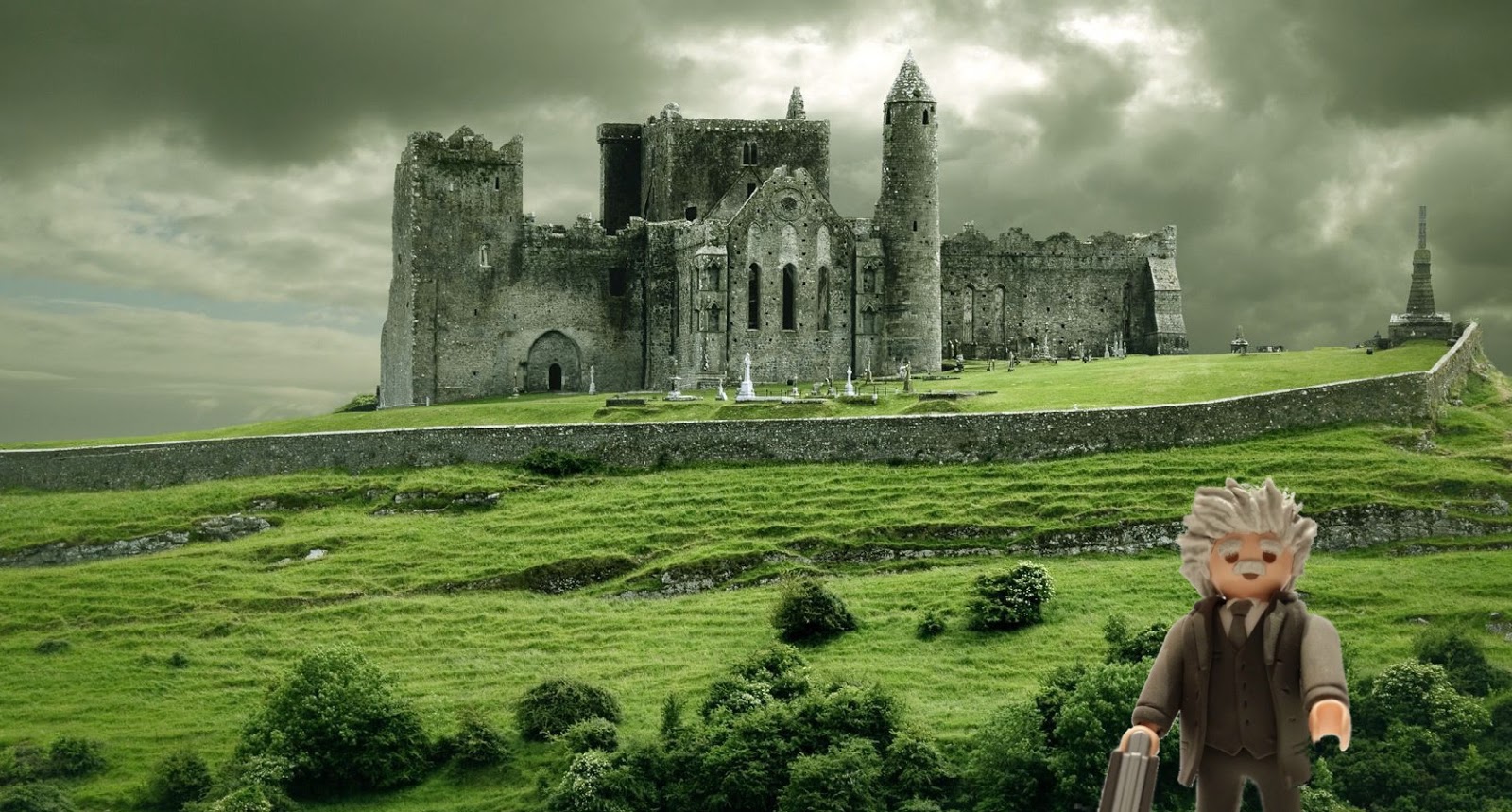
Ireland has a proud history of neutrality and it is perhaps for this reason much of the details of Albert Einstein’s 1941 visit to Ireland has been erased from the history books.
What was to be but a short two day visit lasted three months and resulted in the construction of Ireland’s first and only nuclear bomb. Now, The Grandma brings you the true story of Einstein’s visit to these shores and the weapon of mass destruction he built for us.
The world's most famous equation
Famed for his passion for pacifism, Einstein was compelled to visit Ireland and see its neutrality first hand while en route to a series of lectures he was to give at Oxford University in England.
The Taoiseach of the day Eamon de Valera learned of Einstein’s passage to Ireland and invited him to an evening of conversation and conviviality in Dublin.
De Valera laid on a most impressive feast for his guest considering the lack of quality produce available in Ireland during wartime which Einstein greatly appreciated. They toured Dublin’s great whorehouses, not to partake in such practices, but having become wearied by the carrying around loose change all evening they decided to divest themselves of it while helping the local economy.
The Taoiseach made several requests of Einstein that evening, asking the great physicist to look into creating the most aerodynamically perfect hurley, which he would then send only to the Clare senior hurling team but Einstein declined.
Albert Einstein
After a detour into a noted and infamous opium emporium Einstein claimed to have witnessed visions of great cataclysmic horrors brought forth by war, de Valera too saw troubling sites in his hallucinations; a capital city obsessed with decent lattes and pulled pork.
Truly frightened of what he thought would be a Nazi reign of hipster culture de Valera struck Einstein in the head with an aerodynamically inferior hurley, knocking him out cold.
Einstein would wake in chains in a room de Valera had nicknamed An Dearg Seomra. It was here DeValera made demands of Einstein to create the basis of a foolproof defence against the Nazis: the atomic bomb.
The world famous physicist was forced to work around the clock for days on end until he completed a bomb of terrifying capabilities surviving only on a diet of chomp bars and Guinness.
Albert Einstein
Upon completion of the device Einstein was liberated and carried on his travels to Oxford, leaving de Valera in charge of the bomb along with its security code. In an act of defiance Einstein instituted a code that would irk de Valera: Michael Collins is da best.
The bomb as you may know remained unused as Hitler and his regime were ultimately defeated, but curiously de Valera had stated he would only use the bomb in the event of the Nazis occupying England as it would have hit two birds with one stone.
Subsequent political generations have kept these events as secretive as possible, but when some newspapers began sniffing around the story in the late 90s the Government of the day decided it was best to hide the bomb from public view.
The exact location of the warhead is not known, but it is probably not a coincidence that after quelling the story in the papers they would announce the construction of the Spire the following day.
.jpg)