Showing posts with label Ukraine. Show all posts

Thursday, 21 April 2022

THE KHARKIV PACT, UKRAINE & RUSSIAN NATURAL GAS

Today, The Grandma has been reading about the Kharkiv Pact, the Agreement between Ukraine and Russia on the Black Sea Fleet in Ukraine.

Nowadays, the situation between these two nations is under a cruel and bloody war with thousans of innocent victims, as always happens in every war.

The Agreement between Ukraine and Russia on the Black Sea Fleet in Ukraine, widely referred to as the Kharkiv Pact, in Ukrainian Харківський пакт or Kharkov Accords, in Russian Харьковские соглашения, was a treaty between Ukraine and Russia whereby the Russian lease on naval facilities in Crimea was extended beyond 2017 until 2042, with an additional five-year renewal option in exchange for a multiyear discounted contract to provide Ukraine with Russian natural gas.

The agreement, signed on 21 April 2010 in Kharkiv, Ukraine, by Ukrainian President Viktor Yanukovych and Russian President Dmitry Medvedev and ratified by the parliaments of the two countries on 27 April 2010, aroused much controversy in Ukraine.

The treaty was effectively a continuation of the lease provisions that were part of the 1997 Black Sea Fleet Partition Treaty between the two states. Shortly after the regime change on 22 February 2014 and the annexation of Crimea by the Russian Federation in March 2014, Russia unilaterally terminated the treaty on 31 March 2014.

In 1997, Russia and Ukraine signed the Partition Treaty, establishing two independent national fleets and dividing armaments and bases between them. Ukraine also agreed to lease major parts of its new bases in Sevastopol to the Russian Black Sea Fleet until 2017.

During the presidency of Victor Yushchenko (January 2005-February 2010) the Ukrainian government declared that the lease would not be extended and that the fleet would have to leave Sevastopol by 2017.

More information: Outriders

Amid several Russia-Ukraine gas disputes, including a halt of natural gas supplies to European countries, the price that Ukraine had to pay for Russian natural gas was raised in 2006 and in 2009.

The Prime Minister of Ukraine, Mykola Azarov, and the Energy Minister, Yuriy Boyko, were in Moscow in late March 2010 to negotiate lower gas prices; neither clearly explained what Ukraine was prepared to offer in return.

Following these talks Russian Prime Minister Vladimir Putin stated that Russia was prepared to discuss the revision of the price for natural gas it sells to Ukraine. Mid-April Ukrainian officials stated they are seeking an average price of $240-$260 per 1000 cubic metres for 2010. Ukraine paid an average of $305 in the first quarter of 2010 and $330 in the second quarter.

On 21 April 2010, Russian President Dmitry Medvedev and Ukrainian President Viktor Yanukovych signed an agreement in which Russia agreed to a 30% drop in the price of natural gas sold to Ukraine. Russia agreed to this in exchange for permission to extend Russia's lease of a major naval base in the Ukrainian Black Sea port of Sevastopol for an additional 25 years (to 2042) with an option for a further 5-year renewal (to 2047). The agreement put a cap on the scale of price hikes; but the main unfavourable terms for Ukraine of the 2009 gas contract remained in place.

We have indeed reached an unprecedented agreement," the Russian president stated. "The rent [for the naval base] will be increased by an amount equivalent to that of the [gas price] discount.

The agreement was subject to approval by both the Russian and Ukrainian parliaments. Both parliaments ratified the agreement on 27 April 2010.

More information: Day Kyiv

Ratification in the Ukrainian parliament proved controversial, and several disturbances occurred during the process. In one incident, several eggs were thrown towards the speaker, Volodymyr Lytvyn, by deputies.

On 28 March 2014, one week after the annexation of Crimea by Russia Russian President Vladimir Putin submitted proposals to the State Duma on the termination of the legal effect of a number of Russian-Ukrainian agreements, including the 2010 Kharkiv Pact treaty and the Partition Treaty on the Status and Conditions of the Black Sea Fleet. The State Duma unanimously approved the unilateral dissolution of these Russian-Ukrainian agreements with 433 members of parliament voting on 31 March 2014.

In June 2010, Ukraine paid Gazprom around $234 per 1,000 cubic metres. However, Ukrainian consumers experienced a 50% increase on household natural gas utility prices in July 2010, a key demand of the International Monetary Fund in exchange for a $15 billion loan.

Payments increased annually since then: in August 2011, Ukraine paid Russia $350 per 1,000 cubic metres; in November 2011, it paid $400 per 1,000 cubic meters; and in January 2013, it paid $430 per 1,000 cubic metres.

In August 2011, Ukrainian Prime Minister Mykola Azarov stated that Ukraine seeks to reduce imports of Russian natural gas by two-thirds, compared with 2010, by 2016.

The treaty allowed Russia to station a limited number of troops in Crimea, 25,000 maximum.

In summer of 2014, the General Prosecutor of Ukraine opened a criminal case against Viktor Yanukovych on several charges.

More information: The Guardian


On the day I became Soviet leader, in March 1985,
I had a special meeting with the leaders
of the Warsaw Pact countries and told them:
'You are independent, and we are independent.
You are responsible for your policies,
we are responsible for ours.
We will not intervene in your affairs, I promise you.

Mikhail Gorbachev

Monday, 26 April 2021

CHERNOBYL, THE WORST NUCLEAR DISASTER IN HISTORY

On a day like today in 1986, the Chernobyl disaster occurred. It is considered the worst nuclear in our history and today, years and years later, the effects of this terrible tragedy are still visible.

The citizens of Pripyat and the members of the emergency services who were the first to arrive to the central to try to avoid more tragic consequences were the most affected. The most part of them died or suffered (and suffer) the sequels of this terrible accident.

The Grandma wants to talk about this incident, and she wants to think about the real necessity of having nuclear plants when we are a planet rich in natural sources and green energies.

The Chernobyl disaster was a nuclear accident that occurred on Saturday 26 April 1986, at the No. 4 reactor in the Chernobyl Nuclear Power Plant, near the city of Pripyat in the north of the Ukrainian SSR in the Soviet Union.

It is considered the worst nuclear disaster in history both in terms of cost and casualties, and is one of only two nuclear energy accidents rated at seven -the maximum severity- on the International Nuclear Event Scale, the other being the 2011 Fukushima Daiichi nuclear disaster in Japan.

The initial emergency response, together with later decontamination of the environment, ultimately involved more than 500,000 personnel and cost an estimated 18 billion Soviet rubles -roughly US$68 billion in 2019, adjusted for inflation.

The accident started during a safety test on an RBMK-type nuclear reactor. The test was a simulation of an electrical power outage to help create a safety procedure for maintaining reactor cooling water circulation until the back-up electrical generators could provide power. Three such tests had been conducted since 1982, but they had failed to provide a solution. On this fourth attempt, an unexpected 10-hour delay meant that an unprepared operating shift was on duty.

More information: Chornobyl NPP

During the planned decrease of reactor power in preparation for the electrical test, the power unexpectedly dropped to a near-zero level.

The operators were able to only partially restore the specified test power, which put the reactor in an unstable condition. This risk was not made evident in the operating instructions, so the operators proceeded with the electrical test. Upon test completion, the operators triggered a reactor shutdown, but a combination of unstable conditions and reactor design flaws caused an uncontrolled nuclear chain reaction instead.

A large amount of energy was suddenly released, and two explosions ruptured the reactor core and destroyed the reactor building.

One was a highly destructive steam explosion from the vaporizing superheated cooling water; the other explosion could have been another steam explosion or a small nuclear explosion, akin to a nuclear fizzle. This was immediately followed by an open-air reactor core fire that released considerable airborne radioactive contamination for about nine days that precipitated onto parts of the USSR and Western Europe, especially Belarus, 16 km away, where around 70% landed, before being finally contained on 4 May 1986.

The fire gradually released about the same amount of contamination as the initial explosion. As a result of rising ambient radiation levels off-site, a 10-kilometre radius exclusion zone was created 36 hours after the accident. About 49,000 people were evacuated from the area, primarily from Pripyat. The exclusion zone was later increased to 30 kilometres when a further 68,000 people were evacuated from the wider area.

More information: World Nuclear Association

The reactor explosion killed two of the reactor operating staff. A massive emergency operation to put out the fire, stabilize the reactor, and clean-up the ejected nuclear core began. In the disaster and immediate response, 134 station staff and firemen were hospitalized with acute radiation syndrome due to absorbing high doses of ionizing radiation. Of these 134 people, 28 died in the days of months afterward and approximately 14 suspected radiation-induced cancer deaths followed within the next 10 years. Significant clean-up operations were taken in the exclusion zone to deal with local fallout, and the exclusion zone was made permanent.

Among the wider population, an excess of 15 childhood thyroid cancer deaths were documented as of 2011. The United Nations Scientific Committee on the Effects of Atomic Radiation (UNSCEAR) has, at multiple times, reviewed all the published research on the incident and found that at present, fewer than 100 documented deaths are likely to be attributable to increased exposure to radiation.

Determining the total eventual number of exposure related deaths is uncertain based on the linear no-threshold model, a contested statistical model, which has also been used in estimates of low level radon and air pollution exposure. Model predictions with the greatest confidence values of the eventual total death toll in the decades ahead from Chernobyl releases vary, from 4,000 fatalities when solely assessing the three most contaminated former Soviet states, to about 9,000 to 16,000 fatalities when assessing the total continent of Europe. 

To reduce the spread of radioactive contamination from the wreckage and protect it from weathering, the protective Chernobyl Nuclear Power Plant sarcophagus was built by December 1986.

It also provided radiological protection for the crews of the undamaged reactors at the site, which continued operating.

Due to the continued deterioration of the sarcophagus, it was further enclosed in 2017 by the Chernobyl New Safe Confinement, a larger enclosure that allows the removal of both the sarcophagus and the reactor debris, while containing the radioactive hazard. Nuclear clean-up is scheduled for completion in 2065.

The ionizing radiation levels in the worst-hit areas of the reactor building have been estimated to be 5.6 roentgens per second (R/s), equivalent to more than 20,000 roentgens per hour. A lethal dose is around 500 roentgens (~5 Gray (Gy) in modern radiation units) over five hours, so in some areas, unprotected workers received fatal doses in less than a minute. However, a dosimeter capable of measuring up to 1,000 R/s was buried in the rubble of a collapsed part of the building, and another one failed when turned on. All remaining dosimeters had limits of 0.001 R/s and therefore read off scale. Thus, the reactor crew could ascertain only that the radiation levels were somewhere above 0.001 R/s, while the true levels were much higher in some areas.

Because of the inaccurate low readings, the reactor crew chief Aleksandr Akimov assumed that the reactor was intact. The evidence of pieces of graphite and reactor fuel lying around the building was ignored, and the readings of another dosimeter brought in by 04:30 were dismissed under the assumption that the new dosimeter must have been defective. Akimov stayed with his crew in the reactor building until morning, sending members of his crew to try to pump water into the reactor. None of them wore any protective gear. Most, including Akimov, died from radiation exposure within three weeks.

More information: BBC

The nearby city of Pripyat was not immediately evacuated. The townspeople, in the early hours of the morning, at 01:23 local time, went about their usual business, completely oblivious to what had just happened. However, within a few hours of the explosion, dozens of people fell ill. Later, they reported severe headaches and metallic tastes in their mouths, along with uncontrollable fits of coughing and vomiting. As the plant was run by authorities in Moscow, the government of Ukraine did not receive prompt information on the accident.

To expedite the evacuation, residents were told to bring only what was necessary, and that they would remain evacuated for approximately three days. As a result, most personal belongings were left behind, and remain there today.

By 15:00, 53,000 people were evacuated to various villages of the Kiev region. The next day, talks began for evacuating people from the 10-kilometre zone. Ten days after the accident, the evacuation area was expanded to 30 kilometres.

The Chernobyl Nuclear Power Plant Exclusion Zone has remained ever since, although its shape has changed and its size has been expanded.

 More information: United States Nuclear Regulatory Commission

The surveying and detection of isolated fallout hotspots outside this zone over the following year eventually resulted in 135,000 long-term evacuees in total agreeing to be moved.

The years between 1986 and 2000 saw the near tripling in the total number of permanently resettled persons from the most severely contaminated areas to approximately 350,000.

Contamination from the Chernobyl accident was scattered irregularly depending on weather conditions, much of it deposited on mountainous regions such as the Alps, the Welsh mountains and the Scottish Highlands, where adiabatic cooling caused radioactive rainfall.

The resulting patches of contamination were often highly localized, and localized water-flows contributed to large variations in radioactivity over small areas.

Sweden and Norway also received heavy fallout when the contaminated air collided with a cold front, bringing rain. There was also groundwater contamination.

More information: National Geographic


Chernobyl is a unique place on the planet,
where nature revives after a world-wide man-made disaster,
where there is a real 'ghost town.'

Volodymyr Zelensky

Monday, 4 May 2020

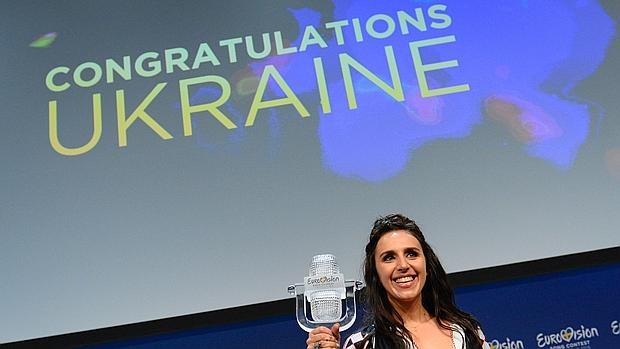
JAMALA SINGS '1984', THE UKRANIAN FIRST TRIUMPH

Jamala won Eurovision in 2016
Today, The Grandma has been talking with The Watsons about Susana Alimivna Jamaladinova, aka Jamala, the Ukrainian singer, actress and songwriter who won the Eurovision Song Contest representing Ukraine in 2016 and singing 1944.

Before talking about Jamala, The Grandma has offered a new Cambridge Key English Test A2 Example to The Watsons.


Susana Alimivna Jamaladinova (born 27 August 1983), better known by her stage name Jamala, is a Ukrainian singer, actress and songwriter. She represented Ukraine and won the Eurovision Song Contest 2016 in Stockholm, Sweden with her song 1944.

Susana Jamaladinova was born in Osh, Kirghiz SSR, to a Crimean Tatar father and an Armenian mother. Her Crimean Tatar ancestors were forcibly resettled from Crimea to the central Asian republic under Joseph Stalin during World War II, although her own relatives fought on the Soviet side. In 1989 her family returned to Crimea. Her maternal ancestors are Armenians from Nagorno-Karabakh. They were well-to-do peasants until her great-grandfather's land was confiscated and he was exiled to Osh where he changed his Armenian name to make it sound more Russian.

Jamala speaks Russian as her mother tongue, and she is also fluent in Ukrainian and English which she learned as an adolescent. Though she wrote some songs in Crimean Tatar, she is not fluent in the language.

Her parents divorced for about four years so that her mother could purchase a house in Crimea for the family under her maiden name. During this period, Soviet authorities did not allow ethnic Crimean Tatars, like her father, to purchase property in Crimea.


More information: Wiwi Blogs

Jamala has been fond of music since her early childhood. She made her first professional recording at the age of nine, singing 12 folk and children's Crimean Tatar songs. She entered the Simferopol Music College and later graduated from Tchaikovsky National Music Academy of Ukraine as an opera singer, but preferred a career in pop music.

On 14 February 2010, she released her first single You Are Made of Love from her debut studio album For Every Heart. She released It's Me, Jamala as the second single on 18 October 2010.


On 23 November 2010, she released Smile as the third single from the album.

Early in 2011, she participated on the national selection show in an attempt to represent Ukraine at the Eurovision Song Contest with the song Smile. The song was a crowd favorite and Jamala herself managed to land a spot in the finals of the competition. However, she later decided to withdraw from the competition.


Jamala won Eurovision in 2016
On 12 April 2011, she released her debut studio album For Every Heart through Moon Records Ukraine.

On 8 November 2012, she released Ya Lyublyu Tebya as the lead single from her second studio album All or Nothing.

She released Hurt as the second single, and Kaktus in Ukrainian Ка́ктус» was released on 6 March 2013, as the third and final single from the album. She released All or Nothing on 19 March 2013, through Moon Records Ukraine.

On 25 September 2014, she released Zaplutalas, in Ukrainian Заплу́талась, as the lead single from her debut EP Thank You. The EP was released on 1 October 2014, through Enjoy Records.

On 26 March 2015, Ochyma was released as the lead single from her third studio album. Shlyakh dodomu, in Ukrainian Шлях додо́му, was released as the second single on 18 May 2015.

On 15 June 2015, Podykh, in Ukrainian По́дих, was released as the third single. She released her album Podykh on 12 October 2015, through Enjoy Records.


More information: VOA News

Jamala successfully represented Ukraine in the Eurovision Song Contest 2016 with the song 1944.


The song is about the deportation of the Crimean Tatars in 1944 and particularly about her great-grandmother, who lost her daughter while being deported to Central Asia. Jamala wrote the song's lyrics in 2014.

In the second semi-final of the contest, Jamala performed 14th and was one of ten participants who qualified for the grand final. It was announced later that she placed second, scoring 287 points, and won the televoting with 152 points.

On 14 May 2016, Jamala won the competition with 534 points. Jamala's song was considered by Russian media and lawmakers to be critical of the Russian annexation of Crimea in 2014 and the ongoing war between Russia and Ukraine in Donbass. For this reason it has been announced that no other flags than the official country-participant are allowed in the arena for the Eurovision Song Contest. This included a ban for flags like Crimean Tatars' flags to be in audience, and only the Ukrainian flags was allowed for her Crimean Tatars' supporters.


Jamala won Eurovision in 2016
After her win in the Eurovision Song Contest, she was awarded the title People's Artist of Ukraine by Ukrainian President.

After winning Eurovision 2016, she has gone on to publish many songs, including I Believe in U, which she performed at Eurovision 2017 as an interval act, along with Zamanyly.

On 17 May 2016, it was announced that the Ukrainian Foreign Ministry would be nominating Jamala as a UNICEF Goodwill Ambassador.

On 12 October 2018, Jamala released her fifth studio album, Kryla. The title track was released as the first single on 21 March 2018. She had previously performed the track as the interval act for the 2018 Ukrainian National Selection for the Eurovision Song Contest, Vidbir.

On 26 April 2017, Jamala married Bekir Suleimanov. Their relationship became known in September 2016, when she appeared with him at the Manhattan Short Film Festival. The couple married in the Islamic Cultural Center of Kyiv using the traditional wedding ceremony Nikah. Suleimanov had recently graduated from the Physics and Mathematics Department of Taras Shevchenko National University of Kyiv and is an activist of the Muslim Crimean Tatar community.


More information: The Guardian

1944 is a song written and performed by Ukrainian singer Jamala. It represented Ukraine in the Eurovision Song Contest 2016 and won with a total of 534 points.

The lyrics for 1944 concern the deportation of the Crimean Tatars, in the 1940s, by the Soviet Union at the hands of Joseph Stalin because of their alleged collaboration with the Nazis.


Jamala was particularly inspired by the story of her great-grandmother Nazylkhan, who was in her mid-20s when she and her five children were deported to barren Central Asia. One of the daughters did not survive the journey. Jamala's great-grandfather was fighting in World War II in the Red Army at this time and thus could not protect his family. The song was also released amid renewed repression of Crimean Tatars following the Russian annexation of Crimea, since most Crimean Tatars refuse to accept the annexation.

Jamala won Eurovision in 2016
The English lyrics were written by the poet Art Antonyan.

The song's chorus, in the Crimean language, is made up of words from a Crimean Tatar folk song called Ey Güzel Qırım that Jamala had heard from her great-grandmother, reflecting on the loss of a youth which could not be spent in her homeland. The song features the duduk played by Aram Kostanyan and the use of the mugham vocal style.

Jamala represented Ukraine in the Eurovision Song Contest 2016, performing in the second half of the second semi-final...

1944 is the first Eurovision song to contain lyrics in the Crimean language. She won the final receiving the second highest televoting score and second highest jury vote.

More information: The Local

In a February 2016 interview with The Guardian, Jamala said that the song also reminded her of her own family living in Crimea nowadays, claiming that since the 2014 Russian annexation of Crimea the Crimean Tatars are on occupied territory. The song lyrics, however, do not address this annexation. Eurovision rules prohibit songs with lyrics that could be interpreted as having political content.


On 9 March 2016, a tweet from the European Broadcasting Union confirmed that neither the title nor the lyrics of the song contained political speech and therefore it did not breach any Eurovision rule, thus allowing it to remain in the competition.

Immediately after the selection of this song, some Russian politicians, as well as authorities in Crimea, accused the Ukrainian authorities of using the song to offend Russia and capitalising on the tragedy of the Tatars to impose on European viewers a false picture of alleged harassment of the Tatars in the Russian Crimea.

More information: DW


When strangers are coming
They come to your house
They kill you all
and say
We’re not guilty
not guilty.


Yaşlığıma toyalmadım
Men bu yerde yaşalmadım
Yaşlığıma toyalmadım
Men bu yerde yaşalmadı.


Jamala

Thursday, 23 February 2017

JOANJO BOND & M.JOSÉ BOND: FLY, FLY, FLY TO WIN

The Bonds flying to Kiev, Ukraine
Today, The Bonds are in Kiev, the capital of Ukraine. They are arriving there to participate in the Eurovision Song Contest.

Before starting to sing, the family has been talking about Some, Any and No compounds and have practised some exercises about Present Perfect vs. Past Simple.

After doing this, The Bonds have demonstrated their best skills playing incredible songs with all their heart. They've introduced themselves and their countries and they have played the songs.

More information: Some, Any and No Compounds

Finally, after a votation full of suprises, Joanjo Bond has won the Contest with his song Fly, fly, fly. Joanjo is from Cyprus and this is the first time that this country wins this Contest, then you can imagine Juanjo's emotion and feelings when he has realized he was going to have this fantastic honour, but Juanjo hasn't done it alone. 

A day in Eurovision with The Bonds
Eurovision is a Contest where is very important having allies and good friends and in this case, Juanjo has received the unforgettable help of M.José Bond, from Norway

They have offered a complete show with all the ingredients: vocal quality, deep lyrics, synchronized choreography and great tones of happiness and sense of humour.

The Bonds have dedicated this prize to David and Irene Bond, from Croatia and Poland, two members of this nice family who had to stay in Paris for laboural reasons.

Tonight, the family is flying to Tenerife in Canary Islands where they want to enjoy the Carnival and celebrate this Eurovision's Prize.


 I started at 5 years old in the kitchen table with my family supporting me. PedroJuanjoI know where I'm from and I know exactly where I'm going.

Céline Dion

Friday, 27 January 2017

REPUTATION: FAME AND RECOGNITION FOREVER

Juanjo and Miriam Bond ready to sing
Today, The Bonds are practising some aspects of Social English and grammar. The family is talking about kosher food and how important is for the Jewish community, in general and Capçanes, in particulary.

More information: BBC Learning English

After some exercises, The Grandma is explaining some stories about Oscar Wilde and Rosalía de Castro two incredible authors who wrote in their native languages: Irish and Galician and François Aragó, a French scientific who studied the timezones.

The Bonds want to participate in the next Eurovision Song Contest in Ukraine. For this reason, they're creating some songs based on the Coplas of Jorge Manrique, the famous Castillian writer.


More information: Eurovision.tv

Finally, the family is talking about the future and about how to prepare it looking for some connections between the past and the present which can be very useful to success in an interview.


 What I like to drink most is wine that belongs to others.
Diogenes

Saturday, 31 January 2015

GEMMA & CAMBRIDGE EXAMS

Last Thursday, we reviewed Future Continuous, some connectors and Zero Conditional. We created a new composition about Occitan Poetry and Gipsy’s tarot and we worked with the W- questions. MJ visited us and talked about the next Cambridge Exams (KET and PET) and their date: 16 May. We talked about online education and some methods of knowledge.


The Collins Family has continued Gemma’s searching. She’s missing since the boat, where all the family was sailing, sunk in the middle of the Mediterranean Sea. It seems that Gemma is fine because the family has received some tweets located in an unknown spot. 


In the middle of the river
I found your heart.

If you want to give me your life

Give me it, give me it, baby!

Give me it, give me it, baby!


Eva C., Karen & Montse Pottery (Cyprus, Ukraine and Germany)