Showing posts with label Present Simple. Show all posts

Monday, 13 April 2026

JANE GOODALL & DAVID ATTENBOROUGH AT LONDON ZOO

Today, The Morgans and The Grandma have visited London Zoo

It has been a very special visit because they have had the amazing of two English celebrities: Jane Goodall, the English primatologist and anthropologist, and David Attenborough, the English broadcaster, natural historian and writer, who have been their guides and informants during this unforgettable visit.

Before the visit, the family has been reviewing English grammar with the Present Simple and Comparatives of Equality Adjectives.

More information: Present Simple

More information: Comparative Equality Adjectives

Download Animals Vocabulary 

London Zoo, previously known as ZSL London Zoo or London Zoological Gardens and sometimes called Regent's Park Zoo, is the world's oldest scientific zoo. It was opened in London on 27 April 1828, and was originally intended to be used as a collection for scientific study.

In 1831 or 1832, the animals of the Tower of London menagerie were transferred to the zoo's collection. It was opened to the public in 1847. As of December 2022, it houses a collection of 14,926 individuals, making it one of the largest collections in the United Kingdom.

It is managed under the aegis of the Zoological Society of London (established in 1826), and is situated at the northern edge of Regent's Park, on the boundary line between the City of Westminster and the borough of Camden (the Regent's Canal runs through it). 

The Society also has a more spacious site at Whipsnade Zoo in Bedfordshire to which the larger animals such as elephants and rhinos have been moved. As well as being the first scientific zoo, London Zoo also opened the first reptile house (1849), the first public aquarium (1853), first insect house (1881) and the first children's zoo (1938).

ZSL receives no state funding and relies on 'Fellows' and 'Friends' memberships, entrance fees, venue hire, and sponsorship to generate income.

The Zoological Society of London (ZSL) was established by Sir Stamford Raffles and Sir Humphry Davy in 1826, who obtained the land for the zoo and saw the plans before Raffles died of apoplexy (a stroke) later that year on 5 July, his birthday. After his death, Henry Petty-Fitzmaurice, 3rd Marquess of Lansdowne took over the project and supervised the building of the first animal houses. The zoo opened in April 1828 to fellows of the Society, providing access to species such as Arabian oryx, greater kudus, orangutan and the now extinct quagga and thylacine. The Society was granted a royal charter in 1829 by King George IV, and in 1847 the zoo opened to the public to aid funding.

More information: London Zoo

Dame Jane Morris Goodall, 3 April 1934, formerly Baroness Jane van Lawick-Goodall, is an English primatologist and anthropologist. Considered to be the world's foremost expert on chimpanzees, Goodall is best known for her over 55-year study of social and family interactions of wild chimpanzees since she first went to Gombe Stream National Park, Tanzania in 1960. 

She is the founder of the Jane Goodall Institute and the Roots & Shoots programme, and she has worked extensively on conservation and animal welfare issues. She has served on the board of the Nonhuman Rights Project since its founding in 1996. In April 2002, she was named a UN Messenger of Peace

More information: The Jane Goodall Institute

Valerie Jane Morris-Goodall was born in 1934 in Hampstead, to Mortimer Herbert Morris-Goodall, a businessman, and Margaret Myfanwe Joseph, a novelist who wrote under the name Vanne Morris-Goodall.

As a child, as an alternative to a teddy bear her father gave Goodall a stuffed chimpanzee named Jubilee, and she has said her fondness for this figure started her early love of animals, commenting that My mother's friends were horrified by this toy, thinking it would frighten me and give me nightmares. Today, Jubilee still sits on Goodall's dresser in London.

Goodall had always been passionate about animals and Africa, which brought her to the farm of a friend in the Kenya highlands in 1957. From there, she obtained work as a secretary, and acting on her friend's advice, she telephoned Louis Leakey, the notable Kenyan archaeologist and palaeontologist, with no other thought than to make an appointment to discuss animals.  

Leakey, believing that the study of existing great apes could provide indications of the behaviour of early hominids, was looking for a chimpanzee researcher, though he kept the idea to himself. Instead, he proposed that Goodall work for him as a secretary. After obtaining approval from his wife Mary Leakey, Louis sent Goodall to Olduvai Gorge in Tanzania, where he laid out his plans.

In 1958, Leakey sent Goodall to London to study primate behaviour with Osman Hill and primate anatomy with John Napier. Leakey raised funds, and on 14 July 1960, Goodall went to Gombe Stream National Park, becoming the first of what would come to be called The Trimates. She was accompanied by her mother, whose presence was necessary to satisfy the requirements of David Anstey, chief warden, who was concerned for their safety; Tanzania was Tanganyika at that time and a British protectorate.
 
More information: British Council

Leakey arranged funding and in 1962, he sent Goodall, who had no degree, to Cambridge University. She went to Newnham College, and obtained a PhD degree in ethology

She became the eighth person to be allowed to study for a PhD there without first having obtained a BA or BSc. Her thesis was completed in 1965 under the tutorship of Robert Hinde, titled Behaviour of free-living chimpanzees, detailing her first five years of study at the Gombe Reserve.

Goodall is best known for her study of chimpanzee social and family life. She began studying the Kasakela chimpanzee community in Gombe Stream National Park, Tanzania, in 1960. Without collegiate training directing her research, Goodall observed things that strict scientific doctrines may have overlooked. Instead of numbering the chimpanzees she observed, she gave them names such as Fifi and David Greybeard, and observed them to have unique and individual personalities, an unconventional idea at the time. 

She found that, it isn't only human beings who have personality, who are capable of rational thought and emotions like joy and sorrow. She also observed behaviours such as hugs, kisses, pats on the back, and even tickling, what we consider human actions. 

Goodall insists that these gestures are evidence of the close, supportive, affectionate bonds that develop between family members and other individuals within a community, which can persist throughout a life span of more than 50 years

These findings suggest that similarities between humans and chimpanzees exist in more than genes alone, but can be seen in emotion, intelligence, and family and social relationships.
 
More information: National Geographic
 
Goodall's research at Gombe Stream is best known to the scientific community for challenging two long-standing beliefs of the day: that only humans could construct and use tools, and that chimpanzees were vegetarians. 

While observing one chimpanzee feeding at a termite mound, she watched him repeatedly place stalks of grass into termite holes, then remove them from the hole covered with clinging termites, effectively fishing for termites. The chimps would also take twigs from trees and strip off the leaves to make the twig more effective, a form of object modification which is the rudimentary beginnings of toolmaking. Humans had long distinguished ourselves from the rest of the animal kingdom as Man the Toolmaker

In response to Goodall's revolutionary findings, Louis Leakey wrote, We must now redefine man, redefine tool, or accept chimpanzees as human!

In 1977, Goodall established the Jane Goodall Institute (JGI), which supports the Gombe research, and she is a global leader in the effort to protect chimpanzees and their habitats. 

With nineteen offices around the world, the JGI is widely recognised for community-centred conservation and development programs in Africa. Its global youth program, Roots & Shoots began in 1991 when a group of 16 local teenagers met with Goodall on her back porch in Dar es Salaam, Tanzania. They were eager to discuss a range of problems they knew about from first-hand experience that caused them deep concern. The organisation now has over 10,000 groups in over 100 countries.

Goodall credits the 1986 Understanding Chimpanzees conference, hosted by the Chicago Academy of Sciences, with shifting her focus from observation of chimpanzees to a broader and more intense concern with animal-human conservation. She is the former president of Advocates for Animals, an organisation based in Edinburgh, Scotland, that campaigns against the use of animals in medical research, zoos, farming and sport.

More information: Wanderlust
 
  
Chimpanzees, gorillas, orangutans 
have been living for hundreds of thousands of years 
in their forest, living fantastic lives, 
never overpopulating, never destroying the forest.

I would say that they have been 
in a way more successful than us 
as far as being in harmony with the environment. 

Jane Goodall

Wednesday, 14 February 2024

MARTA FOSTER, ALL YOU NEED IS LOVE & GOOD LUCK

Today, The Fosters and The Grandma have travelled to Liverpool to meet John Lennon and The Beatles
 
Liverpool is a city in Merseyside, North West England. It is located on the eastern side of the Mersey Estuary, adjacent to the Irish Sea, and is approximately 286 km from London. The name comes from the Old English lifer, meaning thick or muddy water, and pōl, meaning a pool or creek, and is first recorded around 1190 as Liuerpul.

They are going to spend two days in this amazing city, and they are going to say goodbye to Marta Foster, the Thai prospector who has found the most important treasure in life: LOVE.

During the travel, the family has been studying Present Simple and State Verbs.

More information: Present Simple

More information: State Verbs

More information: Free Time Activities

All You Need Is Love is a song by the English rock band the Beatles that was released as a non-album single in July 1967.

It was written by John Lennon and credited to the Lennon–McCartney partnership. The song was Britain's contribution to Our World, the first live global television link, for which the band were filmed performing it at EMI Studios in London on 25 June.

The programme was broadcast via satellite and seen by an audience of over 400 million in 25 countries. Lennon's lyrics were deliberately simplistic, to allow for the show's international audience, and captured the utopian ideals associated with the Summer of Love. The single topped sales charts in Britain, the United States and many other countries, and became an anthem for the counterculture's embrace of flower power philosophy.

Our World coincided with the height of the Beatles' popularity and influence, following the release of their album Sgt. Pepper's Lonely Hearts Club Band. Rather than perform the song entirely live, the group played to a pre-recorded backing track. With an orchestral arrangement by George Martin, the song begins with a portion of the French national anthem and ends with musical quotations from works such as Glenn Miller's In the Mood, Greensleeves, Bach's Invention No. 8 in F major, and the Beatles' 1963 hit She Loves You. Adding to the broadcast's festive atmosphere, the studio was adorned with signs and streamers and filled with guests dressed in psychedelic attire, including members of the Rolling Stones, the Who and the Small Faces. Brian Epstein, the Beatles' manager, described the performance as the band's finest moment.

All You Need Is Love was later included on the US Magical Mystery Tour album and served as the moral for the Beatles' 1968 animated film Yellow Submarine. Originally broadcast in black-and-white, the Our World performance was colourised for inclusion in the Beatles' 1995 Anthology documentary series.

While the song remains synonymous with the 1967 Summer of Love ethos and provided the foundation for Lennon's legacy as a humanitarian, numerous critics found the message naive in retrospect, particularly during the 1980s.

Since 2009, Global Beatles Day, an international celebration of the Beatles' music and social message, takes place on 25 June each year in tribute to their Our World performance.

In the decades following the record's release, Beatles biographers and music journalists criticised the lyrics as naive and simplistic and detected a smugness in the message; the song's musical content was similarly dismissed as unimaginative.

More information: The History Press


Love, love, love
Love, love, love
Love, love, love

There's nothing you can do that can't be done (love)
Nothing you can sing that can't be sung (love)
Nothing you can say, but you can learn how to play the game (love)

It's easy

Nothing you can make that can't be made (love)
No one you can save that can't be saved (love)
Nothing you can do, but you can learn how to be you in time (love)

It's easy

All you need is love
All you need is love, love

Love is all you need

Love, love, love
Love, love, love
Love, love, love

Love is all you need

Nothing you can know that isn't known (love)
Nothing you can see that isn't shown (love)
There's nowhere you can be that isn't where you're meant to be, it's easy

The Beatles

Tuesday, 13 February 2024

THE FOSTERS HAVE BREAKFAST WITH BRIDGET JONES

Today, The Fosters and The Grandma have met Bridget Jones, the
single, engagingly imperfect, and worried about her weight publisher, well-known by her Diary. 
 
Before meeting Bridget, the family has adopted a new member, Joan Foster, a street musician, who they have met playing and performing in Covent Garden.

Welcome to the family, Joan!
 
Finally, the family has been studying Present Simple.

More information: Present Simple
 

Bridget Jones is a British trilogy based on the novels of Helen Fielding. The main characters of the movies are Bridget Jones (Renée Zellweger), Mark Darcy (Colin Firth), Daniel Cleaver (Hugh Grant) and Jack Qwant (Patrick Dempsey).
 
Bridget Jones's Diary is a 2001 romantic comedy film directed by Sharon Maguire and written by Richard Curtis, Andrew Davies, and Helen Fielding.

It is based on Fielding's 1996 novel of the same name, which is a reinterpretation of Jane Austen's Pride and Prejudice. The adaptation stars Renée Zellweger as Bridget; Colin Firth as Bridget's true love, Mark Darcy; and Hugh Grant as the caddish Daniel Cleaver. Production began in August 2000 and ended in November 2000, and took place largely on location in London and the Home Counties. The film premiered on 4 April 2001 in the United Kingdom and was released to theatres on 13 April 2001 simultaneously in the United Kingdom and in the United States.

Bridget Jones's Diary received positive reviews and was a commercial success, grossing over $280 million worldwide. Zellweger was nominated for the Academy Award for Best Actress for her role in the film.

A sequel, Bridget Jones: The Edge of Reason, was released in 2004, and another sequel, Bridget Jones's Baby, was released in 2016.

Bridget Jones (Renée Zellweger) is 32, single, engagingly imperfect, and worried about her weight. She works at a publishing company in London where her main focus is fantasizing about her boss, Daniel Cleaver (Hugh Grant). At her parents' New Year party Bridget is introduced to Mark Darcy (Colin Firth), a childhood acquaintance and barrister, son of her parents' friends. Mark finds Bridget foolish and vulgar and Bridget thinks Mark arrogant and rude, and is disgusted by his novelty Christmas jumper. Overhearing Mark grumble to his mother about her attempt to set him up with a verbally incontinent spinster who smokes like a chimney, drinks like a fish and dresses like her mother, Bridget decides to turn her life around. She begins keeping a diary to chronicle her attempts to stop smoking, lose weight, and find her Mr. Right.

Bridget and Daniel begin to flirt heavily at work, ahead of an important book launch, at which Bridget bumps into Mark and his glamorous but haughty colleague Natasha (Embeth Davidtz). Bridget leaves with Daniel and they have dinner, despite Daniel's notorious reputation as a womaniser. Daniel tells Bridget that he and Mark were formerly friends but says Mark slept with Daniel's fiancée, for which they now hate each other. Bridget and Daniel start dating.
 
Bridget is invited to a family party, originally a Tarts & Vicars costume party which is tied into a mini break weekend with Daniel. They spend the day before the party at a country inn where Mark and Natasha are also staying. The morning of the party Daniel says he must return to London for work and leaves Bridget to endure the party alone. When she returns to London & drops in on Daniel, she discovers his American colleague, Lara en flagrante (Lisa Barbuscia), naked in his flat. Bridget cuts ties with him and immediately searches for a new career. She lands a new job in television, and when Daniel pleads with her to stay, she declares that she would rather have a job wiping Saddam Hussein's arse.

Bridget attends a friend's long-standing dinner party, where she is the only single person. Once again she crosses paths with Mark and Natasha. Mark privately confesses to Bridget that, despite her faults, he likes her just as you are. Some time later, as a well known barrister, he allows Bridget an exclusive TV interview in a landmark legal case which boosts her career and allows her to begin to see him in a different light.

Bridget begins to develop feelings for Mark, and when she misguidedly and somewhat disastrously, attempts to cook her own birthday dinner party, he comes to her rescue. A drunken Daniel arrives after a happy dinner celebration with Bridget's friends and Mark, and temporarily monopolizes Bridget's attention. Mark leaves, but returns to challenge Daniel and the two fight in the street, eventually smashing through a window of a Greek restaurant. They eventually call a draw only to have Daniel mutter wanker at Mark as he turns away and which only Mark can hear; Mark knocks Daniel down; shocked, Bridget chides Mark and he leaves, but after a self-serving appeal from Daniel, she rejects him as well.

Bridget's mother, Pamela (Gemma Jones) has left Bridget's father, Colin (Jim Broadbent) and begun an affair with perma-tanned shopping channel presenter Julian. When the affair ends, she returns to the Jones's family home with an unintentional revelation: Mark and Daniel's falling-out resulted from Daniel (then Mark's best friend at Cambridge University) sleeping with Mark's wife which Mark walked in on, not the other way around.

At the Darcys' ruby wedding anniversary party the same day, Bridget confesses her feelings for Mark, only to learn that he and Natasha have accepted jobs in New York and are on the verge of an engagement, according to Mark's father. Bridget interrupts the toast with an emotionally moving speech which peters out as she realizes the hopelessness of her position; her words clearly have an effect on Mark, but he still flies to New York. Bridget's friends rally to repair her broken heart with a surprise trip to Paris, but as they are about to leave, Mark appears at Bridget's flat.

Just as they are about to kiss for the first time, Bridget flies to her bedroom to change into sexier underwear. Mark peeks at her diary, finds her older unflattering opinions of him, and leaves. Bridget, realising what he has read and that she might lose him again, runs outside after him in the snow in her tiger skin-print underwear and a skimpy jumper, but is unable to find him. Disheartened, she is about to return home when Mark appears with a new diary for her to make a fresh start. They kiss in the snow-covered street, and Bridget remarks that nice boys don't kiss like that, to which Mark retorts Oh, yes, they fucking do.

More information: The Guardian


 Well, better dash. I’ve got another party to go to.
It’s single people… mainly poofs. Bye!

Bridget Jones
 
 
Bridget Jones: The Edge of Reason is a 2004 romantic comedy film directed by Beeban Kidron and written by Adam Brooks, Richard Curtis, Andrew Davies, and Helen Fielding, based on Fielding's 1999 novel of the same name. It stars Renée Zellweger as Bridget Jones, Colin Firth as Mark Darcy, and Hugh Grant as Daniel Cleaver.

The sequel to Bridget Jones's Diary (2001), the film was released in the United Kingdom on 12 November 2004 and in the United States a week later on 19 November 2004 to generally negative reviews from film critics. Despite this, the film was a box office success, grossing over $260 million worldwide.

Bridget Jones (Renée Zellweger) is ecstatic about her new relationship with Mark Darcy (Colin Firth). However, Bridget's confidence is shattered when she meets Mark's assistant, the beautiful, slim, quick-witted Rebecca Gillies (Jacinda Barrett). At her job on TV morning show Sit-Up Britain, Bridget crosses paths with her ex, Daniel Cleaver (Hugh Grant), and is offered a position alongside Cleaver in a new travel series. Bridget initially refuses, declaring Daniel a deceitful, sexist, disgusting specimen of humanity, but eventually signs on, despite her friends' misgivings.


Bridget is delighted when Mark invites her to his Law Council Dinner, believing he will propose afterward. However, a series of fashion/cosmetic mishaps make the evening a debacle, culminating in the team trivia quiz: Bridget makes a critical error on a question about Madonna, which Rebecca Gillies wins, leaving Bridget thoroughly deflated.

After the dinner, Mark and Bridget argue and she leaves in a huff. Mark goes to Bridget's apartment, apologizes, and tells her he loves her for the first time. Later that night, Mark invites Bridget on a ski holiday to Lech, Austria. On the slopes, she learns Rebecca recommended the vacation spot and that she is there as well with a few other colleagues. Bridget suspects that she is pregnant since her period is late, but after an argument over the upbringing and education of their future children, the pregnancy test proves negative. Returning home, Bridget and Mark attend a lunch with their parents, where Bridget is hurt by Mark's dismissal of their prospective marriage.

Bridget
overhears a suspicious message from Rebecca on Mark's answering machine and dissects it with her friends, who advise her to confront him; Bridget does, Mark refuses to dignify the question with an answer, and Bridget breaks up with him. She travels to Thailand with her friend, Shazzer (Sally Phillips) and Daniel Cleaver to film The Smooth Guide. Bridget and Daniel visit several exotic locations and flirtily reconnect, but Bridget's trust in Daniel is again demolished by the arrival of a prostitute he ordered, and she realizes he has not changed his boorish ways.

Shazzer has a fling with the much younger Jed (Paul Nicholls), who gives her an ivory tusk as a gift to take back to Britain, which winds up in Bridget's bag. When security dogs at the airport detect a large stash of cocaine inside the tusk, Bridget is arrested and sent to a Thai prison and locked in a cell with almost 50 other Thai female inmates. Feeling low and scared but glad at the friendliness of the inmates, Bridget shares relationship advice with the other inmates and teaches them to sing and dance to Madonna's Like a Virgin. Mark arrives to tell Bridget that her release has been put in motion. After confirming Jed as the true perpetrator and that Bridget spent the night with Daniel Cleaver, he declares that her sex life does not interest him; Bridget does not correct his presumption, and he departs, leaving Bridget certain he no longer loves her. Back in Britain, Mark confronts Daniel for abandoning Bridget in Thailand, and they fight outside an art gallery in Kensington Gardens. Daniel swears off Bridget for good and sarcastically suggests to Mark, Why don't you just marry her?

Bridget arrives at Heathrow Airport as an international human rights celebrity. She is greeted by her parents, who have been busy planning their vow renewal ceremony. At home, Bridget is surprised by her friends, who reveal that Mark personally tracked down the drug trafficker Jed, secured his custody and extradition, and forced him to admit Bridget's innocence. Hopeful that Mark still loves her, Bridget immediately runs to his house. She finds Rebecca there and assumes she is romantically involved with Mark, but Rebecca reveals that she is actually infatuated with Bridget and kisses her; though flattered, Bridget politely turns her down.

Bridget confronts Mark at his legal chambers and asks him to give her another chance. Mark proposes to Bridget and she accepts. The film ends with Bridget's parents renewing their vows and Bridget catching the bouquet.

More information: The Guardian


I truly believe that happiness is possible...
even when you're thirty-three and have a bottom
the size of two bowling balls.
 
Bridget Jones
 
 
Bridget Jones's Baby is a 2016 romantic comedy film directed by Sharon Maguire and written by Helen Fielding, Dan Mazer and Emma Thompson, based on the fictional columns by Fielding. It is the third film in the franchise and a sequel to 2004 film Bridget Jones: The Edge of Reason. The film stars Renée Zellweger as Bridget Jones, who after becoming pregnant is unsure if Mark Darcy (Colin Firth, also reprising his role) or Jack Qwant (Patrick Dempsey) is the father.

Filming began on 2 October 2015 in London. The film was released theatrically on 16 September 2016 in the United Kingdom and United States and on 5 October in France. It received generally positive reviews and grossed over $211 million worldwide.

On her forty-third birthday, Bridget Jones attends the funeral of Daniel Cleaver, presumed dead after a plane crash. She sees her ex Mark Darcy with his new wife Camilla.

Bridget
now works as a television producer and is close friends with anchor Miranda. After spending the night of her birthday alone, Bridget embraces her single life, accepting Miranda's offer to go to a music festival where she meets a man called Jack. Later that evening a drunk Bridget crawls into a yurt she thinks belongs to her and Miranda, but actually belongs to Jack. Despite the surprise, Jack invites her to stay and the two have a one-night stand. In the morning, finding the bed empty, Bridget leaves, unaware Jack is out getting breakfast for both of them.

Returning home, Bridget goes to the christening of Jude's youngest child, where she is the godmother and Mark has been asked to be the godfather at the last minute. Mark tells her that he and his wife are divorcing and Camilla was only at the funeral for moral support. Realising they are still in love, Bridget and Mark spend the night together. Mark says he is travelling for work early the next day, so Bridget exits before he wakes up, leaving behind a note telling him that reconnecting with him is too painful.

A few weeks later, Bridget realises she is pregnant. She decides that she wants to keep the baby despite being single, as it might be her last chance to have a child. After a visit to the clinic of Dr. Rawling, she realises that the father could be Mark or Jack. She is unable to contact Jack until Miranda spots him on an TV ad and they realise he is Jack Qwant, a billionaire inventor of a dating website.

Miranda conspires with Bridget to have Jack as a guest on their news show so that they can take DNA samples to work out if Jack is the father. Although Bridget tries to stay incognito, Jack recognises her and asks her why she left after their night together. She apologises and decides to tell him that she is pregnant and that he is the father, without mentioning Mark. Initially taken aback at the responsibility of having a child with a stranger, Jack throws himself into the role of being a father. Bridget also tells Mark the news who is so thrilled at the prospect that she cannot find the courage to tell him about Jack. Dr Rawlings tries to administer a DNA test, but Bridget decides not to go ahead with it while her child is still in the womb as she is terrified by the risk of miscarriage.

Bridget invites Jack to a work event, and is startled when Mark shows up as well. The two men meet, and the three go out to dinner, where Bridget finally admits that she is unsure who the father is. Although disappointed, Jack takes the news well, but Mark is upset and walks out though he eventually becomes supportive as well. Mark and Jack eventually become jealous of each other and when Jack implies that he and Bridget had sex without condoms Mark leaves and ignores Bridget's calls. Jack asks her to move in with him, but he eventually confesses to Bridget what he told Mark. Upset, Bridget rushes to talk to Mark, but sees his wife arriving at his house, so she walks away.

Nine months into her pregnancy Bridget finds herself locked out in the rain. Mark arrives and breaks into the flat for her. After Bridget asks him about his wife at his flat, he informs her that she was there to pick up the last of her things. Just as they are about to kiss, Bridget's water breaks. When his phone rings for work, Mark throws it out the window, which, although romantic, leaves them without a means to call help. They eventually make it to the hospital with some help from Jack. Later Jack apologises to Mark for his behaviour. Bridget gives birth to a boy, and her friends and parents come to visit them. Rawlings takes Mark and Jack away to perform the DNA test, and they genuinely wish each other luck.

A year later, Bridget is at church for her wedding to Mark. Jack Qwant attends as a guest and holds onto Bridget and Mark's son William.

Later a newspaper lying on a bench reveals that Daniel Cleaver has been found alive.

More information: The Guardian


Sometimes you love someone
because he is not the same as you.
And sometimes you love someone
because it feels like home.

Bridget Jones

Tuesday, 20 June 2023

ENJOYING THE BRITISH MUSEUM WITH THE WEASLEYS

Today, The Weasleys & The Grandma have visited the British Museum, a must in this city. They have spent a wonderful day between masterpieces of all time.

Before visiting this amazing place, the family has been practising Present Simple and the Adverbs of Frequency.

More information: AoF

The British Museum is a public institution dedicated to human history, art and culture and it is considered one of the most important museums of the world thanks to its more than two hundred thirty million objects.

The British Museum opened on a day like today in 1759 and The Grandma wants to commemorate this event talking about the Museum and its history.

The British Museum, in the Bloomsbury area of London, United Kingdom, is a public institution dedicated to human history, art and culture. Its permanent collection of some eight million works is among the largest and most comprehensive in existence, having been widely sourced during the era of the British Empire. It documents the story of human culture from its beginnings to the present. It was the first public national museum in the world.

More information: British Musem

The British Museum was established in 1753, largely based on the collections of the Irish physician and scientist Sir Hans Sloane.

It first opened to the public in 1759, in Montagu House, on the site of the current building. Its expansion over the following 250 years was largely a result of expanding British colonisation and has resulted in the creation of several branch institutions, the first being the Natural History Museum in 1881.

In 1973, the British Library Act 1972 detached the library department from the British Museum, but it continued to host the now separated British Library in the same Reading Room and building as the museum until 1997. The museum is a non-departmental public body sponsored by the Department for Digital, Culture, Media and Sport, and as with all national museums in the UK it charges no admission fee, except for loan exhibitions.

Its ownership of some of its most famous objects originating in other countries is disputed and remains the subject of international controversy, most notably in the case of the Parthenon Marbles.

Although today principally a museum of cultural art objects and antiquities, the British Museum was founded as a universal museum. Its foundations lie in the will of the Irish physician and naturalist Sir Hans Sloane (1660–1753), a London-based doctor and scientist from Ulster.


During the course of his lifetime, and particularly after he married the widow of a wealthy Jamaican planter, Sloane gathered a large collection of curiosities and, not wishing to see his collection broken up after death, he bequeathed it to King George II, for the nation, for a sum of £20,000. At that time, Sloane's collection consisted of around 71,000 objects of all kinds including some 40,000 printed books, 7,000 manuscripts, extensive natural history specimens including 337 volumes of dried plants, prints and drawings including those by Albrecht Dürer and antiquities from Sudan, Egypt, Greece, Rome, the Ancient Near and Far East and the Americas.

On 7 June 1753, King George II gave his Royal Assent to the Act of Parliament which established the British Museum. The British Museum Act 1753 also added two other libraries to the Sloane collection, namely the Cottonian Library, assembled by Sir Robert Cotton, dating back to Elizabethan times, and the Harleian Library, the collection of the Earls of Oxford. They were joined in 1757 by the Old Royal Library, now the Royal manuscripts, assembled by various British monarchs. Together these four foundation collections included many of the most treasured books now in the British Library including the Lindisfarne Gospels and the sole surviving manuscript of Beowulf.

More information: British Museum-Youtube

The British Museum was the first of a new kind of museum -national, belonging to neither church nor king, freely open to the public and aiming to collect everything.

Sloane's collection, while including a vast miscellany of objects, tended to reflect his scientific interests. The addition of the Cotton and Harley manuscripts introduced a literary and antiquarian element and meant that the British Museum now became both National Museum and library.

By the last years of the 19th century, The British Museum's collections had increased to the extent that its building was no longer large enough. In 1895 the trustees purchased the 69 houses surrounding the museum with the intention of demolishing them and building around the west, north and east sides of the museum. The first stage was the construction of the northern wing beginning 1906.

All the while, the collections kept growing. Emil Torday collected in Central Africa, Aurel Stein in Central Asia, D.G. Hogarth, Leonard Woolley and T. E. Lawrence excavated at Carchemish.

Around this time, the American collector and philanthropist J Pierpont Morgan donated a substantial number of objects to the museum, including William Greenwell's collection of prehistoric artefacts from across Europe which he had purchased for £10,000 in 1908. Morgan had also acquired a major part of Sir John Evans's coin collection, which was later sold to the museum by his son John Pierpont Morgan Junior in 1915.

In 1918, because of the threat of wartime bombing, some objects were evacuated via the London Post Office Railway to Holborn, the National Library of Wales (Aberystwyth) and a country house near Malvern.

On the return of antiquities from wartime storage in 1919 some objects were found to have deteriorated. A conservation laboratory was set up in May 1920 and became a permanent department in 1931. It is today the oldest in continuous existence. In 1923, the British Museum welcomed over one million visitors.

Today the museum no longer houses collections of natural history, and the books and manuscripts it once held now form part of the independent British Library.

More information: Smithsonian

The museum nevertheless preserves its universality in its collections of artefacts representing the cultures of the world, ancient and modern. The original 1753 collection has grown to over 13 million objects at the British Museum, 70 million at the Natural History Museum and 150 million at the British Library.

The Round Reading Room, which was designed by the architect Sydney Smirke, opened in 1857. For almost 150 years researchers came here to consult the museum's vast library. The Reading Room closed in 1997 when the national library (the British Library) moved to a new building at St Pancras. Today it has been transformed into the Walter and Leonore Annenberg Centre.

This department covers all levels of education, from casual visitors, schools, degree level and beyond. The museum's various libraries hold in excess of 350,000 books, journals and pamphlets covering all areas of the museum's collection.

Also the general museum archives which date from its foundation in 1753 are overseen by this department; the individual departments have their own separate archives and libraries covering their various areas of responsibility, which can be consulted by the public on application.

The Anthropology Library is especially large, with 120,000 volumes. However, the Paul Hamlyn Library, which had become the central reference library of the British Museum and the only library there freely open to the general public, closed permanently in August 2011. The website and online database of the collection also provide increasing amounts of information.

It is a point of controversy whether museums should be allowed to possess artefacts taken from other countries, and the British Museum is a notable target for criticism.

The Elgin Marbles, Benin Bronzes, Ethiopian Tabots and the Rosetta Stone are among the most disputed objects in its collections, and organisations have been formed demanding the return of these artefacts to their native countries of Greece, Nigeria, Ethiopia, and Egypt respectively. Parthenon Marbles claimed by Greece were also claimed by UNESCO among others for restitution. From 1801 to 1812, Elgin's agents took about half of the surviving sculptures of the Parthenon, as well as sculptures from the Propylaea and Erechtheum.

In recent years, controversies pertaining to reparation of artefacts taken from the Old Summer Palace in Beijing during the Anglo-French invasion of China in 1860 have also begun to surface. Victor Hugo condemned the French and British for their plundering.

More information: The Culture Trip

The British Museum and the Victoria and Albert Museum, among others, have been asked since 2009 to open their archives for investigation by a team of Chinese investigators as a part of an international mission to document lost national treasures. However, there have been fears that the United Kingdom may be asked to return these treasures.

The British Museum has refused to return these artefacts, stating that the restitutionist premise, that whatever was made in a country must return to an original geographical site, would empty both the British Museum and the other great museums of the world.

The museum has also argued that the British Museum Act of 1963 legally prevents any object from leaving its collection once it has entered it. Nevertheless, it has returned items such as the Tasmanian Ashes after a 20-year-long battle with Australia.

The British Museum continues to assert that it is an appropriate custodian and has an inalienable right to its disputed artefacts under British law.

In 2016, the British Museum moved its bag searches to marquees in the front courtyard and beside the rear entrance. This has been criticised by heritage groups as out-of-character with the historic building. The British Museum clarified that the change was purely logistical to save space in the main museum entrance and did not reflect any escalation in threat.

More information: My Modern Met
 
 
 It is a standing source of astonishment
and amusement to visitors that the British Museum
has so few British things in it: that it is a museum about
the world as seen from Britain rather than a history
focused on these islands.

Neil MacGregor

Tuesday, 28 February 2023

NEW YORK POLICE DEPARTMENT, THE EUROPEAN ROOTS

Another day in New York and The Grangers and The Grandma have continued their formation in English.

They have studied the Present Simple, and they have asked for help to the CSI NY members to find Perla, who is missing since last week.

Finally, they have started to read Oscar Wilde's The Canterville Ghost.

More info: Present Simple

& Question pronouns

CSI: NY (Crime Scene Investigation: New York) is an American police procedural television series that ran on CBS from September 22, 2004, to February 22, 2013, for a total of nine seasons and 197 original episodes.


The show follows the investigations of a team of NYPD forensic scientists and police officers identified as Crime Scene Investigators, instead of the actual title of Crime Scene Unit Forensic Technicians (CSU)) as they unveil the circumstances behind mysterious and unusual deaths, as well as other crimes.

The series is an indirect spin-off from the veteran series CSI: Crime Scene Investigation and a direct spin-off from CSI: Miami, during an episode in which several of the CSI: NY characters made their first appearances. It is the third series in the CSI franchise.

Originally in 2004, CSI: NY was produced in partnership with the Canadian media company Alliance Atlantis. The company dissolved after season three in 2007, and all production after that was done under the purview of CBS Paramount Television.

The series was filmed at the CBS Studio Center, with many of the outside scenes shot in and around Los Angeles. Occasionally, scenes were filmed on location in New York City.

The series ended its ninth and final season on February 22, 2013. It was canceled by CBS on May 10, 2013.

CSI: NY follows a group of investigators who work for the New York City crime lab. The series mixes gritty subject matter and deduction in the same manner as its predecessors, yet also places a great deal of emphasis on criminal profiling.

The team is led by Detective Mac Taylor, a former Marine from Chicago. Mac is a veteran of the NYPD who lost his wife on 9/11, and as such must work to rebuild his personal life while supervising his team. He is organized, efficient, dedicated, and very proper in his management style.

Mac's partner is originally Stella Bonasera. Stella is half-Greek, half-Italian, and entirely New York City. She helped Mac through the impact of his wife's death and has been by his side ever since. She is a savvy investigator, yet she often speaks before she thinks. Stella leaves New York to head a crime lab in New Orleans and is replaced by Detective Jo Danville.

Jo is a former FBI criminalist and an experienced psychological profiler. She and Mac quickly form a strong friendship and an even stronger working rapport. Jo is still haunted by her ousting from the FBI after blowing the whistle on improper lab procedure, so she works to regain her professional reputation.

Together, Mac, Stella, and Jo head an elite team of detectives including Danny Messer, Aiden Burn, and Lindsay Monroe. The team also works alongside CSI Sheldon Hawkes, Detective Don Flack, Medical Examiner Sid Hammerback, and CSI trainee Adam Ross.

More information: Screen Rant

No one in this lab knows how to drag their feet.

Mac Taylor

Tuesday, 15 September 2020

OSCAR FINGAL O'FLAHERTIE WILLS WILDE, THE IDENTITY

Oscar Wilde
Today, The Grandma and The Stones have continued studying English Grammar. It is their first week together after the confinement and they must start step by step to not collapse.

They have been talking about the Present Simple and the Prepositions of Time and they have practised how to write compositions using connectors and paying attention about how many information they want to express.

Finally, The Grandma has talked about the importance of agriculture for European communities along our history with three little stories about Malta and Comino Islands, Sant Boi de Llobregat sites and the Irish Potato Famine. These stories have been a good introduction to talk about Oscar Wilde, one of her favourite writers and, in her opinion, one of the most incredible writers of Universal Literature.


Oscar Fingal O'Flahertie Wills Wilde (16 October 1854-30 November 1900) was an Irish poet and playwright.

After writing in different forms throughout the 1880s, the early 1890s saw him become one of the most popular playwrights in London. He is best remembered for his epigrams and plays, his novel The Picture of Dorian Gray, and the circumstances of his criminal conviction for gross indecency for consensual homosexual acts, imprisonment, and early death at age 46.

Wilde's parents were Anglo-Irish intellectuals in Dublin. A young Wilde learned to speak fluent French and German. At university, Wilde read Greats; he demonstrated himself to be an exceptional classicist, first at Trinity College Dublin, then at Oxford. He became associated with the emerging philosophy of aestheticism, led by two of his tutors, Walter Pater and John Ruskin. After university, Wilde moved to London into fashionable cultural and social circles.

As a spokesman for aestheticism, he tried his hand at various literary activities: he published a book of poems, lectured in the United States and Canada on the new English Renaissance in Art and interior decoration, and then returned to London where he worked prolifically as a journalist. Known for his biting wit, flamboyant dress and glittering conversational skill, Wilde became one of the best-known personalities of his day.

At the turn of the 1890s, he refined his ideas about the supremacy of art in a series of dialogues and essays, and incorporated themes of decadence, duplicity, and beauty into what would be his only novel, The Picture of Dorian Gray (1890).

The opportunity to construct aesthetic details precisely, and combine them with larger social themes, drew Wilde to write drama. He wrote Salome (1891) in French while in Paris but it was refused a licence for England due to an absolute prohibition on the portrayal of Biblical subjects on the English stage. Unperturbed, Wilde produced four society comedies in the early 1890s, which made him one of the most successful playwrights of late-Victorian London.

More information: The Paris Review

At the height of his fame and success, while The Importance of Being Earnest (1895) was still being performed in London, Wilde prosecuted the Marquess of Queensberry for criminal libel. The Marquess was the father of Wilde's lover, Lord Alfred Douglas. The libel trial unearthed evidence that caused Wilde to drop his charges and led to his own arrest and trial for gross indecency with men. 

After two more trials he was convicted and sentenced to two years' hard labour, the maximum penalty, and was jailed from 1895 to 1897.

During his last year in prison, he wrote De Profundis, published posthumously in 1905, a long letter which discusses his spiritual journey through his trials, forming a dark counterpoint to his earlier philosophy of pleasure.

On his release, he left immediately for France, never to return to Ireland or Britain. There he wrote his last work, The Ballad of Reading Gaol (1898), a long poem commemorating the harsh rhythms of prison life.

Wilde died of meningitis on 30 November 1900. Wilde was initially buried in the Cimetière de Bagneux outside Paris; in 1909 his remains were disinterred and transferred to Père Lachaise Cemetery, inside the city. His tomb there was designed by Sir Jacob Epstein. It was commissioned by Robert Ross, who asked for a small compartment to be made for his own ashes, which were duly transferred in 1950.

In 2017, Wilde was among an estimated 50,000 men who were pardoned for homosexual acts that were no longer considered offences under the Policing and Crime Act 2017, homosexuality was decriminalised in England and Wales in 1967. The 2017 Act implements what is known informally as the Alan Turing law.


No great artist ever sees things as they really are.
If he did, he would cease to be an artist.

Oscar Wilde

Thursday, 2 July 2020

A REUNION WITH THE WATSONS, RESTARTING WORK

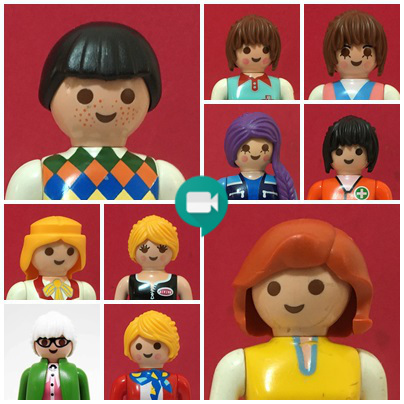
The Watsons & The Grandma connected by Meet
Today, The Grandma has restarted her English course with The Watsons. It has been a great joy seeing them again.

They are fine with full batteries and with their incredible positive attitude to confront difficult situations. 

Elisabeth, Raquel, Sònia, Yolanda, Mariana, Elisabeth, Neus, Maria and Judit welcome home again.

The Watsons and The Grandma are going to continue their English course online and they are going to use Google Applications to do it. Today, The Grandma wants to talk about Google Hangout and Google Meet and she also wants to talk about Present Simple.

More information: Present Simple

Google Hangouts is a communication software developed by Google. Originally a feature of Google+, Hangouts became a stand-alone product in 2013, when Google also began integrating features from Google+ Messenger and Google Talk into Hangouts.

In 2017, Google began developing Hangouts into a product aimed at enterprise communication. Hangouts is now part of the G Suite line of products and consists of two primary products: Google Meet and Google Chat.

Google has also begun integrating features of Google Voice, its IP telephony product, into Hangouts, stating that Hangouts is designed to be the future of Voice.

Google plans to transition users to Meet and Chat in June 2020, but will continue to support the consumer version of classic Hangouts, raising some speculation in the matter after Google Meet became free.

More information: Present Simple

On March 9, 2017, Google announced that Hangouts would be targeted at business users with the Hangouts brand divided into two products: Hangouts Meet and Hangouts Chat.

Meet would focus on video conferences and Hangouts Chat would be focused on instant messaging with additional features such as bot assistant and threaded messaging.

In August 2019, Google announced that the G-Suite version of Hangouts will be replaced by Meet and Chat, and push the shut down to June 2020.

In April 2020, in response to COVID-19, Google Meet became free for all users, raising speculation as to the future of Google Hangouts.

Google Meet
Hangouts allows conversations between two or more users. The service can be accessed online through the Gmail or Google+ websites, or through mobile apps available for Android and iOS, which were distributed as a successor to their existing Google Talk apps. However, because it uses a proprietary protocol instead of the XMPP open standard protocol used by Google Talk, most third-party applications which had access to Google Talk do not have access to Google+ Hangouts.

Chat histories are saved online, allowing them to be synced between devices. A watermark of a user's avatar is used as a marker to indicate how far they have read into the conversation.

Photos can be shared during conversations, which are automatically uploaded into a private Google+ album. Users can also now use color emoji symbols in their messages.

More information: Google I & II

Google Meet is a video-communication service developed by Google. It is one of two apps that constitute the replacement for Google Hangouts, the other being Google Chat. Google planned to begin retiring Google Hangouts in October 2019.

After being invite-only and quietly releasing an iOS app in February 2017, Google formally launched Meet in March 2017. The service was unveiled as a video conferencing app for up to 30 participants, described as an enterprise-friendly version of Hangouts.

At launch, it featured a web app, an Android app, and an iOS app. Features for G Suite users include:

-Up to 100 members per call for G Suite Basic users, up to 150 for G Suite Business users, and up to 250 for G Suite Enterprise users.

-Ability to join meetings from the web or through the Android or iOS app.

-Ability to call into meetings with a dial-in number.

-Password-protected dial-in numbers for G Suite Enterprise edition users.

-Integration with Google Calendar for one-click meeting calls.

-Screen-sharing to present documents, spreadsheets, or presentations.

-Encrypted calls between all users.

-Real-time closed captioning based on speech recognition.

Free users have some further limitations:

-Meetings (after September 2020) are limited to 60 minutes.

-All participants must have a Google account.

Google Meet
While Google Meet introduced the above features to upgrade the original Hangouts application, some standard Hangouts features were deprecated, including viewing attendees and chat simultaneously.

The number of video feeds allowed at one time was also reduced to 8, while up to 4 feeds can be shown in a tiles layout, prioritizing those attendees who most recently used their microphone. Additionally features such as the chat box were changed to overlay the video feeds, rather than resizing the latter to fit.

In response to the COVID-19 crisis in March 2020, Google began offering Meet's advanced features that previously required an enterprise account to anyone using G Suite or G Suite for Education.

The use of Meet grew by a factor of 30 between January and April of 2020, with 100 million users a day accessing Meet, compared to 200 million daily uses for Zoom as of the last week of April 2020.

Until May 2020, a G Suite account was required to initiate and host a Meet video conference, but with increased demand for video conferencing due to the COVID-19 pandemic, Google rolled out free access to Meet also for holders of consumer accounts. Following the announcement, Google's Director of Product Management recommended that consumers use Meet over Hangouts.

More information: Android Central

Free Meet calls can only have a single host and up to 100 participants, compared to the 250-caller limit for G Suite users and the 25-participant limit for Hangouts.

Unlike business calls with Meet, consumer calls are not recorded and stored and the company states that consumer data from Meet will not be used for advertisement targeting. While call data is reportedly not being used for advertising purposes, based on an analysis of Meet's privacy policy, Google reserves the right to collect data on call duration, who is participating, and participants' IP addresses.

Users need a Google account to initiate calls and like G Suite users, anyone with a Google account is able to start a Meet call from within Gmail. Free meet calls have no time limit, but will be limited to 60 minutes starting in September 2020. 

For security reasons, hosts can deny entry and remove users during a call. As of April 2020, Google plans to roll out a noise cancelling audio filter and a low-light mode.

More information: CNet


We've arranged a civilization in which
most crucial elements profoundly
depend on science and technology.

Carl Sagan