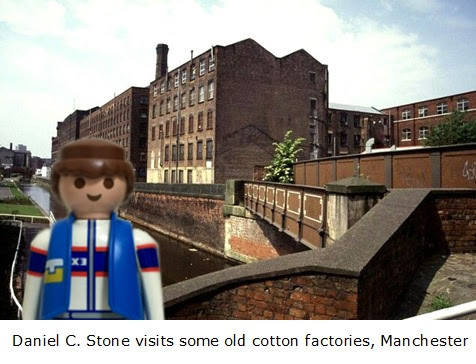
Today, The Stones are preparing their next trip to Hawaii.
Mireia Stone continues her process of recovering after being missing after a boat accident and TheGrandma is doing her last businesses in Manchester, a city very familiar for her, because she lives in Barcelona wherethere is a popular neighbourhood named Poblenou which during the Industrial Revolution of the 19th century, was the epicenter of Catalan and Iberian industry, earning it its sobriquet of the Catalan Manchester.
El Poblenou, Catalan for new village is an extensive neighborhood of Barcelona in Sant Martí district that borders the Mediterranean Sea to the south, Sant Adrià del Besòs to the east, Parc de la Ciutadella in Ciutat Vella to the west, and Horta-Guinardó and Sant Andreu to the north.
It is technically part of the Eixample, its layout having been drafted by Ildefons Cerdà, although the historic center of the neighborhood, which was oncea town entirely separated from Barcelona, predates the grid.
During the Industrial Revolution of the 19th century, Poblenou was the epicenter of Catalan and Iberian industry, earning it its sobriquet of the Catalan Manchester.
Surrounding the extensive cluster of factories stood mostly working class residential areas. When the industrial buzz passed, the neighborhood fell into a state of abandon and after a period of decay, the neighborhood underwent a dramatic transformation.
The Olympic Games in 1992 were the main trigger for this massive transformation of El Poblenou. Many of the areas that have been developed -including the Vila Olímpica, the Diagonal Mar area, and the Fòrum area- arguably comprise their own neighborhoods.
Completing its original, unfinished plan, The Avinguda Diagonal now stretches from Plaça de les Glòries to the sea.
The massive 22@ plan sets to convert Poblenou into the city's technological and innovation district, as well as to increase leisure and residential spaces.
Alongside the newly built, upscale Vila Olímpica and Diagonal Mar areas, many artists and young professionals have converted the former factories andwarehouses into lofts, glleries, and shops. Art & Design schools and studios have also opened, making the area known for its creative outlook.
Some of the old factory buildings are now declared historic monuments and are under protection. This is the case of the Factory Hispania SA, built by the Cuban-German merchant Emilio Heydrich, and architect Josep Graner in 1923, or the factory of chemicals Valls, Teixidor i Jordana.
The leafy Rambla del Poblenou, which stretches from Avinguda Diagonal to the beach, is the main commercial street.
El Poblenou lies between the great beaches of Barcelona and city center which allow its residents on the one hand a great chilled beach lifestyle and, on the other hand, proximity to a huge variety of shopping centers, bars and restaurants. Due to its rising popularity, prices of flats in the area have increased dramatically. Besides good beaches this neighborhood offers wide open spaces, green parks and relatively few tourists.
Notable buildings of Poblenou include the Torre Agbar by Jean Nouvel, Herzog & de Meuron's Forum Building, which houses Europe's largest scale model of a city, and the ME Barcelona Hotel, former Habitat Sky Hotel by Dominique Perrault.
Major public spaces include the Parc de Diagonal Mar by Enric Miralles, the Plaça de les Glòries Catalanes, the Parc Central del Poblenou by Jean Nouvel, the beachfront Parc del Poblenou, the vast Parc del Forum, Oficines Diagonal 197 by David Chipperfield, the Media-Tic Building by Enric Ruiz Geli-CLOUD 9 and the historic Poblenou Cemetery as well as many kilometres of beaches.
Today, The Stones have received some wonderful news. A woman whose description has a match with Mireia Stone has been found near the Mersey River,in an industrial suburb. The family is going to the Police Station to identify her because the police has told them that Mireia does not remember anything.
Until the arrival of the family and the correct identification, Mireia is going to be named JaneDoe, the true name of a person is unknown or is being intentionally concealed.
The Grandma wants to thank all people known and unknown, friends, colleagues, Manchester citizens, security and medical forces who have not giving up in her searching until she has appeared alive.
Lots of people have worked like Jack of all Tradessearching Mireia, doing all kind of things, everywhere, all time.
John Doe (for males) and Jane Doe (for females) are multiple-use names that are used when the true name of a person is unknown or is being intentionally concealed.
In the context of law enforcement in the United States, such names are often used to refer to a corpse whose identity is unknown or unconfirmed.
Secondly, such names are also often used to refer to a hypothetical everyman in other contexts, in a manner similar to John Q. Public or Joe Public. There are many variants to the above names, including John Roe, Richard Roe, JaneRoe and Baby Doe, Janie Doe or Johnny Doe (for children).
In other English-speaking countries, unique placeholder names, numbers or codenames have become more often used in the context of police investigations.
This has included the United Kingdom, where usage of John Doe originated during the Middle Ages. However, the legal term John Doe injunction or JohnDoe order has survived in English law and other legal systems influenced by it.
Other names such as Joe Bloggs or John Smith have sometimes been informally used as placeholders for an everyman in the UK, Australia and New Zealand; such names are seldom used in legal or police circles in the same sense as John Doe.
The name John Doe or John Doo, Richard Roe, along with John Roe, were regularly invoked in English legal instruments to satisfy technical requirements governing standing and jurisdiction, beginning perhaps as early as the reign of England's King Edward III (1327–1377).
Though the rationale behind the choices of Doe and Roe is unknown, there are many suggested folk etymologies. Other fictitious names for a person involved in litigation in medieval English law were John Noakes or Nokes and John-a-Stiles or John Stiles.
The Oxford English Dictionary states that John Doe is the name given to the fictitious lessee of the plaintiff, in the (now obsolete in the UK) mixed action of ejectment, the fictitious defendant being called Richard Roe.
After this event, The Stones have decided to stay a pair of days in Manchester before starting their new trip to Hawaii.
A hurricane blows, brings a hard rain When the blue sky breaks, feels like the world's gonna change We'll start caring for each other like Jesus said that we might I'm a Jack of all trades, we'll be alright...
The Stones and The Grandma continuesearching Mireia Stone.They start being desperate and they have asked for help to all their friends around the world. Really, they can do nothing except waiting for police's work.
Brauny Stone has communicated to her family that she is not continuing this travel with them. She has decided to search a job in Manchester, a place that she has discovered she loves.
The family is going to lose two members in a few days if the authorities are not able to find their beautiful lovely Mireia.
The family is worried about the real situation of working after the global economic crisis which has affected lives of millions of people severely.
The Grandma has been reading about labour insertion, especially about the importance of the CV, the most important gate to access to a job interview.
A curriculum vitae, Latin for course of life, often shortened as CV or vitais a written overview of someone's life's work (academic formation, publications and qualifications).
Vitae often aim to be a complete record of someone's career, and can be extensive. They are (depending on country) used in the same way as a résumé,which is typically a brief 1–2 page summary of qualifications and work experience for the purposes of employment, and often only presents recent highlights.
In many countries, a résumé is typically the first item that a potential employer encounters regarding the job seeker and is typically used to screen applicants, often followed by an interview.
Vitae may also be requested for applicants to postsecondary programs, scholarships, grants and bursaries. In the 2010s it became popular for applicants to provide an electronic text of their CV to employers using email, an online employment website or using a job-oriented social-networking-service website, such as LinkedIn.
Canva is a graphic design platform that allows users to create social media graphics, presentations, posters and other visual content.
It is available on web and mobile, and integrates millions of images, fonts, templates and illustrations.
Users can choose from many professional designed templates, and edit the designs and upload their own photos through a drag and drop interface. The platform is free to use, and paid subscriptions like Canva Pro and Canva forEnterprise offer additional functionality. Users can also pay for physical products to be printed and shipped.
The River Mersey is a river in the North West of England. Its name is derived from the Anglo-Saxon language and translates as boundary river.
The river may have been the border between the ancient kingdoms of Mercia and Northumbria, and for centuries it formed part of the boundary between the historic counties of Lancashire and Cheshire. The start of the Mersey is at the confluence of the River Tame and River Goyt in Stockport. It flows westwards through the suburban areas of south Manchester, then into the Manchester ShipCanal at Irlam, becoming a part of the canal and maintaining the canal's water levels.
After 6.4 km the river exits the canal, flowing towards Warrington where the river widens. It then narrows as it passes between the towns of Runcorn and Widnes. From Runcorn the river widens into a large estuary, which is 4.8 km across at its widest point near Ellesmere Port.
The course of the river then turns
north as the estuary narrows between Liverpool and Birkenhead on the
Wirral Peninsula to the west, and empties into Liverpool Bay. In total,
the river flows 113 km.
A railway tunnel between Birkenhead and Liverpool as part of the MerseyRailway opened in 1886. Two road tunnels pass under the estuary from Liverpool: the Queensway Tunnel opened in 1934 connecting the city to Birkenhead, and the Kingsway Tunnel, opened in 1971, to Wallasey.
A road bridge, completed in 1961 and later named the Silver Jubilee Bridge, crosses between Runcorn and Widnes, adjacent to the Runcorn Railway Bridge which opened in 1868.
A second road bridge, the Mersey Gateway, opened in October 2017, carrying a six-lane road connecting Runcorn's Central Expressway with Speke Road and Queensway in Widnes.
The Mersey Ferry operates between Pier Head in Liverpool and Woodside in Birkenhead and Seacombe, and has become a tourist attraction, offering cruises that provide an overview of the river and surrounding areas.
Water quality in the Mersey was severely affected by industrialization, and in 1985, the MerseyBasin Campaign was established to improve water quality and encourage waterside regeneration.
In 2009, it was announced that the river is cleaner than at any time since the industrial revolution and is now considered one of the cleanest in the UK. TheMersey Valley Countryside Warden Service manages local nature reserves such as Chorlton Ees and Sale Water Park. The river gave its name to Merseybeat, developed by bands from Liverpool, notably the Beatles.
In 1965, it was the subject of the top-ten hit single Ferry Cross the Mersey by Gerry and the Pacemakers.
Its name is derived from the Anglo-Saxon mǣres, of a boundary and ēa, a river.
The Mersey was possibly the border river between Mercia and Northumbria. Its Welsh name is either Afon Mersi in essence a respelling of the name Mersey or Afon Merswy, apparently no older than the nineteenth century, with the suffix wy replacing the final syllable of the name, thought at the time to mean water; river and appropriate for forming river names.
Today, The Stones have sailed along the Mersey River. Before sailing along the river, the family had been studying some English grammar. They have revised Comparatives of Equality and the Order of Adjectives.
While they were contemplating the amazing, wonderful views, the boat has suffered a terrible accident, and it has sunk. All the members of the family has arrived swimming to the shore. All except Mireia Stone who is missing. The family has phoned the police, and they have started a great campaign in social networks asking for help and support.
Today, The Stones have received the wonderful visit of one of their closestfriends, DR.
DR is an expert in OccupationalSafety and Health and has accompanied the family while they have been visiting some of the current examples of the industrial golden past of the city of Manchester.
Manchester was very important during the Industrial Revolution thanks to its cotton production. Working two centuries ago was much more dangerous than now but this does not mean that we must notprotect ourselves and take care of us when we are working.
Manchester was a pioneer city in occupational safety and health especially after the Factory Acts of the early nineteenth century (from 1802 onwards) arose out of concerns about the poor health of children working in cotton mills: the Actof 1833 created a dedicated professional Factory Inspectorate.
The Stones have discovered these and other events and they have learnt lots of things about the importance of occupational safety and health.
While they were visiting these factories, The Grandma was doing business. She is preparing a great surprise for the family.
Occupational Safety and Health (OSH), also commonly referred to as Health and Safety, Occupational Health and Safety (OHS), Occupational Health, or Occupational Safety, is a multidisciplinary field concerned with the safety, health, and welfare of people at work.
The goal of an occupational safety and health program is to foster a safe and healthy work environment.
OSH may also protect co-workers, family members, employers, customers, and many others who might be affected by the workplace environment.
In common-law jurisdictions, employers have a common law duty to take reasonable care of the safety of their employees. Statute law may, in addition, impose other general duties, introduce specific duties, and create government bodies with powers to regulate workplace safety issues: details of this vary from jurisdiction to jurisdiction.
The research and regulation of Occupational Safety and Health are a relatively recent phenomenon. As labor movements arose in response to worker concerns in the wake of the Industrial Revolution, worker's health entered consideration as a labor-related issue.
In the United Kingdom, the Factory Acts of the early nineteenth century (from 1802 onwards) arose out of concerns about the poor health of children working in cotton mills: the Act of 1833 created a dedicated professional Factory Inspectorate.
The initial remit of the Inspectorate was to police restrictions on the working hours in the textile industry of children and young persons, introduced to prevent chronic overwork, identified as leading directly to ill-health and deformation, and indirectly to a high accident rate.
However, on the urging of the FactoryInspectorate, a further Act in 1844 giving similar restrictions on working hours for women in the textile industry introduced a requirement for machinery guarding but only in the textile industry, and only in areas that might be accessed by women or children.
In 1840 a Royal Commission published its findings on the state of conditions for the workers of the mining industry that documented the appallingly dangerous environment that they had to work in and the high frequency of accidents. The commission sparked public outrage which resulted in the Mines Act of 1842. The act set up an inspectorate for mines and collieries which resulted in many prosecutions and safety improvements, and by 1850, inspectors were able to enter and inspect premises at their discretion.
Otto von Bismarck inaugurated the first social insurance legislation in 1883 and the first worker's compensation law in 1884, the first of their kind in the Western world. Similar acts followed in other countries, partly in response to labor unrest.
A hazard is an agent which has the potential to cause harm to a vulnerable target.
Hazards can be both natural or human induced. Sometimes natural hazards such as floods and drought can be caused by human activity. Floods can be caused by bad drainage facilities and droughts can be caused by over-irrigation or groundwater pollution.
The terms hazard and risk are often used interchangeably however, in terms of risk assessment, they are two very distinct terms. A hazard is any agent that can cause harm or damage to humans, property, or the environment.
Risk is defined as the probability that exposure to a hazard will lead to a negative consequence, or more simply, a hazard poses no risk if there is no exposure to that hazard.
Hazards can be dormant or potential, with only a theoretical probability of harm. An event that is caused by interaction with a hazard is called an incident. The likely severity of the undesirable consequences of an incident associated with a hazard, combined with the probability of this occurring, constitute the associated risk. If there is no possibility of a hazard contributing towards an incident, there is no risk.
Hazards can be classified in several ways. One of these ways is by specifying the origin of the hazard.
One key concept in identifying a hazard is the presence of stored energy that, when released, can cause damage. Stored energy can occur in many forms: chemical, mechanical, thermal, radioactive or electrical.
Another class of hazard does not involve release of stored energy, rather it involves the presence of hazardous situations. Examples include confined or limited egress spaces, oxygen-depleted atmospheres, awkward positions, repetitive motions, low-hanging or protruding objects.
Hazards may also be classified as natural, anthropogenic, or technological. They may also be classified as health or safety hazards, by the populations that may be affected, and the severity of the associated risk. In most cases a hazard may affect a range of targets, and have little or no effect on others.
Identification of hazards assumes that the potential targets are defined, and is the first step in performing a risk assessment.
Hazards may be grouped according to their characteristics. These factors are related to geophysical events which are not process specific:
-Areal extent of damage zone
-Intensity of impact at a point
-Duration of impact at a point
-Rate of onset of the event
-Predictability of the event
The terms hazard and risk are often used interchangeably. However, in terms of risk assessment, these are two very distinct terms. A hazard is an agent that can cause harm or damage to humans, property, or the environment. Risk is the probability that exposure to a hazard will lead to a negative consequence, or more simply, a hazard poses no risk if there is no exposure to that hazard.
Risk can be defined as the likelihood or probability of a given hazard of a given level causing a particular level of loss of damage.
The elements of risk are populations, communities, the built environment, the natural environment, economic activities and services which are under threat of disaster in a given area.
The total risk according to UNDRO 1982 is the sum of predictable deaths, injuries, destruction, damage, disruption, and costs of repair and mitigation caused by a disaster of a particular level in a given area or areas.
Another definition of risk is the probable frequency and probable magnitude of future losses. This definition also focuses on the probability of future loss whereby degree of vulnerability to hazard represents the level of risk on a particular population or environment. The threats posed by a hazard are:
-Hazards to people – death, injury, disease and stress
-Hazards to goods – property damage and economic loss
-Hazards to environment – loss of flora and fauna, pollution and loss of amenity
After listening to DR's explanations, The Stones have prepared their next visit. Tonight, they are going to travel to Wolverhampton to watch the match between the local team, Wolverhampton Wanderers Football Club and Manchester City in the Molineux Stadium in Wolverhampton, Staffordshire. They have been invited by Pep Guardiola and they are very happy, especially Yolanda Stone.
Today, The Stones and TheGrandma have started to visit Manchester. They have decided to visit some specific places and they have talked about which of them and when.
IN THE MORNING, the family has visited the JohnRylands Library.
Daniel Stone was very interested in this place because he loves old music books and ancient scores. This visit has been a great opportunity to contemplate some of them. The library is an amazing and wonderful place.
The John Rylands Library is a late-Victorian neo-Gothic building on Deansgate in Manchester, England.
The library, which opened to the public in 1900, was founded by Enriqueta Augustina Rylands in memory of her husband, John Rylands.
The John Rylands Library and the library of the University of Manchester merged in July 1972 into the John Rylands University Library of Manchester; today it is part of The University of Manchester Library.
Special collections built up by both libraries were progressively concentrated in the Deansgate building. The special collections, believed to be among the largest in the United Kingdom, include medieval illuminated manuscripts and examples of early European printing, including a Gutenberg Bible, the second largest collection of printing by William Caxton, and the most extensive collection of the editions of the Aldine Press of Venice.
The Rylands Library Papyrus P52 has a claim to be the earliest extant New Testament text. The library holds personal papers and letters of notable figures, among them Elizabeth Gaskell and John Dalton.
The architectural style is primarily neo-Gothic with elements of Arts and Crafts Movement in the ornate and imposing gatehouse facing Deansgate which dominates the surrounding streetscape. The library, granted Grade I listed status in 1994, is maintained by the University of Manchester and open for library readers and visitors.
Enriqueta Rylands purchased a site on Deansgate for her memorial library in 1889 and commissioned a design from architect Basil Champneys. Rylands commissioned the Manchester academic Alice Cooke to index the vast library of the 2nd Earl Spencer which she had purchased and another collection of autographs.
Mrs Rylands intended the library to be principally theological, and the building, which is a fine example of Victorian Gothic, has the appearance of a church, although the concept was of an Oxford college library on a larger scale. Champneys presented plans to Mrs Rylands within a week of gaining the commission. Thereafter frequent disagreements arose and Mrs Rylands selected decorative elements, window glass and statues against his wishes.
By the nineteenth century Manchester was a prosperous industrial town and the demands of cotton manufacturing stimulated the growth of engineering and chemical industries.
If you have a garden and a library, you have everything you need.
Marcus Tullius Cicero
IN THE AFTERNOON, The Stones have lunched in one of the most popular places of the city, Mr Thomas's Chop House, a wonderful place to eat and drink the best specialities of the city.
Juan Stone has insisted in tasting good expensive wine and steak and kidney pie, a typical local dish. Juan is a synesthesic person and he transforms everything in art using the wonderful world of senses.
Mr Thomas's Chop House is a grade II listed building which first opened as a public house in 1870.
It's cast iron frame building and terracotta block displaying Art Nouveau motifs is a local institution in Manchester and one of the jewels in Manchester's crown. The managers and staff are committed to keeping MrThomas's at the forefront of Manchester life with fine food, fine wines, good beer and great company.
Steak and kidney pie is a representative dish of British cuisine. Steak and kidney pie is a savoury pie that is filled principally with a mixture of diced beef, diced kidney (often of beef, lamb, or pork), friedonion, and brown gravy.
The gravy typically consists of salted beef broth flavoured with Worcestershiresauce and black pepper, and thickened with refined flour, beurre manié, or corn starch. The gravy may also contain ale or stout. Hot water crust pastry, puff pastry, and shortcrust pastry are among the pastry crusts prepared for steak and kidney pie.
Among the various vernacular rhyming slang names for steak and kidney pie are Kate and Sidney pie, snake and kiddy pie, and snake and pygmy pie.
Oh, don’t poo poo a nickle, Lisa. A nickle will buy you a steak and kidney pie,a cup of coffee, a slice of cheesecake, and a newsreel,with enough change left over to ride the trolleyfrom Battery Park to the Polo Grounds.
C.M. Burns
IN THE EVENING, the family has visited the Whitworth Art Gallery, a beautiful cultural place that belongs to the University of Manchester.
Mireia Stone, who is a fan of modern art, has been very happy with this visit and has become the best guide for the rest of the family. She has been very interested in the last Lego art pieces.
The Whitworth is an art gallery in Manchester, England, containing about 55,000 items in its collection. The gallery is located in Whitworth Park and is part of the University of Manchester.
In 2015, the Whitworth reopened after it was transformed by a £15 million capital redevelopment that doubled its exhibition spaces, restored period features and opened itself up to its surrounding park. The gallery received more than 440,000 visitors in its first year and was awarded the Art Fund's Museum of the Year prize in 2015.
The gallery was founded in 1889 by Robert Dukinfield Darbishire with a donation from Sir Joseph Whitworth, as The Whitworth Institute and Park. The first building was completed in 1908. In 1958 the gallery became part of the University of Manchester.
In October 1995 the mezzanine court in the centre of the building was opened. The new gallery, designed chiefly for the display of sculpture, won a RIBA regional award.
In 2010 the art gallery received 172,000 visitors, making it one of GreaterManchester's ten most-visited tourist attractions.
In February 2015, the Whitworth reopened after a £15 million capital redevelopment and received over 440,000 visitors in its first reopening year. It was shortlisted for the Stirling Prize and won the Art Fund's Museum of the Year in 2015.
The Whitworth has notable collections of watercolours, sculptures, wallpapers and textiles.
The gallery focuses on modern artists, and the art collections include works by Henry Moore, Barbara Hepworth, Ford Madox Brown, Eduardo Paolozzi, Francis Bacon, William Blake, David Hockney, L. S. Lowry, Paul Gauguin, Vincent van Gogh and Pablo Picasso, and a fine collection of works by J. M. W. Turner. One of its most famous works is the marble sculpture Genesis (1929–31) by Sir Jacob Epstein. It also houses the Musgrave Kinley Outsider Art Collection.
Art is inspiring. Walking into a gallery, or when the lights go up on a stage; that thrill of getting something that has nothing to do with acquisition.
MANCHESTERis a city and metropolitan borough in Greater Manchester,England.
It has a population of 547,627 as of 2018. It lies within the United Kingdom's second-most populous urban area, with a population of 2.5 million and third-most populous metropolitan area, with a population of 3.3 million.
It is fringed by the Cheshire Plain to the south, the Pennines to the north and east, and an arc of towns with which it forms a continuous conurbation. The local authority for the city is ManchesterCity Council.
The recorded history of Manchester began with the civilian settlement associated with the Roman fort of Mamucium or Mancunium, which was established in about AD 79 on a sandstone bluff near the confluence of the rivers Medlock and Irwell. Although historically and traditionally a part of Lancashire, areas of Cheshire south of the River Mersey were incorporated into Manchester in the 20th century.
The city is notable for its architecture, culture, musical exports, medialinks, scientific and engineering output, social impact, sports clubs andtransport connections.
Manchester is a city of notable firsts. Manchester Liverpool Road railway station was the world's first inter-city passenger railway station and the oldest remaining railway station.
The city has also excelled in scientific and engineering advancement, as it was at The University of Manchester, in 1917, that scientist Ernest Rutherford first split the atom. The university's further achievements include Frederic C. Williams, Tom Kilburn and Geoff Tootill who developed and built the world's first stored-program computer in 1948; and, in 2004, Andre Geim and Konstantin Novoselov successfully isolated and characterised the first graphene.
The name Manchester originates from the Latin name Mamucium or its variant Mancunio and the citizens are still referred to as Mancunians.These names are generally thought to represent a Latinisation of an original Brittonic name.
Manchester's history is concerned with textile manufacture during the Industrial Revolution.
The great majority of cotton spinning took place in the towns of south Lancashire and north Cheshire, and Manchester was for a time the most productive centre of cotton processing.
Manchester became known as the world's largest marketplace for cotton goods and was dubbed Cottonopolis and Warehouse City during the Victorian era.
In Australia, New Zealand and South Africa, the term manchester is still used for household linen: sheets, pillow cases or towels. The industrial revolution brought about huge change in Manchester and was key to the increase in Manchester's population.
Manchester began expanding at an astonishing rate around the turn of the 19th century as people flocked to the city for work from Scotland, Wales, Ireland and other areas of England as part of a process of unplanned urbanisation brought on by the Industrial Revolution. It developed a wide range of industries, so that by 1835 Manchester was without challenge the first and greatest industrial city in the world.
Engineering firms initially made machines for the cotton trade, but diversified into general manufacture. Similarly, the chemical industry started by producing bleaches and dyes, but expanded into other areas. Commerce was supported by financial service industries such as banking and insurance.
The
Stones have started their long trip flying from Barcelona to Manchester,the
first stop. They have left the El Prat Barcelona Airport this afternoon
and they have just arrived to Manchester.
The
Grandma has rented an enormous mansion to spend these days. She is
afraid with the current COVID situation and she trusts more in a private
residence than in a hotel.
The
family has arrived to the mansion with enough time to leave their
baggage and go out to have dinner in one of the most popular places of
the city. They have been preparing this trip carefully and they want to
enjoy this amazing city, MANCHESTER.
The Grandma loves reading British and American press and last Tuesday, December 4, was the anniversary of a prestigious English newspaper which she follows and reads every Sunday: TheObserver.
It's very interesting to have access to news immediately by Internet, but TheGrandma is an old-fashioned woman, and she prefers reading the paper version. For this reason, she has been very happy when she has received the visit of Joseph de Ca'th Lon, who has offered her, the last edition of TheObserver in a paper version.
Before the arrival of Joseph, The Grandma had studied a new lesson of her Elementary Language Practice manual (Grammar 32).
The Observer is a British newspaper published on Sundays. In the same place on the political spectrum as its sister papers The Guardian and TheGuardian Weekly, whose parent company Guardian Media Group Limited acquired it in 1993, it takes a social liberal or social democratic line on most issues. First published in 1791, it is the world's oldest Sunday newspaper.The paper was banned in Egypt in February 2008 after reprinting cartoons allegedly insulting Mohammed.
The first issue, published on 4 December 1791 by W.S. Bourne, was the world's first Sunday newspaper. Believing that the paper would be a means of wealth, Bourne instead soon found himself facing debts of nearly £1,600. Though early editions purported editorial independence, Bourne attempted to cut his losses and sell the title to the government. When this failed, Bourne's brother, a wealthy businessman, made an offer to the government, which also refused to buy the paper but agreed to subsidize it in return for influence over its editorial content. As a result, the paper soon took a strong line against radicals such as Thomas Paine, Francis Burdett and Joseph Priestley.
The Observer Newspaper, Sunday, June 11th 1944
In 1807, the brothers decided to relinquish editorial control, naming Lewis Doxat as the new editor. Seven years later, the brothers sold TheObserver to William Innell Clement, a newspaper proprietor who owned a number of publications.
The paper continued to receive government subsidies during this period; in 1819, of the approximately 23,000 copies of the paper distributed weekly, approximately 10,000 were given away as specimen copies, distributed by postmen who were paid to deliver them to lawyers, doctors, and gentlemen of the town.
Yet the paper began to demonstrate a more independent editorial stance, criticising the authorities' handling of the events surrounding the PeterlooMassacre and defying an 1820 court order against publishing details of the trial of the Cato Street Conspirators, who were alleged to have plotted to murder members of the Cabinet. The woodcut pictures published of the stable and hayloft where the conspirators were arrested reflected a new stage of illustrated journalism that the newspaper pioneered during this time.
Clement maintained ownership of The Observer until his death in 1852. During that time, the paper supported parliamentary reform, but opposed a broader franchise and the Chartist leadership. After Doxat retired in 1857, Clement'sheirs sold the paper to Joseph Snowe, who also took over the editor's chair. Under Snowe, the paper adopted a more liberal political stance, supporting the North during the American Civil War and endorsing universal manhood suffrage in 1866. These positions contributed to a decline in circulation during this time.
In 1870, wealthy businessman Julius Beer bought the paper and appointed Edward Dicey
as editor, whose efforts succeeded in reviving circulation. Though
Beer's son Frederick became the owner upon Julius's death in 1880, he
had little interest in the newspaper and was content to leave Dicey as
editor until 1889. Henry Duff Traill took over the editorship after Dicey's departure, only to be replaced in 1891 by Frederick's wife, Rachel Beer,
of the Sassoon family. Though circulation declined during her tenure,
she remained as editor for thirteen years, combining it in 1893 with the
editorship of The Sunday Times, a newspaper that she had also bought.
The Observer Newspaper, 2010
Upon Frederick's death in 1901, the paper was purchased by the newspaper magnate LordNorthcliffe. After maintaining the existing editorial leadership for a couple of years, in 1908 Northcliffe named JamesLouis Garvin as editor. Garvin quickly turned the paper into an organ of political influence, boosting circulation from 5,000 to 40,000 within a year of his arrival as a result. Yet the revival in the paper's fortunes masked growing political disagreements between Garvin and Northcliffe. These disagreements ultimately led Northcliffe to sell the paper to WilliamWaldorf Astor in 1911, who transferred ownership to his son Waldorf Astor, 2nd Viscount Astor four years later.
During this period, the Astors were content to leave the control of the paper in Garvin's hands. Under his editorship, circulation reached 200,000 during the interwar years, a figure which Garvin fought to maintain even during the depths of the Great Depression. Politically, the paper pursued an independent Conservative stance, which eventually brought Garvin into conflict with Waldorf's more liberal son David Astor. Their conflict contributed to Garvin's departure as editor in 1942, after which the paper took the unusual step of declaring itself non-partisan.
Ownership passed to Waldorf's sons in 1948, with David taking over as editor. He remained in the position for 27 years, during which time he turned it into a trust-owned newspaper employing, among others, George Orwell, Paul Jennings and C. A. Lejeune. Under Astor's editorship, The Observer became the first national newspaper to oppose the government's 1956 invasion of Suez, a move which cost it many readers. In 1977, the Astors sold the ailing newspaper to US oil giant Atlantic Richfield, now called ARCO, who sold it to Lonrho plc in 1981.
It became part of the Guardian Media Group in June 1993, after a rival bid to acquire it by The Independent was rejected.
In 1990, Farzad Bazoft, a journalist for The Observer, was executed in Iraq on charges of spying. In 2003, The Observer interviewed the Iraqi colonel who had arrested and interrogated Bazoft and who was convinced that Bazoft was not a spy.
In 2003 the editorial supported the Iraq war, stating Military intervention in the Middle East holds many dangers. But if we want a lasting peace, it may be the only option.
Farzad Bazoft
On 27 February 2005, TheObserverBlog was launched, making TheObserver the first newspaper to purposely document its own internal decisions, as well as the first newspaper to release podcasts. The paper's regular columnists include Andrew Rawnsley and Nick Cohen.
In addition to the weekly Observer Magazine, which is still present every Sunday, for several years each issue of The Observer came with a different free monthly magazine. These magazines had the titles Observer SportMonthly, Observer Music Monthly, Observer Woman and Observer Food Monthly.
Content from The Observer is included in The Guardian Weekly for an international readership.
The Observer followed its daily partner The Guardian and converted to Berliner format on Sunday 8 January 2006.
The Observer was awarded the National Newspaper of the Year at the British Press Awards 2007. Editor Roger Alton stepped down at the end of 2007 and was replaced by his deputy, John Mulholland.
In early 2010, the paper was restyled. An article on the paper's website previewing the new version stated that The News section, which will incorporate Business and personal finance, will be home to a new section, Seven Days, offering a complete round-up of the previous week's main news from Britain and around the world, and will also focus on more analysis and comment.
The Observer and its sister newspaper The Guardian operate a visitor centre in London called TheNewsroom. It contains their archives, including bound copies of old editions, a photographic library and other items such as diaries, letters and notebooks. This material may be consulted by members of the public. TheNewsroom also mounts temporary exhibitions and runs an educational program for schools.
In November 2007, The Observer and The Guardian made their archives available over the Internet. The current extent of the archives available are 1791 to 2000 for The Observer and 1821 to 2000 for The Guardian. These archives will eventually go up to 2003.