Today, The Grandma has been reading about labourrisks or occupationalhazards.
An occupational hazard is any workplace condition that causes a risk to employee health. There are defined six main categories of occupational hazards:
-Safety. This category includes any condition, substance, or object that can injure a worker, like working from heights, spills on floors, machinery with moving parts, confined spaces, steep stairs, or exposed electrical wiring.
-Chemical. There are many kinds of hazardous chemicals and toxins in different workplaces, including environmental smoke, cleaning products, acids, pesticides, carbon monoxide, and flammable liquids.
-Biological. In some settings, such as farms, zoos, hospitals or medical offices, or veterinary clinics, workers can be exposed to biological health hazards like blood, fungi, mold, viruses, animal droppings, and insect bites.
-Physical. These are hazards in the environment that can harm your body without you actually touching it, like radiation, prolonged exposure to sunlight, extreme high or low temperatures, and loud noise.
-Ergonomic. These hazards put strain on your body over a period of time. You may just feel sore or cramped in the short term, but repeatedly sitting or standing in awkward positions or completing the same movements over and over, across a long period of time, can lead to long-term injury and illness.
-Work organization hazards. Workplace violence, discrimination, lack of respect, sexual harassment, and other conditions are hazardous to mental, emotional, and physical health.
To talk about risks in chemistry, TheGrandma has been talking with SeamusFinnigan, a Gryffindor student at Hogwarts School of Witchcraft and Wizardry, who is a specialist in explosions and in mistaken potions and spells.
Before talking with Seamus, TheGrandma has met Poppy Pomprey, the matron in the hospital wing, who has been explaining her labour risks in medicine, and with Cedrid Diggory, who has explained her labour risks in sports.
Seamus Finnigan is an Irish half-blood wizard, son of Muggle Mr Finnigan and Irishwitch Mrs Finnigan. Mr Finnigan did not learn this until after they were married and it gave him a nasty shock when he first learned it.
Seamus was a Gryffindor student at Hogwarts School of Witchcraft and Wizardry. He was also the best friend of Dean Thomas.
Seamus originally doubted Harry Potter's claim that Lord Voldemort
had returned in 1995, as his mother doubted it. However, late in 1995
he eventually joined Dumbledore's Army. The D.A. was an organisation
taught and led by HarryPotter. Seamus joined after apologising to Harry.
He continued his seventh year of education at Hogwarts, although the school was under the control of Voldemort. Seamus
remained in the D.A. and fought bravely in the Battle of Hogwarts. It
is currently unknown what he did after the Second Wizarding War.
Seamus was born to Muggle Mr Finnigan and his witch wife. It was mentioned that Seamus' father had no idea that his wife was a witch before they married and it came as a nasty shock to him when he found out, but nevertheless accepted it.
Seamus came from an Irish family, as suggested by his name, and as shown in the Quidditch World Cup he attended just before his fourth year. It is possible that Seamus is from Kenmare, County Kerry due to his support of the local Quidditch team and him and his mother support of the Irish NationalQuidditch team in the Quidditch World Cup. He had an older cousin named Fergus, who would frequently Apparate just to annoy him. Seamus had plans to annoy Fergus back, once he passed his apparition test.
Seamus arrived at HogwartsSchool ofWitchcraft and Wizardry with other students like Harry Potter, RonWeasley, HermioneGranger, and DracoMalfoy.
When Professor Minerva McGonagall asked the
first years to form a line to head into the Great Hall, Seamus ended up in front of HarryPotter. When Seamus'name was called during the Sorting ceremony, he waited for almost a minute before the SortingHat placed him into Gryffindor. After joining the Gryffindor table, Seamus was introduced to the Gryffindor house ghost Nicholas de Mimsy-Porpington, who students often called Nearly Headless Nick. Seamus asked how one could be nearly headless, to which Nick demonstrated by pulling his head off of his neck, which disgusted most of the table.
During his first Potions lesson the next Friday, Seamus was partnered with Neville Longbottom to brew a Boil-Cure Potion. Neville managed to melt Seamus' cauldron and was drenched in their potion. Professor Severus Snape told Seamus to take Neville to the Hospital Wing, which he did.
When the Gryffindor first years learned about their first flying lesson with Madam Hooch, Seamus bragged that in his youth he spent most of his time flying around the countryside.
During Charms class on Hallowe'en morning, Seamus was partnered with Harry to practise the Levitation Charm. While practising, Seamus managed to set fire to their feather with his wand, and Harry had to put it out with his hat. Seamus would have many such experiences throughout his school career.
Before leaving Hogwarts for the Christmas holiday, Seamus lent Harry his Wizard's Chess pieces so Harry could learn how to play.
He survived the Second Wizarding War and was seen sitting with Dean Thomas and Aberforth Dumbledore
once the battle had ended. It is unknown what happened to him after the
war. It can be assumed that he attended the reunion of Dumbledore's
Army.
Being a Gryffindor, Seamus usually wore a red-and-gold tie and a black jumper along with his black Hogwarts robes. His uniform was always scruffy and untidy, making him look like a slob.
During Seamus's final year at Hogwarts, his face had been battered and bruised by the Carrows to an extent that neither Harry nor Dean Thomas could recognise him, until he spoke with his distinct Irish accent. Seamus had sandy coloured hair.
Through his school years, Seamus
generallyappeared good-natured and easy-going. He was also rather
clumsy, as he set fire to a feather he was supposed to be levitating in
his first year. He seems to display traits of more than one Hogwarts house, since the Sorting Hat had to think for almost a minute before deciding to sort him into Gryffindor. Seamus is also very curious, asking Professor Quirinus Quirrell where he got his turban, Nicholas de Mimsy-Porpington how he could be nearly headless and Professor Severus Snape about Inferi.
Of all the boys in Harry's dormitory, Seamus was the least enthusiastic supporter of Harry Potter and Albus Dumbledore, often demonstrating scepticism of Harry's claims. However, after reading Rita Skeeter's interview with Harry in the fifth year, he apologised to Harry and sent a copy to his mam, as she did not believe that Lord Voldemort was back. He did join Dumbledore's Army, although he did not sign the actual membership list of the group.
After Dumbledore's events the following year, Seamus insisted on remaining at Hogwarts,
despite his mother's wish to remove him immediately from the perceived
dangers at the school, demonstrating his allegiance to Dumbledore and
Harry.
Seamus also demonstrated the characteristic bravery and loyalty of his house by opposing the Death Eaters at great personal risk during his final year at Hogwarts and in the final battle.
Seamus was able to conjure a corporeal fox Patronus.
This charm is an incredibly advanced piece of magic and is proof of
superior magical ability. He also demonstrated his superior skills in
duelling by surviving the Battle of Hogwarts.
Seamus is an Irish version of the name James, which means supplanter, one who takes the place of another, usually by force. Finnigan is an Irish name that includes finn (white, fair) and means fair-haired one.
Today, The Stones have been talking with DR by Meet. DR has explained them the risks of surfing and extreme sports.
While The Stones have been listening to DR, TheGrandma has been reading about the most famous surfers from Hawaii.
Duke Kahanamoku
Probably considered the forefather of professional surfing, Duke Kahanamoku is widely revered as an icon and a beloved character of modern Hawaiian history. Hawaii was still its own kingdom when Kahanamoku was born. He grew up during the annexation of Hawaii and is a strong representative of Hawaiianculture and attitude.
After retiring from an incredible Olympic swimming career representing the U.S. internationally, Kahanamoku toured around the world. It was at this time that he was able to introduce the Hawaiian sport of surfing in places like Australia and California. Today, visitors can admire his nine-foot bronze statue on Waikiki beach, where locals honor him constantly, placing multitudes of freshly made leis to hang off of his outstretched arms.
Eddie Aikau
Eddie Aikau's career in the water started strong. He was the first lifeguard protecting beaches on the North Shore of Oahu with its famous giant waves that would sometimes reach 20 feet. Rescuing over 500 people, Aikau became a local hero to the community. Aikau's Hawaiian heritage was also something he was extremely proud of, garnering even more local support in the community.
In 1978, he was recruited by the Polynesian Voyaging Society as a member of the Hōkūleʻa crew on their second voyage. Unfortunately, the canoe capsized by the island of Molokai. As was his nature, Aikau paddled out towards the island of Lanai to seek help and unfortunately was not seen again. Hawaii's beloved big wave surfer was lost at sea at the young age of 31.
Today, the fame of his bravery is honored in surf competitions as well as charities that support the sustainability and advancement of Hawaiian culture. Beach and surf gear with the writing Eddie Would Go honors his memory and fearlessness in taking on the biggest of waves.
Probably one of the most inspirational people in the public eye, Bethany Hamilton has proved to be unstoppable. A Kauai native and born into a surfing family, she started competing at the age of eight. Unfortunately, Hamilton was the victim of an attack by one of nature's toughest predators. In 2003, at the age of 13, Hamilton was surfing with her best friend when she was attacked by a tiger shark. She lost her left arm almost completely, making it difficult to continue the sport. This wasn’t enough to stop her, though. Barely skipping a beat, she returned merely a month after her attack.
Hamilton continued to be a force in the surf community, taking first place at Pipeline Women's Pro in 2014. Now a mother, she's still in the water competing and has become a role model for not only women or those in the surfing community, but people everywhere. Hamilton not only competes, but is also now a speaker and author.
Andy Irons
A native of Kauai, Andy was known to those around him as someone with a lot of heart. Even the headline of his public rivalry with Kelly Slater was complemented by their respect for one another. In his intense and impressive surfing career, he won three world titles, as well as over 20 international victories.
However, he battled substance abuse and difficulties with a possible bipolar disorder. This ended sadly with his passing in 2010, shocking the community. Andy's legacy, which has been honored in a film called Andy Irons: Kissed by God, reminds us that we are all human.
Laird Hamilton
Tow-in surfing is under some serious debate in the professional community, with some believing that it takes away from the sport and others claiming that it makes it even better. What no one can argue is that Laird Hamilton was a revolutionary in what had been a very traditional sport originating in Hawaii.
Hailing from the island of Oahu, Hamilton paved the way for many new ideas in the surf community. He was involved in the innovative conception and introduction of SUP boarding and hydrofoil, as well as tow-in surfing, a game changer and time saver for those brave enough to surf the big waves.
Today, The Stones have assisted to a Meet Conference with DR, their Occupational Hazards teacher. DR has given them some important information about risks and hazards. While TheStones were talking to DR, TheGrandma was reading about the most important risks in Hawaiian Islands, their volcanoes.
Kīlauea is an active shield volcano in the Hawaiian Islands that last erupted between 1983 and 2018.
Historically, Kīlauea is the most active of the five volcanoes that together form the island of Hawaiʻi. Located along the southeastern shore of the island, the volcano is between 210,000 and 280,000 years old and emerged above sea level about 100,000 years ago.
It is the second youngest product of the Hawaiian hotspot and the current eruptive center of the Hawaiian–Emperor seamount chain. Because it lacks topographic prominence and its activities historically coincided with those of Mauna Loa, Kīlauea was once thought to be a satellite of its much larger neighbor.
Structurally, Kīlauea has a large, fairly recently formed caldera at its summit and two active rift zones, one extending 125 km east and the other 35 km west, as an active fault of unknown depth moving vertically an average of 2 to 20 mm per year.
Kīlauea erupted nearly continuously from 1983 to 2018, causing considerable property damage, including the destruction of the towns of Kalapana and Kaimū along with the renowned black sand beach, in 1990.
On May 17, 2018 the volcano explosively erupted at the summit in Halemaʻumaʻu, throwing ash 30,000 feet into the air. Continued explosive activity at the summit caused a months-long closure of the Kīlauea section of Hawaii Volcanoes National Park. Vigorous eruptive lava fountains in lower Puna sent destructive rivers of molten rock into the ocean in three places.
The lava destroyed Hawaii's largest natural freshwater lake, covered substantial portions of Leilani Estates and Lanipuna Gardens, and completely inundated the communities of Kapoho, Vacationland Hawaii and most of the Kapoho Beach Lots. Lava also filled Kapoho Bay and extended new land nearly a mile into the sea. The County of Hawaii reported that 716 dwellings were destroyed by lava.
By early August the eruption subsided substantially, and the last active lava was reported at the surface on September 4, 2018. On December 5, 2018, after 90 days of inactivity from the volcano, the eruption that began in 1983 was declared to have ended.
Mauna Loa, in English Long Mountainis one of five volcanoes that form the Island of Hawaii in the U.S. state of Hawaiʻi in the Pacific Ocean.
The largest subaerial volcano in both mass and volume, Mauna Loa has historically been considered the largest volcano on Earth, dwarfed only by Tamu Massif.
It is an active shield volcano with
relatively gentle slopes, with a volume estimated at approximately
75,000 km3, although its peak is about 38 m lower than that of its
neighbour, Mauna Kea.
Lava eruptions from MaunaLoa are silica-poor and
very fluid, and they tend to be non-explosive.
Mauna Loa has probably been erupting for at least 700,000 years, and may have emerged above sea level about 400,000 years ago. The oldest-known dated rocks are not older than 200,000 years.
The volcano's magma comes from the Hawaii hotspot, which has been responsible for the creation of the Hawaiian island chain over tens of millions of years. The slow drift of the Pacific Plate will eventually carry Mauna Loa away from the hotspot within 500,000 to one million years from now, at which point it will become extinct.
Mauna Loa's most recent eruption occurred from March 24 to April 15, 1984. No recent eruptions of the volcano have caused fatalities, but eruptions in 1926 and 1950 destroyed villages, and the city of Hilo is partly built on lava flows from the late 19th century. Because of the potential hazards it poses to population centers, Mauna Loa is part of the Decade Volcanoes program, which encourages studies of the world's most dangerous volcanoes.
Mauna Loa has been monitored intensively by the Hawaiian Volcano Observatory since 1912. Observations of the atmosphere are undertaken at the Mauna Loa Observatory, and of the Sun at the Mauna Loa Solar Observatory, both located near the mountain's summit.
Hawaii Volcanoes National Park covers the summit and the southeastern flank of the volcano, and also incorporates Kīlauea, a separate volcano.
Mount Kilauea spilled glowing lava like cords of orange neon-lighting from seemingly nowhere. In the blackness that engulfed the night, electric heat lit flowing streams that fell into the sea, disappearing in a cloud of steam with a sizzling splash.
Today, The Stones have received the amazing visit of DR, their OccupationalHazards consultor.
With the current situation, Occupational Hazards have more importance and we must protect and care ourselves not only at home but at work. The family is going to travel to Hawaii and they want to know which kind of measures have been taken in the USA to prevent SARS-CoV-2 contagion.
While The Stones have been talking with DR about it, The Grandma has visited a business consultor and investor. She wants to do an important business in Manchester before travelling to Hawaii.
The risks from SARS-CoV-2, the virus that causes Coronavirus Disease 2019(COVID-19), for workers depends on how extensively the virus spreads between people; the severity of resulting illness; pre-existing medical conditions workers may have; and the medical or other measures available to control the impact of the virus and the relative success of these measures. The U.S. Centers forDisease Control and Prevention (CDC) provides detailed information about this topic.
According to the CDC, certain people, including older adults and those with underlying conditions such as heart or lung disease or diabetes, are at higher risk for developing more serious complications from COVID-19.
Classifying Risk of Worker Exposure to SARS-CoV-2
Worker risk of occupational exposure to SARS-CoV-2 during a pandemic may depend in part on the industry type and the need for contact within 6 feet of people known to be, or suspected of being, infected with SARS-CoV-2.
Other factors, such as conditions in communities where employees live and work, their activities outside of work (including travel to COVID-19-affected areas), and individual health conditions, may also affect workers' risk of getting COVID-19 and/or developing complications from the illness.
OSHA has divided job tasks into four risk exposure levels: very high, high, medium, and lower risk, as shown in the occupational risk pyramid, below. The four exposure risk levels represent the probable distribution of risk. Most American workers will likely fall in the lower exposure risk (caution) or medium exposure risk levels.
Lower Exposure Risk (Caution)
Jobs that do not require contact with people known to be, or suspected of being, infected with SARS-CoV-2. Workers in this category have minimal occupational contact with the public and other coworkers. Examples include:
-Remote workers (those working from home during the pandemic).
-Office workers who do not have frequent close contact with coworkers, customers, or the public.
-Manufacturing and industrial facility workers who do not have frequent close contact with coworkers, customers, or the public.
-Healthcare workers providing only telemedicine services.
-Long-distance truck drivers.
Medium Exposure Risk
Jobs that require frequent/close contact with people who may be infected, but who are not known to have or suspected of having COVID-19. Workers in this category include:
-Those who may have frequent contact with travelers who return from international locations with widespread COVID-19 transmission.
-Those who may have contact with the general public (in schools, high population density work environments, and some high-volume retail settings).
High Exposure Risk
Jobs with a high potential for exposure to known or suspected sources of SARS-CoV-2. Workers in this category include:
-Healthcare delivery and support staff (hospital staff who must enter patients’ rooms) exposed to known or suspected COVID-19 patients.
-Medical transport workers (ambulance vehicle operators) moving known or suspected COVID-19 patients in enclosed vehicles.
-Mortuary workers involved in preparing bodies for burial or cremation of people known to have, or suspected of having, COVID-19 at the time of death.
Very High Exposure Risk
Jobs with a very high potential for exposure to known or suspected sources of SARS-CoV-2 during specific medical, postmortem, or laboratory procedures. Workers in this category include:
-Healthcare workers (doctors, nurses, dentists, paramedics, emergency medical technicians) performing aerosol-generating procedures (intubation, cough induction procedures, bronchoscopies, some dental procedures and exams, or invasive specimen collection) on known or suspected COVID-19 patients.
-Healthcare or laboratory personnel collecting or handling specimens from known or suspected COVID-19 patients (manipulating cultures from known or suspected COVID-19 patients).
-Morgue workers performing autopsies, which generally involve aerosol-generating procedures, on the bodies of people who are known to have, or are suspected of having, COVID-19 at the time of their death.
Today, The Stones have received the wonderful visit of one of their closestfriends, DR.
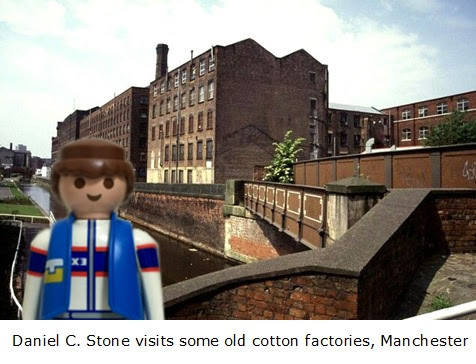
DR is an expert in OccupationalSafety and Health and has accompanied the family while they have been visiting some of the current examples of the industrial golden past of the city of Manchester.
Manchester was very important during the Industrial Revolution thanks to its cotton production. Working two centuries ago was much more dangerous than now but this does not mean that we must notprotect ourselves and take care of us when we are working.
Manchester was a pioneer city in occupational safety and health especially after the Factory Acts of the early nineteenth century (from 1802 onwards) arose out of concerns about the poor health of children working in cotton mills: the Actof 1833 created a dedicated professional Factory Inspectorate.
The Stones have discovered these and other events and they have learnt lots of things about the importance of occupational safety and health.
While they were visiting these factories, The Grandma was doing business. She is preparing a great surprise for the family.
Occupational Safety and Health (OSH), also commonly referred to as Health and Safety, Occupational Health and Safety (OHS), Occupational Health, or Occupational Safety, is a multidisciplinary field concerned with the safety, health, and welfare of people at work.
The goal of an occupational safety and health program is to foster a safe and healthy work environment.
OSH may also protect co-workers, family members, employers, customers, and many others who might be affected by the workplace environment.
In common-law jurisdictions, employers have a common law duty to take reasonable care of the safety of their employees. Statute law may, in addition, impose other general duties, introduce specific duties, and create government bodies with powers to regulate workplace safety issues: details of this vary from jurisdiction to jurisdiction.
The research and regulation of Occupational Safety and Health are a relatively recent phenomenon. As labor movements arose in response to worker concerns in the wake of the Industrial Revolution, worker's health entered consideration as a labor-related issue.
In the United Kingdom, the Factory Acts of the early nineteenth century (from 1802 onwards) arose out of concerns about the poor health of children working in cotton mills: the Act of 1833 created a dedicated professional Factory Inspectorate.
The initial remit of the Inspectorate was to police restrictions on the working hours in the textile industry of children and young persons, introduced to prevent chronic overwork, identified as leading directly to ill-health and deformation, and indirectly to a high accident rate.
However, on the urging of the FactoryInspectorate, a further Act in 1844 giving similar restrictions on working hours for women in the textile industry introduced a requirement for machinery guarding but only in the textile industry, and only in areas that might be accessed by women or children.
In 1840 a Royal Commission published its findings on the state of conditions for the workers of the mining industry that documented the appallingly dangerous environment that they had to work in and the high frequency of accidents. The commission sparked public outrage which resulted in the Mines Act of 1842. The act set up an inspectorate for mines and collieries which resulted in many prosecutions and safety improvements, and by 1850, inspectors were able to enter and inspect premises at their discretion.
Otto von Bismarck inaugurated the first social insurance legislation in 1883 and the first worker's compensation law in 1884, the first of their kind in the Western world. Similar acts followed in other countries, partly in response to labor unrest.
A hazard is an agent which has the potential to cause harm to a vulnerable target.
Hazards can be both natural or human induced. Sometimes natural hazards such as floods and drought can be caused by human activity. Floods can be caused by bad drainage facilities and droughts can be caused by over-irrigation or groundwater pollution.
The terms hazard and risk are often used interchangeably however, in terms of risk assessment, they are two very distinct terms. A hazard is any agent that can cause harm or damage to humans, property, or the environment.
Risk is defined as the probability that exposure to a hazard will lead to a negative consequence, or more simply, a hazard poses no risk if there is no exposure to that hazard.
Hazards can be dormant or potential, with only a theoretical probability of harm. An event that is caused by interaction with a hazard is called an incident. The likely severity of the undesirable consequences of an incident associated with a hazard, combined with the probability of this occurring, constitute the associated risk. If there is no possibility of a hazard contributing towards an incident, there is no risk.
Hazards can be classified in several ways. One of these ways is by specifying the origin of the hazard.
One key concept in identifying a hazard is the presence of stored energy that, when released, can cause damage. Stored energy can occur in many forms: chemical, mechanical, thermal, radioactive or electrical.
Another class of hazard does not involve release of stored energy, rather it involves the presence of hazardous situations. Examples include confined or limited egress spaces, oxygen-depleted atmospheres, awkward positions, repetitive motions, low-hanging or protruding objects.
Hazards may also be classified as natural, anthropogenic, or technological. They may also be classified as health or safety hazards, by the populations that may be affected, and the severity of the associated risk. In most cases a hazard may affect a range of targets, and have little or no effect on others.
Identification of hazards assumes that the potential targets are defined, and is the first step in performing a risk assessment.
Hazards may be grouped according to their characteristics. These factors are related to geophysical events which are not process specific:
-Areal extent of damage zone
-Intensity of impact at a point
-Duration of impact at a point
-Rate of onset of the event
-Predictability of the event
The terms hazard and risk are often used interchangeably. However, in terms of risk assessment, these are two very distinct terms. A hazard is an agent that can cause harm or damage to humans, property, or the environment. Risk is the probability that exposure to a hazard will lead to a negative consequence, or more simply, a hazard poses no risk if there is no exposure to that hazard.
Risk can be defined as the likelihood or probability of a given hazard of a given level causing a particular level of loss of damage.
The elements of risk are populations, communities, the built environment, the natural environment, economic activities and services which are under threat of disaster in a given area.
The total risk according to UNDRO 1982 is the sum of predictable deaths, injuries, destruction, damage, disruption, and costs of repair and mitigation caused by a disaster of a particular level in a given area or areas.
Another definition of risk is the probable frequency and probable magnitude of future losses. This definition also focuses on the probability of future loss whereby degree of vulnerability to hazard represents the level of risk on a particular population or environment. The threats posed by a hazard are:
-Hazards to people – death, injury, disease and stress
-Hazards to goods – property damage and economic loss
-Hazards to environment – loss of flora and fauna, pollution and loss of amenity
After listening to DR's explanations, The Stones have prepared their next visit. Tonight, they are going to travel to Wolverhampton to watch the match between the local team, Wolverhampton Wanderers Football Club and Manchester City in the Molineux Stadium in Wolverhampton, Staffordshire. They have been invited by Pep Guardiola and they are very happy, especially Yolanda Stone.
Today, The Stones have received the wonderful visit of DR and Hermione Granger.
DR, their Occupational Hazards' teacher, has been talking them about labour risks in veterinary.
Hermione Granger has talked them about cats, their stories and their owners. She is the owner of Crookshanks, an amazing cat and she transformed into a cat thanks to a potion. She is always a member of Gryffindor, whose director, Professor Minerva McGonagall's Patronus is a cat. They have discovered this curious animal, the most typical pet in Hogwarts, an animal that has been always surrounded by mystery and magic.
There are some famous cats in Hogwarts and two people who are strongly relationed with them, Arabella Figg and Argus Flich, two Squibs.
A Squib, also known as a wizard-born, is a non-magical person who is born to at least one magical parent.
Squibs are, in essence, wizard-born Muggles. They are rare and are looked upon with a degree of disdain by some witches and wizards, particularly pure-bloods. Muggle-born witches and wizards are descended from Squibs who married Muggles; the magical ability unexpectedly resurfaces after many generations.
In addition to being born into magical rather than Muggle families, Squibs are different from Muggles by their knowledge of the wizarding world. They are able to see things that are hidden from the Muggles and have access to certain magical objects and creatures that can help them.
Argus Filch, as well as Arabella Figg, have formed wizarding-like relationships with cats that, in the case of the latter, have been cross-bred with Kneazles.
Squibs should also be contrasted with the Muggle relatives of witches and wizards. Muggle parents, siblings or spouses are simply Muggles who happen to know about the magical world.
Mrs Arabella Doreen Figg is a Squib, a dealer of cross-bred cats and kneazles, and a member of the Order of the Phoenix.
She lived on Wisteria Walk in Little Whinging, in a house that smelled strongly of cabbage; she also owned and extensively photographed at least four part-kneazle cats, named Mr Tibbles, Snowy, Mr Paws, and Tufty.
Arabella Figg
She lived near Harry Potter and the Dursleyfamily, and used to babysit Harry, mainly to keep an eye on him for Albus Dumbledore.
As Dumbledore had believed Harry was too young to understand his place in the wizarding world, MrsFigg kept her true identity a secret throughout most of Harry's childhood, and he knew nothing about her affiliation to the wizarding world until after he and Dudley Dursley were attacked by dementors.
Mrs Figg supported the Order to the best of her abilities, but probably did not fight at the Battle of Hogwarts. She most likely survived the war and continued cross-breeding and trading part-kneazle cats.
It is possible that she became a member of the Order of the Phoenix in the First Wizarding War, although her most notable contribution to the cause was taking up residence in Little Whinging, most probably on AlbusDumbledore'sorders, to keep an eye on young Harry Potter. This may have begun prior to the end of the First War, initially in order to watch over the Dursley family.
Arabella Figg lived in a Muggle community, working undercover for the Order of the Phoenix. Most of her job involved watching Harry Potter andensuring that no harm came to him from Lord Voldemort.
During times when the Dursley family went on holiday, they left Harry Potter with Mrs Figg, who once gave him an ancient chocolate cake as a treat but most often bored him senseless with pictures of her part-kneazle cats.
She made sure he didn't particularly enjoy his time with her, and took care never to reveal her heritage to either Harry or the Dursleys, to ensure that the Dursleys would not withdraw Harry from her care.
Lord Voldemort returned to power. Informed of Voldemort's return by Harry Potter, Albus Dumbledore gave Sirius Black the task of alerting the old crowd of Voldemort's return, including Arabella Figg, Remus Lupin and Mundungus Fletcher.
Despite hearing the name Figg, Harry was unaware that this was the same Mrs Figg he had been neighbours with.
Arabella Figg
Harry and his cousin Dudley were attacked by dementors in Little Whinging.
Figg sensed the distinct presence of the Dementors and despite, as a Squib,being unable to actually see them, she was still able to describe the Dementors in front of the Wizengamot during Harry's trial. Not trusting Mundungus Fletcher to effectively fulfil his duties of following and protecting Harry, she charged MrTibbles with the task, and upon discovering Mundungus had abandoned his post, she eventually tracked Harry and his cousin Dudley down herself, to discover they had just barely survived a dementor attack.
As the three walked back to the Dursleys, with Harry half carrying Dudley, she revealed that she was not a Muggle, as previously believed, but a Squib, and moreover, a member of the Order of the Phoenix. Before returning Harry to Privet Drive, she apologised for the way she had been forced to treat him while he was growing up.
Mrs Figg was also a witness at Harry's trial before the Wizengamot,regarding his unauthorised use of magic as an underaged wizard. She arrived in her bedroom slippers, and her description of the Dementors was unimpressive, as she described them as big and wearing cloaks. However, she ultimately managed to convince Amelia Bones and various other unbiased members of the Wizengamot with her accurate description of a Dementor's presence.
Despite Cornelius Fudge's attempts to discredit her on the basis of being a Squib, Mrs Figg, along with Albus Dumbledore, managed to persuade the Ministry to clear Harry of all charges.
Arabella Figg is
described as a batty old woman with grizzled grey fly away hair, almost
always seen wearing a hairnet and tartan carpet slippers.
Arabella Figg
In Harry Potter's youth, the Dursleys left him in MrsFigg's care at least once a year, and during their time together, she had often forced him to look endlessly at photos of all the cats she'd ever owned.
Figg may be variation of a fig, a fruit-bearing tree. In Biblical times, the fig tree was important to Roman and Hebrew cultures as a valuable source of food and medicinal ingredients, and its flowering signified the end of winter.
In addition, fig leaves are associated with concept of a poorly concealed secret, with common usage in classical sculptures and paintings of nudes. This may be a reference to the fact that Mrs Figg is a Squib concealing herself as a Muggle, which was arguably poorly done, given her reputation of being quite eccentric.
In Agatha Christie's Hercule Poirot thriller The Clocks a Mrs Hemming with an equal fascination of cats has a young kitten named Arabella, which may be a likely inspiration.
Another possibility for the name Arabella may be from the classic car of the main character sitcom Nanny and the Professor, the main charcter Phoebe Figalily, herself a magical being.
Mr Tibbles was a part-kneazle cat owned by Arabella Figg. He appeared to have the ability to communicate with humans, as he was able to inform his owner when Harry and his cousin, Dudley Dursley, were attacked by two Dementors.
The name Tibbles is spelling variant of Tibbals and means son of Tibbal which is an English form of the name Theobald. The name is deriving from the Old High German first name Dietbald which means people+bold.
Tibbles and the variant Tibby
became popular cat names in the Middle Ages due to popularity of the
cat Tibert in the Reynard the Fox stories. The character Tybalt in Romeo
and Juliet was named after Tibert and is mocked in the play as the Prince of Cats.
Arabella Figg
Mr Paws was one of Mrs Figg's part-Kneazles. The other three were Mr Tibbles, Snowy and Tufty.
Harry Potter saw it, or possibly its picture, when he went to stay with MrsFigg when Dudley got to go to places on his birthday.
Harry found a hard time being remorseful when Mrs Figg broke her leg after reminding himself that it would be a while before he had to see Mr Tibbles, Snowy, Tufty and Mr Paws again.
Tufty was one of Mrs Figg's part-Kneazle cats. The other three were MrTibbles, Snowy and Mr Paws.
Harry Potter saw it, or possibly its picture, when he went to stay with Mrs Figg when Dudley got to go to places on his birthday. Harry found a hard time being remorseful when Mrs Figg broke her leg after reminding himself that it would be a while before he had to see Mr Tibbles, Snowy, Tufty and Mr Paws again.
Snowy was one of Arabella Figg's pet cats. The other three were MrTibbles, Mr Paws and Tufty. Whenever Harry Potter got sent to her house on the Dursleys orders, she would show him pictures of all her cats, which he did not find terribly entertaining. Most likely, they were actually Kneazles or part Kneazles.
I was to keep an eye on you but not say anything, you were too young.
I'm sorry I gave you such a miserable time, Harry,
but the Dursleys would never have let you come
if they'd thought you enjoyed it. It wasn't easy, you know...
Arabella Figg
Argus Filch is a Squib and the caretaker of Hogwarts School of Witchcraft and Wizardry.
Filch usually wandered around the school corridors with his cat Mrs Norris,trying to catch students breaking the school rules and complaining about Peeves the Poltergeist.
After Mrs Norris was petrified by Salazar Slytherin's Basilisk, Filch was furious; however, his cat was healed by the end of the year. When Dolores Umbridge became High Inquisitor at Hogwarts, Filch gladly supportedher. The next year, he was responsible for recognising Dark objects that were brought into Hogwarts.
Argus Filch
Filch helped the students evacuate during the Battle of Hogwarts and participated in the battle himself. He kept his job of caretaker after the Second Wizarding War.
Filch is also the only one of the Hogwarts staff to stay at Hogwarts Castle during the summer holidays.
Little is known about Filch's early life. He was born to at least one wizard parent somewhere in the British Isles. Despite his magical parentage, Filch was a Squib,meaning he could not perform magic.
Filch joined the Hogwarts School of Witchcraft and Wizardry, succeeding Apollyon Pringle as Caretaker.
Filch waged a constant war against the students and Peeves, the school's resident poltergeist. He disliked the students and constantly hassled them over the littlest infraction and took delight in the doling out of detention-worthy write-ups.
Filch had already filled at least one thousand and fifty-six boxes with punishment records.
Filch frequently patrolled the hallways at night-time, hunting down students wandering out of bed and looking for excuses to give them detentions. In his years as Caretaker, Filch learned all about the Castle's secret passageways and hidden doors better than anyone but the Weasley twins and the Marauders.
Filch lived in a dingy and windowless office containing filing cabinets with detailed records of all the students Filch had disciplined. A highly polished collection of chains and manacles hung on the wall behind Filch's desk. He always begged Headmaster Albus Dumbledore to let him suspend students by their ankles from the ceiling.
Filch did many write-ups of James Potter and Sirius Black, occasionally accompanied by the names of Remus Lupin and Peter Pettigrew.
Argus Filch & Mrs. Norris
Filch, probably on a tip-off from Severus Snape, whose obsession it had become to expose his arch-rival, James Potter in wrongdoing, confiscated the Marauder's Map after the Marauders over-reached themselves and were cornered.
Filch stored the map in a cabinet marked Confiscated and Highly Dangerous. Although Filch was a Squib and could not make the map work properly, he did know that it was called the Marauder's Map.
Filch had Mrs Norris, his cat, following Rubeus Hagrid every time he went up into the Castle.
Filch and Mrs Norris found the cursed ice. Suspecting it was linked to the Cursed Vaults, he was about to report to Dumbledore, but spotted Professor Severus Snape first and told him instead. He brought the Professor to the corridor where he found the ice.
During this time, the Marauder's Map was stolen from his office by a thief that he suspected to be Peeves. The Map was later brought back to Filch's office and kept there until Fred and George Weasleynicked it during their first year at Hogwarts School of Witchcraft and Wizardry after being hauled to his office for letting off a Dungbomb in a corridor.
During the Start-of-Term Feast, Filch stood by the double doors leading to the Great Hall as Headmaster Albus Dumbledore gave his start-of-term notices.
Argus Filch & Mrs. Norris
Argus Filch was a rheumatic man with hunched-shoulders and a hunchback. He had a horrible, pouchy and pasty face and bulging, pale eyes, along with sunken, veined cheeks. He had long hair with a bald spot on the top of his head and quivery jowls.
Skinny-ankled, Filch would usually wheeze and shuffle when walking. He had knobbly hands and whenever he got the flu, a bulbous and unusually purple nose.
The name Argus comes from Greek mythology, where it was the name of a giant with one hundred eyes who served the goddess Hera as a watchman, much like Mr Filch's role in patrolling the hallways of Hogwarts.
His surname, Filch, is an English word meaning to steal, usually in a sneaky manner.
Mrs Norris was the pet cat of Argus Filch, the caretaker of Hogwarts School of Witchcraft and Wizardry.
Mrs Norris was described as having an unusually strong connection with her master, alerting him to any students misbehaving inside the school grounds.
She was described as appearing almost the same way as Filch, with bulging yellow, lamp-like eyes, a scrawny, skeletal body and dust-coloured fur.
Mrs Norris was born sometime prior, and become the pet cat of the Hogwarts school caretaker, Argus Filch. She formed an unusually strong bond with her owner, and often alerted him to any misbehaving students almost instantly. Because of this, she along with Filch were widely loathed by most of the Hogwarts student body, and many students had the urge to give her a good kick.
Rowling said she obtained the name Mrs Norris from a character in Jane Austen's Mansfield Park, who is similarly odious and is hanging around in the background a lot.
What's going on here? What's going on? My cat! My cat!
What's happened to Mrs Norris? You! You! You've murdered my cat!
You've killed her! I'll kill you! I'll kill you!
Argus Filch
A cat is a small, furry domesticated mammal of the feline family which is used in both the wizarding and Muggle worlds as a pet.
Cats are sometimes kept as pets of witches and wizards.
Students at Hogwarts School of Witchcraft and Wizardry are allowed tobring cats, among owls and toads, as a permitted pet at the school.
Cats are also able to interbreed with Kneazles, and generally have up to eight kittens in every litter. Some wizards and witches make a living by breeding Kneazles or part-Kneazles. Arabella Figg, a Squib, made her living in this manner.
It is a possible corporeal form of the Patronus Charm. Minerva McGonagall's Patronus is a cat. There are also Animagi wizards and witches, some of whom can assume the form of a cat.
Black Cats make loyal, charming pets.
Black Cat is a type of cat, commonly recognised by of its black fur. It is not a particular breed of cat and may be mixed or of a specific breed.
Black Cats are one of several species of cats available at Magical Menagerie on Diagon Alley. One could purchase one for 9 Galleons.
Black Cats are popularly associated with folklore; for instance, in Great Britain and in Ireland, black cats are a symbol of good luck. However in both Slavic and Italian folklore it is believed that black cats cause bad luck when one sees it pass across one's way.
Ginger Cats are allowed
at Hogwarts,
and often keep students company throughout their studies.
Ginger Cat is a coat-colour of cat, commonly recognised by its ginger fur. It is a possible corporeal form of the Patronus Charm.
Ginger Cat is one of several colours of cats available at Magical Menagerie on Diagon Alley. One can be purchased for 9 Galleons.
With
its striking eyes, elegant frame and triangular pointed features, the
Siamese Cat is seen by some as the most attractive
in the feline
family.
Siamese
Cat is one of the first distinctly recognised breeds of Oriental cat.
The breed originated in Thailand, formerly known as Siam.
Siamese
Cats are one of several species of cats available at Magical Menagerie
in Diagon Alley. One could purchase it for 11 Galleons.
The Tabby Cat has a distinctive patterned coat
which can have grey,brown or red stripes.
A Tabby Cat is any cat that has a distinctive coat that features stripes, dots, lines or swirling patterns, usually together with a mark resembling an M on its forehead. Tabbies are sometimes erroneously assumed to be a cat breed.
Tabby Cat is one of several types of cats available at Magical Menagerie on Diagon Alley. One can purchase it for 9 Galleons.
Minerva McGonagall, former Transfiguration teacher and Headmistress at Hogwarts School of Witchcraft and Wizardry, was an Animagus that could morph into a Tabby Cat.
These felines often have bright blue eyes which stand
out beautifully from their snowy white fur.
White Cat is a type of cat, commonly recognised by its pure white fur. Some white cats suffer from congenital deafness caused by degeneration of the inner ear.
White Cat is one of several species of cats available at Magical Menagerie on Diagon Alley. One can purchase it for 9 Galleons.
A Ocicat is a breed of small cat and one possible corporeal form of the Patronus Charm.
A Russian Blue Cat is a breed of cat and one possible corporeal form of the Patronus Charm.
He's the most intelligent of his kind I've ever met. (Sirius Black's acknowledgement of Crookshanks' advanced intelligence)
Crookshanks is Hermione Granger's pet cat. He was half-Kneazle, as evidenced by his lion-like appearance, ability to solve problems on his own without aid or teaching, and clear dislike of and ability at recognising untrustworthy persons, even if they are transfigured.
Crookshanks was purchased from Magical Menagerie by Hermione Granger. The saleswoman from whom she had purchased him stated that he had been in the shop for a long time as nobody wanted him.
Crookshanks
Crookshanks
During the height of the Second Wizarding War, Crookshanks stayed at the the Burrow. It is unknown what happened to him after the war, but it can be assumed that he was returned to Hermione.
Crookshanks was purchased by Hermione Granger from the Magical Menagerie, who had originally gone there seeking an owl. The proprietor informed Hermione that he had been there for quite some time, and that nobody wanted him.
Hermione took Crookshanks to Hogwarts School of Witchcraft and Wizardry with her and he was present on the train when dementors boarded in search of Sirius Black.
Perhaps because he was half-kneazle, the newly-adopted cat demonstrated the ability to detect frauds masquerading as animals, most notable of which being Animagi.
Crookshanks attacked Peter Pettigrew in his Animagus form of Scabbers, Ron's beloved pet rat when Ron took him in as he was looking unwell after the Weasley family's trip to Egypt. Afterwards, Crookshanks sought Scabbers out even attacking him in Ron's presence and causing the rat to seek hiding places.
The name Crookshanks seems to refer to the cat's bandy legs, from crook, meaning a bend, and shank, a term for the lower part of the legs. It is likely to be derived from the Scottish surname Cruikshanks, which is pronounced in exactly the same way
George Cruikshank was a well-known British illustrator in the 1800s and illustrated Charles Dickens' novel Oliver Twist, the first of the famous orphan novels that influenced J. K. Rowling as she came up with the character Harry Potter.
.jpg)