Showing posts with label Jaume I. Show all posts

Tuesday, 27 January 2026

MONTPELHIÈR, FROM JAUME I TO FRANCESCO PETRARCA

Joseph de De Ca'th Lon, Claire Fontaine and The Grandma are visiting Montpelhièr, the beautiful Occitan city where Jaume I was born. 

For The Grandma, visiting Montpelhièr is very special because of all the memories she has of living there while studying the Occitan poets for her Literature degree. In addition to learning Occitan, a very important language also in Catalunya where it is an official language, The Grandma shared wonderful moments with her Occitan colleagues and friends and visiting them again is always something very special and emotional.

Montpelhièr is a city in Occitània near the Mediterranean Sea. One of the largest urban centres in the region, is the prefecture of the department of Hérault. Montpelhièr is the third-largest city near the Mediterranean coast, behind Marselha and Nice, and the seventh-largest city of France overall.

In the Middle Ages, Montpelhièr was an important city of the Crown of Aragon (and was the birthplace of Jaume I), and then of Mallorca, before its sale to France in 1349. Established in 1220, the University of Montpelhièr is one of the oldest universities in the world and has the oldest medical school still in operation, with notable alumni such as Francesco Petrarca, Nostradamus and François Rabelais. Above the medieval city, the ancient citadel of Montpelhièr is a stronghold built in the seventeenth century by Louis XIII.

Since the 1990s, Montpelhièr has experienced one of the strongest economic and demographic growths in the country. Its living environment, with one of Europe's largest pedestrian areas, along with its rich cultural life and Mediterranean climate, explains the enthusiasm for the city, which is nicknamed the Gifted. It is ranked as a Sufficiency city by the Globalization and World Cities Research Network.

In the Early Middle Ages, the nearby episcopal town of Maguelone was the major settlement in the area but raids by pirates encouraged settlement a little farther inland. In 737, Charles Martel destroyed Maguelone.

Montpelhièr, first mentioned in a document of 985, was founded under a local feudal dynasty, the Guilhem, who combined two hamlets and built a castle and walls around the united settlement. The name is from medieval Latin mons pisleri, Woad Mountain referring to the woad (Latin pastellus, pestellus) used for dyeing locally. There is no real mountain in the area, with the mons referring to a pile of stones.

In 986, the Lords of Montpelhièr begin with William I of Montpelhièr. In the 10th century the town consisted of two portions, Montpelhièr and Montpelliéret.

In 1160, the law school was active.

The two surviving towers of the city walls, the Tour des Pins and the Tour de la Babotte, were built later, around the year 1200. Montpelhièr came to prominence in the 12th century -as a trading centre, with trading links across the Mediterranean world, and a rich Jewish cultural life that flourished within traditions of tolerance of Muslims, Jews and Cathars- and later of its Protestants. William VIII of Montpelhièr gave freedom for all to teach medicine in Montpelhièr in 1180. The city's faculties of law and medicine were established in 1220 by Cardinal Conrad of Urach, legate of Pope Honorius III; the medical faculty has, over the centuries, been one of the major centres for the teaching of medicine in Europe. This era marked the high point of Montpelhièr's prominence. The city became a possession of the Kings of Aragon in 1204 by the marriage of Pere II of Aragon with Marie of Montpelhièr, who was given the city and its dependencies as part of her dowry.

Montpelhièr gained a charter in 1204 when Pere and Marie confirmed the city's traditional freedoms and granted the city the right to choose twelve governing consuls annually. Under the Kings of Aragon, Montpelhièr became a very important city, a major economic centre and the primary centre for the spice trade in the Kingdom of France. It was the second or third most important city of France at that time, with some 40,000 inhabitants before the Black Death. Montpelhièr remained a possession of the crown of Aragon until it passed to James III of Mallorca, who sold the city to the French king Philip VI in 1349, to raise funds for his ongoing struggle with Pere IV of Aragon.

From the middle of the 14th century until the French Revolution (1789), Montpelhièr was part of the province of Languedoc.

In the 14th century, Pope Urban VIII gave Montpelhièr a new monastery dedicated to Saint Peter, noteworthy for the very unusual porch of its chapel, supported by two high, somewhat rocket-like towers. With its importance steadily increasing, the city finally gained a bishop, who moved from Maguelone in 1536, and the huge monastery chapel became a cathedral.

In 1432, Jacques Cœur established himself in the city and it became an important economic centre, until 1481 when Marseilles overshadowed it in this role.

At the time of the Reformation in the 16th century, many of the inhabitants of Montpelhièr became Protestants (or Huguenots as they were known in France) and the city became a stronghold of Protestant resistance to the Catholic French crown. Montpelhièr was among the most important of the 66 villes de sûreté ('cities of protection' or 'protected cities') that the Edict of Nantes granted to the Huguenots. The city's political institutions and the university were all handed over to the Huguenots.

Increasing tension with Paris led to King Louis XIII besieging the city in 1622. The city surrendered after a two-month siege. Peace terms called for the dismantling of the city's fortifications and the building of the royal Citadel of Montpelhièr to secure the city for the government. The university and consulate were taken over by the Catholic party. Even before the Edict of Alès in 1629, Protestant rule was dead and the ville de sûreté was no more.

Louis XIV made Montpelhièr capital of Bas Languedoc, and the town started to embellish itself, by building the Promenade du Peyrou, the Esplanade and a large number of houses in the historic centre.

After the French Revolution, the city became the capital of the much smaller Department of Hérault.

During the 19th century the city thrived on the wine culture that it was able to produce due to the abundance of sun throughout the year. The wine consumption in France allowed Montpelhièr's citizens to become very wealthy until in the 1890s the phylloxera induced fungal disease had spread amongst the vineyards and the people were no longer able to grow the grapes needed for wine.

During the repression of January and February 1894, the police conducted raids targeting the anarchists living there, without much success.

After this the city grew because it welcomed French repatriates from Algeria and other parts of northern Africa after Algeria's independence from France. In the 21st century Montpelhièr is between France's number seventh and eighth largest city. The city had another influx in population more recently, largely due to the student population, who make up about one-fourth of Montpelhièr's population. The school of medicine kickstarted the city's thriving university culture, though many other universities have been well established there. The coastal city also benefited in the past 40 years from major construction programs such as Antigone, Port Marianne and Odysseum districts.

More information: Montpellier Tourism


A mièja-votz
cal parlar de l'amor.
A bramals de la tèrra raubada,
a ponhs sarrats amb nòstre pòple,
a dents copadas, a contra-jorn,
de la lutz que de còps endevinhi.

In a half-voice
we need to talk about love.
To cries of the robbed land,
hand in hand with our people,
to teeth cut, to counter-day,
of the light I sometimes guess.

Ives Roqueta

Tuesday, 27 July 2021

'LIBRE DELS FEYTS', DISCOVERING A CATALAN CHRONICLE

Today, The Grandma has been relaxing at home. She has decide to reread one of the greatest treasures of Medieval Literature, the Llibre dels fets, the autobiographical chronicle of Jaume I (James I), count of Barcelona and king of Aragon.

She has decided to chose this masterpiece to remember the figure of Jaume I, who died on a day like today in 1276.

The Llibre dels fets, originally spelled Libre dels feyts, literally in English Book of Deeds, is the autobiographical chronicle of the reign of James I of Aragon (1213–1276).

It is written in Old Catalan in the first person and is the first chronologically of the four works classified as The Four Great Catalan Chronicles, all belonging to the early medieval Crown of Aragon, and its first royal dynasty, the House of Barcelona.

James I inherited as a child the titles of King of Aragon, Count of Barcelona, and Lord of Montpellier, but also became by conquest King of Majorca and King of Valencia. James emphasizes in his chronicles his conquest of Majorca (1229) and of Valencia (1238).

James I of Aragon dedicates a couple of chapters to his mother Maria of Montpellier and his father Peter II of Aragon, called Peter the Catholic, who had been given the title of Rex Catholicissimus by the Pope after the Battle of Las Navas de Tolosa in which he helped Alfonso VIII of Castile fight against the Moors, one year before his death.

Peter II of Aragon died defending his vassal lords of Occitania, who were accused of allowing the Cathar heresy to proliferate in their counties. He was killed in the Battle of Muret, fighting against the Crusader troops commanded by Simon de Montfort. Though the text of the Llibre dels fets was dictated and edited by James I, the actual writing was done by scribes, not James himself; it is written is colloquial language, representing the native tongue as spoken, and its style is direct.

Download Libre dels Feyts/Llibre dels fets

Islands held by the Muslim Almohads, and his consequent founding of the Kingdom of Majorca, probably inspired him to start the dictation of his chronicles, he was having had an active part in the Reconquista of the Iberian Peninsula, in the context of Europe's medieval Christian Crusades. The Llibre dels fets narrative ends with James' death in 1276. Though the original is lost, many ancient copies of the codex have survived.

The oldest extant manuscript written in the original Catalan language, a copy dating to 1343, was commissioned by the abbot of the Poblet Monastery. 

An older manuscript dating to 1313, the Cronice Illustrissimi Regis Aragonum, was the version translated into Latin from the Catalan original Llibre dels Feyts del Rei en Jacme.

The Latin translation is signed by the Dominican friar Pere Marsili, who was ordered by James II of Aragon (James I's grandson) to honour his grandfather's memory by promulgating his words in the internationally used Latin language.

As the title itself indicates, more than a bare chronicle, the Llibre dels fets is in fact a Book of Deeds. Studies conducted in the 1980s concluded that this medieval manuscript is of an undefined literary style, since it was dictated entirely orally.

James I of Aragon, a cultivated man, dictated the entire book to royal scribes, who at that point in history commonly performed the labour of actually writing the king's words with pen on paper. Its style is informal and colloquial.

The principal characteristics of James' style are:

-Religious Feeling

-The love of the King for his realms

-Direct participation in the events described

-Military and heroic spirit

-Popular and improvised language

In the Llibre del Fets, James I of Aragon describes his life and his most important actions, such as the conquest of the Muslim-held Valencia and Majorca. 

The narrative begins with his birth in 1203 and ends with his death in 1276. The prologue and epilogue are written in a different style, more erudite and perfectionist than the rest of the text, and presumably written after his death.

In the Latin translation of 1313 by Pere Marsili, the friar informs his readers that he has translated chapters from the manuscripts then kept in the royal archives, indicating that the texts of the chronicles already existed and that they were written in the vulgar language, i.e., not in Latin, but in Catalan.

The oldest preserved copy of the manuscript in the Catalan language is the copy ordered in 1343, more than 60 years after James' death, by the Abbot of the Poblet Monastery.

The text of the Catalan manuscript is nearly identical to that of the Latin translation, but the Catalan version cannot be a copy of the Latin version, as the Catalan one is written in the first person, mainly using the majestic plural we, and only a few times the singular I, while the Latin version is written in the third person, using the first person in only a few quotes. This fact makes it improbable that the Catalan manuscript comes from the Latin version.

The internal structure of both versions seems to indicate two moments in time: the first part may have been dictated around 1240, shortly after James' conquest of Valencia. The facts before 1228 are explained in a brief, imprecise way even with significant errors, while from then on, the narrative shows greater detail and precision.

The supposed second part might have been dictated around 1274, and has a similar structure; the facts from 1242-1265 are condensed in a few pages, while the later years are again explicated in great detail. The prologue and the section that describes his illness and death were probably written or dictated by someone in James' trust. The Catalan copy of 1343 and the Latin translation of 1313 have left posterity the same content.

A didactic and justifying intention is largely reflected throughout the chronicle as a religious impulse, indicating that James I believed the execution of the work was guided by divine providence. The king, who normally desired to appear as an epic hero, not only recounts military and political history in the narrative, but also frequently mentions small details of his daily life, as well as some of his most intimate thoughts.

A popular and vivid language full of proverbs and colloquial expressions is used in the chronicles, which also quote foreign personages speaking other languages such as Aragonese, Galician-Portuguese (used by the Crown of Castile), Arabic or Old French.

Five codices of the text from the 14th century and two from the 15th are preserved, all based on a translation of the original Catalan text into Latin by the Dominican friar Pere Marsili at the order of King James' grandson, his namesake James II of Aragon.

The official delivery of the Cronice Illustrissimi Regis Aragonum domini Jacobi victorissimi principis was made on 2 June 1314 at the Church of the Friars Preachers, església dels frares predicadors, of Valencia.

More information: History Extra

Six official copies of the Latin translation by Pere Marsili exist. Four dating from the 14th century, conserved respectively in the National Library of Catalonia, the Archives of the Kingdom of Majorca, the Archives of the Cathedral of Palma de Majorca and the University of Barcelona's Library. A copy from the 17th century is kept at the Archives of the Crown of Aragon and another from the 19th in the Real Academia de la Historia of Spain.

Dated to 1343, the oldest surviving codex in the original Catalan language is the copy ordered by Ponç de Copons, the abbot of the Poblet Monastery.

This copy from the Poblet Monastery was made from an original manuscript owned by the Royal Chancellery. On 11 November 1343, King Peter IV of Aragon sent a letter to the abbot of the Poblet Monastery demanding the return of the original codex.

In 1585 King Philip II of Spain visited the Poblet Monastery and ordered a copy of the chronicle for the Royal Library of San Lorenzo de El Escorial, Madrid.

The second Catalan codex manuscript source, dating to 1380, comes directly from the Royal Chancellery of King Peter IV of Aragon, and must be a direct copy of the original, as the king himself commanded Johan de Barbastro to make it.

A relevant fact about this copy is that Johan de Barbastro used an official codex from the Royal Chancellerie, now disappeared. King Pere IV the Ceremonious ordered three copies: one for Majorca, one for Barcelona and another for Valencia. Only the Majorcan copy has survived, and is now preserved in the National Library of Catalonia.

This first printed edition was ordered and paid for by the Jury of the city of Valencia in 1557. Made in a period of historical inquiries, once the print was finished, a copy was sent to Madrid to King Philip II of Spain, known by the Catalans as Philip II of Castile, from the House of Habsburg, who had also been very interested in the manuscript codex kept in the Poblet Monastery.

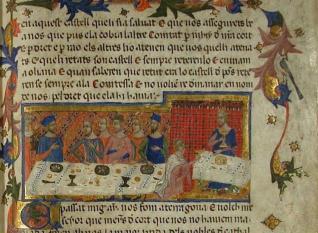
Other manuscripts have survived, all copies of the one made for the Poblet Monastery in 1343. There is one relevant codex between them conserved in the library of the University of Barcelona made by student Jaume Ferrera by order of his master, Prior Jaume Ramon Vila, who added a prologue, which is its singular feature.

The Prior explains the reason he ordered the present copy of the Llibre dels fets, was to deny the forgery issues that Castilian historians were throwing at Catalans. He indicates as well that the illustrations are faithful copies of the manuscript dated 1343 from the Poblet Monastery.

The other relevant feature of this codex is the second original illustration that did not survive from the Poblet manuscript. In this picture the Mayor of the Palace, Hugh de Forcalquier, and Blasco de Alagón are kneeling before James I.

More information: Royal Monastery of Santa Maria de Poblet


 Aquest es lo començament del prolech sobre el libre que feu el rey en Jacme per la gracia de Deu rey de Arago e de Mallorches e de Valencia,
comte de Barchinona e d'Urgell e senyor de Muntpesler
de tots los fets e de les gracies que Nostre Senyor li féu en la sua vida.
 
This is the beginning of the prologue about the book that King James made, by Holy Grace, King of Aragon, of Majorca and Valentia,
Count of Barcelona and Count of Urgell, and Lord of Montpellier,
of all his deeds and gifts, our Lord gave to him in his lifetime.
 
Libre dels Feyts

Sunday, 11 August 2019

MONESTIR DE PEDRALBES, COMMUNITY OF POOR CLARES

Arriving to the Monastery of Pedralbes, Barcelona
Today is Saint Clare of Assisi and Claire Fontaine is celebrating her feast day.

Claire has invited The Grandma to visit the Monestir de Pedralbes, a monastery founded by James II for his wife Elisenda de Montcada in 1326 and housed by Poor Clares, the community that was founded by  Saint Clare of Assisi, and her most important legacy. During her visit to the Monastery of Pedralbes, Claire and The Grandma has been remembering other important places built in honour to Saint Clare of Assisi.

Claire has remembered her last visits to the Santa Clara Convents in Palma and Naples, and The Grandma has been talking about the Santa Clara Convent in Barcelona.

Before visiting the monastery with Claire, The Grandma has
studied a new lesson of her Ms. Excel course.

Chapter 11. Printing (III) (Spanish Version)

Saint Clare of Assisi (16 July 1194 – 11 August 1253, born Chiara Offreduccio and sometimes spelled Clara, Clair, Claire or Sinclair) is an Italian saint and one of the first followers of Saint Francis of Assisi.


She founded the Order of Poor Ladies, a monastic religious order for women in the Franciscan tradition, and wrote their Rule of Life, the first set of monastic guidelines known to have been written by a woman.

Following her death, the order she founded was renamed in her honour as the Order of Saint Clare, commonly referred to today as the Poor Clares. Her feast day is on 11 August.
  
Old picture of the Monastery of Pedralbes
The Santa Clara Convent in Barcelona was a feminine convent built in what is now the Ribera district of the city of Barcelona.

Very damaged during the siege of Barcelona (1713-1714) was definitively devastated by order of Philip V of Spain, as part of the Ribera district to build the citadel of Barcelona during the postwar years and some of its architectural remains were distributed in some remarkable buildings of the city. Traditionally, it is considered the first foundation of the Clarisses in the Iberian Peninsula, although its founding date has been strongly discussed.

The date of its founding of legendary and traditional character was 1233/1234 by Agnès de Peranda d'Assís, supposedly the daughter of Peranda and niece of Santa Clara d'Assís, the founder of the order- and Clara de Janua -this second would be Maria de Pisa according to other sources-, they arrived at the port of Barcelona, coming from the monastery of Saint Damià d'Assís, after embarking on Ancona and suffering a shipwreck. They arrived in a boat without rims or sails, with the idea of founding a monastery.


The first documentation places the foundation around 1236/1237 by a bula of Gregori IX confirming the foundation initiated by several women headed by Berenguera d'Antic and Guillerma de Polinyà and ten other sisters.

In 1327, a fourteenth of these clan nuns founded the Monastery of Pedralbes.

In 1691, during the French invasion, the convent left for a few days. During the Siege of Barcelona (1713-1714) the convent was very damaged and the nuns were temporarily welcomed in houses of relatives and friends with the intention of repairing the damage, which was not possible due to the destruction and devastation of a large part from the Ribera district to build the citadel of Barcelona.


The Monastery of Pedralbes is a Gothic monastery in Barcelona, Catalonia. The name of the site in the XIV century was Petras Albas, Latin for white stones. The original name devolved into the current one.


The monastery was founded by Jaume II for his wife Elisenda de Montcada in 1326. It housed a community of Poor Clares, mostly members of noble families. The queen gave the monastery a series of privileges, including the direct protection of the city of Barcelona, through the Consell de Cent, who had the task to defend it in case of danger. Elisenda also built a palace annexed to the monastery, where she lived after her husband's death in 1327. She died there in 1367. The remains of the palace were discovered in the 1970s.

Visiting the cloister, Monastery of Pedralbes
During the Catalan Revolt (1640), the nuns were expelled, but later returned. A small number of nuns still reside in the complex. The monastery was declared a national monument in 1991.

Originally the monastery was defended by a line of walls, of which today only two towers and one gate remain. The church has a single nave, with rib vaults and a polygonal apse, and houses a Gothic retablo by Jaume Huguet. The façade is characterized by a large rose window. The cloister has three floors, and a length of 40 meters, with a central garden of orange trees and palms. It is formed by wide arches on columns, whose capitals are decorated with the emblems of the Kings of Aragon and the House of Montcada.

The sepulchre of Queen Elisenda, in alabaster stone, is located in one of the cloister's wings.

Also notable is the Chapel of St. Michael, housing several fresco paintings by Ferrer Bassa. Dating to 1346, they show the influence of the Italian painter Giotto. The former dormitory previously housed a permanent exhibition of painters such as Rubens, Canaletto, Tintoretto, Velázquez and Beato Angelico.

More information: Monestir de Pedralbes

The Santa Clara Convent is located on Santa Clara Street in Palma, on the island of Mallorca. The first reference that exists in the convent of Santa Clara in Palma dates back to the 13th century, at the time of Jaume I.


In 1256, Pope Alexander IV granted permission for the creation of a new monastery in Palma, request made by clarissa, Sister Caterina, abbess of the monastery of Santa Maria de Tarragona, who wanted to send a group of nuns to the island of Mallorca to found a new convent. Alexandre IV sent a letter to the Majorcan Franciscans, in which he will assist them at all times with the new Claretian nuns who had to settle in the capital of Mallorca.

Claire Fontaine visited Santa Clara Convent, Palma
On January 13, 1260, they settled in the center of the capital, on a land ceded for the construction of their convent. Catalina Berenguer and Guillermina, her sister, belonged to the nobility, and this made the convent progress rapidly. 

In 1837 the Franciscan nuns of the Convent of the Immaculate Conception of El Olivar went to the convent of Santa Clara. In the 17th century, great reforms were made, replacing the gothic part for one of the Renaissance and almost Baroque period. By 2007, the proceedings began to restore the convent completely.

The base of the building was built on remains of Muslim origin. Over the following centuries the convent was renovated and enlarged. And as witness of the extensions, there are round archways, blinded, from civil constructions, like the house of the family Montsó.


The chapter room is from the 16th century, the cloister corridors contain gothic tombs of the abbesses. The current church is the third of the built in this convent. The four chapels on the left are rectangular with a back cover, and on the right there are several plants with a canopy cover. The cover of the rostrum has a double row with vault of three sections of edge. At the top of the altar there is an image of The Immaculate Conception and at the bottom one of Santa Clara d'Assisi. On the left side of the facade there is a quadrangular bell tower embedded in the wall, which stands out with three bodies.

The portal dates back to 1671 and is thin. The entablature has a cornice topped by a broken fronton; In the center there is a medallion that has a relief that represents the image of Santa Clara.

More information: +Mallorca


Go forth in peace, for you have followed the good road.
Go forth without fear, for he who created you has made you holy,
has always protected you, and loves you as a mother.

Saint Clare of Assisi

Monday, 31 December 2018

JAUME I IN MEDINA MAYURQA, LA FESTA DE L'ESTENDARD

December 31, 1229, Mallorca Island
Today is a special day for The Grandma and she wants to share it with everybody. December, 31 is one of the most important days in Mallorca (Majorca), a place that The Grandma loves with all her heart.

Majorcan people celebrate La Festa de l'Estendard that commemorates the arrival of Jaume I to the island, then named Medina Mayurqa, in 1229. All the island celebrates this important date in its history, a commemoration that begins, at morning, with the ceremonial placing of the Royal Standard in Plaça Cort, followed by a Mass in the Cathedral and follows and, at noon, continues when the poem La Colcada is read in Plaça Cort.

It has been impossible for The Grandma to assist to this important event in Mallorca today, as she has done in the past several times but her heart is today in that wonderful island that is one of the most beautiful Mediterranean places and where The Grandma has an important part of her own history and culture.

La Balanguera is the official anthem of Balearic Island. This song talks about the importance of keeping the traditions and the own culture but being courageous and brave and working for a better future full of hope, respect and chances. This is also the main wish of The Grandma for the New Year. 

Happy New Year for everyone. Tons of hope and trust in our splendorous future that is arriving.

Before remembering Mallorca, The Grandma has studied a new lesson of her
Elementary Language Practice manual (Grammar 59).


Mallorca or Majorca is the largest island in the Balearic Islands, located in the Mediterranean. The native language, as on the rest of the Balearic Islands, is Catalan, which is co-official with Spanish.

There are two small islands off the coast of Mallorca: Cabrera, southeast of Ciutat de Palma, and Dragonera, west of Ciutat de Palma. The anthem of Mallorca is La Balanguera.

Francinaina, Giant of Ciutat de Palma
The name derives from Classical Latin insula maior, larger island. Later, in Medieval Latin, this became Maiorica, the larger one, in comparison to Menorca, the smaller one.

Little is recorded of the earliest inhabitants of the island. Burial chambers and traces of habitation from the Neolithic period (6000–4000 BC) have been discovered, particularly the prehistoric settlements called talaiots. They raised Bronze Age megaliths as part of their Talaiotic culture.

The Phoenicians, a seafaring people from the Levant, arrived around the eighth century BC and established numerous colonies. The island eventually came under the control of Carthage in North Africa, which had become the principal Phoenician city. After the Second Punic War, Carthage lost all of its overseas possessions and the Romans took over.

The island was occupied by the Romans in 123 BC under Quintus Caecilius Metellus Balearicus. It flourished under Roman rule, during which time the towns of Pollentia (Alcúdia), and Palmaria (Palma) were founded. In addition, the northern town of Bocchoris, dating back to pre-Roman times, was a federated city to Rome. The local economy was largely driven by olive cultivation, viticulture, and salt mining. Majorcan soldiers were valued within the Roman legions for their skill with the sling.

More information: Majorcan Villas

In 427, Gunderic and the Vandals captured the island. Geiseric, son of Gunderic, governed Mallorca and used it as his base to loot and plunder settlements around the Mediterranean, until Roman rule was restored in 465.

In 534, Mallorca was recaptured by the Eastern Roman Empire, led by Apollinarius. Under Roman rule, Christianity thrived and numerous churches were built.

From 707, the island was increasingly attacked by Muslim raiders from North Africa. Recurrent invasions led the islanders to ask Charlemagne for help.

In 902, Issam al-Khawlani, in Arabic عصام الخولاني‎, conquered the Balearic Islands, ushering in a new period of prosperity under the Emirate of Córdoba.  

Miquela Lladó in La Festa de l'Estendard
The town of Palma was reshaped and expanded, and became known as Medina Mayurqa. Later on, with the Caliphate of Córdoba at its height, the Moors improved agriculture with irrigation and developed local industries.

The caliphate was dismembered in 1015. Majorca came under rule by the Taifa of Dénia, and from 1087 to 1114, was an independent Taifa. During that period, the island was visited by Ibn Hazm.

However, an expedition of Pisans and Catalans in 1114–15, led by Ramon Berenguer III, Count of Barcelona, overran the island, laying siege to Palma for eight months. After the city fell, the invaders retreated due to problems in their own lands. They were replaced by the Almoravides from North Africa, who ruled until 1176. The Almoravides were replaced by the Almohad dynasty until 1229. Abú Yahya was the last Moorish leader of Mallorca.

In the ensuing confusion and unrest, King Jaume I, also known as James the Conqueror, launched an invasion which landed at Santa Ponça, Majorca, on 8–9 September 1229 with 15,000 men and 1,500 horses. His forces entered the city of Medina Mayurqa on 31 December 1229. In 1230 he annexed the island to his Crown of Aragon under the name Regnum Maioricae.

The capital of Mallorca, Ciutat de Palma, was founded as a Roman camp called Palmaria upon the remains of a Talaiotic settlement. The turbulent history of the city had it subject to several Vandal sackings during the fall of the Western Roman Empire. It was later reconquered by the Byzantines, established by the Moors, who called it Medina Mayurqa, and finally occupied by Jaume I.


 De tradicions i d'esperances tix la senyera pel jovent,
com qui fa un vel de nuviances amb cabelleres d'or i argent.
De la infantesa qui s'enfila, de la vellura qui se'n va...
La balanguera fila, fila. La balanguera filarà...


From traditions and from hopes, she weaves the flag for the youth
as one who prepares a wedding veil, with hairs of gold and silver.
For childhood that grews up, for old age who goes away.
The Balanguera spins, spins. The Balanguera will spin.


La Balanguera

Tuesday, 9 October 2018

OCTOBER, 9 1238, JAUME I & THE KINGDOM OF VALÈNCIA

Jaume I conquers Valencia, 1238
Today, The Grandma is in València. She has gone to participate in the events of the Valencian National Day, October 9 a commemoration of the day when Jaume I conquered the city and founded the Valencian Kingdom.  

She is in the city with Miquel and Lluïsa, her Valencian friends and they are ready to enjoy Valencian culture, especially something that The Grandma loves, the Muixerangues.

During the travel by train, The Grandma has studied a new lesson of her First Certificate Language Practice manual (Vocabulary 6).

 More information: Vehicles and Transport

James I the Conqueror, in Catalan Jaume el Conqueridor, in Aragonese Chaime lo Conqueridor, and in Occitan Jacme lo Conquistaire (2 February 1208-27 July 1276) was King of Aragon, Count of Barcelona, and Lord of Montpellier from 1213 to 1276; King of Majorca from 1231 to 1276; and Valencia from 1238 to 1276. His long reign, the longest of any Iberian monarch, saw the expansion of the House of Aragon and House of Barcelona in three directions: Languedoc to the north, the Balearic Islands to the southeast, and Valencia to the south.

By a treaty with Louis IX of France, he wrested the county of Barcelona from nominal French suzerainty and integrated it into his crown. He renounced northward expansion and taking back the once Catalan territories in Occitania and vassal counties loyal to the County of Barcelona, lands that were lost by his father Peter II of Aragon in the Battle of Muret during the Albigensian Crusade and annexed by the Kingdom of France, and then decided to turn south. 

Jaume I accepts to conquer Valencia
One of the main reasons for this formal renunciation of most of the once Catalan territories in Languedoc and Occitania and any expansion into them is the fact that he was raised by the Knights Templar crusaders, who had defeated his father fighting for the Pope alongside the French, so it was effectively forbidden for him to try to maintain the traditional influence of the Count of Barcelona that previously existed in Occitania and Languedoc.

As a legislator and organiser, he occupies a high place among the European kings. Jaume compiled the Llibre del Consolat de Mar, which governed maritime trade and helped establish Catalan-Aragonese supremacy in the western Mediterranean. He was an important figure in the development of the Catalan language, sponsoring Catalan literature and writing a quasi-autobiographical chronicle of his reign: the Llibre dels Fets

Jaume was born at Montpellier as the only son of Peter II of Aragon and Marie of Montpellier. As a child, Jaume was made a pawn in the power politics of Provence, where his father was engaged in struggles helping the Cathar heretics of Albi against the Albigensian Crusaders led by Simon IV de Montfort, Earl of Leicester, who were trying to exterminate them.

More information: Cathar

Peter endeavoured to placate the northern crusaders by arranging a marriage between his son James and Simon's daughter, when the former was only two years old. He entrusted the boy to be educated in Montfort's care in 1211, but was soon forced to take up arms against him, dying at the Battle of Muret on 12 September 1213.

Montfort would willingly have used Jaume as a means of extending his own power had not the Catalan-Aragonese appealed to Pope Innocent III, who insisted that Montfort surrender him. Jaume was handed over to the papal legate Peter of Benevento at Carcassonne in May or June 1214.

Castle of Montso, Aragon
Jaume was then sent to Montsó, where he was entrusted to the care of Guillem de Montredó, the head of the Knights Templar in Provence

The kingdom was given over to confusion until, in 1217, the Templars and some of the more loyal nobles brought the young king to Zaragoza.

Jaume built and consecrated the Cathedral of Lleida, which was constructed in a style transitional between Romanesque and Gothic with little influence from Moorish styles.

Jaume was a patron of the University of Montpellier, which owed much of its development to his impetus. He also founded a studium at Valencia in 1245 and received privileges for it from Pope Innocent IV, but it did not develop as splendidly. In 1263, Jaume presided over a debate in Barcelona between the Jewish rabbi Nahmanides and Pablo Christiani, a prominent converso.

More information: Turó Seu Vella

Jaume was the first great sponsor and patron of vernacular Catalan literature. Indeed, he may himself be called the first of the Catalan prose writers.

Jaume wrote or dictated at various stages a chronicle of his own life in Catalan, Llibre dels Fets, the first autobiography by a Christian king. As well as being a fine example of autobiography, the Book of Deeds expresses concepts of the power and purpose of monarchy, examples of loyalty and treachery in the feudal order, and medieval military tactics. More controversially, some historians have looked at these writings as a source of Catalan identity, separate from that of Occitania and Rome.

Llibre dels Fets, the autobiography of Jaume I
Jaume also wrote the Libre de la Saviesa or Book of Wisdom. The book contains proverbs from various authors, reaching from the time of King Solomon to nearly his own time with Albertus Magnus.

It even contains maxims from the medieval Arab philosophers and from the Apophthegmata Philosophorum of Honein ben Ishak, which was probably translated at Barcelona during his reign. A Hebrew translator by the name of Jehuda was employed at Jaume's court during this period.

Though Jaume was himself a prose writer and sponsored mostly prose works, he had an appreciation of verse. In consequence of the Albigensian Crusade, many troubadours were forced to flee southern France and many found refuge in Catalonia and Aragon

On 5 September 1229, the troops from Aragon, consisting of 155 ships, 1,500 horsemen and 15,000 soldiers, set sail from Tarragona, Salou, and Cambrils to conquer Majorca from Abú Yahya, the semi-independent Almohad governor of the island. Although a group of Aragonese knights took part in the campaign because of their obligations to the king, the conquest of Majorca was mainly a Catalan undertaking, and Catalans would later make up the majority of Majorca's settlers.

Jaume conquered Majorca on 31 December 1229, and Menorca (1232) and Ibiza (1235) were later acquired during the reconquest.

Valencia capitulated to Catalan-Aragonese rule on 28 September 1238, following an extensive campaign that included the Siege of Burriana and the decisive Battle of the Puig, where the Aragonese commander, Bernardo Guillermo de Entenza, who was also the king's cousin, died from wounds received in action. Chroniclers say he used gunpowder in the siege of Museros castle. Finally, in October 9, Jaume entered in the city of Valencia and founded the Valencian Kingdom.

More information: UNESCO


The air is moving for freedom
and the west wind will turn to the east.

The Song of the Muixeranga