Today, The Grandma has been reading about Marguerite Higgins Hall, the American reporter and war correspondent, who was born on a day like today on 1920.
Marguerite Higgins Hall (September 3, 1920-January 3, 1966) was an American reporter and war correspondent.
Higgins covered World War II, theKorean War, and the Vietnam War, and in the process advanced the cause of equal access for female war correspondents.
She had a long career with the New York Herald Tribune (1942-1963), and later, as a syndicated columnist for Newsday(1963-1965).
She was the first woman to win a Pulitzer Prize for Foreign Correspondence awarded in 1951 for her coverage of the Korean War.
Higgins was born on September 3, 1920, in Hong Kong, where her father, Lawrence Higgins, was working at a shipping company. Her father, an Irish-American, met his future wife and Higgins' mother, Marguerite de Godard Higgins (who was of French aristocratic descent) in WWI Paris. Shortly afterward, they moved to Hong Kong, where their daughter was born.
The family moved back to the United States three years later and settled in Oakland.
Higgins started at the University of California, Berkeley in the fall of 1937 where she was a member of the Gamma Phi Beta sorority and wrote for The Daily Californian, serving as an editor in 1940.
She walked into the New York Herald Tribune city office after arriving in New York in August 1941. She met with the city editor at the time, L.L. Engel Engelking, and showed him her clippings. While he didn't offer her a job at the time, he told her to come back in a month and maybe he'd have a position for her. Shedecided to stay in New York and studied at Columbia.
Eager to become a war correspondent, Higgins persuaded the management of the New York Herald Tribune to send her to Europe in 1944, after working for the paper for two years. After being stationed in London and Paris, she was reassigned to Germany in March 1945. She witnessed the liberation of the Dachau concentration camp in April 1945 and received a U.S. Army campaign ribbon for her assistance during the surrender by its S.S. guards. She later covered the Nuremberg war trials and the Soviet Union's blockade of Berlin.
In 1947, she became the Chief of the Tribune's bureau in Berlin.
In 1950, Higgins was named chief of the Tribune's Tokyo bureau, and she received a cold welcome by her colleagues in Tokyo. She later learned that a recently published novel by her colleague in Berlin had created a hostile impression. The novel, Shriek With Pleasure, depicted a female reporter in Berlin who stole stories and slept with sources.
As a result of her reporting from Korea, Higgins received the 1950 George Polk Memorial Award from the Overseas Press Club. She contributed along with other major journalistic and political figures to the Collier's magazine collaborative special issue Preview of the War We Do Not Want, with an article entitled Women of Russia.
Higgins continued to cover foreign affairs throughout the rest of her life, interviewing world leaders such as Francisco Franco, Nikita Khrushchev, and Jawaharlal Nehru.
In 1955, she established and became chief of the Tribune's Moscow bureau and was the first American correspondent allowed back into the Soviet Union after Stalin's death.
In 1963, she joined Newsday and was assigned to cover Vietnam, where she visited hundreds of villages, interviewed most of the major figures, and wrote a book entitled Our Vietnam Nightmare. While in Vietnam, another feud developed between Higgins and David Halberstam, a New York Times correspondent who was assigned to replace Bigart. Her battle was not for scoops or headlines this time. Instead, it was based on the ideological differences and ego between an experienced correspondent, Higgins, and a young Halberstam.
When Higgins was six months old, she came down with malaria. A doctor told the family to take her to a mountain resort in present-day Vietnam to recover, which she did. Decades later, Higgins returned from assignment in South Vietnam in November 1965, where Higgins contracted leishmaniasis, a disease that led to her death on January 3, 1966, aged 45, in Washington, D.C. She is interred at Arlington National Cemetery with her husband.
I thought then how much more matter-of-fact the actuality of war is than any of its projections in literature. The wounded seldom cry -there’s no one with time and emotion to listen.
Yesterday, The Jones visited Hiroshima and Nagasaki, the two cities which were annihilated by a nuclear bomb in 1945. They were hard visits full of sadness and anger to discover how stupid and cruel humanity can be.
The family didn't take any photo or selfie because they considered the places they visited aren't touristic ones but historic and they wanted to preserve the honour of the victims without forgetting their pain, suffering and terrible experiences. We must never forget what happened in Hiroshima on August 6, and in Nagasaki on August 9.
Hiroshima, literally Broad Island, is the capital of Hiroshima Prefecture and the largest city in the Chūgoku region of western Honshu, the largest island of Japan. Hiroshima gained city status on April 1, 1889. On April 1, 1980, Hiroshima became a designated city.
Hiroshima, August 1945
Hiroshima is known as the first city in history to be targeted by a nuclear weapon when the United States Army Air Forces (USAAF) dropped an atomic bomb on the city at 8:15 a.m. on August 6, 1945, near the end of World War II.
During World War I, Hiroshima became a focal point of military activity, as the Japanese government entered the war on the Allied side. About 500 German prisoners of war were held in Ninoshima Island in Hiroshima Bay. The growth of Hiroshima as a city continued after the First World War, as the city now attracted the attention of the Catholic Church, and on May 4, 1923, an Apostolic Vicar was appointed for that city.
During World War II, the Second General Army and Chūgoku Regional Army were headquartered in Hiroshima, and the Army Marine Headquarters was located at Ujina port. The city also had large depots of military supplies, and was a key center for shipping.
Nuclear shadows in Hiroshima
The bombing of Tokyo and other cities in Japan during World War II caused widespread destruction and hundreds of thousands of civilian deaths. There were no such air raids on Hiroshima.
However, a real threat existed and was recognized. In order to protect against potential firebombings in Hiroshima, school children aged 11–14 years were mobilized to demolish houses and create firebreaks.
On Monday, August 6, 1945, at 8:15 a.m., the nuclear weapon Little Boy was dropped on Hiroshima from an American Boeing B-29 Superfortress, the Enola Gay, flown by Colonel Paul Tibbets, directly killing an estimated 70,000 people, including 20,000 Japanese combatants and 2,000 Korean slave laborers.
By the end of the year, injury and radiation brought the total number of deaths to 90,000–166,000. The population before the bombing was around 340,000 to 350,000. About 70% of the city's buildings were destroyed, and another 7% severely damaged.
Sumitomo Bank in Hiroshima, Japan.
The public release of film footage of the city following the attack, and some of the Atomic Bomb Casualty Commission research about the human effects of the attack, was restricted during the occupation of Japan, and much of this information was censored until the signing of the Treaty of San Francisco in 1951, restoring control to the Japanese.
News of the terrible consequences of the atom bomb attacks on Japan was deliberately withheld from the Japanese public by US military censors during the Allied occupation, even as they sought to teach the natives the virtues of a free press. Casualty statistics were suppressed. Film shot by Japanese cameramen in Hiroshima and Nagasaki after the bombings was confiscated.
The US occupation authorities maintained a monopoly on scientific and medical information about the effects of the atomic bomb through the work of the Atomic Bomb Casualty Commission, which treated the data gathered in studies of hibakusha as privileged information rather than making the results available for the treatment of victims or providing financial or medical support to aid victims. The US also stood by official denial of the ravages associated with radiation. Finally, not only was the press tightly censored on atomic issues, but literature and the arts were also subject to rigorous control prior.
Hiroshima has become a metaphor not just for nuclear war
but for war and destruction and violence toward civilians.
It's not just the idea we should not use nuclear arms.
We should not start another war because it's madness.
Max von Sydow
Nagasaki is the capital and the largest city of Nagasaki Prefecture on the island of Kyushu. The city's name, means long cape in Japanese. Nagasaki became a centre of colonial Portuguese and Dutch influence in the 16th through 19th centuries, and Churches and Christian Sites in Nagasaki have been proposed for inscription on the UNESCO World Heritage List. Part of Nagasaki was home to a major Imperial Japanese Navy base during the First Sino-Japanese War and Russo-Japanese War.
During World War II, the American atomic bombings of Hiroshima and Nagasaki made Nagasaki the second and, to date, last city in the world to experience a nuclear attack at 11:02 a.m., August 9, 1945' Japan Standard Time.
On the day of the nuclear strike, August 9, 1945, the population in Nagasaki was estimated to be 263,000, which consisted of 240,000 Japanese residents, 10,000 Korean residents, 2,500 conscripted Korean workers, 9,000 Japanese soldiers, 600 conscripted Chinese workers, and 400 Allied POWs. That day, the Boeing B-29 Superfortress Bockscar, commanded by Major Charles Sweeney, departed from Tinian's North Field just before dawn, this time carrying a plutonium bomb, code named Fat Man.
Less than a second after the detonation, the north of the city was destroyed and 35,000 people were killed. Among the deaths were 6,200 out of the 7,500 employees of the Mitsubishi Munitions plant, and 24,000 others, including 2,000 Koreans, who worked in other war plants and factories in the city, as well as 150 Japanese soldiers.
Dropping those atomic bombs on Hiroshima and Nagasaki
was a war crime.
George Wald
The Japanese word kamikaze is usually translated as divine wind. Kami is the word for god, spirit, or divinity, and kaze for wind. The word originated from Makurakotoba of waka poetry modifying Ise and has been used since August 1281 to refer to the major typhoons which dispersed Mongolian invasion fleets under Kublai Khan in 1274.
A Japanese monoplane which made a record-breaking flight from Tokyo to London in 1937 for the Asahi newspaper group was named Kamikaze. She was a prototype for the Mitsubishi Ki-15.
In Japanese, the formal term used for units carrying out suicide attacks during 1944–1945 is tokubetsu kōgeki tai, which literally means special attack unit. This is usually abbreviated to tokkōtai. More specifically, air suicide attack units from the Imperial Japanese Navy were officially called shinpū tokubetsu kōgeki tai, divine wind special attack units. Shinpū is the on-reading, on'yomi or Chinese-derived pronunciation, of the same characters that form the word kamikaze in Japanese.
During World War II, kamikaze, officially Tokubetsu Kōgekitai which means Special Attack Unit, were a part of the Japanese Special Attack Units of military aviators who initiated suicide attacks for the Empire of Japan against Allied naval vessels in the closing stages of the Pacific campaign, designed to destroy warships more effectively than possible with conventional air attacks. About 3,800 kamikaze pilots died during the war, and more than 7,000 naval personnel were killed by kamikaze attacks.
The USS Arizona hit by kamikaze, Pearl Harbor
Kamikaze aircraft were essentially pilot-guided explosive missiles, purpose-built or converted from conventional aircraft. Pilots would attempt to crash their aircraft into enemy ships in what was called a body attack in planes laden with some combination of explosives, bombs, torpedoes and full fuel tanks.
Accuracy was much better than a conventional attack, and the payload and explosion larger; about 19% of kamikaze attacks were successful. A kamikaze could sustain damage which would disable a conventional attacker and still achieve its objective. The goal of crippling or destroying large numbers of Allied ships, particularly aircraft carriers, was considered by the Empire of Japan to be a just reason for sacrificing pilots and aircraft.
These attacks, which began in October 1944, followed several critical military defeats for the Japanese. They had long since lost aerial dominance due to outdated aircraft and the loss of experienced pilots.
USS Bunker Hill hit by kamikazes
Japan suffered from a diminishing capacity for war, and a rapidly declining industrial capacity relative to the Allies. Japan was also losing pilots faster than it could train their replacements. In combination, these factors, coupled with the unwillingness to surrender, led to the use of kamikaze tactics as Allied forces advanced towards the Japanese home islands.
While the term kamikaze usually refers to the aerial strikes, it has also been applied to various other suicide attacks. The Japanese military also used or made plans for non-aerial Japanese Special Attack Units, including those involving submarines, human torpedoes, speedboats and divers.
The tradition of death instead of defeat, capture, and shame is deeply entrenched in Japanese military culture. One of the primary traditions in the samurai life and the Bushido code: loyalty and honour until death.
The Normandy Landings, codenamed Operation Neptune, were the landing operations on Tuesday, 6 June 1944 (termed D-Day) of the Allied invasion of Normandy in Operation Overlord during World War II. The largest seaborne invasion in history, the operation began the liberation of German-occupied northwestern Europe from Nazi control, and contributed to the Allied victory on the Western Front.
Planning for the operation began in 1943. In the months leading up to the invasion, the Allies conducted a substantial military deception, codenamed Operation Bodyguard, to mislead the Germans as to the date and location of the main Allied landings. The weather on D-Day was far from ideal, but postponing would have meant a delay of at least two weeks, as the invasion planners had requirements for the phase of the moon, the tides, and the time of day that meant only a few days in each month were deemed suitable. Adolf Hitler placed German Field Marshal Erwin Rommel in command of German forces and of developing fortifications along the Atlantic Wall in anticipation of an Allied invasion.
The amphibious landings were preceded by extensive aerial and naval bombardment and an airborne assault—the landing of 24,000 American, British, and Canadian airborne troops shortly after midnight. Allied infantry and armoured divisions began landing on the coast of France at 06:30. The target 80 km stretch of the Normandy coast was divided into five sectors: Utah, Omaha, Gold, Juno, and Sword. Strong winds blew the landing craft east of their intended positions, particularly at Utah and Omaha.
Operation Overload Map
The men landed under heavy fire from gun emplacements overlooking the beaches, and the shore was mined and covered with obstacles such as wooden stakes, metal tripods, and barbed wire, making the work of the beach-clearing teams difficult and dangerous. Casualties were heaviest at Omaha, with its high cliffs. At Gold, Juno, and Sword, several fortified towns were cleared in house-to-house fighting, and two major gun emplacements at Gold were disabled, using specialised tanks.
The Allies failed to achieve any of their goals on the first day. Carentan, St. Lô, and Bayeux remained in German hands, and Caen, a major objective, was not captured until 21 July. Only two of the beaches (Juno and Gold) were linked on the first day, and all five beachheads were not connected until 12 June; however, the operation gained a foothold which the Allies gradually expanded over the coming months. German casualties on D-Day have been estimated at 4,000 to 9,000 men. Allied casualties were at least 10,000, with 4,414 confirmed dead.
Albert Einstein (14 March 1879-18 April 1955) was a German-born theoretical physicist. He developed the theory of relativity, one of the two pillars of modern physics, alongside quantum mechanics. Einstein's work is also known for its influence on the philosophy of science. Einstein is best known in popular culture for his mass, energy equivalence formula E = mc2, which has been dubbed the world's most famous equation. He received the 1921 Nobel Prize in Physicsfor his services to theoretical physics, and especially for his discovery of the law of the photoelectric effect, a pivotal step in the evolution of quantum theory.
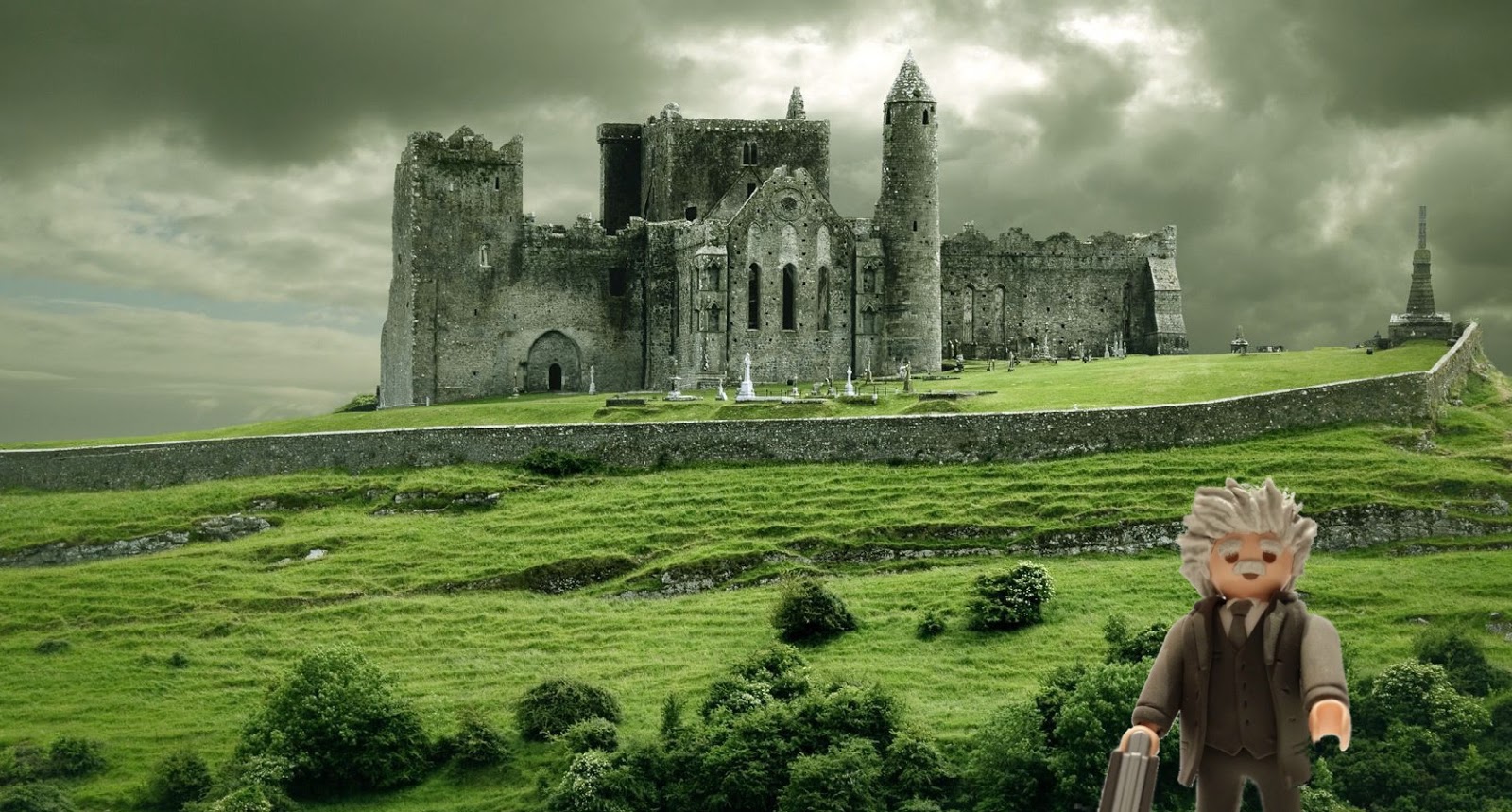
Ireland has a proud history of neutrality and it is perhaps for this reason much of the details of Albert Einstein’s 1941 visit to Ireland has been erased from the history books.
What was to be but a short two day visit lasted three months and resulted in the construction of Ireland’s first and only nuclear bomb. Now, The Grandma brings you the true story of Einstein’s visit to these shores and the weapon of mass destruction he built for us.
The world's most famous equation
Famed for his passion for pacifism, Einstein was compelled to visit Ireland and see its neutrality first hand while en route to a series of lectures he was to give at Oxford University in England.
The Taoiseach of the day Eamon de Valera learned of Einstein’s passage to Ireland and invited him to an evening of conversation and conviviality in Dublin.
De Valera laid on a most impressive feast for his guest considering the lack of quality produce available in Ireland during wartime which Einstein greatly appreciated. They toured Dublin’s great whorehouses, not to partake in such practices, but having become wearied by the carrying around loose change all evening they decided to divest themselves of it while helping the local economy.
The Taoiseach made several requests of Einstein that evening, asking the great physicist to look into creating the most aerodynamically perfect hurley, which he would then send only to the Clare senior hurling team but Einstein declined.
Albert Einstein
After a detour into a noted and infamous opium emporium Einstein claimed to have witnessed visions of great cataclysmic horrors brought forth by war, de Valera too saw troubling sites in his hallucinations; a capital city obsessed with decent lattes and pulled pork.
Truly frightened of what he thought would be a Nazi reign of hipster culture de Valera struck Einstein in the head with an aerodynamically inferior hurley, knocking him out cold.
Einstein would wake in chains in a room de Valera had nicknamed An Dearg Seomra. It was here DeValera made demands of Einstein to create the basis of a foolproof defence against the Nazis: the atomic bomb.
The world famous physicist was forced to work around the clock for days on end until he completed a bomb of terrifying capabilities surviving only on a diet of chomp bars and Guinness.
Albert Einstein
Upon completion of the device Einstein was liberated and carried on his travels to Oxford, leaving de Valera in charge of the bomb along with its security code. In an act of defiance Einstein instituted a code that would irk de Valera: Michael Collins is da best.
The bomb as you may know remained unused as Hitler and his regime were ultimately defeated, but curiously de Valera had stated he would only use the bomb in the event of the Nazis occupying England as it would have hit two birds with one stone.
Subsequent political generations have kept these events as secretive as possible, but when some newspapers began sniffing around the story in the late 90s the Government of the day decided it was best to hide the bomb from public view.
The exact location of the warhead is not known, but it is probably not a coincidence that after quelling the story in the papers they would announce the construction of the Spire the following day.
Berliner Mauer, The Berlin Wall, in an old picture
Today, The Bonds are going to visit The Berliner Mauer aka The Berlin Wall and the East Side Gallery. It will be an exciting visit full of feeling and emotions because this wall has determined the lives of millions of people and when it fell the Cold War gave another step to the end. The Wall wasn't only a construction of bricks but the line that separate two manners of understanding economy,commerce and free expression. Firstly, this German fact changed the recent history of many countries like Romania, Hungary, Latvia, Lithuania, Estonia, Poland, Belorussia, Ukraine, Moldavia, Czech Republic, Slovakia, Georgia, Azerbaijan, Armenia or Bulgaria and prepared another one in Yugoslavia (Balkan War), Albania, China or Cuba.
Berliner Mauer or The Berlin Wall was a barrier that divided Berlin from 1961 to 1989.
Constructed by the GermanDemocratic Republic, GDR, East Germany, starting on 13 August 1961, the Wall completely cut off by land West Berlin from surrounding East Germany and from East Berlin until government officials opened it in November 1989.
Its demolition officially began on 13 June 1990 and was completed in 1992. The barrier included guard towers placed along large concrete walls, which circumscribed a wide area, later known as the death strip, that contained anti-vehicle trenches, fakir beds and other defenses.
The Eastern Bloc claimed that the Wall was erected to protect its population from fascist elements conspiring to prevent the will of the people in building a socialist state in East Germany. In practice, the Wall served to prevent the massive emigration and defection that had marked East Germany and the communist Eastern Bloc during the post-World War II period.
Some children playing next to the Berlin Wall
After the end of World War II in Europe, what remained of pre-war Germany west of the Oder-Neisse line was divided into four occupation zones, as per the Potsdam Agreement, each one controlled by one of the four occupying Allied powers: the United States, United Kingdom, France and the Soviet Union. The capital of Berlin, as the seat of the Allied Control Council, was similarly subdivided into four sectors despite the city's location, which was fully within the Soviet zone.
Within two years, political divisions increased between the Soviets and the other occupying powers. These included the Soviets' refusal to agree to reconstruction plans making post-war Germany self-sufficient and to a detailed accounting of the industrial plants, goods and infrastructure already removed by the Soviets. Britain, France, the United States and the Benelux countries later met to combine the non-Soviet zones of the country into one zone for reconstruction and to approve the extension of the Marshall Plan.
On 15 June 1961, First Secretary of the Socialist Unity Party and GDR State Council chairman Walter Ulbricht stated in an international press conference, Niemand hat die Absicht, eine Mauer zu errichten!, No one has the intention of erecting a wall!. It was the first time the colloquial term Mauer, wall, had been used in this context.
The transcript of a telephone call between Nikita Khrushchev and Ulbricht on 1 August in the same year, suggests that the initiative for the construction of the Wall came from Khrushchev.
However, other sources suggest that Khrushchev had initially been wary about building a wall, fearing negative Western reaction. What is beyond dispute, though, is that Ulbricht had pushed for a border closure for quite some time, arguing that East Germany's very existence was at stake.
Khrushchev had been emboldened by US President John F. Kennedy's tacit indication that the US would not actively oppose this action in the Soviet sector of Berlin.
On Saturday, 12 August 1961, the leaders of the GDR attended a garden party at a government guesthouse in Döllnsee, in a wooded area to the north of East Berlin. There Ulbricht signed the order to close the border and erect a wall.
The line of the Berlin Wall nowadays
Hungary effectively disabled its physical border defenses with Austria on 19 August 1989 and, in September, more than 13,000 East German tourists escaped through Hungary to Austria. This set up a chain of events.
This was followed by mass demonstrations within East Germany itself. Protest demonstrations spread throughout East Germany in September 1989. This was the start of what East Germans generally call the Peaceful Revolution of late 1989. The protest demonstrations grew considerably by early November.
The movement neared its height on 4 November, when half a million people gathered to demand political change, at the Alexanderplatz demonstration, East Berlin's large public square and transportation The fall of the Berlin Wall began the evening of 9 November 1989 and continued over the following days and weeks, with people nicknamed Mauerspechte, wall woodpeckers, using various tools to chip off souvenirs, demolishing lengthy parts in the process, and creating several unofficial border crossings.
Television coverage of citizens demolishing sections of the Wall on 9 November was soon followed by the East German regime announcing ten new border crossings, including the historically significant locations of Potsdamer Platz, Glienicker Brücke, and Bernauer Straße. Crowds gathered on both sides of the historic crossings waiting for hours to cheer the bulldozers that tore down portions of the Wall to reinstate ancient roads. While the Wall officially remained guarded at a decreasing intensity, new border crossings continued for some time, including the Brandenburg Gate on 22 December 1989.
The Bonds visiting East Side Gallery
In some European capitals at the time, there was a deep anxiety over prospects for a reunified Germany. In September 1989, British Prime Minister Margaret Thatcher pleaded with Soviet President Mikhail Gorbachev not to let the Berlin Wall fall and confided that she wanted the Soviet leader to do what he could to stop it.
We do not want a united Germany. This would lead to a change to postwar borders and we cannot allow that because such a development would undermine the stability of the whole international situation and could endanger our security, Thatcher told Gorbachev.
After the fall of the Berlin Wall, French President François Mitterrand warned Thatcher that a unified Germany could make more ground than Adolf Hitler ever had and that Europe would have to bear the consequences.
Nowadays, Berlin is a symbol of peace and reconciliation, a modern city, capital of one of the more powerful European countries. The East Side Gallery is an international memorial for freedom. It is a 1316 m long section of the Berlin Wall located near the centre of Berlin on Mühlenstraße in Friedrichshain-Kreuzberg. The actual border at this point was the river Spree. The gallery is located on the so-called hinterland mauer, which closed the border to West Berlin.
The Berlin Wall wasn't the only barrier to fall after the collapse of the Soviet Union and the end of the Cold War. Traditional barriers to the flow of money, trade, people and ideas also fell.
The Bonds are spending their last hours in Berlin. The visit has been incredible and the family is preparing their suitcases. Tomorrow, they'll return to Barcelona but today they're visiting Potsdamer Platz.
Potsdamer Platz is an important public square and traffic intersection in the centre of Berlin, Germany, lying about 1 km south of the Brandenburg Gate and the Reichstag and close to the southeast corner of the Tiergarten park.
It is named after the city of Potsdam, some 25 km to the south west, and marks the point where the old road from Potsdam passed through the city wall of Berlin at the Potsdam Gate.
After developing within the space of little over a century from an intersection of rural thoroughfares into the most bustling traffic intersection in Europe, it was totally laid waste during World War II and then left desolate during the Cold War era when the Berlin Wall bisected its former location. Since German reunification, Potsdamer Platz has been the site of major redevelopment projects.
Potsdamer Platzbegan as a trading post where several country roads converged just outside Berlin's old customs wall. The history of Potsdamer Platz can probably be traced back to 29 October 1685, when the Tolerance Edict of Potsdam was signed, whereby Frederick William, Elector of Brandenburg-Prussia from 1640 to 1688, allowed large numbers of religious refugees, including Jews from Austria and Huguenots expelled from France, to settle on his territory.
Potsdamer Platz in an old picture
A key motivation behind the Edict was so the Elector could encourage the rapid repopulation, restabilising and economic recovery of his kingdom, following the ravages of the Thirty Years' War (1618–48). Altogether up to 15,000 Huguenots made new homes in the Brandenburg region, some 6,000 of these in its capital, Berlin, indeed, by 1700 and for a while afterwards as much as 20% of Berlin’s population was French-speaking.
As was the case in most of central Berlin, almost all of the buildings around Potsdamer Platz were turned to rubble by air raids and heavy artillery bombardment during the last years of World War II. The three most destructive raids, out of 363 that the city suffered, occurred on 23 November 1943, and 3 February and 26 February 1945. Things were not helped by the very close proximity of Hitler's Reich Chancellery, just one block away in Voßstraße, and many other Nazi government edifices nearby as well, and so Potsdamer Platz was right in a major target area.
With the construction of the Berlin Wall on 13 August 1961, along the intracity frontier, Potsdamer Platz now found itself physically divided in two. What had once been a busy intersection had become totally desolate. With the clearance of most of the remaining bomb-damaged buildings on both sides, on the eastern side, this was done chiefly to give border guards a clear view of would-be escapees and an uninterrupted line of fire, little was left in an area of dozens of hectares.
After the initial opening of the Berlin Wall on 9 November 1989, Potsdamer Platz became one of the earliest locations where the Wall was breached to create a new border crossing between East and West Berlin.
The future Potsdamer Platz was most definitely outside Berlin, and therefore not subject to the planning guidelines and constraints that would normally be expected in a city keen to show itself off as the capital of an empire. It grew very rapidly in a piecemeal and haphazard way, and came to epitomise wildness and excess in a manner that contributed much to its legendary status.
The Bonds are visiting one of the most popular Christmas Markets of Berlin, The Gendarmenmarkt. They're buying some presents and souvenirs because they're their last 72 hours in the city. They're enjoying every moment and trying to catch all of it in their minds. It's a wonderful place with very nice people.
The Gendarmenmarktis a square and the site of an architectural ensemble including the Konzerthaus, concert hall, and the French and German Churches. In the centre of the square stands a monumental statue of Germany's renowned poet Friedrich Schiller. The square was created by Johann Arnold Nering at the end of the seventeenth century as the Linden-Markt and reconstructed by Georg Christian Unger in 1773. The Gendarmenmarkt is named after the cuirassier regiment Gens d'Armes, which had stables at the square until 1773.
During World War II, most of the buildings were badly damaged or destroyed. Today all of them have been restored.
Gendarmenmarkt was first built in 1688. It was a marketplace and part of the city's Western expansion of Friedrichstadt, one of Berlin's emerging quarters.
The Gendarmenmarkt in Berlin
The French Church or Französischer Dom is the older of the two churches, was built by the Huguenot community between 1701 and 1705. It was modelled after the destroyed Huguenot church in Charenton-Saint-Maurice, France. The tower and porticoes, designed by Carl von Gontard, were added to the building in 1785.
The French Church has a viewing platform, a restaurant and a Huguenot museum.
The Konzerthaus Berlin is the most recent building on the Gendarmenmarkt. It was built by Karl Friedrich Schinkel in 1821 as the Schauspielhaus. It was based on the ruins of the National Theatre, which had been destroyed by fire in 1817.
Parts of the building contain columns and some outside walls from the destroyed building. Like the other buildings on the square, it was also badly damaged during World War II. The reconstruction, finished in 1984, turned the theatre into a concert hall. Today, it is the home of the KonzerthausorchesterBerlin.
The Gendarmenmarkt hosts one of Berlin's most popular Christmas markets.
Christmas waves a magic wand over this world, and behold,
The Memorial to the Murdered Jews of Europe, Denkmal für die ermordeten Juden Europas, also known as the Holocaust Memorial or Holocaust-Mahnmal, is a memorial in Berlin to the Jewish victims of the Holocaust, designed by architect Peter Eisenman and engineer Buro Happold.It consists of a 19,000 m2 site covered with 2,711 concrete slabs or "stelae", arranged in a grid pattern on a sloping field. The stelae are 2.38 m long, 0.95 m wide and vary in height from 0.2 to 4.7 m. They are organized in rows, 54 of them going north–south, and 87 heading east–west at right angles but set slightly askew.
An attached underground Place of Information, Ort der Information, holds the names of approximately 3 million Jewish Holocaust victims, obtained from the Israeli museum Yad Vashem. Building began on April 1, 2003, and was finished on December 15, 2004. It was inaugurated on May 10, 2005, sixty years after the end of World War II, and opened to the public two days later.
The Memorial to the Murdered Jews of Europe
It is located in the Friedrichstadt neighborhood in Berlin, a city that had one of the largest Jewish populations in Europe before World War 2.
Nestled next to the Tiergarten, it has a central location in the Friedrichstadt district of Berlin. The memorial is close to the Reichstag building and the Brandenburg Gate. The monument is located on the former location of the Berlin Wall, where the death strip once divided the city.
It acts as a focal point, connecting the various holocaust monuments spread across the city and the country; the monument provides a central reference point for visitors. The center represents a central focus on the diverse memorial sites across Germany which stress the living memory aspect of remembrance. In Berlin an example of this is the Stolpersteine, tripping stones, initiative plaques on street pavements, usually outside the house's main entrance, commemorating deported Jewish residents.
The Memorial to the Murdered Jews of Europe
The monument is composed of 2711 rectangular concrete blocks, laid out in agrid formation, the monument is organized into a rectangle-like array covering 4.7 acres. This lets for long, straight, and narrow alleys between them, along which the ground undulates. The installation is a living experiment in montage, a Kuleshov of the juxtaposition of image and text.
People have applauded the location of the memorial. During the war, the area acted as the administrative center of Hitler's killing machine. His chancellery building, designed by Albert Speer and since demolished, was a few hundred yards away just to the south; his bunker lies beneath a nearby parking lot. The memorial is also located near Berlin’s foreign embassies. Allowing political diplomats and leaders from around the world to observe how Germany acknowledges its past while continuing to move forward.
.jpg)