Showing posts with label Sant Boi de Llobregat. Show all posts

Monday, 23 March 2026

THE MORGANS & THE GRANDMA, ADVENTURE IS COMING

Today, The Grandma has started a new work and educational project in Sant Boi de Llobregat. MJ has called her to start to work with another family, The Morgans.

MJ and The Grandma have received the new members of this new family in this amazing place and after a long session of bureaucracy The Grandma has been able to start to know her new family. 

Tomorrow, they are going to start with their new manuals and they are going to share lots of hours of effort, knowledge and hard work with the goal of improving their English, having the chance of passing an important exam, and finding a job.

More information: The ABC

English is a West Germanic language that was first spoken in early medieval England and eventually became a global lingua franca.

It is named after the Angles, one of the Germanic tribes that migrated to the area of Great Britain that later took their name, as England.

Both names derive from Anglia, a peninsula in the Baltic Sea. The language is closely related to Frisian and Low Saxon, and its vocabulary has been significantly influenced by other Germanic languages, particularly Norse (a North Germanic language), and to a greater extent by Latin and French.

English has developed over the course of more than 1,400 years. The earliest forms of English, a group of West Germanic (Ingvaeonic) dialects brought to Great Britain by Anglo-Saxon settlers in the 5th century, are collectively called Old English.

Middle English began in the late 11th century with the Norman conquest of England; this was a period in which the language was influenced by French.

Early Modern English began in the late 15th century with the introduction of the printing press to London, the printing of the King James Bible and the start of the Great Vowel Shift.

Modern English has been spreading around the world since the 17th century by the worldwide influence of the British Empire and the United States.

Through all types of printed and electronic media of these countries, English has become the leading language of international discourse and the lingua franca in many regions and professional contexts such as science, navigation and law.

English is the largest language by number of speakers, and the third most-spoken native language in the world, after Standard Chinese and Spanish. It is the most widely learned second language and is either the official language or one of the official languages in almost 60 sovereign states.

There are more people who have learned it as a second language than there are native speakers. It is estimated that there are over 2 billion speakers of English. English is the majority native language in the United States, the United Kingdom, Canada, Australia, New Zealand and the Republic of Ireland, and it is widely spoken in some areas of the Caribbean, Africa and South Asia.

More information:  English Club

It is a co-official language of the United Nations, the European Union and many other world and regional international organisations. It is the most widely spoken Germanic language, accounting for at least 70% of speakers of this Indo-European branch. English has a vast vocabulary, though counting how many words any language has is impossible. English speakers are called Anglophones.

Modern English grammar is the result of a gradual change from a typical Indo-European dependent marking pattern, with a rich inflectional morphology and relatively free word order, to a mostly analytic pattern with little inflection, a fairly fixed subject–verb–object word order and a complex syntax.

Modern English relies more on auxiliary verbs and word order for the expression of complex tenses, aspect and mood, as well as passive constructions, interrogatives and some negation. The variation among the accents and dialects of English used in different countries and regions -in terms of phonetics and phonology, and sometimes also vocabulary, idioms, grammar, and spelling-can often be understood by speakers of different dialects, but in extreme cases can lead to confusion or even mutual unintelligibility between English speakers.

The earliest form of English is called Old English or Anglo-Saxon (c. 550–1066 CE). Old English developed from a set of North Sea Germanic dialects originally spoken along the coasts of Frisia, Lower Saxony, Jutland, and Southern Sweden by Germanic tribes known as the Angles, Saxons, and Jutes.

From the 5th century CE, the Anglo-Saxons settled Britain as the Roman economy and administration collapsed. By the 7th century, the Germanic language of the Anglo-Saxons became dominant in Britain, replacing the languages of Roman Britain, a Celtic language, and Latin, brought to Britain by the Roman occupation. England and English (originally Ænglaland and Ænglisc) are named after the Angles.

Old English was divided into four dialects: the Anglian dialects (Mercian and Northumbrian) and the Saxon dialects, Kentish and West Saxon. Through the educational reforms of King Alfred in the 9th century and the influence of the kingdom of Wessex, the West Saxon dialect became the standard written variety.

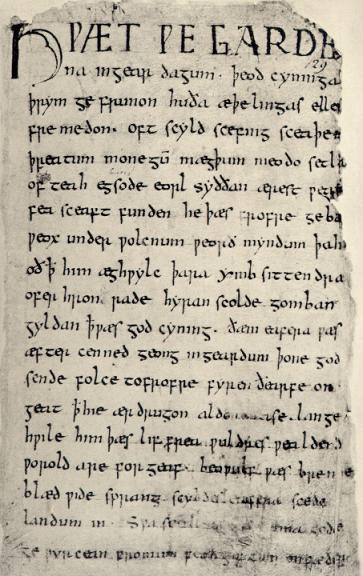
The epic poem Beowulf is written in West Saxon, and the earliest English poem, Cædmon's Hymn, is written in Northumbrian. Modern English developed mainly from Mercian, but the Scots language developed from Northumbrian. A few short inscriptions from the early period of Old English were written using a runic script. By the 6th century, a Latin alphabet was adopted, written with half-uncial letterforms.

Old English is essentially a distinct language from Modern English and is virtually impossible for 21st-century unstudied English speakers to understand. Its grammar was similar to that of modern German, and its closest relative is Old Frisian.

More information: BBC

Nouns, adjectives, pronouns, and verbs had many more inflectional endings and forms, and word order was much freer than in Modern English. Modern English has case forms in pronouns (he, him, his) and has a few verb inflections (speak, speaks, speaking, spoke, spoken), but Old English had case endings in nouns as well, and verbs had more person and number endings.

From the 8th to the 12th century, Old English gradually transformed through language contact into Middle English. Middle English is often arbitrarily defined as beginning with the conquest of England by William the Conqueror in 1066, but it developed further in the period from 1200–1450.

The next period in the history of English was Early Modern English (1500–1700). Early Modern English was characterised by the Great Vowel Shift (1350–1700), inflectional simplification, and linguistic standardisation.

By the late 18th century, the British Empire had spread English through its colonies and geopolitical dominance. Commerce, science and technology, diplomacy, art, and formal education all contributed to English becoming the first truly global language. English also facilitated worldwide international communication.

More information: Mental Floss
 
 
 Viewed freely, the English language is the accretion
and growth of every dialect, race, and range of time,
and is both the free and compacted composition of all.

Walt Whitman

Monday, 8 December 2025

VISITING THE CATHÉDRALE SAINT-BÉNIGNE DE DIGION

It's a beautiful day and The Grandma has decided to visit Sant Boi de Llobregat where they are celebrating their winter fair today.

The Grandma has a lot of friends in Sant Boi and any excuse is good to visit them. Before going there, however, she has been talking to another friend, Joseph de Ca'th Lon, who is still in Digion enjoying that beautiful city, its gastronomy and its architecture.

Joseph has visited the Cathedral of Saint Benignus, a place where history and spirituality mix and where it always seems that time stands still and you can find those inner moments that are so difficult to find in the rest of the city in the day to day.

Dijon Cathedral, or the Cathedral of Saint Benignus of Dijon, in French Cathédrale Saint-Bénigne de Dijon, is a Roman Catholic church located in the town of Dijon, Burgundy, France, and dedicated to Saint Benignus of Dijon.

The Gothic cathedral building, constructed between 1280 and 1325, and dedicated on 9 April 1393, is a listed national monument.

Originating as the church of the Abbey of St. Benignus, it became the seat of the Diocese of Dijon during the French Revolution, replacing the previous cathedral when it was secularised, and has been the seat of the succeeding Archbishopric of Dijon since the elevation of the diocese in 2002.

The first church here was a basilica built over the supposed sarcophagus of Saint Benignus, which was placed in a crypt constructed for it by Saint Gregory of Langres in 511; the basilica over the crypt was completed in 535. From the early 9th century St. Bénigne was the personal monastery of the bishops of Langres. In 869 Isaac, Bishop of Langres, re-founded it as a Benedictine abbey, and restored the basilica at the same time.

In 989 Bruno, Bishop of Langres, requested Mayeul, Abbot of Cluny, to send monks to re-settle the abbey, grown decadent, as a Cluniac house. In 990 William of Volpiano was appointed the new abbot. By 1002, the ruin of the previous building had been razed and construction began on a new Romanesque structure designed by William, consisting of a subterranean church round the sarcophagus of Benignus, a ground floor church for worship, and a rotunda, 17 metres in diameter, on three levels in the place of the apse, linking the two. Dedicated in October 1016 by Lambert I, this suite of buildings was decorated in the ornate Cluniac style, of which only a few traces survive.

In 1137, a fire destroyed most of the town of Dijon and damaged the monastery and its church. The repaired building was consecrated by Pope Eugene III in 1147.

In 1272 the crossing tower collapsed, destroying the whole of the upper church and severely damaging the subterranean one, and smashing some of the supporting columns of the rotunda. Then the abbot, Hugh of Arc, of a powerful Burgundian family, was able, thanks to his contacts, to mobilise enough support to begin the construction of a new Gothic abbey church in 1281. Progress was at first rapid, and at Hugh's death in 1300 the building was close to completion. Progress slowed, however, and the work was not finished until 1325. The new church, unlike its Cluniac predecessor, is noted for its plainness and severity.

The abbey was secularised during the French Revolution, but the church was made, firstly, a parish church, and then in 1792 the cathedral of the Diocese of Dijon. The rotunda was however destroyed at that time; all that remains is the lowest storey, which was excavated in the 19th century and has since been reworked as a crypt.

More information: Cathédrale de Dijon

He who has seen one cathedral ten times
has seen something; 
he who has seen ten cathedrals once 
has seen but little; 
and he who has spent half an hour in each of a hundred cathedrals 
has seen nothing at all.

Sinclair Lewis

Tuesday, 21 January 2025

THE WINSORS & THE GRANDMA, ADVENTURE IS COMING

Today, The Grandma has started to Sant Boi de Llobregat urgently because MJ has called her to start to work with another family, The Winsors.

MJ and The Grandma have received the new members of the family in the emplacement in Sant Boi de Llobregat and after a long session of bureaucracy The Grandma has been able to start to know her new family. Tomorrow, they are going to start with their new manuals and they are going to share lots of hours of effort, knowledge and hard work with the goal of improving English and having the chance of passing an important exam.

More information: The ABC

English is a West Germanic language that was first spoken in early medieval England and eventually became a global lingua franca.

It is named after the Angles, one of the Germanic tribes that migrated to the area of Great Britain that later took their name, as England.

Both names derive from Anglia, a peninsula in the Baltic Sea. The language is closely related to Frisian and Low Saxon, and its vocabulary has been significantly influenced by other Germanic languages, particularly Norse (a North Germanic language), and to a greater extent by Latin and French.

English has developed over the course of more than 1,400 years. The earliest forms of English, a group of West Germanic (Ingvaeonic) dialects brought to Great Britain by Anglo-Saxon settlers in the 5th century, are collectively called Old English.

Middle English began in the late 11th century with the Norman conquest of England; this was a period in which the language was influenced by French.

Early Modern English began in the late 15th century with the introduction of the printing press to London, the printing of the King James Bible and the start of the Great Vowel Shift.


Modern English has been spreading around the world since the 17th century by the worldwide influence of the British Empire and the United States.

Through all types of printed and electronic media of these countries, English has become the leading language of international discourse and the lingua franca in many regions and professional contexts such as science, navigation and law.

English is the largest language by number of speakers, and the third most-spoken native language in the world, after Standard Chinese and Spanish. It is the most widely learned second language and is either the official language or one of the official languages in almost 60 sovereign states.

There are more people who have learned it as a second language than there are native speakers. It is estimated that there are over 2 billion speakers of English. English is the majority native language in the United States, the United Kingdom, Canada, Australia, New Zealand and the Republic of Ireland, and it is widely spoken in some areas of the Caribbean, Africa and South Asia.

More information:  English Club

It is a co-official language of the United Nations, the European Union and many other world and regional international organisations. It is the most widely spoken Germanic language, accounting for at least 70% of speakers of this Indo-European branch. English has a vast vocabulary, though counting how many words any language has is impossible. English speakers are called Anglophones.

Modern English grammar is the result of a gradual change from a typical Indo-European dependent marking pattern, with a rich inflectional morphology and relatively free word order, to a mostly analytic pattern with little inflection, a fairly fixed subject–verb–object word order and a complex syntax.

Modern English relies more on auxiliary verbs and word order for the expression of complex tenses, aspect and mood, as well as passive constructions, interrogatives and some negation. The variation among the accents and dialects of English used in different countries and regions -in terms of phonetics and phonology, and sometimes also vocabulary, idioms, grammar, and spelling-can often be understood by speakers of different dialects, but in extreme cases can lead to confusion or even mutual unintelligibility between English speakers.

The earliest form of English is called Old English or Anglo-Saxon (c. 550–1066 CE). Old English developed from a set of North Sea Germanic dialects originally spoken along the coasts of Frisia, Lower Saxony, Jutland, and Southern Sweden by Germanic tribes known as the Angles, Saxons, and Jutes.


From the 5th century CE, the Anglo-Saxons settled Britain as the Roman economy and administration collapsed. By the 7th century, the Germanic language of the Anglo-Saxons became dominant in Britain, replacing the languages of Roman Britain, a Celtic language, and Latin, brought to Britain by the Roman occupation. England and English (originally Ænglaland and Ænglisc) are named after the Angles.

Old English was divided into four dialects: the Anglian dialects (Mercian and Northumbrian) and the Saxon dialects, Kentish and West Saxon. Through the educational reforms of King Alfred in the 9th century and the influence of the kingdom of Wessex, the West Saxon dialect became the standard written variety.

The epic poem Beowulf is written in West Saxon, and the earliest English poem, Cædmon's Hymn, is written in Northumbrian. Modern English developed mainly from Mercian, but the Scots language developed from Northumbrian. A few short inscriptions from the early period of Old English were written using a runic script. By the 6th century, a Latin alphabet was adopted, written with half-uncial letterforms.

Old English is essentially a distinct language from Modern English and is virtually impossible for 21st-century unstudied English speakers to understand. Its grammar was similar to that of modern German, and its closest relative is Old Frisian.

More information: BBC

Nouns, adjectives, pronouns, and verbs had many more inflectional endings and forms, and word order was much freer than in Modern English. Modern English has case forms in pronouns (he, him, his) and has a few verb inflections (speak, speaks, speaking, spoke, spoken), but Old English had case endings in nouns as well, and verbs had more person and number endings.

From the 8th to the 12th century, Old English gradually transformed through language contact into Middle English. Middle English is often arbitrarily defined as beginning with the conquest of England by William the Conqueror in 1066, but it developed further in the period from 1200–1450.

The next period in the history of English was Early Modern English (1500–1700). Early Modern English was characterised by the Great Vowel Shift (1350–1700), inflectional simplification, and linguistic standardisation.

By the late 18th century, the British Empire had spread English through its colonies and geopolitical dominance. Commerce, science and technology, diplomacy, art, and formal education all contributed to English becoming the first truly global language. English also facilitated worldwide international communication.

More information: Mental Floss
 
 
 Viewed freely, the English language is the accretion
and growth of every dialect, race, and range of time,
and is both the free and compacted composition of all.

Walt Whitman

Wednesday, 31 January 2024

THE FOSTERS & THE GRANDMA, ADVENTURE IS COMING

Today, The Grandma has started to Sant Boi de Llobregat urgently because MJ has called her to start to work with another family, The Fosters.

MJ and The Grandma have received the new members of the family in the emplacement in Sant Boi de Llobregat and after a long session of bureaucracy The Grandma has been able to start to know her new family. Tomorrow, they are going to start with their new manuals and they are going to share lots of hours of effort, knowledge and hard work with the goal of improving English and having the chance of passing an important exam.

More information: The ABC

English is a West Germanic language that was first spoken in early medieval England and eventually became a global lingua franca.

It is named after the Angles, one of the Germanic tribes that migrated to the area of Great Britain that later took their name, as England.

Both names derive from Anglia, a peninsula in the Baltic Sea. The language is closely related to Frisian and Low Saxon, and its vocabulary has been significantly influenced by other Germanic languages, particularly Norse (a North Germanic language), and to a greater extent by Latin and French.

English has developed over the course of more than 1,400 years. The earliest forms of English, a group of West Germanic (Ingvaeonic) dialects brought to Great Britain by Anglo-Saxon settlers in the 5th century, are collectively called Old English.

Middle English began in the late 11th century with the Norman conquest of England; this was a period in which the language was influenced by French.

Early Modern English began in the late 15th century with the introduction of the printing press to London, the printing of the King James Bible and the start of the Great Vowel Shift.


Modern English has been spreading around the world since the 17th century by the worldwide influence of the British Empire and the United States.

Through all types of printed and electronic media of these countries, English has become the leading language of international discourse and the lingua franca in many regions and professional contexts such as science, navigation and law.

English is the largest language by number of speakers, and the third most-spoken native language in the world, after Standard Chinese and Spanish. It is the most widely learned second language and is either the official language or one of the official languages in almost 60 sovereign states.

There are more people who have learned it as a second language than there are native speakers. It is estimated that there are over 2 billion speakers of English. English is the majority native language in the United States, the United Kingdom, Canada, Australia, New Zealand and the Republic of Ireland, and it is widely spoken in some areas of the Caribbean, Africa and South Asia.

More information:  English Club

It is a co-official language of the United Nations, the European Union and many other world and regional international organisations. It is the most widely spoken Germanic language, accounting for at least 70% of speakers of this Indo-European branch. English has a vast vocabulary, though counting how many words any language has is impossible. English speakers are called Anglophones.

Modern English grammar is the result of a gradual change from a typical Indo-European dependent marking pattern, with a rich inflectional morphology and relatively free word order, to a mostly analytic pattern with little inflection, a fairly fixed subject–verb–object word order and a complex syntax.

Modern English relies more on auxiliary verbs and word order for the expression of complex tenses, aspect and mood, as well as passive constructions, interrogatives and some negation. The variation among the accents and dialects of English used in different countries and regions -in terms of phonetics and phonology, and sometimes also vocabulary, idioms, grammar, and spelling-can often be understood by speakers of different dialects, but in extreme cases can lead to confusion or even mutual unintelligibility between English speakers.

The earliest form of English is called Old English or Anglo-Saxon (c. 550–1066 CE). Old English developed from a set of North Sea Germanic dialects originally spoken along the coasts of Frisia, Lower Saxony, Jutland, and Southern Sweden by Germanic tribes known as the Angles, Saxons, and Jutes.


From the 5th century CE, the Anglo-Saxons settled Britain as the Roman economy and administration collapsed. By the 7th century, the Germanic language of the Anglo-Saxons became dominant in Britain, replacing the languages of Roman Britain, a Celtic language, and Latin, brought to Britain by the Roman occupation. England and English (originally Ænglaland and Ænglisc) are named after the Angles.

Old English was divided into four dialects: the Anglian dialects (Mercian and Northumbrian) and the Saxon dialects, Kentish and West Saxon. Through the educational reforms of King Alfred in the 9th century and the influence of the kingdom of Wessex, the West Saxon dialect became the standard written variety.

The epic poem Beowulf is written in West Saxon, and the earliest English poem, Cædmon's Hymn, is written in Northumbrian. Modern English developed mainly from Mercian, but the Scots language developed from Northumbrian. A few short inscriptions from the early period of Old English were written using a runic script. By the 6th century, a Latin alphabet was adopted, written with half-uncial letterforms.

Old English is essentially a distinct language from Modern English and is virtually impossible for 21st-century unstudied English speakers to understand. Its grammar was similar to that of modern German, and its closest relative is Old Frisian.

More information: BBC

Nouns, adjectives, pronouns, and verbs had many more inflectional endings and forms, and word order was much freer than in Modern English. Modern English has case forms in pronouns (he, him, his) and has a few verb inflections (speak, speaks, speaking, spoke, spoken), but Old English had case endings in nouns as well, and verbs had more person and number endings.

From the 8th to the 12th century, Old English gradually transformed through language contact into Middle English. Middle English is often arbitrarily defined as beginning with the conquest of England by William the Conqueror in 1066, but it developed further in the period from 1200–1450.

The next period in the history of English was Early Modern English (1500–1700). Early Modern English was characterised by the Great Vowel Shift (1350–1700), inflectional simplification, and linguistic standardisation.

By the late 18th century, the British Empire had spread English through its colonies and geopolitical dominance. Commerce, science and technology, diplomacy, art, and formal education all contributed to English becoming the first truly global language. English also facilitated worldwide international communication.

More information: Mental Floss
 
 
 Viewed freely, the English language is the accretion
and growth of every dialect, race, and range of time,
and is both the free and compacted composition of all.

Walt Whitman

Monday, 13 February 2023

WELCOME GRANGERS! A NEW FAMILY TO LEARN ENGLISH

Today, The Grandma has started a new adventure with a new family, The Grangers, in Sant Boi de Llobregat.

They are going to spend some months together learning English and preparing their new goal -the A2 Cambridge Exam.

Welcome Grangers! Roll of the dice!

Hermione Jean Granger is a fictional character in J. K. Rowling's Harry Potter series. She first appears in the novel Harry Potter and the Philosopher's Stone (1997), on the Hogwarts express as a first year student on her way to Hogwarts.

After Harry and Ron save her from a mountain troll in the girls' restroom, she becomes best friends with them and often uses her quick wit, deft recall, and encyclopaedic knowledge to lend aid in dire situations.

Hermione is a Muggle-born Gryffindor, who becomes best friends with Harry Potter and Ron Weasley.

She was born on 19 September 1979 and she was nearly twelve when she first attended Hogwarts. She is an overachiever who excels academically and is described as a very logical, upright and good character.

Hermione's parents, two Muggle dentists, are a bit bemused by their odd daughter but quite proud of her all the same. They are well aware of the wizard world and have visited Diagon Alley with her.

Hermione is an only child whose first name is taken from a character in William Shakespeare's The Winter's Tale.

More information: Wizarding World

English is a West Germanic language in the Indo-European language family, with its earliest forms spoken by the inhabitants of early medieval England.

It is named after the Angles, one of the ancient Germanic peoples that migrated to the island of Great Britain. Existing on a dialect continuum with Scots and then most closely related to the Low German and Frisian languages, English is genealogically Germanic. However, its vocabulary also shows major influences from French (about 28% of Modern English words) and Latin (also about 28%), plus some grammar and a small amount of core vocabulary influenced by Old Norse (a North Germanic language). Speakers of English are called Anglophones.

The earliest forms of English, collectively known as Old English, evolved from a group of North Sea Germanic dialects brought to Great Britain by Anglo-Saxon settlers in the 5th century and further mutated by Norse-speaking Viking settlers starting in the 8th and 9th centuries.

Middle English began in the late 11th century after the Norman Conquest of England, when considerable Old French (especially Old Norman French) and Latin-derived vocabulary was incorporated into English over some three hundred years.

Early Modern English began in the late 15th century with the start of the Great Vowel Shift and the Renaissance trend of borrowing further Latin and Greek words and roots into English, concurrent with the introduction of the printing press to London. This era notably culminated in the King James Bible and the works of William Shakespeare.

Modern English grammar is the result of a gradual change from a typical Indo-European dependent-marking pattern with a rich inflectional morphology and relatively free word order to a mostly analytic pattern with little inflection and a fairly fixed subject-verb-object word order.

Modern English relies more on auxiliary verbs and word order for the expression of complex tenses, aspects and moods, as well as passive constructions, interrogatives, and some negation.

More information: Oxford International English


Books! And cleverness! There are more important things!
-Friendship! And Bravery!

Hermione Granger

Saturday, 11 December 2021

ENJOYING 'LA PURÍSSIMA' WITH CLAIRE, DAVID & TONYI

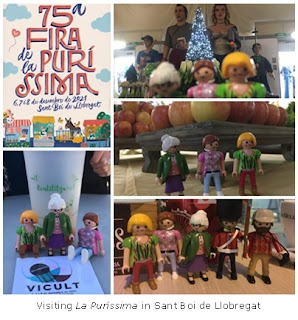
Last Wednesday, December 8, after talking with Tonyi Tamaki about Metallica, they went to Sant Boi de Llobregat to visit the local fair, named La Puríssima. They met Claire Fontaine and David Stone, and altogether spent a wonderful day.

Sant Boi de Llobregat is a city in the county of El Baix Llobregat, near Barcelona, in Catalonia, located on the banks of the Llobregat river. In 2019, it had 83,605 inhabitants.

The city is divided into six neighbourhoods, named barris in Catalan: Ciutat Cooperativa-Molí Nou, Marianao-Can Paulet, Barri Centre, Vinyets-Molí Vell, Camps Blancs-Canons-Orioles, and Casablanca.

It is bordered on the north by the towns of Santa Coloma de Cervelló and Sant Joan Despí and the village of Sant Climent de Llobregat; on the east by the town of Cornellà de Llobregat; on the west by Viladecans; and on the south by El Prat de Llobregat and the Mediterranean Sea, via a narrow southward salient.

Although the main business activity is trading, which is centred around the service sector, Sant Boi is also known for industrial activities, especially metallurgy.

Agriculturally, its mild climate and fertile waterlogged lands, located at the mouth of the Llobregat river, produce a wide variety of vegetables, including the famous Llobregat Delta artichokes.

The region offers three different artichoke varieties: white artichoke from Tudela, camús from Bretagne, considered to be the largest variety, and artichoke from Benicarló. Production is concentrated mostly in March, but products can be found in local markets throughout the year.

The finding of archaeological remains corresponding to Iberian colonies (VI-I bC) and to the Romans (I-V BC) -a noteworthy Roman bath is located near the river- suggests that Sant Boi was created in pre-Roman times.

As with most of the surrounding lands, from the 8th to the 11th century the town was controlled by the Moors, until their expulsion from Iberia during the Reconquista. The Moors called it Alcalà, which means castle, due to the existence of a hillock from where the river and the valley were dominated. The town's current name is derived from the name of Saint Baudilus, known as Boi or Baldiri in Catalonia.

During the Middle Ages, the village progressively grew, expanding from the castle's surroundings to adjacent zones. A baroque-style church was built during the 16th century. The growth continued in the following centuries, giving rise to numerous masies, typical Catalan agricultural country houses, near the river and fertile lands. By the end of the 19th century, Sant Boi was a village of nearly 5,000 inhabitants, with an economy driven mainly by agriculture.

In the early stages of the 20th century, industry arrived and subsequently flourished in Sant Boi, ranging from brick manufacturing to metalwork. With the end of the Spanish Civil War in 1939, there was a massive influx of immigrants from many parts of Spain. These new arrivals consisted mostly of people from villages and small towns. They were searching for jobs and career opportunities in the city of Barcelona, since it was stimulated by the regrowth of Catalan industry in post-war Spain.

The population rose from 10,000 people in 1940 to 65,000 in 1975. This period is characterized by the construction of complete quarters (Casablanca, Camps Blancs, and Cooperativa) for the housing of immigrants.

Sant Boi is now a town with more than 80,000 inhabitants, with well-established industrial and service sectors, and good cultural and recreational offerings.

More information: Turisme Baix Llobregat

The Fira de la Puríssima is one of the oldest fairs in Catalonia, which is held annually in Sant Boi de Llobregat. It takes place on 6, 7 and 8 December in several streets and other emblematic spaces of the town of Sant Boi de Llobregat with about 52,000 m2 of fairgrounds, 11,900 m2 of exhibition space and more than 480 exhibitors, which generate an economic impact of approximately 5 million euros.

The roots of the Fair can be found in the exhibition of apples that began to be held on 12 and 13 July 1931 on the floor of the old municipal library, and where the first was also held fruit set competition.

In 1947, the seasonal fruit exhibition was discontinued in the summer months and became a fair and exhibition of plants, fruit trees and ornamentation on December 8 of the same year. It was not until 1956 that the name Fira de la Puríssima was first adopted, but made Spanish by the imposition of the Franco dictatorship.

At the end of the year 1960, the local magazine Vida Samboyana collected quite critical writings with the Tour where it was pointed out that it had gone into decline and that, in order to trace it back, the collaboration of the whole population was needed: individuals and entities.

In November 1961, the creation of a Board of Trustees was announced, which, with greater financial availability as a result of the participation of the local administration, should ensure the good organization and development of the Fair. This, encouraged by a wide range of advertising, multiplied in relation to the critical editions of previous years.

Another remarkable date was the 1967 edition which was used to inaugurate the new Sant Jordi market which came to meet the demand of a large sector of the population, newly established. The Fair would reach its 26th edition in 1971. The Board of Trustees revived an old initiative and instituted a Poster Contest which was won by local artist Maria Dolors Villadelprat.

The current poster has been made by the local artist Iván Castro.

More information: Catalunya


The role of culture is that it's the form through
which we as a society reflect on who we are,
where we've been, where we hope to be.

Wendell Pierce

Saturday, 4 December 2021

TASTE THE BEST ARTICHOKES IN SANT BOI DE LLOBREGAT

Today, The Grandma has spent a wonderful day with her closest friends Claire Fontaine and Tonyi Tamaki in Sant Boi de Llobregat, the Catalan town of artichoke. They have been eating delicious dishes, especially artichokes, in El Mar de la Tranquil·litat 1969, a must in this city.

The globe artichoke (Cynara cardunculus var. scolymus), also known by the names French artichoke and green artichoke in the U.S., is a variety of a species of thistle cultivated as food.

The edible portion of the plant consists of the flower buds before the flowers come into bloom. The budding artichoke flower-head is a cluster of many budding small flowers (an inflorescence), together with many bracts, on an edible base. Once the buds bloom, the structure changes to a coarse, barely edible form. Another variety of the same species is the cardoon, a perennial plant native to the Mediterranean region. Both wild forms and cultivated varieties (cultivars) exist.

This vegetable grows to 1.4–2 m (4 ft 7 in–6 ft 7 in) tall, with arching, deeply lobed, silvery, glaucous-green leaves 50–83 cm (19+1⁄2–32+1⁄2 in) long. The flowers develop in a large head from an edible bud about 8–15 cm (3–6 in) diameter with numerous triangular scales; the individual florets are purple. The edible portions of the buds consist primarily of the fleshy lower portions of the involucral bracts and the base, known as the heart; the mass of immature florets in the centre of the bud is called the choke or beard. These are inedible in older, larger flowers.

More information: NPR

Artichoke contains the bioactive agents apigenin and luteolin.

The total antioxidant capacity of artichoke flower heads is one of the highest reported for vegetables. Cynarine is a chemical constituent in Cynara. The majority of the cynarine found in artichoke is located in the pulp of the leaves, though dried leaves and stems of artichoke also contain it.

The artichoke is a domesticated variety of the wild cardoon (Cynara cardunculus), which is native to the Mediterranean area.

There was debate over whether the artichoke was food among the ancient Greeks and Romans, or whether that cultivar was developed later, with Classical sources referring instead to the wild cardoon.

The Dutch introduced artichokes to England, where they grew in Henry VIII's garden at Newhall in 1530. They were taken to the United States in the 19th century-to Louisiana by French immigrants and to California by Spanish immigrants.

Cultivation of the globe artichoke is concentrated in the Americas and the countries bordering the Mediterranean basin. The main European producers are Italy, Spain, and France and the main American producers are Argentina, Peru and the United States.

More information: Simply Recipes

In the United States, California provides nearly 100% of the U.S. crop, with about 80% of that being grown in Monterey County; there, Castroville proclaims itself to be The Artichoke Center of the World and holds the annual Castroville Artichoke Festival. More recently, artichokes have been grown in South Africa in a small town called Parys, located along the Vaal River.

In 2019, the world produced approximately 1.6 million tons of artichokes.

Artichokes can be produced from seeds or from vegetative means such as division, root cuttings, or micropropagation. Although technically perennials that normally produce the edible flower during only the second and subsequent years, certain varieties of artichokes can be grown from seed as annuals, producing a limited harvest at the end of the first growing season, even in regions where the plants are not normally winter-hardy.

This means home gardeners in northern regions can attempt to produce a crop without the need to overwinter plants with special treatment or protection. The seed cultivar Imperial Star has been bred to produce in the first year without such measures. An even newer cultivar, Northern Star, is said to be able to overwinter in more northerly climates, and readily survives subzero temperatures.

Cooked unsalted artichoke is 82% water, 12% carbohydrates, 3% protein, and 3% fat (table). In a 100 gram reference serving, cooked artichoke supplies 74 calories, is a rich source (20% or more of the Daily Value, DV) of folate, and is a moderate source (10-19% DV) of vitamin K (16% DV), magnesium, sodium, and phosphorus (10-12% DV).

The globe artichoke genome has been sequenced. The genome assembly covers 725 of the 1,084 Mb genome and the sequence codes for about 27,000 genes. An understanding of the genome structure is an important step in understanding traits of the globe artichoke, which may aid in the identification of economically important genes from related species.

More information: Health Line


 Life is like eating artichokes;
you have got to go through so much to get so little.

Tad Dorgan

Wednesday, 14 October 2020

THE STONES HAVE TO PREPARE THEIR CAMBRIDGE EXAM

Today, The Stones and The Grandma have talked with MJ by Google Meet. They are in Honolulu and MJ is in Sant Boi de Llobregat preparing their A2 Cambridge Exam documentation.

The family is preparing this important exam in Hawaii without interferences and surrounded by a wonderful an amazing environment that helps them to study and understand all the English grammar that they are discovering.

They have reviewed Modal Verbs (Have to/Don't have to); Countable and Uncountable (Some/Any) and they have started to prepare their own stories to pass their Cambridge speaking.

The University of Cambridge, legal name The Chancellor, Masters, and Scholars of the University of Cambridge, is a collegiate research university in Cambridge, England.

Founded in 1209 and granted a royal charter by King Henry III in 1231, Cambridge is the second-oldest university in the English-speaking world and the world's fourth-oldest surviving university.

The university grew out of an association of scholars who left the University of Oxford after a dispute with the townspeople. The two English ancient universities share many common features and are often referred to jointly as Oxbridge.

Cambridge is formed from a variety of institutions which include 31 semi-autonomous constituent colleges and over 150 academic departments, faculties and other institutions organised into six schools.

All the colleges are self-governing institutions within the university, each controlling its own membership and with its own internal structure and activities.

More information: Have to/Don't have to

All students are members of a college. Cambridge does not have a main campus, and its colleges and central facilities are scattered throughout the city. Undergraduate teaching at Cambridge is organised around weekly small-group supervisions in the colleges –a feature unique to the Oxbridge system. These are supported by classes, lectures, seminars, laboratory work and occasionally further supervisions provided by the central university faculties and departments. Postgraduate teaching is provided predominantly centrally.

Cambridge University Press, a department of the university, is the oldest university press in the world and currently the second largest university press in the world.

Cambridge Assessment, also a department of the university, is one of the world's leading examining bodies and provides assessment to over eight million learners globally every year.

The university also operates eight cultural and scientific museums, including the Fitzwilliam Museum, as well as a botanic garden. Cambridge's libraries, of which there are 116, hold a total of around 16 million books, around nine million of which are in Cambridge University Library, a legal deposit library.

The university is home to, but independent of, the Cambridge Union -the world's oldest debating society. The university is closely linked to the development of the high-tech business cluster known as Silicon Fen. It is the central member of Cambridge University Health Partners, an academic health science centre based around the Cambridge Biomedical Campus.

Cambridge has educated many notable alumni, including eminent mathematicians, scientists, politicians, lawyers, philosophers, writers, actors, monarchs and other heads of state.

More information: Some/Any

As of October 2020, 121 Nobel laureates, 11 Fields Medalists, 7 Turing Award winners and 14 British prime ministers have been affiliated with Cambridge as students, alumni, faculty or research staff. University alumni have won 194 Olympic medals.

By the late 12th century, the Cambridge area already had a scholarly and ecclesiastical reputation, due to monks from the nearby bishopric church of Ely. However, it was an incident at Oxford which is most likely to have led to the establishment of the university: three Oxford scholars were hanged by the town authorities for the death of a woman, without consulting the ecclesiastical authorities, who would normally take precedence and pardon the scholars in such a case, but were at that time in conflict with King John.

Fearing more violence from the townsfolk, scholars from the University of Oxford started to move away to cities such as Paris, Reading, and Cambridge. Subsequently, enough scholars remained in Cambridge to form the nucleus of a new university when it had become safe enough for academia to resume at Oxford.

In order to claim precedence, it is common for Cambridge to trace its founding to the 1231 charter from King Henry III granting it the right to discipline its own members (ius non-trahi extra) and an exemption from some taxes; Oxford was not granted similar rights until 1248.

A bull in 1233 from Pope Gregory IX gave graduates from Cambridge the right to teach everywhere in Christendom. After Cambridge was described as a studium generale in a letter from Pope Nicholas IV in 1290, and confirmed as such in a bull by Pope John XXII in 1318, it became common for researchers from other European medieval universities to visit Cambridge to study or to give lecture courses.

More information: University of Cambridge


Cambridge is one of the best universities in the world,
especially in my field.

Stephen Hawking