Showing posts with label Salzburg. Show all posts

Thursday, 10 January 2019

WOLFGANG AMADÈ MOZART, THE GENIUS OF SALZBURG

Wolfgang Amadeus Mozart
Today, Joseph de Ca'th Lon and his friends have visited Wolfgang Amadeus Mozart's birthplace in Salzburg.

Joseph is a great fan of classical music and he has enjoyed during the visit. Tina Picotes has bought some sweets and liquor of Mozart and Claire Fontaine and Tonyi Tamaki have taken lots of photos.

Before visiting Mozarts Geburtshause in Makartplazt, Salzburg, The Grandma has studied a new lesson of her
Elementary Language Practice manual (Grammar 69).


Wolfgang Amadeus Mozart (27 January 1756-5 December 1791), baptised as Johannes Chrysostomus Wolfgangus Theophilus Mozart, was a prolific and influential composer of the classical era.

Born in Salzburg, Mozart showed prodigious ability from his earliest childhood. Already competent on keyboard and violin, he composed from the age of five and performed before European royalty.

At 17, Mozart was engaged as a musician at the Salzburg court but grew restless and traveled in search of a better position. While visiting Vienna in 1781, he was dismissed from his Salzburg position. He chose to stay in the capital, where he achieved fame but little financial security. During his final years in Vienna, he composed many of his best-known symphonies, concertos, and operas, and portions of the Requiem, which was largely unfinished at the time of his early death at the age of 35. The circumstances of his death have been much mythologized.

Visiting Mozarts Geburtshaus in Salzburg
He composed more than 600 works, many acknowledged as pinnacles of symphonic, concertante, chamber, operatic, and choral music. He is among the most enduringly popular of classical composers, and his influence is profound on subsequent Western art music.

Wolfgang Amadeus Mozart was born on 27 January 1756 to Leopold Mozart (1719–1787) and Anna Maria, née Pertl (1720–1778), at 9 Getreidegasse in Salzburg. This was the capital of the Archbishopric of Salzburg, an ecclesiastic principality in what is now Austria, then part of the Holy Roman Empire.

He was the youngest of seven children, five of whom died in infancy. His elder sister was Maria Anna Mozart (1751–1829), nicknamed Nannerl. Mozart was baptized the day after his birth, at St. Rupert's Cathedral in Salzburg. The baptismal record gives his name in Latinized form, as Joannes Chrysostomus Wolfgangus Theophilus Mozart. He generally called himself Wolfgang Amadè Mozart as an adult, but his name had many variants.

More information: Mozarteum

Leopold Mozart, a native of Augsburg, Germany, was a minor composer and an experienced teacher. In 1743, he was appointed as fourth violinist in the musical establishment of Count Leopold Anton von Firmian, the ruling Prince-Archbishop of Salzburg. Four years later, he married Anna Maria in Salzburg. 

Leopold became the orchestra's deputy Kapellmeister in 1763. During the year of his son's birth, Leopold published a violin textbook, Versuch einer gründlichen Violinschule, which achieved success.

Wolfgang Amadeus Mozart
While Wolfgang was young, his family made several European journeys in which he and Nannerl performed as child prodigies. These began with an exhibition in 1762 at the court of Prince-elector Maximilian III of Bavaria in Munich, and at the Imperial Courts in Vienna and Prague.

A long concert tour followed, spanning three and a half years, taking the family to the courts of Munich, Mannheim, Paris, London, The Hague, again to Paris, and back home via Zurich, Donaueschingen, and Munich. During this trip, Wolfgang met a number of musicians and acquainted himself with the works of other composers. A particularly important influence was Johann Christian Bach, whom he visited in London in 1764 and 1765. When he was eight years old, Mozart wrote his first symphony, most of which was probably transcribed by his father.

In August 1777, Mozart resigned his position at Salzburg and on 23 September ventured out once more in search of employment, with visits to Augsburg, Mannheim, Paris, and Munich.

In January 1781, Mozart's opera Idomeneo premiered with considerable success in Munich. The following March, Mozart was summoned to Vienna, where his employer, Archbishop Colloredo, was attending the celebrations for the accession of Joseph II to the Austrian throne.

Mozart's new career in Vienna began well. He performed often as a pianist, notably in a competition before the Emperor with Muzio Clementi on 24 December 1781, and he soon had established himself as the finest keyboard player in Vienna.

He also prospered as a composer, and in 1782 completed the opera Die Entführung aus dem Serail, The Abduction from the Seraglio, which premiered on 16 July 1782 and achieved a huge success. The work was soon being performed throughout German-speaking Europe, and fully established Mozart's reputation as a composer.

Sweets and Liquor of Wolfgang Amadeus Mozart
In the course of 1782 and 1783, Mozart became intimately acquainted with the work of Johann Sebastian Bach and George Frideric Handel as a result of the influence of Gottfried van Swieten, who owned many manuscripts of the Baroque masters. 

Mozart's study of these scores inspired compositions in Baroque style and later influenced his personal musical language, for example in fugal passages in Die Zauberflöte, The Magic Flute, and the finale of Symphony No. 41. On 14 December 1784, Mozart became a Freemason, admitted to the lodge Zur Wohltätigkeit, Beneficence. Freemasonry played an important role in the remainder of Mozart's life: he attended meetings, a number of his friends were Masons, and on various occasions he composed Masonic music, the Maurerische Trauermusik.

Despite the great success of Die Entführung aus dem Serail, Mozart did little operatic writing for the next four years, producing only two unfinished works and the one-act Der Schauspieldirektor. He focused instead on his career as a piano soloist and writer of concertos.

More information: Gutenberg

Around the end of 1785, Mozart moved away from keyboard writing and began his famous operatic collaboration with the librettist Lorenzo Da Ponte. 1786 saw the successful premiere of The Marriage of Figaro in Vienna. Its reception in Prague later in the year was even warmer, and this led to a second collaboration with Da Ponte: the opera Don Giovanni, which premiered in October 1787 to acclaim in Prague, but less success in Vienna in 1788. 

The two are among Mozart's most important works and are mainstays of the operatic repertoire today, though at their premieres their musical complexity caused difficulty for both listeners and performers. These developments were not witnessed by Mozart's father, who had died on 28 May 1787.

Mozart fell ill while in Prague for the 6 September 1791 premiere of his opera La clemenza di Tito, written in that same year on commission for the Emperor's coronation festivities.
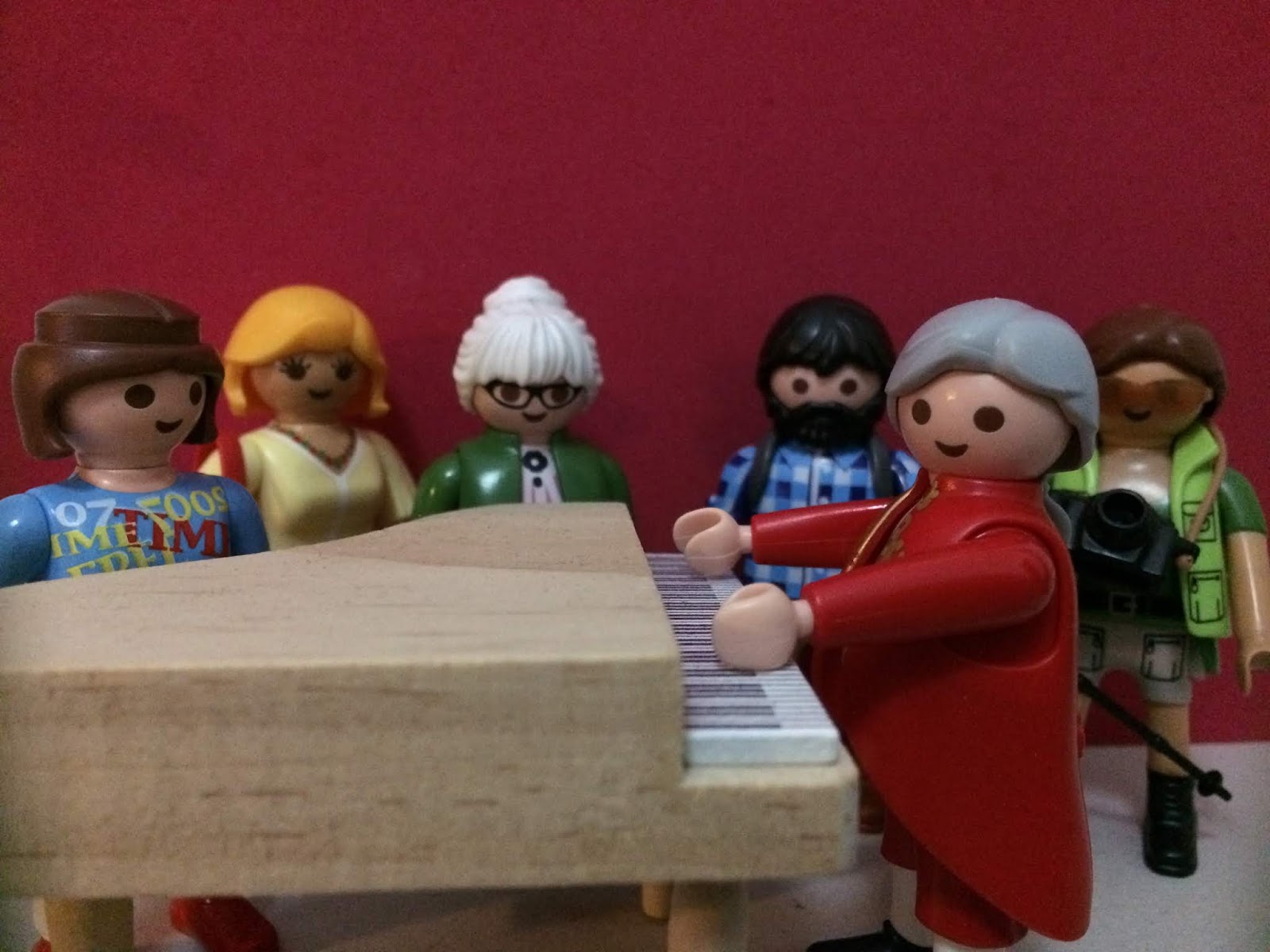
Wolfgang Amadeus Mozart with some friends
He continued his professional functions for some time and conducted the premiere of The Magic Flute on 30 September. His health deteriorated on 20 November, at which point he became bedridden, suffering from swelling, pain, and vomiting.

Mozart was nursed in his final illness by his wife and her youngest sister, and was attended by the family doctor, Thomas Franz Closset. He was mentally occupied with the task of finishing his Requiem, but the evidence that he actually dictated passages to his student Franz Xaver Süssmayr is minimal.

Mozart's music, like Haydn's, stands as an archetype of the Classical style. At the time he began composing, European music was dominated by the style galant, a reaction against the highly evolved intricacy of the Baroque. 
 
Progressively, and in large part at the hands of Mozart himself, the contrapuntal complexities of the late Baroque emerged once more, moderated and disciplined by new forms, and adapted to a new aesthetic and social milieu. Mozart was a versatile composer, and wrote in every major genre, including symphony, opera, the solo concerto, chamber music including string quartet and string quintet, and the piano sonata.

These forms were not new, but Mozart advanced their technical sophistication and emotional reach. He almost single-handedly developed and popularized the Classical piano concerto. He wrote a great deal of religious music, including large-scale masses, as well as dances, divertimenti, serenades, and other forms of light entertainment.

More information: Famous People Lessons


My father is maestro at the Metropolitan church, 
which gives me an opportunity to write for the church 
as much as I please.

Wolfgang Amadeus Mozart

Tuesday, 8 January 2019

SALZBURG, BAROQUE ARCHITECTURE & 35 CHURCHES

Visiting Salzburg, Austria
Today, Tina Picotes and her friends are visiting Salzburg, an incredible city where Wolfgang Amadeus Mozart was born in 1756. Salzburg is also the scenery of The Sound of Music a cinema masterpiece that was based on the figure of Maria Von Trapp, the stepmother and matriarch of the Trapp Family Singers.

Salzburg is wonderful place and The Grandma has enjoyed its cafès and local food but, especially, its churches. The Grandma isn't a religious person but she likes visiting them because churches are great demonstrations of history and culture. Claire Fontaine and Tonyi Tamaki have searched information about Wolfgang Amadeus Mozart and his music, and Joseph de Ca'th Lon has been interested in the biography of Maria Von Trapp.

Before visiting the city, The Grandma had had a local breakfast while she has been studying a new lesson of her
Elementary Language Practice manual (Grammar 67).


Salzburg, literally salt castle, is the fourth-largest city in Austria and the capital of Federal State of Salzburg.

Its historic centre, Altstadt, is renowned for its baroque architecture and is one of the best-preserved city centres north of the Alps, with 27 churches. It was listed as a UNESCO World Heritage Site in 1996. The city has three universities and a large population of students. Tourists also visit Salzburg to tour the historic centre and the scenic Alpine surroundings.

More information: UNESCO

Salzburg was the birthplace of the 18th-century composer Wolfgang Amadeus Mozart. In the mid‑20th century, the city was the setting for the musical play and film The Sound of Music.

Claire Fontaine in Salzburg, the city of churches
Traces of human settlements have been found in the area, dating to the Neolithic Age. The first settlements in Salzburg continuous with the present were apparently by the Celts around the 5th century BC.

Around 15 BC the Roman Empire merged the settlements into one city. At this time, the city was called Juvavum and was awarded the status of a Roman municipium in 45 AD. Juvavum developed into an important town of the Roman province of Noricum. After the Norican frontier’s collapse, Juvavum declined so sharply that by the late 7th century it nearly became a ruin.

The Life of Saint Rupert credits the 8th-century saint with the city's rebirth. When Theodo of Bavaria asked Rupert to become bishop c. 700, Rupert reconnoitered the river for the site of his basilica. Rupert chose Juvavum, ordained priests, and annexed the manor of Piding. Rupert named the city Salzburg. He travelled to evangelise among pagans.

More information: Salzburg

The name Salzburg means Salt Castle from Latin Salis Burgium. The name derives from the barges carrying salt on the River Salzach, which were subject to a toll in the 8th century as was customary for many communities and cities on European rivers. Hohensalzburg Fortress, the city's fortress, was built in 1077 by Archbishop Gebhard, who made it his residence. It was greatly expanded during the following centuries.

Independence from Bavaria was secured in the late 14th century. Salzburg was the seat of the Archbishopric of Salzburg, a prince-bishopric of the Holy Roman Empire.

Joseph de Ca'th Lon in Altenmarkt-Zauchensee
As the Reformation movement gained steam, riots broke out among peasants in the areas in and around Salzburg. The city was occupied during the German Peasants' War, and the Archbishop had to flee to the safety of the fortress It was besieged for three months in 1525.

Eventually, tensions were quelled, and the city's independence led to an increase in wealth and prosperity, culminating in the late 16th to 18th centuries under the Prince Archbishops Wolf Dietrich von Raitenau, Markus Sittikus, and Paris Lodron. It was in the 17th century that Italian architects, and Austrians who had studied the Baroque style, rebuilt the city centre as it is today along with many palaces.

On 31 October 1731, the 214th anniversary of the 95 Theses, Archbishop Count Leopold Anton von Firmian signed an Edict of Expulsion, the Emigrationspatent, directing all Protestant citizens to recant their non-Catholic beliefs. 21,475 citizens refused to recant their beliefs and were expelled from Salzburg. Most of them accepted an offer by King Friedrich Wilhelm I of Prussia, travelling the length and breadth of Germany to their new homes in East Prussia. The rest settled in other Protestant states in Europe and the British colonies in America.

More information: Austria

In 1772–1803, under archbishop Hieronymus Graf von Colloredo, Salzburg was a centre of late Illuminism.

In 1803, the archbishopric was secularised by Emperor Napoleon; he transferred the territory to Ferdinando III of Tuscany, former Grand Duke of Tuscany, as the Electorate of Salzburg.

In 1805, Salzburg was annexed to the Austrian Empire, along with the Berchtesgaden Provostry.

In 1809, the territory of Salzburg was transferred to the Kingdom of Bavaria after Austria's defeat at Wagram.

The Grandma visits Salzburg
After the Congress of Vienna with the Treaty of Munich (1816), Salzburg was definitively returned to Austria, but without Rupertigau and Berchtesgaden, which remained with Bavaria. 

Salzburg was integrated into the Province of Salzach and Salzburgerland was ruled from Linz.

In 1850, Salzburg's status was restored as the capital of the Duchy of Salzburg, a crownland of the Austrian Empire. The city became part of Austria-Hungary in 1866 as the capital of a crownland of the Austrian Empire. The nostalgia of the Romantic Era led to increased tourism. In 1892, a funicular was installed to facilitate tourism to Hohensalzburg Fortress.

More information: The Abroad Guide

Following World War I and the dissolution of the Austro-Hungarian Empire; Salzburg, as the capital of one of the Austro-Hungarian territories, became part of the new German Austria. In 1918, it represented the residual German-speaking territories of the Austrian heartlands. This was replaced by the First Austrian Republic in 1919, after the Treaty of Saint-Germain-en-Laye (1919).

The Anschluss, the occupation and annexation of Austria, including Salzburg, into the Third Reich, took place on 12 March 1938, one day before a scheduled referendum on Austria's independence. German troops moved into the city.


Political opponents, Jewish citizens and other minorities were subsequently arrested and deported to concentration camps.

The Grandma & Claire contemplate Salzburg
The synagogue was destroyed. After Germany invaded the Soviet Union, several POW camps for prisoners from the Soviet Union and other enemy nations were organized in the city.

During the Nazi occupation, a Romani camp was built in Salzburg-Maxglan. It was an Arbeitserziehungslager, work education camp, which provided slave labour to local industry. It also operated as a Zwischenlager, transit camp, holding Roma before their deportation to German extermination camps or ghettos in German-occupied territories in eastern Europe.

More information: Lonely Planet

Allied bombing destroyed 7,600 houses and killed 550 inhabitants. Fifteen air strikes destroyed 46 percent of the city's buildings, especially those around Salzburg railway station. Although the town's bridges and the dome of the cathedral were destroyed, much of its Baroque architecture remained intact. As a result, Salzburg is one of the few remaining examples of a town of its style.

American troops entered the city on 5 May 1945 and it became the centre of the American-occupied area in Austria. Several displaced persons camps were established in Salzburg -among them Riedenburg, Camp Herzl (Franz-Josefs-Kaserne), Camp Mülln, Bet Bialik, Bet Trumpeldor, and New Palestine.

After World War II, Salzburg became the capital city of the Federal State of Salzburg (Land Salzburg).

On 27 January 2006, the 250th anniversary of the birth of Wolfgang Amadeus Mozart, all 35 churches of Salzburg rang their bells after 8:00 p.m., local time, to celebrate the occasion. Major celebrations took place throughout the year.

More information: NBC News


When I was four years old, my father, 
who was a colonel in the army, was stationed in Salzburg, Austria. 
Across the street from our house was an ancient castle on a cliff. 
So when I first heard fairy tales, I felt as if the magic of 'Cinderella' or 'Sleeping Beauty' was taking place right in my own neighborhood. 

Mary Pope Osborne

Tuesday, 20 December 2016

VIENNA & CLASSICAL MUSIC: THE CITY OF DREAMS

The Grandma in Vienna, Austria
The Grandma has arrived to Vienna, the capital of Austria, this morning. She's travelling on The Orient Express. Vienna is an incredible city and The Grandma wants to share her visit with you.

Vienna, Wien, is one of the nine states of Austria. Until the beginning of the 20th century, it was the largest German-speaking city in the world, and before the splitting of the Austro-Hungarian Empire in World War I, the city had 2 million inhabitants. 

The city is located in the eastern part of Austria and is close to the borders of the Czech Republic, Slovakia, and Hungary. In 2001, the city centre was designated a UNESCO World Heritage Site.

Apart from being regarded as The City of Music because of its musical legacy, Vienna is also said to be The City of Dreams because it was home to the world's first psycho-analyst, Sigmund Freud

More information: Vienna / Wien City Hall

The city's roots lie in early Celtic and Roman settlements that transformed into a Medieval and Baroque city, and then the capital of the Austro-Hungarian Empire. It is well known for having played an essential role as a leading European music centre, from the great age of Viennese Classicism through the early part of the 20th century. The historic centre of Vienna is rich in architectural ensembles, including Baroque castles and gardens, and the late-19th-century Ringstraße lined with grand buildings, monuments and parks.

The Grandma waiting the tram in Vienna
Evidence has been found of continuous habitation since 500 BC, when the site of Vienna on the Danube River was settled by the Celts. In 15 BC, the Romans fortified the frontier city they called Vindobona to guard the empire against Germanic tribes to the north. One of the earliest references to Vienna is from the Jewish historian, Josephus, who recounts that the king of Judea, Herod Archelaus (ca. 23 BCE–18 CE) was banished to the city of Vienna in Gaul by Caesar.

Close ties with other Celtic peoples continued through the ages. The Irish monk Saint Colman or Koloman, Irish Colmán, derived from colm dove is buried in Melk Abbey and Saint Fergil was Bishop of Salzburg for forty years, and twelfth-century monastic settlements were founded by Irish Benedictines. Evidence of these ties is still evident in Vienna's great Schottenstift monastery, once home to many Irish monks.

More information: About Vienna

In 976, Leopold I of Babenberg became count of the Eastern March, a 60-mile district centering on the Danube on the eastern frontier of Bavaria. This initial district grew into the duchy of Austria. Each succeeding Babenberg ruler expanded the march east along the Danube eventually encompassing Vienna and the lands immediately east. In 1145, Duke Henry II Jasomirgott moved the Babenberg family residence from Klosterneuburg to Vienna. Since that time, Vienna remained the center of the Babenberg dynasty.

The Grandma in Saint Stephansdom, Vienna
In 1440, Vienna became the resident city of the Habsburg dynasty. It eventually grew to become the de facto capital of the Holy Roman Empire (1483–1806) and a cultural centre for arts and science, music and fine cuisine. Hungary occupied the city between 1485–1490.

In the 16th and 17th centuries, the Ottoman armies were stopped twice outside Vienna. A plague epidemic ravaged Vienna in 1679, killing nearly a third of its population.

In 1804, during the Napoleonic Wars, Vienna became the capital of the Austrian Empire and continued to play a major role in European and world politics. 
More information: The History of Vienna

In 1938, after a triumphant entry into Austria, Austrian-born Adolf Hitler spoke to the Austrian Germans from the balcony of the Neue Burg, a part of the Hofburg at the Heldenplatz. Between 1938 and the end of the Second World War, Vienna lost its status as a capital to Berlin as Austria ceased to exist and became a part of Nazi Germany. It was not until 1955 that Austria regained full sovereignty.

The Grandma in a Christmas Market in Vienna
On 2 April 1945, the Soviets launched the Vienna Offensive against the Germans holding the city and besieged it. British and American air raids and artillery duels between the SS and Wehrmacht and the Red Army crippled infrastructure, such as tram services and water and power distribution, and destroyed or damaged thousands of public and private buildings. Vienna fell eleven days later. Austria was separated from Germany, and Vienna was restored as the republic's capital city, but the Soviet hold on the city remained until 1955.

The four-power control of Vienna lasted until the Austrian State Treaty was signed in May 1955. That year, after years of reconstruction and restoration, the State Opera and the Burgtheater, both on the Ringstraße, reopened to the public. 

The Soviet Union signed the State Treaty only after having been provided with the political guarantee by the federal government to declare Austria's neutrality after the withdrawal of the allied troops. This law of neutrality, passed in late October 1955 and not the State Treaty itself, ensured that modern Austria would align with neither NATO nor the Soviet bloc, and is considered one of the reasons for Austria's late entry into the European Union.


Vienna is a handsome, lively city, and pleases me exceedingly. 

Frederic Chopin

Tuesday, 10 February 2015

M.ÁNGELES: SALZBURG & MOZART

Salzburg, Austria
Salzburg is a city surrounded by the Alps landscape, the fourth most populous in Austria. 

Near the German border, is the native town of Mozart and Patrimony of Humanity (World Heritage Site).

There they shot the film “The Sound of Music”, and other more.

What to see? 

FORT HOHENSALZBURG: The best preserved fortress in Europe.

-Fortress Hohensalzburg is a real eye-catcher peaking out high above the baroque towers of the city. The castle in Salzburg is an unmistakable landmark providing the city’s world famous silhouette. Even from afar the visitor is able to appreciate the might of this edifice. Up close the history contained in these powerful walls is almost tangible.

SALZBURG CATHEDRAL: More emblematic religious building in the city, one of the most important baroque monuments in the Alps.

-Salzburg Cathedral is probably the city's most significant piece of church architecture and its ecclesiastical center. With its magnificent façade and mighty dome it represents the most impressive early Baroque edifice north of the Alps.

PALACE HELLBRUNN: The summer residence of the Prince Archbishop Markus Sittikusis is the oldest stage in Europe.

-Here you can experience the former pleasures of the Prince Archbishops of Salzburg: mysterious gorges, water-operated tabletop games and surprising water fountains in every corner of the Hellbrunn Palace. The water features have inspired visitors for about 400 years. The name says it all: the water features in Hellbrunn are an extraordinary pleasure which you should not miss.

MUSEUM OF SALZBURG: Offers a full version of the city throughout its history.

-Housed in the Neuen Residenz.  The Salzburg Museum is the museum of artistic and cultural history for the city and region of Salzburg, Austria. It originated as the Provincialmuseum and was also previously known as the Museum Carolino-Augusteum.

Wolfgang Amadeus Mozart

BIRTHPLACE OF MOZART: place of pilgrimage for music lovers. The museum preserves rooms in original state.

-Now a museum, Mozart's birthplace introduces visitors to the early life of the composer, his first musical instruments, his friends and his passionate interest in opera. The third floor exhibits Mozart's childhood violin as well as portraits, documents and early editions of his music, and the second floor is devoted to Mozart's interest in opera and includes the clavichord on which he composed The Magic Flute. The structure is owned by the Mozart Foundation.

WOLFGANG AMADEUS MOZART

Wolfgang Amadeus Mozart has been considered the most prominent composer of the history of Western music and his influence was profound, both in the Germanic world as in the Latin.

Its extensive production includes almost all kind (lied, German dances, concerts instruments, symphonies and operas). And any of them we can find masterpieces, we remind the passionate opinions of Goethe referring to the composer “How else could not manifest the divinity, but for the evidence of the miracles that occur in some men, which simply amaze and baffle?”


M.Ángeles  @ngelinaJolina