Showing posts with label Europe. Show all posts

Wednesday, 11 August 2021

THE GREAT FAMINE OF 1315, EUROPE UNDER A BIG CRISIS

Today, The Grandma has been reading Hansel and Gretel, a wonderful German fairy tale collected by the Brothers Grimm and published in 1812 in Grimm's Fairy Tales.

Reading Hansel and Gretel, The Grandma has remembered one of the most important European crises, the Great Famine of 1315–1317, that was so hard that the chronicles say that even the king of England has difficulties buying bread for himself and his entourage on a day like today in 1315.
 
The Great Famine of 1315–1317 (occasionally dated 1315–1322) was the first of a series of large-scale crises that struck Europe early in the 14th century
 
Most of Europe (extending east to Russia and south to Italy) was affected. The famine caused many deaths over an extended number of years and marked a clear end to the period of growth and prosperity from the 11th to the 13th centuries.

The Great Famine started with bad weather in spring 1315. Crop failures lasted through 1316 until the summer harvest in 1317, and Europe did not fully recover until 1322. Crop failures were not the only problem; cattle disease caused sheep and cattle numbers to fall as much as 80 percent.

The period was marked by extreme levels of crime, disease, mass death, and even cannibalism and infanticide. The crisis had consequences for the Church, state, European society, and for future calamities to follow in the 14th century.

Research has shown the Great Famine was possibly precipitated by a volcanic event, specifically that of Mount Tarawera, New Zealand, which lasted about five years beginning in 1315.

Famines were familiar occurrences in medieval Europe. For example, localised famines occurred in France during the 14th century in 1304, 1305, 1310, 1315–1317 (the Great Famine), 1330–1334, 1349–1351, 1358–1360, 1371, 1374–1375, and 1390.

In England, the most prosperous kingdom affected by the Great Famine, there were additional famines in 1321, 1351, and 1369.

For most people there was often not enough to eat, and life was a relatively short and brutal struggle to survive to old age. According to official records about the English royal family, an example of the best off in society, for whom records were kept, the average life expectancy at birth in 1276 was 35.28 years.

Between 1301 and 1325, during the Great Famine it was 29.84 years, while between 1348 and 1375 during the Plague, it was only 17.33 years. It demonstrates the relative steep population drop between 1348 and 1375 of about 42%.

More information: Historic UK

During the Medieval Warm Period, the period prior to 1300, the population of Europe exploded compared to prior eras, reaching levels that were not matched again in some places until the 19th century-indeed, parts of rural France today are still less populous than at the beginning of the 14th century. However, the yield ratios of wheat, the number of seeds one could harvest and eat per seed planted, had been dropping since 1280, and food prices had been climbing. After favourable harvests, the ratio could be as high as 7:1, but after unfavourable harvests it was as low as 2:1 -that is, for every seed planted, two seeds were harvested, one for next year's seed, and one for food. By comparison, modern farming has ratios of 30:1 or more.

The onset of the Great Famine followed the end of the Medieval Warm Period

Between 1310 and 1330, Northern Europe saw some of the worst and most sustained periods of bad weather in the entire Middle Ages, characterized by severe winters and rainy and cold summers. Changing weather patterns, the ineffectiveness of medieval governments in dealing with crises, and population level at a historical high made it a time with little margin for error in food production.

In the spring of 1315, unusually heavy rain began in much of Europe. Throughout the spring and the summer, it continued to rain, and the temperature remained cool. Under such conditions, grain could not ripen, leading to widespread crop failures. Grain was brought indoors in urns and pots to keep dry. The straw and hay for the animals could not be cured, so there was no fodder for the livestock. In England, lowlands in Yorkshire and Nottingham were flooded, while stew ponds on the River Foss in Yorkshire were washed away.

The price of food began to rise; prices in England doubled between spring and midsummer. Salt, the only way to cure and preserve meat, was difficult to obtain because brine could not be effectively evaporated in wet weather; its price increased from 30 to 40 shillings. 
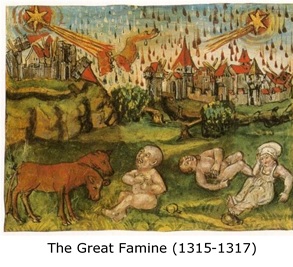
In Lorraine, wheat prices rose by 320%, making bread unaffordable to peasants. Stores of grain for long-term emergencies were limited to royalty, lords, nobles, wealthy merchants, and the Church. Because of the general increased population pressures, even lower-than-average harvests meant some people would go hungry; there was little margin for failure. People began to harvest wild edible roots, grasses, nuts, and bark in the forests.

A number of documented incidents show the extent of the famine. Edward II of England stopped at St Albans on 10 August 1315 and had difficulty finding bread for himself and his entourage; it was a rare occasion in which the king of England was unable to eat.

In Bristol the city's chronicles reported that in 1315 there was: a great Famine of Dearth with such mortality that the living could scarce suffice to Bury the dead, horse flesh and Dogs flesh was accounted good meat, and some eat their own Children. The thieves that were in Prison did pluck and tear in pieces, such as were newly put into Prison, and devoured them half alive.

The French, under Louis X, tried to invade Flanders, but in low-lying areas of the Netherlands, the fields were soaked, and the army became so bogged down that they were forced to retreat, burning their provisions where they left them, unable to carry them away.

In the spring of 1316, it continued to rain on a European population deprived of energy and reserves to sustain itself. All segments of society, from nobles to peasants were affected, but especially the peasants, who represented 95% of the population and who had no reserve food supplies. To provide some measure of relief, the future was mortgaged by slaughtering the draft animals, eating the seed grain, abandoning children to fend for themselves (see Hansel and Gretel) and, among old people, voluntarily refusing food for the younger generation to survive. The chroniclers of the time noted many incidents of cannibalism, although, one can never tell if such talk was not simply a matter of rumour-mongering.

The height of the famine was in 1317, as the wet weather continued. Finally, in that summer, the weather returned to its normal patterns. By then, however, people were so weakened by diseases such as pneumonia, bronchitis, and tuberculosis, and so much of the seed stock had been eaten, that it was not until 1325 that the food supply returned to relatively normal levels and the population began to increase again.

Historians debate the toll, but it is estimated that 10–25% of the population of many cities and towns died. Though the Black Death (1347–1351) would kill more people, it often swept through an area in a matter of months, whereas the Great Famine lingered for years, prolonging the suffering of the populace.

Jean-Pierre Leguay noted the Great Famine produced wholesale slaughter in a world that was already overcrowded, especially in the towns, which were natural outlets for rural overpopulation. Estimates of death rates vary by place, but some examples include a loss of 10–15% in the south of England. Northern France lost about 10% of its population.

More information: Medievalists

The Great Famine was restricted to Northern Europe, including the British Isles, Northern France, the Low Countries, Scandinavia, Germany, and western Poland. It also affected some Baltic States, except for the far eastern Baltic, which was affected only indirectly. The famine was bounded to the south by the Alps and the Pyrenees.

The Great Famine is noteworthy for the number of people who died, the vast geographic area that was affected and its length, but also its lasting consequences.

In a society whose final recourse for nearly all problems had been religion, and Roman Catholicism was the only tolerated Christian faith, no amount of prayer seemed effective against the root causes of the famine. This undermined the institutional authority of the Roman Catholic Church, and helped lay the foundations for later movements that were deemed heretical by the Church, as they opposed the papacy and blamed the perceived failure of prayer on corruption and doctrinal errors within the Roman Catholic Church.

Medieval Europe in the fourteenth century had already experienced widespread social violence, and even acts then punishable by death such as rape and murder were demonstrably far more common, especially relative to the population size, compared with modern times.

The famine led to a stark increase in crime, even among those not normally inclined to criminal activity, because people would resort to any means to feed themselves or their families. For the next several decades after the famine, Europe took on a tougher and more violent edge; it became an even less amicable place than during the twelfth and the thirteenth centuries.

This could be seen across all segments of society, perhaps most strikingly in the way warfare was conducted in the fourteenth century during the Hundred Years' War, when chivalry ended, as opposed to the twelfth and the thirteenth centuries when nobles were more likely to die by accident in tournament games than on the field of battle.

The famine also undermined confidence in medieval governments, due to their failure to deal with its resulting crises.

The Great Famine marked a clear end to an unprecedented period of population growth that had started around 1050. Although some believe growth had already been slowing down for a few decades, the famine was undoubtedly a clear end of high population growth.

The Great Famine would later have consequences for future events in the fourteenth century, such as the Black Death, when an already weakened population would be struck again.

More information: Nature


 Near the gates and within two cities there will be scourges
the like of which was never seen:
famine within plague, people put out by steel,
crying to the great immortal God for relief.

Nostradamus

Thursday, 24 June 2021

ST. JOHN'S OR ST. VITUS' DANCE, DANCING ERRATICALLY

Today is Saint John and The Grandma has been reading about an incredible and mysterious case that occurred in Europe between the 14th and 17th centuries, a social phenomenon where groups of people started to dance erratically without explanation until they collapsed from exhaustion and injuries. 

It is a phenomenon named St. John's Dance, St. Vitus' Dance or tarantism in Europe that was firstly reported when a sudden outbreak of St. John's Dance causes people in the streets of Aachen, on a day like today in 1374.

Dancing mania, also known as dancing plague, choreomania, St. John's Dance, tarantism and St. Vitus' Dance, was a social phenomenon that occurred primarily in mainland Europe between the 14th and 17th centuries.

It involved groups of people dancing erratically, sometimes thousands at a time. The mania affected men, women, and children who danced until they collapsed from exhaustion and injuries.

One of the first major outbreaks was in Aachen, in the Holy Roman Empire in 1374, in modern-day Germany, and it quickly spread throughout Europe; one particularly notable outbreak occurred in Strasbourg in 1518 in Alsace, also in the Holy Roman Empire, now France.

Affecting thousands of people across several centuries, dancing mania was not an isolated event, and was well documented in contemporary reports. It was nevertheless poorly understood, and remedies were based on guesswork. 

Often musicians accompanied dancers, due to a belief that music would treat the mania, but this tactic sometimes backfired by encouraging more to join in. There is no consensus among modern-day scholars as to the cause of dancing mania.

More information: Smithsonian Magazine

The several theories proposed range from religious cults being behind the processions to people dancing to relieve themselves of stress and put the poverty of the period out of their minds.

It is speculated to have been a mass psychogenic illness, in which physical symptoms with no known physical cause are observed to affect a group of people, as a form of social influence.

Dancing mania is derived from the term choreomania, from the Greek choros (dance) and mania (madness), and is also known as dancing plague. The term was coined by Paracelsus, and the condition was initially considered a curse sent by a saint, usually St. John the Baptist or St. Vitus, and was therefore known as St. Vitus' Dance or St. John's Dance.

Victims of dancing mania often ended their processions at places dedicated to that saint, who was prayed to in an effort to end the dancing; incidents often broke out around the time of the feast of St. Vitus.

St. Vitus' Dance was diagnosed, in the 17th century, as Sydenham chorea.

Dancing mania has also been known as epidemic chorea and epidemic dancing. A disease of the nervous system, chorea is characterized by symptoms resembling those of dancing mania, which has also rather unconvincingly been considered a form of epilepsy.

Other scientists have described dancing mania as a collective mental disorder, collective hysterical disorder and mass madness.

 More information: Europeana

The earliest-known outbreak of dancing mania occurred in the 7th century, and it reappeared many times across Europe until about the 17th century, when it stopped abruptly. One of the earliest-known incidents occurred sometime in the 1020s in Bernburg, where 18 peasants began singing and dancing around a church, disturbing a Christmas Eve service.

Further outbreaks occurred during the 13th century, including one in 1237 in which a large group of children travelled from Erfurt to Arnstadt, about 20 km, jumping and dancing all the way, in marked similarity to the legend of the Pied Piper of Hamelin, a legend that originated at around the same time.

Another incident, in 1278, involved about 200 people dancing on a bridge over the River Meuse resulting in its collapse. Many of the survivors were restored to full health at a nearby chapel dedicated to St. Vitus. The first major outbreak of the mania occurred between 1373 and 1374, with incidents reported in England, Germany and the Netherlands.

On 24 June 1374, one of the biggest outbreaks began in Aachen, Germany, before spreading to other places such as Cologne, Flanders, Franconia, Hainaut, Metz, Strasbourg, Tongeren, Utrecht, and countries such as Italy and Luxembourg.

Further episodes occurred in 1375 and 1376, with incidents in France, Germany and Netherlands, and in 1381 there was an outbreak in Augsburg. Further incidents occurred in 1418 in Strasbourg, where people fasted for days and the outbreak was possibly caused by exhaustion. In another outbreak, in 1428 in Schaffhausen, a monk danced to death and, in the same year, a group of women in Zurich were reportedly in a dancing frenzy.

Another of the biggest outbreaks occurred in July 1518, in Strasbourg, where a woman began dancing in the street and between 50 and 400 people joined her. Further incidents occurred during the 16th century, when the mania was at its peak: in 1536 in Basel, involving a group of children; and in 1551 in Anhalt, involving just one man.

Dancing mania appears to have completely died out by the mid-17th century.

According to John Waller, although numerous incidents were recorded, the best documented cases are the outbreaks of 1374 and 1518, for which there is abundant contemporary evidence.

The outbreaks of dancing mania varied, and several characteristics of it have been recorded. Generally occurring in times of hardship, up to tens of thousands of people would appear to dance for hours, days, weeks, and even months.

Women have often been portrayed in modern literature as the usual participants in dancing mania, although contemporary sources suggest otherwise. Whether the dancing was spontaneous, or an organized event, is also debated. What is certain, however, is that dancers seemed to be in a state of unconsciousness, and unable to control themselves.

In Italy, a similar phenomenon was tarantism, in which the victims were said to have been poisoned by a tarantula or scorpion. Its earliest-known outbreak was in the 13th century, and the only antidote known was to dance to particular music to separate the venom from the blood. It occurred only in the summer months. As with dancing mania, people would suddenly begin to dance, sometimes affected by a perceived bite or sting and were joined by others, who believed the venom from their own old bites was reactivated by the heat or the music. Dancers would perform a tarantella, accompanied by music which would eventually cure the victim, at least temporarily.

Some participated in further activities, such as tying themselves up with vines and whipping each other, pretending to sword fight, drinking large amounts of wine, and jumping into the sea. Some died if there was no music to accompany their dancing. Sufferers typically had symptoms resembling those of dancing mania, such as headaches, trembling, twitching and visions.

More information: History

As with dancing mania, participants apparently did not like the colour black, and women were reported to be most affected. Unlike dancing mania, tarantism was confined to Italy and Southern Europe.

It was common until the 17th century, but ended suddenly, with only very small outbreaks in Italy until as late as 1959.

As the real cause of dancing mania was unknown, many of the treatments for it were simply hopeful guesses, although some did seem effective. The 1374 outbreak occurred only decades after the Black Death, and was treated similarly: dancers were isolated, and some were exorcized. People believed that the dancing was a curse brought about by St. Vitus; they responded by praying and making pilgrimages to places dedicated to St. Vitus.

Prayers were also made to St. John the Baptist, who some believed also caused the dancing. Others claimed to be possessed by demons, or Satan, therefore exorcisms were often performed on dancers.

Numerous hypotheses have been proposed for the causes of dancing mania, and it remains unclear whether it was a real illness or a social phenomenon. One of the most prominent theories is that victims suffered from ergot poisoning, which was known as St. Anthony's fire in the Middle Ages. During floods and damp periods, ergots were able to grow and affect rye and other crops. Ergotism can cause hallucinations and convulsions, but cannot account for the other strange behaviour most commonly identified with dancing mania.

More information: Medium

Other theories suggest that the symptoms were similar to encephalitis, epilepsy, and typhus, but as with ergotism, those conditions cannot account for all symptoms.

Numerous sources discuss how dancing mania, and tarantism, may have simply been the result of stress and tension caused by natural disasters around the time, such as plagues and floods.

Another popular theory is that the outbreaks were all staged, and the appearance of strange behaviour was due to its unfamiliarity. Religious cults may have been acting out well-organized dances, in accordance with ancient Greek and Roman rituals. Despite being banned at the time, these rituals could be performed under the guise of uncontrollable dancing mania.

It is certain that many participants of dancing mania were psychologically disturbed, but it is also likely that some took part out of fear, or simply wished to copy everyone else.

Sources agree that dancing mania was one of the earliest-recorded forms of mass hysteria, and describe it as a psychic epidemic, with numerous explanations that might account for the behaviour of the dancers. It has been suggested that the outbreaks may have been due to cultural contagion triggered, in times of particular hardship, by deeply rooted popular beliefs in the region regarding angry spirits capable of inflicting a dancing curse to punish their victims.

More information: Read Actively Learn


For all that exists in man, whether good or evil,
is rendered conspicuous by the presence of great danger.
His inmost feelings are roused
-the thought of self-preservation masters his spirit-
self-denial is put to severe proof,
and wherever darkness and barbarism prevail,
there the affrighted mortal flies to the idols of his superstition,
and all laws, human and divine, are criminally violated.

Justus Friedrich Karl Hecker

Friday, 23 December 2016

0836656565: CLAIRE FONTAINE PHONES PÈRE NÖEL!

Saint Nicholas of Myra
Claire Fontaine wants to talk about Santa Claus, his origins and his tradition around Europe and The USA.

Santa Claus, also known as Saint Nicholas, Saint Nick, Kris Kringle, Father Christmas, or simply Santa, Santy in Hiberno-English, is a legendary figure of Western culture who is said to bring gifts to the homes of well-behaved good or nice children on Christmas Eve, 24 December, and the early morning hours of Christmas Day, 25 December. 

The modern Santa Claus grew out of traditions surrounding the historical Saint Nicholas, a fourth-century Greek bishop and gift-giver of Myra, the British figure of Father Christmas, the Dutch figure of Sinterklaas, himself based on Saint Nicholas, the German figure of the Christkind, a fabulized Christ Child, and the holidays of Twelfth Night and Epiphany and their associated figures of the Three Kings, based on the gift-giving Magi of the Nativity and Befana. Some maintain Santa Claus also absorbed elements of the Germanic god Wodan, who was associated with the pagan midwinter event of Yule and led the Wild Hunt, a ghostly procession through the sky.

More information: Saint Nicholas Center

Saint Nicholas of Myra was a 4th-century Greek Christian bishop of Myra, now Demre, in Lycia, a province of the Byzantine Empire, now in Turkey. Nicholas was famous for his generous gifts to the poor, in particular presenting the three impoverished daughters of a pious Christian with dowries so that they would not have to become prostitutes. He was very religious from an early age and devoted his life entirely to Christianity. 

Claire in the Church of St Nicholas in Moscow
In continental Europe, more precisely the Netherlands, Belgium, Austria and Germany he is usually portrayed as a bearded bishop in canonical robes.

The remains of Saint Nicholas are in Italy. In 1087, the Italian city of Bari mounted an expedition to locate the tomb of the Saint. The reliquary of St. Nicholas was conquered by Italian sailors and his relics were taken to Bari where they are kept to this day. A basilica was constructed the same year to store the loot and the area became a pilgrimage site for the devout. Sailors from Bari collected just half of Nicholas' skeleton, leaving all the minor fragments in the grave. These were collected by Venetian sailors during the First Crusade and taken to Venice, where a church to St. Nicholas, the patron of sailors, was built on the San Nicolò al Lido. This tradition was confirmed in two important scientific investigations of the relics in Bari and Venice, which revealed that the relics in the two Italian cities belong to the same skeleton. Saint Nicholas was later claimed as a patron saint of many diverse groups, from archers, sailors, and children to pawnbrokers. He is also the patron saint of both Amsterdam and Moscow.


During the Middle Ages, often on the evening before his name day of 6 December, children were bestowed gifts in his honour. This date was earlier than the original day of gifts for the children, which moved in the course of the Reformation and its opposition to the veneration of saints in many countries on the 24 and 25 December. 

Claire in the Church of San Nicolò al Lido, Venice
So Saint Nicholas changed to Santa Claus. The custom of gifting to children at Christmas has been propagated by Martin Luther as an alternative to the previous very popular gift custom on St. Nicholas, to focus the interest of the children to Christ instead of the veneration of saints. 

Martin Luther first suggested the Christkind as the bringer of gifts. But Nicholas remained popular as gifts bearer for the people.

Father Christmas dates back as far as 16th century in England during the reign of Henry VIII, when he was pictured as a large man in green or scarlet robes lined with fur. 


He typified the spirit of good cheer at Christmas, bringing peace, joy, good food and wine and revelry. As England no longer kept the feast day of Saint Nicholas on 6 December, the Father Christmas celebration was moved to 25 December to coincide with Christmas Day. The Victorian revival of Christmas included Father Christmas as the emblem of good cheer

Santa Claus and Coca Cola
His physical appearance was variable,with one famous image being John Leech's illustration of the Ghost of Christmas Present in Charles Dickens's festive classic A Christmas Carol (1843), as a great genial man in a green coat lined with fur who takes Scrooge through the bustling streets of London on the current Christmas morning, sprinkling the essence of Christmas onto the happy populace.

In the Netherlands and Belgium the character of Santa Claus has to compete with that of Sinterklaas, Santa's presumed progenitor. 

Santa Claus is known as de Kerstman in Dutch and Père Noël in French, where you can phone him to the free number: 0836656565.

More information:  The Coca Cola Company

Images of Santa Claus were further popularized through Haddon Sundblom's depiction of him for The Coca-Cola Company's Christmas advertising in the 1930s. The popularity of the image spawned urban legends that Santa Claus was invented by The Coca-Cola Company or that Santa wears red and white because they are the colors used to promote the Coca-Cola brand. Historically, Coca-Cola was not the first soft drink company to utilize the modern image of Santa Claus in its advertising, White Rock Beverages had already used a red and white Santa to sell mineral water in 1915 and then in advertisements for its ginger ale in 1923. 


Santa Claus has the right idea: visit people only once a year. 

Victor Borge

Sunday, 13 November 2016

JOHN McCRAE & LEONARD COHEN: IN FLANDERS FIELDS

World War I in Montenegro
The day before yesterday, we could commemorate the anniversary of the end of the World War I.

World War I also known as the First World War, or the Great War, was a global war originating in Europe that lasted from 28 July 1914 to 11 November 1918. More than 70 million military personnel, including 60 million Europeans, were mobilised in one of the largest wars in history. Over nine million combatants and seven million civilians died as a result of the war, including the victims of a number of genocides, a casualty rate exacerbated by the belligerents' technological and industrial sophistication, and the tactical stalemate caused by gruelling trench warfare. 

It was one of the deadliest conflicts in history, and paved the way for major political changes, including revolutions in many of the nations involved.

More information: History.com

John McCrae
Claire Fontaine wants to talk about an unforgettable fellow citizen, a great Canadian poet, John McCrae, who created one of the most beautfil poems ever writter: In Flanders Fields. McCrae died of pneumonia near the end of the war. 

Though various legends have developed as to the inspiration for the poem, the most commonly held belief is that McCrae wrote In Flanders Fields on May 3, 1915, the day after presiding over the funeral and burial of his friend Lieutenant Alexis Helmer, who had been killed during the Second Battle of Ypres

The poem was written as he sat upon the back of a medical field ambulance near an advance dressing post at Essex Farm, just north of Ypres. The poppy, which was a central feature of the poem, grew in great numbers in the spoiled earth of the battlefields and cemeteries of Flanders.

More information:  In Flanders Fields Museum

In 1855, British historian Lord Macaulay, writing about the site of the Battle of Landen in modern Belgium, 100 miles from Ypres in 1693, wrote The next summer the soil, fertilised by twenty thousand corpses, broke forth into millions of poppies. The traveller who, on the road from Saint Tron to Tirlemont, saw that vast sheet of rich scarlet spreading from Landen to Neerwinden, could hardly help fancying that the figurative prediction of the Hebrew prophet was literally accomplished, that the earth was disclosing her blood and refusing to cover the slain

Leonard Cohen
The Canadian government has placed a memorial to John McCrae that features In Flanders Fields at the site of the dressing station which sits beside the Commonwealth War Graves Commission's Essex Farm Cemetery. The Belgian government has named this site the John McCrae Memorial Site.

Some days ago, another Claire's fellow citizen died: Leonard Cohen. He was one of the best singers and writers who composed incredible songs like Bird on a wire, Hallelujah, Suzanne, The Partizan or So Long Marianne. In 2015, Leonard Cohen paid a tribute to John McCrae's poem in its 100th anniversary.

More information: The Official Leonard Cohen

In Flanders fields the poppies blow
Between the crosses, row on row,
That mark our place; and in the sky
The larks, still bravely singing, fly
Scarce heard amid the guns below.
 
We are the Dead. Short days ago
We lived, felt dawn, saw sunset glow,
Loved and were loved, and now we lie
In Flanders fields.
 
Take up our quarrel with the foe:
To you from failing hands we throw
The torch; be yours to hold it high.
 
If ye break faith with us who die
We shall not sleep, though poppies grow
In Flanders fields.


 Poetry is just the evidence of life. If your life is burning well, 
poetry is just the ash. 
Leonard Cohen

Sunday, 11 January 2015

DAVID, ABBA, GRETA & ROXETTE: SWEDISH STYLE

Greta Garbo
David, our surgeon, was born in Sweden the native country of Greta Garbo, Max Von Sydow or Ingrid Bergman but also of Europe, Roxette or Stieg Larsson. 

He’s the Nordic archetype: blond, blue eyes and terribly charming. Nobody resists him. His job enables the possibility of traveling around the world. He’s not a normal surgeon. He’s one of the best plastic surgeons. He’s created and retouched hundreds of famous people and his results are better than no Photoshop. 

One day, David got bored about these superficial people and, inspired in one ABBA’s song, his favourite group, decided to change his live and dedicate it to help without receiving anything.


Chiquitita, you and I know
How the heartaches come and they go and the scars they're leaving
You'll be dancing once again and the pain will end
You will have no time for grieving
Chiquitita, you and I cry
But the sun is still in the sky and shining above you


ABBA