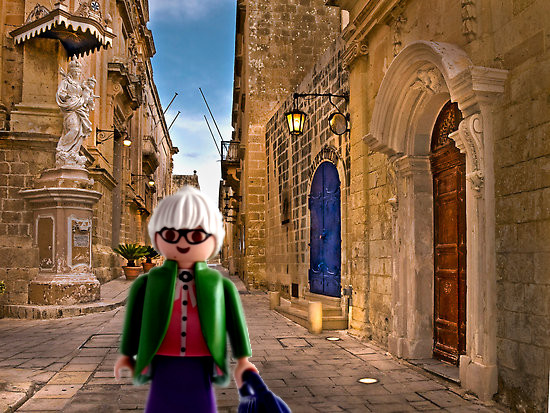
Thursday, 14 June 2018

KAPELLA TA' SANTA MARIJA MADDALENA, HAD-DINGLI

Tina & Joseph are visiting Ħad-Dingli cliffs
The Grandma wants to visit the chapel of Saint Mary Magdalene in Digli

Today, she and her friends are discovering this wonderful place where you can enjoy the most spectacular breath-taking views of Ħad-Digli cliffs.
 
Dingli, in Maltese Ħad-Dingli, is a village in the Northern Region, with a population of 3,608. It is 13 kilometres from the capital Valletta and two kilometers from the nearest town, Rabat

The village lies on a plateau some 250 metres above sea level, which is one of the highest points of Malta. The area provides not only open sea views over the tiny, uninhabited isle of Filfla, but is also a good vantage point over Malta. From the cliffs there are also views of the nearby Buskett Gardens and Verdala Palace.

The name Dingli is believed to be derived from the name of Sir Thomas Dingley, an English knight of the Order of St. John, who owned much of the lands in the surrounding area.

More information: Dingli Local Council

Rock-cut tombs dating back to Phoenician, Carthaginian and Roman times have been found in the limits of Dingli. Roman baths and other remains were also found at Għajn Handful and the area of Ta' Baldu.

Until the early 16th century, a small village known as Ħal Tartarni existed, somewhere between Buskett and the present location of Dingli. The village was one of the ten original parishes of Malta by 1436, having a church dedicated to Saint Domenica. The original church no longer exists, but a nearby chapel built in 1669 with the same dedication is still standing.

The noble family Inguanez had a lot of land in the area, and employed the population of Ħal Tartarni to work the fields. Over time, the people moved closer towards the fields, abandoning the original village. The new village eventually grew to what is now Dingli. The site of Ħal Tartarni now consists of open fields.

Claire Fontaine in Ħad-Dingli cliffs
The parish of Dingli was established in 1678 and is dedicated to the Assumption of Our Lady into heaven. The church is situated in the centre of the village on a prominent position, overlooking all the surrounding area. 

The church which one finds today, was built in the form of a Latin cross in the beginning of the 20th century. The church was heavily modified in the middle of the same century, with the building of a new façade and extensions to the width of the main aisle. A more recent development, was the building of the dome during the 60s and 70s, which completed the construction work of the church. 

The same church was given the title of Arch parish church by a decree of the Archbishop of Malta on 22 August 2015, the eve of the titular feast of Dingli.

The feast of the Assumption in Dingli is celebrated on the first Sunday after the 15th August. The titular statue of Our Lady in the parish is the fifth one in the island, made by Anton Busuttil in 1861. The statue is carved in wood and is used in a procession on the day of the feast each year carried by 8 statue bearers from the parish. The statue was restored twice: in 1934 and 1977.

More information: My Malta Guide

Throughout the rule of the Order of Saint John, Dingli was considered to be safe from corsair attacks because it was impossible for pirates to land in the area due to the Dingli Cliffs.

The Grandma walks to St Mary Magdalene chapel
The village began to see more development after the mid-20th century where the population doubled from 2,000 into the 21st century. Telephone service was introduced in private homes, and public transport began to reach the village itself instead of stopping at Rabat.

Until the early 20th century, it was difficult to send children to school, since boys used to work in the fields while girls helped in the domestic work. This changed over time, and today everyone goes to school, on both primary and secondary levels. Some continue their studies on post-secondary and tertiary levels, from where they can attain a doctorate in their field of study.

Those who appreciate inspiring coastal scenery should take a short drive or bus ride from the Blue Grotto in Wied iz-Zurrieq to the Dingli Cliffs. The appeal and the drawback of this location is its remoteness. The sheer 250-meter Dingli Cliffs drop off dramatically into the Mediterranean Sea, and the sloping hillsides are fertile land used by small farms. 


More information: Bald Hiker

The highlight of Dingli Cliffs is the viewpoint that offers breathtaking seaside panoramas. Besides a short walking trail, there is nothing at Dingli Cliffs except a tiny hilltop chapel that is devoted to Saint Mary Magdalene

The Grandma & Claire contemplate the starred night
Saint Mary Magdalene Chapel, in Maltese Kappella ta' Santa Marija Maddalena is a Roman Catholic chapel in the limits of Dingli, dedicated to Saint Mary Magdalene. It overlooks the Dingli Cliffs, and is therefore commonly known as il-kappella tal-irdum

The chapel was built in 1646 on the site of an earlier one which had existed since at least the 15th century. Its simple architecture is typical of Maltese wayside chapels. The date of construction of the chapel is not known, but the oldest reference to the building was made in 1446. It was used by farmers who lived in nearby farms. The chapel was in a state of disrepair by 1575, and it later collapsed. It was rebuilt in the 17th century. The chapel is listed on the National Inventory of the Cultural Property of the Maltese Islands.

More information: Malta 360

St. Mary Magdalene Chapel has a simple design, typical of Maltese wayside chapels. It has a rectangular structure, with its façade containing a single doorway and a circular window. A Latin inscription is located just above the door, while a slab originally containing a coat of arms is located above the window. A small parvis, in Maltese zuntier, is located outside the church, and a railing is located nearby to protect visitors to the chapel from falling down the cliffs.

The church has an altar built of Maltese limestone. The altarpiece is The Risen Christ by Paul Camilleri Cauchi, depicting Jesus forgiving a penitent Mary Magdalene after his resurrection.

More information: Times of Malta


The Catholic Church has never really come to terms with women. 
What I object to is being treated either 
as Madonnas or Mary Magdalenes. 

Shirley Williams

Wednesday, 13 June 2018

MALTA'S NATIONAL IDENTITY, THE TARXIEN TEMPLES

Joseph and his friends in the Tarxien Temples
Joseph de Ca'th Lon loves archaeology, history and anthropology. 

Malta is a great opportunity to enjoy the most amazing Megalithic Temples and discover the past of the Humanity. 

Today, he's visiting the Tarxien Temples with his friends Tina Picotes, Claire Fontaine and The Grandma.

The Tarxien Temples are an archaeological complex in Tarxien. They date to approximately 3150 BC. The site was accepted as a UNESCO World Heritage Site in 1992 along with the other Megalithic temples on the island of Malta.

More information: UNESCO

The Tarxien consist of three separate, but attached, temple structures. The main entrance is a reconstruction dating from 1956, when the whole site was restored. At the same time, many of the decorated slabs discovered on site were relocated indoors for protection at the Museum of Archaeology in Valletta

The first temple has been dated to approximately 3100 BC and is the most elaborately decorated of the temples of Malta. The middle temple dates to about 3000 BC, and is unique in that, unlike the rest of the Maltese temples, it has three pairs of apses instead of the usual two.The east temple is dated at around 3100 BC. The remains of another temple, smaller, and older, having been dated to 3250 BC, are visible further towards the east.

More information: Heritage Malta

Claire Fontaine & Tina Picotes in the Tarxien Temples
Of particular interest at the temple site is the rich and intricate stonework, which includes depictions of domestic animals carved in relief, altars, and screens decorated with spiral designs and other patterns.

Demonstrative of the skill of the builders is a chamber set into the thickness of the wall between the South and Central temples and containing a relief showing a bull and a sow. Excavation of the site reveals that it was used extensively for rituals, which probably involved animal sacrifice. Especially interesting is that Tarxien provides rare insight into how the megaliths were constructed: stone rollers were left outside the South temple. 

Additionally, evidence of cremation has been found at the center of the South temple, which is an indicator that the site was reused as a Bronze Age cremation cemetery.

More information: Malta Uncovered

The large stone blocks were discovered in 1914 by local farmers ploughing a field. After the accidental discovery of the nearby Tarxien hypogeum in 1913, the proprietor of the land underneath which the temples were buried figured that the large stones that were continually struck by workers' ploughs may also have had some archaeological value. 

On that notion, he contacted the director of the National Museum, Sir Themistocles Zammit, who began to dig even on his first inspection of the site, where he discovered the center of the temple compound. It was not long before Zammit found himself standing in what appeared to be an apse formed by a semicircle of enormous hewn stones. 

More information: Ancient Origins

Joseph is contemplating the Fat Lady
Over the course of three years, Zammit enlisted the help of local farmers and townspeople for an excavation project of unprecedented scale in Malta

By 1920, Zammit had identified and carried out restoration work on five separate but interconnected temples, all yielding a remarkable collection of artifacts, including the famous Fat Lady statue, a representation of a Mother Goddess or a fertility charm, according to the Malta Archaeological Museum, the Fat Lady statue is sexless, and could represent either a man or a woman, and several unique examples of prehistoric relief, including ships. 

The temples were included on the Antiquities List of 1925. Further excavations at the temples were conducted in the post-World War II period under the directorship of Dr. J.G. Baldacchino.

Protective tent-like shelters, similar to those at Ħaġar Qim and Mnajdra, were built around the Tarxien Temples in 2015, and were completed in December of that year.

The discovery of the complex did much to further Malta's national identity, solidly confirming the existence of a thriving ancient culture on the island

Also, the general interest aroused by the finds engendered for the first time a public concern for the protection of Malta's historical treasures, including a need for management of the sites, the promulgation of laws, and other measures to protect and preserve monuments

At the same time, Sir Themistocles' thorough method in excavating the site paved the way for a new scientific approach to archaeology.

More information: Malta Info Guide


Ruins, for me, are the beginning. 
With the debris, you can construct new ideas. 
They are symbols of a beginning. 

Anselm Kiefer

Tuesday, 12 June 2018

THE PHOENICIAN SETTLERS IN L-IMDINA, THE SILENT CITY

Claire and her friends near L-Imdina, Malta
Claire Fontaine loves silent places. She is visiting L-Imdina, the silent city in Malta, with Joseph de Ca'th Lon, Tina Picotes and The Grandma.

Mdina, in Maltese L-Imdina, also known by its titles Città Vecchia or Città Notabile, is a fortified city in the Northern Region of Malta, which served as the island's capital from antiquity to the medieval period. The city is still confined within its walls, and has a population of just under 300, but it is contiguous with the town of Rabat, which takes its name from the Arabic word for suburb, and has a population of over 11,000.

More information: Malta

The city was founded as Maleth in around the 8th century BC by Phoenician settlers, and was later renamed Melite by the Romans. Ancient Melite was larger than present-day Mdina, and it was reduced to its present size during the Byzantine or Arab occupation of Malta. During the latter period, the city adopted its present name, which derives from the Arabic word medina. 


Tina Picotes in the entrance of L-Imdina
The city remained the capital of Malta throughout the Middle Ages, until the arrival of the Order of St. John in 1530, when Birgu became the administrative centre of the island.  

Mdina experienced a period of decline over the following centuries, although it saw a revival in the early 18th century. At this point, it acquired several Baroque features, although it did not lose its medieval character.

Mdina remained the centre of the Maltese nobility and religious authorities, and property continues to largely be passed down from families and from generation to generation, but it never regained its pre-1530 importance, giving rise to the popular nickname the Silent City by both locals and visitors. Mdina is on the tentative list of UNESCO World Heritage Sites, and it is now one of the main tourist attractions in Malta.


More information: UNESCO

The plateau on which Mdina is built has been inhabited since prehistory, and by the Bronze Age it was a place of refuge since it was naturally defensible. The Phoenicians colonized Malta in around the 8th century BC, and they founded the city of Maleth on this plateau. 

The Grandma is enjoying L-Imdina
It was taken over by the Roman Republic in 218 BC, becoming known as Melite. The Punic-Roman city was about three times the size of present-day Mdina and it was extending into a large part of modern Rabat.

According to Early Modern interpretation the Acts of the Apostles, when Paul the Apostle was shipwrecked on Malta in 60 AD, he was greeted by Publius, the governor of Melite, and he cured his sick father. According to tradition, the population of Melite converted to Christianity, and Publius became the first Bishop of Malta and then Bishop of Athens before being martyred in 112 AD.

More information: Visit Malta

Very few remains of the Punic-Roman city survive today. The most significant are the ruins of the Domvs Romana, in which several well-preserved mosaics, statues and other remains were discovered. Remains of the podium of a Temple of Apollo, fragments of the city walls and some other sites have also been excavated.


Mosaic, Domvs Romana, L-Imdina
At some point following the fall of the Western Roman Empire, a retrenchment was built within the city, reducing it to its present size. 

This was done to make the city's perimeter more easily defensible, and similar reductions in city sizes were common around the Mediterranean region in the early Middle Ages. Although it was traditionally assumed that the retrenchment was built by the Arabs, it has been suggested that it was actually built by the Byzantine Empire in around the 8th century, when the threat from the Arabs increased.

In 870, Byzantine Melite, which was ruled by governor Amros, probably Ambrosios, was besieged by Aghlabids led by Halaf al-Hādim. He was killed in the fighting, and Sawāda Ibn Muhammad was sent from Sicily to continue the siege following his death. 


More information: Heritage Malta

The duration of the siege is unknown, but it probably lasted for some weeks or months. After Melite fell to the invaders, the inhabitants were massacred, the city was destroyed and its churches were looted. Marble from Melite's churches was used to build the castle of Sousse.
According to Al-Himyarī, Malta remained almost uninhabited until it was resettled in 1048 or 1049 by a Muslim community and their slaves, who built a settlement called Medina on the site of Melite

Joseph de Ca'th Lon is visiting L-Imdina
Archaeological evidence suggests that the city was already a thriving Muslim settlement by the beginning of the 11th century, so 1048–49 might be the date when the city was officially founded and its walls were constructed. 

The layout of the new city was completely different to that of ancient Melite. Mdina still has features typical of a medina, a legacy of the period of Arab rule.

The Byzantines besieged Medina in 1053–54, but were repelled by its defenders. The city surrendered peacefully to Roger I of Sicily after a short siege in 1091, and Malta was subsequently incorporated into the County and later the Kingdom of Sicily, being dominated by a succession of feudal lords. A castle known as the Castellu di la Chitati was built on the southeast corner of the city near the main entrance, probably on the site of an earlier Byzantine fort.


More information: Malta Guide

The population of Malta during the fifteenth century was about 10,000, with town life limited to Mdina, Birgu and the Gozo Citadel. Mdina was comparatively small and partly uninhabited and by 1419, it was already outgrown by its suburb, Rabat


Under Aragonese rule, local government rested on the Università, a communal body based in Mdina, which collected taxation and administered the islands' limited resources. At various points during the fifteenth century, this town council complained to its Aragonese overlords that the islands were at the mercy of the sea and the saracens.

The Grandma is walking across L-Imdina
The city withstood a siege by Hafsid invaders in 1429. While the exact number of casualties or Maltese who were carried into slavery is unknown, the islands suffered depopulation in this raid.

When the Order of Saint John took over in Malta in 1530, the nobles ceremoniously handed over the keys of the city to Grand Master Philippe Villiers de L'Isle-Adam, but the Order settled in Birgu and Mdina lost its status as capital city. In the 1540s, the fortifications began to be upgraded during the magistracy of Juan de Homedes y Coscon, and in 1551 the city withstood a brief Ottoman attack.

During the Great Siege of Malta in 1565, Mdina was the base of the Order's cavalry, which made occasional sorties on the invading Ottomans. On 7 August 1565, the cavalry attacked the unprotected Ottoman field hospital, which led in the invaders abandoning a major assault on the main fortifications in Birgu and Senglea


 More information: Malta Uncovered

The Ottomans attempted to take Mdina in September so as to winter there, but abandoned their plans when the city fired its cannon, leading them to believe that it had ammunition to spare. After the siege, Maltese military engineer Girolamo Cassar drew up plans to reduce Mdina's size by half and turning it into a fortress, but these were never implemented due to protests by the city's nobles. The fortifications were again upgraded in the mid-17th century, when the large De Redin Bastion was built at the centre of the land front.

Claire Fontaine in L-Imdina
Mdina suffered severe damage during the 1693 Sicily earthquake, although no casualties were reported. The 13th-century Cathedral of St. Paul was partially destroyed, and it was rebuilt by Lorenzo Gafà in the Baroque style between 1697 and 1703.

On 3 November 1722, newly elected Grand Master António Manoel de Vilhena issued orders for the restoration and renovation of Mdina. This renovation was entrusted to the French architect and military engineer Charles François de Mondion, who introduced strong French Baroque elements into what was still a largely medieval city. 


More information: Malta Info Guide

At this point, large parts of the fortifications and the city entrance were completely rebuilt. The remains of the Castellu di la Chitati were demolished to make way for Palazzo Vilhena, while the main gate was walled up and a new Mdina Gate was built nearby. 

Claire Fontaine and Saint Paul's Cathedral Dome
Several public buildings were also built, including the Banca Giuratale and the Corte Capitanale. The last major addition to the Mdina fortifications was Despuig Bastion, which was completed in 1746.

On 10 June 1798, Mdina was captured by French forces without much resistance during the French invasion of Malta. A French garrison remained in the city, but a Maltese uprising broke out on 2 September of that year. The following day, rebels entered the city through a sally port and massacred the garrison of 65 men. These events marked the beginning of a two-year uprising and blockade, and the Maltese set up a National Assembly which met at Mdina's Banca Giuratale. The rebels were successful, and in 1800 the French surrendered and Malta became a British protectorate.

More information: Made in Moments

From 1883 to 1931, Mdina was linked with Valletta by the Malta Railway. Today, Mdina is one of Malta's major tourist attractions, hosting about 750,000 tourists a year. No cars, other than a limited number of residents, emergency vehicles, wedding cars and horses, are allowed in Mdina, partly why it has earned the nickname the Silent City. The city displays an unusual mix of Norman and Baroque architecture, including several palaces, most of which serve as private homes. 


More information: Adventurous Kate


Iż-żmien hu l-akbar għalliem.
Time is the greatest teacher.

Maltese Proverb

Monday, 11 June 2018

SAINT JOHN'S CO-CATHEDRAL, CHURCH OF THE KNIGHTS

Tina Picotes and her friends at St.John's Co-Cathedral
Tina Picotes loves painting. She's a great painter and she likes visiting places where she can contemplate these masterpieces. Today, she's visiting St John's Co-Cathedral in Valletta where she is going to enjoy with Caravaggio works. She's not alone. Claire Fontaine, Joseph de Ca'th lon and The Grandma are with her.

St John's Co-Cathedral in Maltese Kon-Katidral ta' San Ġwann is a Roman Catholic co-cathedral in Valletta, dedicated to Saint John the Baptist. It was built by the Order of St. John between 1572 and 1577, having been commissioned by Grand Master Jean de la Cassière as the Conventual Church of Saint John, in Maltese Knisja Konventwali ta' San Ġwann.

More information: St John's Co-Cathedral

The church was designed by the Maltese architect Girolamo Cassar, who designed several of the more prominent buildings in Valletta. In the 17th century, its interior was redecorated in the Baroque style by Mattia Preti and other artists. The interior of the church is considered to be one of the finest examples of high Baroque architecture in Europe.

St John's Co-Cathedral was commissioned in 1572 by Jean de la Cassière, Grand Master of the Order of St. John. It was initially named, in the Italian common language of the time, as Chiesa Conventuale di San Giovanni Battista

Claire Fontaine in St. John's Co-Cathedral
The church was designed by the Maltese architect Girolamo Cassar, who was also responsible for the construction of many important buildings in Valletta

It is held that Cassar went to Rhodes to bring a plan of an already existing church with the exact role of St. John's, that was by then converted to a Mosque, to use it as a model for the present Con-Cathedral. However Cassar still took decisions over the final design and made modifications, and thus being the sole architect of the Con-Cathedral. Once St. John's was completed in 1577, it became the new conventual church of the Order instead of St. Lawrence's Church in the Order's former headquarters Birgu

Construction of the oratory and sacristy began in 1598, during the magistracy of Martin Garzez, and they were completed by Grand Master Alof de Wignacourt in 1604.

More information: Malta Culture Guide

For the first century of its existence, the church's interior was modestly decorated. However, in the 1660s, Grand Master Raphael Cotoner ordered the redecoration of the interior so as to rival the churches of Rome. Calabrian artist Mattia Preti was in charge of the embellishment, and effectively completely transformed the interior in the Baroque style.The annexes on the side of the cathedral were added later and feature the coat of arms of Grand Master António Manoel de Vilhena who reigned from 1722 to 1736.

St. John's remained the conventual church of the Order until the latter was expelled from Malta with the French occupation in 1798. Over time, the church grew to equal prominence with the archbishop's cathedral at Mdina

Joseph de Ca'th Lon in St. John's Co-Cathedral
In the 1820s, the Bishop of Malta was allowed to use St John's as an alternative see and it thus formally became a Co-Cathedral.

In 1831, Sir Walter Scott called the cathedral a magnificent church, the most striking interior he had ever seen. Later on in the 19th century, Giuseppe Hyzler, a leader of the Nazarene movement, removed some of the Baroque art of the cathedral, including the ornate altar in the Chapel of the Langue of France.

The cathedral's exterior was slightly damaged by aerial bombardment in 1941, during World War II, barely escaping total destruction. The contents of the cathedral had been transferred elsewhere before the bombardment, so no works of art were lost.

More information: Malta Info Guide

The cathedral was restored between the late 1980s and the early 1990s. In 2001, the St John's Co-Cathedral Foundation was set up to administer and conserve the cathedral and its museum. The sides of the cathedral were restored between 2008 and 2010, and a complete restoration of the exterior began to be carried out in July 2014. This restoration is being directed by architect Jean Frendo and eight restorers. Restoration of the central part of the façade was completed in September 2015, and project completion was expected in 2017.

Enjoying the Chapel of the Langue of Aragon
Today, the cathedral is one of the most popular tourist attractions in Malta, and it is listed on the National Inventory of the Cultural Property of the Maltese Islands.

he cathedral's exterior is built in the Mannerist style typical of its architect Girolamo Cassar. Its façade is rather plain but well-proportioned, being bounded by two large bell towers. The doorway is flanked by Doric columns supporting an open balcony from which the Grand Master used to address the people on important occasions. On the side are also two empty niches. The niches and the columns are a break with the rest of exterior Mannerist architecture.

Overall, the exterior is rather austere and it is reminiscent of a fortress, reflecting both Cassar's style as a military engineer as well as the Order's mood in the years following the Great Siege of Malta in 1565.

More information: Vassall o History

The cathedral's interior is extremely ornate, standing in sharp contrast with the façade. The interior was largely decorated by Mattia Preti, the Calabrian artist and knight, at the height of the Baroque period. Preti designed the intricate carved stone walls and painted the vaulted ceiling and side altars with scenes from the life of John the Baptist

Tina in front of St. John's Co-Cathedral
Interestingly, the figures painted into the ceiling next to each column initially appear to the viewer as three-dimensional statues, but on closer inspection we see that the artist cleverly created an illusion of three-dimensionality by his use of shadows and placement. 

Also noteworthy is the fact that the carving was all undertaken in-place rather than being carved independently and then attached to the walls. The Maltese limestone from which the Cathedral is built lends itself particularly well to such intricate carving. The whole marble floor is an entire series of tombs, housing about 400 Knights and officers of the Order. There is also a crypt containing the tombs of Grand Masters like Philippe Villiers de L'Isle-Adam, Claude de la Sengle, Jean Parisot de Valette, and Alof de Wignacourt.

More information: Wander Wisdom

In 1666, a project for the main altar by Malta's greatest sculptor, Melchiorre Cafà, was approved and begun. Cafà intended a large sculpture group in bronze depicting the Baptism of Christ. Following Cafà's tragical death in 1667 in a foundry accident while working on this work in Rome, the plans were abandoned. 

Only in 1703, Giuseppe Mazzuoli, Cafà's only pupil, finished a marble group of the Baptism of Christ which might have been influenced by his master's undocumented designs but certainly is strongly dependent on a small baptism group by Alessandro Algardi.

The Grandma in the Chapel of the Langue of Italy
The funerary monument of Grand Master Marc'Antonio Zondadari, died in 1722, nephew of Pope Alexander VII, is located close to the main entrance. 

It was originally meant to be installed in the Chapel of the Langue of Italy, but it was too large so it was placed in the nave.

The painting depicting The Beheading of Saint John the Baptist (1608) by Caravaggio (1571–1610) is the most famous work in the church. Considered one of Caravaggio's masterpieces, the largest canvas he painted and the only painting signed by the painter, the canvas is displayed in the Oratory for which it was painted. 

Restored in the late 1990s in Florence, this painting is one of Caravaggio's most impressive uses of the chiaroscuro style for which he is most famous with a circle of light illuminating the scene of St John's beheading at the request of Salome. The oratory also houses Caravaggio's Saint Jerome Writing (1607–1608).

More information: Reveal Malta

Another impressive feature of the church is the collection of marble tombstones in the nave in which were buried important knights. The more important knights were placed closer to the front of the church. These tombstones, richly decorated with in-laid marble and with the coats of arms of the knight buried below as well as images relevant to that knight, often telling a story of triumph in battle, form a rich visual display in the church.

Caravaggio in St. John's Co-Cathedral
Adjoining to the church is the St John's Co-Cathedral Museum containing art objects. 

Among the contents of the museum there are the Flemish Tapestries designed by Peter Paul Rubens, which were donated by Grand Master Ramon Perellos i Roccaful, paintings of Grand Masters Jean de la Cassière, Nicolas Cotoner and Manuel Pinto da Fonseca, and paintings which were formerly in the side chapels such as St. George killing the Dragon by Francesco Potenzano.

More information: Bald Hiker

The Cathedral contains nine rich chapels, one dedicated to Our Lady of Philermos and the rest dedicated to the patron saints of each of the Order's eight langues. The following chapels are located on the south side of the church:

-Chapel of Our Lady of Philermos, also known as the Chapel of the Blessed Sacrament, originally contained an icon of Our Lady of Philermos, which had been in the possession of the Order since the Crusades.

-Chapel of the Langue of Auvergne (Augvernat-Occitan), dedicated to the Saint Sebastian.

-Chapel of the Langue of Aragon (Catalan & Aragonese), dedicated to Saint George.

-Chapel of the Langue of Castile, Leon and Portugal (Castilian & Galician), dedicated to Saint James.

-Chapel of the Anglo-Bavarian Langue (Bavarian), also known as the Chapel of Relics, dedicated to Saint Charles Borromeo.

-Chapel of the Langue of Provence (Provençal-Occitan), dedicated to Saint Michael the Archangel.

-Chapel of the Langue of France (French), dedicated to the Conversion of Saint Paul.

-Chapel of the Langue of Italy (Italian), dedicated to the Immaculate Conception and Saint Catherine of Alexandria.

-Chapel of the Langue of Germany (German), dedicated to the Epiphany of Christ. 

More information: Times of Malta


Change your mind. God’s kingdom is here. 

John the Baptist

Sunday, 10 June 2018

THE MALTESE FALCON: A CLASSIC BASED ON REAL FACTS

The Maltese Falcon
The Grand Master of the Order of St John of Jerusalem had to pay an annual tribute to the Emperor Charles V and his mother Queen Joanna of Castile as monarchs of Sicily, for the granting of Tripoli, Malta and Gozo. There were also other conditions. 

The annual tribute payable on All Saints day, 1 November, was one falcon. The grant was made at Castel Franco and is dated the 23rd day of the month of March, Third Indiction, in the Year of Our Lord 1530; in the 10th year of our reign as Emperor, the 27th as King of Castile, Granada, the 16th of Navarre, the 15th of Aragon, the Two Sicilies, Jerusalem and all our other realms.

More information: How to Malta

We grant, and of our liberality we bountifully bestow upon the aforesaid Very Reverend Grand Master of the Religion and Order of Saint John of Jerusalem, in feudal perpetuity, noble, free and unencumbered, our cities, castles, places and islands of Tripoli, Malta and Gozo, with all their cities, castles, places and island territories; with pure and mixed jurisdiction, right, and property of useful government; with power of life and death over males and females residing within their limits, and with the laws, constitutions, and rights now existing amongst the inhabitants; together with all other laws and rights, exemptions, privileges, revenues and other immunities whatsoever; so that they may hereafter hold them in feudal tenure from us, as Kings of both Sicilies, and from our successors in the same kingdom, reigning at the time, under the sole payment of a falcon; which every year, on the Feast of All Saints, shall be presented by the person or persons duly authorised for that purpose, into the hands of the Viceroy or President, who may at that time be administering the government, in sign and recognition of feudal tenure; and having made that payment, they shall remain exempt and free from all other service claimable by law, and by custom performed by feudal vassals.

More information: Atlantis On Line

Dashiell Hammett's The Maltese Falcon
The investiture had to be renewed in every case of a new succession, and completed according to the dispositions of common law. Other conditions included:

-Non-aggression against Sicily.
-No immunity to fugitives of justice.
-Nomination of bishop of Malta.
-Appointment of bishop as Grand Cross and membership of the Order's Council.
-Preference to appoint an Italian as Admiral of the Order.
-Prohibition of transferability of the fief.
-Arbitration in case of dispute.

Under whatsoever laws or conditions they may have in favour of the people already residing there.

The order and grand master paid the annual falcon until 1798 when the Order was expelled from the Maltese islands by the French Directory.


The Maltese Falcon is a 1941 film noir written and directed by John Huston in his directorial debut, and based on Dashiell Hammett's 1930 novel of the same name. The film stars Humphrey Bogart as private investigator Sam Spade and Mary Astor as his femme fatale client. Gladys George, Peter Lorre, and Sydney Greenstreet co-star, with Greenstreet appearing in his film debut. 

The Maltese Falcon Film Poster
The story follows a San Francisco private detective and his dealings with three adventurers, all of whom are competing to obtain a jewel-encrusted falcon statuette. The film premiered on October 3, 1941, in New York City, and was nominated for three Academy Awards. The Maltese Falcon was selected for inclusion in the Library of Congress' National Film Registry in 1989. The Maltese Falcon is a part of Roger Ebert's Great Movies series and was cited by Panorama du Film Noir Américain as the first major film noir.

In 1539 the Knight Templars of Malta, paid tribute to Charles V, by sending him a Golden Falcon encrusted from beak to claw with rarest jewels, but pirates seized the galley carrying this priceless token and the fate of the Maltese Falcon remains a mystery to this day


In San Francisco in 1941, private investigators Sam Spade and Miles Archermeet prospective client Ruth Wonderly. She claims to be looking for her missing sister, who is involved with a man named Floyd Thursby. Archer agrees to follow her that night and help get her sister back.

Sam Spade, Ruth Wonderly and Miles Archermeet
Spade is awakened by a phone call early in the morning and the police inform him that Archer has been killed. He meets his friend, Police Detective Tom Polhaus at the murder scene and then tries calling his client at her hotel, but she has checked out. Back at his apartment, he is grilled by Polhaus and Lieutenant Dundy, who tell him that Thursby was also murdered the same evening. Dundy suggests that Spade had the opportunity and motive to kill Thursby, who likely killed Archer. Archer's widow Iva later visits him in his office, believing that Spade shot his partner so he could have her.

Later that morning, Spade meets his client, now calling herself Brigid O'Shaughnessy. She explains that Thursby was her partner and probably killed Archer, but claims to have no idea who killed Thursby. Spade distrusts her, but agrees to investigate the murders.


At his office, Spade meets Joel Cairo, who first offers him $5,000 to find a black figure of a bird, then pulls a gun on him in order to search the room for it. Spade knocks Cairo out and goes through his belongings. When Cairo comes round, he hires Spade. Later that evening, Spade tells O'Shaughnessy about Cairo. When Cairo shows up, it becomes clear that Spade's acquaintances know each other. Cairo becomes agitated when O'Shaughnessy reveals that the Fat Man is in San Francisco.

Sam Spade with the Maltese Falcon
In the morning, Spade goes to Cairo's hotel, where he spots Wilmer, a young man who had been following him earlier, and gives Wilmer a message for his boss, Kasper Gutman. 

When Spade goes to meet Gutman, alias the Fat Man, in his hotel suite, Gutman will only talk about the Black Falcon evasively, so Spade pretends to throw a temper tantrum and storms out. 

Later, Wilmer takes Spade at gunpoint to see Gutman. Spade overpowers him, but meets Gutman anyway. Gutman relates the history of the Maltese Falcon, then offers Spade $25,000 for the bird and a quarter of the proceeds from its sale. 

After Spade passes out because his drink had been spiked, Wilmer and Cairo come in from another room and leave with Gutman.

More information: Mental Floss

On coming round, Spade searches the suite and finds a newspaper with the arrival time of the freighter La Paloma circled. He goes to the dock, only to find the ship on fire. Later, the ship's captain, Jacobi, shot several times, staggers into Spade's office before dying. The bundle he was clutching contains the Maltese Falcon.

The Maltese Falcon
O'Shaughnessy calls the office, gives an address, then screams before the line goes dead. Spade stashes the package at the bus terminal, then goes to the address, which turns out to be an empty lot. Spade returns home and finds O'Shaughnessy hiding in a doorway. 

He takes her inside and finds Gutman, Cairo, and Wilmer waiting for him, guns drawn. Gutman gives Spade $10,000 for the Falcon, but Spade tells them that part of his price is someone he can turn over to the police for the murders of Thursby and Captain Jacobi, suggesting Wilmer. After some intense negotiation, Gutman and Cairo agree and Wilmer is knocked out and disarmed.

More information: TV Tropes

Just after dawn, Spade calls his secretary, Effie Perin, to bring him the bundle. However, when Gutman inspects the statuette, he finds it is a fake and Wilmer escapes during the tumult. Recovering his composure, Gutman invites Cairo to return with him to Istanbul to continue their quest. After they leave, Spade calls the police and tells them where to pick up the pair. Spade then angrily confronts O'Shaughnessy, telling her he knows she killed Archer to implicate Thursby, her unwanted accomplice. She confesses, but begs Spade to not turn her over to the police. Despite his feelings for her, Spade gives O'Shaughnessy up.


  I don't care what your secrets are. 
But I can't go ahead without more confidence in you than I've got now. 
You've got to convince me that you know what this is all about, 
hat you aren't just fiddling around, hoping that it will all 
come out right in the end.

Sam Spade