In Hogwarts today, TheWeasleys and The Grandma have been talking about slavery and freedom in the wizard's world with two nice elfs, Dobby and Kreacher,treated as slaves by their masters.
Slavery
is any system in which principles of property law are applied to
people, allowing individuals to own, buy and sell other individuals, as a
de jure form of property. A slave is unable to withdraw unilaterally from such an arrangement and works without remuneration.
Slavery
existed in many cultures, dating back to early human civilizations. A
person could become enslaved from the time of their birth, capture, or
purchase.
Slavery
was legal in most societies at some time in the past but is now
outlawed in all recognized countries. The last country to officially
abolish slavery wasMauritania in 1981. Nevertheless, there are an estimated 40.3 million people worldwide subject to some form of modern slavery.
The most common form of modern slave trade is commonly referred to as human trafficking. In other areas, slavery continues through practices such as debt bondage, the most widespread form of slavery today; serfdom; domestic servants kept in captivity; certain adoptions in which children are forced to work as slaves; child soldiers; and forced marriage.
The word slave is derived from the ethnonym, ethnic name Slav. It arrived in English via the Old French sclave. In Medieval Latin the word was sclavus; in Byzantine Greek σκλάβος.
At a very early medieval date, when Christian government in most of
Europe had collapsed, trading expeditions to eastern Europe brought back
Slavs as slaves. An older interpretation connected it to the Greek verb skyleúo to strip a slain enemy.
The Grandma wants to add another kind of situation that she considers slavery. It is economic slavery
that is produced when you are a victim of the economic social rules
nowadays. This social pyramid that has not changed since the origins of
humanity and this economic system that allows that, every time, rich
people have more and poor people have less creating a big hole between
one social range and the other and destroying the middle-class, the real
motor of any society.
Before talking about Dobby and Kreacher, The Grandma wants to offer a new Cambridge Key EnglishTest A2 to practice and study.
Dobby is a male house-elf who served the Malfoy family. His masters were Dark Wizards who treated him cruelly. He disobeyed his masters and tried to warn Harry Potter of the plot to have the Chamber of Secrets reopened. He came to know this via the contact between his masters and Lord Voldemort.
At the end of that school year, after Harry had vanquished the memory of Tom Riddle and slayed the basilisk in the Chamber of Secrets, he tricked LuciusMalfoy into freeing Dobby. Harry
accomplished this by placing the Diary of Tom Riddle inside his own
sock. Lucius disgustedly ripped the sock off the book and threw the sock
into the air, where Dobby caught it.
Harry's only request in return for granting Dobby freedom was for Dobby never to try to save his life again.
Dobby suffered a period
of unemployment, during which he was often ostracised for having no proper shame in regards to being out of work. He was generally pleased
to be free, although he did enjoy working as a hobby.
Dobby was ecstatic to be
out of the abusive hands of the Malfoys, but equally pleased to join
the Hogwarts staff. At Hogwarts he could come and go as he liked, did
not have many tasks, and those he did have were fairly simple.
Dobby was the resident house-elf of MalfoyManor, serving Lucius Malfoy,his wife Narcissa, and their only son Draco. They treated Dobby
with unkindness and cruelty, often reminding him to perform extra
punishments on himself when he did something disagreeable to them. The Malfoys were harsh and abused Dobby often.
Dobby was threatened many times during his time serving the Malfoy family and told HarryPotter that he was accustomed to death threats, because he received them five times a day from the Malfoys. Though he always did as he was told, he knew that their behaviour was wrong and he longed to be free of them.
Dobby is a house-elf,
much shorter in stature than humans, standing only about 1.06 m. He had
large, tennis-ball-like green eyes, a pencil-like nose and long,
bat-like pointed ears.
Before he was given
freedom, he wore a body-covering pillowcase. Later at Hogwarts, he wore a
mismatched variety of jumpers, shorts, and socks.
Dobby
is a brave, loyal house-elf, willing to put himself in dangerous
situations when he knew it to be the right thing to do. He was also very
loyal to the few friends he had. He considered himself to be a good
house-elf, though other house-elves seemed to find his desires and
proclamations of being a free house-elf to be shameful.
According to the Oxford English Dictionary, a dobby
is an old English word for a benevolent elf that would perform
household tasks secretly in the night, like the elves in tales of the
elves and the shoemaker. However, just as those elves disappeared when the shoemaker made them shoes, so the dobbies were said to disappear when offered clothing. Also called a Brownie. A dobby is also a small mechanical part in a loom that enables the weaver to create small geometric patterns.
Kreacher was a male house-elf who served the House of Black with fanatical loyalty for most of his life, until he was left to Harry Potter upon the death of Sirius Black.
He was particularly fond of his mistressWalburga Black but whose portrait still shrieked orders from the wall in the front hall of the Black house. After Mrs Black's death, Kreacher let the home fall into disarray, doing little, if any, cleaning.
He was also fiercely loyal to Regulus Black, and later to Harry Potter
whom he fought for in the Battle of Hogwarts alongside many other
house-elves. Kreacher survived the final battle of the Second Wizarding
War; it is unknown what happened to him later in life, though he died at
some point after Albus Potter went to Hogwarts.
When Lord Voldemort told Regulus Black that he needed a house-elf, Regulus
volunteered Kreacher, saying it would be an honour to serve the Dark
Lord.
Voldemort took Kreacher to the Crystal Cave and forced him to
drink the potion in the basin so that Voldemort could place Salazar
Slytherin's Locket in the basin.
The potion, the same one Dumbledore drank, caused Kreacher to have nightmarish delusions, intense stomach pains and made him dehydrated.
Voldemort then left, leaving Kreacher to drink from the lake, as any water conjured evaporates, and die at the hands of the Inferi. However, Voldemort, in his arrogance, had never cared to learn that House Elves can apparate out of locations that Wizards and Witches cannot, so Kreacher,
using his own special type of magic and not contained by the
enchantments on the cave, was able to disapparate from the cave and
follow his master's orders, to come home when he finished his task.
Kreacher is considered somewhat of a liability by the Order of the Phoenix,
who used the Blacks' house as headquarters; as a house-elf, Kreacher
overheard sensitive information, but was forbidden to disclose it.
Like all house elves, Kreacher
was considerably smaller than a human. He was described as having a
bulbous, snout-like nose, bloodshot eyes, many folds of skin, and white
hair growing out of his bat-like ears. Dobby also knocked out half of his teeth with a punch in 1997, and it is unclear as to whether he had them magically grown back.
Kreacher was very loyal to all the members of the Black family except SiriusBlack, whom he hated because he treated Kreacher poorly. He had a strong bond with Sirius' brother, Regulus Black and was devastated by his death.
Kreacher was usually hostile, bitter and miserable and had a habit of insulting people, including his masters. He frequently called Hermione Granger a Mudblood. He hated taking orders from those he hated, often giving them a dirty look or a biting remark.
Kreacher's name is most likely derived from the word creature. Reminiscent of the German Kriecher derived from kriechen, meaning to creep, crawl, cringe, grovel, tuckle, or fawn upon."
Today is Columbus Day in most places of the American continent. It is urgent that we stop commemorating genocides, and we start to honour Native American peoples, who suffered the actions and effects of colonialism and slavery.
The Grandma has been reading about the Morant Bay Rebellion, a protest march in Jamaica that meant the end of slavery in this country, on a day like today in 1865.
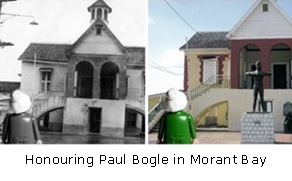
The Morant Bay Rebellion (11 October 1865) began with a protest march to thecourthouse by hundreds of people led bypreacher Paul Bogle in Morant Bay, Jamaica.
Some were armed with sticks and stones. After seven men were shot and killed by the volunteer militia, the protesters attacked and burned the courthouse and nearby buildings. A total of 25 people died. Over the next two days, poor freedmen, many ex-slaves, rose in rebellion across most of St. Thomas-in-the-East parish.
The Jamaicans were protesting injustice and widespread poverty. Most freedmen were prevented from voting by high poll taxes, and their living conditions had worsened following crop damage by floods, cholera and smallpox epidemics, and a long drought. A few days before the march, when police tried to arrest a man for disrupting a trial, a fight broke out against them by spectators. Officials then issued a warrant for the arrest of preacher Bogle, who had called for reforms, and was charged with inciting to riot.
Governor Edward John Eyre declared martial law in the area, ordering in troops to hunt down the rebels. They killed many innocent black individuals, including women and children, with an initial death toll of more than 400. Troops arrested more than 300 persons, including Bogle. Many of these were also innocent, but were quickly tried and executed under martial law; both men and women were punished by whipping and long sentences.
This was the most severe suppression of unrest in the history of the British West Indies.
The governor had George William Gordon, a mixed-race representative of the parish in the House of Assembly, arrested in Kingston and brought back to Morant Bay, where he tried the politician under martial law. Gordon was quicklyconvicted and executed.
The violent suppression and numerous executions generated a fierce debate in England, with some protesting about the unconstitutional actions of the governor John Eyre, and others praising him for his response to a crisis. The rebellion and its suppression remain controversial, and it is frequently debated by specialists in black and colonial studies.
Slavery in Jamaica was abolished on 1 August 1834 with the passage of the Slavery Abolition Act.
The act also stipulated that all formerly enslaved persons in Jamaica over the age of six would work as apprentices for a period of four to six years for their former enslavers, though British abolitionists protested against the apprenticeship system, and it was fully abolished by 1 August 1838.
This date marked the start of Jamaicans formerly in the apprenticeship system being allowed to choose their employer and profession; though they also gained the right to vote, most Jamaicans could not afford to pay the poll tax required to participate in Jamaica's political system. The poll tax was introduced by the colonial government to disfranchise the majority of emancipated Jamaicans, being fearful of causing an anti-colonial uprising (such as the Haitian Revolution) if they granted too much political power.
A few days later on 11 October, Paul Bogle with hundreds of Jamaican peasant-labourers,
again marched to Morant Bay. The marchers had taken oaths, to cleave
to the black and leave the white, a sign that they were preparing for
insurrection, or so Gad Heuman argues, indicating that oath taking in
African tradition was a way to bring the group together and prepare for
war.
When
the group arrived at the courthouse in Morant Bay, they were met by
local officials and a small and inexperienced volunteer militia,
gathered from personnel from the plantations. The crowd began pelting
the militia with rocks and sticks, and the militia opened fire on the
protesters. This angered the crowd, who reacted violently, burning the
courthouse and nearby buildings.
More than 25 people were killed on both
sides, before the militia retreated. For the next two days, the mass of
rebellious black peasants took over the parish of St.
Thomas-in-the-East.
In response, Governor John Eyre sent government troops, under Brigadier-General Alexander Nelson, to hunt down the poorly armed rebels and bring Bogle back to Morant Bay for trial. The troops met with no organized resistance, but they killed blacks indiscriminately, most of whom had not been involved in either the riot at the courthouse or the later rebellion. Heuman has described it as a reign of terror.
The Jamaican Maroons of Moore Town, under the command of former Charles Town superintendent Alexander Fyfe, committed a number of atrocities and extrajudicial murders before they captured and arrested Bogle, and delivered him to the colonial authorities.
Believing that the blacks could not have planned such events themselves, as he shared the widespread white assumption of the time that they were not capable of it, Governor John Eyre had representative George William Gordon arrested. The mixed-race Jamaican businessman and politician was wealthy and well-known; he was openly critical of the governor and his policies. Eyre believed that Gordon had been behind the rebellion. Despite having very little to do with it, Gordon was quickly convicted and executed. Though he was arrested in Kingston, where martial law had not been declared, Eyre had him transferred to Morant Bay, where he could be tried under martial law.
The trial and execution of Gordon via martial law, following the excessesof suppressing the rebellion, added to the outrage felt by many in Britain.
They felt there were serious constitutional issues by Eyre's bringing Gordon under martial law. They were concerned about whether British dependencies should be ruled under the government of law, or through military licence. With a speedy trial, Gordon was convicted quickly and hanged on 23 October, just two days after his trial had begun.
On 25 October, Paul Bogle was hanged alongside 14 others, including his brother Moses.
Other punishments included flogging of more than 600 men and women, including some pregnant women, and long prison sentences.
The soldiers burned thousands of homes belonging to black Jamaicans without any justifiable reason, leaving families homeless throughout the parish. This was the most severe suppression of unrest in the history of the British WestIndies, exceeding incidents during slavery years.
Eyre was replaced as governor by John Peter Grant who arrived in August 1866.
Since the 1830s free people of colour, like Gordon, Edward Jordon, and Robert Osborn, had been elected to the Jamaican House of Assembly in increasing numbers, and that alarmed the colonial authorities. In the wake of the MorantBay Rebellion, Eyre, with the support of the Colonial Office, persuaded the Assembly to renounce its charter, thus ending two centuries of elected representation in the Colony of Jamaica.
White planters were appointed by the governor. However, this move deprived the black majority of a voice in the colony's government, and it was condemned by Jordon and Osborn.
Jamaica became a Crown Colony, under direct rule from London.
In 1969, Paul Bogle and George William Gordon were among several men who were named as Jamaican National Heroes, the highest honour in the nation.
Jamaica is more than just the 'brand' the world recognizes so well; it's a place of pride for the people who live here, its educational institutions, its sports achievements, its science and technology growth.
In Hogwarts today, TheStones and The Grandma have been talking about slavery and freedom in the wizard's world with two nice elfs, Dobby and Kreacher,treated as slaves by their masters.
Slavery is any system in which principles of property law are applied to people, allowing individuals to own, buy and sell other individuals, as a de jure form of property. A slave is unable to withdraw unilaterally from such an arrangement and works without remuneration.
Slavery existed in many cultures, dating back to early human civilizations. A person could become enslaved from the time of their birth, capture, or purchase.
Slavery was legal in most societies at some time in the past but is now outlawed in all recognized countries. The last country to officially abolish slavery wasMauritania in 1981. Nevertheless, there are an estimated 40.3 million people worldwide subject to some form of modern slavery.
The most common form of modern slave trade is commonly referred to as human trafficking. In other areas, slavery continues through practices such as debt bondage, the most widespread form of slavery today; serfdom; domestic servants kept in captivity; certain adoptions in which children are forced to work as slaves; child soldiers; and forced marriage.
The word slave is derived from the ethnonym, ethnic name Slav. It arrived in English via the Old French sclave. In Medieval Latin the word was sclavus; in Byzantine Greek σκλάβος. At a very early medieval date, when Christian government in most of Europe had collapsed, trading expeditions to eastern Europe brought back Slavs as slaves. An older interpretation connected it to the Greek verb skyleúo to strip a slain enemy.
The Grandma wants to add another kind of situation that she considers slavery. It is economic slavery that is produced when you are a victim of the economic social rules nowadays. This social pyramid that has not changed since the origins of humanity and this economic system that allows that, every time, rich people have more and poor people have less creating a big hole between one social range and the other and destroying the middle-class, the real motor of any society.
Before talking about Dobby and Kreacher, The Grandma wants to offer a new Cambridge Key EnglishTest A2 to practice and study.
Dobby is a male house-elf who served the Malfoy family. His masters were Dark Wizards who treated him cruelly. He disobeyed his masters and tried to warn Harry Potter of the plot to have the Chamber of Secrets reopened. He came to know this via the contact between his masters and Lord Voldemort.
At the end of that school year, after Harry had vanquished the memory of Tom Riddle and slayed the basilisk in the Chamber of Secrets, he tricked LuciusMalfoy into freeing Dobby. Harry accomplished this by placing the Diary of Tom Riddle inside his own sock. Lucius disgustedly ripped the sock off the book and threw the sock into the air, where Dobby caught it.
Harry's only request in return for granting Dobby freedom was for Dobby never to try to save his life again.
Dobby suffered a period
of unemployment, during which he was often ostracised for having no proper shame in regards to being out of work. He was generally pleased
to be free, although he did enjoy working as a hobby.
Dobby was ecstatic to be
out of the abusive hands of the Malfoys, but equally pleased to join
the Hogwarts staff. At Hogwarts he could come and go as he liked, did
not have many tasks, and those he did have were fairly simple.
Dobby
Dobby was the resident house-elf of MalfoyManor, serving Lucius Malfoy,his wife Narcissa, and their only son Draco. They treated Dobby with unkindness and cruelty, often reminding him to perform extra punishments on himself when he did something disagreeable to them. The Malfoys were harsh and abused Dobby often.
Dobby was threatened many times during his time serving the Malfoy family and told HarryPotter that he was accustomed to death threats, because he received them five times a day from the Malfoys. Though he always did as he was told, he knew that their behaviour was wrong and he longed to be free of them.
Dobby is a house-elf, much shorter in stature than humans, standing only about 1.06 m. He had large, tennis-ball-like green eyes, a pencil-like nose and long, bat-like pointed ears.
Before he was given
freedom, he wore a body-covering pillowcase. Later at Hogwarts, he wore a
mismatched variety of jumpers, shorts, and socks.
Dobby is a brave, loyal house-elf, willing to put himself in dangerous situations when he knew it to be the right thing to do. He was also very loyal to the few friends he had. He considered himself to be a good house-elf, though other house-elves seemed to find his desires and proclamations of being a free house-elf to be shameful.
According to the Oxford English Dictionary, a dobby is an old English word for a benevolent elf that would perform household tasks secretly in the night, like the elves in tales of the elves and the shoemaker. However, just as those elves disappeared when the shoemaker made them shoes, so the dobbies were said to disappear when offered clothing. Also called a Brownie. A dobby is also a small mechanical part in a loom that enables the weaver to create small geometric patterns.
Kreacher was a male house-elf who served the House of Black with fanatical loyalty for most of his life, until he was left to Harry Potter upon the death of Sirius Black.
He was particularly fond of his mistressWalburga Black but whose portrait still shrieked orders from the wall in the front hall of the Black house. After Mrs Black's death, Kreacher let the home fall into disarray, doing little, if any, cleaning.
He was also fiercely loyal to Regulus Black, and later to Harry Potter whom he fought for in the Battle of Hogwarts alongside many other house-elves. Kreacher survived the final battle of the Second Wizarding War; it is unknown what happened to him later in life, though he died at some point after Albus Potter went to Hogwarts.
When Lord Voldemort told Regulus Black that he needed a house-elf, Regulus
volunteered Kreacher, saying it would be an honour to serve the Dark
Lord.
Voldemort took Kreacher to the Crystal Cave and forced him to
drink the potion in the basin so that Voldemort could place Salazar
Slytherin's Locket in the basin.
Kreacher
The potion, the same one Dumbledore drank, caused Kreacher to have nightmarish delusions, intense stomach pains and made him dehydrated.
Voldemort then left, leaving Kreacher to drink from the lake, as any water conjured evaporates, and die at the hands of the Inferi. However, Voldemort, in his arrogance, had never cared to learn that House Elves can apparate out of locations that Wizards and Witches cannot, so Kreacher, using his own special type of magic and not contained by the enchantments on the cave, was able to disapparate from the cave and follow his master's orders, to come home when he finished his task.
Kreacher is considered somewhat of a liability by the Order of the Phoenix, who used the Blacks' house as headquarters; as a house-elf, Kreacher overheard sensitive information, but was forbidden to disclose it.
Like all house elves, Kreacher was considerably smaller than a human. He was described as having a bulbous, snout-like nose, bloodshot eyes, many folds of skin, and white hair growing out of his bat-like ears. Dobby also knocked out half of his teeth with a punch in 1997, and it is unclear as to whether he had them magically grown back.
Kreacher was very loyal to all the members of the Black family except SiriusBlack, whom he hated because he treated Kreacher poorly. He had a strong bond with Sirius' brother, Regulus Black and was devastated by his death.
Kreacher was usually hostile, bitter and miserable and had a habit of insulting people, including his masters. He frequently called Hermione Granger a Mudblood. He hated taking orders from those he hated, often giving them a dirty look or a biting remark.
Kreacher's name is most likely derived from the word creature. Reminiscent of the German Kriecher derived from kriechen, meaning to creep, crawl, cringe, grovel, tuckle, or fawn upon."
Today, The Grandma has received the visit of her closer friend Nuria. Nuria is from Tenerife, CanaryIslands.
They have been talking about their lives and their future projects and Nuria has been explained to TheGrandma an interesting story about Sicutdudum, a papal bull promulgated by PopeEugene IV on a day like today in 1435, which forbade the enslavement of Guanches, the local natives in the Canary Islands who had converted or were converting to Christianity.
Canary Islands have an amazing an exciting history that must be explained and remembered. Their native people, Guanches, suffered all kind of repression -including genocide- by the Spanish colonizers who wanted to submit these peoples to the Spanish culture and religion.
Sicut dudum, in English Just as Long Ago, is a papal bull promulgated by Pope Eugene IV in Florence on January 13, 1435, which forbade the enslavement of local natives in the Canary Islands who had converted or were converting to Christianity.
Sicut dudum was meant to reinforce Creator Omnium, issued the previous year, condemning Portuguese slave raids in the Canary Islands. Over forty years after Creator omnium and Sicut dudum, Pope Sixtus IV found it necessary to repeat the prohibition in his papal bull Regimini gregis, which threatened the excommunication of all captains or pirates who enslaved Christians.
Christianity had gained many converts in the Canary Islands by the early 1430s. The ownership of the lands had been the subject of dispute between Portugal and the Kingdom of Castille. The lack of effective control had resulted in periodic raids on the islands to procure slaves.
Acting on a complaint by Fernando Calvetos, bishop of the islands, PopeEugene IV issued a papal bull, Creator omnium, on 17 December 1434, annulling previous permission granted to Portugal to conquer those islands still pagan. Eugene excommunicated anyone who enslaved newly converted Christians, the penalty to stand until the captives were restored to their liberty and possessions.
Slave raids continued in the islands during 1435 and Eugene issued a further edict (Sicut dudum) that affirmed the ban on enslavement, and ordered, under pain of excommunication, that all such slaves be immediately set free:
We order and command all and each of the faithful of each sex, within the space of fifteen days of the publication of these letters in the place where they live, that they restore to their earlier liberty all and each person of either sex who were once residents of said Canary Islands, and made captives since the time of their capture, and who have been made subject to slavery. These people are to be totally and perpetually free, and are to be let go without the exaction or reception of money.
Eugene went on to say that, If this is not done when the fifteen days have passed, they incur the sentence of excommunication by the act itself, from which they cannot be absolved, except at the point of death, even by the Holy See, or by any Spanish bishop, or by the aforementioned Ferdinand, unless they have first given freedom to these captive persons and restored their goods.
The specific reference to Spanish bishops and Bishop Ferdinand of San Marcial del Rubicón in Lanzarote suggests that the Portuguese were not the only ones engaged in slave raids in the Canaries.
Joel S. Panzer views Sicut dudum as a significant condemnation of slavery, issued sixty years before the Europeans found the New World.
Eugene tempered Sicut dudum with another bull (15 September 1436) due to the complaints made by King Duarte of Portugal, that allowed the Portuguese to conquer any unconverted parts of the Canary Islands. The king suggested that Portugal be authorized to evangelize and civilize the islands, as other less reputable persons were unlikely to heed the pontiff. Political weakness compelled the Renaissance Papacy to adopt an acquiescent and unchallenging position when approached for requests for privileges in favour of these ventures. Without a navy of his own to police the islands, the Pope opted in favor of the Portuguese as the lesser of two evils.
In 1476 Pope Sixtus IV reiterated the concerns expressed in Sicut dudum in his papal bull, Regimini gregis, in which he threatened to excommunicate all captains or pirates who enslaved Christians.
Today, The Grandma and her friends have arrived to Barcelona. They are going to rest some days before starting a new travel. They haven't chosen the place, yet.
The Grandma has spent all day looking for a place for her new Canarian souvenirs and watching all the photos they took in the islands. Visiting Canary Islands has been a wonderful experience that she is going to remember forever.
Jordi Santanyí has invited The Grandma to assist to a conference about Harriet Beecher Stowe, the author of Uncle Tom's Cabin a masterpiece that talks against slavering in the USA that was published on a day like today in 1852.
Before going to the conference, The Grandma has studied a new lesson of her Intermediate Language Practice manual (Grammar 38).
Harriet Elisabeth Beecher Stowe (June 14, 1811-July 1, 1896) was an American abolitionist and author. She came from the Beecher family, a famous religious family, and is best known for her novel Uncle Tom's Cabin (1852), which depicts the harsh conditions for enslaved African Americans. The book reached millions as a novel and play, and became influential in the United States and Great Britain, energizing anti-slavery forces in the American North, while provoking widespread anger in the South. Stowe wrote 30 books, including novels, three travel memoirs, and collections of articles and letters. She was influential for both her writings and her public stances and debates on social issues of the day.
Uncle Tom's Cabin; or, Life Among the Lowly, is an anti-slavery novel.Published in 1852, the novel had a profound effect on attitudes toward African Americans and slavery in the U.S. and is said to have helped lay the groundwork for the Civil War.
Harriet Beecher Stowe
Stowe, a Connecticut-born teacher at the Hartford Female Seminary and an activeabolitionist, featured the character of Uncle Tom, a long-suffering black slave around whom the stories of other characters revolve. The sentimental novel depicts the reality of slavery while also asserting that Christian love can overcome something as destructive as enslavement of fellow human beings.
Uncle Tom's Cabin was the best-selling novel of the 19th century and the second best-selling book of that century,following the Bible. It is credited with helping fuel the abolitionist cause in the 1850s. In the first year after it was published, 300,000 copies of the book were sold in the United States; one million copies in Great Britain.
In 1855, three years after it was published, it was called the most popular novel of our day. The impact attributed to the book is great, reinforced by a story that when Abraham Lincoln met Stowe at the start of the Civil War, Lincoln declared, So this is the little lady who started this great war. The quote is apocryphal; it did not appear in print until 1896, and it has been argued that The long-term durability of Lincoln's greeting as an anecdote in literary studies and Stowe scholarship can perhaps be explained in part by the desire among many contemporary intellectuals ... to affirm the role of literature as an agent of social change.
The book and the plays it inspired helped popularize a number of stereotypes about black people. These include the affectionate, dark-skinned mammy; the pickaninny stereotype of black children; and the Uncle Tom, or dutiful, long-suffering servant faithful to his white master or mistress.
Uncle Tom's Cabin first appeared as a 40-week serial in The National Era, an abolitionist periodical, starting with the June 5, 1851, issue. It was originally intended as a shorter narrative that would run for only a few weeks. Stowe expanded the story significantly, however, and it was instantly popular, such that several protests were sent to the Era office when she missed an issue. Because of the story's popularity, the publisher John P. Jewett contacted Stowe about turning the serial into a book. While Stowe questioned if anyone would read Uncle Tom's Cabin in book form, she eventually consented to the request.
Convinced the book would be popular, Jewett made the unusual decision, for the time, to have six full-page illustrations by Hammatt Billings engraved for the first printing. Published in book form on March 20, 1852, the novel sold 3,000 copies on that day alone, and soon sold out its complete print run. A number of other editions were soon printed, including a deluxe edition in 1853, featuring 117 illustrations by Billings.
In the first year of publication, 300,000 copies of Uncle Tom's Cabin were sold. At that point, however, demand
came to an unexpected halt.... No more copies were produced for many
years, and if, as is claimed, Abraham Lincoln greeted Stowe in 1862 as
'the little woman who wrote the book that made this great war,' the work
had effectively been out of print for many years. Jewett went out
of business, and it was not until Ticknor and Fields put the work back
in print in November 1862 that demand began again to increase.
Uncle Tom's Cabin First Edition, 1853
The book was translated into all major languages, and in the United States it became the second best-selling book after the Bible. A number of the early editions carried an introduction by Rev James Sherman, a Congregational minister in London noted for his abolitionist views. Uncle Tom's Cabin sold equally well in Britain, with the first London edition appearing in May 1852 and selling 200,000 copies.
Uncle Tom's Cabin is dominated by a single theme: the evil and immorality of slavery. While Stowe weaves other subthemes throughout her text, such as the moral authority of motherhood and the redeeming possibilities offered by Christianity, she emphasizes the connections between these and the horrors of slavery.
Stowe sometimes changed the story's voice so she could give a homily on the destructive nature of slavery. One way Stowe showed the evil of slavery was how this peculiar institution forcibly separated families from each other. One of the subthemes presented in the novel is temperance.
Stowe made it somewhat subtle and in some cases she weaved it into events that would also support the dominant theme.
Because Stowe saw motherhood as the ethical and structural model for all of American life and also believed that only women had the moral authority to save the United States from the demon of slavery, another major theme of Uncle Tom's Cabin is the moral power and sanctity of women.
Stowe shows how she believed women could save those around them from even the worst injustices. While later critics have noted that Stowe's female characters are often domestic clichés instead of realistic women, Stowe's novel reaffirmed the importance of women's influence and helped pave the way for the women's rights movement in the following decades.
Uncle Tom's Cabin is written in the sentimental and melodramatic style common to 19th-century sentimental novels and domestic fiction, also called women's fiction. These genres were the most popular novels of Stowe's time and tended to feature female main characters and a writing style which evoked a reader's sympathy and emotion.
Even though Stowe's novel differs from other sentimental novels by focusing on a large theme like slavery and by having a man as the main character, she still set out to elicit certain strong feelings from her readers. The power in this type of writing can be seen in the reaction of contemporary readers.
Georgiana May, a friend of Stowe's, wrote a letter to the author, saying: I was up last night long after one o'clock, reading and finishing Uncle Tom's Cabin. I could not leave it any more than I could have left a dying child."