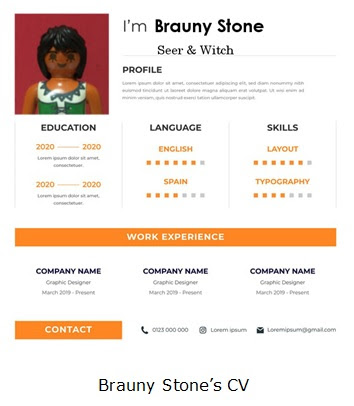
Today, The Fosters and TheGrandma have talked about how to create a modern CV using Canva,one of the most popular software to create and design all kind of brochures, CV and other. They have also talked about the importance of communication skills in an interview.
Canva is a graphic design platform that allows users to create social media graphics, presentations, posters and other visual content.
On average, recruiters spend just 8.8 seconds reading your CV.
This means you have less than a sixth of a minute to sell yourself and
your strengths to the reader. This is easier said than done: three
quarters of CVs are rejected due to bad grammar, spelling and poor
visual layout.
So what makes a successful job application? We asked career experts for their tips. Here is a step-by-step Guardian Jobs guide on how to create the perfect CV.
It's vital your CV is as tailored and concise as possible. One of the simplest mistakes job hunters make is not matching their experience to the new job role. It's essential to look down the list of requirements and show against each points how you can do each one, says Jon Gregory, a job search, application and interview coach.
It's also important to drop the clichés.Words like passionate and phrases like 'I'm excellent at' are overused, says Gregory. Show
your passion rather than say it. Don't use subjective statements like
'I can hit the ground running' instead use objective proof that you have
demonstrated those skills – such as a list of numbers and achievements.
Lis McGuire, founder of Giraffe CVS, agrees you should avoid clichés: The
most important thing to leave off a CV is white noise – essentially
anything that isn't directly relevant to the job role you're applying.
For non-relevant work simply give the bare bones and instead focus on
explaining relevant experience that will win you the role.
In summary, your writing style should be professional, concise and specific to the job you're applying to. Make it as easy as possible for them to scan your CV and tick boxes, advice the experts.
The personal profile is often tricky. How can you strike the perfect professional yet enthusiastic voice? Without a profile your CV is just a list without context, points out McGuire. Use it to show the reader who you are and the value you can bring.
But how exactly can this be done? Your CV profile should strive to provide abalanced complement of skills, achievements, and softer attributes that will engage the reader, advises Debra Wheatman, founder and owner of Careers Done Write. I generally recommend that the summary comprises 4-5 lines with a relevant example to quickly engage the reader.
Your
profile should sum up exactly who you are and whether you're a good fit
for the role, says Gregory. Likewise, Sarah Archer, career coach and
co-founder of CareerTree, says: Make it specific, interesting and
relevant to the job. Highlight the key skills and experiences you have
and the kinds of environments you have worked in.
They are worried about the real situation of working after the global economic
crisis which has affected lives of millions of people severely.
They have
taken information to help other people to find a work. This is the
reason because of they have to find the best, and not the best thing,
about all of them.
Today, The Fosters and TheGrandma have talked about labour insertion. Theyhavesaid goodbye to Hogwarts to returnto London, and study during some days some important things about labour insertion. Unemployment is one of the worst aspects of a community.
Unemployment,
according to the Organisation for Economic Co-operation and Development
(OECD), is persons above a specified age not being in paid employment
or self-employment but currently available for work during the reference
period.
Unemployment can have many sources, such as the following:
-New technologies and inventions
-The status of the economy, which can be influenced by a recession
-Competition caused by globalization and international trade
-Policies of the government
-Regulation and market
The family has been creating personal SWOTs to try to understand themselves better.
SWOT analysis or SWOT matrix is a strategic planning technique used tohelp a person or organization identify strengths, weaknesses, opportunities, and threats related to business competition or projectplanning.
This technique, which operates by peeling back layers of the company
is designed for use in the preliminary stages of decision-making
processes and can be used as a tool for evaluation of the strategic
position of a city or organization. It is intended to specify the
objectives of the business venture or project and identify the internal
and external factors that are favorable and unfavorable to achieving
those objectives.
Users of a SWOT analysis
often ask and answer questions to generate meaningful information for
each category to make the tool useful and identify their competitive
advantage.
SWOT has been described as the tried-and-true tool of strategic analysis, but has also been criticized for its limitations.
SWOT
assumes that strengths and weaknesses are frequently
internally-related, while opportunities and threats commonly focus are
due to the external environment.
The name is an acronym for the four parameters the technique examines:
-Strengths: characteristics of the business or project that give it an advantage over others.
-Weaknesses: characteristics of the business that place the business or project at a disadvantage relative to others.
-Opportunities: elements in the environment that the business or project could exploit to its advantage.
-Threats: elements in the environment that could cause trouble for the business or project.
The
degree to which the internal environment of the firm matches with the
external environment is expressed by the concept of strategic fit.
Identification of SWOTs is important because they can inform later steps in planning to achieve the objective.
First, decision-makers should consider whether the objective is attainable, given the SWOTs. If the objective is not attainable, they must select a different objective and repeat the process.
Some authors credit SWOT
to Albert Humphrey, who led a convention at the Stanford Research
Institute, now SRI International, in the 1960s and 1970s using data from
Fortune 500 companies. However, Humphrey himself did not claim the
creation of SWOT, and the origins remain obscure.
Internal factors are viewed as strengths or weaknesses depending upon their effect on the organization's objectives.
SWOT
What may represent
strengths with respect to one objective may be weaknesses (distractions,
competition) for another objective. The factors may include personnel,
finance, manufacturing capabilities, and all of the marketing mix's 4Ps.
External factors include
macroeconomics, technologicalchange, legislation, andsocioculturalchanges, as well as changes in the marketplace. Results are often
presented in the form of a matrix.
SWOT
analysis is a method of categorization for which lists are compiled,
uncritically and without prioritization, rather than seeking important
factors to achieving objectives; weak opportunities may appear to
balance strong threats.
The SWOT analysis has been used in community work as a tool to identify positive and negative factors
within organizations, communities, and the broader society that promote
or inhibit successful implementation of social services and social
change efforts.
It is used
as a preliminary resource, assessing strengths, weaknesses,
opportunities, and threats in a community served by a nonprofit or
community organization.
Although SWOT analysis is a part of the planning, it will not provide a strategic plan if used by itself, but a SWOT list can becomes a series of recommendations.
-Demographics—changes in the age, race, gender, culture of those you serve or in your area
-The physical environment —is your building in a growing part of town? Is the bus company cutting routes?
-Legislation—do new federal requirements make your job harder...or easier?
-Local, national, or international events
Although the SWOT analysis
was originally designed as an organizational method for business and
industries, it has been replicated in various community work as a tool
for identifying external and internal support to combat internal and
external opposition.
The SWOT analysis
is necessary to provide direction to the next stages of the change
process. It has been used by community organizers and community members
to further social justice in the context of Social Work practice.
Today, TheGrandma has been reading about labour insertion.
Unemployment,according to the Organisation for Economic Co-operation and Development
(OECD), is persons above a specified age not being in paid employment
or self-employment but currently available for work during the reference
period.
Unemployment can have many sources, such as the following:
-New technologies and inventions
-The status of the economy, which can be influenced by a recession
-Competition caused by globalization and international trade
-Policies of the government
-Regulation and market
The family has been creating personal SWOTs to try to understand themselves better.
SWOT analysis or SWOT matrix is a strategic planning technique used tohelp a person or organization identify strengths, weaknesses, opportunities, and threats related to business competition or projectplanning.
This technique, which operates by peeling back layers of the company
is designed for use in the preliminary stages of decision-making
processes and can be used as a tool for evaluation of the strategic
position of a city or organization. It is intended to specify the
objectives of the business venture or project and identify the internal
and external factors that are favorable and unfavorable to achieving
those objectives.
Users of a SWOT analysis
often ask and answer questions to generate meaningful information for
each category to make the tool useful and identify their competitive
advantage.
SWOT has been described as the tried-and-true tool of strategic analysis, but has also been criticized for its limitations.
SWOT
assumes that strengths and weaknesses are frequently
internally-related, while opportunities and threats commonly focus are
due to the external environment.
The name is an acronym for the four parameters the technique examines:
-Strengths: characteristics of the business or project that give it an advantage over others.
-Weaknesses: characteristics of the business that place the business or project at a disadvantage relative to others.
-Opportunities: elements in the environment that the business or project could exploit to its advantage.
-Threats: elements in the environment that could cause trouble for the business or project.
The
degree to which the internal environment of the firm matches with the
external environment is expressed by the concept of strategic fit.
Identification of SWOTs is important because they can inform later steps in planning to achieve the objective.
First, decision-makers should consider whether the objective is attainable, given the SWOTs. If the objective is not attainable, they must select a different objective and repeat the process.
Some authors credit SWOT
to Albert Humphrey, who led a convention at the Stanford Research
Institute, now SRI International, in the 1960s and 1970s using data from
Fortune 500 companies. However, Humphrey himself did not claim the
creation of SWOT, and the origins remain obscure.
Internal factors are viewed as strengths or weaknesses depending upon their effect on the organization's objectives.
What may represent
strengths with respect to one objective may be weaknesses (distractions,
competition) for another objective. The factors may include personnel,
finance, manufacturing capabilities, and all of the marketing mix's 4Ps.
External factors includemacroeconomics, technologicalchange, legislation, andsocioculturalchanges, as well as changes in the marketplace. Results are often
presented in the form of a matrix.
SWOT
analysis is a method of categorization for which lists are compiled,
uncritically and without prioritization, rather than seeking important
factors to achieving objectives; weak opportunities may appear to
balance strong threats.
The SWOT analysis has been used in community work as a tool to identify positive and negative factors
within organizations, communities, and the broader society that promote
or inhibit successful implementation of social services and social
change efforts.
It is used
as a preliminary resource, assessing strengths, weaknesses,
opportunities, and threats in a community served by a nonprofit or
community organization.
Although SWOT analysis is a part of the planning, it will not provide a strategic plan if used by itself, but a SWOT list can becomes a series of recommendations.
-Demographics—changes in the age, race, gender, culture of those you serve or in your area
-The physical environment —is your building in a growing part of town? Is the bus company cutting routes?
-Legislation—do new federal requirements make your job harder...or easier?
-Local, national, or international events
Although the SWOT analysis
was originally designed as an organizational method for business and
industries, it has been replicated in various community work as a tool
for identifying external and internal support to combat internal and
external opposition.
The SWOT analysis
is necessary to provide direction to the next stages of the change
process. It has been used by community organizers and community members
to further social justice in the context of Social Work practice.
The Stones and The Grandma continuesearching Mireia Stone.They start being desperate and they have asked for help to all their friends around the world. Really, they can do nothing except waiting for police's work.
Brauny Stone has communicated to her family that she is not continuing this travel with them. She has decided to search a job in Manchester, a place that she has discovered she loves.
The family is going to lose two members in a few days if the authorities are not able to find their beautiful lovely Mireia.
The family is worried about the real situation of working after the global economic crisis which has affected lives of millions of people severely.
The Grandma has been reading about labour insertion, especially about the importance of the CV, the most important gate to access to a job interview.
A curriculum vitae, Latin for course of life, often shortened as CV or vitais a written overview of someone's life's work (academic formation, publications and qualifications).
Vitae often aim to be a complete record of someone's career, and can be extensive. They are (depending on country) used in the same way as a résumé,which is typically a brief 1–2 page summary of qualifications and work experience for the purposes of employment, and often only presents recent highlights.
In many countries, a résumé is typically the first item that a potential employer encounters regarding the job seeker and is typically used to screen applicants, often followed by an interview.
Vitae may also be requested for applicants to postsecondary programs, scholarships, grants and bursaries. In the 2010s it became popular for applicants to provide an electronic text of their CV to employers using email, an online employment website or using a job-oriented social-networking-service website, such as LinkedIn.
Canva is a graphic design platform that allows users to create social media graphics, presentations, posters and other visual content.
It is available on web and mobile, and integrates millions of images, fonts, templates and illustrations.
Users can choose from many professional designed templates, and edit the designs and upload their own photos through a drag and drop interface. The platform is free to use, and paid subscriptions like Canva Pro and Canva forEnterprise offer additional functionality. Users can also pay for physical products to be printed and shipped.
Today, The Watsons and TheGrandma have finnished their collaboration together. They have been several interesting and amazing weeks working with this wonderful family and TheGrandma is going to miss them a lot.
They have been talking about how to create a modern CV using Canva,one of the most popular software to create and design all kind of brochures, CV, posters and other. They have been also talking about the importance of communication skills in an interview.
The Grandma hope her family has good luck in a closer future and she knows they are going to meet together very soon perhaps in another adventure.
Good luck Watsons (Elisabeth, Neus, Mariana, Judit, Maria, Elisabeth, Yolanda, Raquel and Sònia) and thanks for these unforgettable moments! See you very soon!
Canva is a graphic design platform that allows users to create social media graphics, presentations, posters and other visual content.
It is available on web and mobile, and integrates millions of images, fonts, templates and illustrations.
Users can choose from many professional designed templates, and edit the designs and upload their own photos through a drag and drop interface. The platform is free to use, and paid subscriptions like Canva Pro and Canva forEnterprise offer additional functionality. Users can also pay for physical products to be printed and shipped.
As of 2019, Canva last raised at a $3.2 billion valuation and has over 20 million users across 190 countries.
In June 2020, Canva raised $60 million at a valuation of $6 billion almost doubling its last valuation from 2019.
The company was founded on 1 January 2012 in Sydney, Australia by Melanie Perkins, Cliff Obrecht and Cameron Adams. In its first year, Canva had more than 750,000 users. Social-media and technology expert Guy Kawasaki joined the company as chief evangelist in April 2014.
In 2015, Canva for Work was launched which gave businesses a tool for producing marketing materials.
During the 2016-17 financial year, revenue increased from $AU 6.8m to $AU 23.5m, with losses of $3.3m. In 2017, the company reached profitability and had 294,000 paying customers.
In January 2018, Perkins announced that the company had raised $40 million from Sequoia Capital, Blackbird Ventures, and Felicis Ventures, and it was valued at $1 billion.
In May 2019, Canva experienced a security breach in which data of roughly 139 million users was hacked. The exposed data included real names, usernames, addresses and geographical information, and password hashes for some users.
During May 2019, the company raised another round of funding of $70m from General Catalyst and Bond and its existing investors Blackbird Ventures and Felicis Ventures, valuing Canva at $2.5 billion.
It was reported that Canva, among other Australian businesses, supported employees attending the Global Climate Strikes that took place on September 20 and 27, 2019. The strikes called for the Australian Government to take greater action on climate change and transition to renewable energy.
In October 2019, Canva announced that it raised an additional $85 million at a valuation of $3.2 billion, and launched an enterprise product.
In December 2019, Canva announced Canva for Education, a free product offering for schools and other educational institutions intended to facilitate collaboration between students and teachers.
Canva received praise in January 2020 for releasing a comprehensible privacy policy written in both Legal English and common language, with the intention of abiding by their brand mission of simplicity while making their practices understandable to everyday users.
In June 2020, Canva announced a partnership with FedEx Office. In July it announced a similar partnership with Office Depot. As of the end of June, Canva's valuation had risen to $6 billion.
In 2018, the company acquired presentations startup Zeetings for an undisclosed amount, as part of its expansion into the presentations space.
In May 2019, the company announced acquisitions of Pixabay and Pexels, two free stock photography sites based in Germany. These sites allow individual photographers to share their work for free, and the photos can be used by Canva users in their designs.
Yesterday, The Watsons and TheGrandma were talking about labour insertion.
Unemployment is one of the worst aspects of a community.
Unemployment, according to the Organisation for Economic Co-operation and Development (OECD), is persons above a specified age not being in paid employment or self-employment but currently available for work during the reference period.
Unemployment can have many sources, such as the following:
-New technologies and inventions
-The status of the economy, which can be influenced by a recession
-Competition caused by globalization and international trade
-Policies of the government
-Regulation and market
The family has been creating personal SWOTs to try to understand themselves better.
SWOT analysis or SWOT matrix is a strategic planning technique used tohelp a person or organization identify strengths, weaknesses, opportunities, and threats related to business competition or projectplanning.
This technique, which operates by peeling back layers of the company is designed for use in the preliminary stages of decision-making processes and can be used as a tool for evaluation of the strategic position of a city or organization. It is intended to specify the objectives of the business venture or project and identify the internal and external factors that are favorable and unfavorable to achieving those objectives.
Users of a SWOT analysis often ask and answer questions to generate meaningful information for each category to make the tool useful and identify their competitive advantage.
SWOT has been described as the tried-and-true tool of strategic analysis, but has also been criticized for its limitations.
SWOT assumes that strengths and weaknesses are frequently internally-related, while opportunities and threats commonly focus are due to the external environment.
The name is an acronym for the four parameters the technique examines:
-Strengths: characteristics of the business or project that give it an advantage over others.
-Weaknesses: characteristics of the business that place the business or project at a disadvantage relative to others.
-Opportunities: elements in the environment that the business or project could exploit to its advantage.
-Threats: elements in the environment that could cause trouble for the business or project.
The degree to which the internal environment of the firm matches with the external environment is expressed by the concept of strategic fit. Identification of SWOTs is important because they can inform later steps in planning to achieve the objective.
First, decision-makers should consider whether the objective is attainable, given the SWOTs. If the objective is not attainable, they must select a different objective and repeat the process.
Some authors credit SWOT to Albert Humphrey, who led a convention at the Stanford Research Institute, now SRI International, in the 1960s and 1970s using data from Fortune 500 companies. However, Humphrey himself did not claim the creation of SWOT, and the origins remain obscure.
Internal factors are viewed as strengths or weaknesses depending upon their effect on the organization's objectives.
SWOT
What may represent
strengths with respect to one objective may be weaknesses (distractions,
competition) for another objective. The factors may include personnel,
finance, manufacturing capabilities, and all of the marketing mix's 4Ps.
External factors include
macroeconomics, technologicalchange, legislation, andsocioculturalchanges, as well as changes in the marketplace. Results are often
presented in the form of a matrix.
SWOT analysis is a method of categorization for which lists are compiled, uncritically and without prioritization, rather than seeking important factors to achieving objectives; weak opportunities may appear to balance strong threats.
The SWOT analysis has been used in community work as a tool to identify positive and negative factors within organizations, communities, and the broader society that promote or inhibit successful implementation of social services and social change efforts.
It is used as a preliminary resource, assessing strengths, weaknesses, opportunities, and threats in a community served by a nonprofit or community organization.
Although SWOT analysis is a part of the planning, it will not provide a strategic plan if used by itself, but a SWOT list can becomes a series of recommendations.
-Demographics—changes in the age, race, gender, culture of those you serve or in your area
-The physical environment —is your building in a growing part of town? Is the bus company cutting routes?
-Legislation—do new federal requirements make your job harder...or easier?
-Local, national, or international events
Although the SWOT analysis was originally designed as an organizational method for business and industries, it has been replicated in various community work as a tool for identifying external and internal support to combat internal and external opposition.
The SWOT analysis is necessary to provide direction to the next stages of the change process. It has been used by community organizers and community members to further social justice in the context of Social Work practice.
Today, The Jones are visiting the Kyoto International Manga Museum. They have taken the bullet train, Shinkansen (600 km/h), to travel from Tokyo to Kyoto in two hours and forty minutes.
The Grandma has taken profit of this trip to read something about work environment and labour insertion in Japan...
Many both in and outside Japan share an image of the Japanese work environment that is based on a simultaneous recruiting of new graduates and lifetime-employment model used by large companies as well as a reputation of long work-hours and strong devotion to one's company.
This environment is said to reflect economic conditions beginning in the 1920s, when major corporations competing in the international marketplace began to accrue the same prestige that had traditionally been ascribed to the daimyō–retainer relationship of feudal Japan or government service in the Meiji Restoration.
At the very top, the most prestigious companies would recruit and retain the best workers by offering better benefits and truly lifetime job security.
By the 1960s, employment at a large prestigious company had become the goal of children of the new middle class, the pursuit of which required mobilization of family resources and great individual perseverance in order to achieve success in the fiercely competitive education system.
Employees are expected to work hard and demonstrate loyalty to the firm, in exchange for some degree of job security and benefits, such as housing subsidies, good insurance, the use of recreation facilities, and bonuses and pensions. Wages begin low, but seniority is rewarded, with promotions based on a combination of seniority and ability.
Leadership is not based on assertiveness or quick decision making but on the ability to create consensus, taking into account the needs of subordinates. Surveys indicate continued preference for bosses who are demanding but show concern for workers' private lives over less-demanding bosses interested only in performance on the job.
Executive & Firewoman
This system rewards behavior demonstrating identification with the team effort, indicated by singing the company song, not taking all of one's vacation days, and sharing credit for accomplishments with the work group.
Pride in one's work is expressed through competition with other parallel sections in the company and between one's company and other companies in similar lines of business. Thus, individuals are motivated to maintain harmony and participate in group activities, not only on the job but also in after-hours socializing.
The image of group loyalty, however, may be more a matter of ideology than practice, especially for people who do not make it to the top.
Working conditions vary from firm to firm. On average, employees worked a forty-six-hour week in 1987; employees of most large corporations worked a modified five-day week with two Saturdays a month, while those in most small firms worked as much as six days each week.
Street sweepers
In the face of mounting international criticism of excessive working hours in Japan, in January 1989 public agencies began closing two Saturdays a month.
Labor unionsmade reduced working hours an important part of their demands, and many larger firms responded in a positive manner.
Japanese working hours have been gradually decreasing. In 1986 the average employee worked 2,097 hours in Japan, compared with 1,828 hours in the United States and 1,702 in France. By 1995 the average annual hours in Japan had decreased to 1,884 hours and by 2009 to 1,714 hours. The average Japanese worker is entitled to fifteen days of paid holidays per year but usually takes only seven days.
In recent years, dispatch haken contracts have been gradually becoming more popular among major companies. Coupled with the decreasing size of the Japanese workforce, the average hours worked in a week has been on the rise at many medium to large sized companies.
Officer
In Tokyo, it is common for many employees to work twelve or more hours a day in certain industries, despite contracts claiming an 8-hour work day. At many companies, there is a written-in overtime allowance per month in the contract. Often the first 20–40 hours of overtime are service overtime and therefore unpaid.
Japanese employment protection is unique and dynamic compared to other nations.Loyalty to one's company is paramount in the Japanese culture.
Many Japanese firms only promote from within, as a result individuals may stay with the same company for their entire life.
Pilot
Japanese workers seek to invest and improve their company, while firms attempt to maintain a family atmosphere and look after employees.
Disappointing coworkers, calling in sick, and having a poor attitude are unacceptable.
Firms in Japan do everything in their power to ensure employment security and prevent laying off employees. Firms' attempts at prevention may include negotiating better deals with suppliers, requesting government subsidies, and eliminating overtime.
The relationship between employer and employee promotes employment security, work ethic, and willingness to work long hours.
There is a growing shift in Japanese working conditions, due to both the government intervention as a result of declining birth rates and labor productivity, and companies competing for increasingly scarce numbers of workers due to a drop in the working-age population as a result of low birth rates.
Bricklayers
Many Japanese companies are reducing work hours and improving working conditions, including by providing amenities such as sports facilities and gyms. The Japanese government is pushing through a bill that would make it compulsory for employees to take a minimum of five days leave, and to ensure that high-income employees in certain sectors such as finance be paid according to performance rather than hours worked.
After reading this interesting post, The Grandma has convinced that Europe has a lot of to learn from Japan. Never is too late if you're really interested in improving people's lives.