Today is a wonderful day and TheGrandma has taken her bike to go to the beach to enjoy one of her favourite activities: reading.
Reading poetry is an indescribable pleasure for the soul and, like any reading, if you can read it in the original language, the pleasure is even deeper.
The Grandma has chosen the poems of ArturLundkvist, the Swedish writer, Nobel Prize in Literature, who left us on a day like today thirty-four years ago.
Nils Artur Lundkvist (3 March 1906-11 December 1991) was a Swedish writer, poet and literary critic. He was a member of the Swedish Academy from 1968.
Artur Lundkvist published around 80 books, including poetry, prose poems, essays, short stories, novels and travel books, and his works have been translated into some 30 languages. He is also noted for having translated many works from Spanish and French into Swedish. Several authors whose works he translated were later awarded the Nobel Prize in Literature. He married the poet Maria Wine in 1936.
Artur Lundkvist was born in Perstorp Municipality, Skåne County. As a child he lived on a small farm, first in Hagstad and then in nearby Toarp. From an early age his main interest was reading and he also liked wandering in the surrounding countryside.
At the age of twenty Lundkvist moved to Stockholm determined to become a writer, he studied at a Folk high school and became acquainted with other young people with the same interests. His first books of poems, the anthology Fem unga and introductions of foreign modernist literature quickly established Lundkvist as a leading figure in Modernist Swedish literature in the 1930s.
Lundkvist went on to publish more than 80 books in many genres and was also a prominent critic.
In 1968 he was elected a member of the Swedish Academy, and was a member of the Academy's Nobel committee from 1969 to 1986. He was married to Maria Wine since 1936 and died on 11 December 1991.
Lundkvist published his first book of poems Glöd (Glowing Embers) in 1928 and contributed to the important anthology Fem unga (Five young men) in 1929. He was one of the dominant figures in Swedish literary modernism, the most vigorous promoter of the modernist breakthrough that took place around 1930, and one of the leading poets of the period. His early works was influenced by Scandinavian and American modernists, most notably Carl Sandburg, and later by surrealism.
In the late 1940s his works became increasingly influenced by Spanish language writers like Pablo Neruda and Federico García Lorca, whose poetry he also translated to Swedish. Although he continued to publish books of poetry, including Liv som gräs (Life as grass, 1954) and Ögonblick och vågor (Moments and waves, 1962) which by many is considered to be among his finest works, prose works dominated his writings from the 1950s and onwards. In several books, starting with Malinga (1952) and leading up to late works such as Skrivet mot kvällen (Written towards the evening, 1980), his ambition was to defy genre limitations and merge prose poetry, fictional stories, short essays, personal memoirs and impressions from his many travels around the world into a new form of literature.
Artur Lundkvist was a very productive writer, and also published numerous articles, short stories, collections of literary essays, and books about his travels in South America, India, China, the Soviet Union and Africa. As a literature critic, and also translator, he introduced foreign literature to Swedish readers,including several authors that would subsequently be awarded the Nobel Prize in Literature, such as William Faulkner, T. S. Eliot, Pablo Neruda, Claude Simon, Vicente Aleixandre, Octavio Paz, Gabriel Garcia Marquez and Mario Vargas Llosa. His later work also include several historical novels such as Snapphanens liv och död (1968, about snapphanar), Tvivla, korsfarare! (1972, about crusaders), Krigarens dikt (1976, about Alexander the Great) and Slavar för Särkland (1978, about vikings).
In 1966, his autobiography Självporträtt av en drömmare med öppna ögon (Self portrait of a dreamer with open eyes) was published, and in 1968 he was elected a member of the Swedish academy.
In 1977, he was awarded the prestigious Golden Wreath of the Struga Poetry Evenings festival in Struga, North Macedonia. He died in Solna, StockholmCounty.
Jag har en envis tro på omedelbar suggestion, automatism eller spontanitet, som du önskar, och jag misstror rationalism och efterföljande modifieringar.
I have a stubborn faith in immediate suggestion, automatism or spontaneity, as you wish, and I distrust rationalism and subsequent modifications.
Monday is always a day of introspection and what really helps on days like these is reading poetry.
The Grandma is reading one of her favourite poets, Gunnar Ekelöf,the Swedish author who was born on a day like today in 1907.
Bengt Gunnar Ekelöf (15 September 1907-16 March 1968) was a Swedish poet and writer. He was a member of the Swedish Academy from 1958 and was awarded an honorary doctorate in philosophy by Uppsala University in 1958. He won a number of prizes for his poetry.
Gunnar Ekelöf was born on 15 September 1907 in Stockholm. He has been called Sweden's first surrealist poet. He made his debut with the collection sent på jorden (late on earth) in 1932, written during an extended stay in Paris in 1929-1930, which was too unconventional to become widely appreciated and described by its author as capturing a period of suicidal thoughts and apocalyptic moods.
While not disavowing his debut, Ekelöf moved towards romanticism and received better reviews for his second poetry collection, Dedikation (1934). Both the volumes are influenced by surrealism and show a violent, at times feverish torrent of images, deliberate breakdown of ordered syntax and traditional poetic language and a defiant spirit bordering on anarchism. This defiant externalism was grounded in his person.
Though he came from an upper-class background, Ekelöf had never felt committed to it -his father had been mentally ill and when his mother remarried, Ekelöf strongly disapproved of his stepfather, and by extension of his mother; he had become a loner and a rebel by his teens and would never feel at ease with the mores of the established upper and middle classes or with their inhibitions and what he perceived as their hypocrisy and back-scratching.
Swedish critic Anders Olsson described Ekelöf's turn to poetry as a choice of the only utterance that doesn't expurge the contradictions and empty spaces of language and of the mind.
Färjesång (1941), showed influence from T.S. Eliot, whose poem East Coker Ekelöf had translated to Swedish. It took influence from oriental poetry and the darkness of the ongoing Second World War. Ekelöf himself considered Färjesång as his personal breakthrough and with its simple and effective language it has had an strong influence on later Swedish poetry.
Färjesång was followed by the acclaimed works, the prose book Promenader (1941, Walks), the disillusioned Non Serviam (1945) in which the title poem borrowed from Lucifer's motto I will not serve in Latin, which symbolises a refusal to adapt to the conformity of the welfare society, and Om hösten (1951, Inautumn) which includes the well-known poem Röster under jorden (Underground voices).
In Strountes (1955), from Swedish strunt (nonsense), Ekelöf returned to his attacks on literary conventions, exploring meaninglessness. With his continual wordplay, he demonstrated that meaning can emerge from apparent nonsense. Similar themes were explored in Opus incertum (1959) och En natt i Otočac (1961). The poetry suite En Mölna-elegi. Metamorfoser (1960) features an advanced technique of allusions, in which the protagonist in a short moment experiences a long time sequence.
In April 1958, Ekelöf was elected a member of the Swedish Academy,succeeding author Bertil Malmberg on chair 18 in December the same year.
Ekelöf's last works, Dīwān över Fursten av Emgión (1965, Diwan on the Prince of Emgion), Sagan om Fatumeh (1966, The Tale of Fatumeh) and Vägvisare till underjorden (1967, Guide to the Underworld) was a trilogy with Byzantine theme. The trilogy was inspired by journey to Istanbul and İzmir in 1965 that resulted in an outburst of creativity. In his diary, Ekelöf described the visit as a revelation that would change his life. Dīwān över Fursten av Emgión tells the story of the fictive Prince of Emgión who participated in the Battle of Manzikert, was captured, tortured and blinded, and then jailed in Constantinople for ten years. On his way home, the Prince is accompanied by a mysterious woman, assisting him in his blindness. For this book, Ekelöf was awarded the Nordic Council Literature Prize in 1966.
Ekelöf is remembered as one of the first surrealist poets of Sweden.
He died on 16 March 1968 in Sigtuna. According to his will, his ashes were scattered in the river Pactolus (now the river Sart) in Salihli, Turkey. Ovid records the legend that King Midas divested himself of the golden touch by washing himself in that river.
On the 103rd anniversary of his birth, 40 Swedish poetry enthusiasts gathered in Salihli. Together with the deputy mayor, they honored Ekelöf's legacy in the city, which he had come to admire ardently on a visit in 1965, and had portrayed in several poems. A bust of Ekelöf by Gürdal Duyar was to have been placed there, but this was never done, and it now waits in the garden of the Swedish Embassy in Istanbul.
Något av det viktigaste i all konst: att överlåta en anständig del åt läsaren, betraktaren, den medverkande. Det ska finnas en tom plats vid det dukade bordet. Den är hans.
One of the most important things in all art: to leave a decent part to the reader, the viewer, the participant. There should be an empty place at the set table. It's his.
Today, The Grandma has continued herEnglish classes with The Bishops inCastelldefels.
First, they have been describing surrealistic works created by SalvadorDalí.
Next, they have proposed a plan to survive a crisis of communication.
Finally, they have played Clue, also known as Cluedo,a fantastic board game when you have to question to discover the great mysteries of a murder: who the murderer is, where it happens and what kind of tool the murderer chooses to kill the victim.
Surrealism is a cultural movement that developed in Europe in the aftermath of World War Iin which artists depicted unnerving, illogicalscenes and developed techniques to allow the unconscious mind to express itself.
Its aim was, according to leader André Breton, to resolve the previously contradictory conditions of dream and reality into an absolute reality, a super-reality, or surreality. It produced works of painting, writing, theatre, filmmaking, photography, and other media.
Works of Surrealism feature the element of surprise, unexpected juxtapositions and non sequitur. However, many Surrealist artists and writers regard their work as an expression of the philosophical movement first and foremost (for instance, of the pure psychic automatism Breton speaks of in the first Surrealist Manifesto), with the works themselves being secondary, i.e. artifacts of surrealist experimentation.
Leader Breton was explicit in his assertion that Surrealism was, above all, a revolutionary movement. At the time, the movement was associated with political causes such as communism and anarchism. It was influenced by the Dada movement of the 1910s.
The term Surrealism originated with Guillaume Apollinaire in 1917. However, the Surrealist movement was not officially established until after October 1924, when the Surrealist Manifesto published by French poet and critic AndréBreton succeeded in claiming the term for his group over a rival faction led by Yvan Goll, who had published his own Surrealist manifesto two weeks prior.
The most important center of the movement was Paris, France. From the 1920s onward, the movement spread around the globe, impacting the visual arts, literature, film, and music of many countries and languages, as well as political thought and practice, philosophy, and social theory.
The word surrealism was first coined in March 1917 by Guillaume Apollinaire. He wrote in a letter to Paul Dermée: All things considered, I think in fact it is better to adopt surrealism than supernaturalism, which I first used [Tout bien examiné, je crois en effet qu'il vaut mieux adopter surréalisme que surnaturalisme que j'avais d'abord employé].
Apollinaire used the term in his program notes for Sergei Diaghilev's Ballets Russes, Parade, which premiered 18 May 1917.
The movement in the mid-1920s was characterized by meetings in cafes where the Surrealists played collaborative drawing games, discussed the theories of Surrealism, and developed a variety of techniques such as automatic drawing. Breton initially doubted that visual arts could even be useful in the Surrealist movement since they appeared to be less malleable and open to chance and automatism. This caution was overcome by the discovery of such techniques as frottage, grattage and decalcomania.
Surrealists believe that non-Western cultures also provide a continued source of inspiration for Surrealist activity because some may induce a better balance between instrumental reason and imagination in flight than Western culture.
Surrealism has had an identifiable impact on radical and revolutionary politics, both directly -as in some Surrealists joining or allying themselves with radical political groups, movements and parties- and indirectly -through the way in which Surrealists emphasize the intimate link between freeing imagination and the mind, and liberation from repressive and archaic social structures.
Today, The Grandma has been reading some poetry. She has chosen GuillaumeApollinaire,one of her favourite poets, who was born on a day like today in 1880.
Guillaume Apollinaire (26 August 1880-9 November 1918) was a Frenchpoet, playwright, shortstory writer, novelist, and art critic of Polish-Belarusian descent.
Apollinaire is considered one of the foremost poets of the early 20th century, as well as one of the most impassioned defenders of Cubism and a forefather of Surrealism.
He is credited with coining the term Cubism in 1911 to describe the emerging art movement, the term Orphism in 1912, and the term Surrealism in 1917 to describe the works of Erik Satie. He wrote poems without punctuation attempting to be resolutely modern in both form and subject.
Apollinaire wrote one of the earliest Surrealist literary works, the play TheBreasts of Tiresias (1917), which became the basis for Francis Poulenc's 1947 opera Les mamelles de Tirésias.
Influenced by Symbolist poetry in his youth, he was admired during his lifetime by the young poets who later formed the nucleus of the Surrealist group (Breton, Aragon, Soupault). He revealed very early on an originality that freed him from any school of influence and made him one of the precursors of the literary revolution of the first half of the 20th century.
His art is not based on any theory, but on a simple principle: the act of creating must come from the imagination, from intuition, because it must be as close as possible to life, to nature, to the environment, and to the human being.
Apollinaire was also active as a journalist and art critic for Le Matin, L'Intransigeant, L'Esprit nouveau, Mercure de France, and Paris Journal.
In 1912 Apollinaire cofounded Les Soirées de Paris, an artistic and literary magazine.
Two years after being wounded in World War I, Apollinaire died during the Spanish flu pandemic of 1918 and was recognized as Mort pour la Francebecause of his commitment during the war.
Wilhelm Albert Włodzimierz Apolinary Kostrowicki was born in Rome, Italy,and was raised speaking French, Italian, and Polish. He emigrated to France in his late teens and adopted the name Guillaume Apollinaire.
Apollinaire eventually moved from Rome to Paris in 1900 and became one of the most popular members of the artistic community of Paris, both in Montmartre and Montparnasse. His friends and collaborators in that period included Pablo Picasso, Henri Rousseau, Gertrude Stein, Max Jacob, André Salmon, André Breton, André Derain, Faik Konitza, Blaise Cendrars, Giuseppe Ungaretti, Pierre Reverdy, Alexandra Exter, Jean Cocteau, Erik Satie, Ossip Zadkine, Marc Chagall, Marcel Duchamp and Jean Metzinger. He became romantically involved with Marie Laurencin, who is often identified as his muse. While there, he dabbled in anarchism and spoke out as a Dreyfusard in defense of Dreyfus's innocence.
Metzinger painted the first Cubist portrait of Apollinaire. In his Vie anecdotique (16 October 1911), the poet proudly writes: I am honoured to be the first model of a Cubist painter, Jean Metzinger, for a portrait exhibited in 1910 at the Salon des Indépendants. It was not only the first Cubist portrait, according to Apollinaire, but it was also the first great portrait of the poet exhibited in public, prior to others by Louis Marcoussis, Amedeo Modigliani, Mikhail Larionov and Picasso.
In 1911 he joined the Puteaux Group, a branch of the Cubist movement soon to be known as the Section d'Or. The opening address of the 1912 Salon de la Section d'Or -the most important pre-World War I Cubist exhibition- was given by Apollinaire.
On 7 September 1911, police arrested and jailed him on suspicion of aiding and abetting the theft of the Mona Lisa and a number of Egyptian statuettes from the Louvre, but released him a week later.
The theft of the statues had been committed in 1907 by a former secretary of Apollinaire, Honoré Joseph Géry Pieret, who had recently returned one of the stolen statues to the French newspaper the Paris-Journal.
Apollinaire implicated his friend Picasso, who had bought Iberian statues from Pieret, and who was also brought in for questioning in the theft of the Mona Lisa,but he was also exonerated.
The theft of the Mona Lisa was perpetrated by Vincenzo Peruggia, an Italian house painter who acted alone and was only caught two years later when he tried to sell the painting in Florence.
Apollinaire wrote the preface for the first Cubist exposition outside of Paris; VIII Salon des Indépendants, Brussels, 1911. In an open-handed preface to the catalogue of the Brussels Indépendants show, Apollinaire stated that these new painters accepted the name of Cubists which has been given to them. He described Cubism as a manifestation nouvelle et très élevée de l'art, non-point un système contraignant les talents, and the differences which characterize not only the talents but even the styles of these artists are an obvious proof of this.
The artists involved with this new movement, according to Apollinaire, included Pablo Picasso, Georges Braque, Jean Metzinger, Albert Gleizes, Robert Delaunay,Fernand Léger, and Henri Le Fauconnier.
By 1912 others had joined the Cubists: Jacques Villon, Marcel Duchamp, Raymond Duchamp-Villon, Francis Picabia, Juan Gris, and Roger de La Fresnaye, among them.
The term Surrealism was first used by Apollinaire concerning the ballet Parade in 1917. The poet Arthur Rimbaud wanted to be a visionary, to perceive the hidden side of things within the realm of another reality. In continuity with Rimbaud, Apollinaire went in search of a hidden and mysterious reality. The term surrealism appeared for the first time in March 1917 (Chronologie de Dada et du surréalisme, 1917) in a letter by Apollinaire to Paul Dermée: Tout bien examiné, je crois en effet qu'il vaut mieux adopter surréalisme que surnaturalisme que j'avais d'abord employé.
He described Parade as une sorte de surréalisme when he wrote the program note the following week, thus coining the word three years before Surrealism emerged as an art movement in Paris.
Apollinaire served as an infantry officer in World War I and, in 1916, received a serious shrapnel wound to the temple, from which he would never fully recover. He wrote Les Mamelles de Tirésias while recovering from this wound. During this period he coined the word Surrealism in the programme notes for Jean Cocteau's and Erik Satie's ballet Parade, first performed on 18 May 1917. He also published an artistic manifesto, L'Esprit nouveau et les poètes.
Apollinaire's status as a literary critic is most famous and influential in his recognition of the Marquis de Sade, whose works were for a long time obscure, yet arising in popularity as an influence upon the Dadaand Surrealist art movements going on in Montparnasse at the beginning of the twentieth century as, The freest spirit that ever existed.
The war-weakened Apollinaire died at the age of 38 on 9 November 1918 of influenza during the Spanish flu pandemic of 1918 ravaging Europe at the time, two years after being wounded in World War I.
Due to his military service for the duration of the war, he was declared Mort pour la France by the French government. He was interred in the Père Lachaise Cemetery, Paris.
In 1900 he wrote his first novel Mirely, ou le petit trou pas cher (pornographic), which was eventually lost.
Apollinaire's first collection of poetry was L'enchanteur pourrissant (1909), but Alcools (1913) established his reputation. The poems, influenced in part by the Symbolists, juxtapose the old and the new, combining traditional poetic forms with modern imagery.
In 1913, Apollinaire published the essay Les Peintres Cubistes, Méditations Esthétiques on the Cubist painters, a movement which he helped to define. He also coined the term orphism to describe a tendency towards absolute abstraction in the paintings of Robert Delaunay and others.
In 1907, Apollinaire published the well-known erotic novel, Les Onze Mille Verges. Officially banned in France until 1970, various printings of it circulated widely for many years.
Apollinaire never publicly acknowledged authorship of the novel. Another erotic novel attributed to him was Les exploits d'un jeune Don Juan, in which the 15-year-old hero fathers three children with various members of his entourage, including his aunt.
Apollinaire's gift to Picasso of the original 1907 manuscript was one of the artist's most prized possessions. The book was made into a movie in 1987.
Shortly after his death, Mercure de France published Calligrammes, a collection of his concrete poetry (poetry in which typography and layout adds to the overall effect), and more orthodox, though still modernist poems informed by Apollinaire's experiences in the First World War and in which he often used the technique of automatic writing.
In his youth Apollinaire lived for a short while in Belgium, mastering the Walloon dialect sufficiently to write poetry, some of which has survived.
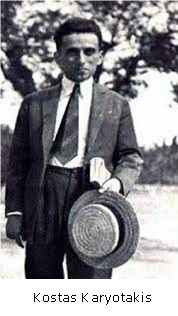
Today, The Grandma has gone to the library to search more information aboutKostas Karyotakis, the Greek poet who was born on a day like today in 1896.
Kostas Karyotakis, in Greek: ΚώσταςΚαρυωτάκης,(30 October 1896-20 July 1928) is considered one of the most representative Greek poets of the 1920s and one of the first poets to use iconoclastic themes in Greece.
His poetry conveys a great deal of nature, imagery and traces of expressionism and surrealism. He also belongs to the Greek Lost Generation movement.
The majority of Karyotakis' contemporaries viewed him in a dim light throughout his lifetime without a pragmatic accountability for their contemptuous views; for after his suicide, the majority began to revert to the view that he was indeed a great poet. He had a significant, almost disproportionately, progressive influence on later Greek poets.
Karyotakis gave existential depth as well as a tragic dimension to the emotional nuances and melancholic tones of the neo-Symbolist and new-Romantic poetry of the time.
With a rare clarity of spirit and penetrating vision, he captures and conveys with poetic daring the climate of dissolution and the impasses of his generation, as well as the traumas of his own inner spiritual world.
Karyotakis was born in Tripoli, Greece, his father's occupation as a county engineer resulted in his early childhood and teenage years being spent in various places, following his family's successive moves around the Greek cities, including Argostoli, Lefkada, Larisa, Kalamata, Athens and Chania. He started publishing poetry in various magazines for children in 1912. It is solely rife speculation that he had felt deeply betrayed that a girl he had cared for in Hania in 1913 had married and sent him into melancholy.
After receiving his degree from the Athens School of Law and Political Sciences, in 1917, he did not pursue a career as a lawyer. Karyotakis became a clerk in the Prefecture of Thessaloniki. However, he greatly disliked his work and could not tolerate the bureaucracy of the state, which he wrote about often in his poems. His prose piece Catharsis is characteristic of this. For this reason he would often be removed from his posts and transferred to other locations in Greece. During these removals he became familiar with the boredom and misery of the country during World War I.
In February 1919, he published his first collection of poetry: The Pain of People and of Things, in Greek Ὁ πόνος τοῦ ἀνθρώπου καὶ τῶν πραμάτων, which was largely ignored or badly reviewed by the critics. In the same year he published, with his friend Agis Levendis, a satirical review, called The Leg, which, despite its success, was banned by the police after the sixth issue.
In 1921, he published his second collection called Nepenthe, in Greek Νηπενθῆ, and also wrote a musical revue, Pell-Mell, in Greek Πελ-Μελ.
In 1922, he began having an affair with the poet Maria Polydouri who was a colleague of his at the Prefecture of Attica.
In 1923, he wrote a poem called Treponema pallidum, in Greek Ὠχρὰ Σπειροχαίτη, which was published under the title Song of Madness and gave rise to speculation that he may have been suffering from syphilis, which before 1945 was considered a chronic illness with no proven cure for it.
George Skouras, a physician of the poet, wrote: He was sick, he was syphilitic and George Savidis (1929–1999), professor of the Aristotle University of Thessaloniki, who possessed the largest archive about Greek poets, revealed that Karyotakis was syphilitic, and that his brother, Thanasis Karyotakis, thought the disease to be a disgrace to the family.
In 1924, he travelled abroad, visiting Italy and Germany.
In December 1927 he published his last collection of poetry: Elegy and Satires, in Greek Ἐλεγεῖα καὶ Σάτιρες.
In February 1928, Karyotakis was transferred to Patras although soon afterwards he spent a month on leave in Paris and in June 1928 he was sent yet again to Preveza by ship.
Karyotakis lived in Preveza only for 33 days, until his suicide on 21 July 1928 at age 31. His work was in the Prefecture of Preveza, in the Palios mansion, 10 Speliadou street, as a lawyer for control of land donations from the State to refugees from Asia Minor War of 1922.
From Preveza he sent desperate letters to friends and relatives describing the misery he felt in the town. His family offered to support him for an indefinite stay in Paris, but he refused, knowing what a monetary sacrifice like this would entail for them. His angst is felt in the poem Preveza, in Greek Πρέβεζα, which he wrote shortly before his suicide. The poem displays an insistent, lilting anaphora on the word Death, which stands at the beginning of several lines and sentences.
On 19 July 1928, Karyotakis went to Monolithi beach and kept trying to drown in the sea for ten hours, but failed in his attempt, because he was an avid swimmer as he himself wrote in his suicide note. In the subsequent morning he returned home and left again to purchase a revolver and went to a little café in the place Vryssoula, near today Hotel Zikas. After smoking for a few hours, and drink cherry juice, he left 75 drachmas as a gratuity, while the cost of the drink was 5 drachmas, he went to Agios Spyridon, where, under a eucalyptus tree, he shot himself through the heart.
Today, The Grandma has received the wonderful visit of one of her closest friends, Jordi Santanyí.
Jordi and The Grandma love literature, and they have been talking aboutAndréBreton, the French writer and poet leader of surrealism, who was born on a day like yesterday in 1896.
André Robert Breton (18 February 1896-28 September 1966) was a French writer andpoet.
He is known best as the co-founder, leader, principal theorist and chief apologist of surrealism. His writings include the first Manifeste du surréalisme of 1924, in which he defined surrealism as pure psychic automatism. Along with his role as leader of the surrealistmovement he is the author of celebrated books such as Nadja and L'Amour fou.
Those activities combined with his critical and theoretical work for writing and the plastic arts, made AndréBreton a major figure in twentieth-century French art and literature.
André Breton was the only son born to a family of modest means in Tinchebray (Orne) in Normandy, France. His father, Louis-Justin Breton, was a policeman and atheistic, and his mother, Marguerite-Marie-Eugénie Le Gouguès, was a former seamstress. Breton attended medical school, where he developed a particular interest in mental illness. His education was interrupted when he was conscripted for World War I.
During World War I, he worked in a neurological ward in Nantes, where he met the devotee of Alfred Jarry, Jacques Vaché, whose anti-social attitude and disdain for established artistic tradition influenced Breton considerably. Vaché committed suicide when aged 24, and his war-time letters to Breton and others were published in a volume entitled Lettres de guerre (1919), for which Breton wrote four introductory essays.
Breton married his first wife, Simone Kahn, on 15 September 1921. The couple relocated to rue Fontaine No. 42 in Paris on 1 January 1922. The flat on rue Fontaine in the Pigalle district became home to Breton's collection of more than 5,300 items: modern paintings, drawings, sculptures, photographs, books, art catalogs, journals, manuscripts, and works of popular and Oceanic art. Like his father, he was an atheist.
Breton launched the review Littérature in 1919, with Louis Aragon and Philippe Soupault. He also associated with Dadaist Tristan Tzara. In 1924, he was instrumental in the founding of the Bureau of Surrealist Research.
In Les Champs Magnétiques, a
collaboration with Soupault, he implemented the principle of automatic
writing. He published the Surrealist Manifesto in 1924, and was editor
of the magazine La Révolution surréaliste from that year on. A group of
writers became associated with him: Soupault, Louis Aragon, Paul Éluard,
René Crevel, Michel Leiris, Benjamin Péret, Antonin Artaud, and Robert
Desnos.
Anxious to combine the themes of personal transformation found in the works of Arthur Rimbaud with the politics of Karl Marx, Breton joined the French Communist Party in 1927, from which he was expelled in 1933. Nadja, a novel about his encounter with an imaginative woman who later became mentally ill, was published in 1928.
Breton celebrated the concept of Mad Love, and many women joined the surrealist group over the years. Toyen was a good friend. During this time, he survived mostly by the sale of paintings from his art gallery.
However, visiting Mexico provided the opportunity to meet Leon Trotsky. Breton and other surrealists travelled via a long boat ride from Patzcuaro to the town of Erongarícuaro. Diego Rivera and Frida Kahlo were among the visitors to the hidden community of intellectuals and artists. Together, Breton and Trotsky wrote the Manifesto for an Independent Revolutionary Art, published under the names of Breton and Diego Rivera, calling for complete freedom of art, which was becoming increasingly difficult with the world situation of the time.
Breton was again in the medical corps of the French Army at the start of World War II. The Vichy government banned his writings as the very negation of the national revolution and Breton escaped, with the help of the American Varian Fry and Hiram Harry Bingham IV, to the United States and the Caribbean during 1941. He emigrated to New York City and lived there for a few years. In 1942, Breton organized a groundbreaking surrealist exhibition at Yale University.
Breton returned to Paris in 1946, where he opposed French colonialism (for example as a signatory of the Manifesto of the 121 against the Algerian War) and continued, until his death, to foster a second group of surrealists in the form of expositions or reviews (La Brèche, 1961–65). In 1959, he organized an exhibit in Paris.
By the end of World War II, André Breton decided to embrace anarchism explicitly.
In 1952, Breton wrote It was in the black mirror of anarchism that surrealism first recognized itself. Breton consistently supported the francophone Anarchist Federation, and he continued to offer his solidarity after the Platformists around founder and Secretary General Georges Fontenis transformed the FA into the Fédération communiste libertaire.
André Breton died at the age of 70 in 1966, and was buried in the Cimetière des Batignolles in Paris.
Today, The Grandma has received the wonderful visit of one of her closest friends, Tina Picotes. Tina loves Art in general and painting particularly, and they have been talking about Antoni Tàpies, the Catalan painter and sculptor, considered one of the great genius of art, who dies on a day like today in 2012.
Antoni Tàpies i Puig (13 December 1923-6 February 2012) was a Catalan painter, sculptor and art theorist, who became one of the most famousEuropean artists of his generation.
The son of Josep Tàpies i Mestre and Maria Puig i Guerra, Antoni Tàpies Puig was born in Barcelona on 13 December 1923. His father was a lawyer and Catalan nationalist who served briefly with the Republican government. Due to this, Tàpies grew up in an environment where he was very much exposed to a cultural and social experiences of leaders in the Catalan public life and its republicanism. His maternal grandmother also exposed him to this world with her great involvement in civil and political activities.
Tàpies was first introduced to contemporary art as he entered secondary school in 1934. He saw a famous Christmas issue of the magazine, D'Ací i d'Allà, which contained reproductions of works by artists such as Duchamp, Braque, Kandinsky, and Picasso.
At 17, Tàpies suffered a near-fatal heart attack caused by tuberculosis. He spent two years as a convalescent in the mountains, reading widely and pursuing an interest in art that had already expressed itself when he was in his early teens.
Tàpies studied at the German School of Barcelona. After studying law for 3 years, he devoted himself from 1943 onwards only to his painting.
In 1945, Tàpies began experimenting with more rinse materials. He would mix oil paint with whiting. At this time he also became increasingly interested in philosophy, especially that of Sartre as well as Eastern thought. He became known as one of the most renowned artists in the second half of the 20th century. His abstract and avant-garde works were displayed in many major museums all over the world.
In 1954, Tàpies married Teresa Barba Fàbregas. Together they had three children Antoni, Miguel and Clara.
He lived mainly in Barcelona and was represented by the Galerie Lelong in Paris and the Pace Gallery in New York. Tàpies died on 6 February 2012. His health had been suffering since 2007.
Tàpies was perhaps the best-known Catalan artist to emerge in the period since the Second World War.
He first came into contact with contemporary art as a teenager through the magazine D'Ací i D'Allà, published in Barcelona, and during the Spanish Civil War (1936–39), while he was still at school, he taught himself to draw and paint.
On a French government scholarship in the early 1950s he lived in Paris, to which
he often returned. Both in Europe and beyond, the highly influential
French critic and curator Michel Tapié enthusiastically promoted the
work of Antoni Tàpies.
In
1948, Tàpies helped co-found the Post-War Movement nown
as Dau al Set which was connected to the Surrealist and Dadaist
Movements. The main leader and founder of Dau al Set was the poet Joan
Brossa. The movement also had a publication of the same name, Dau al
Set.
Tàpies started as a surrealist painter, his early works were influenced by Paul Klee and Joan Miró; but soon become an informal artist, working in a style known as pintura matèrica, in which non-artistic materials are incorporated into the paintings.
In 1953, he began working in mixed media; this is considered his most original contribution to art. One of the first to create serious art in this way, he added clay and marble dust to his paint and used waste paper, string, and rags. Canvas Burned to Matter from c. 1960, in the collection of the Honolulu Museum of Art, is an example of the artist's mixed media assemblages that combine the principles of Dada and Surrealism.
Tàpies' international reputation was well established by the end of the 1950s. From the late 1950s to early 1960s, Tàpies worked with Enrique Tábara, Antonio Saura, Manolo Millares and many other Informalist artists.
In
1966, he was arrested at a clandestine assembly at the University of
Barcelona; his work of the early 1970s is marked by symbols of Catalan
identity, which was anathema to Franco.
In
1974, he made a series of lithographs called Assassins and displayed
them in the Galerie Maeght in Paris, in honour of regime critic Salvador
Puig Antich'smemory. From about 1970, influenced by Pop art, he began
incorporating more substantial objects into his paintings, such as parts
of furniture.
Tàpies's ideas have had worldwide influence on art,
especially in the realms of painting, sculpture, etchings and
lithography. Examples of his work are found in numerous major
international collections. His work is associated with both Tachisme and
Abstract Expressionism.
The
paintings produced by Tàpies, later in the 1970s and in the 1980s,
reveal his application of this aesthetic of meditative emptiness, for
example in spray-painted canvases with linear elements suggestive of
Oriental calligraphy, in mixed-media paintings that extended the
vocabulary of Art informel, and in his oblique allusions to imagery
within a fundamentally abstract idiom, as in Imprint of a Basket on
Cloth (1980). Among the artists' work linked in style to that of Tàpies
is that of the American painter Julian Schnabel as both have been
connected to the art term Matter.
From
1947 Tàpies also produced graphic work. He produced collector’s books
and dossiers in association with poets and writers such as Alberti,
Bonnefoy, Du Bouchet, Brodsky, Brossa, Daive, Dupin, Foix, Frémon,
Gimferrer, Guillén, Jabès, Mestres Quadreny, Mitscherlich, Paz,
Saramago, Takiguchi, Ullán, Valente and Zambrano.
Tàpies has written essays which have been collected in a series of publications, some translated into different languages: La pràctica de l’art (1970), L'art contra l'estètica, (1974), Memòria personal (1978), La realitat com a art (1982), Per un art modern i progressista (1985), Valor de l’art (1993) and L'art i els seus llocs (1999). These works include Tàpies reflecting on things such as art, life, and politics. He also discusses the social role of art and the artist, reflects on the influences of his work, and explains his artistic as well as political views.
Throughout the span of his life Antoni Tàpies has been associated with a number of movements such as Art Informel and Haute Pâte or Matter Painting. He became a part of the avant-garde group Dau al Set in 1948 which was a group that had strong ties to Surrealism. Early works of his were surrealistic, but in 1953 he began working in abstract art. It is here that he becomes a part of the Art Informel movement and starts working with mixed media.
Art Informel in Europe was the equivalent to Abstract Expressionism in America. This was among the most prevalent styles of art in post-war Europe. Within this movement is the category of Matter Painting. Its focus on the use of odd objects completely undermines the acts of traditional fine art.
Some of Tàpies's most famous and original works fall within this genre. They are characterized by his use of marble dust and clay that he mixed with his paints as well as the incorporation of found objects such as string, paper, and cloth. In the late 1960s into the early 1970s Tàpies began to be influenced by the movement of Pop Art. Because of this he began using larger items, such as pieces of furniture, in his works.
Al nostre món, en què les imatges religioses perden sentit, en què els nostres costums són cada vegada més laics, perdem el sentit de l’etern. Crec que és una pèrdua que ha fet molt de mal a l’art modern. La pintura és un retorn als orígens.
In our world, in which religious images are losing their meaning, in which our customs are getting more and more secular, we are losing our sense of the eternal. I think it's a loss that has done a great deal of damage to modern art. Painting is a return to origins.
.jpg)

.jpg)
.jpg)
.jpg)