Showing posts with label Raquel Watson. Show all posts

Saturday, 28 November 2020

CAMBRIDGE EXAM, THE STONES MEET THE WATSONS

Today has been an exciting day. The Stones and The Watsons have meet with The Grandma in Hospitalet de Llobregat.

After travelling around the world in an unforgettable trip, The Stones have joined The Watsons and have gone together to do their A2 Cambridge Exam. It has been a wonderful experience.

The Grandma has said goodbye to another beloved family and she returns to her home hoping that she could find another one to continue travelling, learning and sharing unforgettable moments.

Thanks to The Stones and thanks to The Watsons for trusting in this project and for being part of it. Remember that you are eternal because myths and dreams never die.

More information: If I Can Dream

Cambridge Assessment English, or Cambridge English, is the biggest of three main exam boards forming Cambridge Assessment, a non-teaching department of the University of Cambridge.

The organisation contributed to the development of the Common European Framework of Reference for Languages (CEFR), the standard used around the world to benchmark language skills. Its qualifications and tests are aligned with the levels of the CEFR.

Cambridge Assessment English develops and produces Cambridge English Qualifications, courses and tests and IELTS, of which Cambridge Assessment English is an owner.

The first Cambridge English exam was produced in 1913 by UCLES (University of Cambridge Local Examinations Syndicate).

UCLES had been set up in 1858 to provide exams to students who were not members of a university.

The first UCLES examinations took place on 14 December 1858. The exams were designed to test for university selection and were taken by 370 candidates in British schools, churches and village halls. Candidates were required to satisfy the examiners in the analysis and parsing of a Shakespeare text; reading aloud; dictation; and composition on either the recently deceased Duke of Wellington; a well-known book; or a letter of application.

Female candidates were accepted by UCLES on a trial basis in 1864 and on a permanent basis from 1867. Cambridge University itself did not examine female students until 1882 and it was not until 1948 that women were allowed to graduate as full members of the university.

In the mid to late 19th century, UCLES exams were taken by candidates based overseas -in Trinidad (from 1863), South Africa (from 1869), Guyana and New Zealand (from 1874), Jamaica (from 1882) and Malaya (from 1891). Many of these candidates were children of officers of the British colonial service and exams were not yet designed for non-native speakers of English.

In 1913 UCLES created the first exam for non-native speakers of English -the Certificate of Proficiency in English. This may have been prompted by the development of English exams ‘for foreigners’ by other universities.

In 1913 the exam could be taken in Cambridge or London, for a fee of £3 (approximately £293 in 2012 prices). The exam lasted 12 hours and included:

-Translation from English into French or German: 2 hours

-Translation from French or German into English, and English Grammar: 2.5 hours

-English Essay: 2 hours

-English Literature: 3 hours

-English Phonetics: 1.5 hours

-Oral test: dictation (30 minutes); reading aloud and conversation (30 minutes)

The 1913 CPE exam was taken by just three candidates. The candidates were able to converse fluently, expressing themselves on the whole, with remarkable ease and accuracy. However, all three candidates failed the exam and none of them were awarded a CPE certificate.

From 1939 onwards, thousands of refugees from the Spanish Civil War and occupied Europe started arriving in the UK and began taking UCLES exams while stationed in the UK.

UCLES launched the Lower Certificate in English (LCE) to meet the demand for certification at a lower level than CPE. A Preliminary exam, at a lower level than LCE, was also offered from 1944 as a special test to meet the contingencies of war. These were the first steps towards developing language assessment at different levels.

UCLES tests were made available for prisoners of war in Britain and in Germany. In Britain 1,500 prisoners of war took the exams, almost 900 of them Italians. In Germany, the War Organisation of the British Red Cross and Order of St John of Jerusalem made arrangements for UCLES examinations to be offered at prisoner-of-war camps with many Indian prisoners of war, in particular, taking LCE or School Certificate exams.

Exams were also maintained clandestinely in continental European exam centres, which frequently meant unusual measures, including acts of determination and courage. However, UCLES was unable to fund and support the growing international network of English language examination centres around the world. 

Meanwhile, the British Council had a brief to disseminate British culture and educational links. In March 1941 a formal Joint Agreement was signed between the two organisations to collaborate on the distribution of UCLES exams around the world. This started a long-lasting relationship, which continues to this day.

More information: Cambridge Assessment English


We all have dreams.
But in order to make dreams come into reality,
it takes an awful lot of determination,
dedication, self-discipline, and effort.

Jesse Owens

Thursday, 2 July 2020

A REUNION WITH THE WATSONS, RESTARTING WORK

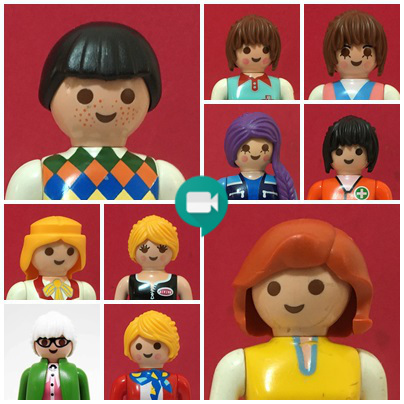
The Watsons & The Grandma connected by Meet
Today, The Grandma has restarted her English course with The Watsons. It has been a great joy seeing them again.

They are fine with full batteries and with their incredible positive attitude to confront difficult situations. 

Elisabeth, Raquel, Sònia, Yolanda, Mariana, Elisabeth, Neus, Maria and Judit welcome home again.

The Watsons and The Grandma are going to continue their English course online and they are going to use Google Applications to do it. Today, The Grandma wants to talk about Google Hangout and Google Meet and she also wants to talk about Present Simple.

More information: Present Simple

Google Hangouts is a communication software developed by Google. Originally a feature of Google+, Hangouts became a stand-alone product in 2013, when Google also began integrating features from Google+ Messenger and Google Talk into Hangouts.

In 2017, Google began developing Hangouts into a product aimed at enterprise communication. Hangouts is now part of the G Suite line of products and consists of two primary products: Google Meet and Google Chat.

Google has also begun integrating features of Google Voice, its IP telephony product, into Hangouts, stating that Hangouts is designed to be the future of Voice.

Google plans to transition users to Meet and Chat in June 2020, but will continue to support the consumer version of classic Hangouts, raising some speculation in the matter after Google Meet became free.

More information: Present Simple

On March 9, 2017, Google announced that Hangouts would be targeted at business users with the Hangouts brand divided into two products: Hangouts Meet and Hangouts Chat.

Meet would focus on video conferences and Hangouts Chat would be focused on instant messaging with additional features such as bot assistant and threaded messaging.

In August 2019, Google announced that the G-Suite version of Hangouts will be replaced by Meet and Chat, and push the shut down to June 2020.

In April 2020, in response to COVID-19, Google Meet became free for all users, raising speculation as to the future of Google Hangouts.

Google Meet
Hangouts allows conversations between two or more users. The service can be accessed online through the Gmail or Google+ websites, or through mobile apps available for Android and iOS, which were distributed as a successor to their existing Google Talk apps. However, because it uses a proprietary protocol instead of the XMPP open standard protocol used by Google Talk, most third-party applications which had access to Google Talk do not have access to Google+ Hangouts.

Chat histories are saved online, allowing them to be synced between devices. A watermark of a user's avatar is used as a marker to indicate how far they have read into the conversation.

Photos can be shared during conversations, which are automatically uploaded into a private Google+ album. Users can also now use color emoji symbols in their messages.

More information: Google I & II

Google Meet is a video-communication service developed by Google. It is one of two apps that constitute the replacement for Google Hangouts, the other being Google Chat. Google planned to begin retiring Google Hangouts in October 2019.

After being invite-only and quietly releasing an iOS app in February 2017, Google formally launched Meet in March 2017. The service was unveiled as a video conferencing app for up to 30 participants, described as an enterprise-friendly version of Hangouts.

At launch, it featured a web app, an Android app, and an iOS app. Features for G Suite users include:

-Up to 100 members per call for G Suite Basic users, up to 150 for G Suite Business users, and up to 250 for G Suite Enterprise users.

-Ability to join meetings from the web or through the Android or iOS app.

-Ability to call into meetings with a dial-in number.

-Password-protected dial-in numbers for G Suite Enterprise edition users.

-Integration with Google Calendar for one-click meeting calls.

-Screen-sharing to present documents, spreadsheets, or presentations.

-Encrypted calls between all users.

-Real-time closed captioning based on speech recognition.

Free users have some further limitations:

-Meetings (after September 2020) are limited to 60 minutes.

-All participants must have a Google account.

Google Meet
While Google Meet introduced the above features to upgrade the original Hangouts application, some standard Hangouts features were deprecated, including viewing attendees and chat simultaneously.

The number of video feeds allowed at one time was also reduced to 8, while up to 4 feeds can be shown in a tiles layout, prioritizing those attendees who most recently used their microphone. Additionally features such as the chat box were changed to overlay the video feeds, rather than resizing the latter to fit.

In response to the COVID-19 crisis in March 2020, Google began offering Meet's advanced features that previously required an enterprise account to anyone using G Suite or G Suite for Education.

The use of Meet grew by a factor of 30 between January and April of 2020, with 100 million users a day accessing Meet, compared to 200 million daily uses for Zoom as of the last week of April 2020.

Until May 2020, a G Suite account was required to initiate and host a Meet video conference, but with increased demand for video conferencing due to the COVID-19 pandemic, Google rolled out free access to Meet also for holders of consumer accounts. Following the announcement, Google's Director of Product Management recommended that consumers use Meet over Hangouts.

More information: Android Central

Free Meet calls can only have a single host and up to 100 participants, compared to the 250-caller limit for G Suite users and the 25-participant limit for Hangouts.

Unlike business calls with Meet, consumer calls are not recorded and stored and the company states that consumer data from Meet will not be used for advertisement targeting. While call data is reportedly not being used for advertising purposes, based on an analysis of Meet's privacy policy, Google reserves the right to collect data on call duration, who is participating, and participants' IP addresses.

Users need a Google account to initiate calls and like G Suite users, anyone with a Google account is able to start a Meet call from within Gmail. Free meet calls have no time limit, but will be limited to 60 minutes starting in September 2020. 

For security reasons, hosts can deny entry and remove users during a call. As of April 2020, Google plans to roll out a noise cancelling audio filter and a low-light mode.

More information: CNet


We've arranged a civilization in which
most crucial elements profoundly
depend on science and technology.

Carl Sagan