Showing posts with label David Stone. Show all posts

Saturday, 11 December 2021

ENJOYING 'LA PURÍSSIMA' WITH CLAIRE, DAVID & TONYI

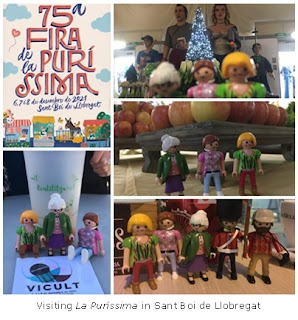
Last Wednesday, December 8, after talking with Tonyi Tamaki about Metallica, they went to Sant Boi de Llobregat to visit the local fair, named La Puríssima. They met Claire Fontaine and David Stone, and altogether spent a wonderful day.

Sant Boi de Llobregat is a city in the county of El Baix Llobregat, near Barcelona, in Catalonia, located on the banks of the Llobregat river. In 2019, it had 83,605 inhabitants.

The city is divided into six neighbourhoods, named barris in Catalan: Ciutat Cooperativa-Molí Nou, Marianao-Can Paulet, Barri Centre, Vinyets-Molí Vell, Camps Blancs-Canons-Orioles, and Casablanca.

It is bordered on the north by the towns of Santa Coloma de Cervelló and Sant Joan Despí and the village of Sant Climent de Llobregat; on the east by the town of Cornellà de Llobregat; on the west by Viladecans; and on the south by El Prat de Llobregat and the Mediterranean Sea, via a narrow southward salient.

Although the main business activity is trading, which is centred around the service sector, Sant Boi is also known for industrial activities, especially metallurgy.

Agriculturally, its mild climate and fertile waterlogged lands, located at the mouth of the Llobregat river, produce a wide variety of vegetables, including the famous Llobregat Delta artichokes.

The region offers three different artichoke varieties: white artichoke from Tudela, camús from Bretagne, considered to be the largest variety, and artichoke from Benicarló. Production is concentrated mostly in March, but products can be found in local markets throughout the year.

The finding of archaeological remains corresponding to Iberian colonies (VI-I bC) and to the Romans (I-V BC) -a noteworthy Roman bath is located near the river- suggests that Sant Boi was created in pre-Roman times.

As with most of the surrounding lands, from the 8th to the 11th century the town was controlled by the Moors, until their expulsion from Iberia during the Reconquista. The Moors called it Alcalà, which means castle, due to the existence of a hillock from where the river and the valley were dominated. The town's current name is derived from the name of Saint Baudilus, known as Boi or Baldiri in Catalonia.

During the Middle Ages, the village progressively grew, expanding from the castle's surroundings to adjacent zones. A baroque-style church was built during the 16th century. The growth continued in the following centuries, giving rise to numerous masies, typical Catalan agricultural country houses, near the river and fertile lands. By the end of the 19th century, Sant Boi was a village of nearly 5,000 inhabitants, with an economy driven mainly by agriculture.

In the early stages of the 20th century, industry arrived and subsequently flourished in Sant Boi, ranging from brick manufacturing to metalwork. With the end of the Spanish Civil War in 1939, there was a massive influx of immigrants from many parts of Spain. These new arrivals consisted mostly of people from villages and small towns. They were searching for jobs and career opportunities in the city of Barcelona, since it was stimulated by the regrowth of Catalan industry in post-war Spain.

The population rose from 10,000 people in 1940 to 65,000 in 1975. This period is characterized by the construction of complete quarters (Casablanca, Camps Blancs, and Cooperativa) for the housing of immigrants.

Sant Boi is now a town with more than 80,000 inhabitants, with well-established industrial and service sectors, and good cultural and recreational offerings.

More information: Turisme Baix Llobregat

The Fira de la Puríssima is one of the oldest fairs in Catalonia, which is held annually in Sant Boi de Llobregat. It takes place on 6, 7 and 8 December in several streets and other emblematic spaces of the town of Sant Boi de Llobregat with about 52,000 m2 of fairgrounds, 11,900 m2 of exhibition space and more than 480 exhibitors, which generate an economic impact of approximately 5 million euros.

The roots of the Fair can be found in the exhibition of apples that began to be held on 12 and 13 July 1931 on the floor of the old municipal library, and where the first was also held fruit set competition.

In 1947, the seasonal fruit exhibition was discontinued in the summer months and became a fair and exhibition of plants, fruit trees and ornamentation on December 8 of the same year. It was not until 1956 that the name Fira de la Puríssima was first adopted, but made Spanish by the imposition of the Franco dictatorship.

At the end of the year 1960, the local magazine Vida Samboyana collected quite critical writings with the Tour where it was pointed out that it had gone into decline and that, in order to trace it back, the collaboration of the whole population was needed: individuals and entities.

In November 1961, the creation of a Board of Trustees was announced, which, with greater financial availability as a result of the participation of the local administration, should ensure the good organization and development of the Fair. This, encouraged by a wide range of advertising, multiplied in relation to the critical editions of previous years.

Another remarkable date was the 1967 edition which was used to inaugurate the new Sant Jordi market which came to meet the demand of a large sector of the population, newly established. The Fair would reach its 26th edition in 1971. The Board of Trustees revived an old initiative and instituted a Poster Contest which was won by local artist Maria Dolors Villadelprat.

The current poster has been made by the local artist Iván Castro.

More information: Catalunya


The role of culture is that it's the form through
which we as a society reflect on who we are,
where we've been, where we hope to be.

Wendell Pierce

Thursday, 21 October 2021

ANKIWEB, CREATE & SHARE DECKS WITH DAVID STONE

Today, The Grandma has spent a wonderful day in the company of one of her closest friends, David Stone, who is creating a project to study English using Anki.

Anki is a free and open-source flashcard program using spaced repetition, a technique from cognitive science, for fast and long-lasting memorization.

Anki (暗記) is the Japanese word for memorization.

The SM-2 algorithm, created for SuperMemo in the late 1980s, forms the basis of the spaced repetition methods employed in the program. Anki's implementation of the algorithm has been modified to allow priorities on cards and to show flashcards in order of their urgency.

The cards are presented using HTML and may include text, images, sounds, videos, and LaTeX equations. The decks of cards, along with the user's statistics, are stored in the open SQLite format.

Cards are generated from information stored as notes. Notes are analogous to database entries and can have an arbitrary number of fields. For example, with respect to learning a language, a note may have the following fields and example entries:

-Field 1: Expression in target language – gâteau
-Field 2: Pronunciation – [sound file with the word gâteau pronounced]
-Field 3: Meaning of expression in familiar language – cake

This example illustrates what some programs call a three-sided flashcard, but Anki's model is more general and allows any number of fields to be combined in various cards.

The user can design cards that test the information contained in each note. One card may have a question (expression) and an answer (pronunciation, meaning).

By keeping the separate cards linked to the same fact, spelling mistakes can be adjusted against all cards at the same time, and Anki can ensure that related cards are not shown in too short a spacing.

A special note type allows generation of cloze deletion cards, in Anki 1.2.x, those were ordinary cards with cloze markup added using a tool in the fact editor.

While Anki's user manual encourages the creation of one's own decks for most material, there is still a large and active database of shared decks that users can download and use.

Available decks range from foreign-language decks (often constructed with frequency tables) to geography, physics, biology, chemistry and more. Various medical science decks, often made by multiple users in collaboration, are also available.

More information: Anki Web

Actually, I failed drama in high school because of nerves.
I wasn't able to memorize the words.
I had complete stage fright.

Constance Marie

Saturday, 28 November 2020

CAMBRIDGE EXAM, THE STONES MEET THE WATSONS

Today has been an exciting day. The Stones and The Watsons have meet with The Grandma in Hospitalet de Llobregat.

After travelling around the world in an unforgettable trip, The Stones have joined The Watsons and have gone together to do their A2 Cambridge Exam. It has been a wonderful experience.

The Grandma has said goodbye to another beloved family and she returns to her home hoping that she could find another one to continue travelling, learning and sharing unforgettable moments.

Thanks to The Stones and thanks to The Watsons for trusting in this project and for being part of it. Remember that you are eternal because myths and dreams never die.

More information: If I Can Dream

Cambridge Assessment English, or Cambridge English, is the biggest of three main exam boards forming Cambridge Assessment, a non-teaching department of the University of Cambridge.

The organisation contributed to the development of the Common European Framework of Reference for Languages (CEFR), the standard used around the world to benchmark language skills. Its qualifications and tests are aligned with the levels of the CEFR.

Cambridge Assessment English develops and produces Cambridge English Qualifications, courses and tests and IELTS, of which Cambridge Assessment English is an owner.

The first Cambridge English exam was produced in 1913 by UCLES (University of Cambridge Local Examinations Syndicate).

UCLES had been set up in 1858 to provide exams to students who were not members of a university.

The first UCLES examinations took place on 14 December 1858. The exams were designed to test for university selection and were taken by 370 candidates in British schools, churches and village halls. Candidates were required to satisfy the examiners in the analysis and parsing of a Shakespeare text; reading aloud; dictation; and composition on either the recently deceased Duke of Wellington; a well-known book; or a letter of application.

Female candidates were accepted by UCLES on a trial basis in 1864 and on a permanent basis from 1867. Cambridge University itself did not examine female students until 1882 and it was not until 1948 that women were allowed to graduate as full members of the university.

In the mid to late 19th century, UCLES exams were taken by candidates based overseas -in Trinidad (from 1863), South Africa (from 1869), Guyana and New Zealand (from 1874), Jamaica (from 1882) and Malaya (from 1891). Many of these candidates were children of officers of the British colonial service and exams were not yet designed for non-native speakers of English.

In 1913 UCLES created the first exam for non-native speakers of English -the Certificate of Proficiency in English. This may have been prompted by the development of English exams ‘for foreigners’ by other universities.

In 1913 the exam could be taken in Cambridge or London, for a fee of £3 (approximately £293 in 2012 prices). The exam lasted 12 hours and included:

-Translation from English into French or German: 2 hours

-Translation from French or German into English, and English Grammar: 2.5 hours

-English Essay: 2 hours

-English Literature: 3 hours

-English Phonetics: 1.5 hours

-Oral test: dictation (30 minutes); reading aloud and conversation (30 minutes)

The 1913 CPE exam was taken by just three candidates. The candidates were able to converse fluently, expressing themselves on the whole, with remarkable ease and accuracy. However, all three candidates failed the exam and none of them were awarded a CPE certificate.

From 1939 onwards, thousands of refugees from the Spanish Civil War and occupied Europe started arriving in the UK and began taking UCLES exams while stationed in the UK.

UCLES launched the Lower Certificate in English (LCE) to meet the demand for certification at a lower level than CPE. A Preliminary exam, at a lower level than LCE, was also offered from 1944 as a special test to meet the contingencies of war. These were the first steps towards developing language assessment at different levels.

UCLES tests were made available for prisoners of war in Britain and in Germany. In Britain 1,500 prisoners of war took the exams, almost 900 of them Italians. In Germany, the War Organisation of the British Red Cross and Order of St John of Jerusalem made arrangements for UCLES examinations to be offered at prisoner-of-war camps with many Indian prisoners of war, in particular, taking LCE or School Certificate exams.

Exams were also maintained clandestinely in continental European exam centres, which frequently meant unusual measures, including acts of determination and courage. However, UCLES was unable to fund and support the growing international network of English language examination centres around the world. 

Meanwhile, the British Council had a brief to disseminate British culture and educational links. In March 1941 a formal Joint Agreement was signed between the two organisations to collaborate on the distribution of UCLES exams around the world. This started a long-lasting relationship, which continues to this day.

More information: Cambridge Assessment English


We all have dreams.
But in order to make dreams come into reality,
it takes an awful lot of determination,
dedication, self-discipline, and effort.

Jesse Owens

Wednesday, 11 November 2020

GUANACOS & CHULENGOS, LLAMAS IN TIERRA DEL FUEGO

Today, The Stones and The Grandma have been riding guanacos, a camelid native to South America, closely related to the llama. It has been an amazing experience that they will never forget. 

Before riding guanacos, the family has been revising The Passive in Present and Past.

The guanaco (Lama guanicoe) is a camelid native to South America, closely related to the llama.
Its name comes from the Quechua word huanaco, modern spelling wanaku. Young guanacos are called chulengos.

Guanacos stand between 1.0 and 1.3 m at the shoulder, body length of 2.1 to 2.2 m and weigh 90 to 140 kg. Their color varies very little, unlike the domestic llama, ranging from a light brown to dark cinnamon and shading to white underneath. Guanacos have grey faces and small, straight ears.

Guanacos are one of the largest terrestrial mammals native to today's South America. Other terrestrial mammalian megafauna to weigh similar to or exceed guanaco include the tapirs, the marsh deer, the white-tailed deer, the spectacled bear, and the jaguar.

Guanacos have thick skin on their neck, a trait also found in their domestic counterparts, the llama and in their relatives, the wild vicuña and domesticated alpaca. This protects their neck from predator attacks. Bolivians use the neck-skin of these animals to make shoes, flattening and pounding the skin to be used for the soles. In Chile, hunting is allowed only in Tierra del Fuego, where the only population not classified as endangered in the country resides. Between 2007 and 2012, 13,200 guanacos were legally hunted in Tierra del Fuego.

More information: The Passive

Guanacos are often found at high altitudes, up to 4,000 meters above sea level, except in Patagonia, where the southerly latitude means ice covers the vegetation at these altitudes. For guanacos to survive in the low oxygen levels found at these high altitudes, their blood is rich in red blood cells. A teaspoon of guanaco blood contains about 68 billion red blood cells -four times that of a human.

Guanaco fiber is particularly prized for its soft, warm feel and is found in luxury fabric.

The guanaco's soft wool is valued second only to that of the vicuña. The pelts, particularly from the calves, are sometimes used as a substitute for red fox pelts, because the texture is difficult to differentiate. Like their domestic descendant, the llama, the guanaco is double-coated with coarse guard hairs and a soft undercoat, the hairs of which are about 16–18 µ in diameter and comparable to the best cashmere.

Guanacos inhabit the steppes, scrublands and mountainous regions of South America. They are found in the altiplano of Peru, Bolivia and Chile, and in Patagonia, with a small population in Paraguay.

In Argentina they are more numerous in Patagonian regions, as well as in places such as Isla Grande de Tierra del Fuego. In these areas, they have more robust populations, since grazing competition from livestock is limited.

Guanaco responded to forage availability, occupying zones with low to intermediate food availability in the breeding season, and those with the highest availability in the non-breeding season. Estimates, as of 2011, place their numbers at 400,000 to 600,000; 466,000–520,000 in Argentina, 150-200 in Bolivia, 66,000 in Chile, 100 in Paraguay, 3,500 in Peru. A small introduced population exists on Staats Island in the Falkland Islands, with a population of around 400 as of 2003.

More information: Animal Diversity

Guanacos live in herds composed of females, their young, and a dominant male. Bachelor males form separate herds. While reproductive groups tend to remain small, often containing no more than 10 adults, bachelor herds may contain as many as 50 males. When they feel threatened, guanacos alert the herd to flee with a high-pitched, bleating call. The male usually runs behind the herd to defend them. They can run at 56 km per hour, often over steep and rocky terrain. They are also excellent swimmers. A guanaco's typical lifespan is 20 to 25 years.

Natural predators of the guanaco include pumas and foxes. When threatened, they alert the rest of the herd with a high-pitched bleating sound, which sounds similar to a short, sharp laugh. Though typically mild-mannered, guanacos often spit when threatened, and can do so up to a distance of six feet.

Mating season occurs between November and February, during which males often fight violently to establish dominance and breeding rights.

Eleven-and-a-half months later, a single chulengo is born. Chulengos are able to walk immediately after birth. Male chulengos are chased off from the herd by the dominant male around one year of age.

Guanacos have long been thought to be the parent species of the domesticated llama, which was confirmed via molecular phylogenetic analysis in 2001, although the analysis also found that domestic llamas had experienced considerable cross-hybridization with alpacas, which are descended from the wild vicuña.

More information: Nathab


We all have a responsibility
to protect endangered species,
both for their sake and for the sake of
our own future generations.


Loretta Lynch

Saturday, 19 September 2020

CITY OF MANCHESTER STADIUM, YOLANDA STONE & PEP

THIS MORNING, The Stones have been invited by Pep Guardiola to visit the City of Manchester Stadium.

Yolanda is his greatest fan and follower and Pep has has a wonderful present for her and her family, being the guide during their visit into the Stadium, introducing them the Manchester City players and inviting the family to assist to the training season and to the next match, next Monday versus the Wolverhampton Wanderers Football Club in the Molineux Stadium in Wolverhampton, Staffordshire.

Yolanda is astonished and she has written some words in her personal diary. Here we have...

The Stones family prepares a great trip, with The Grandma, full of adventures across Manchester-Hawaii and Buenos Aires this September.

Yesterday, we landed at Manchester Airport. It is a great airport sited in Ringway, 13 km from the centre of the city of Manchester.

Firstly, Manchester is a city usually known by football, and that's why we will visit the Manchester City's Stadium and we will watch the match between Manchester CIty and Wolves. We start! Let's go!

Once there, the hostesses have offered us a welcome cocktail in the VIP zone named 'Aspire Longe', while we were waiting a limousine to go to have lunch in the Catalan food restaurant 'Tast'. The cook is Paco Pérez. He has five Michelin stars and food is very good.

We were eating when Pep Guardiola has appeared. He is the owner of this restaurant and he has said to us: 'You should go to watch the next match between Manchester City and Wolves in Wolverhampton next Mondat at 20:15. I invite you. You are going to be my special guests'.

Yolanda is very happy with this invitation and the rest of the family is going to change their plans to adapt them to this new visit. They know it is a special moment for her and they want to make her happy.

More information: Manchester City FC


 I am grateful to be here, and I will always be grateful for the opportunity Manchester City gave me.

Pep Guardiola


THIS EVENING, the family has been to the Manchester Museum. It has been a private visit and they have been alone only accompanied by the Museum guides. David Stone, who is a great sculptor, was very interested in this visit and he has contemplated some of the most beautiful and spectacular creations sited in this amazing museum.

Manchester Museum is a museum displaying works of archaeology, anthropology and natural history and is owned by the University of Manchester, in England.

Sited on Oxford Road (A34) at the heart of the university's group of neo-Gothic buildings, it provides access to about 4.5 million items from every continent. It is the UK's largest university museum and serves both as a major visitor attraction and as a resource for academic research and teaching. It has around 430,000 visitors each year.

The museum's first collections were assembled by the Manchester Society of Natural History formed in 1821 with the purchase of the collection of John Leigh Philips.

The society established a museum in Peter Street, Manchester, on a site later occupied by the Young Men's Christian Association, in 1835.

In 1850 the collections of the Manchester Geological Society (founded 1838) were added. By the 1860s both societies encountered financial difficulties and, on the advice of the evolutionary biologist Thomas Huxley, Owens College (now the University of Manchester) accepted responsibility for the collections in 1867. The museum in Peter Street was sold in 1875 after Owens College moved to new buildings in Oxford Street.

The college commissioned Alfred Waterhouse, architect of London's Natural History Museum, to design a museum to house the collections for the benefit of students and the public on a site in Oxford Road (then Oxford Street).

The Manchester Museum was opened to the public in 1888. At the time, the scientific departments of the college were immediately adjacent, and students entered the galleries from their teaching rooms in the Beyer Building.

Two subsequent extensions mirror the development of its collections. The 1912 pavilion was largely funded by Jesse Haworth, a textile merchant, to house the archaeological and Egyptological collections acquired through excavations he had supported. The 1927 extension was built to house the ethnographic collections. 

The Gothic Revival street frontage which continues to the Whitworth Hall has been ingeniously integrated by three generations of the Waterhouse family. When the adjacent University Dental Hospital of Manchester moved to a new site, its old building was used for teaching and subsequently occupied by the museum.

The museum is one of the University of Manchester's cultural assets, along with the Whitworth Art Gallery, John Rylands Library, Jodrell Bank visitor centre and others.

More information: Manchester Museum

I went to the museum where they had all the heads and arms from the statues that are in all the other museums.

Steven Wright

Saturday, 7 March 2020

KONSTANTINOS PETROU KAVAFIS'S POEM 'ITHAKA'

Konstantinos Petrou Kavafis
After a Loli Stone's masterclass about The Iliad, accompanied by Homer, The Stones have decided to visit the island. Ithaca is a wonderful Mediterranean island and a fantastic place to practice trekking.

The family has decided to discover the hidden places of the island by foot. While The Stones enjoyed and contemplated the views, Daniel Stone was playing his fidle and Loli Stone was reciting one of the most transcendental and beautiful poems ever written, Konstantinos Petrou Kavafis's Ithaca.

Konstantin or Konstantinos Petrou Kavafis, also known as Constantine Peter Cavafy, in Greek Κωνσταντίνος Π. Καβάφης (April 29 1863-April 29, 1933) was an Egyptiot Greek poet, journalist and civil servant. His consciously individual style earned him a place among the most important figures not only in Greek poetry, but in Western poetry as well.

Kavafis wrote 155 poems, while dozens more remained incomplete or in sketch form. During his lifetime, he consistently refused to formally publish his work and preferred to share it through local newspapers and magazines, or even print it out himself and give it away to anyone interested.

His most important poems were written after his fortieth birthday, and officially published two years after his death.

More information: Poetry Foundation

Kavafis was born in 1863 in Alexandria, Egypt, to Greek parents, originated from the Greek community of Constantinople (Istanbul), and was baptized into the Greek Orthodox Church.

His father's name was Πέτρος Ἰωάννης, Petros Ioannēs -hence the Petrou patronymic (GEN) in his name- and his mother's Charicleia. His father was a prosperous importer-exporter who had lived in England in earlier years and acquired British nationality. After his father died in 1870, Kavafis and his family settled for a while in Liverpool.

David & Loli Stone recite Kavafis's Ithaka in Aetos
In 1876, his family faced financial problems due to the Long Depression of 1873, so, by 1877, they had to move back to Alexandria.

In 1882, disturbances in Alexandria caused the family to move again, though temporarily, to Constantinople. This was the year when a revolt broke out in Alexandria against the Anglo-French control of Egypt, thus precipitating the 1882 Anglo-Egyptian War. Alexandria was bombarded by a British fleet, and the family apartment at Ramleh was burned.

In 1885, Kavafis returned to Alexandria, where he lived for the rest of his life. His first work was as a journalist; then he took a position with the British-run Egyptian Ministry of Public Works for thirty years. Egypt was a British protectorate until 1926.

He published his poetry from 1891 to 1904 in the form of broadsheets, and only for his close friends. Any acclaim he was to receive came mainly from within the Greek community of Alexandria. Eventually, in 1903, he was introduced to mainland-Greek literary circles through a favourable review by Gregorios Xenopoulos.

He received little recognition because his style differed markedly from the then-mainstream Greek poetry. It was only twenty years later, after the Greek defeat in the Greco-Turkish War (1919–1922), that a new generation of almost nihilist poets would find inspiration in Kavafis's work.

More information: Cambridge Scholars

He died on April 29, 1933, his 70th birthday. Since his death, Kavafis's reputation has grown. His poetry is taught in school in Greece and Cyprus, and in universities around the world.

E. M. Forster knew him personally and wrote a memoir of him, contained in his book Alexandria. Forster, Arnold J. Toynbee, and T. S. Eliot were among the earliest promoters of Kavafis in the English-speaking world before the Second World War. In 1966, David Hockney made a series of prints to illustrate a selection of Kavafis's poems, including In the dull village.

Kavafis was instrumental in the revival and recognition of Greek poetry both at home and abroad. His poems are, typically, concise but intimate evocations of real or literary figures and milieux that have played roles in Greek culture. 

Visiting the Alalkomenes Acropolis, Ithaca
Uncertainty about the future, sensual pleasures, the moral character and psychology of individuals, homosexuality, and a fatalistic existential nostalgia are some of the defining themes.

Besides his subjects, unconventional for the time, his poems also exhibit a skilled and versatile craftsmanship, which is extremely difficult to translate.

Kavafis was a perfectionist, obsessively refining every single line of his poetry. His mature style was a free iambic form, free in the sense that verses rarely rhyme and are usually from 10 to 17 syllables. In his poems, the presence of rhyme usually implies irony.

Kavafis drew his themes from personal experience, along with a deep and wide knowledge of history, especially of the Hellenistic era. Many of his poems are pseudo-historical, or seemingly historical, or accurately but quirkily historical.

One of
Kavafis's most important works is his 1904 poem Waiting for the Barbarians. The poem begins by describing a city-state in decline, whose population and legislators are waiting for the arrival of the barbarians. When night falls, the barbarians have not arrived. The poem ends: What is to become of us without barbarians? Those people were a solution of a sort.

More information: Poets

In 1911,
Kavafis wrote Ithaca, inspired by the Homeric return journey of Odysseus to his home island, as depicted in the Odyssey.

The poem's theme is the destination which produces the journey of life: Keep Ithaka always in your mind. / Arriving there is what you’re destined for. The traveller should set out with hope, and at the end you may find Ithaca has no more riches to give you, but Ithaca gave you the marvelous journey.

Almost all of
Kavafis's work was in Greek; yet, his poetry remained unrecognized and underestimated in Greece, until after the publication of the first anthology in 1935 by Heracles Apostolidis, father of Renos Apostolidis.

His unique style and language, which was a mixture of Katharevousa and Demotic Greek, had brought him under the criticism of Kostis Palamas, the greatest poet of his era in mainland Greece, and his followers, who were in favour of the simplest form of Demotic Greek.

He is known for his prosaic use of metaphors, his brilliant use of historical imagery, and his aesthetic perfectionism. These attributes, amongst others, have assured him an enduring place in the literary pantheon of the Western World.

More information: The New Yorker


Ithaka gave you the marvelous journey.
Without her you would not have set out.
She has nothing left to give you now.
And if you find her poor, Ithaka won’t have fooled you.
Wise as you will have become, so full of experience,
you will have understood by then what these Ithakas mean.

 
Konstantinos P. Kavafis