Today, The Grandma has been reading about the Chemical Weapons Convention, that was celebrated on a day like today in Paris in 1997.
The Chemical Weapons Convention (CWC),officially the Convention on the Prohibition of the Development, Production, Stockpiling and Use of Chemical Weapons and on their Destruction, is an arms control treaty administered by the Organisation for the Prohibition of Chemical Weapons (OPCW), an intergovernmental organization based in The Hague, The Netherlands. The treaty entered into force on 29 April 1997. It prohibits the use of chemical weapons, and also prohibits large-scale development, production, stockpiling, or transfer of chemical weapons or their precursors, except for very limited purposes (research, medical, pharmaceutical or protective).
The main obligation of member states under the convention is to effect this prohibition, as well as the destruction of all current chemical weapons. All destruction activities must take place under OPCW verification.
As of August 2022, 193 states have become parties to the CWC and accept its obligations. Israel has signed but not ratified the agreement, while three other UN member states (Egypt, North Korea and South Sudan) have neither signed nor acceded to the treaty. Most recently, the State of Palestine deposited its instrument of accession to the CWC on 17 May 2018.
In September 2013, Syria acceded to the convention as part of an agreement for the destruction of Syria's chemical weapons.
As of February 2021, 98.39% of the world's declared chemical weapons stockpiles had been destroyed. The convention has provisions for systematic evaluation of chemical production facilities, as well as for investigations of allegations of use and production of chemical weapons based on the intelligence of other state parties.
Some chemicals which have been used extensively in warfare but have numerous large-scale industrial uses (such as phosgene) are highly regulated; however, certain notable exceptions exist. Chlorine gas is highly toxic, but being a pure element and widely used for peaceful purposes, is not officially listed as a chemical weapon. Certain state powers continue to regularly manufacture and implement such chemicals in combat munitions.
Although these chemicals are not specifically listed as controlled by the CWC,the use of any toxic chemical as a weapon (when used to produce fatalities solely or mainly through its toxic action) is in-and-of itself forbidden by the treaty. Other chemicals, such as white phosphorus, are highly toxic but are legal under the CWC when they are used by military forces for reasons other than their toxicity.
The CWC augments the Geneva Protocol of 1925, which bans the use of chemical and biological weapons in international armed conflicts, but not their development or possession. The CWC also includes extensive verification measures such as on-site inspections, in stark contrast to the 1975 Biological Weapons Convention (BWC), which lacks a verification regime.
After several changes of name and composition, the ENDC evolved into the Conference on Disarmament (CD) in 1984.
On 3 September 1992, the CD submitted to the U.N. General Assembly its annual report, which contained the text of the Chemical Weapons Convention. The General Assembly approved the convention on 30 November 1992, and the U.N. Secretary-General then opened the convention for signature in Paris on 13 January 1993.
The CWC remained open for signature until its entry into force on 29 April 1997, 180 days after the deposit at the UN by Hungary of the 65th instrument of ratification.
The convention is administered by the Organisation for the Prohibition of Chemical Weapons (OPCW), which acts as the legal platform for specification of the CWC provisions. The Conference of the States Parties is mandated to change the CWC and pass regulations on the implementation of CWC requirements.
The Technical Secretariat of the organization conducts inspections to ensure compliance of member states. These inspections target destruction facilities (where permanent monitoring takes place during destruction), chemicalweapons production facilities which have been dismantled or converted for civil use, as well as inspections of the chemical industry. The Secretariat may furthermore conduct investigations of alleged use of chemical weapons and give assistance after use of chemical weapons.
The 2013 Nobel Peace Prize was awarded to the organization because it had, with the Chemical Weapons Convention, defined the use of chemical weapons as a taboo under international law according to Thorbjørn Jagland, Chairman of the Norwegian Nobel Committee.
I believe the proliferation of weapons of mass destruction presents the greatest threat that the world has ever known. We are finding more and more countries who are acquiring technology -not only missile technology- and are developing chemical weapons and biological weapons capabilities to be used in theater and also on a long range basis. So I think that is perhaps the greatest threat that any of us will face in the coming years.
Today is Christmas Day. TheGrandma and her friends want to congratulate all people who celebrate this feast.
December, 25 is not only Christmas Day but an important day in recent European history. On a day like today in 1991, MikhailGorbachev resigned as Presidentof the Soviet Union and the union itself was dissolved the next day. The Grandma wants to talk about this important event that changed the history of the world because of it was the end of the cold war and about Mikhail Gorbachev, an important figure in the USSR and in the European history.
Mikhail Sergeyevich Gorbachev (born 2 March 1931) is a Russian and formerly Soviet politician. The eighth and last leader of the Soviet Union,he was the general secretary of the Communist Party of the Soviet Union from 1985 until 1991.
He was also the country's head of state from 1985 until 1991, serving as Chairman of the Presidium of the Supreme Soviet from 1988 to 1989, Chairman of the Supreme Soviet from 1989 to 1990, and President of the Soviet Union from 1990 to 1991. Ideologically, he initially adhered to Marxism-Leninism although by the early 1990s had moved toward social democracy.
Of mixed Russian and Ukrainian heritage, Gorbachev was born in Privolnoye, Stavropol Krai to a poor peasant family. Growing up under the rule of Joseph Stalin, in his youth he operated combine harvesters on a collective farm before joining the Communist Party, which then governed the Soviet Union as a one-party state according to Marxist-Leninist doctrine. While studying at Moscow State University, he married fellow student Raisa Titarenko in 1953 prior to receiving his law degree in 1955.
Moving to Stavropol, he
worked for the Komsomol youth organisation and, after Stalin's death,
became a keen proponent of the de-Stalinization reforms of Soviet leader
Nikita Khrushchev. He was appointed the First Party Secretary of the
Stavropol Regional Committee in 1970, in which position he oversaw
construction of the Great Stavropol Canal.
In 1978 he returned to Moscow to become a Secretary of the party's Central Committee and in 1979 joined its governing Politburo. Within three years of the death of Soviet leader Leonid Brezhnev, following the brief regimes of Yuri Andropov and Konstantin Chernenko, the Politburo elected Gorbachev as General Secretary, the de facto head of government, in 1985.
Although committed to preserving the Soviet state and to its socialist ideals, Gorbachev believed significant reform was necessary, particularly after the 1986 Chernobyl disaster. He withdrew from the Soviet-Afghan War and embarked on summits with United States President Ronald Reagan to limit nuclear weapons and end the Cold War.
Domestically,
his policy of glasnost, openness allowed for enhanced freedom of speech
and press, while his perestroikarestructuring sought to decentralise
economic decision making to improve efficiency. His democratisation
measures and formation of the elected Congress of People's Deputies
undermined the one-party state.
Mikhail Sergeyevich Gorbachev
Gorbachev declined to intervene militarily when various Eastern Bloc countries abandoned Marxist-Leninist governance in 1989-90. Internally, growing nationalist sentiment threatened to break up the Soviet Union, leading Marxist-Leninist hardliners to launch the unsuccessful August Coup against Gorbachev in 1991.
In the wake of this, the Soviet Union dissolved against Gorbachev's wishes and he resigned. After leaving office, he launched his Gorbachev Foundation,became a vocal critic of Russian Presidents Boris Yeltsin and Vladimir Putin, and campaigned for Russia's social-democratic movement.
Widely considered one of the most significant figures of the second half of the 20th century, Gorbachev remains the subject of controversy. The recipient of a wide range of awards -including the Nobel Peace Prize-he was widely praised for his pivotal role in ending the Cold War, curtailing human rights abuses in the Soviet Union, and tolerating both the fall of Marxist-Leninist administrations in eastern and central Europe and the reunification of Germany.
Conversely,
in Russia he is often derided for not stopping the Soviet collapse, an
event which brought a decline in Russia's global influence and
precipitated an economic crisis.
Gorbachev's
leadership style differed from that of his predecessors. He would stop
to talk to civilians on the street, forbade the display of his portrait
at the 1985 Red Square holiday celebrations, and encouraged frank and
open discussions at Politburo meetings.
To the West, Gorbachev was seen as a more moderate and less threatening Soviet leader; some Western commentators however believed this an act to lull Western governments into a false sense of security. His wife was his closest adviser, and took on the unofficial role of a first lady by appearing with him on foreign trips; her public visibility was a breach of standard practice and generated resentment. His other close aides were Georgy Shakhnazarov and Anatoly Chernyaev.
Gorbachev was aware that
the Politburo could remove him from office, and that he could not
pursue more radical reform without a majority of supporters in the
Politburo. He sought to remove several older members from the Politburo,
encouraging Grigory Romanov, Nikolai Tikhonov, and Viktor Grishin into
retirement.
He moved Gromyko from
his role in foreign policy to that of head of state and replaced
Gromyko's former role with his own ally, Eduard Shevardnadze. Other
allies whom he saw promoted were Yakovlev, Anatoly Lukyanov, and Vadim
Medvedev. Another of those promoted by Gorbachev was Boris Yeltsin, who
was made a Secretary of the Central Committee in July 1985.
Five key moments in the fall of the USSR
Most of these appointees
were from a new generation of well-educated officials who had been
frustrated during the Brezhnev era. In his first year, 14 of the 23
heads of department in the secretariat were replaced. Doing so,
Gorbachev secured dominance in the Politburo within a year, faster than
either Stalin, Khrushchev, or Brezhnev had achieved. In January 1987, Gorbachev attended a Central Committee plenum where he talked about perestroika and democratisation while criticising widespread corruption. He considered putting a proposal to allow multi-party elections into his speech, but decided against doing so.
After the plenum, he focused his attentions on economic reform, holding discussions with government officials and economists. Many
economists proposed reducing ministerial controls on the economy and
allowing state-owned enterprises to set their own targets; Ryzhkov and
other government figures were sceptical.
In
June, Gorbachev finished his report on economic reform. It reflected a
compromise: ministers would retain the ability to set output targets but
these would not be considered binding. That month, a plenum accepted
his recommendations and the Supreme Soviet passed a law on enterprises
implementing the changes.
Economic problems
remained: by the late 1980s there were still widespread shortages of
basic goods, rising inflation, and declining living standards. These
stoked a number of miners' strikes in 1989.
By
1987, the ethos of glasnost had spread through Soviet society:
journalists were writing increasingly openly, many economic problems
were being publicly revealed, and studies appeared that critically
reassessed Soviet history. Gorbachev was broadly supportive, describing
glasnost as the crucial, irreplaceable weapon of perestroika.
He
nevertheless insisted that people should use the newfound freedom
responsibly, stating that journalists and writers should avoid sensationalism and be completely objective in their reporting.
Nearly two hundred previously restricted Soviet films were publicly
released, and a range of Western films were also made available. In
1989, Soviet culpability for the 1940 Katyn massacre was finally
revealed.
In September 1987, the government stopped jamming the signal of the British Broadcasting Corporation and Voice of America.
The reforms also
included greater tolerance of religion; an Easter service was broadcast
on Soviet television for the first time and the millennium celebrations
of the Russian Orthodox Church were given media attention.
Independent
organisations appeared, most supportive of Gorbachev, although the
largest, Pamyat, was ultra-nationalist and anti-Semitic in nature.
Gorbachev also announced that Soviet Jews wishing to migrate to Israel
would be allowed to do so, something previously prohibited.
In
February 1990, both liberalisers and Marxist-Leninist hardliners
intensified their attacks on Gorbachev. A liberaliser march took part in
Moscow criticising Communist Party rule, while at a Central Committee
meeting, the hardliner Vladimir Brovikov accused Gorbachev of reducing
the country to anarchy and ruin and of pursuing Western approval at
the expense of the Soviet Union and the Marxist-Leninist cause.
Gorbachev
was aware that the Central Committee could still oust him as General
Secretary, and so decided to reformulate the role of head of government
to a presidency from which they could not remove him. He decided that
the presidential election should be held by the Congress of People's
Deputies. He chose this over a public vote because he thought the latter
would escalate tensions and feared that he might lose it; a spring 1990
poll nevertheless still showed him as the most popular politician in
the country.
The New York Times announced the end of the USSR
At
the 28th Communist Party Congress in July, hardliners criticised the
reformists but Gorbachev was re-elected party leader with the support of
three-quarters of delegates and his choice of Deputy General Secretary,
Vladimir Ivashko, was also elected.
Seeking compromise with the
liberalisers, Gorbachev assembled a team of both his own and Yeltsin's
advisers to come up with an economic reform package: the result was the 500 Days programme. This called for further decentralisation and some
privatisation.
Gorbachev
described the plan as modern socialism rather than a return to
capitalism but had many doubts about it. In September, Yeltsin presented
the plan to the Russian Supreme Soviet, which backed it. Many in the
Communist Party and state apparatus warned against it, arguing that it
would create marketplace chaos, rampant inflation, and unprecedented
levels of unemployment.
The
500 Days plan was abandoned. At this, Yeltsin rallied against Gorbachev
in an October speech, claiming that Russia would no longer accept a
subordinate position to the Soviet government.
By
mid-November 1990, much of the press was calling for Gorbachev's resignation and predicting civil war. Hardliners were urging Gorbachev
to disband the presidential council and arrest vocal liberals in the
media.
In
November, he addressed the Supreme Soviet where he announced an
eight-point program, which included governmental reforms, among them the
abolition of the presidential council. By this point, Gorbachev was
isolated from many of his former close allies and aides. Yakovlev had
moved out of his inner circle and Shevardnadze had resigned. His support
among the intelligentsia was declining, and by the end of 1990 his
approval ratings had plummeted.
Amid growing dissent in the Baltics, especially Lithuania, in January 1991 Gorbachev demanded that the Lithuanian Supreme Council rescind its pro-independence reforms. Soviet troops occupied several Vilnius buildings and clashed with protesters, 15 of whom were killed.
Gorbachev was widely blamed by liberalisers, with Yeltsin calling for his
resignation. Gorbachev denied sanctioning the military operation,
although some in the military claimed that he had; the truth of the
matter was never clearly established. Fearing more civil disturbances,
that month Gorbachev banned demonstrations and ordered troops to patrol
Soviet cities alongside the police. This further alienated the
liberalisers but was not enough to win-over hardliners.
Wanting
to preserve the Union, in April Gorbachev and the leaders of nine
Soviet republics jointly pledged to prepare a treaty that would renew
the federation under a new constitution; six of the republics -Estonia,
Latvia, Lithuania, Moldova, Georgia, and Armenia- did not endorse this. A
referendum on the issue brought 76.4% in favour of continued federation
but the six rebellious republics had not taken part. Negotiations as to
what form the new constitution would take took place, again bringing
together Gorbachev and Yeltsin in discussion; it was planned to be
formally signed in August.
The fall of the USSR
On 30 October, Gorbachev attended a conference in Madrid trying to revive the Israeli–Palestinian peace process.
The event was co-sponsored by the U.S. and Soviet Union, one of the first examples of such cooperation between the two countries. There, he again met with Bush. En route home, he travelled to France where he stayed with Mitterrand at the latter's home near Bayonne. After the coup, Gorbachev continued to pursue plans for a new union treaty but found increasing opposition to the idea of a continued federal state as the leaders of various Soviet republics bowed to growing nationalist pressure. Yeltsin stated that he would veto any idea of a unified state, instead favouring a confederation with little central authority. Only the leaders of the Kazakhstan and Kirghizia supported Gorbachev'sapproach. On 1 December a referendum in Ukraine produced over 90% support for secession from the Union; Gorbachev had expected Ukrainians to reject independence.
Without Gorbachev's
knowledge, Yeltsin met with Ukrainian President Leonid Kravchuk and
Belarusian President Stanislav Shushkevich in Belovezha Forest, near
Brest, Belarus, on 8 December and signed the Belavezha Accords, which
declared the Soviet Union had ceased to exist and formed the
Commonwealth of Independent States (CIS) as its successor.
Gorbachev only learned of this development when Shushkevich phoned him; Gorbachev was furious. He desperately looked for an opportunity to preserve the Soviet Union, hoping in vain that the media and intelligentsia might rally against the idea of its dissolution.
Ukrainian, Belarussian, and Russian Supreme Soviets then ratified the establishment of the CIS. On 10 December, he issued a statement calling the CIS agreement illegal and dangerous. On 20 December, the leaders of 11 of the 12 remaining republics -all except Georgia– met in Alma-Ata and signed the Alma-Ata Protocol, agreeing to dismantle the Soviet Union and formally establish the CIS. They also provisionally accepted Gorbachev's resignation as president of what remained of the Soviet Union. Gorbachev revealed that he would resign as soon as he saw that the CIS was a reality.
Yeltsin was tasked with overseeing the transfer of power from Gorbachev to its successor states. He and Gorbachev agreed that the latter would formally announce his resignation as Soviet President and Commander-in-Chief on 25 December, before vacating the Kremlin by 29 December.
Yakovlev, Chernyaev, and Shevardnadze joined Gorbachev to help him write a resignation speech. Gorbachev then gave his speech in the Kremlin in front of television cameras, allowing for international broadcast. In it, he announced, I hereby discontinue my activities at the post of President of the Union of Soviet Socialist Republics.
He expressed regret for the breakup of the Soviet Union but cited what he saw as the achievements of his administration: political and religious freedom, the end of totalitarianism, the introduction of democracy and a market economy, and an end to the arms race and Cold War.
Gorbachev was only the second Soviet leader, after Khrushchev, not to die in office.
The Soviet Union officially ceased to exist at midnight on 31 December 1991.
Nelson Rolihlahla Mandela (18 July 1918-5 December 2013) was a South African politician, and philanthropist, who served as President of South Africa from 1994 to 1999.
He was the country's first black head of state and the first elected in a fully representative democratic election. His government focused on dismantling the legacy of apartheid by tackling institutionalised racism and fostering racial reconciliation. Ideologically an African nationalist and socialist, he served as President of the African National Congress (ANC) party from 1991 to 1997.
A Xhosa, Mandela was born in Mvezo to the Thembu royal family. He studied law at the University of Fort Hare and the University of the Witwatersrand before working as a lawyer in Johannesburg. There he became involved in anti-colonial and African nationalist politics, joining the ANC in 1943 and co-founding its Youth League in 1944.
Nelson Mandela
After the National Party's white-only government established apartheid, a system of racial segregation that privileged whites, he and the ANC committed themselves to its overthrow.
Mandela was appointed President of the ANC's Transvaal branch, rising to prominence for his involvement in the 1952 Defiance Campaign and the 1955 Congress of the People.
He was repeatedly arrested for seditious activities and was unsuccessfully prosecuted in the 1956 Treason Trial. Influenced by Marxism, he secretly joined the banned South African Communist Party (SACP). Although initially committed to non-violent protest, in association with the SACP he co-founded the militant Umkhonto we Sizwe in 1961 and led a sabotage campaign against the government. In 1962, he was arrested for conspiring to overthrow the state and sentenced to life imprisonment in the Rivonia Trial.
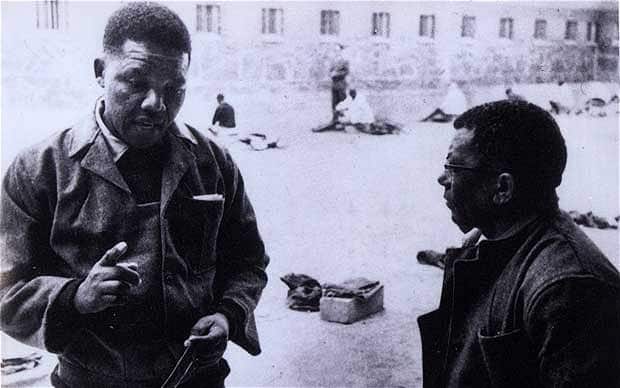
Mandela served 27 years in prison, initially on Robben Island, and later in Pollsmoor Prison and Victor Verster Prison. Amid growing domestic and international pressure, and with fears of a racial civil war, President F. W. de Klerk released him in 1990.
Nelson Mandela imprisoned on Robben Island
Mandela and de Klerk negotiated an end to apartheid and organised the 1994 multiracial general election in which Mandela led the ANC to victory and became President. Leading a broad coalition government which promulgated a new constitution, Mandela emphasised reconciliation between the country's racial groups and created the Truth and Reconciliation Commission to investigate past human rights abuses.
Economically, Mandela's administration retained its predecessor's liberal framework despite his own socialist beliefs, also introducing measures to encourage land reform, combat poverty, and expand healthcare services.
Widely regarded as an icon of democracy and social justice, he received more than 250 honours, including the Nobel Peace Prize, and became the subject of a cult of personality. He is held in deep respect within South Africa, where he is often referred to by his Xhosa clan name, Madiba, and described as the Father of the Nation.
Desmond Mpilo Tutu was born on October 7, 1931 in Klerksdorp, South
Africa. The South Africa of Tutu's youth was rigidly segregated, with black
Africans denied the right to vote and forced to live only in specific areas.
Tutu became
increasingly frustrated with the racism corrupting all aspects of South African
life under apartheid. In 1948, when Tutu was 17 years old, the National Party
won control of the government and codified the nation's long-present
segregation and inequality into the official, rigid policy of apartheid. In
1953, the government passed the Bantu Education Act, a law that lowered the
standards of education for black South Africans to ensure that they only
learned what was necessary for a life of servitude.
In 1958,
Tutu enrolled at St. Peter's Theological College in Johannesburg. He was
ordained as an Anglican deacon in 1960 and as a priest in 1961. Tutu was
selected as the General Secretary of the South African Council of Churches in
1978, and he continued to use his elevated position in the South African
religious hierarchy to advocate for an end to apartheid.
In 1984,
Desmond Tutu received the Nobel Peace
Prizenot only as a gesture of support to him and to the South
African Council of Churches of which he is leader, but also to all individuals
and groups in South Africa who, with their concern for human dignity,
fraternity and democracy, incite the admiration of the world. Tutu's
receipt of the Nobel Peace Prize transformed South Africa's anti-apartheid movement into a truly international force
with deep sympathies all across the globe.
In 1985,
Tutu was appointed the Bishop of Johannesburg, and a year later he became thefirst black person to hold the highest position in the South African Anglican
Church when he was chosen as the Archbishop of Cape Town.
Nowadays, Desmond
Tutu continues his fight in a favour of peace and democracy supporting acts
around the world.
If you are neutral in situations of injustice, you
have chosen the side of the oppressor. If an elephant has its foot on the tail
of a mouse and you say that you are neutral, the mouse will not appreciate your
neutrality.
.jpg)