Today, The Grandma has been reading about the British colonization of Egypt, and about the Nile, the longest river in Africa.She has remembered a trip along the river with her friends ClaireFontaine, TinaPicotes, Joseph de Ca'th Lon, TonyiTamaki and Jordi Santanyí.Itwas an incredible experience to remember and explain.
The Nile is a major north-flowing river in northeastern Africa. It flows into the Mediterranean Sea.
The Nile is the longest river in Africa and has historically been considered the longest river in the world, though this has been contested by research suggesting that the Amazon River is slightly longer.
Of the world's major rivers, the Nile is one of the smallest, as measured by annual flow in cubic metres of water. About 6,650 km long, its drainage basin covers eleven countries: the Democratic Republic of the Congo, Tanzania, Burundi, Rwanda, Uganda, Kenya, Ethiopia, Eritrea, South Sudan, Republic of the Sudan, and Egypt.
In particular, the Nile is the primary water source of Egypt, Sudan and South Sudan. Additionally, the Nile is an important economic river, supporting agriculture and fishing.
The Nile has two major tributaries -the White Nile and the Blue Nile. The White Nile is traditionally considered to be the headwaters stream. However, the BlueNile is the source of most of the water of the Nile downstream, containing 80% of the water and silt. The White Nile is longer and rises in the Great Lakes region. It begins at Lake Victoria and flows through Uganda and South Sudan. The Blue Nile begins at Lake Tana in Ethiopia and flows into Sudan from the southeast. The two rivers meet at the Sudanese capital of Khartoum.
The northern section of the river flows north almost entirely through the NubianDesert to Cairo and its large delta, and the river flows into the Mediterranean Sea at Alexandria. Egyptian civilization and Sudanese kingdoms have depended on the river and its annual flooding since ancient times. Most of the population and cities of Egypt lie along those parts of the Nile valley north of the Aswan Dam. Nearly all the cultural and historical sites of Ancient Egypt developed and are found along river banks. The Nile is, with the Rhône and Po, one of the three Mediterranean rivers with the largest water discharge.
The standard English names White Nile and Blue Nile refer to the river's source, derived from Arabic names formerly applied to only the Sudanese stretches that meet at Khartoum.
In the ancient Egyptian language, the Nile is called Ḥ'pī (Hapy) or Iteru, meaning river. In Coptic, the word ⲫⲓⲁⲣⲟ, pronounced piaro (Sahidic) or phiaro (Bohairic), means the river, and comes from the same ancient name. In Nobiin the river is called Áman Dawū, meaning the great water. In Luganda the river is called Kiira or Kiyira. In Runyoro it is called Kihiira. In Egyptian Arabic, the Nile is called en-Nīl, while in Standard Arabic it is called an-Nīl. In Biblical Hebrew, it is הַיְאוֹר, Ha-Ye'or or הַשִׁיחוֹר, Ha-Shiḥor.
The English name Nile and the Arabic names en-Nîl and an-Nîl both derive from the Latin Nilus and the Ancient Greek Νεῖλος. Beyond that, however, the etymology is disputed. Homer called the river Αἴγυπτος, Aiguptos, but in subsequent periods, Greek authors referred to its lower course as Neilos; this term became generalised for the entire river system. Thus, the name may derive from Ancient Egyptian expression nꜣ rꜣw-ḥꜣw(t) the mouths of the front parts, which referred specifically to the branches of the Nile transversing the Delta, and would have been pronounced ni-lo-he in the area around Memphis in the 8th century BCE. Hesiod at his Theogony refers to Nilus (Νεῖλος) as one of the Potamoi (river gods), son of Oceanus and Tethys.
Another derivation of Nile might be related to the term Nil, which refers to Indigofera tinctoria, one of the original sources of indigo dye. Another may be Nymphaea caerulea, known as The Sacred Blue Lily of the Nile, which was found scattered over Tutankhamun's corpse when it was excavated in 1922. Another possible etymology derives from the Semitic term Nahal, meaning river. Old Libyan has the term lilu, meaning water (in modern Berber ilel ⵉⵍⴻⵍ means sea).
With a total length of about 6,650 km between the region of Lake Victoria and the Mediterranean Sea, the Nile is among the longest rivers on Earth. The drainage basin of the Nile covers 3,254,555 square kilometers, about 10% of the area of Africa. Compared to other major rivers, though, the Nile carries little water (5% of that of the Congo River, for example). The Nile basin is complex, and because of this, the discharge at any given point along the main stem depends on many factors including weather, diversions, evaporation and evapotranspiration, and groundwater flow.
Upstream from Khartoum (to the south), the river is known as the White Nile, a term also used in a limited sense to describe the section between Lake No and Khartoum. At Khartoum, the river is joined by the Blue Nile. The White Nile starts in equatorial East Africa, and the Blue Nile begins in Ethiopia. Both branches are on the western flanks of the East African Rift.
Below the Aswan Dam, at the northern limit of Lake Nasser, the Nile resumes its historic course. North of Cairo, the Nile splits into two branches (or distributaries) that feed the Mediterranean: the Rosetta Branch to the west and the Damietta to the east, forming the Nile Delta.
Agatha Mary Clarissa Christie, Lady Mallowan, (15 September 1890-12 January 1976) was an English writer known for her 66 detective novels and 14 short story collections, particularly those revolving around fictional detectives Hercule Poirot and Miss Marple.
She wrote the world's longest-running play, the murder mystery TheMousetrap, which has been performed in the West End since 1952.
A writer during the Golden Age of Detective Fiction, Christie has been called the Queen of Crime. She also wrote six novels under the pseudonym Mary Westmacott.
In 1971, she was made a Dame (DBE) by Queen Elizabeth II for her contributions to literature. Guinness World Records lists Christie as the best-selling fiction writer of all time, her novels having sold more than two billion copies.
In her youth, Christie showed little interest in antiquities. After her marriage to Mallowan in 1930, she accompanied him on annual expeditions, spending three to four months at a time in Syria and Iraq at excavation sites at Ur, Nineveh, Tell Arpachiyah, Chagar Bazar, Tell Brak, and Nimrud. Mallowans also took side trips whilst travelling to and from expedition sites, visiting Italy, Greece, Egypt, Iran, and the Soviet Union, among other places. Their experiences travelling and living abroad are reflected in novels such as Murder on the Orient Express, Death on the Nile, and Appointment with Death.
Death on the Nile is a work of detective fiction by British writer Agatha Christie, published in the UK by the Collins Crime Club on 1 November 1937 and in the US by Dodd, Mead and Company the following year. The UK edition retailed at seven shillings and sixpence and the US edition at $2.00.
The book features the Belgian detective Hercule Poirot. The action takes place in Egypt, mostly on the River Nile. The novel is unrelated to Christie's earlier short story of the same name, which featured Parker Pyne as the detective.
Contemporary reviews of the book were primarily positive. The Times Literary Supplement's short review concluded by saying Hercule Poirot, as usual, digs out a truth so unforeseen that it would be unfair for a reviewer to hint at it.
The Scotsman review of 11 November 1937 finished by saying that, the author has again constructed the neatest of plots, wrapped it round with distracting circumstances, and presented it to what should be an appreciative public.
E R Punshon of The Guardian in his review of 10 December 1937 began by saying, To decide whether a writer of fiction possesses the true novelist's gift it is often a good plan to consider whether the minor characters in his or her book, those to whose creation the author has probably given little thought, stand out in the narrative in their own right as living personalities. This test is one Mrs Christie always passes successfully, and never more so than in her new book.
In a later review, Robert Barnard wrote that this novel is One of the top ten, in spite of an overcomplex solution. The familiar marital triangle, set on a Nile steamer. The weakness is that there is Comparatively little local colour, but some good grotesques among the passengers – of which the film took advantage. He notes a change in Christie's novels with this plot published in 1937, as Spies and agitators are beginning to invade the pure Christie detective story at this period, as the slide towards war begins.
The trip is arriving to the end. The travel along the NileRiver has been an incredible and unforgettable experience. Every member of the group has different favourite places to choose and to explain and they have edited some videos to remember their travel. Joseph de Ca'th Lon loves Archaeology and he has chosen the Land of the Pharaohs as his best experience. For Tina Picotes and Claire Fontaine it's impossible to choose only one site and they prefer to remember every place they have visited. The Grandma is a fan of Saint George and she remembers with a special feeling the visit to the Copts and Saint George's churches. They are living the lasts hours in Egypt and they're enjoying the wonderful pyramids of Giza and the incredible activity of the Egyptian capital, Cairo. Before finishing this amazing travel, The Grandma has studied two new chapters of her Intermediate Language Practice manual (Vocabulary 13 & 14). For The Grandma, it has been a very special travel because she wanted to discover the origins of Saint George, a very important figure for lots of communities and for their culture.
Giza is the third-largest city in Egypt and the capital of the Giza Governorate. It is located on the west bank of the Nile, 4.9 km southwest of central Cairo.
Giza's most famous land form and archaeological site, the Giza Plateau, holds some major monuments of Egyptian history, and is home to the Great Sphinx. Once thriving with the Nile that flowed right into the Giza Plateau, the pyramids of Giza were built overlooking the ancient Egyptian capital city of Memphis,across the river from modern day Cairo.
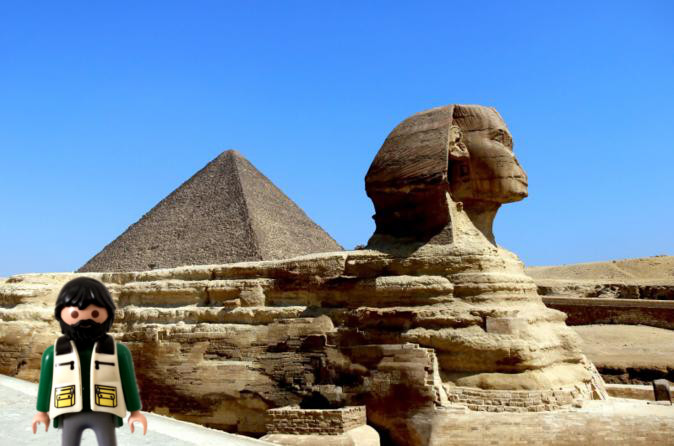
Joseph de Ca'th Lon & The Great Sphinx, Giza
The Giza Plateau is also home to Egyptianmonuments such as the tomb of Pharaoh DjetoftheFirst Dynasty, as well as that of Pharaoh Ninetjer of the Second Dynasty. The Great Pyramid of Giza at one time was advocated (1884) as the location for the Prime Meridian, a reference point used for determining a base longitude. Giza lies less than 20 km north of Mn Nefer, Memphis, which means the beautiful wall in the ancient Egyptian language, and which was the capital city of the first unified Egyptian state since the days of Pharaoh Narmer. Memphis was the ancient Pharaonic capital of the Old Kingdom. Its St. George cathedral is the episcopal see of the Coptic Catholic Eparchy of Giza.
The Giza pyramid complex is an archaeological site on the Giza Plateau, on the outskirts of Cairo. It includes the three Great Pyramids, Khufu/Cheops, Khafre/Chephren and Menkaure, the Great Sphinx, several cemeteries, a workers' village and an industrial complex. It is located in the Western Desert, approximately 9 km west of the Nile River at the old town of Giza, and about 13 km southwest of Cairo city centre.
The pyramids, which have historically been common as emblems of ancient Egypt in the Western imagination, were popularised in Hellenistic times, when the Great Pyramid was listed by Antipater of Sidon as one of the Seven Wonders of the World. It is by far the oldest of the ancient Wonders and the only one still in existence.
The Pyramids of Giza consist of the Great Pyramid of Giza, also known as the Pyramid of Cheops or Khufu and constructed c.2560 – c.2540 BC, the somewhat smaller Pyramid of Khafre or Chephren a few hundred meters to the south-west, and the relatively modest-sized Pyramid of Menkaure or Mykerinos a few hundred meters farther south-west.
The Grandma, Joseph & The Great Sphinx, Giza
The Great Sphinx lies on the east side of the complex. Current consensus among Egyptologists is that the head of the GreatSphinx is that of Khafre. Along with these major monuments are a number of smaller satellite edifices, known as queens pyramids, causeways and valley pyramids.
Khufu’s pyramid complex consists of a valley temple, nowburied beneath the village of Nazlet el-Samman; basalt paving and nummulitic limestone walls have been found but the site has not been excavated. The valley temple was connected to a causeway which was largely destroyed when the village was constructed. The causeway led to the Mortuary Temple of Khufu. From this temple the basalt pavement is the only thing that remains. The mortuary temple was connected to the king’s pyramid. The king’s pyramid has three smaller queen’s pyramids associated with it and five boat pits. The boat pits contained a ship, and the 2 pits on the south side of the pyramid still contained intact ships. One of these ships has been restored and is on display. Khufu's pyramid still has a limited collection of casing stones at its base. These casing stones were made of fine white limestone quarried from the nearby range.
Khafre’s pyramid complex consists of a valley temple, the Sphinx temple, a causeway, a mortuary temple and the king’s pyramid. The valley temple yielded several statues of Khafre. Several were found in a well in the floor of the temple by Mariettein 1860. Others were found during successive excavations by Sieglin (1909–10), Junker, Reisner, and Hassan. Khafre’s complex contained five boat-pits and a subsidiary pyramid with a serdab. Khafre's pyramid appears larger than the adjacent Khufu Pyramid by virtue of its more elevated location, and the steeper angle of inclination of its construction, it is, in fact, smaller in both height and volume. Khafre's pyramid retains a prominent display of casing stones at its apex.
Visiting The Great Sphinx, Giza
Menkaure’s pyramid complex consists of a valley temple, a causeway, a mortuary temple, and the king’s pyramid. The valley temple once contained several statues of Menkaure. During the 5th Dynasty, a smaller ante-temple was added on to the valley temple. The mortuary temple also yielded several statues of Menkaure. The king’s pyramid has three subsidiary or queen’s pyramids. Of the four major monuments, only Menkaure's pyramid is seen today without any of its original polished limestone casing.
The Sphinx dates from the reign of king Khafre. During the New Kingdom, Amenhotep II dedicated a new temple to Hauron-Haremakhet and this structure was added onto by later rulers.
Khentkaus I was buried in Giza. Her tomb is located in the Central Field, near the valley temple of Menkaure. The pyramid complex of Queen Khentkaus includes: her pyramid, a boat pit, a valley temple and a pyramid town. Most
construction theories are based on the idea that the pyramids were
built by moving huge stones from a quarry and dragging and lifting them
into place. The disagreements center on the method by which the stones
were conveyed and placed and how possible the method was.
In building the pyramids, the architects might have developed their techniques over time. They would select a site on a relatively flat area of bedrock, not sand, which provided a stable foundation. After carefully surveying the site and laying down the first level of stones, they constructed the pyramids in horizontal levels, one on top of the other.
For the Great Pyramid of Giza, most of the stone for the interior seems to
have been quarried immediately to the south of the construction site.
The smooth exterior of the pyramid was made of a fine grade of white
limestone that was quarried across the Nile. These exterior
blocks had to be carefully cut, transported by river barge to Giza, and
dragged up ramps to the construction site. Only a few exterior blocks
remain in place at the bottom of the Great Pyramid. During the Middle Ages, 5th century to 15th century, people may have taken the rest away for building projects in the city of Cairo.
The Grandma & Claire contemplate the pyramids
To ensure that the pyramid remained symmetrical, the exterior casing stones all had to be equal in height and width. Workers might have marked all the blocks to indicate the angle of the pyramid wall and trimmed the surfaces carefully so that the blocks fit together. During construction, the outer surface of the stone was smooth limestone; excess stone has eroded as time has passed.
The pyramids of Giza and others are thought to have been constructed to house the remains of the deceased Pharaohs who ruled over Ancient Egypt. A portion of the Pharaoh's spirit called his ka was believed to remain with his corpse. Proper care of the remains was necessary in order for the former Pharaoh to perform his new duties as king of the dead. It's theorized the pyramid not only served as a tomb for the Pharaoh, but also as a storage pit for various items he would need in the afterlife. The people of Ancient Egypt believed that death on Earth was the start of a journey to the next world. The embalmed body of the King was entombed underneath or within the pyramid to protect it and allow his transformation and ascension to the afterlife.
The sides of all three of the Giza pyramids were astronomically oriented to the north-south and east-west within a small fraction of a degree. The arrangement of the pyramids is a representation of the Orion constellation according to the disputed Orion Correlation Theory.
Cairo is the capital of Egypt. The city's metropolitan area is one of the largest in Africa, the largest in the Middle East and the Arab world, and the 15th-largest in the world, and is associated with ancient Egypt, as the famous Giza pyramid complex and the ancient city of Memphis are located in its geographical area. Located near the Nile Delta, modern Cairo was founded in 969 CE by the Fatimid Dynasty,
but the land composing the present-day city was the site of ancient
national capitals whose remnants remain visible in parts of Old Cairo.
Tina Picotes in the market, Cairo
Cairo has long been a center of the region's political and cultural life, and is titled the city of a thousand minarets for its preponderance of Islamicarchitecture.
Cairo is located in northernEgypt,known as LowerEgypt, 165 kilometres south of the Mediterranean Sea and 120 kilometres west of the Gulf of Suez and Suez Canal. The city lies along the NileRiver, immediately south of the point where the river leaves its desert-bound valley and branches into the low-lying Nile Delta region.
Until the mid-19th century, when the river was tamed by dams, levees, and other controls, the Nile in the vicinity of Cairo was highly susceptible to changes in course and surface level.
Over the years, the Nile gradually shifted westward, providing the site between the eastern edge of the river and the Mokattam highlands on which the city now stands. The land on which Cairo was established in 969, present-day IslamicCairo, was located underwater just over three hundred years earlier, when Fustat was first built.
Low periods of the Nile during the 11th century continued to add to the landscape of Cairo; a new island, known as Geziret al-Fil, first appeared in 1174, but eventually became connected to the mainland. Today, the site of Geziret al-Fil is occupied by the Shubra district. The low periods created another island at the turn of the 14th century that now composes Zamalek and Gezira. Land reclamation efforts by the Mamluks and Ottomans further contributed to expansion on the east bank of the river.
Visiting the Salah El Din Citadel, Cairo
Because of the Nile's movement, the newer parts of the city, Garden City, Downtown Cairo, and Zamalek, are located closest to the riverbank. The areas, which are home to most of Cairo's embassies, are surrounded on the north, east, and south by the older parts of the city. Old Cairo, located south of the centre, holds the remnants of Fustat and the heart of Egypt's Coptic Christian community, Coptic Cairo. The Boulaq district, which lies in the northern part of the city, was born out of a major 16th-century port and is now a major industrial centre. The Citadel is located east of the city centre around Islamic Cairo, which dates back to the Fatimid era and the foundation of Cairo. While western Cairo is dominated by wide boulevards, open spaces, and modern architecture of European influence, the eastern half, having grown haphazardly over the centuries, is dominated by crowded tenements, and Islamic architecture.
Egyptians often refer to Cairo as Maṣr, the Egyptian Arabic name for Egypt itself, emphasizing the city's importance for the country. Its official name al-Qāhirah means the Vanquisher or the Conqueror, supposedly due to the fact that the planet Mars, an-Najm al-Qāhir, the Conquering Star, was rising at the time when the city was founded, possibly also in reference to the much awaited arrival of the Fatimid Caliph Al-Mu'izz who reached Cairo in 973 from Mahdia, the old Fatimid capital. The location of the ancient city of Heliopolis is the suburb of Ain Shams, Eye of the Sun.
Claire Fontaine in the Cairo Citadel
The Coptic name of the city is Kashromi which means man breaker which is akin to Arabic al-Qāhirah . Sometimes the city is informally referred to as Kayro by people from Alexandria.
The area around present-day Cairo,especially Memphis that was the old capital of Egypt, had long been a focal point of Ancient Egypt due to its strategic location just upstream from the Nile Delta. However, the origins of the modern city are generally traced back to a series of settlements in the first millennium. Around the turn of the 4th century, as Memphis was continuing to decline in importance, the Romans established a fortress town along the east bank of the Nile. This fortress, known as Babylon, was the nucleus of the Roman and then the Byzantine city and is the oldest structure in the city today. It is also situated at the nucleus of the Coptic Orthodox community, which separated from the Roman and Byzantine churches in the late 4th century.
Many of Cairo's oldest Copticchurches, including the HangingChurch, are located along the fortress walls in a section of the city known as CopticCairo.
The Church of St. George is a Greek Orthodox church within Babylon Fortress in Coptic Cairo. It is part of the Holy Patriarchal Monastery of St George under the Greek Orthodox Patriarchate of Alexandria and all Africa. The church dates back to the 10th century or earlier. The current structure was rebuilt following a 1904 fire, construction was finished in 1909. Since 2009, the monastery's hegumen has had the rank of bishop with title Bishop Babylonos.
The Grandma at the Church of Saint George, Cairo
St. George is the only round church in Egypt, but unlike the original Church of the Holy Sepulchre and its many imitators, such as Rome's Santa Stefano Rotondo and London's Temple Church, this is only for practical reasons, it is built atop the foundations of a Roman round tower. Inside, the dark interior is heavy with incense and pierced by sunbeams that filter through its stained glass windows. A closed flight of steps leads down into the old Roman tower, once believed to be peopled by devils. Next door, the Monastery of St. George is now the seat of the Greek Orthodox Patriarchate of Alexandria. The monastery rarely admits tourists.
There are another Church of St. George and a Convent of St. George, the latter of which opens its chapel to visitors and has some English-speaking nuns. Both of these institutions are Coptic Orthodox.
The Church of Saint George is situated in the district of Old Cairo, is an area known as Coptic Cairo, the first settlement of Christians in central Egypt back in the 10th Century. The word Copt means Egyptian Christian.
The Grandma loves Saint George, Cairo
The Church of Saint Georgeis located about 30 minutes from Downtown Cairo, Saint Georges Church sits in the heart of Old Coptic Cairo in the Old Cairodistrict. It is located amongst several other Churches in a private Christiancommunity which has been established and preserved since the 10th Century.
The Church of Saint George, which is Greek Orthodox,was built by Athanasius during the reign of IbnMarwan, Governor of Egypt, and was mentioned in the History of the Patriarchs of the Coptic Church and by Al-Maqrizi. The church was destroyed by fire in the middle of the last century and later reconstructed without cupolas. The modern church, of the four pillar type, is without architectural interest, but the Qa’at Al-Irsan, the Nuptial Hall, which belong to the complex, is a small palace from the 13th/14th century measuring 15 by 12 meters. The hall contains beautiful tracery and carving reminiscent of ornamentation found in some Cairo mansions from the Mameluke Period.
Old Cairo is well and truly a fantastic part of Cairo where visitors can easily spend an entire day or more exploring the many ancient sites.
The Coptic
area in particular is a place not to be missed, since it is home to
many famous religious buildings, one of which is the delightful Church of St. George. In fact, many visitors believe that the Church of St. George is the most eye catching building in the area.
Dragon weather vane, Church of St. George, Cairo
The interior of the GreekOrthodox St. George church is accessed through the massive front doors. The interior of the
church is renowned for its beautiful stained glass and the abundance of
rich darkly stained wood. The closed stairs go down into the
ruins of the older Roman tower.
There are some interesting places to visit in the Coptic area. The Coptic Museum; Hanging Church; Ben Ezra Synagogue; Church of St. Barbara and the Coptic St. George Church are all within easy walking distance of each other.
It's possible to ascend the steps along the Roman towers and see a relief of St. George slaying a dragon on the outer brickwork of the wall. Inside, the austere ancient artwork grace the church with depictions of St. George and his quest to defend Christianity.
The trip is arriving to the end. The travel along the Nile River has been an incredible and unforgettable experience. Every member of the group has different favourite places to choose and to explain and they have edited some videos to remember their travel. Joseph de Ca'th Lon loves Archaeology and he has chosen the Land of thePharaohs as his best experience. For Tina Picotes and Claire Fontaine it's impossible to choose only one site and they prefer to remember every place they have visited. The Grandma is a fan of Saint George and she remembers with a special feeling the visit to the Copts and Saint George's churches. They are living the lasts hours in Egypt and they're enjoying the wonderful pyramids of Giza and the incredible activity of the Egyptian capital, Cairo. Before finishing this amazing travel, The Grandma has studied two new chapters of her Intermediate Language Practice manual (Vocabulary 13 & 14). For The Grandma, it has been a very special travel because she wanted to discover the origins of Saint George, a very important figure for lots of communities and for their culture.
Giza is the third-largest city in Egypt and the capital of the Giza Governorate. It is located on the west bank of the Nile, 4.9 km southwest of central Cairo.
Giza's most famous land form and archaeological site, the Giza Plateau, holds some major monuments of Egyptian history, and is home to the Great Sphinx. Once thriving with the Nile that flowed right into the Giza Plateau, the pyramids of Giza were built overlooking the ancient Egyptian capital city of Memphis,across the river from modern day Cairo.
Joseph de Ca'th Lon & The Great Sphinx, Giza
The Giza Plateau is also home to Egyptianmonuments such as the tomb of Pharaoh DjetoftheFirst Dynasty, as well as that of Pharaoh Ninetjer of the Second Dynasty. The Great Pyramid of Giza at one time was advocated (1884) as the location for the Prime Meridian, a reference point used for determining a base longitude. Giza lies less than 20 km north of Mn Nefer, Memphis, which means the beautiful wall in the ancient Egyptian language, and which was the capital city of the first unified Egyptian state since the days of Pharaoh Narmer. Memphis was the ancient Pharaonic capital of the Old Kingdom. Its St. George cathedral is the episcopal see of the Coptic Catholic Eparchy of Giza.
The Giza pyramid complex is an archaeological site on the Giza Plateau, on the outskirts of Cairo. It includes the three Great Pyramids, Khufu/Cheops, Khafre/Chephren and Menkaure, the Great Sphinx, several cemeteries, a workers' village and an industrial complex. It is located in the Western Desert, approximately 9 km west of the Nile River at the old town of Giza, and about 13 km southwest of Cairo city centre.
The pyramids, which have historically been common as emblems of ancient Egypt in the Western imagination, were popularised in Hellenistic times, when the Great Pyramid was listed by Antipater of Sidon as one of the Seven Wonders of the World. It is by far the oldest of the ancient Wonders and the only one still in existence.
The Pyramids of Giza consist of the Great Pyramid of Giza, also known as the Pyramid of Cheops or Khufu and constructed c.2560 – c.2540 BC, the somewhat smaller Pyramid of Khafre or Chephren a few hundred meters to the south-west, and the relatively modest-sized Pyramid of Menkaure or Mykerinos a few hundred meters farther south-west.
The Grandma, Joseph & The Great Sphinx, Giza
The Great Sphinx lies on the east side of the complex. Current consensus among Egyptologists is that the head of the GreatSphinx is that of Khafre. Along with these major monuments are a number of smaller satellite edifices, known as queens pyramids, causeways and valley pyramids.
Khufu’s pyramid complex consists of a valley temple, now buried beneath the village of Nazlet el-Samman; basalt paving and nummulitic limestone walls have been found but the site has not been excavated. The valley temple was connected to a causeway which was largely destroyed when the village was constructed. The causeway led to the Mortuary Temple of Khufu. From this temple the basalt pavement is the only thing that remains. The mortuary temple was connected to the king’s pyramid. The king’s pyramid has three smaller queen’s pyramids associated with it and five boat pits. The boat pits contained a ship, and the 2 pits on the south side of the pyramid still contained intact ships. One of these ships has been restored and is on display. Khufu's pyramid still has a limited collection of casing stones at its base. These casing stones were made of fine white limestone quarried from the nearby range.
Khafre’s pyramid complex consists of a valley temple, the Sphinx temple, a causeway, a mortuary temple and the king’s pyramid. The valley temple yielded several statues of Khafre. Several were found in a well in the floor of the temple by Mariettein 1860. Others were found during successive excavations by Sieglin (1909–10), Junker, Reisner, and Hassan. Khafre’s complex contained five boat-pits and a subsidiary pyramid with a serdab. Khafre's pyramid appears larger than the adjacent Khufu Pyramid by virtue of its more elevated location, and the steeper angle of inclination of its construction, it is, in fact, smaller in both height and volume. Khafre's pyramid retains a prominent display of casing stones at its apex.
Visiting The Great Sphinx, Giza
Menkaure’s pyramid complex consists of a valley temple, a causeway, a mortuary temple, and the king’s pyramid. The valley temple once contained several statues of Menkaure. During the 5th Dynasty, a smaller ante-temple was added on to the valley temple. The mortuary temple also yielded several statues of Menkaure. The king’s pyramid has three subsidiary or queen’s pyramids. Of the four major monuments, only Menkaure's pyramid is seen today without any of its original polished limestone casing.
The Sphinx dates from the reign of king Khafre. During the New Kingdom, Amenhotep II dedicated a new temple to Hauron-Haremakhet and this structure was added onto by later rulers.
Khentkaus I was buried in Giza. Her tomb is located in the Central Field, near the valley temple of Menkaure. The pyramid complex of Queen Khentkaus includes: her pyramid, a boat pit, a valley temple and a pyramid town. Most
construction theories are based on the idea that the pyramids were
built by moving huge stones from a quarry and dragging and lifting them
into place. The disagreements center on the method by which the stones
were conveyed and placed and how possible the method was.
In building the pyramids, the architects might have developed their techniques over time. They would select a site on a relatively flat area of bedrock, not sand, which provided a stable foundation. After carefully surveying the site and laying down the first level of stones, they constructed the pyramids in horizontal levels, one on top of the other.
For the Great Pyramid of Giza, most of the stone for the interior seems to
have been quarried immediately to the south of the construction site.
The smooth exterior of the pyramid was made of a fine grade of white
limestone that was quarried across the Nile. These exterior
blocks had to be carefully cut, transported by river barge to Giza, and
dragged up ramps to the construction site. Only a few exterior blocks
remain in place at the bottom of the Great Pyramid. During the Middle Ages, 5th century to 15th century, people may have taken the rest away for building projects in the city of Cairo.
The Grandma & Claire contemplate the pyramids
To ensure that the pyramid remained symmetrical, the exterior casing stones all had to be equal in height and width. Workers might have marked all the blocks to indicate the angle of the pyramid wall and trimmed the surfaces carefully so that the blocks fit together. During construction, the outer surface of the stone was smooth limestone; excess stone has eroded as time has passed.
The pyramids of Giza and others are thought to have been constructed to house the remains of the deceased Pharaohs who ruled over Ancient Egypt. A portion of the Pharaoh's spirit called his ka was believed to remain with his corpse. Proper care of the remains was necessary in order for the former Pharaoh to perform his new duties as king of the dead. It's theorized the pyramid not only served as a tomb for the Pharaoh, but also as a storage pit for various items he would need in the afterlife. The people of Ancient Egypt believed that death on Earth was the start of a journey to the next world. The embalmed body of the King was entombed underneath or within the pyramid to protect it and allow his transformation and ascension to the afterlife.
The sides of all three of the Giza pyramids were astronomically oriented to the north-south and east-west within a small fraction of a degree. The arrangement of the pyramids is a representation of the Orion constellation according to the disputed Orion Correlation Theory.
Cairo is the capital of Egypt. The city's metropolitan area is one of the largest in Africa, the largest in the Middle East and the Arab world, and the 15th-largest in the world, and is associated with ancient Egypt, as the famous Giza pyramid complex and the ancient city of Memphis are located in its geographical area. Located near the Nile Delta, modern Cairo was founded in 969 CE by the Fatimid Dynasty,
but the land composing the present-day city was the site of ancient
national capitals whose remnants remain visible in parts of Old Cairo.
Tina Picotes in the market, Cairo
Cairo has long been a center of the region's political and cultural life, and is titled the city of a thousand minarets for its preponderance of Islamicarchitecture.
Cairo is located in northernEgypt,known as LowerEgypt, 165 kilometres south of the Mediterranean Sea and 120 kilometres west of the Gulf of Suez and Suez Canal. The city lies along the Nile River, immediately south of the point where the river leaves its desert-bound valley and branches into the low-lying Nile Delta region.
Until the mid-19th century, when the river was tamed by dams, levees, and other controls, the Nile in the vicinity of Cairo was highly susceptible to changes in course and surface level.
Over the years, the Nile gradually shifted westward, providing the site between the eastern edge of the river and the Mokattam highlands on which the city now stands. The land on which Cairo was established in 969, present-day IslamicCairo, was located underwater just over three hundred years earlier, when Fustat was first built.
Low periods of the Nile during the 11th century continued to add to the landscape of Cairo; a new island, known as Geziret al-Fil, first appeared in 1174, but eventually became connected to the mainland. Today, the site of Geziret al-Fil is occupied by the Shubra district. The low periods created another island at the turn of the 14th century that now composes Zamalek and Gezira. Land reclamation efforts by the Mamluks and Ottomans further contributed to expansion on the east bank of the river.
Visiting the Salah El Din Citadel, Cairo
Because of the Nile's movement, the newer parts of the city, Garden City, Downtown Cairo, and Zamalek, are located closest to the riverbank. The areas, which are home to most of Cairo's embassies, are surrounded on the north, east, and south by the older parts of the city. Old Cairo, located south of the centre, holds the remnants of Fustat and the heart of Egypt's Coptic Christian community, Coptic Cairo. The Boulaq district, which lies in the northern part of the city, was born out of a major 16th-century port and is now a major industrial centre. The Citadel is located east of the city centre around Islamic Cairo, which dates back to the Fatimid era and the foundation of Cairo. While western Cairo is dominated by wide boulevards, open spaces, and modern architecture of Europeaninfluence, the eastern half, having grown haphazardly over the centuries, is dominated by crowded tenements, and Islamic architecture.
Egyptians often refer to Cairo as Maṣr, the Egyptian Arabic name for Egypt itself, emphasizing the city's importance for the country. Its official name al-Qāhirah means the Vanquisher or the Conqueror, supposedly due to the fact that the planet Mars, an-Najm al-Qāhir, the Conquering Star, was rising at the time when the city was founded, possibly also in reference to the much awaited arrival of the Fatimid Caliph Al-Mu'izz who reached Cairo in 973 from Mahdia, the old Fatimid capital. The location of the ancient city of Heliopolis is the suburb of Ain Shams, Eye of the Sun.
Claire Fontaine in the Cairo Citadel
The Coptic name of the city is Kashromi which means man breaker which is akinto Arabic al-Qāhirah . Sometimes the city is informally referred to as Kayro by people from Alexandria.
The area around present-day Cairo,especially Memphis that was the old capital of Egypt, had long been a focal point of Ancient Egypt due to its strategic location just upstream from the Nile Delta. However, the origins of the modern city are generally traced back to a series of settlements in the first millennium. Around the turn of the 4th century, as Memphis was continuing to decline in importance, the Romans established a fortress town along the east bank of the Nile. This fortress, known as Babylon, was the nucleus of the Roman and then the Byzantine city and is the oldest structure in the city today. It is also situated at the nucleus of the Coptic Orthodox community, which separated from the Roman and Byzantine churches in the late 4th century.
Many of Cairo's oldest Copticchurches, including the HangingChurch, are located along the fortress walls in a section of the city known as CopticCairo.
The Church of St. George is a Greek Orthodox church within Babylon Fortress in Coptic Cairo. It is part of the Holy Patriarchal Monastery of St George under the Greek Orthodox Patriarchate of Alexandria and all Africa. The church dates back to the 10th century or earlier. The current structure was rebuilt following a 1904 fire, construction was finished in 1909. Since 2009, the monastery's hegumen has had the rank of bishop with title Bishop Babylonos.
The Grandma at the Church of Saint George, Cairo
St. George is the only round church in Egypt, but unlike the original Church of the Holy Sepulchre and its many imitators, such as Rome's Santa Stefano Rotondo and London's Temple Church, this is only for practical reasons, it is built atop the foundations of a Roman round tower. Inside, the dark interior is heavy with incense and pierced by sunbeams that filter through its stained glass windows. A closed flight of steps leads down into the old Roman tower, once believed to be peopled by devils. Next door, the Monastery of St. George is now the seat of the Greek Orthodox Patriarchate of Alexandria. The monastery rarely admits tourists.
There are another Church of St. George and a Convent of St. George, the latter of which opens its chapel to visitors and has some English-speaking nuns. Both of these institutions are Coptic Orthodox.
The Church of Saint George is situated in the district of Old Cairo, is an area known as Coptic Cairo, the first settlement of Christians in central Egypt back in the 10th Century. The word Copt means Egyptian Christian.
The Grandma loves Saint George, Cairo
The Church of Saint Georgeis located about 30 minutes from Downtown Cairo, Saint Georges Church sits in the heart of Old Coptic Cairo in the Old Cairodistrict. It is located amongst several other Churches in a private Christiancommunity which has been established and preserved since the 10th Century.
The Church of Saint George, which is Greek Orthodox,was built by Athanasius during the reign of IbnMarwan, Governor of Egypt, and was mentioned in the History of the Patriarchs of the Coptic Church and by Al-Maqrizi. The church was destroyed by fire in the middle of the last century and later reconstructed without cupolas. The modern church, of the four pillar type, is without architectural interest, but the Qa’at Al-Irsan, the Nuptial Hall, which belong to the complex, is a small palace from the 13th/14th century measuring 15 by 12 meters. The hall contains beautiful tracery and carving reminiscent of ornamentation found in some Cairo mansions from the Mameluke Period.
Old Cairo is well and truly a fantastic part of Cairo where visitors can easily spend an entire day or more exploring the many ancient sites.
The Coptic
area in particular is a place not to be missed, since it is home to
many famous religious buildings, one of which is the delightful Church of St. George. In fact, many visitors believe that the Church of St. George is the most eye catching building in the area.
Dragon weather vane, Church of St. George, Cairo
The interior of the GreekOrthodox St. George church is accessed through the massive front doors. The interior of the
church is renowned for its beautiful stained glass and the abundance of
rich darkly stained wood. The closed stairs go down into the
ruins of the older Roman tower.
There are some interesting places to visit in the Coptic area. The Coptic Museum; Hanging Church; Ben Ezra Synagogue; Church of St. Barbara and the Coptic St. George Church are all within easy walking distance of each other.
It's possible to ascend the steps along the Roman towers and see a relief of St. George slaying a dragon on the outer brickwork of the wall. Inside, the austere ancient artwork grace the church with depictions of St. George and his quest to defend Christianity.
.jpg)

.jpg)