Showing posts with label Egypt. Show all posts

Friday, 23 June 2023

THE NILE, THE CRADLE OF THE EGYPTIAN CIVILIZATION

Today, The Grandma has been reading about the British colonization of Egypt, and about the Nile, the longest river in Africa. She has remembered a trip along the river with her friends Claire Fontaine, Tina Picotes, Joseph de Ca'th Lon, Tonyi Tamaki and Jordi Santanyí. It was an incredible experience to remember and explain.

The Nile is a major north-flowing river in northeastern Africa. It flows into the Mediterranean Sea.  

The Nile is the longest river in Africa and has historically been considered the longest river in the world, though this has been contested by research suggesting that the Amazon River is slightly longer.

Of the world's major rivers, the Nile is one of the smallest, as measured by annual flow in cubic metres of water. About 6,650 km long, its drainage basin covers eleven countries: the Democratic Republic of the Congo, Tanzania, Burundi, Rwanda, Uganda, Kenya, Ethiopia, Eritrea, South Sudan, Republic of the Sudan, and Egypt.

In particular, the Nile is the primary water source of Egypt, Sudan and South Sudan. Additionally, the Nile is an important economic river, supporting agriculture and fishing.

The Nile has two major tributaries -the White Nile and the Blue Nile. The White Nile is traditionally considered to be the headwaters stream. However, the Blue Nile is the source of most of the water of the Nile downstream, containing 80% of the water and silt. The White Nile is longer and rises in the Great Lakes region. It begins at Lake Victoria and flows through Uganda and South Sudan. The Blue Nile begins at Lake Tana in Ethiopia and flows into Sudan from the southeast. The two rivers meet at the Sudanese capital of Khartoum.

The northern section of the river flows north almost entirely through the Nubian Desert to Cairo and its large delta, and the river flows into the Mediterranean Sea at Alexandria. Egyptian civilization and Sudanese kingdoms have depended on the river and its annual flooding since ancient times. Most of the population and cities of Egypt lie along those parts of the Nile valley north of the Aswan Dam. Nearly all the cultural and historical sites of Ancient Egypt developed and are found along river banks. The Nile is, with the Rhône and Po, one of the three Mediterranean rivers with the largest water discharge.

More information: National Geographic

The standard English names White Nile and Blue Nile refer to the river's source, derived from Arabic names formerly applied to only the Sudanese stretches that meet at Khartoum.

In the ancient Egyptian language, the Nile is called Ḥ'pī (Hapy) or Iteru, meaning river. In Coptic, the word ⲫⲓⲁⲣⲟ, pronounced piaro (Sahidic) or phiaro (Bohairic), means the river, and comes from the same ancient name. In Nobiin the river is called Áman Dawū, meaning the great water. In Luganda the river is called Kiira or Kiyira. In Runyoro it is called Kihiira. In Egyptian Arabic, the Nile is called en-Nīl, while in Standard Arabic it is called an-Nīl. In Biblical Hebrew, it is הַיְאוֹר‎, Ha-Ye'or or הַשִׁיחוֹר‎, Ha-Shiḥor.

The English name Nile and the Arabic names en-Nîl and an-Nîl both derive from the Latin Nilus and the Ancient Greek Νεῖλος. Beyond that, however, the etymology is disputed. Homer called the river Αἴγυπτος, Aiguptos, but in subsequent periods, Greek authors referred to its lower course as Neilos; this term became generalised for the entire river system. Thus, the name may derive from Ancient Egyptian expression nꜣ rꜣw-ḥꜣw(t) the mouths of the front parts, which referred specifically to the branches of the Nile transversing the Delta, and would have been pronounced ni-lo-he in the area around Memphis in the 8th century BCE. Hesiod at his Theogony refers to Nilus (Νεῖλος) as one of the Potamoi (river gods), son of Oceanus and Tethys.

Another derivation of Nile might be related to the term Nil, which refers to Indigofera tinctoria, one of the original sources of indigo dye. Another may be Nymphaea caerulea, known as The Sacred Blue Lily of the Nile, which was found scattered over Tutankhamun's corpse when it was excavated in 1922. Another possible etymology derives from the Semitic term Nahal, meaning river. Old Libyan has the term lilu, meaning water (in modern Berber ilel ⵉⵍⴻⵍ means sea).

With a total length of about 6,650 km between the region of Lake Victoria and the Mediterranean Sea, the Nile is among the longest rivers on Earth. The drainage basin of the Nile covers 3,254,555 square kilometers, about 10% of the area of Africa. Compared to other major rivers, though, the Nile carries little water (5% of that of the Congo River, for example). The Nile basin is complex, and because of this, the discharge at any given point along the main stem depends on many factors including weather, diversions, evaporation and evapotranspiration, and groundwater flow.

Upstream from Khartoum (to the south), the river is known as the White Nile, a term also used in a limited sense to describe the section between Lake No and Khartoum. At Khartoum, the river is joined by the Blue Nile. The White Nile starts in equatorial East Africa, and the Blue Nile begins in Ethiopia. Both branches are on the western flanks of the East African Rift.

Below the Aswan Dam, at the northern limit of Lake Nasser, the Nile resumes its historic course. North of Cairo, the Nile splits into two branches (or distributaries) that feed the Mediterranean: the Rosetta Branch to the west and the Damietta to the east, forming the Nile Delta

More information: Science Alert

Egypt is the gift of the Nile.

Herodotus

Wednesday, 21 June 2023

HOWARD CARTER DISCOVERS TUTANKHAMUN'S TOMB

Today, The Weasleys & The Grandma have been reading about Howard Carter,one of the most important archaeologists of the history who discovered the tomb of Tutankhamun.
 
They have also studied the Articles.
 
More information: Articles

Howard Carter (9 May 1874-2 March 1939) was a British archaeologist and Egyptologist who became world-famous after discovering the intact tomb, designated KV62, of the 18th Dynasty Pharaoh, Tutankhamun, colloquially known as King Tut and the boy king, in November 1922.

Howard Carter was born in Kensington, which is in England, on 9 May 1874, the son of Samuel John Carter, an artist, and Martha Joyce Carter. His father trained and developed Howard's artistic talents.

Carter spent much of his childhood with relatives in the Norfolk market town of Swaffham, the birthplace of both his parents. Nearby was the mansion of the Amherst family, Didlington Hall, containing a sizable collection of Egyptian antiques, which sparked Carter's interest in that subject.

In 1891 the Egypt Exploration Fund (EEF), on the prompting of Mary Cecil, sent Carter to assist an Amherst family friend, Percy Newberry, in the excavation and recording of Middle Kingdom tombs at Beni Hasan.

Although only 17, Carter was innovative in improving the methods of copying tomb decoration. In 1892, he worked under the tutelage of Flinders Petrie for one season at Amarna, the capital founded by the pharaoh Akhenaten.

From 1894 to 1899, he worked with Édouard Naville at Deir el-Bahari, where he recorded the wall reliefs in the temple of Hatshepsut.

In 1899, Carter was appointed to the position of Chief Inspector of the Egyptian Antiquities Service (EAS). He supervised a number of excavations at Thebes, now known as Luxor.

More information: Eye Witness to History

In 1904, he was transferred to the Inspectorate of Lower Egypt. Carter was praised for his improvements in the protection of, and accessibility to, existing excavation sites, and his development of a grid-block system for searching for tombs. The Antiquities Service also provided funding for Carter to head his own excavation projects.

Carter resigned from the Antiquities Service in 1905 after a formal inquiry into what became known as the Saqqara Affair, a noisy confrontation between Egyptian site guards and a group of French tourists. Carter sided with the Egyptian personnel.

In 1907, after three hard years for Carter, Lord Carnarvon employed him to supervise excavations of nobles' tombs in Deir el-Bahri, near Thebes. Gaston Maspero had recommended Carter to Carnarvon as he knew he would apply modern archaeological methods and systems of recording.

In 1914, Lord Carnarvon received the concession to dig in the Valley of the Kings, Carter was again employed to lead the work. However excavations and study were soon interrupted by the First World War, Carter spending these war years working for the British Government as a diplomatic courier and translator. He enthusiastically resumed his excavation work towards the end of 1917.

By 1922, Lord Carnarvon had become dissatisfied with the lack of results after several years of finding little. He informed Carter that he had one more season of funding to make a significant find in the Valley of the Kings.

More information: UnMuseum

Carter returned to the Valley of Kings, and investigated a line of huts that he had abandoned a few seasons earlier. The crew cleared the huts and rock debris beneath. 

On 4 November 1922, their young water boy accidentally stumbled on a stone that turned out to be the top of a flight of steps cut into the bedrock. Carter had the steps partially dug out until the top of a mud-plastered doorway was found. The doorway was stamped with indistinct cartouches, oval seals with hieroglyphic writing. Carter ordered the staircase to be refilled, and sent a telegram to Carnarvon, who arrived two-and-a-half weeks later on 23 November.

On 26 November 1922, Carter made a tiny breach in the top left hand corner of the doorway, with Carnarvon, his daughter Lady Evelyn Herbert, and others in attendance, using a chisel that his grandmother had given him for his 17th birthday. 

He was able to peer in by the light of a candle and see that many of the gold and ebony treasures were still in place. He did not yet know whether it was a tomb or merely a cache, but he did see a promising sealed doorway between two sentinel statues.

Carnarvon asked, Can you see anything? Carter replied with the famous words: Yes, wonderful things! Carter had, in fact, discovered Tutankhamun's tomb, subsequently designated KV62.

The next several months were spent cataloguing the contents of the antechamber under the often stressful supervision of Pierre Lacau, director general of the Department of Antiquities of Egypt.

More information: ThoughtCo

On 16 February 1923, Carter opened the sealed doorway and found that it did indeed lead to a burial chamber, and he got his first glimpse of the sarcophagus of Tutankhamun.

The tomb was considered the best preserved and most intact pharaonic tomb ever found in the Valley of the Kings, and the discovery was eagerly covered by the world's press, but most of their representatives were kept in their hotels, much to their annoyance. Only H. V. Morton of The Times was allowed on the scene, and his vivid descriptions helped to cement Carter's reputation with the British public.

Carter's own notes and photographic evidence indicate that he, Lord Carnarvon, and Lady Evelyn Herbert entered the burial chamber in November 1922, shortly after the tomb's discovery and before the official opening.

Towards the end of February 1923 a rift between Lord Carnarvon and Carter, probably caused by a disagreement on how to manage the supervising Egyptian authorities, temporarily closed excavation. Work recommenced in early March after Lord Carnarvon apologised to Carter.

Later that month Lord Carnarvon contracted blood poisoning while staying in Luxor near the tomb site. He died in Cairo on 5 April 1923. Lady Carnarvon retained her late husband's concession in the Valley of the Kings, allowing Carter to continue his work.

Carter's painstaking cataloguing of the thousands of objects in the tomb continued until 1932, most being moved to the Egyptian Museum in Cairo. There were a number of breaks in the work, including one lasting nearly a year in 1924–25, caused by to a dispute over what Carter saw as excessive control of the excavation by the Egyptian Antiquities Service. The Egyptian authorities eventually agreed that Carter should complete the tomb's clearance.

Despite being involved in the greatest archaeological find of his time, Carter received no honour from the British government. However, in 1926, Carter received the Order of the Nile, third class, from King Fuad I of Egypt.

Carter died at his London flat at 49 Albert Court, next to the Royal Albert Hall, on 2 March 1939, aged 64 from Hodgkin's Disease. Few people attended his funeral, one of them was his older brother William (b. 1863) who died in the same year. Carter is buried in Putney Vale Cemetery in London.

More information: Spiegel
 
 
 The news of the discovery spread fast all over the country,
and inquisitive enquiries mingled with congratulations
from this moment became the daily programme.

Howard Carter

Saturday, 23 May 2020

GEORGES MOUSTAKI, THE SENSITIVITY OF AUTHOR MUSIC

Georges Moustaki
Today, The Grandma has been talking with The Watsons about Georges Moustaki, the French singer-songwriter of Jewish Italo-Greek origin who died on a day like today in 2013.

Georges Moustaki is one of the best songwriters of the history and his lyrics have become hymns for different generations.

The Watsons must start to create a song for Rennette Watson and listen to George Moustaki is always a great source  of inspiration.

Georges Moustaki (born Giuseppe Mustacchi; 3 May 1934-23 May 2013) was an Egyptian-French singer-songwriter of Jewish Italo-Greek origin, best known for the poetic rhythm and simplicity of the romantic songs he composed and often sang.

Moustaki gave France some of its best-loved music by writing about 300 songs for some of the most popular singers in that country, such as Édith Piaf, Dalida, Françoise Hardy, Yves Montand, Barbara, Brigitte Fontaine, Herbert Pagani, France Gall, Cindy Daniel, Juliette Gréco, Pia Colombo, and Tino Rossi, as well as for himself.

Georges Moustaki was born Giuseppe Mustacchi in Alexandria, Egypt, on 3 May 1934. His parents, Sarah and Nessim Mustacchi, were Francophile, Greek Jews from the ancient Romaniote Jewish community.

More information: All Music

Originally from the Greek island of Corfu, they moved to Egypt, where young Giuseppe was born and first learned French. They owned the Cité du Livre −one of the finest book shops in the Middle East– in the cosmopolitan city of Alexandria, where many ethnic communities lived together.

Moustaki's father spoke five languages whereas his mother spoke six. The young Giuseppe and his two older sisters spoke Italian at home and Arabic in the streets. The parents placed Giuseppe and his sisters in a French school where they learned to speak French.

At the age of 17, after a summer holiday in Paris, Moustaki obtained his father's permission to move there, working as a door-to-door salesman of poetry books. He began playing the piano and singing in nightclubs in Paris, where he met some of the era's best-known performers. His career took off after the young singer-songwriter Georges Brassens took Moustaki under his wing.

Georges Moustaki
Brassens introduced him to artists and intellectuals who spent much of their time around Saint-Germain-des-Prés. Out of gratitude, Moustaki adopted the first name of the only musician he called master.

Moustaki said that his taste for music came from hearing various French singers -Édith Piaf, Charles Trenet, Henri Salvador, Georges Ulmer, Yves Montand, Georges Guétary and Luis Mariano- sing.

Moustaki was introduced to Édith Piaf in the late 1950s by a friend whose praise of the young songwriter was so flattering that Piaf, then at the peak of her fame, requested somewhat sarcastically to hear him sing his best works. I picked up a guitar and I was lamentable. But something must have touched her. She asked me to go and see her perform that same evening at the Olympia music hall and to show her later the songs I had just massacred.

He soon began writing songs for Piaf, the most famous of which, Milord, about a lower-class girl who falls in love with an upper-class British traveller, reached number one in Germany in 1960 and number 24 in the British charts the same year. It has since been performed by numerous artists, including Bobby Darin and Cher.

Piaf was captivated by Moustaki's music, as well as his great charm. Piaf liked how his musical compositions were flavored with jazz and styles that went beyond France's borders. Moustaki and Piaf became lovers and embarked on what the newspaper Libération described as a year of devastating, mad love, with the newspapers following the 'scandal' of the 'gigolo' and his dame day after day.

More information: UNESCO

After a decade of composing songs for various famous singers, Moustaki launched a successful career as a performer himself, singing in French, Italian, English, Greek, Portuguese, Arabic and Spanish.

Moustaki's songwriting career peaked in the 1960s and 1970s with songs like Sarah, performed by Serge Reggiani, and La Longue Dame brune, written for the singer Barbara (Monique Serf).

In 1969 Moustaki composed the song Le Métèque -métèque is a pejorative word for a shifty-looking immigrant of Mediterranean origin- in which he described himself as a wandering Jew and a Greek shepherd.

Serge Reggiani rejected it and the record companies refused to produce it. Moustaki then sang it himself, on a 45rpm disc, and it became a huge hit in France, spending six non-consecutive weeks at number one in the charts.

Georges Moustaki
A small, subliminal settling of scores became the hymn of anti-racism and the right to be different, the cry of revolt of all minorities, Moustaki said of the song.

In 1971 Moustaki adapted the Ennio Morricone/Joan Baez song Here's to You under the new title Marche de Sacco et Vanzetti for his album Il y avait un jardin. One year later, Moustaki popularized the translation of two songs by Mikis Theodorakis, l'Homme au cœur blessé and Nous sommes deux, the latter being a French version of Imaste dio.

Moustaki's philosophy was reflected in his 1973 song Déclaration: I declare a permanent state of happiness and the right of everyone to every privilege. I say that suffering is a sacrilege when there are roses and white bread for everyone.
 
Moustaki became a French citizen in 1985.

In 2008, after a 50-year career during which he performed on every continent, Moustaki recorded his last album, Solitaire. On it, he recorded two songs with China Forbes.

In 2009, in a packed concert hall in Barcelona, he told the stunned audience that he was giving his last public performance as he would no longer be capable of singing because of an irreversible bronchial illness.

Moustaki married Annick Yannick Cozannec when he was twenty years old and she was twenty-five. Their daughter, Pia, was born the following year. They lived in an apartment at rue des Deux-Ponts on the Île Saint-Louis in Paris for many years, before his lung illness forced him to leave his beloved Paris to seek out warmer and cleaner air in the French Riviera.

In his last interview given to Nice-Matin newspaper in February 2013, Moustaki said, I regret not being able to sing in my bathroom. But singing in public, no. I've done it all... I've witnessed magical moments."

Georges Moustaki died on 23 May 2013 at a hospital in Nice, France, after a long battle with emphysema.

More information: The Guardian


En Méditerranée, dans ce bassin où jouent
Des enfants aux yeux noirs, il y a trois continents
Et des siècles d'histoire, des prophètes des dieux,
Le Messie en personne, il y a un bel été
Qui ne craint pas l'automne, en Méditerranée.

 
Georges Moustaki

Friday, 6 December 2019

1912, NEFERTITI BUST IS DISCOVERED IN AMARNA (EGYPT)

Nefertiti bust, Neues Museum, Berlin
Today, The Grandma has received the grateful visit of her closer friend Joseph de Ca’th Lon. They have visited El Museu Egipci de Barcelona (Barcelona Egyptian Museum) together. Joseph is a great expert in History and The Grandma loves visiting museums and expositions with him. They have chosen this amazing museum sited in the downtown of the city to commemorate that on a day like today in 1912, Nefertiti Bust was discovered and also the 25th anniversary of the Museum that is a private foundation.

The Clos Archaeological Foundation is a private not-for-profit entity founded by Jordi Clos Llombart in 1992. Its mission is to promote and disseminate art in general and archaeology, in particular Ancient Egypt.

Before visiting El Museu Egipci, The Grandma has read a new chapter of Mary Stewart's This Rough Magic.

The Nefertiti bust is a painted stucco-coated limestone bust of Nefertiti, the Great Royal Wife of Egyptian Pharaoh Akhenaten.

The work is believed to have been crafted in 1345 B.C. by Thutmose because it was found in his workshop in Amarna, Egypt. It is one of the most copied works of ancient Egypt.

Nefertiti has become one of the most famous women of the ancient world and an icon of feminine beauty.


A German archaeological team led by Ludwig Borchardt discovered the bust in 1912 in Thutmose's workshop. It has been kept at various locations in Germany since its discovery, including the cellar of a bank, a salt mine in Merkers-Kieselbach, the Dahlem museum, the Egyptian Museum in Charlottenburg, and the Altes Museum. It is currently on display at the Neues Museum in Berlin, where it was originally displayed before World War II.

The Nefertiti bust has become a cultural symbol of Berlin as well as ancient Egypt. It has also been the subject of an intense argument between Egypt and Germany over Egyptian demands for its repatriation, which began in 1924 once the bust was first displayed to the public. Egyptian inspectors were not shown the actual bust before they let it out of the country.

Visiting El Museu Egipci, Barcelona
Nefertiti, meaning the beautiful one has come forth was the 14th-century BC Great Royal Wife (chief consort) of the Egyptian Pharaoh Akhenaten of the Eighteenth dynasty of Egypt.

Akhenaten initiated a new monotheistic form of worship called Atenism dedicated to the Sun disc Aten. Little is known about Nefertiti.

Theories suggest she could have been an Egyptian royal by birth, a foreign princess or the daughter of a high government official named Ay, who became pharaoh after Tutankhamun. She may have been the co-regent of Egypt with Akhenaten, who ruled from 1352 BC to 1336 BC.

Nefertiti bore six daughters to Akhenaten, one of whom, Ankhesenpaaten, renamed Ankhesenamun after the suppression of the Aten cult, married Tutankhamun, Nefertiti's stepson.

Nefertiti was thought to have disappeared in the twelfth year of Akhenaten's reign, though whether this is due to her death or because she took a new name is not known. She may also have later become a pharaoh in her own right, ruling alone for a short time after her husband's death. However, it is now known that she was still alive in the sixteenth year of her husband's reign from a limestone quarry inscription found at Dayr Abū Ḥinnis. Dayr Abū Ḥinnis is located on the eastern side of the Nile, about ten kilometres north of Amarna.

More information: The Guardian

The bust of Nefertiti is believed to have been crafted about 1345 BC by the sculptor Thutmose.

The bust does not have any inscriptions, but can be certainly identified as Nefertiti by the characteristic crown, which she wears in other surviving and clearly labelled depictions, for example the house altar.

The Nefertiti bust was found on 6 December 1912 at Amarna by the German Oriental Company (Deutsche Orient-Gesellschaft-DOG), led by German archaeologist Ludwig Borchardt.

It was found in what had been the sculptor Thutmose's workshop, along with other unfinished busts of Nefertiti. Borchardt's diary provides the main written account of the find; he remarks, Suddenly we had in our hands the most alive Egyptian artwork. You cannot describe it with words. You must see it.

Nefertiti, Neues Museum, Berlin
A 1924 document found in the archives of the German Oriental Company recalls a 20 January 1913 meeting between Ludwig Borchardt and a senior Egyptian official to discuss the division of the archeological finds of 1912 between Germany and Egypt. According to the secretary of the German Oriental Company, who was the author of the document and who was present at the meeting, Borchardt wanted to save the bust for us. Borchardt is suspected of having concealed the bust's real value, although he denied doing so.

The bust of Nefertiti is 48 centimetres tall and weighs about 20 kilograms. It is made of a limestone core covered with painted stucco layers. The face is completely symmetrical and almost intact, but the left eye lacks the inlay present in the right. The pupil of the right eye is of inserted quartz with black paint and is fixed with beeswax. The background of the eye-socket is unadorned limestone.

Nefertiti wears her characteristic blue crown known as the Nefertiti cap crown with a golden diadem band looped around like horizontal ribbons and joining at the back, and an Uraeus (cobra) over her brow -which is now broken. She also wears a broad collar with a floral pattern on it. The ears also have suffered some damage.

More information: Al Arabiya

The Nefertiti bust reflects the classical Egyptian art style, deviating from the eccentricities of the Amarna art style, which was developed in Akhenaten's reign. The exact function of the bust is unknown, though it is theorized that the bust may be a sculptor's modello to be used as a basis for other official portraits, kept in the artist's workshop.

Ludwig Borchardt commissioned a chemical analysis of the coloured pigments of the head. The result of the examination was published in the book Portrait of Queen Nofretete in 1923:

-Blue: powdered frit, coloured with copper oxide

-Skin colour (light red): fine powdered lime spar colored with red chalk (iron oxide)

-Yellow: orpiment (arsenic sulfide)

-Green: powdered frit, coloured with copper and iron oxide

-Black: coal with wax as a binding medium

-White: chalk

When the bust was first discovered, no piece of quartz to represent the iris of the left eyeball was present, as in the other eye, and none was found despite an intensive search and a then significant reward of £1000 being put up for information regarding its whereabouts. Borchardt assumed that the quartz iris of the left eye had fallen out when the sculptor Thutmose's workshop fell into ruin. The missing eye led to speculation that Nefertiti may have suffered from an ophthalmic infection, and actually lost her left eye, though the presence of an iris in other statues of her contradicted this possibility.

Nefertiti, Neues Museum, Berlin
The bust of Nefertiti has become one of the most admired, and most copied, images from ancient Egypt, and the star exhibit used to market Berlin's museums.

It is seen as an icon of international beauty. Showing a woman with a long neck, elegantly arched brows, high cheekbones, a slender nose and an enigmatic smile played about red lips, the bust has established Nefertiti as one of the most beautiful faces of antiquity.

It is described as the most famous bust of ancient art, comparable only to the mask of Tutankhamun.

Nefertiti has become an icon of Berlin's culture. Some 500,000 visitors see Nefertiti every year. The bust is described as the best-known work of art from ancient Egypt, arguably from all antiquity". Her face is on postcards of Berlin and 1989 German postage stamps.

The Nefertiti bust has been in Germany since 1913, when it was shipped to Berlin and presented to James Simon, a wholesale merchant and the sponsor of the Amarna excavation. It was displayed at Simon's residence until 1913, when Simon lent the bust and other artifacts from the Amarna dig to the Berlin Museum. Although the rest of the Amarna collection was displayed in 1913–14, Nefertiti was kept secret at Borchardt's request.

In 1918, the Museum discussed the public display of the bust, but again kept it secret on the request of Borchardt. It was permanently donated to the Berlin Museum in 1920.

Finally, in 1923, the bust was first revealed to the public in Borchardt's writings and in 1924, displayed to the public as part of the Egyptian Museum of Berlin. The bust created a sensation, swiftly becoming a world-renowned icon of feminine beauty, and one of the most universally-recognised artifacts to survive from Ancient Egypt.

More information: The Spectator
 
The Nefertiti bust was displayed in Berlin's Neues Museum on Museum Island until the museum was closed in 1939; with the onset of World War II, the Berlin museums were emptied and the artifacts moved to secure shelters for safekeeping.

Nefertiti was initially stored in the cellar of the Prussian Governmental Bank and then, in the autumn of 1941, moved to the tower of a flak bunker in Berlin. The Neues Museum suffered bombings in 1943 by the Royal Air Force. On 6 March 1945, the bust was moved to a German salt mine at Merkers-Kieselbach in Thuringia.

In March 1945, the bust was found by the American Army and given over to its Monuments, Fine Arts and Archives branch. It was moved to the Reichsbank in Frankfurt and then, in August, shipped to the U.S. Central Collecting Point in Wiesbaden where it was displayed to the public in 1946.

In 1956, the bust was returned to West Berlin. There it was displayed at the Dahlem Museum. As early as 1946, East Germany (German Democratic Republic) insisted on the return of Nefertiti to Museum Island in East Berlin, where the bust had been displayed before the war.

In 1967, Nefertiti was moved to the Egyptian Museum in Charlottenburg and remained there until 2005, when it was moved to the Altes Museum.

The bust returned to the Neues Museum as its centerpiece when the museum reopened in October 2009.

More information: NZ Herald


People who know very little about ancient Egypt are most likely,
if they know anything at all, to have at least a vague idea about the Pharaoh Akhenaten and be able to recognize
the face of his beautiful wife, Nefertiti.
Pamela Sargent

Saturday, 16 February 2019

HOWARD CARTER DISCOVERS TUTANKHAMUN'S TOMB

Howard Carter
Today, The Grandma feels better and she has decided to get up and try to arrive to her sofa. She has received the wonderful visit of Joseph de Ca'th Lon.

They are very interested in reading about Howard Carter, one of the most important archaeologists of the history who discovered the tomb of Tutankhamun. 

The Grandma loves History and Joseph loves Archaeology and talking about Howard Carter and all his discoveries in Egypt is a fantastic way to spend the day.

Before Joseph's arrival, The Grandma has studied a new lesson of her Intermediate Language Practice manual (Grammar 6).

More information: Present Perfect 1-I & II

Howard Carter (9 May 1874-2 March 1939) was a British archaeologist and Egyptologist who became world-famous after discovering the intact tomb, designated KV62, of the 18th Dynasty Pharaoh, Tutankhamun, colloquially known as King Tut and the boy king, in November 1922.

Howard Carter was born in Kensington, which is in England, on 9 May 1874, the son of Samuel John Carter, an artist, and Martha Joyce Carter. His father trained and developed Howard's artistic talents.

Carter spent much of his childhood with relatives in the Norfolk market town of Swaffham, the birthplace of both his parents. Nearby was the mansion of the Amherst family, Didlington Hall, containing a sizable collection of Egyptian antiques, which sparked Carter's interest in that subject.

Opening the sealed doorway
In 1891 the Egypt Exploration Fund (EEF), on the prompting of Mary Cecil, sent Carter to assist an Amherst family friend, Percy Newberry, in the excavation and recording of Middle Kingdom tombs at Beni Hasan.

Although only 17, Carter was innovative in improving the methods of copying tomb decoration. In 1892, he worked under the tutelage of Flinders Petrie for one season at Amarna, the capital founded by the pharaoh Akhenaten.

From 1894 to 1899, he worked with Édouard Naville at Deir el-Bahari, where he recorded the wall reliefs in the temple of Hatshepsut.

In 1899, Carter was appointed to the position of Chief Inspector of the Egyptian Antiquities Service (EAS). He supervised a number of excavations at Thebes, now known as Luxor.

More information: Eye Witness to History

In 1904, he was transferred to the Inspectorate of Lower Egypt. Carter was praised for his improvements in the protection of, and accessibility to, existing excavation sites, and his development of a grid-block system for searching for tombs. The Antiquities Service also provided funding for Carter to head his own excavation projects.

Carter resigned from the Antiquities Service in 1905 after a formal inquiry into what became known as the Saqqara Affair, a noisy confrontation between Egyptian site guards and a group of French tourists. Carter sided with the Egyptian personnel.

Howard Carter working in Egypt
In 1907, after three hard years for Carter, Lord Carnarvon employed him to supervise excavations of nobles' tombs in Deir el-Bahri, near Thebes. Gaston Maspero had recommended Carter to Carnarvon as he knew he would apply modern archaeological methods and systems of recording.

In 1914, Lord Carnarvon received the concession to dig in the Valley of the Kings, Carter was again employed to lead the work. However excavations and study were soon interrupted by the First World War, Carter spending these war years working for the British Government as a diplomatic courier and translator. He enthusiastically resumed his excavation work towards the end of 1917.

By 1922, Lord Carnarvon had become dissatisfied with the lack of results after several years of finding little. He informed Carter that he had one more season of funding to make a significant find in the Valley of the Kings.

More information: UnMuseum

Carter returned to the Valley of Kings, and investigated a line of huts that he had abandoned a few seasons earlier. The crew cleared the huts and rock debris beneath. 

On 4 November 1922, their young water boy accidentally stumbled on a stone that turned out to be the top of a flight of steps cut into the bedrock. Carter had the steps partially dug out until the top of a mud-plastered doorway was found. The doorway was stamped with indistinct cartouches, oval seals with hieroglyphic writing. Carter ordered the staircase to be refilled, and sent a telegram to Carnarvon, who arrived two-and-a-half weeks later on 23 November.

On 26 November 1922, Carter made a tiny breach in the top left hand corner of the doorway, with Carnarvon, his daughter Lady Evelyn Herbert, and others in attendance, using a chisel that his grandmother had given him for his 17th birthday. 

Carter, Carnarvon & Lady Herbert, Tutankhamen's tomb
He was able to peer in by the light of a candle and see that many of the gold and ebony treasures were still in place. He did not yet know whether it was a tomb or merely a cache, but he did see a promising sealed doorway between two sentinel statues.

Carnarvon asked, Can you see anything? Carter replied with the famous words: Yes, wonderful things! Carter had, in fact, discovered Tutankhamun's tomb, subsequently designated KV62.

The next several months were spent cataloguing the contents of the antechamber under the often stressful supervision of Pierre Lacau, director general of the Department of Antiquities of Egypt.

More information: ThoughtCo

On 16 February 1923, Carter opened the sealed doorway and found that it did indeed lead to a burial chamber, and he got his first glimpse of the sarcophagus of Tutankhamun.

The tomb was considered the best preserved and most intact pharaonic tomb ever found in the Valley of the Kings, and the discovery was eagerly covered by the world's press, but most of their representatives were kept in their hotels, much to their annoyance. Only H. V. Morton of The Times was allowed on the scene, and his vivid descriptions helped to cement Carter's reputation with the British public.

Carter's own notes and photographic evidence indicate that he, Lord Carnarvon, and Lady Evelyn Herbert entered the burial chamber in November 1922, shortly after the tomb's discovery and before the official opening.

Howard Carter working in Egypt
Towards the end of February 1923 a rift between Lord Carnarvon and Carter, probably caused by a disagreement on how to manage the supervising Egyptian authorities, temporarily closed excavation. Work recommenced in early March after Lord Carnarvon apologised to Carter.

Later that month Lord Carnarvon contracted blood poisoning while staying in Luxor near the tomb site. He died in Cairo on 5 April 1923. Lady Carnarvon retained her late husband's concession in the Valley of the Kings, allowing Carter to continue his work.

Carter's painstaking cataloguing of the thousands of objects in the tomb continued until 1932, most being moved to the Egyptian Museum in Cairo. There were a number of breaks in the work, including one lasting nearly a year in 1924–25, caused by to a dispute over what Carter saw as excessive control of the excavation by the Egyptian Antiquities Service. The Egyptian authorities eventually agreed that Carter should complete the tomb's clearance.

Despite being involved in the greatest archaeological find of his time, Carter received no honour from the British government. However, in 1926, Carter received the Order of the Nile, third class, from King Fuad I of Egypt.

Carter died at his London flat at 49 Albert Court, next to the Royal Albert Hall, on 2 March 1939, aged 64 from Hodgkin's Disease. Few people attended his funeral, one of them was his older brother William (b. 1863) who died in the same year. Carter is buried in Putney Vale Cemetery in London.

More information: Spiegel


The news of the discovery spread fast all over the country,
and inquisitive enquiries mingled with congratulations
from this moment became the daily programme.

Howard Carter

Sunday, 26 August 2018

GIZA & CAIRO: THE END OF THE MYSTERY ON THE NILE

The Grandma at Giza in the past
The trip is arriving to the end. The travel along the Nile River has been an incredible and unforgettable experience. Every member of the group has different favourite places to choose and to explain and they have edited some videos to remember their travel.

Joseph de Ca'th Lon loves Archaeology and he has chosen the Land of the Pharaohs as his best experience. For Tina Picotes and Claire Fontaine it's impossible to choose only one site and they prefer to remember every place they have visited. The Grandma is a fan of Saint George and she remembers with a special feeling the visit to the Copts and Saint George's churches.

They are living the lasts hours in Egypt and they're enjoying the wonderful pyramids of Giza and the incredible activity of the Egyptian capital, Cairo. Before finishing this amazing travel, The Grandma has studied two new chapters of her Intermediate Language Practice manual (Vocabulary 13 & 14).


For The Grandma, it has been a very special travel because she wanted to discover the origins of Saint George, a very important figure for lots of communities and for their culture.


Giza is the third-largest city in Egypt and the capital of the Giza Governorate. It is located on the west bank of the Nile, 4.9 km southwest of central Cairo.

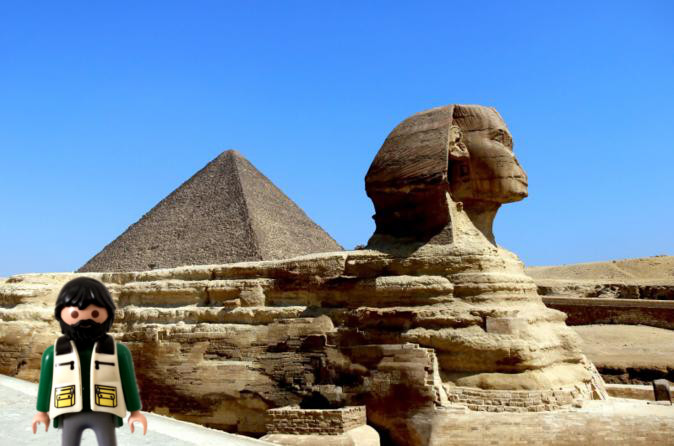
Giza's most famous land form and archaeological site, the Giza Plateau, holds some major monuments of Egyptian history, and is home to the Great Sphinx. Once thriving with the Nile that flowed right into the Giza Plateau, the pyramids of Giza were built overlooking the ancient Egyptian capital city of Memphis, across the river from modern day Cairo.


Joseph de Ca'th Lon & The Great Sphinx, Giza
The Giza Plateau is also home to Egyptian monuments such as the tomb of Pharaoh Djet of the First Dynasty, as well as that of Pharaoh Ninetjer of the Second Dynasty.

The Great Pyramid of Giza at one time was advocated (1884) as the location for the Prime Meridian, a reference point used for determining a base longitude. Giza lies less than 20 km north of Mn Nefer, Memphis, which means the beautiful wall in the ancient Egyptian language, and which was the capital city of the first unified Egyptian state since the days of Pharaoh Narmer.

Memphis was the ancient Pharaonic capital of the Old Kingdom. Its St. George cathedral is the episcopal see of the Coptic Catholic Eparchy of Giza.

The Giza pyramid complex is an archaeological site on the Giza Plateau, on the outskirts of Cairo. It includes the three Great Pyramids, Khufu/Cheops, Khafre/Chephren and Menkaure, the Great Sphinx, several cemeteries, a workers' village and an industrial complex. It is located in the Western Desert, approximately 9 km west of the Nile River at the old town of Giza, and about 13 km southwest of Cairo city centre.

More information: History

The pyramids, which have historically been common as emblems of ancient Egypt in the Western imagination, were popularised in Hellenistic times, when the Great Pyramid was listed by Antipater of Sidon as one of the Seven Wonders of the World. It is by far the oldest of the ancient Wonders and the only one still in existence.

The Pyramids of Giza consist of the Great Pyramid of Giza, also known as the Pyramid of Cheops or Khufu and constructed c.2560 – c.2540 BC, the somewhat smaller Pyramid of Khafre or Chephren a few hundred meters to the south-west, and the relatively modest-sized Pyramid of Menkaure or Mykerinos a few hundred meters farther south-west.


The Grandma, Joseph & The Great Sphinx, Giza
The Great Sphinx lies on the east side of the complex. Current consensus among Egyptologists is that the head of the Great Sphinx is that of Khafre. Along with these major monuments are a number of smaller satellite edifices, known as queens pyramids, causeways and valley pyramids.

Khufu’s pyramid complex consists of a valley temple, now buried beneath the village of Nazlet el-Samman; basalt paving and nummulitic limestone walls have been found but the site has not been excavated. The valley temple was connected to a causeway which was largely destroyed when the village was constructed.


The causeway led to the Mortuary Temple of Khufu. From this temple the basalt pavement is the only thing that remains. The mortuary temple was connected to the king’s pyramid. The king’s pyramid has three smaller queen’s pyramids associated with it and five boat pits. The boat pits contained a ship, and the 2 pits on the south side of the pyramid still contained intact ships. One of these ships has been restored and is on display. Khufu's pyramid still has a limited collection of casing stones at its base. These casing stones were made of fine white limestone quarried from the nearby range.

More information: National Geographic

Khafre’s pyramid complex consists of a valley temple, the Sphinx temple, a causeway, a mortuary temple and the king’s pyramid. The valley temple yielded several statues of Khafre. Several were found in a well in the floor of the temple by Mariette in 1860. Others were found during successive excavations by Sieglin (1909–10), Junker, Reisner, and Hassan.


Khafre’s complex contained five boat-pits and a subsidiary pyramid with a serdab. Khafre's pyramid appears larger than the adjacent Khufu Pyramid by virtue of its more elevated location, and the steeper angle of inclination of its construction, it is, in fact, smaller in both height and volume. Khafre's pyramid retains a prominent display of casing stones at its apex.

Visiting The Great Sphinx, Giza
Menkaure’s pyramid complex consists of a valley temple, a causeway, a mortuary temple, and the king’s pyramid. The valley temple once contained several statues of Menkaure.

During the 5th Dynasty, a smaller ante-temple was added on to the valley temple. The mortuary temple also yielded several statues of Menkaure. The king’s pyramid has three subsidiary or queen’s pyramids. Of the four major monuments, only Menkaure's pyramid is seen today without any of its original polished limestone casing.

The Sphinx dates from the reign of king Khafre. During the New Kingdom, Amenhotep II dedicated a new temple to Hauron-Haremakhet and this structure was added onto by later rulers.

Khentkaus I was buried in Giza. Her tomb is located in the Central Field, near the valley temple of Menkaure. The pyramid complex of Queen Khentkaus includes: her pyramid, a boat pit, a valley temple and a pyramid town.


Most construction theories are based on the idea that the pyramids were built by moving huge stones from a quarry and dragging and lifting them into place. The disagreements center on the method by which the stones were conveyed and placed and how possible the method was.

More information: Discover Magazine

In building the pyramids, the architects might have developed their techniques over time. They would select a site on a relatively flat area of bedrock, not sand, which provided a stable foundation. After carefully surveying the site and laying down the first level of stones, they constructed the pyramids in horizontal levels, one on top of the other.

For the Great Pyramid of Giza, most of the stone for the interior seems to have been quarried immediately to the south of the construction site. The smooth exterior of the pyramid was made of a fine grade of white limestone that was quarried across the Nile. These exterior blocks had to be carefully cut, transported by river barge to Giza, and dragged up ramps to the construction site. Only a few exterior blocks remain in place at the bottom of the Great Pyramid. During the Middle Ages, 5th century to 15th century, people may have taken the rest away for building projects in the city of Cairo.

The Grandma & Claire contemplate the pyramids
To ensure that the pyramid remained symmetrical, the exterior casing stones all had to be equal in height and width. 

Workers might have marked all the blocks to indicate the angle of the pyramid wall and trimmed the surfaces carefully so that the blocks fit together. During construction, the outer surface of the stone was smooth limestone; excess stone has eroded as time has passed.

The pyramids of Giza and others are thought to have been constructed to house the remains of the deceased Pharaohs who ruled over Ancient Egypt. A portion of the Pharaoh's spirit called his ka was believed to remain with his corpse. Proper care of the remains was necessary in order for the former Pharaoh to perform his new duties as king of the dead. It's theorized the pyramid not only served as a tomb for the Pharaoh, but also as a storage pit for various items he would need in the afterlife.  


The people of Ancient Egypt believed that death on Earth was the start of a journey to the next world. The embalmed body of the King was entombed underneath or within the pyramid to protect it and allow his transformation and ascension to the afterlife.

The sides of all three of the Giza pyramids were astronomically oriented to the north-south and east-west within a small fraction of a degree. The arrangement of the pyramids is a representation of the Orion constellation according to the disputed Orion Correlation Theory.


More information: UNESCO


When we find something new at Giza, 
we announce it to the world. 
The Sphinx and the Pyramids are world treasures. 
We are the guardian's of these treasures, 
but they belong to the world.

Zahi Hawass


Cairo is the capital of Egypt. The city's metropolitan area is one of the largest in Africa, the largest in the Middle East and the Arab world, and the 15th-largest in the world, and is associated with ancient Egypt, as the famous Giza pyramid complex and the ancient city of Memphis are located in its geographical area.


Located near the Nile Delta, modern Cairo was founded in 969 CE by the Fatimid Dynasty, but the land composing the present-day city was the site of ancient national capitals whose remnants remain visible in parts of Old Cairo.  

Tina Picotes in the market, Cairo
Cairo has long been a center of the region's political and cultural life, and is titled the city of a thousand minarets for its preponderance of Islamic architecture.

Cairo is located in northern Egypt, known as Lower Egypt, 165 kilometres south of the Mediterranean Sea and 120 kilometres west of the Gulf of Suez and Suez Canal. The city lies along the Nile River, immediately south of the point where the river leaves its desert-bound valley and branches into the low-lying Nile Delta region.

Until the mid-19th century, when the river was tamed by dams, levees, and other controls, the Nile in the vicinity of Cairo was highly susceptible to changes in course and surface level. 


More information: Lonely Planet

Over the years, the Nile gradually shifted westward, providing the site between the eastern edge of the river and the Mokattam highlands on which the city now stands. The land on which Cairo was established in 969, present-day Islamic Cairo, was located underwater just over three hundred years earlier, when Fustat was first built.

Low periods of the Nile during the 11th century continued to add to the landscape of Cairo; a new island, known as Geziret al-Fil, first appeared in 1174, but eventually became connected to the mainland. Today, the site of Geziret al-Fil is occupied by the Shubra district. The low periods created another island at the turn of the 14th century that now composes Zamalek and Gezira. Land reclamation efforts by the Mamluks and Ottomans further contributed to expansion on the east bank of the river.


Visiting the Salah El Din Citadel, Cairo
Because of the Nile's movement, the newer parts of the city, Garden City, Downtown Cairo, and Zamalek, are located closest to the riverbank. The areas, which are home to most of Cairo's embassies, are surrounded on the north, east, and south by the older parts of the city.  

Old Cairo, located south of the centre, holds the remnants of Fustat and the heart of Egypt's Coptic Christian community, Coptic Cairo. The Boulaq district, which lies in the northern part of the city, was born out of a major 16th-century port and is now a major industrial centre. 

The Citadel is located east of the city centre around Islamic Cairo, which dates back to the Fatimid era and the foundation of Cairo. While western Cairo is dominated by wide boulevards, open spaces, and modern architecture of European influence, the eastern half, having grown haphazardly over the centuries, is dominated by crowded tenements, and Islamic architecture.

More information: Ask Aladdin

Egyptians often refer to Cairo as Maṣr, the Egyptian Arabic name for Egypt itself, emphasizing the city's importance for the country. Its official name al-Qāhirah  means the Vanquisher or the Conqueror, supposedly due to the fact that the planet Mars, an-Najm al-Qāhir, the Conquering Star, was rising at the time when the city was founded, possibly also in reference to the much awaited arrival of the Fatimid Caliph Al-Mu'izz who reached Cairo in 973 from Mahdia, the old Fatimid capital. The location of the ancient city of Heliopolis is the suburb of Ain Shams, Eye of the Sun.


Claire Fontaine in the Cairo Citadel
The Coptic name of the city is Kashromi which means man breaker which is akin to Arabic al-Qāhirah . Sometimes the city is informally referred to as Kayro by people from Alexandria.

The area around present-day Cairo, especially Memphis that was the old capital of Egypt, had long been a focal point of Ancient Egypt due to its strategic location just upstream from the Nile Delta. However, the origins of the modern city are generally traced back to a series of settlements in the first millennium. 


Around the turn of the 4th century, as Memphis was continuing to decline in importance, the Romans established a fortress town along the east bank of the Nile. This fortress, known as Babylon, was the nucleus of the Roman and then the Byzantine city and is the oldest structure in the city today. It is also situated at the nucleus of the Coptic Orthodox community, which separated from the Roman and Byzantine churches in the late 4th century.

More information: Britannica

Many of Cairo's oldest Coptic churches, including the Hanging Church, are located along the fortress walls in a section of the city known as Coptic Cairo.

The Church of St. George is a Greek Orthodox church within Babylon Fortress in Coptic Cairo. It is part of the Holy Patriarchal Monastery of St George under the Greek Orthodox Patriarchate of Alexandria and all Africa

The church dates back to the 10th century or earlier. The current structure was rebuilt following a 1904 fire, construction was finished in 1909. Since 2009, the monastery's hegumen has had the rank of bishop with title Bishop Babylonos.

The Grandma at the Church of Saint George, Cairo
St. George is the only round church in Egypt, but unlike the original Church of the Holy Sepulchre and its many imitators, such as Rome's Santa Stefano Rotondo and London's Temple Church, this is only for practical reasons, it is built atop the foundations of a Roman round tower.

Inside, the dark interior is heavy with incense and pierced by sunbeams that filter through its stained glass windows. A closed flight of steps leads down into the old Roman tower, once believed to be peopled by devils.


Next door, the Monastery of St. George is now the seat of the Greek Orthodox Patriarchate of Alexandria. The monastery rarely admits tourists.


More information: Britannica

There are another Church of St. George and a Convent of St. George, the latter of which opens its chapel to visitors and has some English-speaking nuns. Both of these institutions are Coptic Orthodox.

The Church of Saint George is situated in the district of Old Cairo, is an area known as Coptic Cairo, the first settlement of Christians in central Egypt back in the 10th Century. The word Copt means Egyptian Christian.

The Grandma loves Saint George, Cairo
The Church of Saint George is located about 30 minutes from Downtown Cairo, Saint Georges Church sits in the heart of Old Coptic Cairo in the Old Cairo district. It is located amongst several other Churches in a private Christian community which has been established and preserved since the 10th Century.

The Church of Saint George, which is Greek Orthodox,was built by Athanasius during the reign of Ibn Marwan, Governor of Egypt, and was mentioned in the History of the Patriarchs of the Coptic Church and by Al-Maqrizi.

The church was destroyed by fire in the middle of the last century and later reconstructed without cupolas. The modern church, of the four pillar type, is without architectural interest, but the Qa’at Al-Irsan, the Nuptial Hall, which belong to the complex, is a small palace from the 13th/14th century measuring 15 by 12 meters. The hall contains beautiful tracery and carving reminiscent of ornamentation found in some Cairo mansions from the Mameluke Period.

Old Cairo is well and truly a fantastic part of Cairo where visitors can easily spend an entire day or more exploring the many ancient sites.

More information: Coptic Cairo

The Coptic area in particular is a place not to be missed, since it is home to many famous religious buildings, one of which is the delightful Church of St. George. In fact, many visitors believe that the Church of St. George is the most eye catching building in the area.

Dragon weather vane, Church of St. George, Cairo
The interior of the Greek Orthodox St. George church is accessed through the massive front doors. The interior of the church is renowned for its beautiful stained glass and the abundance of rich darkly stained wood. The closed stairs go down into the ruins of the older Roman tower.

There are some interesting places to visit in the Coptic area. The Coptic Museum; Hanging Church; Ben Ezra Synagogue; Church of St. Barbara and the Coptic St. George Church are all within easy walking distance of each other.

It's possible to ascend the steps along the Roman towers and see a relief of St. George slaying a dragon on the outer brickwork of the wall. Inside, the austere ancient artwork grace the church with depictions of St. George and his quest to defend Christianity.
 
 More information: Smithsonian


I love the Middle East. I love the colors and smells 
and cadence of Arabic spoken in the streets of Cairo. 
Kai Bird