Showing posts with label Modernism. Show all posts

Saturday, 27 December 2025

LLUÍS DOMÈNECH I MONTANER SEEN FROM THE 21ST C.

It's still raining in Barcelona. It seems like the rain we haven't had in ten years is falling in five days.

After attending another year a wonderful performance by the Orfeó Català at the Sant Esteve Concert at the Palau de la Música Catalana, today, The Grandma is reading a very interesting book about the life of the brilliant architect who built this fascinating and magical UNESCO World Heritage Site. The book is written by Lluís Domenech i Girbau, his grandson, and talks about the work and idea of​​ architecture of this universal architect, a key figure of Catalan Modernism, who passed away on a day like today in 1923.

Lluís Domènech i Montaner (21 December 1850-27 December 1923) was a Catalan architect who was very much involved in and influential for the Catalan Modernism, the Art Nouveau/Jugendstil movement. He was also a Catalan politician.

Born in Barcelona, he initially studied physics and natural sciences, but soon switched to architecture. He was registered as an architect in Barcelona in 1873. He also held a 45-year tenure as a professor and director at the Escola d'Arquitectura, Barcelona's school of architecture, and wrote extensively on architecture in essays, technical books and articles in newspapers and journals.

His most famous buildings, the Hospital de Sant Pau and Palau de la Música Catalana in Barcelona, have been collectively designated as a UNESCO World Heritage Site.

As an architect, 45-year professor of architecture and prolific writer on architecture, Domènech i Montaner played an important role in defining the Modernisme arquitectònic in Catalonia. This style has become internationally renowned, mainly due to the work of Antoni Gaudí.  

Domènech i Montaner's article En busca d'una arquitectura nacional (In search of a national architecture), published 1878 in the journal La Renaixença, reflected the way architects at that time sought to build structures that reflected the Catalan character.

His buildings displayed a mixture between rationalism and fabulous ornamentation inspired by Arabic architecture, and followed the curvilinear design typical of Art Nouveau

In the Castell dels Tres Dragons in Barcelona (built for the World's Fair in 1888), which was for many years the Zoological Museum, he applied very advanced solutions (a visible iron structure and ceramics). He later developed this style further in other buildings, such as the Palau de la Música Catalana in Barcelona (1908), where he made extensive use of mosaic, ceramics and stained glass, the Hospital de Sant Pau in Barcelona, and the Institut Pere Mata in Reus.

Domènech i Montaner's work evolved towards more open structures and lighter materials, evident in the Palau de la Música Catalana. Other architects, like Gaudí, tended to move in the opposite direction.

Domènech i Montaner also played a prominent role in the Catalan autonomist movement. He was a member of the La Jove Catalunya and El Centre Català and later chaired the Lliga de Catalunya (1888)and the Unió Catalanista (1892). He was one of the organisers of the commission that approved the Bases de Manresa, a list of demands for Catalan autonomy. He was a member of the Centre Nacional Català (1889) and Lliga Regionalista (1901), and was one of the four parliamentarians who won the so-called candidature of the four presidents in 1901. Though re-elected in 1903, he abandoned politics in 1904 to devote himself fully to archeological and architectural research.

He died in Barcelona in 1923 and was buried in the Sant Gervasi Cemetery in that city.

Born in Carrer Avinyó in Barcelona, he was the second son of Pere Domènech i Saló, a prestigious publisher and book-binder, and Maria Montaner i Vila, a member of a prosperous family from Canet de Mar, where Domènech i Montaner spent much time in his home/office, now converted into a museum.

Having completed his studies, he travelled through France, Switzerland, Italy, Germany and Austria to gain experience of trends in architecture.

In 1875, as soon as the Barcelona school of architecture opened, he joined it, along with his friend Josep Vilaseca, as a teacher of topography and mineralogy. 

In 1877, he became professor of Knowledge of materials and the application of physiochemical science to architecture

In 1899, he was appointed professor of Architectural Composition and project teacher. 

In 1900 he became director of the school of architecture, and between 1901 and 1905 he was substituted by Joan Torras i Guardiola but he returned to the post from 1905 to 1920.

His teaching career lasted 45 years, and he exercised a considerable influence on what was to become Modernisme in Catalonia. With his colleague Antoni Maria Gallissà he subsequently set up a workshop for advanced work on the decorative arts applied to architecture.

Domènech i Montaner's buildings combine structural rationality with extraordinary ornamentation inspired by Hispano-Arabic architectural tradition and by the curves typical of Modernisme. They were in the architectural vanguard at the time, with the use of structural steel and the total utilization of exposed brickwork, and incorporated a profusion of mosaics, ceramics and stained glass, arranged in exquisite harmony.

As director of the School of Architecture he promoted a style that was adopted by many of his pupils. Puig i Cadafalch regarded him as a man of a certain period and of a certain artistic school, who was a sounding-board for developments in other countries, adapting them to his own character in an innovative way.

As the years went by, unlike many Modernist architects, Domènech i Montaner's buildings tended to become lighter, reducing the amount of structural material but retaining ornamentation as a primary element.

No sooner had Domènech graduated than he set out on a tour of Europe in the company of Josep Vilaseca, and was attracted by Prussian architecture. This, as well as Vilaseca's personality, had an influence on his subsequent work.

This influence can be seen in a number of Domènech's works from before 1878 (the year when he published his manifesto En busca d'una arquitectura nacional): the Clavé family tomb and the Casa Montaner on the Ronda de la Universitat, as well as a project for the provincial education institutions that was never built. These works can be regarded as pre-Modernista.

The building for the Editorial Montaner i Simón (1879-1885) was in fact his first work after the manifesto and it employs Mudejar decorative solutions while not abandoning Germanic influence and symbolism.

Domènech went beyond European manifestations, employing a forthright new language to implement an architectural approach founded on a new, integrated concept of all the arts. It was commissioned by his uncle Ramon Montaner i Vila, who also had him build his town house in Barcelona, the Palau Ramon Montaner, and remodel the Castell de Santa Florentina, his residence in Canet de Mar.

Domènech received a number commissions associated with the Exposición Universal de Barcelona (1888). The best-known of these works are undoubtedly the construction of the Hotel Internacional, which no longer exists, but which was put up in a record time of 53 days, and the cafe-restaurant known as the Castell dels Tres Dragons (now the Museu de Zoologia de Barcelona), the building that best expresses these new trends and is considered to mark the beginning of the Modernista period.

At the height of his professional career, Domènech i Montaner took on his largest and most complex works, the ones for which he is most widely recognized. His work on these projects overlapped in time, and he was able to take advantage of the experience gained on each one. Much of the knowledge gained and many of the technical innovations employed on the Expo restaurant (the Castell dels Tres Dragons, now the Geology Museum) were later used in the design and construction of the Palau de la Música, and the avant-garde concepts applied in the Institut Pere Mata were later adopted and improved on at the Hospital de Sant Pau.

The Palau de la Música Catalana and the Hospital de Sant Pau both won awards in the annual architectural competition organized by the Barcelona City Council, in 1905 and 1913 respectively. More recently UNESCO has declared them to be World Heritage.

Domènech contributed to the leading Catalan publications: La Renaixença, Lo Catalanista, Revista de Catalunya, El Diluvio and La Veu de Catalunya

In 1904, after falling out with Francesc Cambó, he ceased to contribute to La Veu de Catalunya and founded the weekly El Poble Català. He was also the author of many books, some technical works and some political and social essays. 

In an article entitled En busca d'una arquitectura nacional (In search of a national architecture), published on 28 February 1878 in La Renaixença, he set forth the guiding principles for a modern, national architecture for Catalonia.

He chaired the assembly that drew up the Bases de Manresa, a document that laid the foundations for the return of the historic rights acknowledged by the Catalan constitutions.

More information: Catalan News


Si poséssim a disposició d’un arquitecte del segle XII o XIII 
la perfecció de la indústria moderna, no construiria 
un edifici com en l’època de Felip August o de sant Lluís, 
perquè això seria falsejar la primera llei de l’art 
que és conformar-se amb les necessitats i costums dels temps.

If we were to place at the disposal of an architect of the 12th or 13th c. 
the perfection of modern industry, he would not construct 
a building like in the time of Philip Augustus or Saint Louis, 
because that would be to falsify the first law of art 
which is to conform to the needs and customs of the times. 

Lluís Domènech i Montaner

Thursday, 11 December 2025

NILS ARTUR LUNDKVIST, SWEDISH POETRY IN THE 2OTH C.

Today is a wonderful day and The Grandma has taken her bike to go to the beach to enjoy one of her favourite activities: reading.
 
Reading poetry is an indescribable pleasure for the soul and, like any reading, if you can read it in the original language, the pleasure is even deeper. 

The Grandma has chosen the poems of Artur Lundkvist, the Swedish writer, Nobel Prize in Literature, who left us on a day like today thirty-four years ago. 

Nils Artur Lundkvist (3 March 1906-11 December 1991) was a Swedish writer, poet and literary critic. He was a member of the Swedish Academy from 1968.

Artur Lundkvist published around 80 books, including poetry, prose poems, essays, short stories, novels and travel books, and his works have been translated into some 30 languages. He is also noted for having translated many works from Spanish and French into Swedish. Several authors whose works he translated were later awarded the Nobel Prize in Literature. He married the poet Maria Wine in 1936.

Artur Lundkvist was born in Perstorp Municipality, Skåne County. As a child he lived on a small farm, first in Hagstad and then in nearby Toarp. From an early age his main interest was reading and he also liked wandering in the surrounding countryside.

At the age of twenty Lundkvist moved to Stockholm determined to become a writer, he studied at a Folk high school and became acquainted with other young people with the same interests. His first books of poems, the anthology Fem unga and introductions of foreign modernist literature quickly established Lundkvist as a leading figure in Modernist Swedish literature in the 1930s

Lundkvist went on to publish more than 80 books in many genres and was also a prominent critic

In 1968 he was elected a member of the Swedish Academy, and was a member of the Academy's Nobel committee from 1969 to 1986. He was married to Maria Wine since 1936 and died on 11 December 1991.

Lundkvist published his first book of poems Glöd (Glowing Embers) in 1928 and contributed to the important anthology Fem unga (Five young men) in 1929. He was one of the dominant figures in Swedish literary modernism, the most vigorous promoter of the modernist breakthrough that took place around 1930, and one of the leading poets of the period. His early works was influenced by Scandinavian and American modernists, most notably Carl Sandburg, and later by surrealism.

In the late 1940s his works became increasingly influenced by Spanish language writers like Pablo Neruda and Federico García Lorca, whose poetry he also translated to Swedish. Although he continued to publish books of poetry, including Liv som gräs (Life as grass, 1954) and Ögonblick och vågor (Moments and waves, 1962) which by many is considered to be among his finest works, prose works dominated his writings from the 1950s and onwards. In several books, starting with Malinga (1952) and leading up to late works such as Skrivet mot kvällen (Written towards the evening, 1980), his ambition was to defy genre limitations and merge prose poetry, fictional stories, short essays, personal memoirs and impressions from his many travels around the world into a new form of literature.

Artur Lundkvist was a very productive writer, and also published numerous articles, short stories, collections of literary essays, and books about his travels in South America, India, China, the Soviet Union and Africa. As a literature critic, and also translator, he introduced foreign literature to Swedish readers, including several authors that would subsequently be awarded the Nobel Prize in Literature, such as William Faulkner, T. S. Eliot, Pablo Neruda, Claude Simon, Vicente Aleixandre, Octavio Paz, Gabriel Garcia Marquez and Mario Vargas Llosa. His later work also include several historical novels such as Snapphanens liv och död (1968, about snapphanar), Tvivla, korsfarare! (1972, about crusaders), Krigarens dikt (1976, about Alexander the Great) and Slavar för Särkland (1978, about vikings).

In 1966, his autobiography Självporträtt av en drömmare med öppna ögon (Self portrait of a dreamer with open eyes) was published, and in 1968 he was elected a member of the Swedish academy.

In 1977, he was awarded the prestigious Golden Wreath of the Struga Poetry Evenings festival in Struga, North Macedonia. He died in Solna, Stockholm County.

More information: The Guardian


 Jag har en envis tro på omedelbar suggestion,
automatism eller spontanitet, som du önskar,
och jag misstror rationalism och efterföljande modifieringar.

I have a stubborn faith in immediate suggestion, 
automatism or spontaneity, as you wish, 
and I distrust rationalism and subsequent modifications.

Artur Lundkvist

Monday, 25 October 2021

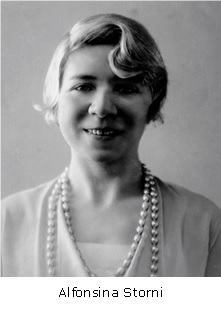
ALFONSINA STORNI, ARGENTINIAN MODERNIST POETRY

Today, The Grandma has been reading some poems written by Alfonsina Storni, the Argentine poet who died on a day like today in 1938.

Alfonsina Storni (29 May 1892-25 October 1938) was an Argentine poet of the modernist period.

Storni was born on May 29, 1892 in Sala Capriasca, Switzerland. Her parents were Alfonso Storni and Paola Martignoni, who were of Italian-Swiss descent. Before her birth, her father had started a brewery in the city of San Juan, Argentina, producing beer and soda.

In 1891, following the advice of a doctor, he returned with his wife to Switzerland, where Alfonsina was born the following year; she lived there until she was four years old.

In 1896 the family returned to San Juan, and a few years later, in 1901, moved to Rosario because of economic issues. There her father opened a tavern, where Storni did a variety of chores. That family business soon failed, however.

Storni wrote her first verse at the age of twelve, and continued writing verses during her free time. She later entered into the Colegio de la Santa Union as a part-time student.

In 1906, her father died, and she began working in a hat factory to help support her family.

In 1907, her interest in dance led her to join a travelling theatre company, which took her around the country. She performed in Henrik Ibsen's Ghosts, Benito Pérez Galdós's La loca de la casa, and Florencio Sánchez's Los muertos.

More information: Poem Hunter

In 1908, Storni returned to live with her mother, who had remarried and was living in Bustinza. After a year there, Storni went to Coronda, where she studied to become a rural primary schoolteacher. During this period, she also started working for the local magazines Mundo Rosarino and Monos y Monadas, as well as the prestigious Mundo Argentino.

In 1912, she moved to Buenos Aires, seeking the anonymity afforded by a big city. There she met and fell in love with a married man, whom she described as an interesting person of certain standing in the community. He was active in politics... That year, she published her first short story in Fray Mocho.

At age nineteen, she found out that she was pregnant with the child of a journalist and became a single mother. Supporting herself with teaching and newspaper journalism, she lived in Buenos Aires, where the social and economic difficulties faced by Argentina's growing middle classes were inspiring an emerging body of women's rights activists.

Storni was among the first women to find success in the male-dominated arenas of literature and theatre in Argentina, and as such, developed a unique and valuable voice that holds particular relevance in Latin American poetry.

Storni was an influential person, not only to her readers but also to other writers. Though she was known mainly for her poetic works, she also wrote prose, journalistic essays, and drama.

Storni often gave controversial opinions. She criticized a wide range of topics, from politics to gender roles and discrimination against women.

In Storni's time, her work did not align itself with a particular movement or genre. It was not until the modernist and avant-garde movements began to fade that her work seemed to fit in. She was criticized for her atypical style, and she has been labelled most often as a postmodern writer.

Storni published some of her first works in 1916 in Emin Arslan's literary magazine La Nota, where she was a permanent contributor from 28 March until 21 November 1919. Her poems Convalecer and Golondrinas were published in the magazine. In spite of economic difficulties, she published La inquietud del rosal in 1916, and later started writing for the magazine Caras y Caretas while working as a cashier in a shop.

Even though today Storni's early works of poetry are among her most well known and highly regarded, they received harsh criticism from some of her male contemporaries, including such well-known figures as Jorge Luis Borges and Eduardo Gonzalez Lanuza. The eroticism and feminist themes in her writing were a controversial subject for poetry during her time, but writing about womanhood in such a direct way was one of her principal innovations as a poet.

In the rapidly developing literary scene of Buenos Aires, Storni soon became acquainted with other writers, such as José Enrique Rodó and Amado Nervo. Her economic situation improved, which allowed her to travel to Montevideo, Uruguay. There she met the poet Juana de Ibarbourou, as well as Horacio Quiroga, with whom she would become great friends. Quiroga led the Anaconda group and Storni became a member together with Emilia Bertolé, Ana Weiss de Rossi, Amparo de Hieken, Ricardo Hicken and Berta Singerman.

During one of her most productive periods, from 1918 to 1920 Storni published three volumes of poetry: El dulce daño, 1918; Irremediablemente, 1919; and Languidez, 1920. The latter received the first Municipal Poetry Prize and the second National Literature Prize, which added to her prestige and reputation as a talented writer.

More information: Poetry North West

She also published many articles in prominent newspapers and journals of the time. Later, she continued her experimentation with form in 1925's Ocre, a volume composed almost entirely of sonnets that are among her most traditional in structure. These verses were written around the same time as the more loosely structured prose poems of her lesser-known volume, Poemas de Amor, from 1926.

After a nearly 8-year hiatus from publishing volumes of poetry, Storni published El mundo de siete pozos, 1934. That volume, together with the final volume she published before her death, Mascarilla y trébol (Mask and Clover), 1938, mark the height of her poetic experimentation. The final volume includes the use of what she termed antisonnets, or poems that used many of the versification structures of traditional sonnets but did not follow the traditional rhyme scheme.

In 1935, Storni may have discovered a lump on her left breast and decided to undergo an operation. On May 20, 1935, she underwent a radical mastectomy.

In 1938, she found out that the breast cancer had reappeared. Around 1:00 AM on Tuesday, 25 October 1938. Storni left her room and headed towards the sea at La Perla beach in Mar del Plata, and committed suicide. Later that morning, two workers found her body washed up on the beach.

Although her biographers hold that she jumped into the water from a breakwater, popular legend is that she slowly walked out to sea until she drowned. She is buried in La Chacarita Cemetery. Her death inspired Ariel Ramírez and Félix Luna to compose the song Alfonsina y el Mar.

More information: Alfonsina y el mar


 Yo he sido aquella que paseó orgullosa
El oro falso de unas cuantas rimas
Sobre su espalda, y se creyó gloriosa,
De cosechas opimas.

I have been the one who walked proudly
The fake gold of a few rhymes
On her back, and she thought herself glorious,
Of opima crops.

Alfonsina Storni

Sunday, 26 September 2021

THOMAS STEARNS ELIOT, MODERNIST POETRY IN ENGLISH

Today, The Grandma is relaxing at home. She has decided to practice one of her favourite hobbies, reading poetry. She has chosen T. S. Eliot, the American-English poet, essayist, publisher, playwright, literary critic and editor, who was born on a day like today in 1888.

Thomas Stearns Eliot (26 September 1888-4 January 1965) was a poet, essayist, publisher, playwright, literary critic and editor. One of the 20th century's major poets, he is a central figure in English-language Modernist poetry.

Born in St. Louis, Missouri, to a prominent Boston Brahmin family, he moved to England in 1914 at the age of 25 and went on to settle, work, and marry there. He became a British citizen in 1927 at the age of 39, subsequently renouncing his American citizenship.

Eliot first attracted widespread attention for his poem The Love Song of J. Alfred Prufrock in 1915, which was received as a modernist masterpiece. It was followed by some best-known poems in the English language, including The Waste Land (1922), The Hollow Men (1925), Ash Wednesday (1930), and Four Quartets (1943).

He was also known for his seven plays, particularly Murder in the Cathedral (1935) and The Cocktail Party (1949). He was awarded the Nobel Prize in Literature in 1948, for his outstanding, pioneer contribution to present-day poetry.

The Eliots were a Boston Brahmin family, with roots in England and New England. Eliot's paternal grandfather, William Greenleaf Eliot, had moved to St. Louis, Missouri, to establish a Unitarian Christian church there. His father, Henry Ware Eliot (1843–1919), was a successful businessman, president and treasurer of the Hydraulic-Press Brick Company in St Louis. His mother, Charlotte Champe Stearns (1843–1929), who wrote poetry, was a social worker, which was a new profession in the U.S. in the early 20th century. Eliot was the last of six surviving children. Known to family and friends as Tom, he was the namesake of his maternal grandfather, Thomas Stearns.

More information: Poem Analysis

Eliot's childhood infatuation with literature can be ascribed to several factors. First, he had to overcome physical limitations as a child. Struggling from a congenital double inguinal hernia, he could not participate in many physical activities and thus was prevented from socializing with his peers. As he was often isolated, his love for literature developed. Once he learned to read, the young boy immediately became obsessed with books, favouring tales of savage life, the Wild West, or Mark Twain's thrill-seeking Tom Sawyer.

From 1898 to 1905, Eliot attended Smith Academy, the boys' college preparatory division of Washington University, where his studies included Latin, Ancient Greek, French, and German.

He began to write poetry when he was 14 under the influence of Edward Fitzgerald's translation of the Rubaiyat of Omar Khayyam. He said the results were gloomy and despairing, and he destroyed them.

His first published poem, A Fable For Feasters, was written as a school exercise and was published in the Smith Academy Record in February 1905. Also published there in April 1905 was his oldest surviving poem in manuscript, an untitled lyric, later revised and reprinted as Song in The Harvard Advocate, Harvard University's student magazine.

He also published three short stories in 1905, Birds of Prey, A Tale of a Whale and The Man Who Was King. The last mentioned story significantly reflects his exploration of the Igorot Village while visiting the 1904 World's Fair of St. Louis. Such a link with indigenous peoples importantly antedates his anthropological studies at Harvard. After working as a philosophy assistant at Harvard from 1909 to 1910, Eliot moved to Paris where, from 1910 to 1911, he studied philosophy at the Sorbonne.

In 1915, he taught English at Birkbeck, University of London.

In 1916, he completed a doctoral dissertation for Harvard on Knowledge and Experience in the Philosophy of F. H. Bradley, but he failed to return for the viva voce exam.

Eliot worked as a schoolteacher, most notably at Highgate School in London, where he taught French and Latin: his students included John Betjeman.

Charles Whibley recommended T.S. Eliot to Geoffrey Faber. In 1925 Eliot left Lloyds to become a director in the publishing firm Faber and Gwyer, later Faber and Faber, where he remained for the rest of his career. At Faber and Faber, he was responsible for publishing distinguished English poets, including W. H. Auden, Stephen Spender, Charles Madge and Ted Hughes.

More information: Poetry Foundation

Eliot died of emphysema at his home in Kensington in London, on 4 January 1965, and was cremated at Golders Green Crematorium. In accordance with his wishes, his ashes were taken to St Michael and All Angels' Church, East Coker, the village in Somerset from which his Eliot ancestors had emigrated to America.

Eliot was commemorated by the placement of a large stone in the floor of Poets' Corner in London's Westminster Abbey. The stone, cut by designer Reynolds Stone, is inscribed with his life dates, his Order of Merit, and a quotation from his poem Little Gidding, the communication / of the dead is tongued with fire beyond / the language of the living.

More information: Grade Saver

For a poet of his stature, Eliot produced a relatively small number of poems. He was aware of this even early in his career.

Eliot also made significant contributions to the field of literary criticism, and strongly influenced the school of New Criticism. He was somewhat self-deprecating and minimizing of his work, and once said his criticism was merely a by-product of his private poetry-workshop.

T.S. Eliot influenced many poets, novelists, and songwriters, including Seán Ó Ríordáin, Máirtín Ó Díreáin, Virginia Woolf, Ezra Pound, Bob Dylan, Hart Crane, William Gaddis, Allen Tate, Andrew Lloyd Webber, Trevor Nunn, Ted Hughes, Geoffrey Hill, Seamus Heaney, Russell Kirk, George Seferis, who in 1936 published a modern Greek translation of The Waste Land, and James Joyce.

T. S. Eliot was a strong influence on 20th-century Caribbean poetry written in English, including the epic Omeros (1990) by Nobel laureate Derek Walcott, and Islands (1969) by Barbadian Kamau Brathwaite.

More information: Archive


 Poetry is not a turning loose of emotion,
but an escape from emotion;
it is not the expression of personality,
but an escape from personality.
But, of course,
only those who have personality and emotions know
what it means to want to escape from these things.

T. S. Eliot

Friday, 7 June 2019

JOSEP MARIA JUJOL I GIBERT IN MONTFERRI, ALT CAMP

Arriving to the sanctuary in Montferri, Alt Camp
Today, Claire Fontaine and The Grandma have visited the sanctuary of Mare de Déu de Montserrat in Montferri, a little municipality in Tarragona. They are very interested in visiting this sanctuary because of its architect, Josep Maria Jujol i Gibert is one of the most admired artists of the Catalan Modernism.

Jujol was a closer friend of Antoni Gaudí and both of them built some of the most incredible buildings you can visit around the world.

Modernisme, Catalan for Modernism, also known as Catalan Modernism, is the historiographic denomination given to an art and literature movement associated with the search of a new entitlement of Catalan culture. Nowadays it is considered a movement based on the cultural reivindication of a Catalan identity.

Its main form of expression was in architecture, but many other arts were involved and especially the design and the decorative arts (cabinetmaking, carpentry, forged iron, ceramic tiles, ceramics, glass-making, silver and goldsmith work), which were particularly important, especially in their role as support to architecture. Modernisme was also a literary movement (poetry, fiction, drama).

Although Modernisme was part of a general trend that emerged in Europe around the turn of the 20th century, in Catalonia the trend acquired its own unique personality.

Sanctuary of Mare de Déu de Montserrat, Montferri
Modernisme's distinct name comes from its special relationship, primarily with Catalonia and Barcelona, which were intensifying their local characteristics for socio-ideological reasons after the revival of Catalan culture and in the context of spectacular urban and industrial development.

It is equivalent to a number of other fin de siècle art movements going by the names of Art Nouveau in France and Belgium, Jugendstil in Germany, Sezession in Austria-Hungary, Liberty style in Italy and Modern or Glasgow Style in Scotland.

Modernisme was active from roughly 1888 (the First Barcelona World Fair) to 1911 (the death of Joan Maragall, the most important Modernist poet). The Modernisme movement was centred in the city of Barcelona, though it reached far beyond, and is best known for its architectural expression, especially in the work of Antoni Gaudí, but was also significant in sculpture, poetry, theatre and painting.

Notable painters include Santiago Rusiñol, Ramon Casas, Isidre Nonell, Hermen Anglada Camarasa, Joaquim Mir, Eliseu Meifrèn, Lluïsa Vidal and Miquel Utrillo. Notable sculptors are Josep Llimona, Eusebi Arnau and Miquel Blai.


Montferri is a municipality in the county of Alt Camp, province of Tarragona, Catalonia. It is home to the sanctuary of Mare de Déu de Montserrat (Our Lady of Monsterrat), a small Modernist church by Josep Maria Jujol.

More information: Catalunya

Josep Maria Jujol i Gibert (16 September 1879-1 May 1949) was a Catalan architect. Jujol's wide field of activity ranged from furniture designs and painting, to architecture.

Josep Maria Jujol i Gibert
He worked with Antoni Gaudí on many of his most famous works. Among Jujol's projects are Casa Batlló, Casa Milà, Park Güell, and Our Lady of Montserrat, and among his design styles are Modernisme and Art Nouveau.

Josep Maria Jujol was born in Tarragona where he lived until age 9. He was the son of Andreu Jujol, a school director, and of Teresa Gibert i Vives. He was born on the top floor of the public school, Sant Joan, where his father worked. 

He began to draw at an early age, and always had an admiration for nature. According to his biography, he would roam the hills of Tarragona and its Roman ruins. They lived at the school for nine years before his father was transferred in 1888 to Carrer Zurbano in Gràcia, which is now integrated into the City of Barcelona.

Jujol's father was transferred once again in 1893 to the City of Barcelona. There Jujol began to walk the medieval district, developed an admiration for gothic architecture and began to draft the buildings.

The family moved to the Gran Via in the Eixample District of Barcelona, where he experienced modern and modernist buildings.

More information: Sh Barcelona

In 1901, he was accepted in the Architectural program in Barcelona. While attending school, he first worked with Antoni Maria Gallissa i Soqué (Don Antoni), whom he admired as a person and an architect.

His first project was a commission for Don Antoni to decorate the street called Carrer Fenen for the Mercè Festival (Festes de la Mercè).


Old memories in Montferri during its construction
Jujol had to create the metal frames and stained glass windows. He continued to work for Don Antoni until 1903. He then began to work in the studio of Josep Font i Gumà where he collaborated with him on the Trinity altar in the Basilica de Santa Maria del Mar.

In his spare time he completed plans for an amusement park that was to emulate the solar system. The plan was never revived.

In 1906 he received his certificate as an architect and was able to work on his own. One of his first projects was to decorate Don Antoni's entrance stairway with his trademark sgraffito.

Jujol became acquainted with Antoni Gaudí through their mutual friend, Dr. Santaló. Gaudí soon worked in partnership with Jujol. Their first project together was Casa Batlló.

It is speculated in Jujol's biography that he had a great influence on Gaudí's use of colour and shapes. However, this is not for certain.

In any case, Gaudí had great respect for Jujol's views and entrusted him as a collaborator on his projects for many years.

Jujol died at Barcelona in 1949.

More information: The Guardian


 Modernism was born in part out of the need 
to find fresh ways of expression, 
to describe a new world that 
was unlike anything that had gone before.

Margaret MacMillan