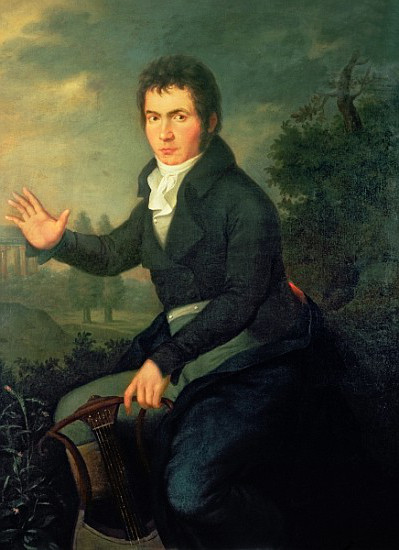
Today, The Grandma is relaxing at home. She has decided to listen to some music and she has chosen Ludwig van Beethoven's Piano Concerto No. 5 in E-flat major, Op. 73, one of her favourite piano concertos, that was premiered on a day like today at the Gewandhaus in Leipzig, Saxony.
The Piano Concerto No. 5 in E-flat major, Op. 73, known as the Emperor Concerto in English-speaking countries, is a piano concerto composed by Ludwig van Beethoven.
Beethoven composed the concerto in 1809 under salary in Vienna, and he dedicated it to Archduke Rudolf, who was his patron, friend, and pupil. Its public premiere was on 28 November 1811in Leipzig, with Friedrich Schneider as the soloist and Johann Philipp Christian Schulz conducting the Gewandhaus Orchestra. Beethoven, usually the soloist, could not perform due to declining hearing.
The work's military aspects and symbolism characterize its heroic style. Beethoven used novel approaches with the piece, such as beginning the solo entrance without orchestral introduction, lengthening the concerto, and creating a new relationship between piano and orchestra. The first of its three movements, Allegro, is in sonata form and is longer than any opening movement of Beethoven's earlier piano concertos. The second movement, Adagio un poco mosso, is a nocturne that directly builds into the third movement. The last movement, Rondo: Allegro ma non troppo, is in seven-part rondo form. The concerto is approximately forty minutes.
The origin of the epithet Emperor is uncertain; it may have been coined by Johann Baptist Cramer, the English publisher of the concerto. The concerto has no association with any emperor, and according to Donald Tovey and Betsy Schwarm, Beethoven would have disliked it due to his disapproval of Napoleon's conquest. As part of his repertoire, Franz Liszt frequently performed the concerto throughout his life. Since its first recording in 1912, it has been recorded numerous times by classical pianists.
Beethoven's return to Vienna from Heiligenstadt in 1802 marked a change in musical style and is now often designated as the start of his middle or heroic period characterized by many original works composed on a grand scale.
In the autumn of 1808, after being rejected for a position at the Royal Theatre, Beethoven received an offer from Napoleon's brother Jérôme Bonaparte, the king of Westphalia, for a well-paid position as Kapellmeister at the court in Cassel. To persuade him to stay in Vienna, Archduke Rudolf, Prince Kinsky, and Prince Lobkowitz pledged to pay him a pension of 4000 florins a year. Archduke Rudolf paid his share of the salary on the agreed date. Kinsky, immediately called to military duty, did not contribute and died in November 1812 after falling from his horse. When the Austrian currency destabilized in 1811, Lobkowitz went bankrupt. To benefit from the agreement, Beethoven had to obtain recourse from the law, which in 1815 brought him some payment.
Beethoven felt the Napoleonic Wars reaching Vienna in early 1809 and completed writing the piano concerto in April while Vienna was under siege by Napoleon's armies. He wrote to his publisher in July 1809 that there was nothing but drums, cannons, men, misery of all sorts around him. To save his hearing, he fled to his brother's cellar and covered his ears with pillows. The work's heroic style reflects the war-ridden era in its military topics and heroic tone. Beethovenexperimented with new techniques, such as the piano entrance beginning earlier than typical and with a cadenza.
The concerto's public premiere was on 28 November 1811 in Leipzig, with Friedrich Schneider as the soloist. Beethoven's hearing loss did not prevent him from composing music, but it made playing at concerts increasingly difficult. The concerto debuted in Vienna on 12 February 1812, with Carl Czerny, Beethoven's pupil, as the soloist. The English premiere was on 8 May 1820 with Charles Neate as soloist. Felix Mendelssohn gave an English performance on 24 June 1829. Archduke Rudolf of Austria was Beethoven's aristocratic patron, and in 1803 or 1804, Rudolf began studying piano and composition with Beethoven. They became friends, and their meetings continued until 1824. Beethoven dedicated many pieces to him, including this concerto.
The origins of the concerto's epithet, Emperor, are obscure and no consensus exists on its origin. An unlikely and unauthenticated story says that at the first Vienna performance, a French officer said, C'est l'Empereur! Other sources say that Johann Baptist Cramer coined it. According to Donald Tovey and Betsy Schwarm, Beethoven would have disliked the epithet due to his disapproval of Napoleon's conquest. Beethoven had previously reconsidered the dedication of his third symphony; initially dedicated to Napoleon, Beethoven changed it after Napoleon assumed the title of emperor in 1804. According to Yan Shen, musicologists agree that the concerto has no connection to an emperor.
The concerto is scored for two flutes, two oboes, two clarinets in B♭ (clarinet 1 playing in A in movement 2), two bassoons, two horns, two trumpets, timpani in E♭ and B♭, and strings. In the second movement, the 2nd flute, 2nd clarinet, trumpets, and timpani are tacet. The concerto is divided into the following three movements:
-Allegro in E♭ major, (4/4)
-Adagio un poco mosso in B major, (4/4)
-Rondo: Allegro ma non troppo in E♭ major, (6/8)
Beethoven began innovating the piano concerto genre with his third piano concerto and continued through his fifth piano concerto. While Wolfgang Amadeus Mozart's piano concertos consisted of the piano and orchestra working in tandem, in Beethoven's last two piano concertos, the pianist was the hero, the dominant and directional soloist. Also, in Mozart's concertos, the soloist was a virtuoso and more important than the composer; in Beethoven's, the pianist is a vector for the composer. Beethoven created the tradition of linkingmovements in concertos, especially the middle and the last. Subsequent composers connected and transitioned through all movements in an attempt to create unity in a piece.
Today, The Grandma has received the wonderful visit of Tina Picotes, one of her closest friends, who is a great painter and fan of classical music. The Grandma loves classical music, too. They have been talking about sonatas, allegros, concerts and authors and they have dedicated special attention to Ludwig van Beethoven, the German music who is considered a crucial figure in the transition between the classical and romantic eras in classical music, who was born on a day like today in 1770.
Before Tina's arrival, The Grandma has read a new chapter of Clare West's Treading on Dreams-Stories from Ireland.
Ludwig van Beethoven (baptised 17 December 1770-26 March 1827) was a German composer and pianist.
A crucial figure in the transition between the classical and romantic eras in classical music, he remains one of the most recognized and influential musicians of this period, and is considered to be one of the greatest composers of all time.
Beethoven was born in Bonn, the capital of the Electorate of Cologne, and part of the Holy Roman Empire. He displayed his musical talents at an early age and was vigorously taught by his father Johann van Beethoven, and was later taught by composer and conductor Christian Gottlob Neefe.
At age 21, he moved to Vienna and studied composition with Joseph Haydn. Beethoven then gained a reputation as a virtuoso pianist, and was soon courted by Karl Alois, Prince Lichnowsky for compositions, which resulted in Opus 1 in 1795.
The piece was a great critical and commercial success, and was followed by Symphony No. 1 in 1800. This composition was distinguished for its frequent use of sforzandi, as well as sudden shifts in tonal centers that were uncommon for traditional symphonic form, and the prominent, more independent use of wind instruments.
In 1801, he also gained notoriety for his six String Quartets and for the ballet
The Creatures of Prometheus. During this period, his hearing began to
deteriorate, but he continued to conduct, premiering his third and fifth
symphonies in 1804 and 1808, respectively. His condition worsened to
almost complete deafness by 1811, and he then gave up performing and
appearing in public.
Ludwig van Beethoven
During this period of self exile, Beethoven composed many of his most admired works; his seventh symphony premiered in 1813, with its second movement, Allegretto, achieving widespread critical acclaim. He composed the piece MissaSolemnis for a number of years until it premiered 1824, which preceded his ninth symphony, with the latter gaining fame for being among the first examples of a choral symphony.
In 1826, his fourteenth String Quartet was noted for having seven linked movements played without a break, and is considered the final major piece performed before his death a year later.
His career is conventionally divided into early, middle, and late periods; the early period is typically seen to last until 1802, the middleperiod from 1802 to 1812, and the late period from 1812 to his death in 1827.
During his life, he composed nine symphonies; five piano concertos; one violin concerto; thirty-two piano sonatas; sixteen string quartets; two masses; and the opera Fidelio. Other works, like Für Elise, were discovered after his death, and are also considered historical musical achievements.
Beethoven's legacy is characterized for his innovative compositions, namely through the combinations of vocals and instruments, and also for widening the scope of sonata, symphony, concerto, and quartet, while he is also noted for his troublesome relationship with his contemporaries.
Beethoven was the grandson of Ludwig van Beethoven (1712–1773), a musician from the town of Mechelen in the Austrian Duchy of Brabant (in what is now the Flemish region of Belgium) who had moved to Bonn at the age of 21.
Ludwig was employed as a bass singer at the court of Clemens August, Archbishop-Elector of Cologne, eventually rising to become, in 1761, Kapellmeister (music director) and thereafter the pre-eminent musician in Bonn. The portrait he commissioned of himself towards the end of his life remained displayed in his grandson's rooms as a talisman of his musical heritage.
Ludwig had one son, Johann (1740–1792), who worked as a tenor in the same musical establishment and gave keyboard and violin lessons to supplement his income. Johann married Maria Magdalena Keverich in 1767; she was the daughter of Johann Heinrich Keverich (1701–1751), who had been the head chef at the court of the Archbishopric of Trier.
Ludwig van Beethoven
Beethoven was born of this marriage in Bonn. There is no authentic record of the date of his birth; however, the registry of his baptism, in a Catholic service at the Parish of St. Regius on 17 December 1770, survives.
As children of that era were traditionally baptised the day after birth in the Catholic Rhine country, and it is known that Beethoven's family and his teacher Johann Albrechtsberger celebrated his birthday on 16 December, most scholars accept 16 December 1770 as his date of birth.
Some time after 1779, Beethoven began his studies with his most important teacher in Bonn, Christian Gottlob Neefe, who was appointed the Court's Organist in that year. Neefe taught him composition, and by March 1783 had helped him write his first published composition: a set of keyboard variations (WoO 63).
Beethoven soon began working with Neefe as assistant organist, at first unpaid (1781), and then as a paid employee (1784) of the court chapel conducted by the Kapellmeister Andrea Luchesi. His first three piano sonatas, named Kurfürst (Elector) for their dedication to the Elector Maximilian Friedrich (1708–1784), were published in 1783. Maximilian Frederick noticed his talent early, and subsidised and encouraged the young man's musical studies.
Maximilian Frederick's
successor as the Elector of Bonn was Maximilian Francis, the youngest
son of Empress Maria Theresa of Austria, and he brought notable changes
to Bonn. Echoing changes made in Vienna by his brother Joseph, he
introduced reforms based on Enlightenment philosophy, with increased
support for education and the arts.
The teenage Beethoven was almost certainly influenced by these changes. He may also have been influenced at this time by ideas prominent in freemasonry, as Neefe and others around Beethoven were members of the local chapter of the Order of the Illuminati.
In December 1786, Beethoven travelled to Vienna, at his employer's expense, for the first time, apparently in the hope of studying with Mozart. The details of their relationship are uncertain, including whether they actually met. Having learned that his mother was ill, Beethoven returned quickly to Bonn in May 1787. His mother died shortly thereafter, and his father lapsed deeper into alcoholism. As a result, he became responsible for the care of his two younger brothers, and spent the next five years in Bonn.
From 1790 to 1792, he
composed a significant number of works -none were published at the time,
and most are now listed as WoO, works without opus number- that
demonstrated his growing range and maturity. With the Elector's help,
he left Bonn for Vienna in November 1792, amid rumours of war spilling
out of France; he learned shortly after his arrival that his father had
died.
Ludwig van Beethoven
Beethoven composed his first six string quartets (Op. 18) between 1798 and 1800 -commissioned by, and dedicated to, Prince Lobkowitz. They were published in 1801.
With premieres of his First and Second Symphonies in 1800 and 1803, he became regarded as one of the most important of a generation of young composers following Haydn and Mozart. He also continued to write in other forms, turning out widely known piano sonatas like the Pathétique sonata (Op. 13), which Cooper describes as surpass[ing] any of his previous compositions, in strength of character, depth of emotion, level of originality, and ingenuity of motivic and tonal manipulation. He also completed his Septet (Op. 20) in 1799, which was one of his most popular works during his lifetime.
His
compositions between 1800 and 1802 were dominated by two large-scale
orchestral works, although he continued to produce other important works
such as the piano sonata Sonata quasi una fantasia known as the Moonlight Sonata. In the spring of 1801 he completed The Creatures of
Prometheus, a ballet. The work received numerous performances in 1801
and 1802, and he rushed to publish a piano arrangement to capitalise on
its early popularity.
In
the spring of 1802 he completed the Second Symphony, intended for
performance at a concert that was cancelled. The symphony received its
premiere instead at a subscription concert in April 1803 at the Theater
an der Wien, where he had been appointed composer in residence. In
addition to the Second Symphony, the concert also featured the First
Symphony, the Third Piano Concerto, and the oratorio Christ on the Mount
of Olives. Reviews were mixed, but the concert was a financial success;
he was able to charge three times the cost of a typical concert ticket.
Beethoven is reported to have dated his hearing loss from a fit he suffered in 1798 induced by a rage at the interruption of his work-having fallen over, he got up to find himself deaf. His hearing only ever partially recovered and, during its gradual decline, was impeded by a severe form of tinnitus.
As early as 1801, he wrote to friends describing his symptoms and the difficulties they caused in both professional and social settings, although it is likely some of his close friends were already aware of the problems.
The cause of his
deafness is unknown, but has variously been attributed to typhus,
auto-immune disorders, such as systemic lupus erythematosus, and even
his habit of immersing his head in cold water to stay awake. The
explanation from his autopsy was that he had a distended inner ear,
which developed lesions over time. Paget's disease is another possible
cause of his deafness.
Ludwig van Beethoven
In the autumn of 1808, after having been rejected for a position at the royal theatre, he received an offer from Napoleon's brother Jérôme Bonaparte, then king of Westphalia, for a well-paid position as Kapellmeister at the court in Cassel. To persuade him to stay in Vienna, the Archduke Rudolph, Prince Kinsky and Prince Lobkowitz, after receiving representations from the composer's friends, pledged to pay him a pension of 4000 florins a year.
Between 1815 and 1817 Beethoven's output dropped again. He attributed part of this to a lengthy illness, he called it an inflammatory fever, that he had for more than a year, starting in October 1816. Biographers have speculated on a variety of other reasons that also contributed to the decline, including the difficulties in the personal lives of his would-be paramours and the harsh censorship policies of the Austrian government. The illness and death of his brother Kaspar from tuberculosis may also have played a role.
Beethoven was bedridden for most of his remaining months, and many friends came to visit. He died on 26 March 1827 at the age of 56 during a thunderstorm. His friend Anselm Hüttenbrenner, who was present at the time, said that there was a peal of thunder at the moment of death. An autopsy revealed significant liver damage, which may have been due to heavy alcohol consumption. It also revealed considerable dilation of the auditory and other related nerves.
Beethoven's funeral
procession on 29 March 1827 was attended by an estimated 20,000 people.
Franz Schubert, who died the following year and was buried next to him,
was one of the torchbearers. He was buried in a dedicated grave in the
Währing cemetery, north-west of Vienna, after a requiem mass at the
church of the Holy Trinity (Dreifaltigkeitskirche). His remains were
exhumed for study in 1862, and moved in 1888 to Vienna's
Zentralfriedhof. In 2012, his crypt was checked to see if his teeth had
been stolen during a series of grave robberies of other famous Viennese
composers.
The Beethoven Monument in Bonn was unveiled in August 1845, in honour of the 75th anniversary of his birth. It was the first statue of a composer created in Germany, and the music festival that accompanied the unveiling was the impetus for the very hasty construction of the original Beethovenhalle in Bonn, it was designed and built within less than a month, on the urging of Franz Liszt. A statue to Mozart had been unveiled in Salzburg, Austria, in 1842. Vienna did not honour Beethoven with a statue until 1880. His is the only name inscribed on one of the plaques that trim Symphony Hall, Boston; the others were left empty because it was felt that only Beethoven's popularity would endure.
There is a museum, the Beethoven House, the place of his birth, in central Bonn. The same city has hosted a musical festival, the Beethovenfest, since 1845. The festival was initially irregular but has been organised annually since 2007.
The Ira F. Brilliant Center for Beethoven Studies serves as a museum, research center, and host of lectures and performances devoted solely to this life and works.
The third largest crater on Mercury is named in his honour, as is the main-belt asteroid 1815 Beethoven.
Suffering the flu is a process of seven days, more or less. During these days, you must stay at home, avoid being in contact with other people and relax as time as you could. It's not easy if you are a very active person like TheGrandma. She is a bit desperate after three days of relax and she is starting to lose her nerves.
The Grandma has a lot of friends, and they are a great help when you are under her situation. Today, Angela, one of her best German friends, has visited her. She has travelled from Hamburg to Barcelona to spend some days with her and help her. Angela has a busy agenda and The Grandma appreciates a lot her visit. Her German friend is a fan of one of the best musicians of the history, Ludwig Van Beethoven, and The Grandma has wanted to offer her a welcoming concert to celebrate her arrival. TheGrandma has chosen a special concerto, No 5, also known as the EmperorConcerto, the Angela's favourite one.
Before Angela's arrival, The Grandma has studied a new lesson of her Elementary Language Practice manual (Grammar 26).
The Piano Concerto No. 5 in E♭ major, Op. 73, by Ludwig van Beethoven, popularly known as the Emperor Concerto, was his last completed piano concerto. It was written between 1809 and 1811 in Vienna, and was dedicated to Archduke Rudolf, Beethoven's patron and pupil.
The first performance took place on 13 January 1811 at the Palace of Prince Joseph Lobkowitz in Vienna, with Archduke Rudolf as the soloist, followed by a public concert on 28 November 1811 at the Gewandhaus in Leipzig under conductor Johann Philipp Christian Schulz, the soloist being Friedrich Schneider. On 12 February 1812, Carl Czerny, another student of Beethoven's, gave the Vienna debut of this work.
Ludwig van Beethoven
The epithet of Emperor for this concerto was not Beethoven's own but was coined by Johann Baptist Cramer, the English publisher of the concerto. Its duration is approximately forty minutes.
The concerto is scored for solo piano, two flutes, two oboes, two clarinets in B♭ (clarinet I playing in A in movement 2), two bassoons, two horns, two trumpets, timpani in E♭ and B♭, and strings. In the second movement, 2nd flute, 2nd clarinet, trumpets, and timpani are tacet.
The concerto is divided into three movements: Allegro in E♭ major, Adagio un poco mosso in B major and Rondo: Allegro in E♭ major.
The first movement begins with the solo piano unfurling a series of virtuosic pronouncements punctuated by mammoth chords from the full orchestra. The vigorous, incessantly propulsive main theme follows, undergoing complex thematic transformation, with a secondary theme of tonic and dominant notes and chords. When the piano enters with the first theme, the expository material is repeated with variations, virtuoso figurations, and modified harmonies. The second theme enters in the unusual key of B minor before moving to B major and at last to the expected key of B♭ major several bars later.
Following the opening flourish, the movement follows Beethoven's three-theme sonata structure for a concerto. The orchestral exposition is a two-theme sonata exposition, but the second exposition with the piano introduces a triumphant, virtuosic third theme that belongs solely to the solo instrument, a trademark of Beethoven's concertos.
Playing The Piano Concerto No. 5
The
coda elaborates upon the open-ended first theme, building in intensity
before finishing in a final climactic arrival at the tonic E♭ major.
The second movement in B major forms a quiet nocturne for the solo piano, muted strings, and wind instruments that converse with the solo piano. The third movementbegins without interruption when a lone bassoon note B drops a semitone to B♭, the dominant of the tonic key E♭. The end of the second movement was written to build directly into the third.
The final movement of the concerto is a seven-part rondo form (ABACABA). The solo piano introduces the main theme before the full orchestra affirms the soloist's statement. The rondo's B-section begins with piano scales, before the orchestra again responds. The C-section is much longer, presenting the theme from the A-section in three different keys before the piano performs a passage of arpeggios. Rather than finishing with a strong entrance from the orchestra, however, the trill ending the cadenza dies away until the introductory theme reappears, played first by the piano and then the orchestra. In the last section, the theme undergoes variation before the concerto ends with a short cadenza and robust orchestral response.
Ludwig van Beethoven (17 December 1770-26 March 1827) was a Germancomposer and pianist. A crucial figure in the transition between the Classical and Romantic eras in Classical music, he remains one of the most recognised and influential of all composers. His best-known compositions include 9 symphonies; 5 piano concertos; 1 violin concerto; 32 piano sonatas; 16 string quartets; a mass, the Missa solemnis; and an opera, Fidelio.
Beethoven was born in Bonn, then the capital of the Electorate of Cologne and part of the Holy Roman Empire. He displayed his musical talents at an early age and was taught by his father Johann van Beethoven and composer and conductor Christian Gottlob Neefe. At the age of 21 Beethoven moved to Vienna, where he began studying composition with Joseph Haydn and gained a reputation as a virtuoso pianist. He lived in Vienna until his death. By his late 20s his hearing began to deteriorate and by the last decade of his life he was almost completely deaf. In 1811 he gave up conducting and performing in public but continued to compose; many of his most admired works come from these last 15 years of his life.
.jpg)