Showing posts with label Haiti. Show all posts

Sunday, 14 August 2022

'REVOLISYON AYISYEN', THE HAITIAN SLAVES UPRISING

Today, The Grandma has been reading about the Haitian Revolution, the insurrection against French colonial rule in Saint-Domingue, that started on a day like today in 1791.

The Haitian Revolution, in Haitian Creole Revolisyon Ayisyen, was a successful insurrection by self-liberated slaves against French colonial rule in Saint-Domingue, now the sovereign state of Haiti.

The revolt began on 22 August 1791, and ended in 1804 with the former colony's independence. It involved black, biracial, French, Spanish, British, and Polish participants -with the ex-slave Toussaint Louverture emerging as Haiti's most charismatic hero.

The revolution was the only slave uprising that led to the founding of a state which was both free from slavery, though not from forced labour, and ruled by non-whites and former captives. It is now widely seen as a defining moment in the history of the Atlantic World.

The revolution's effects on the institution of slavery were felt throughout the Americas. The end of French rule and the abolition of slavery in the former colony was followed by a successful defense of the freedoms the former slaves won and, with the collaboration of already free people of color, their independence from white Europeans.

The revolution represented the largest slave uprising since Spartacus' unsuccessful revolt against the Roman Republic nearly 1,900 years earlier, and challenged long-held European beliefs about alleged black inferiority and about slaves' ability to achieve and maintain their own freedom. The rebels' organizational capacity and tenacity under pressure inspired stories that shocked and frightened slave owners in the hemisphere.

Much of Caribbean economic development in the 18th century was contingent on Europeans' demand for sugar. Plantation owners produced sugar as a commodity crop from cultivation of sugarcane, which required extensive labor. The colony of Saint-Domingue also had extensive coffee, cocoa, and indigo plantations, but these were smaller and less profitable than the sugar plantations. The commodity crops were traded for European goods.

More information: BBC

Starting in the 1730s, French engineers constructed complex irrigation systems to increase sugarcane production. By the 1740s Saint-Domingue, together with the British colony of Jamaica, had become the main supplier of the world's sugar. Production of sugar depended on extensive manual labor provided by enslaved Africans. An average of 600 ships engaged every year in shipping products from Saint-Domingue to Bordeaux, and the value of the colony's crops and goods was almost equal in value to all of the products shipped from the Thirteen Colonies to Great Britain.

The livelihood of 1 million of the approximately 25 million people who lived in France in 1789 depended directly upon the agricultural imports from Saint-Domingue, and several million indirectly depended upon trade from the colony to maintain their standard of living.

Saint-Domingue was the most profitable French colony in the world, indeed one of the most profitable of all the European colonies in the 18th century.

Slavery sustained sugar production under harsh conditions, including the unhealthy climate of the Caribbean, where diseases such as malaria (brought from Africa) and yellow fever caused high mortality.

In 1787 alone, the French imported about 20,000 slaves from Africa into Saint-Domingue, while the British imported about 38,000 slaves total to all of their Caribbean colonies. The death rate from yellow fever was such that at least 50% of the slaves from Africa died within a year of arriving, so while the white planters preferred to work their slaves as hard as possible, providing them only the bare minimum of food and shelter, they calculated that it was better to get the most work out of their slaves with the lowest expense possible, since they were probably going to die of yellow fever anyway.

The death rate was so high that polyandry -one woman being married to several men at the same time- developed as a common form of marriage among the slaves. As slaves had no legal rights, rape by planters, their unmarried sons, or overseers was a common occurrence on the plantations.

More information: World Atlas

In 1789, Saint-Domingue produced 60% of the world's coffee and 40% of the sugar imported by France and Britain. The colony was not only the most profitable possession of the French colonial empire, but it was the wealthiest and most prosperous colony in the Caribbean.

The colony's white population numbered 40,000; mulattoes and free blacks, 28,000; and black slaves, an estimated 452,000. This was almost half the total slave population in the Caribbean, estimated at one million that year. Enslaved blacks, regarded as the lowest class of colonial society, outnumbered whites and free people of color by a margin of almost eight to one.

Two-thirds of the slaves were African born, and they tended to be less submissive than those born in the Americas and raised in slave societies.

On the night of 21 August 1791, when the slaves of Saint-Domingue rose in revolt; thousands of slaves attended a secret vodou ceremony as a tropical storm came in -the lighting and the thunder were taken as auspicious omens- and later that night, the slaves began to kill their masters and plunged the colony into civil war.

To prevent military disaster, and secure the colony for republican France as opposed to Britain, Spain, and French royalists, separately or in combination, the French commissioners Sonthonax and Étienne Polverel freed the slaves in Saint-Domingue in their declaration of abolition on 29 August 1793.

In nationalistic terms, the abolition of slavery also served as a moral triumph of France over England, as seen in the latter half of the above quote.

More information: Aeon

It is Toussaint's supreme merit that
while he saw European civilisation as a valuable and necessary thing,
and strove to lay its foundations among his people,
he never had the illusion that it conferred any moral superiority.
He knew French, British, and Spanish imperialists
for the insatiable gangsters that they were,
that there is no oath too sacred for them to break,
no crime, deception, treachery, cruelty,
destruction of human life and property
which they would not commit against those
who could not defend themselves.

C.L.R.James

Friday, 7 October 2016

HAITI UNDER DEVASTATION: HOPE FOR THE HOPELESS

A UNO soldier in Haiti
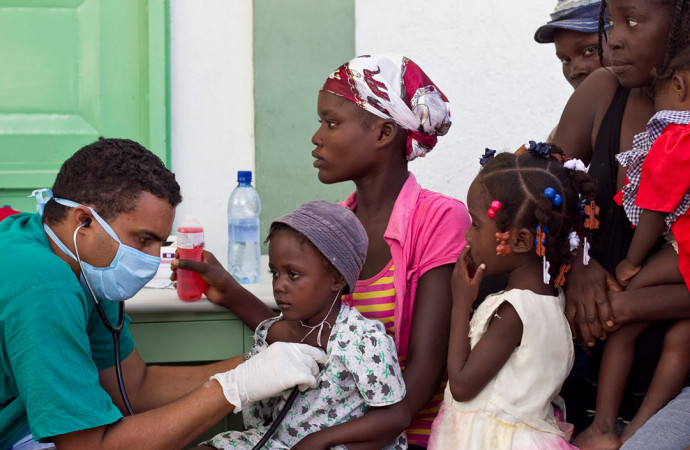
Tina wants to talk about her experience visiting the Caribbean Islands, especially, Haiti, a beautiful island full of kind and nice people who are suffering a drama after a drama without stopping. Hurricanes, floods, earthquakes are moulded the idiosincrasy and the character of Haitian people, the inhabitants of a country, which is the poorest in the American continent.

Tina thinks that this is the real drama of the island: the poverty. If the International Community doesn't help Haitian population with honest and true intentions, Haiti will always be a poor country without resources which can not fight against the natural disasters with a minumum of guarantees.


Haiti is a sovereign state in the Western Hemisphere, North America. The country is located on the island of Hispaniola, in the Greater Antilles archipelago of the Caribbean. It occupies the western three-eighths of the island, which it shares with the Dominican Republic. Haiti is 27,750 square kilometres in size and has an estimated 10.6 million people, making it the most populous country in the Caribbean Community.

More information: United Nations News Centre

The name Haïti or Hayti comes from the indigenous Taíno language which was the native name given to the entire island of Hispaniola to mean, land of high mountains.

The region was originally inhabited by the indigenous Taíno people. Spain first discovered the island on 5 December 1492 during the first voyage of Christopher Columbus across the Atlantic. When Columbus initially landed in Haiti, he had thought he had found India or Asia. On Christmas Day 1492, Columbus' flagship the Santa Maria, ran aground north of what is now Limonade. As a consequence, Columbus ordered his men to salvage what they could from the ship, and he created the first European settlement in the Americas, naming it La Navidad after the day the ship was destroyed.

A Cuban doctor helping Haitian people
In the midst of the French Revolution (1789–1799), slaves and free people of colour revolted in the Haitian Revolution (1791–1804), culminating in the abolition of slavery and the defeat of Napoleon Bonaparte's army at the Battle of Vertières. Afterward the sovereign nation of Haiti was established on 1 January 1804, the first independent nation of Latin America and the Caribbean, the second republic in the Americas.

The gene pool of Haiti is about 95.5% Sub-Saharan African, 4.3% European, with the rest showing some traces of East Asian genes; according to a 2010 autosomal genealogical DNA testing.

Vodou, a religion with African roots similar to those of Cuba and Brazil, originated during colonial times in which slaves were obliged to disguise their loa or spirits as Roman Catholic saints, an element of a process called syncretism and is still practiced by some Haitians today. Since the religious syncretism between Catholicism and Vodou, it is difficult to estimate the number of Vodouists in Haiti.


The two official languages of Haiti are French and Haitian Creole. French is the principal written and administratively authorized language, as well as the main language of the press, and is spoken by 42% of Haitians. It is spoken by all educated Haitians, is the medium of instruction in most schools, and is used in the business sector. It is also used in ceremonial events such as weddings, graduations and church masses.

Haiti is one of two independent nations in the Americas, along with Canada, to designate French as an official language; the other French-speaking areas are all overseas départements, or collectivités, of France. Haitian Creole, which has recently undergone a standardization, is spoken by virtually the entire population of Haiti. Haitian Creole is one of the French-based creole languages. Its vocabulary is 90% derived from French, but its grammar and influences are from some West African, Taino, Spanish, and Portuguese languages. Haitian Creole is related to the other French creoles, but most closely to Antillean Creole and Louisiana Creole variants.


We want to remember the figure of Isabel Solà, a Catalan nun who was living and working in Haiti until she was killed by robbers in Port-au-Prince.

Isabel Solà in Haiti
Isabel said: You think how is possible I'm still living in Haiti in the middle of poverty and misery, suffering earthquakes, hurricanes, floods and cholera. The only thing I could say is that Haiti is now the onlt place where I can be and heal my heart. Haiti is my home, my family, my work, my pain, my happiness, and my meeting with God.

Last night, a new hurricane, Matthew, destroyed Haiti again and left hundreds of deaths. We hope a strong and real action of the International Community to help Haitian people who are alone again.


The first step in the evolution of ethics is a sense of solidarity 
with other human beings.
Albert Schweitzer

Thursday, 5 February 2015

THE SONG OF THE SYBIL, EURO DISNEY & VOODOO

Today, we’ve reviewed the First Conditional and May (modal verb). We’ve written a composition about our experience in Euro Disney. We’ve talked about the Song of the Sybil (El Cant de la Sibil·la), an important liturgical drama sung every 24 December in some Mediterranean cities and recognized as Masterpiece of the Oral and Intangible Heritage of Humanity by UNESCO.

The sun will lose its lightness showing itself dark and veiled, the moon will give no light and the whole world will be sorrow.

   More information: The Song of the Sybil

After the breakfast, we’ve talked about Voodoo and its influence in places like Haiti and we’ve practised a little of it. We've predicted the weather with Vanesa and we’ve reflected about The European Union and its future.

We don't know anything about our future, but if we had to ask for a wish, we would like to be forever young. 


May your hands always be busy
May your feet always be swift
May you have a strong foundation
When the winds of changes shift
May your heart always be joyful
And may your song always be sung
May you stay forever young
Forever young, forever young
May you stay forever young.


Joan Baez