Today, The Grandma has been reading some tales written by Jacob Grimm, the German linguist, philologist and folklorist, who was born on a day like today in 1785.
Jacob Ludwig Karl Grimm (4 January 1785-20 September 1863), also known as Ludwig Karl, was a German author, linguist, philologist, jurist, and folklorist. He formulated Grimm's law of linguistics, and was the co-author of the Deutsches Wörterbuch, the author of Deutsche Mythologie, and the editor of Grimms' Fairy Tales. He was the older brother of Wilhelm Grimm; together, they were the literary duo known as the Brothers Grimm.
Jacob Grimm was born 4 January 1785, inHanau in Hesse-Kassel. His father, Philipp Grimm, was a lawyer who died while Jacob was a child, and his mother Dorothea was left with a very small income. Her sister was the lady of the chamber to the Landgravine of Hesse, and she helped to support and educate the family. Jacob was sent to the public school at Kassel in 1798 with his younger brother Wilhelm.
In 1802, he went to the University of Marburg where he studied law, a profession for which he had been intended by his father. His brother joined him at Marburg a year later, having just recovered from a severe illness, and likewise began the study of law.
Grimm's Geschichte der deutschen Sprache (History of the German Language) explores German history hidden in the words of the German language and is the oldest linguistic history of the Teutonic tribes. He collected scattered words and allusions from classical literature and tried to determine the relationship between the German language and those of the Getae, Thracians, Scythians, and other nations whose languages were known only through Greek and Latin authors.
Grimm's results were later greatly modified by a wider range of available comparisons and improved methods of investigation. Many questions that he raised remain obscure due to the lack of surviving records of the languages, but his book's influence was profound.
Grimm's famous Deutsche Grammatik (German Grammar) was the outcome of his purely philological work. He drew on the work of past generations, from the humanists onwards, consulting an enormous collection of materials in the form of text editions, dictionaries, and grammars, mostly uncritical and unreliable.
Jacob is recognized for enunciating Grimm's law, the Germanic Sound Shift, which was first observed by the Danish philologist Rasmus Christian Rask. Grimm's law,also known as the Rask-Grimm Rule or the First Germanic Sound Shift, was the first law in linguistics concerning a non-trivial sound change.
Grimm's monumental dictionary of the German Language, the DeutschesWörterbuch, was started in 1838 and first published in 1854.
Jacob Grimm died on 20 September 1863, in Berlin, Germany from disease, at the age of 78.
Today, The Grandma has been reading Hansel and Gretel, a wonderful German fairy tale collected by the Brothers Grimm and published in 1812 in Grimm's Fairy Tales.
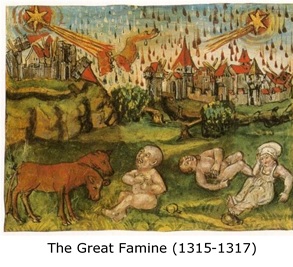
Reading Hansel and Gretel, TheGrandma has remembered one of themost important European crises, theGreat Famine of1315–1317, that was so hard that the chronicles say that even the king of England has difficulties buying bread for himself and his entourage on a day like today in 1315.
The Great Famine of 1315–1317 (occasionally dated 1315–1322) wasthe first of a series of large-scale crises that struck Europe early in the 14th century.
Most of Europe (extending east to Russia and south to Italy) was affected. The famine caused many deaths over an extended number of years and marked a clear end to the period of growth and prosperity from the 11th to the 13th centuries.
The Great Famine started with bad weather in spring 1315. Crop failures lasted through 1316 until the summer harvest in 1317, and Europe did not fully recover until 1322. Crop failures were not the only problem; cattle disease caused sheep and cattle numbers to fall as much as 80 percent.
The period was marked by extreme levels of crime, disease, mass death, and even cannibalism and infanticide. The crisis had consequences for the Church, state, European society, and for future calamities to follow in the 14th century.
Research has shown the Great Famine was possibly precipitated by a volcanic event,specifically that of Mount Tarawera, New Zealand, which lasted about five years beginning in 1315.
Famines were familiar occurrences in medieval Europe. For example, localised famines occurred in France during the 14th century in 1304, 1305, 1310, 1315–1317 (the Great Famine), 1330–1334, 1349–1351, 1358–1360, 1371, 1374–1375, and 1390.
In England, the most prosperous kingdom affected by the Great Famine, there were additional famines in 1321, 1351, and 1369.
For
most people there was often not enough to eat, and life was a
relatively short and brutal struggle to survive to old age. According to
official records about the English royal family, an example of the best
off in society, for whom records were kept, the average life expectancy
at birth in 1276 was 35.28 years.
Between
1301 and 1325, during the Great Famine it was 29.84 years, while
between 1348 and 1375 during the Plague, it was only 17.33 years. It
demonstrates the relative steep population drop between 1348 and 1375 of
about 42%.
During the Medieval Warm Period, the period prior to 1300, the population of Europe exploded compared to prior eras, reaching levels that were not matched again in some places until the 19th century-indeed, parts of rural France today are still less populous than at the beginning of the 14th century. However, the yield ratios of wheat, the number of seeds one could harvest and eat per seed planted, had been dropping since 1280, and food prices had been climbing. After favourable harvests, the ratio could be as high as 7:1, but after unfavourable harvests it was as low as 2:1 -that is, for every seed planted, two seeds were harvested, one for next year's seed, and one for food. By comparison, modern farming has ratios of 30:1 or more.
The onset of the Great Famine followed the end of the Medieval Warm Period.
Between 1310 and 1330, Northern Europe saw some of the worst and most sustained periods of bad weather in the entire Middle Ages, characterized by severe winters and rainy and cold summers. Changing weather patterns, the ineffectiveness of medieval governments in dealing with crises, and population level at a historical high made it a time with little margin for error in food production.
In
the spring of 1315, unusually heavy rain began in much of Europe.
Throughout the spring and the summer, it continued to rain, and the
temperature remained cool. Under such conditions, grain could not ripen,
leading to widespread crop failures. Grain was brought indoors in urns
and pots to keep dry. The straw and hay for the animals could not be
cured, so there was no fodder for the livestock. In England, lowlands in
Yorkshire and Nottingham were flooded, while stew ponds on the River
Foss in Yorkshire were washed away.
The
price of food began to rise; prices in England doubled between spring
and midsummer. Salt, the only way to cure and preserve meat, was
difficult toobtain because brine could not be effectively evaporated in
wet weather; its price increased from 30 to 40 shillings.
In Lorraine, wheat prices rose by 320%, making bread unaffordable to peasants. Stores of grain for long-term emergencies were limited to royalty, lords, nobles, wealthy merchants, and the Church. Because of the general increased population pressures, even lower-than-average harvests meant some people would go hungry; there was little margin for failure. People began to harvest wild edible roots, grasses, nuts, and bark in the forests.
A number of documented incidents show the extent of the famine. Edward II of England stopped at St Albans on 10 August 1315 and had difficulty finding bread for himself and his entourage; it was a rare occasion in which the king of England was unable to eat.
In Bristol the city's chronicles reported that in 1315 there was: a great Famine of Dearth with such mortality that the living could scarce suffice to Bury the dead, horse flesh and Dogs flesh was accounted good meat, and some eat their own Children. The thieves that were in Prison did pluck and tear in pieces, such as were newly put into Prison, and devoured them half alive.
The French, under Louis X, tried to invade Flanders, but in low-lying areas of the Netherlands, the fields were soaked, and the army became so bogged down that they were forced to retreat, burning their provisions where they left them, unable to carry them away.
In the spring of 1316, it continued to rain on a European population deprived of energy and reserves to sustain itself. All segments of society, from nobles to peasants were affected, but especially the peasants, who represented 95% of the population and who had no reserve food supplies. To provide some measure of relief, the future was mortgaged by slaughtering the draft animals, eating the seed grain, abandoning children to fend for themselves (see Hansel and Gretel) and, among old people, voluntarily refusing food for the younger generation to survive. The chroniclers of the time noted many incidents of cannibalism, although, one can never tell if such talk was not simply a matter of rumour-mongering.
The height of the famine was in 1317, as the wet weather continued. Finally, in that summer, the weather returned to its normal patterns. By then, however, people were so weakened by diseases such as pneumonia, bronchitis, and tuberculosis, and so much of the seed stock had been eaten, that it was not until 1325 that the food supply returned to relatively normal levels and the population began to increase again.
Historians debate the toll, but it is estimated that 10–25% of the population of many cities and towns died. Though the Black Death (1347–1351) would kill more people, it often swept through an area in a matter of months, whereas the Great Famine lingered for years, prolonging the suffering of the populace.
Jean-Pierre
Leguay noted the Great Famineproduced wholesale slaughter in a world
that was already overcrowded, especially in the towns, which were
natural outlets for rural overpopulation. Estimates of death rates vary
by place, but some examples include a loss of 10–15% in the south of
England. Northern France lost about 10% of its population.
The Great Famine was restricted to Northern Europe, including the British Isles, Northern France, the Low Countries, Scandinavia, Germany, and western Poland. It also affected some Baltic States, except for the far eastern Baltic, which was affected only indirectly. The famine was bounded to the south by the Alps and the Pyrenees.
The Great Famine is noteworthy for the number of people who died, the vast geographic area that was affected and its length, but also its lasting consequences.
In a society whose final recourse for nearly all problems had been religion, and Roman Catholicism was the only tolerated Christian faith, no amount of prayer seemed effective against the root causes of the famine. This undermined the institutional authority of the Roman Catholic Church, and helped lay the foundations for later movements that were deemed heretical by the Church, as they opposed the papacy and blamed the perceived failure of prayer on corruption and doctrinal errors within the Roman Catholic Church.
Medieval Europe in the fourteenth century had already experienced widespread social violence, and even acts then punishable by death such as rape and murder were demonstrably far more common, especially relative to the population size, compared with modern times.
The famine led to a stark increase in crime, even among those not normally inclined to criminal activity, because people would resort to any means to feed themselves or their families. For the next several decades after the famine,Europe took on a tougher and more violent edge; it became an even less amicable place than during the twelfth and the thirteenth centuries.
This could be seen across all segments of society, perhaps most strikingly in the way warfare was conducted in the fourteenth century during the Hundred Years' War, when chivalry ended, as opposed to the twelfth and the thirteenth centuries when nobles were more likely to die by accident in tournament games than on the field of battle.
The famine also undermined confidence in medieval governments, due totheir failure to deal with its resulting crises.
The Great Famine marked a clear end to an unprecedented period of population growth that had started around 1050. Although some believe growth had already been slowing down for a few decades, the famine was undoubtedly a clear end of high population growth.
The Great Famine would later have consequences for future events in the fourteenth century, such as the Black Death, when an already weakened population would be struck again.
Near the gates and within two cities there will be scourges the like of which was never seen: famine within plague, people put out by steel, crying to the great immortal God for relief.
.jpg)