Showing posts with label Alan Lomax. Show all posts

Tuesday, 14 April 2026

WE LOVE FOOTBALL CRAZILY, SO WE LIKE WATCHING LFC

Today, The Morgans and The Grandma arrived in Liverpool to spend two days visiting the city and witnessing the UCL match between Liverpool and PSG live at Anfield.

The family had breakfast with The Beatles, old friends of The Grandma with whom they talked about love and musical tastes.

The Grandma told a very interesting story about Alan Lomax and Rosalía whose indisputable works gives incalculable value to oral tradition and the classics.

After the visit, the family has been reviewing English grammar with Adverbs of Manner and State Verbs. They have also created templates for writing essays.

This evening, The Morgans will be special guests in the Anfield stadium box from where they will cheer on Liverpool and remind them that they will never walk alone. The whole family is very excited about this event, well not everyone, with the exception of Andrea Morgan, who doesn't like football.

More information: Adverbs of Manner

More information: State Verbs (I) & (II) 

More information: Alan Lomax Archive

Liverpool is a city in Merseyside, North West England. It is located on the eastern side of the Mersey Estuary, adjacent to the Irish Sea, and is approximately 286 km from London. The name comes from the Old English lifer, meaning thick or muddy water, and pōl, meaning a pool or creek, and is first recorded around 1190 as

All You Need Is Love is a song by the English rock band the Beatles that was released as a non-album single in July 1967.

It was written by John Lennon and credited to the Lennon–McCartney partnership. The song was Britain's contribution to Our World, the first live global television link, for which the band were filmed performing it at EMI Studios in London on 25 June.

The programme was broadcast via satellite and seen by an audience of over 400 million in 25 countries. Lennon's lyrics were deliberately simplistic, to allow for the show's international audience, and captured the utopian ideals associated with the Summer of Love. The single topped sales charts in Britain, the United States and many other countries, and became an anthem for the counterculture's embrace of flower power philosophy.

Our World coincided with the height of the Beatles' popularity and influence, following the release of their album Sgt. Pepper's Lonely Hearts Club Band. Rather than perform the song entirely live, the group played to a pre-recorded backing track. With an orchestral arrangement by George Martin, the song begins with a portion of the French national anthem and ends with musical quotations from works such as Glenn Miller's In the Mood, Greensleeves, Bach's Invention No. 8 in F major, and the Beatles' 1963 hit She Loves You. Adding to the broadcast's festive atmosphere, the studio was adorned with signs and streamers and filled with guests dressed in psychedelic attire, including members of the Rolling Stones, the Who and the Small Faces. Brian Epstein, the Beatles' manager, described the performance as the band's finest moment.

All You Need Is Love was later included on the US Magical Mystery Tour album and served as the moral for the Beatles' 1968 animated film Yellow Submarine. Originally broadcast in black-and-white, the Our World performance was colourised for inclusion in the Beatles' 1995 Anthology documentary series.

While the song remains synonymous with the 1967 Summer of Love ethos and provided the foundation for Lennon's legacy as a humanitarian, numerous critics found the message naive in retrospect, particularly during the 1980s.

Since 2009, Global Beatles Day, an international celebration of the Beatles' music and social message, takes place on 25 June each year in tribute to their Our World performance.

In the decades following the record's release, Beatles biographers and music journalists criticised the lyrics as naive and simplistic and detected a smugness in the message; the song's musical content was similarly dismissed as unimaginative.

More information: The History Press


Love, love, love
Love, love, love
Love, love, love

There's nothing you can do that can't be done (love)
Nothing you can sing that can't be sung (love)
Nothing you can say, but you can learn how to play the game (love)
 
The Beatles 

Monday, 15 August 2022

MIKE SEEGER, AMERICAN FOLK MUSICIAN & FOLKLORIST

Today, The Grandma has been listening to some music. She has chosen Mike Seeger's songs, the American folk musician and folklorist who was born on a day like today in 1933.

Mike Seeger (August 15, 1933-August 7, 2009) was an American folk musician and folklorist

He was a distinctive singer and an accomplished musician who played autoharp, banjo, fiddle, dulcimer, guitar, mouth harp, mandolin, dobro, jaw harp, and pan pipes.

Seeger, a half-brother of Pete Seeger, produced more than 30 documentary recordings, and performed in more than 40 other recordings.

He desired to make known the caretakers of culture that inspired and taught him.

Seeger was born in New York and grew up in Maryland and Washington D.C. His father, Charles Louis Seeger Jr., was a composer and pioneering ethnomusicologist, investigating both American folk and non-Western music. His mother, Ruth Crawford Seeger, was a composer. His eldest half-brother, Charles Seeger III, was a radio astronomer, and his next older half-brother, John Seeger, taught for years at the Dalton School in Manhattan. His next older half brother was Pete Seeger. His uncle, Alan Seeger, the poet who wrote I have a rendezvous with Death, was killed during the First World War. 

Seeger was a self-taught musician who began playing stringed instruments at the age of 18. He also sang Sacred Harp with British folk singer Ewan MacColl and his son, Calum. Seeger's sister Peggy Seeger, also a well-known folk performer, married MacColl, and his sister Penny wed John Cohen, a member of Mike's musical group, New Lost City Ramblers.

The family moved to Washington D.C. in 1936 after his father's appointment to the music division of the Resettlement Administration. While in Washington D.C., Ruth Seeger worked closely with John and Alan Lomax at the Archive of American Folk Song at the Library of Congress to preserve and teach American folk music. Ruth Seeger's arrangements and interpretations of American Traditional folk songs in the 1930s, 1940s and 1950s are well regarded.

At about the age of 20, Mike Seeger began collecting songs by traditional musicians on a tape recorder. Folk musicians such as Lead Belly, Woody Guthrie, John Jacob Niles, and others were frequent guests in the Seeger home.

More information: Mike Seeger

In 1958 he co-founded the New Lost City Ramblers, an old-time string band in New York City, during the Folk Revival. The other founding members included John Cohen and Tom Paley. Paley later left the group in 1962 and was replaced by Tracy Schwarz. The New Lost City Ramblers directly influenced countless musicians in subsequent years.

The Ramblers distinguished themselves by focusing on the traditional playing styles they heard on old 78rpm records of musicians recorded during the 1920s and 1930s. Tracy was also in Mike's other band, Strange Creek Singers. So was Mike's former wife, Alice Gerrard. She was Alice Seeger in that band and sang and played guitar in it. The other people in Strange Creek Singers were bass player and singer Hazel Dickens and banjo player Lamar Grier. Mike sang and played guitar, banjo, fiddle, mandolin, autoharp, and harmonica in the band.

Seeger received six Grammy nominations and was the recipient of four grants from the National Endowment for the Arts, including a 2009 National Heritage Fellowship, which is the United States government's highest honour in the folk and traditional arts. His influence on the folk scene was described by Bob Dylan in his autobiography, Chronicles: Volume One. He was a popular presenter and performer at traditional music gatherings such as Breakin' Up Winter.

Eight days before his 76th birthday, Mike Seeger died at his home in Lexington, Virginia, on August 7, 2009, after stopping cancer treatment.

The Mike Seeger Collection, which includes original sound and video recordings by Mike Seeger, is located in the Southern Folklife Collection of the Wilson Library of the University of North Carolina at Chapel Hill.

More information: Folkways


Of I sing for my friends
When death's cold hand I see
When I reach my journey's end
Who will sing one song for me.

Mike Seeger

Monday, 31 January 2022

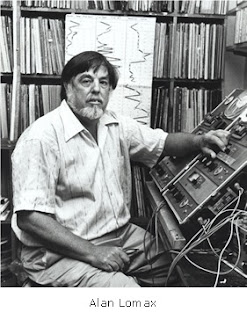
ALAN LOMAX, THE ETHNOMUSICOLOGIST OF FOLK MUSIC

Today, The Grandma has been listening to some Mallorcan tonades, country songs sung by farmers and local workers, some of them recorded by Alan Lomax, the American ethnomusicologist who was born on a day like today in 1915.

Alan Lomax (January 31,1915-July 19, 2002) was an American ethnomusicologist, best known for his numerous field recordings of folk music of the 20th century.

He was also a musician himself, as well as a folklorist, archivist, writer, scholar, political activist, oral historian, and film-maker.

Lomax produced recordings, concerts, and radio shows in the US and in England, which played an important role in preserving folk music traditions in both countries, and helped start both the American and British folk revivals of the 1940s, 1950s, and early 1960s.

He collected material first with his father, folklorist and collector John Lomax, and later alone and with others, Lomax recorded thousands of songs and interviews for the Archive of American Folk Song, of which he was the director, at the Library of Congress on aluminum and acetate discs.

After 1942, when Congress cut off the Library of Congress's funding for folk song collecting, Lomax continued to collect independently in Britain, Ireland, the Caribbean, Italy, and Spain, as well as the United States, using the latest recording technology, assembling an enormous collection of American and international culture.

In March 2004, the material captured and produced without Library of Congress funding was acquired by the Library, which brings the entire seventy years of Alan Lomax's work together under one roof at the Library of Congress, where it has found a permanent home.

More information: Cultural Equity

With the start of the Cold War, Lomax continued to speak out for a public role for folklore, even as academic folklorists turned inward. He devoted much of the latter part of his life to advocating what he called Cultural Equity, which he sought to put on a solid theoretical foundation through to his Cantometrics research (which included a prototype Cantometrics-based educational program, the Global Jukebox).

In the 1970s and 1980s, Lomax advised the Smithsonian Institution's Folklife Festival and produced a series of films about folk music, American Patchwork, which aired on PBS in 1991. In his late seventies, Lomax completed a long-deferred memoir, The Land Where the Blues Began (1995), linking the birth of the blues to debt peonage, segregation, and forced labor in the American South.

Lomax's greatest legacy is in preserving and publishing recordings of musicians in many folk and blues traditions around the US and Europe

Among the artists Lomax is credited with discovering and bringing to a wider audience include blues guitarist Robert Johnson, protest singer Woody Guthrie, folk artist Pete Seeger, country musician Burl Ives, Scottish Gaelic singer Flora MacNeil, and country blues singer Lead Belly, among many others.

Lomax was born in Austin, Texas, in 1915, the third of four children born to Bess Brown and pioneering folklorist and author John A. Lomax. 

Two of his siblings also developed significant careers studying folklore: Bess Lomax Hawes and John Lomax Jr.

Lomax, now 17, therefore took a break from studying to join his father's folk song collecting field trips for the Library of Congress, co-authoring American Ballads and Folk Songs (1934) and Negro Folk Songs as Sung by Lead Belly (1936).

From 1937 to 1942, Lomax was Assistant in Charge of the Archive of Folk Song of the Library of Congress to which he and his father and numerous collaborators contributed more than ten thousand field recordings.

From 1942 to 1979 Lomax was repeatedly investigated and interviewed by the Federal Bureau of Investigation (FBI), although nothing incriminating was ever discovered and the investigation was eventually abandoned.

In December 1949 a newspaper printed a story, Red Convictions Scare 'Travelers', that mentioned a dinner given by the Civil Rights Association to honor five lawyers who had defended people accused of being Communists.

Lomax spent the 1950s based in London, from where he edited the 18-volume Columbia World Library of Folk and Primitive Music, an anthology issued on newly invented LP records.

More information: The Library of Congress

Upon his return to New York in 1959, Lomax produced a concert, Folksong '59, in Carnegie Hall, featuring Arkansas singer Jimmy Driftwood; the Selah Jubilee Singers and Drexel Singers (gospel groups); Muddy Waters and Memphis Slim (blues); Earl Taylor and the Stoney Mountain Boys (bluegrass); Pete Seeger, Mike Seeger (urban folk revival); and The Cadillacs (a rock and roll group).

Lomax was a consultant to Carl Sagan for the Voyager Golden Record sent into space on the 1977 Voyager Spacecraft to represent the music of the earth.

Music he helped choose included the blues, jazz, and rock 'n' roll of Blind Willie Johnson, Louis Armstrong, and Chuck Berry; Andean panpipes and Navajo chants; Azerbaijani mugham performed by two balaban players, a Sicilian sulfur miner's lament; polyphonic vocal music from the Mbuti Pygmies of Zaire, and the Georgians of the Caucasus; and a shepherdess song from Bulgaria by Valya Balkanska; in addition to Bach, Mozart, and Beethoven, and more.

Alan Lomax died in Safety Harbor, Florida on July 19, 2002, at the age of 87.

More information: Open Culture


And the thing that I always tried to do with important singers
when I met them was to sit down and record everything they knew,
give them a first real run-through of their art.

Alan Lomax