Claire Fontaine is in Donostia, Euskadi. She has participated in the Donostia Forum called Language Diversity in Action.
Claire wants to share her experiences about this forum and invites you to read a Tamari Bulia's post about this event.
Donostia is a venue for the European Language Diversity Forum and for the official launch of the Protocol to Ensure Language Rights.
For the last two days, Donostia, San Sebastian is a hub of experts on language policies. UNESCO Etxea, in collaboration with the Donostia-San Sebastián Foundation 2016 organised the European Language Diversity Forum to reflect on and debate the different aspects of the development of minority languages in Europe.
ECMI Director Prof. Tove Malloy was among the participants of the event discussing EU language policies at the panel. The event featured prominent experts on linguistic diversity who discussed topics such as multilingual education with a minority language, the European Charter of Regional or Minority Languages and European Language Policy, good practices, achievement, and challenges.
In addition to the 24 official languages of the EU member states, linguistic diversity in the European Union comprises a further 90 languages which are spoken by 50 million people.
Claire Fontaine in Donostia, Euskadi
The current and future vitality of many of these languages is not guaranteed, and around 30 are in danger of extinction. The challenge we face is precisely to create the necessary conditions for all of this cultural richness to endure and develop equally.
It is therefore urgent that linguistic diversity is included as a key theme in the debates about the construction of Europe, in order to guarantee the rights of all its citizens, and as an essential element for a model in which communities live together in the richness of diversity.
The European Forum on Linguistic Diversity aspires to generate debate on this issue and to offer a large-scale opportunity to establish strategies and agreements among the different parties involved, thus enabling the revitalisation and normalisation of vulnerable and minoritized languages.
The Language Diversity Forum seeks to place linguistic rights on the agenda from a new perspective.
Every two weeks, a language dies. The world is diminished
The Sun Stone, Stone of the Five Eras, or sometimes called Aztec calendar stone is a late post-classic Mexica sculpture housed in the National Anthropology Museum in Mexico City, and is perhaps the most famous work of Aztec sculpture.
The stone is 358 centimetres in diameter and 98 centimetres thick, and it weighs about 24 tons. Shortly after the Spanish conquest, the monolithic sculpture was buried in the Zócalo, or main square of Mexico City. It was rediscovered on December 17, 1790 during repairs on the Mexico City Cathedral.
Following its rediscovery, the calendar stone was mounted on an exterior wall of the Cathedral, where it remained until 1885. Most scholars think that the stone was carved some time between 1502 and 1521, though some believe that it is several decades older than that.
The sculpted motifs that cover the surface of the stone refer to central components of the Mexica cosmogony. In the center of the monolith is the face of the solar deity, Tonatiuh, which appears inside the glyph for movement, Nahuatl: ollin, the name of the current era. The central figure is shown holding a human heart in each of his clawed hands, and his tongue is represented by a stone sacrificial knife (Tecpatl).
Jacqueline Kennedy and The Sun Stone, 1962
The four squares that surround the central deity represent the four previous suns or eras, which preceded the present era, 4 Movement, Nahuatl: Nahui Ollin. Each era ended with the destruction of the world and humanity, which were then recreated in the next era.
The top right square represents 4 Jaguar, Nahuatl: Nahui Ocelotl, the day on which the first era ended, after having lasted 676 years, due to the appearance of monsters that devoured all of humanity.
The top left square shows 4 Wind, Nahuatl: Nahui Ehecatl, the date on which, after 364 years, hurricane winds destroyed the earth, and humans were turned into monkeys.
The bottom left square shows 4 Rain, Nahuatl: Nahui Quiahuitl. This era lasted 312 years, before being destroyed by a rain of fire, which transformed humanity into turkeys.
The bottom right square represents 4 Water, Nahuatl: Nahui Atl, an era that lasted 676 years and ended when the world was flooded and all the humans were turned into fish.
Placed among these four squares are three additional dates, 1 Flint, 1 Rain, and 7 Monkey, and a Xiuhuitzolli, or ruler's turquoise diadem, glyph. It has been suggested that these dates may have had both historical and cosmic significance, and that the diadem may form part of the name of the Mexica ruler Moctezuma II.
The exact purpose and meaning of the Calendar Stone are unclear. Archaeologists and historians have proposed numerous theories, and it is likely that there are several aspects to its interpretation.
Joseph visiting The Stone of the Five Eras
The earliest interpretations of the stone relate to its use as a calendar.
In 1792, two years after the stone's unearthing, Mexican anthropologist Antonio de León y Gama wrote a treatise on the Aztec calendar using the stone as its basis. Some of the circles of glyphs are the glyphs for the days of the month. Some of the symbols may represent the five ages that the Mexica believed the earth had passed through.
Another aspect of the stone is its religious significance. One theory is that the face at the center of the stone represents Tonatiuh, the Aztec deity of the sun. It is for this reason that the stone became known as the Sun Stone. Richard Townsend proposed a different theory, claiming that the figure at the centre of the stone represents Tlaltecuhtli, the Mexica earth deity who features in Mexica creation myths. Modern archaeologists, such as those at the National Anthropology Museum in Mexico City, believe it is more likely to have been used primarily as a ceremonial basin or ritual altar for gladiatorial sacrifices, than as an astrological or astronomical reference.
Yet another characteristic of the stone is its possible geographic significance. The four points may relate to the four corners of the earth or the cardinal points. The inner circles may express space as well as time.
Lastly, there is the political aspect of the stone. It may have been intended to show Tenochtitlan as the center of the world and therefore, as the center of authority.
When you think about archaeology, archaeology is the only field
that allows us to tell the story of 99 percent of our history prior to 3,000 B.C. and writing.
TheInternational Covenant on Civil and Political Rights (ICCPR) is a multilateral treaty adopted by the United Nations General Assembly on 16 December 1966, and in force from 23 March 1976. It commits its parties to respect the civil and political rights of individuals, including the right to life, freedom of religion, freedom of speech, freedom of assembly, electoral rights and rights to due process and a fair trial. As of April 2014, the Covenant has 74 signatories and 168 parties.
The ICCPR is part of the International Bill of Human Rights, along with the International Covenant on Economic, Social and Cultural Rights (ICESCR) and the Universal Declaration of Human Rights (UDHR).
The ICCPR is monitored by the United Nations Human Rights Committee, a separate body to the United Nations Human Rights Council, which reviews regular reports of States parties on how the rights are being implemented. States must report initially one year after acceding to the Covenant and then whenever the Committee requests, usually every four years. The Committee normally meets in Geneva and normally holds three sessions per year.
The ICCPR has its roots in the same process that led to the Universal Declaration of Human Rights. A Declaration on the Essential Rights of Man had been proposed at the 1945 San Francisco Conference which led to the founding of the United Nations, and the Economic and Social Council was given the task of drafting it. Early on in the process, the document was split into a declaration setting forth general principles of human rights, and a convention or covenant containing binding commitments. The former evolved into the UDHR and was adopted on 10 December 1948.
The States Parties to the present Covenant, including those having responsibility for the administration of Non-Self-Governing and Trust Territories, shall promote the realization of the right of self-determination, and shall respect that right, in conformity with the provisions of the Charter of the United Nations.
Drafting continued on the convention, but there remained significant differences between UN members on the relative importance of negative Civil and Political versus positive Economic, Social and Cultural rights. These eventually caused the convention to be split into two separate covenants, one to contain civil and political rights and the other to contain economic, social and cultural rights. The two covenants were to contain as many similar provisions as possible, and be opened for signature simultaneously. Each would also contain an article on the right of all peoples to self-determination.
The first document became the International Covenant on Civil and Political Rights and the second the International Covenant on Economic, Social and Cultural Rights. The drafts were presented to the UN General Assembly for discussion in 1954, and adopted in 1966. As a result of diplomatic negotiations the International Covenant on Economic, Social and Cultural Rights was adopted shortly before the International Covenant on Civil and Political Rights.
Without freedom of thought, there can be no such thing as wisdom and no such thing as public liberty without freedom of speech.
Pericles (Περικλῆς Periklēs, c. 495–429 BC) was a prominent and influential Greek statesman, orator and general of Athens during the Golden Age, specifically the time between the Persian and Peloponnesian wars. He was descended, through his mother, from the powerful and historically influential Alcmaeonid family.
Pericles had such a profound influence on Athenian society that Thucydides, a contemporary historian, acclaimed him as the first citizen of Athens. Pericles turned the Delian League into an Athenian empire, and led his countrymen during the first two years of the Peloponnesian War. The period during which he led Athens, roughly from 461 to 429 BC, is sometimes known as the Age of Pericles, though the period thus denoted can include times as early as the Persian Wars, or as late as the next century.
Pericles promoted the arts and literature; it is principally through his efforts that Athens holds the reputation of being the educational and cultural center of the ancient Greek world. He started an ambitious project that generated most of the surviving structures on the Acropolis, including the Parthenon. This project beautified and protected the city, exhibited its glory, and gave work to the people. Pericles also fostered Athenian democracy to such an extent that critics call him a populist. Pericles' most visible legacy can be found in the literary and artistic works of the Golden Age, most of which survive to this day.
The Acropolis, though in ruins, still stands and is a symbol of modern Athens. Paparrigopoulos wrote that these masterpieces are sufficient to render the name of Greece immortal in our world. In politics, Victor L. Ehrenberg argues that a basic element of Pericles' legacy is Athenian imperialism, which denies true democracy and freedom to the people of all but the ruling state. The promotion of such an arrogant imperialism is said to have ruined Athens. Pericles and his expansionary policies have been at the center of arguments promoting democracy in oppressed countries.
Other analysts maintain an Athenian humanism illustrated in the Golden Age. The freedom of expression is regarded as the lasting legacy deriving from this period. Pericles is lauded as the ideal type of the perfect statesman in ancient Greece and his Funeral Oration is nowadays synonymous with the struggle for participatory democracy and civic pride.
What you leave behind is not what is engraved in stone monuments,
The Grandma is in Budapest, the capital of Hungary. The weather is cold, -1ºC of average and it's snowing without stopping.
She prefers to stay inside her cabin in The Orient Express reading something. Today, a biography about Peter O'Toole, one of the most important Irish actors who offered the best performances about the great William Shakespeare's characters.
Peter Seamus O'Toole (2 August 1932-14 December 2013) was a British-Irish stage and film actor. He attended the Royal Academy of Dramatic Art and began working in the theatre, gaining recognition as a Shakespearean actor at the Bristol Old Vic and with the English Stage Company before making his film debut in 1959.
He achieved international recognition playing T. E. Lawrence in Lawrence of Arabia (1962) for which he received his first nomination for the Academy Award for Best Actor. He was nominated for this award another seven times for Becket (1964), The Lion in Winter (1968), Goodbye, Mr. Chips (1969), The Ruling Class (1972), The Stunt Man (1980), My Favorite Year (1982), and Venus (2006) – and holds the record for the most Academy Award nominations for acting without a win. In 2002, O'Toole was awarded the Academy Honorary Award for his career achievements.
O'Toole was born in 1932. Some sources give his birthplace as Connemara, County Galway, Ireland, while others cite St James University Hospital, Leeds, England. O'Toole claimed he was not certain of his birthplace or date, noting in his autobiography that, while he accepted 2 August as his birthdate, he had a birth certificate from each country, with the Irish one giving a June 1932 birth date O'Toole was evacuated from Leeds early in the Second World War and went to a Catholic school for seven or eight years, St Joseph's Secondary School at Joseph Street, Hunslet.
He first appeared on film in 1959 in a minor role in The Day They Robbed the Bank of England. O'Toole's major break came when he was chosen to play T. E. Lawrence in Sir David Lean's Lawrence of Arabia (1962), after Marlon Brando proved unavailable and Albert Finney turned down the role. His performance was ranked number one in Premiere magazine's list of the 100 Greatest Performances of All Time. The role introduced him to US audiences and earned him the first of his eight nominations for the Academy Award for Best Actor. T. E. Lawrence, portrayed by O'Toole, was selected in 2003 as the tenth-greatest hero in cinema history by the American Film Institute.
O'Toole in Lawrence of Arabia, 1962
O'Toole fulfilled a lifetime ambition in 1970 when he performed on stage in Samuel Beckett's Waiting for Godot, alongside Donal McCann, at Dublin's Abbey Theatre. In 1980, O'Toole starred as Tiberius in the Penthouse-funded biopic, Caligula.
In 1980, he received critical acclaim for playing the director in the behind-the-scenes film The Stunt Man. He received mixed reviews as John Tanner in Man and Superman and Henry Higgins in Pygmalion, and won a Laurence Olivier Award for his performance in Jeffrey Bernard is Unwell (1989). O'Toole was nominated for another Oscar for My Favorite Year (1982), a light romantic comedy about the behind-the-scenes at a 1950s TV variety-comedy show, in which O'Toole plays an aging swashbuckling film star reminiscent of Errol Flynn. He also appeared in 1987's The Last Emperor.
On 10 July 2012, O'Toole released a statement announcing his retirement from acting. O'Toole died on14 December 2013 at Wellington Hospital, London, aged 81. His funeral was held at Golders Green Crematorium in London on 21 December 2013, where he was cremated in a wicker coffin.
O'Toole's remains are planned to be taken to Connemara, Ireland. His daughter Kate said: We're bringing him home. It's what he would have wanted. They are currently being kept at the residence of the President of Ireland, Áras an Uachtaráin, by the President Michael D. Higgins who is an old friend of the actor. His family plan to return to Ireland to fulfill his wishes and take them to the west of Ireland when they can.
On 18 May 2014, a new prize was launched in memory of Peter O'Toole at the Bristol Old Vic Theatre School; this includes an annual award given to two young actors from the Bristol Old Vic Theatre School, including a professional contract at Bristol Old Vic Theatre. He has a memorial plaque in St Paul's, the Actors' Church in Covent Garden.
I woke up one morning to find I was famous.
I bought a white Rolls-Royce and drove down Sunset Boulevard,
wearing dark specs and a white suit, waving like the Queen Mum.
Today is December 13, Santa Lucia and you must visit two incredible Mediterranean cities.
Tina Picotes is in Barcelona, in the Gothic zone, next to the new Cathedral of Barcelona. In this beautiful place, every year you can find hundreds of little stands with Christmas details in La Fira de Santa Llúcia. Tina recommends two: The Tió and The Caganer.
The Tió, Christmas Log, is a big piece of cut wood. It is a character in Catalan mythology relating to a Christmas tradition widespread in Catalonia and some regions of Aragon. A similar tradition exists in other places, such as the Cachafuòc or Soc de Nadal in Occitania. In Aragon it is also called Tizón de Nadal or Toza.
The form of the Tió de Nadal found in many Aragonese and Catalan homes during the holiday season is a hollow log about thirty centimetres long. Recently, the Tió has come to stand up on two or four stick legs with a broad smiling face painted on its higher end, enhanced by a little red sock hat. a miniature of the traditional barretina, and often a three-dimensional nose. Those accessories have been added only in recent times, altering the more traditional and rough natural appearance of a dead piece of wood.
Beginning with the Feast of the Immaculate Conception in December 8, one gives the tió a little bit to eat every night and usually covers him with a blanket so that he will not be cold. The story goes that in the days preceding Christmas, children must take good care of the log, keeping it warm and feeding it, so that it will poop presents on Christmas Day.
Tina Picotes with some Tiós
On Christmas Day or, in some households, on Christmas Eve, one puts the Tió partly into the fireplace and orders it to defecate. The fire part of this tradition is no longer as widespread as it once was, since many modern homes do not have a fireplace. To make it defecate, one beats the tió with sticks, while singing various songs of Tió de Nadal.
The tradition says that before beating the tió all the kids have to leave the room and go to another place of the house to pray, asking for the tió to deliver a lot of presents. This makes the perfect excuse for the relatives to do the trick and put the presents under the blanket while the kids are praying.
The tió does not drop larger objects, as those are considered to be brought by the Three Wise Men. It does leave candies, nuts and torrons. Depending on the region of Catalonia, it may also give out dried figs. What comes out of the Tió is a communal rather than individual gift, shared by everyone there.
The tió is often popularly called Caga tió, Shitting log. This derives from the many songs of Tió de Nadal that begin with this phrase, which was originally, in the context of the songs, an imperative Shit, log!. The use of this expression as a name is not believed to be part of the ancient tradition.
Caga tió, caga torró, avellanes i mató.
Si no cagues bé et daré un cop de bastó.
Caga tió!
Shit, log, shit nougats, hazelnuts and mató cheese.
If you don't shit well, I'll hit you with a stick.
Shit, log!
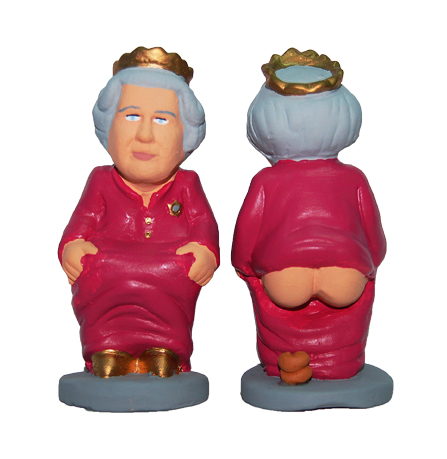
The Caganeris a figurine depicted in the act of defecation appearing in nativity scenes in Catalonia and neighbouring areas with Catalan culture such as Andorra, Valencia, and Northern. It is most popular and widespread in these areas, but can also be found in Murcia, Portugal, and Naples.
Queen Elizabeth II in a Caganer figure
The name El Caganer literally means the crapper or the shitter. Traditionally, the figurine is depicted as a peasant, wearing the traditional Catalan red cap (the barretina) and with his trousers down, showing a bare backside, and defecating.
Catalonia and Naples were independent kingdoms and they were together during some years. The influence of Catalan traditions in Naples is strong.
The Caganer is also a typical figure in Naples where there is one of the most beautiful suburbs that you can visit around the world: Santa Lucia. In front of the Mediterranean sea, Castel de l'Ovo emerges like an incredible fortress witness of the shared past.
Claire Fontaine is in Santa Lucia, an historical rione of Naples. The area rises around the street of the same name and takes that name from the parish sanctuary of Santa Lucia a mare, of which the presence is attested since the 9th century, on the river of the sea, in spite of legend that would have it founded by a granddaughter of Constantine I.
Santa Lucia in Naples, 1865
The territory of the ward coincides with that of the Parish and extends along via Santa Lucia and Orsini and their cross streets, the Islet of Megaride with the Borgo Marinari, the Casteldell'Ovo, and via Chiatamone, all features of the Partenope promenade.
Santa Lucia has been identified with the history of Naples ever since the Greeks from Cumae landed here to found the small market harbour of Falero, which later gave rise, between the beach, the islet of Megaride and the Pizzofalcone hill, to the polis Partenope, from the siren who tried to enchant Ulysses; later that town would be known as Palepoli.
In the preimperial Roman age, general Lucullus moved to the area and built his magnificent villa, known as Oppidum Lucullianum, to which the last Roman emperor Romulus Augustus exiled to live out his days. In the imperial age the area became famous for its proximity to the platamoniae caves, where magic rituals were held and in which Petronius set parts of his Satyricon. In the 7th century Saint Patricia from Constantinople, directed towards the Holy Land, was shipwrecked here and, according to legend, founded the sanctuary and decided to settle in Naples.
Claire Fontaine and Castel de l'Ovo in Napoli
Already in 1845, the sea level rose considerably, making it necessary to bury the original sanctuary and build a new one on top of it; after the annexion of the Kingdom of Naples to Italy (1861) Santa Lucia underwent a complete transformation, including the enlarging and straightening of the Partenope promenade. It involved reclaining large tracts of land from the sea and the creation of new streets, all of which has served the area well in this age of modern tourism.
Santa Lucia has been like subject of some traditional Neapolitan songs, among which is the most famous, Santa Lucia and Santa Lucia Luntana, a musical symbol of Neapolitans leaving home to emigrate to America.
Partono 'e bastimente pe' terre assaje luntane... Cantano a buordo: so' Napulitane! Cantano pe' tramente 'o golfo gia scumpare, e 'a luna, 'a miez'o mare, nu poco 'e Napule
The ships are leaving for far away lands. The Neapolitans sing on board. They sing while in the sunset the bay disappears and the moon, above the sea lets them see a glimpse of Naples.
The Grandma has arrived to Budapest this morning on The Orient Express and she has done a little tour round the city which is ornamented with Christmas details. The place is very beautiful and plenty of historic places but the most incredible for her has been to remember the last scenes of Music Box of her favourite films near the original place where it was filmed.
Music Box is a 1989 American crime drama film that tells the story of a Hungarian-American immigrant (Armin Mueller-Stahl) who is accused of having been a war criminal. The plot revolves around his daughter (Jessica Lange) an attorney, who defends him, and her struggle to uncover the truth. The film was written by Joe Eszterhas and directed by Costa-Gavras.
Now, The Grandma is having dinner in a luxurious hotel in the downtown of the city and she's reading a guide. Here, you have some explanations about this wonderful eastern city.
Budapest is the capital and most populous city of Hungary, one of the largest cities in the European Union and sometimes described as the primate city of Hungary. Budapest became a single city occupying both banks of the Danube river with the unification of Buda and Óbuda on the west bank, with Pest on the east bank on November 17, 1873.
The
origins of the names Buda and Pest are obscure. According to chronicles
from the Middle Ages, the name Buda comes from the name of its founder,
Bleda (Buda), brother of the Hunnic ruler Attila. The theory that Buda was named after a person is also supported by modern scholars. An
alternative explanation suggests that Buda derives from the Slavic word
вода, voda (water), a translation of the Latin name Aquincum, which was
the main Roman settlement in the region and where it is believed that Marcus Aurelius wrote at least part of his book Meditations.
The Grandma walking on the snow in Budapest
There
are also several theories about the origin of the name Pest. One of the
theories states that the word Pest comes from the Roman times, since
there was a fortress Contra-Aquincum in this region that was referred to
as Pession by Ptolemaios. According to another theory, Pest originates
from the Slavic word for cave (пещера, peștera), or oven (пещ, peșt), in
reference either to a cave where fires burned or to a local limekiln.
The history of Budapest began with Aquincum, originally a Celtic settlement that became the Roman capital of Lower Pannonia. Hungarians arrived in the territory in the 9th century. Their first settlement was pillaged by the Mongols in 1241–42. The re-established town became one of the centres of Renaissance humanist culture by the 15th century. Following the Battle of Mohács and nearly 150 years of Ottoman rule, the region entered a new age of prosperity in the 18th and 19th centuries, and Budapest became a global city after its unification in 1873. It also became the co-capital of the Austro-Hungarian Empire, a great power that dissolved in 1918, following World War I. Budapest was the focal point of the Hungarian Revolution of 1848, the Hungarian Republic of Councils in 1919, the Battle of Budapest in 1945, and the Hungarian Revolution of 1956.
If you come from Paris to Budapest you think you are in Moscow but if you go from Moscow to Budapest you think you are in Paris.