Friday, 28 July 2023

ADELINE VIRGINIA WOOLF, STREAM OF CONSCIOUSNESS

Today, The Grandma is relaxing at home. She wants to go to the public library to borrow some books about Virginia Woolf, the English writer who is a referent in the Modernist literature in particular and in the world one in general. She was the pioneer in the use of stream of consciousness following the Russian authors and she is one of The Grandma's favourite writers.

Adeline Virginia Woolf (25 January 1882-28 March 1941) was an English writer, considered one of the most important modernist 20th-century authors and a pioneer in the use of stream of consciousness as a narrative device.

Woolf was born into an affluent household in South Kensington, London, the seventh child in a blended family of eight. Her mother, Julia Prinsep Jackson, celebrated as a Pre-Raphaelite artist's model, had three children from her first marriage; her father, Leslie Stephen, a notable man of letters, had one previous daughter; their marriage produced another four children, including the modernist painter Vanessa Bell.

More information: The British Library

While the boys in the family were educated at university, the girls were home-schooled in English classics and Victorian literature. An important influence in her early life was the summer home the family used in St Ives, Cornwall, where she first saw the Godrevy Lighthouse, which was to become iconic in her novel To the Lighthouse (1927).

Woolf's childhood came to an abrupt end in 1895 with the death of her mother and her first mental breakdown, followed two years later by the death of her stepsister and surrogate mother, Stella Duckworth.

From 1897–1901, she attended the Ladies' Department of King's College London, where she studied classics and history and came into contact with early reformers of women's higher education and the women's rights movement.

Other important influences were her Cambridge-educated brothers and unfettered access to their father's vast library. She began writing professionally in 1900, encouraged by her father, whose death in 1905 was a major turning point in her life and the cause of another breakdown.

Following the death, the family moved from Kensington to the more bohemian Bloomsbury, where they adopted a free-spirited lifestyle; it was there that, in conjunction with their brothers' intellectual friends, they formed the artistic and literary Bloomsbury Group.
 
More information: BBC

In 1912, Woolf married Leonard Woolf and in 1917 they founded the Hogarth Press, which published much of her work. The couple rented second homes in Sussex and moved there permanently in 1940. Throughout her life, Woolf was troubled by bouts of mental illness, which included being institutionalised and attempting suicide. Her illness is considered to have been bipolar disorder, for which there was no effective intervention at the time.

She published her first novel, The Voyage Out, in 1915, through her half-brother's publishing house, Gerald Duckworth and Company. Virginia Woolf provides insight into her early life in her autobiographical essays, including Reminiscences (1908) and 22 Hyde Park Gate (1921).
 
During the interwar period, Woolf was an important part of London's literary and artistic society. Her best-known works include the novels Mrs Dalloway (1925), To the Lighthouse (1927) and Orlando (1928).

She is also known for her essays, including A Room of One's Own (1929), in which she wrote the much-quoted dictum, A woman must have money and a room of her own if she is to write fiction", Leslie Stephen (1932) and A Sketch of the Past (1940).

Woolf became one of the central subjects of the 1970s movement of feminist criticism, and her works have since garnered much attention and widespread commentary for inspiring feminism, an aspect of her writing that was unheralded earlier. Her works are widely read all over the world and have been translated into more than 50 languages.

A large body of literature is dedicated to her life and work, and she has been the subject of many plays, novels, and films. Some of her writing has been considered offensive and has been criticised for a number of complex and controversial views, including anti-semitism and elitism. Woolf is commemorated today by statues, societies dedicated to her work and a building at the University of London.

In the late nineteenth century, education was sharply divided along gender lines, a tradition that Virginia would note and condemn in her writing. Boys were sent to school, and in upper-middle-class families such as the Stephens, this involved private boys schools, often boarding schools, and university. Girls, if they were afforded the luxury of education, received it from their parents, governesses and tutors. Virginia was educated by her parents who shared the duty. There was a small classroom off the back of the drawing room, with its many windows, which they found perfect for quiet writing and painting.

More information: The Culture Trip

Much examination has been made of Woolf's mental health. From the age of 13, following the death of her mother, Woolf suffered periodic mood swings from severe depression to manic excitement, including psychotic episodes, which the family referred to as her madness.

After completing the manuscript of her last novel, posthumously published, Between the Acts (1941), Woolf fell into a depression similar to that which she had earlier experienced.

The onset of World War II, the destruction of her London home during the Blitz, and the cool reception given to her biography of her late friend Roger Fry all worsened her condition until she was unable to work. After World War II began, Woolf's diary indicates that she was obsessed with death, which figured more and more as her mood darkened.

On 28 March 1941, Woolf drowned herself by filling her overcoat pockets with stones and walking into the River Ouse near her home. Her body was not found until 18 April. Her husband buried her cremated remains beneath an elm tree in the garden of Monk's House, their home in Rodmell, Sussex.

Woolf is considered to be one of the greatest twentieth century novelists and short story writers and one of the pioneers, among modernist writers using stream of consciousness as a narrative device, alongside contemporaries such as Marcel Proust, Dorothy Richardson and James Joyce.

Woolf's reputation was at its greatest during the 1930s, but declined considerably following World War II. The growth of feminist criticism in the 1970s helped re-establish her reputation.

A major influence on Woolf from 1912 onward was Russian literature as Woolf adopted many of its aesthetic conventions. The style of Fyodor Dostoyevsky with his depiction of a fluid mind in operation helped to influence Woolf's writings about a discontinuous writing process, though Woolf objected to Dostoyevsky's obsession with psychological extremity and the tumultuous flux of emotions in his characters together with his right-wing, monarchist politics as Dostoyevsky was an ardent supporter of the autocracy of the Russian Empire.

More information: ThoughtCo
 
 
 Every secret of a writer's soul, 
every experience of his life,
every quality of his mind 
is written large in his works.

Virginia Woolf

Thursday, 27 July 2023

MARY ANN NICHOLS, JACK THE RIPPER'S FIRST VICTIM

Today, The Weasleys and The Grandma have talked about Mary Ann Nichols, the first victim of Jack The Ripper.

Mary Ann "Polly" Nichols (26 August 1845-31 August 1888) was one of the Whitechapel murder victims. Her death has been attributed to the notorious unidentified serial killer Jack The Ripper, who is believed to have killed and mutilated at least five women in the Whitechapel area of London from late August to early November 1888.

Mary Ann was born to locksmith Edward Walker and his wife Caroline on 26 August 1845, in Dean Street in London. On 16 January 1864 she married William Nichols, a printer's machinist, and between 1866 and 1879, the couple had five children: Edward John, Percy George, Alice Esther, Eliza Sarah, and Henry Alfred. Their marriage broke up in 1880 or 1881 because of disputed causes. Her father accused William of leaving her after he had an affair with the nurse who had attended the birth of their final child, though Nichols claimed to have proof that their marriage had continued for at least three years after the date alleged for the affair. He maintained that his wife had deserted him and was practising prostitution. Police reports say they separated because of her drunken habits.

More information: Casebook: Jack the Ripper

Legally required to support his estranged wife, William Nichols paid her an allowance of five shillings a week until 1882, when he heard that she was working as a prostitute; he was not required to support her if she was earning money through illicit means. Nichols spent most of her remaining years in workhouses and boarding houses, living off charitable handouts and her meagre earnings as a prostitute. She lived with her father for a year or more but left after a quarrel; her father stated he had heard she had subsequently lived with a blacksmith named Drew in Walworth. 

In early 1888, the year of her death, she was placed in the Lambeth workhouse after being discovered sleeping rough in Trafalgar Square, and in May left the workhouse to take a job as a domestic servant in Wandsworth.

Unhappy in that position, she was an alcoholic and her employer, Mr Cowdry, and his wife, were teetotallers, she left two months later, stealing clothing worth three pounds ten shillings.  At the time of her death, Nichols was living in a Whitechapel common lodging house in Spitalfields, where she shared a room with a woman named Emily "Nelly" Holland.

At about 23:00 on 30 August, Nichols was seen walking the Whitechapel Road; at 00:30 on 31 August she was seen to leave a pub in Brick Lane, Spitalfields.

More information: Historical Events

An hour later, she was turned out of 18 Thrawl Street as she was lacking the fourpence required for a bed, implying by her last recorded words that she would soon earn the money on the street with the help of a new bonnet she had acquired.

She was last seen alive standing at the corner of Osborn Street and Whitechapel Road at approximately 02:30, one hour before her death, by her roommate, Emily Holland. To Holland, Nichols claimed she had earned enough money to pay for her bed three times that evening, but had repeatedly spent the money on alcohol.

A meat cart driver named Charles Allen Lechmere, who also used the name Charles Cross, claimed to have discovered Mary Ann Nichols lying on the ground in front of a gated stable entrance in Buck's Row, since renamed Durward Street, Whitechapel at 3:40 AM, about 150 yards from the London Hospital and 100 yards from Blackwall Buildings. Her skirt was raised.
 
Another passing cart driver on his way to work, Robert Paul, approached and saw Lechmere kneeling over the body. Lechmere called him over. He expressed his opinion that she was dead, but Paul was uncertain and thought she might simply be unconscious.

They pulled her skirt down to cover her lower body, and went in search of a policeman. Upon encountering PC Jonas Mizen, Lechmere informed the constable: She looks to me to be either dead or drunk, but for my part, I believe she's dead. The two men then continued on their way to work, leaving Mizen to inspect Nichols' body.

As Mizen approached the body, PC John Neale came from the opposite direction on his beat and by flashing his lantern, called a third policeman, PC John Thain, to the scene.

More information: Huffington Post

As news of the murder spread, three horse slaughterers from a neighbouring knacker's yard in Winthrop Street, who had been working overnight, came to look at the body. None of the slaughterers, the police officers patrolling nearby streets, or the residents of houses alongside Buck's Row reported hearing or seeing anything suspicious before the discovery of the body.

PC Thain fetched surgeon Dr Henry Llewellyn, who arrived at 04:00 and decided she had been dead for about 30 minutes. Her throat had been slit twice from left to right and her abdomen mutilated with one deep jagged wound, several incisions across the abdomen, and three or four similar cuts on the right side caused by the same knife, estimated to be at least 15–20 cm long, used violently and downwards.  
Llewellyn expressed surprise at the small amount of blood at the crime scene, about enough to fill two large wine glasses, or half a pint at the most. His comment led to the supposition that Nichols was not killed where her body was found, but the blood from her wounds had soaked into her clothes and hair, and there was little doubt that she had been killed at the crime scene by a swift slash to the throat. Death would have been instantaneous, and the abdominal injuries, which would have taken less than five minutes to perform, were made by the murderer after she was dead. 

When a person is killed, further wounds to their body do not always result in a large amount of blood loss. When the body was lifted a mass of congealed blood, in PC Thain's words, lay beneath the body.

As the murder had occurred in the territory of the Bethnal Green Division of the Metropolitan Police, it was initially investigated by the local detectives, inspectors John Spratling and Joseph Helson, who had little success. 

More information: All That's Interesting

Elements of the press linked the attack on Nichols to two previous murders, those of Emma Elizabeth Smith and Martha Tabram, and suggested the killing might have been perpetrated by a gang, as in the case of Smith. The Star newspaper instead suggested a single killer was the culprit and other newspapers took up their storyline. Suspicions of a serial killer at large in London led to the secondment of Detective Inspectors Frederick Abberline, Henry Moore and Walter Andrews from the Central Office at Scotland Yard.

Although Llewellyn had speculated that the attacker could have been left-handed, he later expressed doubt over this initial thought, but the belief that the killer was left-handed endured.

Rumours that a local character called Leather Apron could have been responsible for the murder were investigated by the police, even though they noted there is no evidence against him. 

Imaginative descriptions of Leather Apron, using crude Jewish stereotypes, appeared in the press, but rival journalists dismissed these as a mythical outgrowth of the reporter's fancy. John Pizer, a Polish Jew who made footwear from leather, was known by the name Leather Apron and was arrested despite a lack of evidence. He was soon released after the confirmation of his alibis. Pizer successfully obtained monetary compensation from at least one newspaper that had named him as the murderer.

After several adjournments, to allow the police to gather further evidence, the inquest concluded on 24 September. On the available evidence, Coroner Baxter found that Nichols was murdered at just after 3 a.m. where she was found.


More information: PRI

In his summing up, he dismissed the possibility that her murder was connected with those of Smith and Tabram since the lethal weapons were different in those cases, and neither of the earlier cases involved a slash to the throat. However, by the time the inquest into Nichols' death had concluded, another woman, Annie Chapman, had been murdered, and Baxter noted The similarity of the injuries in the two cases is considerable. The police investigations into the murders of Chapman and Nichols were merged.

The subsequent murders of Elizabeth Stride and Catherine Eddowes the week after the inquest had closed, and that of Mary Jane Kelly on 9 November, were also linked by a similar modus operandi, and the murders were blamed by the press and public on a single serial killer, called Jack The Ripper.

More information: History
 
 
All English people have a fascination 
with Jack The Ripper. 
I don't know why, 
because it's so dreadful, 
but such a strange, 
endearing part of our culture. 
Morbid fascination sums it up.

Jane Goldman

Wednesday, 26 July 2023

BRAMLEY VS HAMBLEDON, FIRST WOMEN CRICKET MATCH

Today, The Weasleys and The Grandma have been reading about the first women's cricket match, played on a day like today in 1745.

Before, they have been studying Past Simple vs Past Continuous

+Info: Past Simple vs Past Continuous

The history of women's cricket can be traced back to a report in The Reading Mercury on 26 July 1745 and a match that took place between the villages of Bramley and Hambledon near Guildford in Surrey.

The Mercury reported:

The greatest cricket match that was played in this part of England was on Friday, the 26th of last month, on Gosden Common, near Guildford, between eleven maids of Bramley and eleven maids of Hambledon, all dressed in white. The Bramley maids had blue ribbons and the Hambledon maids red ribbons on their heads. The Bramley girls got 119 notches and the Hambledon girls 127. There was of bothe sexes the greatest number that ever was seen on such an occasion. The girls bowled, batted, ran and catches as well as most men could do in that game.

Early matches were not necessarily genteel affairs. A match, on 13 July 1747, held at the Artillery Ground between a team from Charlton and another from Westdean and Chilgrove in Sussex spilled over into the following day after it was interrupted by crowd trouble.

Contemporary records show that women's matches were played on many occasions between villages in Sussex, Hampshire and Surrey. Other matches, often held in front of large crowds with heavy betting on the side, pitted single women against their married counterparts. Prizes ranged from barrels of ale to pairs of lace gloves. The first county match was held in 1811 between Surrey and Hampshire at Ball's Pond in Middlesex. Two noblemen underwrote the game with 1,000 guineas, and its participants ranged in age from 14 to 60.

Originally, cricket deliveries were bowled underarm. Legend has it that the roundarm bowling action was pioneered in the early 19th century by Christiana Willes, sister of John Willes, to avoid becoming ensnared in her skirts. In fact, roundarm was devised by Tom Walker in the 1790s.

The first women's cricket club was formed in 1887 at Nun Appleton in Yorkshire and named the White Heather Club. 

In 1890, a team known as the Original English Lady Cricketers, toured England, playing in exhibition matches to large crowds. The team was highly successful until its manager absconded with the profits, forcing the ladies to disband.

James Lillywhite's Cricketers' Annual for 1890 has a photograph of the team and short article on women's cricket. As an exercise, cricket is probably not so severe as lawn tennis, and it is certainly not so dangerous as hunting or skating; and if, therefore, the outcome of the present movement is to induce ladies more generally to play cricket, we shall consider that a good result has been attained.

More information: Home Counties Women Cricket League

The Women's Cricket Association was founded in 1926. The England team first played against The Rest at Leicester in 1933 and undertook the first international tour to Australia in 1934–5, playing the first Women's Test match between England and Australia in December 1934. After winning two tests and drawing one. England travelled on to New Zealand where Betty Snowball scored 189 in the first Test in Christchurch.

The founding mother of women's cricket in Australia was the young Tasmanian, Lily Poulett-Harris, who captained the Oyster Cove team in the league she created in 1894. Lily's obituary, from her death a few years later in 1897, states that her team was almost certainly the first to be formed in the colonies. Following this, the Victoria Women's Cricket Association was founded in 1905 and the Australian Women's Cricket Association in 1931. The current competition is run by the Women's National Cricket League.

The International Women's Cricket Council was formed in 1958 to coordinate women's cricket which was now being played regularly in Australia, England, New Zealand, South Africa, the West Indies, Denmark and the Netherlands. Test cricket has now been played by Australia, England, India, Ireland, Netherlands, New Zealand, Pakistan, South Africa, Sri Lanka and the West Indies.

131 women's Test matches have been played to date, the majority featuring England or Australia. Originally these were three-day matches, but since 1985 most have been played over four days. England have played 87 Test matches since their first in 1934, winning 19, losing 11 and drawing 57. Australia have played 67 in the same period, winning 18, losing nine and drawing 40.

Club and county cricket in England has undergone constant evolution. There is currently a National Knock-Out Cup and a league structure culminating in a Northern and Southern Premier league. The major county competition is the LV Women's County Championship, while Super Fours, featuring teams named after precious stones, bridges the gap for the elite players between domestic and international competition.

More information: The Conversation


 No cricket team in the world depends 
on one or two players.
The team always plays to win.

Virat Kohli

SINÉAD O'CONNOR, THE TENDERNESS OF MOLLY MALONE

Sad news have arrived from London, England.

In memoriam.

In Dublin's fair city
Where the girls are so pretty
I first set my eyes on sweet Molly Malone
As she wheeled her wheelbarrow
Through streets broad and narrow
Crying, "Cockles and mussels, alive, alive, oh!"
Alive, alive, oh
Alive, alive, oh
Crying, "Cockles and mussels, alive, alive, oh"
She was a fishmonger
And sure 'twas no wonder
For so were her father and mother before
And they both wheeled their barrows
Through streets broad and narrow
Crying, "Cockles and mussels, alive, alive, oh
Alive, alive, oh
Alive, alive, oh
Crying, "Cockles and mussels, alive, alive, oh
She died of a fever
And no one could save her
And that was the end of sweet Molly Malone
But her ghost wheels her barrow
Through streets broad and narrow
Crying, "Cockles and mussels, alive, alive, oh
Alive, alive, oh
Alive, alive, oh
Crying, "Cockles and mussels, alive, alive, oh
Alive, alive, oh
Alive, alive, oh
Crying, "Cockles and mussels, alive, alive, oh

Download Molly Malone's piano version


When I sing, it's the most solitary state:
just me, and the microphone, and the holy spirit.
It's not about notes or scales, it's all about emotion.
Nobody gets between me and my microphone.

Sinead O'Connor

Tuesday, 25 July 2023

'FROM HELL' LETTER, THE 3RD NOTICE OF JACK THE RIPPER

Today, The Grandma has been reading about one of the most popular serial killers of all time, Jack the Ripper, who sent a letter named From Hell to the investigators, on a day like today in 1888.
 
The From Hell letter, also known as the Lusk letter, was a letter sent alongside half of a preserved human kidney to the chairman of the Whitechapel Vigilance Committee, George Lusk, in October 1888.

The author of this letter claimed to be the unidentified serial killer known as Jack the Ripper, who had murdered and mutilated at least four women in the Whitechapel and Spitalfields districts of London in the two months prior to Lusk receiving this letter, and whose vigilance committee Lusk led in community efforts to assist police in efforts to identify and apprehend the perpetrator.

The letter was postmarked on 15 October 1888 and was received by Lusk the following day.

An examination of the kidney revealed the individual from whom the organ originated had suffered from Bright's disease. The author of this letter claimed to have fried and eaten the other half.

Police, press, and public alike received many letters claiming to be from the Whitechapel Murderer, with investigators at one stage having to deal with an estimated 1,000 letters related to the case. However, the From Hell letter is one of the few articles of correspondence that has received serious consideration as to actually being genuine. Nonetheless, opinions remain divided with regard to the letter's authenticity.

The murders committed by Jack the Ripper have attracted much attention in popular culture for decades, with several factual and fictional works directly making reference to the From Hell letter.

More information: Jack The Ripper 1888

The 31 August 1888 murder of Mary Ann Nichols resulted in increased media attention focusing on the individual known as the Whitechapel murderer and, later, Leather Apron. The grotesque mutilation upon Nichols and later victims was generally described as involving their bodies having been ripped up, and residents spoke of their worries of a ripper or high rip gang. However, the identification of the killer as Jack the Ripper did not occur until after 27 September, when the offices of Central News Ltd received the Dear Boss letter. 

The author of this letter signed the letter Yours truly, Jack the Ripper, vowing to continue ripping [prostitutes] until his arrest. The author of this letter also threatened to remove and post the ears of his next victim to the police.

While newsmen considered this letter a mere joke, they decided after two days to notify Scotland Yard of the matter. The double murder of Elizabeth Stride and Catherine Eddowes took place the night that the police received the Dear Boss letter.

The Central News people received a second communication known as the Saucy Jacky postcard on 1 October 1888, the day after the double murder, and the message was duly passed over to the authorities. Copies of both messages were soon posted to the public in the hopes that the writing style would be recognized. While the police felt determined to discover the author of both messages, they found themselves overwhelmed by the media circus around the Ripper killings and soon received a large amount of material, most of it useless.

The original letter and the kidney which accompanied it have been lost, along with other contents that were contained in the Ripper police files. The image shown here is from a photograph.

More informatio: All That Is Interesting

Hundreds of letters claiming to be from the killer were posted at the time of the Ripper murders, but many researchers argue that the From Hell letter is one of a handful of possibly authentic writings received from the murderer.

Its author did not sign it with the Jack the Ripper pseudonym, distinguishing it from the earlier Dear Boss letter and Saucy Jacky postcard, as well as their many imitators. The handwriting is also similar in the earlier two messages but dissimilar in the one From Hell.

The letter was delivered to Lusk personally without reference to the police or to the British government, which could indicate animosity towards Lusk or the local Whitechapel community of which he was a member.

The From Hell letter is written at a much lower level of literacy than other letters purporting to be from the murderer, in that this letter features numerous errors in spelling and grammar.

Scholars have debated whether this is a deliberate misdirection, as the author observed the silent k in knif[e] and h in whil[e]. The formatting of the letter also features a cramped writing style in which letters are pressed together haphazardly; many ink blots appear in a manner which might indicate that the writer was unfamiliar with using a pen.

The formatting of the message might point to it being a hoax by a well-educated individual, but some researchers have argued that it is the genuine work of a partly functional but deranged individual.

More information: Whitechapel Jack

From hell.

Mr Lusk,

Sor

I send you half the Kidne I took from one woman and prasarved
it for you tother piece I fried and ate it was very nise.
I may send you the bloody knif that took it out
if you only wate a whil longer.

Jack The Ripper

Monday, 24 July 2023

SCOTLAND YARD, THE METROPOLITAN POLICE OF LONDON

Today, The Grandma has been reading some Arthur Conan Doyle's books, and she has enjoyed Sherlock Holmes and his relation with Scotland Yard, the Metropolitan Police of London that was founded on a day like today in 1829.

Before, they have studied Past Continuous.

More info: Past Continuous

The Metropolitan Police Service (MPS), formerly and still commonly known as the Metropolitan Police and informally as the Met Police, the Met, Scotland Yard, or the Yard, is the territorial police force responsible for law enforcement in the Metropolitan Police District, which consists of the 32 London boroughs. The MPD does not include the square mile of the City of London, which is policed by the much smaller City of London Police. The Met also has significant national responsibilities, such as co-ordinating and leading on UK-wide national counter-terrorism matters and protecting the Royal Family, certain members of Her Majesty's Government and others as deemed appropriate.

As the police force for the capital, the Met has significant unique responsibilities and challenges within its police area, such as protecting 164 foreign embassies and High Commissions, policing London City and Heathrow Airports, policing and protecting the Palace of Westminster, and dealing with significantly more protests and events than any other force in the country, with 3,500 such events in 2016.

The force, by officer numbers, is the largest in the United Kingdom by a significant margin, and one of the biggest in the world. Leaving its national responsibilities aside, the Met has the eighth-smallest police area (primary geographic area of responsibility) of the territorial police forces in the United Kingdom.

More information: MET

The force is led by the Commissioner, whose formal title is the Commissioner of Police of the Metropolis. The Commissioner is answerable, responsible and accountable to The Queen, the Home Office and the Mayor of London, through the Mayor's Office for Policing and Crime. The post of Commissioner was first held jointly by Sir Charles Rowan and Sir Richard Mayne. Dame Cressida Dick was appointed Commissioner in April 2017.

A number of informal names and abbreviations are applied to the Metropolitan Police Service, the most common being the Met. In colloquial London (or Cockney) slang, it is sometimes referred to as the Old Bill.

The Met is also referred to as Scotland Yard after the location of its original headquarters in a road called Great Scotland Yard in Whitehall. 

The Met's current headquarters is New Scotland Yard, situated on the Victoria Embankment.

The Metropolitan Police Service was founded in 1829 by Robert Peel under the Metropolitan Police Act 1829 and on 29 September of that year, the first constables of the service appeared on the streets of London.

Ten years later, Metropolitan Police Act 1839 consolidated policing within London by expanding the Metropolitan Police District and either abolishing or amalgamating the various other law enforcement entities within London into the Metropolitan Police such as the Thames River Police, which had been formed in 1800, and the end of the Bow Street Runners and Horse Patrol.

Since January 2012, the Mayor of London is responsible for the governance of the Metropolitan Police through the Mayor's Office for Policing and Crime (MOPAC).

More information: National Archives


There is no crime to detect, or, at most,
some bungling villainy with a motive so transparent
that even a Scotland Yard official can see through it.

Arthur Conan Doyle

Sunday, 23 July 2023

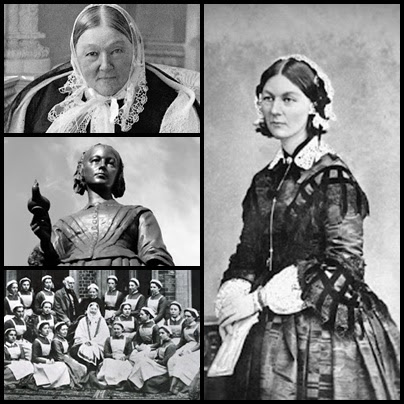
FLORENCE NIGHTINGALE, THE LADY WITH THE LAMP

Today, The Grandma has been reading about Florence Nightingale, the founder of modern nursing, and a woman who changed medical attention during wars.

Florence Nightingale (12 May 1820-13 August 1910) was an English social reformer and statistician, and the founder of modern nursing.

Nightingale came to prominence while serving as a manager and trainer of nurses during the Crimean War, in which she organised care for wounded soldiers. She gave nursing a favourable reputation and became an icon of Victorian culture, especially in the persona of The Lady with the Lamp making rounds of wounded soldiers at night.

Recent commentators have asserted Nightingale's Crimean War achievements were exaggerated by media at the time, but critics agree on the importance of her later work in professionalising nursing roles for women. In 1860, Nightingale laid the foundation of professional nursing with the establishment of her nursing school at St Thomas' Hospital in London.

It was the first secular nursing school in the world, and is now part of King's College London. In recognition of her pioneering work in nursing, the Nightingale Pledge taken by new nurses, and the Florence Nightingale Medal, the highest international distinction a nurse can achieve, were named in her honour, and the annual International Nurses Day is celebrated around the world on her birthday.

Her social reforms included improving healthcare for all sections of British society, advocating better hunger relief in India, helping to abolish prostitution laws that were harsh for women, and expanding the acceptable forms of female participation in the workforce.

Nightingale was a prodigious and versatile writer. In her lifetime, much of her published work was concerned with spreading medical knowledge. Some of her tracts were written in simple English so that they could easily be understood by those with poor literary skills. She was also a pioneer in the use of infographics, effectively using graphical presentations of statistical data. Much of her writing, including her extensive work on religion and mysticism, has only been published posthumously.

Florence Nightingale was born on 12 May 1820 into a rich, upper-class, well-connected British family at the Villa Colombaia, in Florence, Tuscany, and was named after the city of her birth. Florence's older sister Frances Parthenope had similarly been named after her place of birth, Parthenope, a Greek settlement now part of the city of Naples. The family moved back to England in 1821, with Nightingale being brought up in the family's homes at Embley, Hampshire and Lea Hurst, Derbyshire.

Florence inherited a liberal-humanitarian outlook from both sides of her family.  Her parents were William Edward Nightingale, and Frances Nightingale.

More information: BBC

In 1838, her father took the family on a tour in Europe where he was introduced to the English-born Parisian hostess Mary Clarke, with whom Florence bonded.

In Rome in 1847, she met Sidney Herbert, a politician who had been Secretary at War (1845–1846) who was on his honeymoon. He and Nightingale became lifelong close friends.

At Thebes, she wrote of being called to God, while a week later near Cairo she wrote in her diary: God called me in the morning and asked me would I do good for him alone without reputation. Later in 1850, she visited the Lutheran religious community at Kaiserswerth-am-Rhein in Germany, where she observed Pastor Theodor Fliedner and the deaconesses working for the sick and the deprived.

Florence Nightingale's most famous contribution came during the Crimean War, which became her central focus when reports got back to Britain about the horrific conditions for the wounded.

On 21 October 1854, she and the staff of 38 women volunteer nurses that she trained, including her aunt Mai Smith, and 15 Catholic nuns, mobilised by Henry Edward Manning, were sent to the Ottoman Empire. Nightingale was assisted in Paris by her friend Mary Clarke. They were deployed about 546 km across the Black Sea from Balaklava in the Crimea, where the main British camp was based.

Nightingale still believed that the death rates were due to poor nutrition, lack of supplies, stale air and overworking of the soldiers. After she returned to Britain and began collecting evidence before the Royal Commission on the Health of the Army, she came to believe that most of the soldiers at the hospital were killed by poor living conditions. This experience influenced her later career, when she advocated sanitary living conditions as of great importance.

More information: History Bits

During the Crimean war, Nightingale gained the nickname The Lady with the Lamp from a phrase in a report in The Times.

In the Crimea on 29 November 1855, the Nightingale Fund was established for the training of nurses during a public meeting to recognise Nightingale for her work in the war. There was an outpouring of generous donations. Sidney Herbert served as honorary secretary of the fund and the Duke of Cambridge was chairman.

Nightingale was considered a pioneer in the concept of medical tourism as well, based on her 1856 letters describing spas in the Ottoman Empire. She detailed the health conditions, physical descriptions, dietary information, and other vital details of patients whom she directed there. The treatment there was significantly less expensive than in Switzerland.

In 1883, Nightingale became the first recipient of the Royal Red Cross. In 1904, she was appointed a Lady of Grace of the Order of St John (LGStJ). In 1907, she became the first woman to be awarded the Order of Merit. In the following year she was given the Honorary Freedom of the City of London. Her birthday is now celebrated as International CFS Awareness Day.

On 13 August 1910, at the age of 90, she died peacefully in her sleep in her room at 10 South Street, Mayfair, London. The offer of burial in Westminster Abbey was declined by her relatives and she is buried in the graveyard at St Margaret's Church in East Wellow, Hampshire, near Embley Park.

She left a large body of work, including several hundred notes that were previously unpublished. A memorial monument to Nightingale was created in Carrara marble by Francis William Sargant in 1913 and placed in the cloister of the Basilica of Santa Croce, Florence.

Florence Nightingale exhibited a gift for mathematics from an early age and excelled in the subject under the tutelage of her father. Later, Nightingale became a pioneer in the visual presentation of information and statistical graphics. She used methods such as the pie chart, which had first been developed by William Playfair in 1801. While taken for granted now, it was at the time a relatively novel method of presenting data.

More information: Mental Floss

Indeed, Nightingale is described as a true pioneer in the graphical representation of statistics, and is credited with developing a form of the pie chart now known as the polar area diagram, or occasionally the Nightingale rose diagram, equivalent to a modern circular histogram, to illustrate seasonal sources of patient mortality in the military field hospital she managed.

Nightingale's lasting contribution has been her role in founding the modern nursing profession. She set an example of compassion, commitment to patient care and diligent and thoughtful hospital administration. The first official nurses' training programme, her Nightingale School for Nurses, opened in 1860 and is now called the Florence Nightingale Faculty of Nursing and Midwifery at King's College London.

In 1912, the International Committee of the Red Cross instituted the Florence Nightingale Medal, which is awarded every two years to nurses or nursing aides for outstanding service.

The Nightingale Pledge is a modified version of the Hippocratic Oath which nurses recite at their pinning ceremony at the end of training. Created in 1893 and named after Nightingale as the founder of modern nursing, the pledge is a statement of the ethics and principles of the nursing profession.


If a patient is cold, 
if a patient is feverish, 
if a patient is faint, 
if he is sick after taking food, 
if he has a bed-sore, 
it is generally the fault not of the disease, 
but of the nursing.

Florence Nightingale