Sunday, 28 March 2021

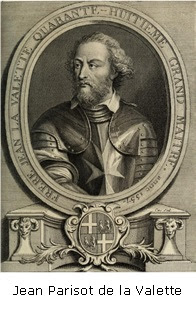
JEAN PARISOT DE VALETTE FOUNDS 'VALETTA' IN MALTA

Today, The Grandma has been reading about one of her favourite places, Malta. She loves this republic, its three islands, its language, its history and culture and its people. Malta is a place with an incredible history and its capital, Valetta, has this name thanks to Jean Parisot de la Valette, a French nobleman,  Knight Hospitaller and 49th Grand Master of the Order of Malta. On a day like today in 1566, the foundation stone of Valletta was laid by Jean Parisot de Valette, Grand Master of the Sovereign Military Order of Malta.

Fra' Jean Parisot de la Valette (4 February 1495-21 August 1568) was a French nobleman and 49th Grand Master of the Order of Malta, from 21 August 1557 to his death in 1568.

As a Knight Hospitaller, joining the order in the Langue de Provence, he fought with distinction against the Turks at Rhodes. As Grand Master, Valette became the Order's hero and most illustrious leader, commanding the resistance against the Ottomans at the Great Siege of Malta in 1565, sometimes regarded as one of the greatest sieges of all time.

The foundation stone of Valletta was laid by Grandmaster La Valette in 1566. He did not live to see Valletta completed, as he died in 1568 and was succeeded by Grandmaster Pierre de Monte.

He was born into the noble La Valette family in Quercy, South-western France, which had been an important family in France for many generations, various members having participated in the Crusades. Jean Parisot's grandfather, Bernard de La Valette, was a Knight and King's Orderly, and his father Guillot was a Chevalier de France. Jean Parisot was a distant cousin, through their mutual ancestor Almaric, Seigneur de Parisot of Jean Louis de Nogaret de La Valette, first Duke of Épernon.

Although his birth year is usually given as 1494, both chroniclers of the Great Siege of Malta, Francisco Balbi di Correggio and Hipolito Sans, say he was 67 at the time, thereby implying that he was born in 1498. In his history of the Order of St. John, the 18th-century historian Abbe Vertot, whose history is largely based on -but often contradictd - the earlier one of Giacomo Bosio, indicates that La Valette was indeed the same age as both Suleiman I and Kızılahmedli Mustafa Pasha, the commander of the Ottoman land forces, which would mean that he was actually 70 years old at the time of the siege.

More information: Order of Malta

La Valette joined the Order when he was 20 years old in around 1514, and he never returned to France or his family estates from that day on. Jean de La Valette was present during the Great Siege of Rhodes in 1522, and accompanied Grand Master Philippe Villiers de L'Isle-Adam, after the Order's expulsion from Rhodes by the Ottoman Turks under Sultan Suleiman the Magnificent.

After the loss of Rhodes, the Order was granted the Maltese Islands and Tripoli by Emperor Charles V. In 1538 he was imprisoned in the Gozo prison for four months after attacking a man.

In 1541 La Valette was involved in a naval battle against Abd-ur-Rahman Kust Aly, in which he was wounded and his galley, the San Giovanni, was captured. La Valette was taken as a galley slave for a year by Barbary pirates under the command of Turgut Reis but was later freed during an exchange of prisoners. In 1546 La Valette became Governor of Tripoli, where he tried to restore order within the vulnerable city.

In 1554, he was elected Captain General of the Order's galleys. This was a great honour to the Langue of Provence, as throughout most of the Order's history, the position of Grand Admiral was usually held by a Knight Grand Cross of the Italian Langue. In that capacity, he won a name that stood conspicuous in that age of great sea captains, and was held in the same regard as the Chevalier Mathurin Romegas -one of the greatest Christian maritime commanders of the age. In fact both sides had extremely talented sailors.

If La Valette, Romegas and Juan de Austria could be considered the best commanders that the Christian forces could bring to the sea, the forces of Islam were able to call on the equally outstanding maritime and leadership skills of admirals such as Barbarossa and Dragut. La Valette was described by Abbe de Branthome as being a very handsome man, speaking several languages fluently including Italian, Spanish, Greek, Arabic and Turkish.

In 1557, upon the death of Grand Master Claude de la Sengle, the Knights, mindful of the attack that was sure to come, elected La Valette to be Grand Master.

In 1560, he formed an alliance with the Habsburg Empire to reconquer Tripoli, but the expedition resulted in a Christian defeat at the Battle of Djerba. Despite this the Order's galleys were able to rescue several other Christian vessels, and later on in his reign, La Valette greatly strengthened the Order's navy.

More information: Visit Malta

He organized the defence of Malta, fought during the siege, and successfully repulsed the Turks at the Great Siege of Malta in 1565. During the siege the vastly outnumbered Christians held out for over 3 months against an Ottoman force containing no less than 30,000 soldiers, including the Janissaries, as well as the Sultan's fleet of some 193 ships. The battle saw the fall of Fort St. Elmo after about a month of fierce fighting, but the Order managed to hold out in Birgu and Senglea until a relief force arrived. Ottoman specialist engineers had originally assessed the fortification of Saint Elmo, from local informants and conducting reconnoitring missions, saying it would fall in three days.

Knight Commander Le Sande, who had sailed from Sicily with reinforcements, ordered a general charge from the Maltese hills toward the end of the siege. They attacked the Ottoman forces until the Ottoman forces retreated to the sea, and at that point the sea had completely changed colour to red, from the sheer volume of blood lost. It was at that point the Ottoman forces boarded their ships, directed their course back to Constantinople. Whilst shaping course back to Constantinople they momentarily contemplated counterattacking. However, they had lost too many men, supplies, and the morale at that point to launch any substantial counterattack.

As a result of the Order's victory La Valette gained much prestige in Europe, but he declined the offer of a cardinal's hat in order to maintain independence from the papacy. This has been attributed to his sense of modesty and his humility as a warrior monk.

After the great siege, he commissioned the construction of the new city of Valletta in 1566, laying the first stone with his own hands. This took place on the slopes of Mount Sciberras, where the flower of the Turkish army had died whilst trying to storm Fort Saint Elmo, which the Turks thought would fall within three or four days, but which, due to the bravery of the defenders, held out for 30 days.

The city named after its founder -Humilissima Civitas Vallettae- became known as the most aristocratic and exclusive fortress in Europe -a city most often referred to as Superbissima- the Most Proud.

Valletta remains the Maltese capital to this day.

La Valette suffered a stroke while praying in a chapel and died soon after on 21 August 1568, exactly eleven years after he became Grandmaster.

La Valette never saw the completed city of Valletta. His tomb, in the form of a sarcophagus, can be found in the Crypt of the Conventual Church of the Order, now St. John's Co-Cathedral, situated within the walls of Valletta.

More information: Nobility


Malta of gold, Malta of silver, Malta of precious metal,
We shall never take you.
No, not even if you were as soft as a gourd,
Not even if you were only protected by an onion skin!

Saturday, 27 March 2021

SARAH LOIS VAUGHAN, 'THE DIVINE ONE' OF JAZZ MUSIC

Today, The Grandma is relaxing at home. She has decided to listen to some music, and she has chosen Sarah Vaughan, the American jazz singer well-known as The Divine One, who was born on a day like today in 1924.

Sarah Lois Vaughan (March 27, 1924-April 3, 1990) was an American jazz singer. Nicknamed Sassy and The Divine One, she won four Grammy Awards, including the Lifetime Achievement Award. She was given an NEA Jazz Masters Award in 1989. Critic Scott Yanow wrote that she had one of the most wondrous voices of the 20th century.

Vaughan was born in Newark, New Jersey, to Asbury Jake Vaughan, a carpenter by trade who played guitar and piano, and Ada Vaughan, a laundress who sang in the church choir, migrants from Virginia. The Vaughans lived in a house on Brunswick Street in Newark for Vaughan's entire childhood. Jake was deeply religious. The family was active in New Mount Zion Baptist Church at 186 Thomas Street. Vaughan began piano lessons at the age of seven, sang in the church choir, and played piano for rehearsals and services.

She developed an early love for popular music on records and the radio. In the 1930s, she frequently saw local and touring bands at the Montgomery Street Skating Rink. By her mid-teens, she began venturing illegally into Newark's nightclubs and performing as a pianist and singer at the Piccadilly Club and the Newark Airport.

Vaughan attended East Side High School, then transferred to Newark Arts High School, which opened in 1931. As her nocturnal adventures as a performer overwhelmed her academic pursuits, she dropped out of high school during her junior year to concentrate on music.

More information: NYLON

Vaughan was frequently accompanied by a friend, Doris Robinson, on her trips into New York City. In the fall of 1942, by which time she was 18 years old, Vaughan suggested that Robinson enter the Apollo Theater Amateur Night contest. Vaughan played piano accompaniment for Robinson, who won second prize. Vaughan later decided to go back and compete as a singer herself. She sang Body and Soul, and won -although the date of this victorious performance is uncertain. The prize, as Vaughan recalled to Marian McPartland, was $10 and the promise of a week's engagement at the Apollo. On November 20, 1942, she returned to the Apollo to open for Ella Fitzgerald.

During her week of performances at the Apollo, Vaughan was introduced to bandleader and pianist Earl Hines, although the details of that introduction are disputed. Billy Eckstine, Hines' singer at the time, has been credited by Vaughan and others with hearing her at the Apollo and recommending her to Hines. Hines claimed later to have discovered her himself and offered her a job on the spot. After a brief try-out at the Apollo, Hines replaced his female singer with Vaughan on April 4, 1943.

Vaughan began her solo career in 1945 by freelancing on 52nd Street in New York City at the Three Deuces, the Famous Door, the Downbeat, and the Onyx Club. She spent time at Braddock Grill next to the Apollo Theater in Harlem. On May 11, 1945, she recorded Lover Man for Guild with a quintet featuring Gillespie and Parker with Al Haig on piano, Curly Russell on double bass, and Sid Catlett on drums. Later that month, she went into the studio with a slightly different and larger Gillespie/Parker aggregation and recorded three more sides.

In 1989, Vaughan's health began to decline, although she rarely revealed any hints of this in her performances. She cancelled a series of engagements in Europe in 1989, citing the need to seek treatment for arthritis of the hand, although she was able to complete a series of performances in Japan. During a run at New York's Blue Note Jazz Club in 1989, she was diagnosed with lung cancer and was too ill to finish the last day of what would turn out to be her final series of public performances.

Vaughan returned to her home in California to begin chemotherapy and spent her final months alternating stays in the hospital and at home. She grew weary of the struggle and demanded to be taken home, where at the age of 66 she died on the evening of April 3, 1990, while watching Laker Girls, a television film featuring her daughter.

Her funeral was held at Mount Zion Baptist Church in Newark, New Jersey. Following the ceremony, a horse-drawn carriage transported her body to Glendale Cemetery, Bloomfield.

More information: Past Daily


When I sing,
trouble can sit right on my shoulder
and I don't even notice.

Sarah Vaughan

Friday, 26 March 2021

MERCOSUR, THE SOUTH AMERICAN COMMON MARKET

Today, The Grandma has been reading about Mercosur the South American trade bloc established in Asunción on a day like today in 1991.

Mercosur (in Spanish), Mercosul (in Portuguese), or Ñemby Ñemuha (in Guarani), officially Southern Common Market, is a South American trade bloc established by the Treaty of Asunción in 1991 and Protocol of Ouro Preto in 1994. Its full members are Argentina, Brazil, Paraguay and Uruguay. Venezuela is a full member but has been suspended since 1 December 2016. Associate countries are Bolivia, Chile, Colombia, Ecuador, Guyana, Peru and Suriname.

The name Mercosur is a Spanish acronym of Mercado Común del Sur (Portuguese Mercosul, acronym of Mercado Comum do Sul) which both mean Common Market of the South.

Mercosur's origins are linked to the discussions for the constitution of a regional economic market for Latin America, which go back to the treaty that established the Latin American Free Trade Association in 1960, which was succeeded by the Latin American Integration Association in the 1980s.

At the time, Argentina and Brazil made progress in the matter, signing the Iguaçu Declaration (1985), which established a bilateral commission, which was followed by a series of trade agreements the following year. The Integration, Cooperation and Development Treaty, signed between both countries in 1988, set the goal of establishing a common market, to which other Latin American countries could join.

Paraguay and Uruguay joined the process and the four countries became signatories to the Treaty of Asunción (1991), which established the Southern Common Market, a trade alliance aimed at boosting the regional economy, moving goods, people among themselves, workforce and capital. Initially a free trade zone was established, in which the signatory countries would not tax or restrict each other's imports.

More information: MERCOSUR

As of January 1, 1995, this area became a customs union, in which all signatories could charge the same quotas on imports from other countries, a common external tariff. The following year, Bolivia and Chile acquired membership status. Other Latin American nations have expressed interest in joining the group.

Mercosur's purpose is to promote free trade and the fluid movement of goods, people, and currency. Since its foundation, Mercosur's functions have been updated and amended many times; it currently confines itself to a customs union, in which there is free intra-zone trade and a common trade policy between member countries.

In 2019, the Mercosur had generated a nominal gross domestic product (GDP) of around 4.6 trillion US dollars, placing the bloc as the 5th economy of the world. The bloc places high on the Human Development Index. It has signed free trade agreements with Israel, Egypt, Japan and the European Union, among others.

For five centuries South America has been the scene of some of the most violent battles in the Americas. Since the arrival of the Spanish and Portuguese to the continent, the La Plata Basin has been the scene of Luso-Spanish disputes over territory, the territory that today is Uruguay, was once Spanish, then Portuguese, again Spanish and Brazilian. However, at the same time, in this region there are fundamental chapters of the political and economic emancipation of future Mercosur members.

During the 16th and 17th centuries, Spain organized the commercial system of its colonies around the fleets and galleons scheme, authorizing only certain ports the right to send or receive goods originating from these colonies. For cities like Buenos Aires, founded in 1580, this system threatened the region's economic development. To face this economic confinement, the population of Buenos Aires saw the only possible way out: the commercial exchange, albeit illegally, with Brazil. This was the beginning of a relationship destined to grow.

In the 19th century, the process of political emancipation in South America accentuated the contrasts between the countries of the region. During this period, important chapters in the history of Brazil, Argentina, Paraguay and Uruguay occurred.

More information: The Wall Street Journal

It is enough to mention the Cisplatine War, the independence of the Republic of Uruguay, the Uruguayan Great War, the Ragamuffin War, the dispute between unitaries and federalists in Argentina and the Paraguayan War: alliances, interventions and conflicts that forged the historical context of formation of the La Plata nation-states.

In 1941, in the middle of the Second World War, Brazil and Argentina for the first time tried to create a Customs Union between their economies. However, this did not happen due to the countries' diplomatic differences in relation to Axis policies, after the attack on Pearl Harbor. With the end of the war, the need for interaction between nations became imminent and, consequently, economic blocs formed. In Latin America, however, there was no union that obtained satisfactory results.

Mercosur was finally established in 1991 by the Treaty of Asunción, based on the Buenos Aires Act, the Treaty of Asunción defined rules and conditions for the creation of a free trade zone among its four signatories.

The Treaty of Asunción was a treaty between the countries of Argentina, Brazil, Paraguay, and Uruguay signed on March 26, 1991. The objective of the treaty, signed in Asunción, was to establish a common market among the participating countries, popularly called Mercosur (Southern Common Market).

Later, the Treaty of Ouro Preto was signed to supplement the first treaty, establishing that the Treaty of Asunción was to be a legally and internationally recognized organization.

The treaty defined a program of gradual elimination of import/export fees that would reach a free commerce zone by the end of 1994. Even though the dates of the program were not followed and the free zone was not yet reached, the treaty established the basis for the Mercado Común del Sur (Mercosur).

More information: Connect Americas


I have suggested that Brazilian enterprises
invest in Uruguay and Paraguay.
These are small economies,
so some things can be produced in these countries
that will give them greater and more equitable
involvement in the Mercosur game.

Luiz Inacio Lula Da Silva

Thursday, 25 March 2021

REGINALD KENNETH DWIGHT AKA ELTON HERCULES JOHN

Today, The Grandma is relaxing at home. She has decided to listen to some music, and she has chosen Elton John, the English singer, songwriter, pianist, and composer who was born on a day like today in 1947.

Elton Hercules John (born Reginald Kenneth Dwight; 25 March 1947) is an English singer, songwriter, pianist, and composer.

Collaborating with lyricist Bernie Taupin since 1967 on more than 30 albums, John has sold over 300 million records, making him one of the best-selling music artists of all time. He has more than fifty Top 40 hits in the UK Singles Chart and US Billboard Hot 100, including seven number ones in the UK and nine in the US, as well as seven consecutive number-one albums in the US.

His tribute single Candle in the Wind 1997, rewritten in dedication to Diana, Princess of Wales, sold over 33 million copies worldwide and is the best-selling single in the history of the UK and US singles charts. He has also produced records and occasionally acted in films. John owned Watford F.C. from 1976 to 1987 and from 1997 to 2002. He is an honorary life president of the club.

Raised in the Pinner area of Greater London, John learned to play piano at an early age, and by 1962 had formed Bluesology, an R&B band with whom he played until 1967. He met his long-time musical partner Taupin in 1967, after they both answered an advert for songwriters. For two years, they wrote songs for artists including Lulu, and John worked as a session musician for artists including the Hollies and the Scaffold.

In 1969, John's debut album, Empty Sky, was released. In 1970, his first hit single, Your Song, from his second album, Elton John, became his first top ten in both the UK and the US. His most commercially successful period, 1970-1976, included Honky Château (1972), Don't Shoot Me I'm Only the Piano Player (1973), Goodbye Yellow Brick Road (1973) and his first Greatest Hits compilation -the latter two listed among the best-selling albums worldwide. John has also had success in musical films and theatre, composing for The Lion King and its stage adaptation, Aida and Billy Elliot the Musical.

More information: Elton John

John has received five Grammy Awards, five Brit Awards; including for Outstanding Contribution to Music; two Academy Awards, two Golden Globes, a Tony Award, a Disney Legends Award, and the Kennedy Center Honor.

In 2004, Rolling Stone ranked him 49th on its list of 100 influential musicians of the rock and roll era.

In 2013, Billboard ranked him the most successful male solo artist on the Billboard Hot 100 Top All-Time Artists, and third overall, behind the Beatles and Madonna. He was inducted into the Songwriters Hall of Fame in 1992 and the Rock and Roll Hall of Fame in 1994, and is a fellow of the British Academy of Songwriters, Composers and Authors. He was knighted by Queen Elizabeth II for services to music and charitable services in 1998.

John has been involved in the fight against AIDS since the late 1980s. In 1992, he established the Elton John AIDS Foundation, and a year later he began hosting his annual Academy Awards Party, which has since become one of the biggest high-profile Oscar parties in the Hollywood film industry. Since its inception, the foundation has raised over £300 million.

John has performed at a number of royal events, such as the funeral of Princess Diana at Westminster Abbey in 1997, the Party at the Palace in 2002 and the Queen's Diamond Jubilee Concert outside Buckingham Palace in 2012.

John, who announced he was bisexual in 1976 and has been openly gay since 1988, entered into a civil partnership with David Furnish on 21 December 2005; they married after same-sex marriage became legal in England and Wales in 2014. In 2018, John embarked on a three-year farewell tour.

More information: Twitter-Elton John

Elton John was born Reginald Kenneth Dwight on 25 March 1947 in Pinner, Middlesex, the eldest child of Stanley Dwight and only child of Sheila Eileen, and was raised in a council house in Pinner by his maternal grandparents. His parents married in 1945, when the family moved to a nearby semi-detached house. He was educated at Pinner Wood Junior School, Reddiford School and Pinner County Grammar School, until he was 17, when he left just prior to his A-Level examinations to pursue a career in music.

At age 15, with his mother's and stepfather's help, John was hired as a pianist at a nearby pub, the Northwood Hills Hotel, playing Thursday to Sunday nights. Known simply as Reggie, he played a range of popular standards, including songs by Jim Reeves and Ray Charles, as well as his own songs. A stint with a short-lived group called the Corvettes rounded out his time. Although normal-sighted as a teenager, John began wearing horn-rimmed glasses to imitate Buddy Holly.

In 1962, John and some friends formed a band called Bluesology. By day, he ran errands for a music publishing company; he divided his nights between solo gigs at a London hotel bar and working with Bluesology. By the mid-1960s, Bluesology was backing touring American soul and R&B musicians like the Isley Brothers, Major Lance and Patti LaBelle and the Bluebelles.

In 1966, the band became Long John Baldry's supporting band and played 16 times at the Marquee Club.

In 1967, John answered an advertisement in the British magazine New Musical Express, placed by Ray Williams, then the A&R manager for Liberty Records. At their first meeting, Williams gave John an unopened envelope of lyrics written by Bernie Taupin, who had answered the same ad. John wrote music for the lyrics and then sent it to Taupin, beginning a partnership that still continues. When the two first met in 1967, they recorded the first Elton John/Bernie Taupin song, Scarecrow.

Six months later, John began going by the name Elton John in homage to two members of Bluesology: saxophonist Elton Dean and vocalist Long John Baldry. He legally changed his name to Elton Hercules John on 7 January 1972.

More information: Instagram-Elton John


Music has healing power.
It has the ability to take people
out of themselves for a few hours.

Elton John

Wednesday, 24 March 2021

EXXON VALDEZ, THE ECOLOGICAL DISASTER OF ALASKA

Today, The Grandma has been reading about one of the latest and greatest disasters of the last century, the Exxon Valdez, the oil tanker that ran aground in Prince William Sound, spilling 11 million gallons of crude oil, impacting miles of Alaska’s coastline and killing millions of animals, on a day like today in 1989.

Oriental Nicety, formerly Exxon Valdez, Exxon Mediterranean, SeaRiver Mediterranean, S/R Mediterranean, Mediterranean, and Dong Fang Ocean, was an oil tanker that gained notoriety after running aground in Prince William Sound spilling hundreds of thousands of barrels of crude oil in Alaska.

On March 24, 1989, while owned by the former Exxon Shipping Company, and captained by Joseph Hazelwood and First Mate James Kunkel bound for Long Beach, California, the vessel ran aground on the Bligh Reef resulting in the second largest oil spill in United States history. The size of the spill is estimated to have been 40,900 to 120,000 m3.

The tanker was 301 meters long, 51 meters wide, and 26 meters deep, with a deadweight of 214,861 long tons and a full-load displacement of 240,291 long tons. The ship was able to transport up to 235,000 m³ at a sustained speed of 30 km/h. Her hull design was of the single-hull type, constructed by National Steel and Shipbuilding Company in San Diego, California. She was a relatively new tanker at the time of the spill, having been delivered to Exxon on December 16, 1986.

More information: National Ocean Service

At the time of the spill, Exxon Valdez was employed to transport crude oil from the Alyeska consortium's pipeline terminal in Valdez, Alaska, to the lower 48 states of the United States. At the time it ran aground, the vessel was carrying about 201,000 m³ of oil. After the spill, the vessel was towed to San Diego, arriving on June 10, 1989, and repairs were started on June 30, 1989. Approximately 1,600 tons of steel were removed and replaced that July, totaling US$30 million of repairs to the tanker. Its single-hull design remained unaltered.

The Exxon Valdez spill occurred under President George H. W. Bush, whose EPA Administrator William K. Reilly played a significant role in mobilizing presidential support for action to contain and clean up the spill.

Litigation was filed on behalf of 38,000 litigants. In 1994, a jury awarded plaintiffs US$287 million in compensatory damages and US$5 billion in punitive damages. Exxon appealed and the Ninth Circuit Court reduced the punitive damages to US$2.5 billion. Exxon then appealed the punitive damages to the Supreme Court which capped the damages to US$507.5 million in June 2008. On August 27, 2008, Exxon Mobil agreed to pay 75% of the US$507.5 million damages ruling to settle the 1989 Exxon Valdez oil spill off Alaska.

In June 2009, a federal ruling ordered Exxon to pay an additional US$480 million in interest on their delayed punitive damage awards.

After repairs, Exxon Valdez was renamed Exxon Mediterranean, then SeaRiver Mediterranean in the early 1990s, when Exxon transferred its shipping business to a new subsidiary company, River Maritime Inc. The name was later shortened to S/R Mediterranean, then to simply Mediterranean in 2005. Although Exxon tried briefly to return the ship to its North American fleet, it was prohibited by law from returning to Prince William Sound. It then served in Europe, the Middle East and Asia. In 2002, the ship was again removed from service.

More information: Marine Insight

In 2005, it began operating under the Marshall Islands flag of convenience. Since then, European Union regulations have also prevented vessels with single-hull designs such as the Valdez from entering European ports.

In early 2008, SeaRiver Maritime, an ExxonMobil subsidiary, sold Mediterranean to the Hong Kong-based shipping company, Hong Kong Bloom Shipping Ltd., which renamed the ship, once again, to Dong Fang Ocean, under Panama registry. In 2008, she was refitted and converted from an oil tanker to an ore carrier. Hong Kong Bloom Shipping, is a subsidiary of Chinese Government owned company China Ocean Shipping (Group) Corporation (COSCO).

On November 29, 2010, Dong Fang Ocean collided in the South China Sea with the Malta-flagged cargo ship, Aali. Both vessels were severely damaged in the incident, and Aali was towed to Weihai and Dong Fang Ocean was towed to Longyan Port in Shandong.

In March 2012, Dong Fang Ocean was purchased by Global Marketing Systems, Inc. for scrap at an estimated US$16 million and sailed under her own power to a ship breaker in Singapore. She changed hands again among scrap merchants, a common occurrence, and was eventually routed to Alang, India, under the ownership of Priya Blue Industries and at some point renamed Oriental Nicety.

Before being beached, some tried to halt the action, arguing that the vessel was in breach of the Basel Convention.

On 30 July 2012, the Supreme Court of India granted permission for the owners of Oriental Nicety to beach her at Gujarat coast to be dismantled. She was then beached at Alang on 2 August 2012.

More information: DW


I went down on the beach and looked around,
and the mussels had all died.
I’d touch them, and they’d fall off the rocks.

Elenore McMullen

Tuesday, 23 March 2021

MARGARET URSULA JONES, EXCAVATIONS AT MUCKING

Today, The Grandma has received the wonderful visit of Joseph de Ca'th Lon, one of her closest friends. Joseph loves Archaeology, and they have been talking about Margaret Ursula Jones, the English archaeologist who died on a day like today in 2001.

Margaret Ursula Jones (16 May 1916-23 March 2001) was an English archaeologist, best known for directing major excavations at Mucking, Essex.

Born in Birkenhead, Jones first became involved in archaeology while studying at the University of Liverpool. After graduating she worked as a wartime postal censor and freelance photojournalist, whilst continuing to volunteer on archaeological excavations around Britain.

In 1956, Jones began working for the Ministry of Works as a freelance archaeologist in the burgeoning field of rescue archaeology. She worked at a number of sites, but is best known for her excavations at Mucking, a major Anglo-Saxon settlement and associated cemetery, with finds ranging from the Stone Age to the Medieval period.

The Mucking excavation, which Jones directed from 1965 to 1978, became Britain's largest ever archaeological excavation.

It produced an unprecedented volume of material, although some academic archaeologists have criticized the fact that the results did not appear in print until decades after the excavation had ended. Jones' work at Mucking, as well as her role in founding the campaign group Rescue, was influential in the establishment of modern commercial archaeology in Britain.

More information: Current Archaeology

Margaret Ursula Owen was born on 16 May 1916 to middle class parents in Birkenhead. She attended Calder High School for Girls in Liverpool before going on to read Geography at the University of Liverpool.

At Liverpool, Jones was taught by archaeologist W. J. Varley and volunteered on his excavations of hill forts in Cheshire in the late 1930s. On these excavations she met Tom Jones, another of Varley's assistant excavators, whom she married in June 1940.

Jones worked as a postal censor during the Second World War. Afterwards, she and her husband moved to Hereford and made a living as freelance photojournalists; Margaret wrote articles to accompany photographs taken by Tom.

While working as photojournalists, the Joneses continued to volunteer on archaeological excavations around Britain, and in 1956 Margaret began working as a freelance archaeologist for the Ministry of Works. At the time the Ministry was responsible for the upkeep of Ancient Monuments and, by extension, the large volume of rescue archaeology required to document archaeological sites before they were destroyed by the postwar construction boom. A small workforce of itinerant archaeologists were employed to excavate these sites in advance of development.

Between 1956 and 1965, Margaret Jones directed a number of such excavations in Buckinghamshire, Yorkshire and Lincolnshire including Old Sleaford.

In 1965, the Ministry of Works asked Jones to conduct an excavation at Linford, a gravel pit near the village of Mucking on the Thames Estuary. The site had been discovered in aerial photographs taken by Kenneth St Joseph and confirmed in a small field walking survey by the Thurrock Local History Society. These initial investigations resulted in the site being designated a Scheduled Monument under the Ancient Monuments Act 1931 and, since it was threatened by gravel extraction, prompted the Ministry to commission an exploratory excavation.

Jones quickly concluded that the crop marks at Mucking represented an extensive site with Iron Age, Roman, Anglo-Saxon and early Medieval remains. On that basis, the Ministry extended her contract and initiated a full excavation of the site.

The Mucking excavation was to become the largest ever carried out in Britain. To keep ahead of its destruction by the gravel company that owned it, Jones, assisted by her husband Tom, directed work at the site continuously for 13 years. Unusually, they excavated all year round, living in a small caravan and employing a shifting workforce of freelance archaeologists and volunteers from around the world.

When it finally completed in 1978, the excavation covered 44 acres and had recorded 44,000 archaeological features, including Beaker burials; a Bronze Age Hillfort; an Iron Age settlement and cemetery; a Roman villa and cemetery; one of the most significant Anglo-Saxon settlements in Britain; two large Anglo-Saxon cemeteries; and a Medieval field system. It involved 5000 archaeologists and volunteers and recovered 1.7 million finds.

After completing the excavations at Mucking in 1978, the Joneses retired from field archaeology and returned to their cottage in Hereford.

Margaret became the patron of the Thurrock Local History Society, the source of many volunteers to the Mucking excavation, and sat on many other archaeology committees in Essex. In this role she regularly gave lectures, guided tours and talks to schoolchildren across the county.

Margaret Jones died on 23 March 2001. In her later years she had suffered from Parkinson's disease, and was predeceased by her husband Tom, who died following a stroke in 1993.

More information: The Guardian


Archaeology can be overlooked as a discipline,
I think, but it's incredibly important to have
this other way of approaching the past
-not just through historical documents,
but through actual physical remains-
objects, buildings and the layout of our towns.
 
Alice Roberts

Monday, 22 March 2021

1894, THE STANLEY CUP PLAYS ITS FIRST PLAYOFF GAME

Today, The Grandma is relaxing at home. She has been reading about the StanleyCup, the championship trophy awarded annually to the NHL playoff winner whose first playoff game for the Stanley Cup started on a day like today in 1894.

The Stanley Cup is the championship trophy awarded annually to the National Hockey League (NHL) playoff winner.

It is the oldest existing trophy to be awarded to a professional sports franchise in North America, and the IIHF considers it to be one of the most important championships available to the sport.

The trophy was commissioned in 1892 as the Dominion Hockey Challenge Cup and is named after Lord Stanley of Preston, the Governor General of Canada, who donated it as an award to Canada's top-ranking amateur ice hockey club. The entire Stanley family supported the sport, the sons and daughters all playing and promoting the game.

The first Cup was awarded in 1893 to Montreal Hockey Club, and winners from 1893 to 1914 were determined by challenge games and league play. Professional teams first became eligible to challenge for the Stanley Cup in 1906.

In 1915, the National Hockey Association (NHA) and the Pacific Coast Hockey Association (PCHA), the two main professional ice hockey organizations, reached a gentlemen's agreement in which their respective champions would face each other annually for the Stanley Cup. It was established as the de facto championship trophy of the NHL in 1926 and then the de jure NHL championship prize in 1947.

There are actually three Stanley Cups: the original bowl of the Dominion Hockey Challenge Cup, the authenticated Presentation Cup, and the spelling-corrected Permanent Cup on display at the Hockey Hall of Fame.

While the NHL has maintained control over the trophy itself and its associated trademarks, the NHL does not actually own the trophy but uses it by agreement with the two Canadian trustees of the cup.

The NHL has registered trademarks associated with the name and likeness of the Stanley Cup, although there has been dispute whether the league has the right to own trademarks associated with a trophy that it does not own.

The original bowl was made of silver and is 18.5 centimetres high and 29 centimetres wide. The current Stanley Cup is topped with a copy of the original bowl, made of a silver and nickel alloy. It has a height of 89.54 centimetres and weighs 15.5 kilograms. A new Stanley Cup is not made each year, unlike the trophies awarded by the other major professional sports leagues of North America. The winners originally kept it until a new champion was crowned, but winning teams currently get the Stanley Cup during the summer and a limited number of days during the season.

More information: NHL

Every year since 1924, a select portion of the winning players, coaches, management, and club staff names are engraved on its bands, which is unusual among trophies. However, there is not enough room to include all the players and non-players, so some names must be omitted. Between 1924 and 1940, a new band was added almost every year that the trophy was awarded, earning the nickname Stovepipe Cup due to the unnatural height of all the bands. In 1947, the cup size was reduced, but not all the large rings were the same size.

In 1958, the modern one-piece Cup was designed with a five-band barrel which could contain 13 winning teams per band. The oldest band is removed when the bottom band is full and preserved in the Hockey Hall of Fame in order to prevent the Stanley Cup from growing, and a new blank band added to the bottom. The first winning team engraved on the newest band is thus, in theory, displayed on the trophy for the next 65 years. It has been referred to as The Cup, Lord Stanley's Cup, The Holy Grail, or facetiously as Lord Stanley's Mug.

The Stanley Cup is surrounded by numerous legends and traditions, the oldest of which is the winning team drinking champagne from it.

Since the 1914–15 season, the Cup has been won a combined 103 times by 20 current NHL teams and 5 defunct teams. It was not awarded in 1919 because of the Spanish flu epidemic and in 2005 because of the 2004–05 NHL lockout. It was held by nine different teams between 1893 and 1914.

The Montreal Canadiens have won it a record 24 times and are the most recent Canadian-based team to win it, doing so in 1993; the Detroit Red Wings have won it 11 times, the most of any United States-based NHL team, most recently in 2008. More than three thousand different names, including the names of over thirteen hundred players, had been engraved on it by 2017.

More information: NHL

After the Lord Stanley of Preston was appointed by Queen Victoria as Governor General of Canada on June 11, 1888, he and his family became highly enthusiastic about ice hockey. Stanley was first exposed to the game at Montreal's 1889 Winter Carnival, where he saw the Montreal Victorias play the Montreal Hockey Club. The Montreal Gazette reported that he expressed his great delight with the game of hockey and the expertise of the players. During that time, organized ice hockey in Canada was still in its infancy and only Montreal and Ottawa had anything resembling leagues.

Soon afterwards, Stanley purchased what is frequently described as a decorative punch bowl, but which silver expert John Culme identified as a rose bowl, made in Sheffield, England, and sold by London silversmith G. R. Collis and Company, for ten guineas, equal to ten and a half pounds sterling, US$48.67, which is equal to $1,385 in 2019 dollars. He had the words Dominion Hockey Challenge Cup engraved on one side of the outside rim, and From Stanley of Preston on the other side. The name Stanley Cup was given to it as early as May 1, 1893, when an Ottawa Journal article used the name as a title.

The Cup trustees issued more specific rules on how the trophy should be defended and awarded:

-The Cup is automatically awarded to the team that wins the title of the previous Cup champion's league, without the need for any other special extra contest.

-Challengers for the Cup must be from senior hockey associations, and must have won their league championship. Challengers will be recognized in the order in which their request is received.

-The challenge games (where the Cup could change leagues) are to be decided either in a one-game affair, a two-game total goals' affair, or the best of three series, to the benefit of both teams involved. All matches are to take place on the home ice of the champions, although specific dates and times have to be approved by the trustees.

-Ticket receipts from the challenge games are to be split equally between both teams.

-If the two competing clubs cannot agree to a referee, the trustees will appoint one, and the two teams shall cover the expenses equally.

-A league could not challenge for the Cup twice in one season.

Stanley never saw a Stanley Cup championship game, nor did he ever present the Cup. Although his term as Governor General ended in September 1893, he was forced to return to England on July 15.

More information: Everything Hockey

Growing up in Canada,
most kids from Canada dream of playing in the NHL,
and they also hope one day to be on a Stanley Cup team.
That was a big goal.

Bobby Orr