Today, The Grandma has been reading about the accident occurred at a salmon farm near CypressIsland, Washington,on a day like today in 2017.
On August 19, 2017, a net pen at a salmon farm near Cypress Island, broke, releasing into the Pacific Ocean hundreds of thousands of non-native Atlantic salmon. The fish farm was run by Cooke Aquaculture Pacific, LLC.
According to the Washington State Department of Natural Resources,inadequate cleaning was likely the primary cause for the pen break; the nets were supporting more than six times their own weight in biofouling.
Coastal tribes were hired to fish the escaped salmon.
Atlantic salmon farming was later banned in Washington state in reaction to the incident.
Prior to the incident, Washington was the only US state on the Pacific coast where Atlantic salmon was farmed.
Atlantic salmon are favoured by salmon farmers, since their domestication process is much farther along; farmed Atlantic salmon have been selected for faster growth, higher tolerance to disease, and greater docility.
The net pen was managed by Cooke Aquaculture, a Canadian company based in New Brunswick and one of the largest aquaculture companies in the world. It took over the Cypress Island aquafarms in 2016.
The pen that was breached was a 10-cage salmon pen that contained 305,000 fish, and had been placed in 2001. It was anchored in Deepwater Bay, southeast of Cypress Island and to the west of Bellingham Channel, which separates Cypress Island from Guemes Island. The pen was submerged from 20 m to 30 m, and was approximately 55 m wide by 133 m long.
The August 2017 pen break was preceded by an incident a month earlier with the same pen; on July 24 and 25 its mooring failed, was restored, failed again, and was restored a second time. This incident occurred during the strongest tidal currents of the summer of 2017.
The salmon pens had been stocked with 369,312 smolts in May 2016, and had been scheduled to be harvested starting September 2017. At the time of the incident, the biomass held by the salmon pen was estimated to be around 1,290 metric tons.
The pen break was reported by a boater on August 19, 2017. The Washington State Department of Natural Resources estimated that 243,000 to 263,000 salmon escaped the pen, which was much higher than Cooke Aquaculture Pacific's estimates of 4,000 to 5,000 salmon. The company later estimated that around 160,000 fish had escaped.
According to Cooke Aquaculture Pacific, the pen break was due to unusually strong tidal currents during that week's solar eclipse, but Washington State Department of Natural Resources investigators found that the tidal currents were well within the range that the same pen had survived in previous years, and the solar eclipse did not affect the tidal currents significantly.
The investigators determined that insufficient maintenance, especially lack of cleaning, was the primary cause of the break. They found that the pen -about 16 metric tons of net material- was supporting around 100 metric tons of biofouling, more than six times its own weight.
In the immediate aftermath of the incident, the Washington State Department of Fish and Wildlife authorized the unlimited catching of escaped Atlanticsalmon from the farm, and around 57,000 were recaptured. Coastal tribes such as the Swinomish, Samish, and Lummi were involved in recapturing them.
The Lummi declared a state of emergency and caught around 44,239, approximately 178 metric tons. The salmon were sold back to Cooke Aquaculture Pacific, which paid $30 per fish. Cooke offered to raise the price to $42 per fish if the Lummi were willing to abandon their pursuit of a prohibition of salmon aquaculture, but they refused.
In November and December 2017, some of the salmon were captured from the Skagit River by members of the Upper Skagit Indian Tribe, who were still finding them in April 2018, up to eight months after the incident.
The Washington State Senate passed a law in March 2018 banning the farming of Atlantic salmon in the state, the ban to be complete by 2025.
In April 2018, the Thurston County Superior Court upheld the termination of Cooke Aquaculture Pacific's farming license by the Washington State Department of Natural Resources; this effectively prevented the company from restocking its Atlantic salmon fishing pens again before the ban took effect.
Today, The Grandma has remembered the last time she visited Washington, D.C.,one of the most beautiful cities of the United States of America.
She enjoyed the city, and she visited all the important monuments, especially the JeffersonMemorial, the presidentialmemorial that was dedicated on the 200th anniversary of PresidentThomasJefferson'sbirth.
The Jefferson Memorial is a presidential memorial built in Washington, D.C. between 1939 and 1943 under the sponsorship of President Franklin D. Roosevelt. Roosevelt thought that it was a suitable memorial to the Founding Fathers of theUnited States and to Thomas Jefferson, the principal author of the United States Declaration of Independence and the founder of the Democratic-Republican Party.
The neoclassical building is situated in West Potomac Park on the shore of the Potomac River. It was designed by John Russell Pope and built by Philadelphia contractor John McShain. Construction began in 1939 and was completed in 1943.
The bronze statue of Jefferson was added in 1947. Pope made references to the Roman Pantheon whose designer was Apollodorus of Damascus, and to Jefferson's own design for the rotunda at the University of Virginia.
The Jefferson Memorial and the White House form one of the main anchor points in the area of the National Mall in D.C.
The Washington Monument was intended to be located at the intersection of the White House and the site for the Jefferson Memorial, but soft swampy ground required that it be situated to the east.
The national memorial is managed by the National Park Service of the Department of the Interior under its National Mall and Memorial Parks division.
In 2007, it was ranked fourth on the List of America's Favorite Architecture by the American Institute of Architects.
It became apparent that the site was well suited for another high-profile memorial since it sat directly south of the White House. By 1901 the Senate Park Commission, better known as the McMillan Commission, had proposed placing a Pantheon-like structure on the site hosting the statues of the illustrious men of the nation, or whether the memory of some individual shall be honored by a monument of the first rank may be left to the future; no action was ever taken by Congress on this issue.
The completion of the Tidal Basin Inlet Bridge in 1908 helped to facilitate the recreational usage of East and West Potomac Parks. In 1918, large liquid-chlorine dispensers were installed under the bridge to treat the water and make the Tidal Basin, also known as Twining Lake, suitable for swimming.
The Tidal Basin Beach, on the site of the future Memorial, opened in May 1918 and operated as a Whites Only facility until 1925, when it was permanently closed to avoid the question of racial integration.
A design competition was held for a memorial to Theodore Roosevelt in 1925. The winning design was submitted by John Russell Pope and consisted of a half-circle memorial situated next to a circular basin. The plan was never funded by Congress and was not built.
The Memorial's chance came in 1934 when President Franklin Roosevelt, an admirer of Jefferson, in large part because of the book on Jefferson by his friend Claude G. Bowers, inquired to the Commission of Fine Arts about the possibility of erecting a memorial to Jefferson, including it in the plans for the Federal Triangle project, which was under construction at the time.
Later the same year, Congressman John J. Boylan followed FDR's lead and urged Congress to create the Thomas Jefferson Memorial Commission. Boylan was appointed the Commission's first chairman and Congress eventually appropriated $3 million for a memorial to Jefferson.
The Commission chose John Russell Pope as the architect in 1935. Pope was also the architect of the National Archives Building and original (west) building of the National Gallery of Art. He prepared four different plans for the project, each on a different site. One was on the Anacostia River at the end of East Capitol Street; one at Lincoln Park; one on the south side of the National Mall across from the National Archives; and one situated on the Tidal Basin, directly south of the White House.
The Commission preferred the site on the Tidal Basin mainly because it was the most prominent site and because it completed the four-point plan called for by the McMillan Commission (Lincoln Memorial to the Capitol; White House to the Tidal Basin site). Pope designed a very large pantheon-like structure, to sit on a square platform, and to be flanked by two smaller, rectangular, colonnaded buildings.
The site of the monument is in West Potomac Park, in Washington, D.C., on the shore of the Potomac River Tidal Basin, and is enhanced with the massed planting of Japanese cherry trees, a gift from the people of Japan in 1912.
Although the Jefferson Memorial is geographically removed from other buildings and monuments in Washington, D.C., as well as from the National Mall and the Washington Metro, it plays host to many events and ceremonies each year, including memorial exercises, the Easter Sunrise Service, and the annual National Cherry Blossom Festival.
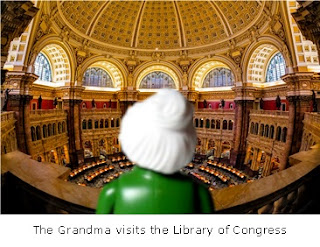
Today, The Grandma has been reading about the Library of Congress, one of the most interesting cultural places that you can visit and enjoy in Washington, D.C., and a place that burnt on a day like today in 1851.
The Library of Congress (LC) is the research library that officially serves the United States Congress and is the de facto national library of the United States. It is the oldest federal cultural institution in the United States.
The library is housed in three buildings on Capitol Hill in Washington, D.C.; it also maintains a conservation center in Culpeper, Virginia.
The library's functions are overseen by the Librarian of Congress, and its buildings are maintained by the Architect of the Capitol.
The Library of Congress is one of the largest libraries in the world. Its collections are universal, not limited by subject, format, or national boundary, and include research materials from all parts of the world and in more than 450 languages.
Congress moved to Washington, D.C., in 1800 after holding sessions for 11 years in the temporary national capitals in New York City and Philadelphia. In both cities, members of the U.S. Congress had access to the sizable collections of the New York Society Library and the Library Company of Philadelphia.
The small Congressional Library was housed in the United States Capitol for most of the 19th century until the early 1890s.
Most of the original collection was burnt by the British during the War of 1812, with the library beginning efforts to restore its collection in 1815.
The library purchased Thomas Jefferson's entire personal collection of 6,487 books, and its collection slowly expanded in the following years, although it suffered another fire in its Capitol chambers in 1851. This destroyed a large amount of the collection, including many of Jefferson's books.
After the American Civil War, the importance of the Library of Congress increased with its growth, and there was a campaign to purchase replacement copies for volumes that had been burned. The library received the right of transference of all copyrighted works to deposit two copies of books, maps, illustrations, and diagrams printed in the United States. It also began to build its collections.
Its development culminated between 1888 and 1894 with the construction of its own separate, large library building across the street from the Capitol. Two additional buildings have been constructed nearby to hold collections and provide services, one in the 1930s and one in the 1970s.
The library's primary mission is to research inquiries made by members of Congress, which is carried out through the Congressional Research Service. It also houses and oversees the United States Copyright Office. The library is open to the public for research, although only high-ranking government officials and library employees may check out books and materials.
James Madison of Virginia is credited with the idea of creating a congressional library, first making such a proposition in 1783.
The Library of Congress was subsequently established on April 24, 1800, when President John Adams signed an act of Congress also providing for the transfer of the seat of government from Philadelphia to the new capital city of Washington.
Part of the legislation appropriated $5,000 for the purchase of such books as may be necessary for the use of Congress... and for fitting up a suitable apartment for containing them.
Books were ordered from London, and the collection consisted of 740 books and three maps, which were housed in the new United States Capitol.
President Thomas Jefferson played an important role in establishing the structure of the Library of Congress.
On January 26, 1802, he signed a bill that allowed the president to appoint the librarian of Congress and establishing a Joint Committee on the Library to regulate and oversee it. The new law also extended borrowing privileges to the president and vice president.
In August 1814, after routing an American militia at Bladensburg, the British bloodlessly occupied Washington, D.C. In retaliation for the American destruction of Port Dover, the British ordered the destruction of numerous public buildings in the city.
British troops burned the Library of Congress, including its collection of 3,000 volumes. These volumes had been held in the Senate wing of the Capitol. One of the few congressional volumes to survive was a government account book of receipts and expenditures for 1810. It was taken as a souvenir by British naval officer Sir George Cockburn, whose family returned it to the United States government in 1940.
On December 24, 1851, the largest fire in the library's history destroyed 35,000 books, about two–thirds of the library's collection and two-thirds of Jefferson's original transfer.
Congress appropriated $168,700 to replace the lost books in 1852 but not to acquire new materials. By 2008, the librarians of Congress had found replacements for all but 300 of the works that had been documented as being in Jefferson's original collection.
In 1859, Congress transferred the library's public document distribution activities to the Department of the Interior and its international book exchange program to the Department of State.
The Library of Congress contents:
-American Memory created in 1990, which became The National Digital Library in 1994. It provides free access online to digitized American history and culture resources, including primary sources, with curatorial explanations to support use in K-12 education.
-thomas.gov website launched in 1994 to provide free public access to U.S. federal legislative information with ongoing updates; and congress.gov website to provide a state-of-the-art framework for both Congress and the public in 2012;
-The National Book Festival, founded in 2000 with First Lady Laura Bush, has attracted more than 1000 authors and a million guests to the National Mall and the Washington Convention Center to celebrate reading. With a major gift from David Rubenstein in 2013, the library established the Library of CongressLiteracy Awards to recognize and support achievements in improving literacy in the U.S. and abroad;
-The Kluge Center, started with a grant of $60 million from John W. Kluge in 2000, this brings international scholars and researchers to use library resources and to interact with policymakers and the public. It hosts public lectures and scholarly events, provides endowed Kluge fellowships, and awards The Kluge Prize for the Study of Humanity (now worth $1.5 million), the first Nobel-level international prize for lifetime achievement in the humanities and social sciences (subjects not included in the Nobel awards);
-Open World Leadership Center, established in 2000, by 2015 this program administered 23,000 professional exchanges for emerging post-Soviet leaders in Russia, Ukraine, and other successor states of the former USSR. Open World began as a Library of Congress project, and later was established as an independent agency in the legislative branch.
-The Veterans History Project, congressionally mandated in 2000 to collect, preserve, and make accessible the personal accounts of American war veterans from WWI to the present day;
-The National Audio-Visual Conservation Center opened in 2007 at a 45-acre site in Culpeper, Virginia, established with a gift of more than $150 million by the Packard Humanities Institute, and $82.1 million in additional support from Congress.
Since 1988, the library has administered the National Film Preservation Board. Established by congressional mandate, it selects American films annually for preservation and inclusion in the new National Registry, a collection of American films.
The library has made these available on the Internet for free streaming.
By 2015, the librarian had named 650 films to the registry. The films in the collection date from the earliest to ones produced more than ten years ago; they are selected from nominations submitted to the board.
-The Gershwin Prize for Popular Song, was launched in 2007 to honor the work of an artist whose career reflects lifetime achievement in song composition. Winners have included Paul Simon, Stevie Wonder, Paul McCartney, Burt Bacharach and Hal David, Carole King, Billy Joel, and Willie Nelson, as of 2015. The library also launched the Living Legend Awards in 2000 to honor artists, activists, filmmakers, and others who have contributed to America's diverse cultural, scientific, and social heritage;
-The Fiction Prize, now the Library of Congress Prize for American Fiction,was started in 2008 to recognize distinguished lifetime achievement in the writing of fiction.
-The World Digital Library, established in association with UNESCO and 181 partners in 81 countries in 2009, makes copies of professionally curated primary materials of the world's varied cultures freely available online in multiple languages.
-National Jukebox, launched in 2011, provides streaming free online access to more than 10,000 out-of-print music and spoken word recordings.
-BARD was started in 2013; it is a digital, talking books mobile app for Braille and Audio Reading Downloads, in partnership with the library's National LibraryService for the blind and physically handicapped. It enables free downloads of audio and Braille books to mobile devices via the Apple App Store.
Today, The Grandma has been reading about the FBI Scientific Crime DetectionLaboratory, adivision within the United States Federal Bureau of Investigation that officially opened in Washington, D.C. on a day like today in 1932.
The FBI Laboratory is a division within the United States Federal Bureau of Investigation that provides forensic analysis support services to the FBI, as well as to state and local law enforcement agencies, free of charge.
The lab is located at Marine Corps Base Quantico in Quantico, Virginia.
Opened November 24, 1932, the lab was first known as the Technical Laboratory. It became a separate division when the Bureau of Investigation (BOI) was renamed as the FBI.
The Lab staffs approximately 500 scientific experts and special agents. The lab generally enjoys the reputation as the premier crime lab in the United States. However, during the 1990s, its reputation and integrity came under withering criticism, primarily due to the revelations of Special Agent Dr. Frederic Whitehurst, the most prominent whistleblower in the history of the Bureau.
Whitehurst was a harsh critic of conduct at the Lab. He believed that a lack of funding had affected operations and that Lab technicians had a pro-prosecution bias. He suggested they were FBI agents first and forensic scientists second, due to the institutional culture of the Bureau, which resulted in the tainting of evidence.
From September 1934 to September 1975, the Lab was located on the 6th floor and the attic of the Justice Department Building in Washington, D.C. Public tours of the lab work area were available until the FBI moved across the street to the newly constructed J. Edgar Hoover Building in 1974.
Tours of the J. Edgar Hoover Building were available, but the tour route shifted away from the lab work space, thus sealing the lab from public view.
The Lab expanded to such an extent that the Forensic Science Research and Training Center (FSRTC) was established at the FBI Academy in Quantico, Virginia.
Methods at the FSRTC have helped establish standardized forensic practices for law enforcement agencies. The FBI Lab has been in Quantico since the relocation from Washington since April 2003.
The more widespread use of DNA testing in the late 20th century brought renewed scrutiny to the scientific reliability of many of the FBI Laboratory'sforensic analyses. Scientific experts consider DNA -which first became widely used in courts in the 1990s- to be the only near-certain indicator of a forensic match.
The scientific reliability of FBI hair analysis has been questioned, as DNA testing has exonerated persons convicted where the only physical evidence was hair analysis. In addition, in a high percentage of cases, the FBI has learned that its expert witnesses overstated the reliability of hair analysis in testimony in court cases.
In 2013 the Department of Justice began a review of thousands of cases from 1982 through 1999 referred to the FBI for hair analysis.
By 2015 it found that these included 32 death penalty convictions, of which 14 people had died in prison or been executed, and narrowed its review to cases that went to court. It has focused on cases in which hair analysis played a part in convictions, in order to follow up with defendants.
In a subsequent investigation in 2012, the DOJ found that evidence related to hair analysis had been falsified, altered, or suppressed, or that FBI agents had overstated the scientific basis of their testimony, to the detriment of defendants. In 2013, the Department of Justice began a review of cases referred to them for hair analysis from 1982 through 1999, as many as 10,000 cases, to determine whether their agents' testimony resulted in wrongful convictions.
DNA testing has revealed some convicted inmates to be innocent of violent crime charges against them.
In 2015 the FBI reported that their expert witnesses overstated the reliability of hair analysis in matching suspects 96 percent of the time, likely influencing conviction of some defendants.
Cases are still being overturned as a result of incorrect hair analysis testimony.
In 2012 DNA testing revealed the innocence of three inmates from the District of Columbia who had been convicted to life and served years in prison based on hair analysis evidence and testimony by FBI experts. They have received large settlements from the city because of wrongful convictions and damages of the lost years.
Bullet and gun analysis is another forensic discipline that has been identified in recent studies as being less scientifically reliable than thought. The Bureau established an interdisciplinary commission in 2013 to establish the highest scientific standards in forensic testing and to understand the limits of these tests, and how they may be properly used in court.
With a heightened attention to scientific rigour in its forensic testing, the FBI lab in 2005 abandoned its four-decade-long practice of tracing bullets to a specific manufacturer's batch through chemical analysis, after its methods were scientifically debunked.
A blue-ribbon panel of the National Academy of Sciences raised concerns about the FBI's reliance on forensic testing in a 2009 report that found nearly every familiar staple of forensic science to be scientifically unsound and highly subjective.
In 2016 a man was exonerated and freed in Virginia, based on DNA evidence, after serving 33 years in prison. He had been convicted of rape and murder and sentenced to life in part based on several FBI experts testifying to identification of him by bite-mark patterns, to a medical certainty.
Scientists say that such certainty is impossible to gain by this test. The DNA testing showed that he was not the perpetrator of the crime. As the Washington Post reported, No court in the United States has barred bite-mark evidence, despite 21 known wrongful convictions, a proposed moratorium in Texas and research showing that experts cannot consistently agree even on whether injuries are caused by human teeth.
This forensic test has been highly suspect for some years, but prosecutors and police continue to rely on it, and FBI agents make claims about it.
Today, The Grandma has been reading about the Great Seattle Fire, a terrible firethat destroyed the entire central business district of Seattle on a day like today in 1889.
The Great Seattle Fire was a fire that destroyed the entire central business district of Seattle, Washington on June 6, 1889.
The conflagration lasted for less than a day, burning through the afternoon and into the night, and during the same summer as the Great Spokane Fire and the Great Ellensburg Fire. Seattle quickly rebuilt using brick buildings that sat 6.1 m above the original street level. Its population swelled during reconstruction, becoming the largest city in the newly admitted state of Washington.
In the fall of 1851, the Denny Party arrived at Alki Point in what is now the state of Washington. After spending a miserable winter on the western shores of Elliott Bay, the party relocated to the eastern shores and established the settlement that would become Seattle.
Early Seattle was dominated by the logging industry. The combination of a safe bay and an abundance of coniferous trees made Seattle the perfect location for shipping lumber to California.
In 1852, Henry Yesler began construction of the first steam-powered mill in the Pacific Northwest. Because of the easy access to lumber, nearly every building was constructed of the affordable, but combustible timber. Additionally, because the area was at or below sea level, the fledgling town was a frequent victim of massive floods, requiring buildings to be built on wooden stilts. The town also used hollowed out scrap logs propped up on wooden braces as sewer and water pipes, increasing the combustible loading.
At approximately 2:30 pm on June 6, 1889, an accidentally overturned glue pot in a carpentry shop started the most destructive fire in the history of Seattle.
The next day, the Seattle Post-Intelligencer, operating out of temporary facilities in the wake of the fire, reported incorrectly that the incident began in Jim McGough's paint shop, under Smith's boot and shoe store, at the corner of Front and Madison streets, in what was known as the Denny block; a correction two weeks later said that it actually started in the Clairmont and Company cabinet shop, below McGough's shop in the basement of the Pontius building, but the original error was often repeated, including in Murray Morgan's bestselling Seattle history book Skid Road (1951).
The pot was tipped over by John Back, a 24-year-old Swede. The fire soon spread to the wood chips and turpentine covering the floor. Back attempted to douse the fire with water, which only served to spread the fire further. The fire department arrived by 2:45, but by that time the area was so smokey that the source of the fire could not be determined.
Fed by the shop's timber and an unusually dry summer, the blaze erupted and shortly devoured the entire block. A nearby liquor store exploded, and the alcohol fuelled the flames. The fire quickly spread north to the Kenyon block and the nearby Madison and Griffith blocks. Wooden boardwalks carried the flames across streets to ignite other blocks.
A combination of ill-preparedness and unfortunate circumstances contributed to the great fire. Seattle's water supply was insufficient in fighting the giant inferno. Fire hydrants were sparsely located on every other street, usually connected to small pipes. There were so many hydrants in use during the fire that the water pressure was too weak to fight such a massive blaze. Seattle was also operatedby a volunteer fire department, which was competent, but inadequate in extinguishing the fire.
By the morning of June 7, the fire had burned 25 city blocks, including the entire business district, four of the city's wharves, and its railroad terminals. The fire would be called the most destructive fire in the history of Seattle. Despite the massive destruction of property, only one person was killed in the blaze, a young boy named James Goin. However, there were fatalities during the clean up process and over 1 million rodents were killed. Total losses were estimated at nearly $20,000,000 ($576 million in today's dollars).
Despite the magnitude of destruction, the rebuilding effort began quickly. Rather than starting over somewhere else, Seattle's citizens decided to rebuild. Seattle rebuilt from the ashes quickly, and the fire killed many rats and other vermin, thereby eliminating the city's rodent problems. A new building ordinance resulted in a downtown of brick and stone buildings, rather than wood.
In the year following the fire, Seattle's population actually grew by nearly 20,000 to 40,000 inhabitants from the influx of people helping to recreate the city. Supplies and funds came from all over the West Coast to support the relief effort. The population increase made Seattle the largest city in Washington, making it a leading contender in becoming the terminus of the Great Northern Railway.
Seattle made many improvements in response to the fire. The Seattle FireDepartment was officially established four months later to replace a volunteer organization with a paid force containing new fire houses and a new chief. The city took control of the water supply, increasing the number of hydrants and adding larger pipes.
The advent of brick buildings to downtown Seattle was one of the many architectural improvements the city made in the wake of the fire. New city ordinances set standards for the thickness of walls and required division walls between buildings.
These changes became principal features of post-fire construction and are still visible in Seattle's Pioneer Square district today, the present-day location of the fire. At Pioneer Square, guided tours are also available to paying customers. Also at this location, visitors can tour the Seattle Underground, where they can visit the original street level (now basement level) of buildings and shopfronts that were built after the fire.
Somewhere in our cultural subconscious, we crave these figures that are big and strong and unassailable, like masculine fortresses. It's like how the 9/11 firemen were venerated.
March, 8 is near and TheGrandma has been reading about the first suffragist parade in Washington, D.C. known as the WomanSuffrage Procession in 1913.
The Woman Suffrage Procession in 1913, wasthe first suffragist parade in Washington, D.C.
It was also the first large, organized march on Washington for political purposes.
The procession was organized by the suffragists Alice Paul and Lucy Burns for the National American Woman Suffrage Association (NAWSA).
Planning for the event began in Washington in December 1912. The parade's purpose, stated in its official program, was to march in a spirit of protest against the present political organization of society, from which women are excluded.
Participation numbers vary between 5,000 and 10,000 marchers.Suffragists and supporters marched down Pennsylvania Avenue on Monday, March 3, 1913, the day before President Woodrow Wilson's inauguration. Paul had selected the venue and date to maximize publicity, but met resistance from the D.C. police department.
The demonstration consisted of a procession with floats, bands, and various groups representing women at home, in school, and in the workplace. At the Treasury Building, a pageant of allegorical tableaux was acted out during the parade. The final act was a rally at the Memorial Continental Hall with prominent speakers, including Anna Howard Shaw and Helen Keller.
Prior to the event, the issue of black participation in the march threatened to cause a rift with delegations from Southern states. Some blacks did march with state delegations. A group from Howard University participated in the parade. It is often said that black women were segregated at the back of the parade, however, contemporaneous sources confirm they marched with their respective state delegations or professional groups.
During the procession, district police failed to keep the enormous crowd off the street, impeding the marchers' progress. Many participants were subjected to heckling from spectators, though there were also many supporters present. The marchers were finally assisted by citizens' groups and eventually the cavalry.
The police were subjected to a congressional inquiry due to security failures. The event premiered Paul's campaign to refocus the suffrage movement on obtaining a national constitutional amendment for woman's suffrage. Intended to pressure President Wilson to support an amendment, he resisted their demands for years afterward.
American suffragists Alice Paul and Lucy Burns spearheaded a drive to adopt a national strategy for women's suffrage in the National American Woman Suffrage Association. Paul and Burns had seen first-hand the effectiveness of militant activism while working for Emmeline Pankhurst in the Women'sSocial and Political Union (WSPU) in Britain.
Their education included rallies, marches, and demonstrations, knowledge of which the two would put to work back in America. They already had first-hand experience with imprisonment as a backlash against suffrage activism. They had gone on hunger strikes and suffered force-feeding. They were not afraid to be provocative, even knowing the potential consequences. The procession would be their first foray into moving into militant mode on a national stage.
According to the media, the suffrage parade had become the primary draw over the inauguration itself. Special suffrage trains were hired to bring spectators from other cities, adding to the crowds in Washington. The novelty of the procession attracted enormous interest throughout the eastern U.S.
As the parade participants gathered near the Peace Monument around noon, the police began roping off part of the parade route. Even before the parade began, the ropes were badly stretched and coming loose in places. The procession drew such a crowd that President-elect Wilson was mystified about why there were no people to be seen when he arrived in town that day.
Yesterday, The Beans said goodbye to Washington, D.C. They chose the last places to visit and they have a closer relationship with the idiosyncrasy of the country.
For one hand, they visited the Treasury Building, symbol of the economical power in the country which represents better the idea of capitalism.
For other hand, the family visited Arlington Cemetery, symbol of the politican and military power of the USA.
Finally, The Grandma wanted to visit the Lincoln Memorial to tribute Abraham Lincoln and to remember another important figure of the recent American history: Martin Luther King, Jr.
The Treasury Building in Washington, D.C., is a National Historic Landmark building which is the headquarters of the United States Department of the Treasury. An image of the Treasury Building is featured on the back of the United States ten-dollar bill.
In the spring of the year 1800, the capital of the United States was preparing to move from the well-established city of Philadelphia to a parcel of tidewater land along the Potomac River. President John Adams issued an Executive Order on May 15th instructing the federal government to move to Washington and to be open for business by June 15, 1800. Arriving in Washington, relocated government employees found only one building completed and ready to be occupied: the Treasury Department building. The building was 147 feet long and 57 feet wide, flanking the south-east end of the White House.
Arlington National Cemetery is a United States military cemetery in Arlington County, Virginia, across the Potomac River from Washington, D.C., in whose 253 ha the dead of the nation's conflicts have been buried, beginning with the Civil War, as well as reinterred dead from earlier wars. The United States Department of the Army, a component of the United States Department of Defense, controls the cemetery. The national cemetery was established during the Civil War on the grounds of Arlington House, which had been the estate of the family of Confederate general Robert E. Lee's wife Mary Anna (Custis) Lee, a great-granddaughter of Martha Washington.
The Lincoln Memorial is an American national monument built to honor the 16th President of the United States, Abraham Lincoln. It is located on the western end of the National Mall in Washington, D.C., across from the Washington Monument. Dedicated in 1922, it is one of several monuments built to honor an American president. It has always been a major tourist attraction and since the 1930s has been a symbolic center focused on race relations.
Grandma's memories with Martin Luther King, Jr.
The building is in the form of a Greek Doric temple and contains a large seated sculpture of Abraham Lincoln and inscriptions of two well-known speeches by Lincoln, The Gettysburg Address and his Second Inaugural Address.
The memorial has been the site of many famous speeches, including Martin Luther King Jr.'s I Have a Dream speech, delivered on August 28, 1963, during the rally at the end of the March on Washington for Jobs and Freedom.
Like other monuments on the National Mall, the memorial is administered by the National Park Service under its National Mall and Memorial Parks group.
After leaving Yasmina with the Amish Community in Lancaster, The Beans have arrived to Washington, DC. They are astonished with Yasmina's decision but, of course, they respect it. She has written a beautiful goodbye's letter to her family explaining her real reasons to not continue the rest of the journey with them.
Yasmina tells that living with the Amish Community will allow her to have the healthiest life, in the quietest place with the most peaceful people who create their own clothes and grow their own food. She has been living a frenetic life as an individual athlete and now she only wants peace, relax and a life under the rules of a community.
The Beans are in the capital of the USA and they have chosen the shore of the Potomac to rest and review their English classes. Today, they have talked about Superlative Adjectives and Neither/Both of them before visiting the Washington National Cathedral.
Washington, DC is a city that has been witness of hundreds of historical past events, lights and shadows of the American history, a city that resume the worst ghosts and demons from the past, lives an intense present and draw the future of millions of people around the world.
The Beans arriving to the White House
It has been a day of incredible surprises because after Yasmina's story, the family has known the last news about the Federal shutdown that affects the most part of places and sights that they wanted to visit.
They don't understand this decision that puts in danger thousands of employments and changes the normal life of the most part of the Federal institutions like museums, monuments or national parks.
This is the main reason because they have visited the White House to try to talk with their inhabitants and try to arrive to a deal to avoid this uncomfortable situation. As you know, all things that happen in the White House are top secret and nobody has access to them but, in that case, some people assure that they have heard an old female voice asking aloud what the hell was happening there and reclaiming her rights to visit the most important and historical places. Other people assure that they had heard sentences like "Do you want to make America great again? Sure? Then, end with the shutdown, pay your workers and open the public buildings now".
Tomorrow, the family is visiting some old Grandma's friends, Fox Mulder and Dana Scully, because they need their help to try to solve the mystery of the sinking in Liberty Island, a real X-File. They're a little afraid because they are sure that a ghost rescued them. All of them heard the same song while they were swimming, Leonard Cohen's Hallelujah, but as you know, this is impossible because ghosts don't exist, do they?
James Marshall "Jimi"Hendrix (November 27, 1942-September 18, 1970) was an American rock guitarist, singer, and songwriter. Although his mainstream career spanned only four years, he is widely regarded as one of the most influential electric guitarists in the history of popular music, and one of the most celebrated musicians of the 20th century.
The Rock and Roll Hall of Fame describes him as arguably the greatest instrumentalist in the history of rock music.
Born in Seattle, Washington, Hendrix began playing guitar at the age of 15. In 1961, he enlisted in the U.S. Army and trained as a paratrooper in the 101st Airborne Division; he was granted an honorable discharge the following year.
Soon afterward, he moved to Clarksville, Tennessee, and began playing gigs on the Chitlin' Circuit, earning a place in the Isley Brothers' backing band and later with Little Richard, with whom he continued to work through mid-1965. He then played with Curtis Knight and the Squires before moving to England in late 1966 after being discovered by Linda Keith, who in turn interested bassist Chas Chandler of the Animals in becoming his first manager.
Jimi Hendrix
Within months, Hendrix had earned three UK top ten hits with the Jimi Hendrix Experience: Hey Joe, Purple Haze, and The Wind Cries Mary.
He achieved fame in the U.S. after his performance at the Monterey Pop Festival in 1967, and in 1968 his third and final studio album, Electric Ladyland, reached number one in the U.S.; it was Hendrix's most commercially successful release and his first and only number one album.
The world's highest-paid performer, he headlined the Woodstock Festival in 1969 and the Isle of Wight Festival in 1970 before his accidental death from barbiturate-related asphyxia on September 18, 1970, at the age of 27.
Watergate was a major political scandal that occurred in the United States in the 1970s, following a break-in at the Democratic National Committee (DNC) headquarters at the Watergate office complex in Washington, D.C. on June 17 1972, and President Richard Nixon’s administration’s attempted cover-up of its involvement. When the conspiracy was discovered and investigated by the U.S. Congress, the Nixon administration’s resistance to its probes led to a constitutional crisis.
The term Watergate, by metonymy, has come to encompass an array of clandestine and often illegal activities undertaken by members of the Nixon administration. Those activities included such dirty tricks as bugging the offices of political opponents and people of whom Nixon or his officials were suspicious. Nixon and his close aides also ordered investigations of activist groups and political figures, using the Federal Bureau of Investigation (FBI), the Central Intelligence Agency (CIA), and the Internal Revenue Service (IRS).
The scandal led to the discovery of multiple abuses of power by members of the Nixon administration, an impeachment process against the president that led to articles of impeachment, and the resignation of Nixon. The scandal also resulted in the indictment of 69 people, with trials or pleas resulting in 48 being found guilty, many of whom were Nixon’s top administration officials.
The Watergate Hotel
The affair began with the arrest of five men for breaking and entering into the DNC headquarters at the Watergate complex on Saturday, June 17, 1972. The FBI investigated and discovered a connection between cash found on the burglars and a slush fund used by the Committee for the Re-Election of the President (CRP), the official organization of Nixon's campaign. In July 1973, evidence mounted against the President’s staff, including testimony provided by former staff members in an investigation conducted by the Senate Watergate Committee. The investigation revealed that President Nixon had a tape-recording system in his offices and that he had recorded many conversations.
After a series of court battles, the U.S. Supreme Court unanimously ruled that the president was obliged to release the tapes to government investigators. The tapes revealed that Nixon had attempted to cover up activities that took place after the break-in, and to use federal officials to deflect the investigation. Facing virtually certain impeachment in the House of Representatives and equally certain conviction by the Senate, Nixon resigned the presidency on August 9, 1974, preventing the House from impeaching him. On September 8, 1974, his successor, Gerald Ford, pardoned him.
The name Watergate and the suffix -gate have since become synonymous with political and non-political scandals in the United States, and some other parts of the world.
The Grandma has decided to return to Twin Peaks, a beautiful place in Washington where she lived incredible moments next to Special Agent Dale Cooper 25 years ago.
In
1989, logger Pete Martell discovers a naked corpse wrapped in plastic
on the bank of a river outside the town of Twin Peaks, Washington.When
Sheriff Harry S. Truman, his deputies, and Dr. Will Hayward arrive, the
body is identified as homecoming queen Laura Palmer. A badly injured
second girl, Ronette Pulaski, is discovered in a fugue state.
FBI
Special Agent Dale Cooper is called in to investigate. Cooper's initial
examination of Laura's body reveals a tiny typed letter "R" inserted
under her fingernail. Cooper informs the community that Laura's death
matches the signature of a killer who murdered another girl in
southwestern Washington the previous year, and that evidence indicates
the killer lives in Twin Peaks.
Twin Peaks is an American serial drama television series created by Mark Frost and David Lynch that premiered on April 8, 1990, on ABC. It was one of the top-rated series of 1990, but declining ratings led to its cancellation after its second season in 1991. It nonetheless gained a cult following and has been referenced in a wide variety of media. In subsequent years, Twin Peaks has often been listed among the greatest television dramas of all time.
FBI
Special Agent Dale Cooper
The series follows an investigation headed by FBI Special Agent Dale Cooper into the murder of homecoming queen Laura Palmer in the fictional town of Twin Peaks, Washington. The narrative draws on elements of crime drama, but its uncanny tone, supernatural elements, and campy, melodramatic portrayal of eccentric characters also draw on American soap operas and horror tropes. Like much of Lynch's work, it is distinguished by surrealism and offbeat humor, as well as distinctive cinematography.
Twin Peaks was followed by a 1992 feature film, Twin Peaks: Fire Walk with Me, that serves as a prequel to the television series.
In October 2014, Showtime announced that the series would return as a limited series, which premiered on May 21, 2017. The limited series is written by Lynch and Frost and directed by Lynch.
Welcome to Twin Peaks. My name is Margaret Lanterman. I live in Twin Peaks. I am known as the Log Lady. There is a story behind that. There are many stories in Twin Peaks — some of them are sad, some funny. Some of them are stories of madness, of violence. Some are ordinary. Yet they all have about them a sense of mystery — the mystery of life. Sometimes, the mystery of death. The mystery of the woods. The woods surrounding Twin Peaks. To introduce this story, let me just say it encompasses the All — it is beyond the Fire, though few would know that meaning. It is a story of many, but begins with one — and I knew her. The one leading to the many is Laura Palmer. Laura is the one.
.jpg)

.jpg)