Showing posts with label The Tió. Show all posts

Tuesday, 23 December 2025

APSE OF SANT CLIMENT DE TAÜLL, 'EGO SUM LUX MUNDI'

Christmas is a time for reunions, especially for those friends who live far away and you don't get to see them very often. Tonyi Tamaki and Joseph de Ca'th Lon are already in Barcelona. They have arrived from Auckland and Basel to spend the holidays with their friends. One of their favourite traditions is to make Tió poop. Traditionally, Tió (who you've been feeding for many weeks) poops on Christmas Eve, but they always celebrate it on the night of December 22nd.

The Grandma is absolutely in love with all the gifts that Tió has pooped her and wants to thank all her friends who have thought of her, and once again, they have been completely right, although, as we already know, beyond the gift itself, the most wonderful thing is the time you can spend with them and the moments you enjoy that will never come back.

All the gifts have been wonderful -the Harry Potter books in Latin, Agatha Christie's Trivia, Robert Graves' Mallorcan fables, Jane Austin's memory game and the Pantocrator puzzle of Sant Climent de Taüll, which reminds us every day that he is the light (EGO SUM LUX MUNDI), a light that the rest of us will take care of so that it never stops shining in present and later generations.

In this world, increasingly difficult to understand and where surviving becomes a revolutionary act of resistance, it is extremely important to always position ourselves on the correct side of history -the side of light, culture, science, critical thinking and humanities. 

The Apse of Sant Climent de Taüll, in Catalan l'Absis de Sant Climent de Taüll, is a Romanesque fresco in the National Art Museum of Catalonia, Barcelona

The fresco is one of the masterpieces of the European Romanesque, from which the unknown Master of Taüll takes his name. It was painted in the early 12th century in the church of Sant Climent de Taüll in the Vall de Boí, Alta Ribagorça in the Catalan Pyrenees

The mural covered the apse of the church. In 1919-1923 it was moved, along with other parts of the fresco decoration, to Barcelona, in an attempt to preserve the murals in a stable, secure museum setting.

The mural was replaced by a replica, but some original decorations remain on the church walls. MNAC Barcelona also has the paintings from the triumphal arches, a side apse, the consecration inscription and an earlier window.

Its genius lies in the way it combines elements from different Biblical visions (Revelation, Isaiah and Ezekiel) to present the Christ of the Day of Judgement. Christ appears from the background causing a movement outwards from the centre of the composition, which is presided by the ornamental sense of the outlines and the skilful use of colour to create volume. The exceptional nature of this work and its pictorial strength have reached out to modernity and fascinated twentieth-century avant-garde artists like Picasso and Francis Picabia.

The round surface beneath Christ's feet represents the earth and the halo on his head represents divinity. Christ's right hand symbolizes blessing, and in his left hand he holds a book with the words EGO SUM LUX MUNDI, which translates in English to I am the light of the world

The symbols of Alpha and Omega hanging like lamps on either side of Christ, symbolize the beginning and end. The fourfold images represent four evangelists. To the right, an angel is seen beside the lion holding one of its hind legs, which is a symbol of St. Mark. To the left, an angel holding the tail of the bull is a symbol of St. Luke. The other two evangelists fit into the triangular space on either side of the mandorla. An angel holding the Gospel Book represents St. Matthew, and the other angel is St. John holding an eagle in his arms. Below the mural painting of Christ in the mandorla is St Thomas, St Bartholomew, Mother of God, St. John the Evangelist, St. James and San Felipe. The Mother of God holds a bowl where red rays emerge from it, which symbolize the blood of Christ.

The paintings in the central apse of Sant Climent in Taüll are the most emblematic in the Museum's collection of Romanesque art and make up one of the most representative and one of the finest works of Romanesque art.

The central theme of the apse is a Theophany, or vision of God, at the end of time, based mainly on the text of Revelation. In the middle, Christ in Majesty inscribed in a mandorla, seated on the arc of Heaven and with the Earth at his feet, blesses with his right hand, while his left holds a book with the inscription EGO SUM LUX MUNDI (I am the light of the world). On either side are the Alpha and the Omega, symbols that God is the beginning and the end of all things. He is surrounded by the four Evangelists. Saints, apostles and the Virgin Mary occupy the semi-cylinder and several scenes from the Old and New Testaments are depicted on the arches over the entrance to the apse. One scene that stands out is of Lazarus the beggar at the door of the rich man Epulon's house, on the intrados of the arch, and at the top, the hand of God and the Agnus Dei (the Lamb of God), symbolising the death and resurrection of Christ (Rev 5, 6-14).

The style combines the geometricisation of forms and the general symmetry of the composition with the decorativism in the details and ornamental elements.

The volume of the pronounced drapery is geometrical, emphasised by coloured lines and glazing, contrasting with the flat tones of the background. In addition, the symmetry, frontality, hieratic nature and the very representation of God could derive from Byzantine art, possibly via Italy. The bands of colour in the backgrounds, present in many Catalan Romanesque paintings, could remind us of what is known as Mozarabic illumination in tenth-century Hispanic manuscripts.

The exceptional artistic nature and the high quality of these paintings have been corroborated by the study of the pigments, which are of better quality and preparation than in other Catalan churches. Some imported pigments have even been found. Through the use of superimposed layers, the painter obtains more intense chromatic effects. Thus blue, obtained from aerinite, is applied over a layer of black, and cinnabar is applied over haematite to get red.

Painted on one of the columns of the nave is the church's inscription of consecration by bishop Ramon de Roda from Ribagorça on 10 December 1123. This reference is fundamental for dating the paintings, of which there are still remains in situ.

More information: MNAC

Externally nothing much is altered for the present; 
the basic tendency of Romanesque art 
remains anti-naturalistic and hieratic.

Arnold Hauser

Monday, 24 December 2018

CHRISTMAS EVE: CAGANER, TIÓ & EL CANT DE LA SIBIL·LA

The Grandma listens to El Cant de la Sibil·la
Today is Christmas Eve and The Grandma is going to go to listen to El Cant de la Sibil·la, The Song of the Sibyl, in Barcelona sung by Maria del Mar Bonet one of her favourite singers.

The Grandma goes to this event every year. She has the opportunity of listening a beautiful song with medieval origins that is recognized by the UNESCO as a Masterpiece of the Oral and Intangible Heritage of Humanity in 2010.

The Song of Sibyl is a liturgical drama and a Gregorian chant, the lyrics of which compose a prophecy describing the Apocalypse, which has been performed at some churches of Majorca, Valencian Country, Alghero (Sardinia), and Catalonia, in Catalan language and in Naples in Neapolitan language, on Christmas Eve nearly uninterruptedly since medieval times.

Before going to the church tonight, The Grandma has studied a new lesson of her
Elementary Language Practice manual (Grammar 52).

More information: Articles 2-Zero Article

The Grandma doesn't like Christmas a lot but she loves culture and traditions and there are two Catalan traditions that she adores, the Tió and the Caganer. Last December, 17, Jessica Jones wrote an interesting article on BBC titled Catalonia's beloved scatological Christmas custom. The Grandma wants to reproduce this full article to talk about these wonderful traditions.

Here it is...

In Catalonia, hidden among the traditional nativity characters is a little figure, trousers down, doing his business right in the middle of the holy scene.

A pessebre, a Catalan nativity scene, contains all the usual suspects. There’s Mary and Joseph gazing down lovingly at baby Jesus, sleeping in his manger. There are the oxen, gently lowing, and perhaps some shepherds. But look closer, and hidden among the traditional characters is a little figure, trousers down, doing his business right in the middle of the holy scene.

The caganer -literally ‘defecator’- is a staple of Christmas in Catalonia. The traditional figure depicts a peasant wearing black trousers, a white shirt and the classic red Catalan cap -the barretina. He may also be smoking a pipe and reading a newspaper.

“It’s like the funny part of something that is supposed to be very serious -the nativity,” laughed caganer collector Marc-Ignasi Corral, 53, from Barcelona. Yes, the figure is so popular it even has its very own society, the Friends of the Caganer Association (L’Associació d'Amics del Caganer), of which Corral is a proud member. Founded in 1990, the society has around 70 members -some from as far afield as the US -who meet twice a year.

The Caganer
Traditional caganers are made from clay, fired in a kiln of more than 1,000C, then hand-painted. As the industry has grown, the caganer has evolved; now there are many different kinds, both in design and material.

“I’ve got ones made of soap, I’ve got chocolate ones, but those are meant to be eaten of course,” said Corral, whose bookshelves are dotted with his collection of more than 200 caganers. “I’ve got glass ones… I’ve seen them made from Nespresso capsules.”

Firmly planted in folk tradition, the roots of the caganer are vague, but generally agreed to date from around the late 17th or early 18th Century when the prevailing Baroque tradition, both in Catalonia and beyond, focused on realism in art, sculpture and literature. In their book El Caganer, authors Jordi Arruga and Josep Mañà write: “This was a time characterised by extreme realism… all of which relied heavily on descriptions of local life and customs. Here, working conditions and homelife were used as artistic themes.”

One real-life depiction was the caganer.

The reason it has been passed down the generations, however, is clear: the idea of defecating has long been linked to everything from good luck to prosperity to good health.

“Excrement equals fertilisation equals money equals luck and prosperity. Or so say the anthropologists,” said historian Enric Ucelay-Da Cal, emeritus professor at Barcelona’s Pompeu Fabra University.

“It is said that to not put a caganer in the crib will bring bad luck,” added caganer maker Marc Alos Pla, whose family runs caganer.com, the world’s biggest caganer producer. This year he predicts sales will surpass 30,000.

And far from seeing the caganer as uncouth or even graphic, Catalans have a relaxed view of them as merely depicting a natural act.

“We don’t see it as rude. I mean as rude as when you go to the toilet,” Corral laughed. “We hide things – we’re in a society where we’re hiding everything. We hide death for instance.”

More information: Caganer.com

Furthermore, Catalans do not stop at one Christmas tradition.

Caga Tió, literally the ‘Defecating Log’ (also called the Tió de Nadal, the ‘Christmas Log’) is also a staple in many Catalan homes in the run-up to Christmas.

On the feast of the Immaculate Conception, on 8 December, families start ‘feeding’ Tió scraps of food. He is covered with a blanket to keep him warm until, on Christmas Eve or Christmas Day, when he has had enough to ‘eat’, the children hit him with sticks while singing a song that encourages him to defecate:

Caga tió / Poo log!
Caga torró, avellanes i mató / Poo nougat, hazelnuts and mató (cheese)
Si no cagues bé / If you don’t poo well,
et daré un cop de bastó / I’ll hit you with a stick
Caga tió / Poo log!

For the log doesn’t produce any old excrement… he defecates Christmas presents.

Before hitting the Tió, children go to another part of the house to pray for him to bring them gifts, while their parents take the opportunity to stash small treats like Christmas sweets under the blanket.

The Tió
“The Tió seems to be a pretty old Christmas idea… in medieval times it was found all over Europe, from Scandinavia down to the Western Mediterranean: the idea of a ‘Yule Log’, which lasted until about World War Two,” Ucelay-Da Cal said.
 
What is it about these traditions, which in other parts of the world might be seen as explicit or rude, that attracts so many Catalans?

“I love the transgression of norms, the tradition they represent and the artwork in itself,” Corral explained, while Ucelay-Da Cal said the caganer “has a pleasantly subversive quality, naughty but nice, as it were.”

In fact, the themes of defecation are reserved not only for Christmas, but run like a common thread through Catalan culture, from idioms to art.

“This fits in with a Catalan taste for egalitarianism: everybody [poos], however important they may be,” said Ucelay-Da Cal.

When it comes to language, Catalan is filled with stool-related sayings and idioms. Where in English we might say two extremely close people are ‘as thick as thieves’ and in Spanish that phrase would be ‘como uña y carne’ (like [finger] nail and flesh), Catalans say two are people are like ‘cul i merda’ – backside and excrement.

“There is a cliché that Germanic languages are [full of] faecal metaphors, while Romance languages stress virility. Certainly the Catalan scatological custom -would deny this affirmation,” Ucelay-Da Cal said.

More information: The New York Times

Defecation has also appeared in Catalan art and literature going back hundreds of years.

In his book, Barcelona, which looks at Catalan history, art and culture, art critic Robert Hughes writes that the figure of the caganer “makes an unmistakable entrance into 20th-Century art” in the work of Joan Miró.

Look closely at Miró’s 1921-22 painting The Farm, and you will see what looks like a small child squatting close to his mother while she does the washing.

This boy, Hughes writes, “is none other than the caganer of Miró’s childhood Christmases. It may also be Miró himself, the future painter of Man and Woman in Front of a Pile of Excrement (1935).”

Catalan writers, too, have long depicted the scatological, with Hughes arguing that it is firmly entrenched in Catalan folk tradition. “…There has always been a vigorous strain of scatological humour in [Catalan] folk songs, folk poetry and educated verse,” he writes.

He cites one verse in particular, in the 13th-Century Versos Bruts (Coarse Poems), which recounts a discussion between two nobles in which they describe “One hundred noble ladies who went to sea in a boat and, becalmed, got back to shore by farting in chorus into its sails.”

One area of Catalan culture you might assume stays firmly away from the scatological is food -but, inevitably, you would be wrong. Feeling peckish, you might wander into a Catalan bakery and be confronted with a popular baked good known -rather unappetisingly- as a ‘pet de monja’, or ‘nun’s fart’.

William Windsor & Kate Middleton
And even Catalan politics has taken a toilet-humour turn, with the region’s strong independence movement reflected in recent caganer bestsellers.

Exiled former regional Catalan president Carles Puigdemont is a favourite, and in 2017, a Tweety Pie caganer sold out (when the Spanish government sent in extra police to control the 2017 independence referendum, they slept on a ship whose exterior featured a gigantic Tweety Pie).

In 2018, a caganer of a yellow ribbon sporting a pair of big eyes and a mouth depicting the symbol used in solidarity with Catalonia’s jailed independence leaders -is expected to be a bestseller.

It’s a reflection of what is happening," said Corral. “The caganer is now turning into a way of keeping a memory of living history. It’s a reality. We have political prisoners.”

While caganers have not reached the worldwide ubiquity of the Christmas tree, they are becoming increasingly well known outside Catalonia. The figures have long been a tradition in areas of Portugal and Naples, Italy, and are also gaining fans further afield.

“In the caganer society we have members from Italy, Germany, Japan, the United States, so it’s an international society,” Corral said.

In fact, around 50% of caganer.com’s foreign sales are shipped to the US, according to Alos Pla, with popular figures including Barack Obama and Hillary Clinton. Alos Pla predicts that Donald Trump and David Bowie will sell in large numbers this year.

Whether you give someone a caganer of someone they love or loathe is up to you -but many people take it as a compliment:

“For many famous people it has become an honour to have their own caganer,” said Alos Pla.

Corral is more blunt. “I mean if you don’t have a caganer, you are nobody nowadays.”

More information: BBC (Original Article)


Before the Judgement the Antichrist will come 
and will give suffering to everyone,
and will make himself be served like God,
and who does not obey he will make die.

The Song of the Sibyl

Tuesday, 13 December 2016

SANTA LLÚCIA, TRADITION FROM BARCELONA TO NAPLES

Fira de Santa Llúcia in Barcelona, 1953
Today is December 13, Santa Lucia and you must visit two incredible Mediterranean cities. 

Tina Picotes is in Barcelona, in the Gothic zone, next to the new Cathedral of Barcelona. In this beautiful place, every year you can find hundreds of little stands with Christmas details in La Fira de Santa Llúcia. Tina recommends two: The Tió and The Caganer.


The Tió, Christmas Log, is a big piece of cut wood. It is a character in Catalan mythology relating to a Christmas tradition widespread in Catalonia and some regions of Aragon. A similar tradition exists in other places, such as the Cachafuòc or Soc de Nadal in Occitania. In Aragon it is also called Tizón de Nadal or Toza.

The form of the Tió de Nadal found in many Aragonese and Catalan homes during the holiday season is a hollow log about thirty centimetres long. Recently, the Tió has come to stand up on two or four stick legs with a broad smiling face painted on its higher end, enhanced by a little red sock hat. a miniature of the traditional barretina, and often a three-dimensional nose. Those accessories have been added only in recent times, altering the more traditional and rough natural appearance of a dead piece of wood.


Beginning with the Feast of the Immaculate Conception in December 8, one
gives the tió a little bit to eat every night and usually covers him with a blanket so that he will not be cold. The story goes that in the days preceding Christmas, children must take good care of the log, keeping it warm and feeding it, so that it will poop presents on Christmas Day

Tina Picotes with some Tiós
On Christmas Day or, in some households, on Christmas Eve, one puts the Tió partly into the fireplace and orders it to defecate. The fire part of this tradition is no longer as widespread as it once was, since many modern homes do not have a fireplace. To make it defecate, one beats the tió with sticks, while singing various songs of Tió de Nadal.

The tradition says that before beating the tió all the kids have to leave the room and go to another place of the house to pray, asking for the tió to deliver a lot of presents. This makes the perfect excuse for the relatives to do the trick and put the presents under the blanket while the kids are praying.


The tió does not drop larger objects, as those are considered to be brought by the Three Wise Men. It does leave candies, nuts and torrons. Depending on the region of Catalonia, it may also give out dried figs. What comes out of the Tió is a communal rather than individual gift, shared by everyone there.

The tió is often popularly called Caga tió, Shitting log. This derives from the many songs of Tió de Nadal that begin with this phrase, which was originally, in the context of the songs, an imperative Shit, log!. The use of this expression as a name is not believed to be part of the ancient tradition.


Caga tió, caga torró, avellanes i mató. 
Si no cagues bé et daré un cop de bastó. 
Caga tió!

Shit, log, shit nougats, hazelnuts and mató cheese. 
If you don't shit well, I'll hit you with a stick.
Shit, log!

The Caganer is a figurine depicted in the act of defecation appearing in nativity scenes in Catalonia and neighbouring areas with Catalan culture such as Andorra, Valencia, and Northern. It is most popular and widespread in these areas, but can also be found in Murcia, Portugal, and Naples.

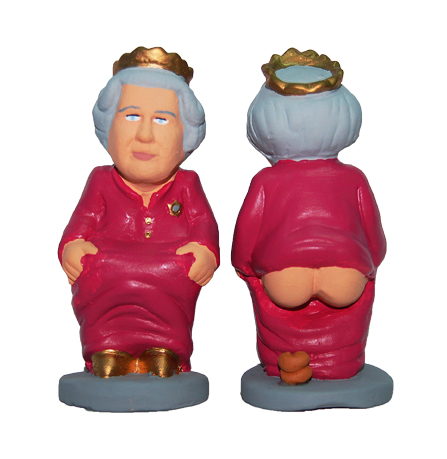
Queen Elizabeth II in a Caganer figure
The name El Caganer literally means the crapper or the shitter. Traditionally, the figurine is depicted as a peasant, wearing the traditional Catalan red cap (the barretina) and with his trousers down, showing a bare backside, and defecating.

Catalonia and Naples were independent kingdoms and they were together during some years. The influence of Catalan traditions in Naples is strong. 

The Caganer is also a typical figure in Naples where there is one of the most beautiful suburbs that you can visit around the world: Santa Lucia. In front of the Mediterranean sea, Castel de l'Ovo emerges like an incredible fortress witness of the shared past.  

More information: Commune di Napoli

Claire Fontaine is in Santa Lucia, an historical rione of Naples. The area rises around the street of the same name and takes that name from the parish sanctuary of Santa Lucia a mare, of which the presence is attested since the 9th century, on the river of the sea, in spite of legend that would have it founded by a granddaughter of Constantine I. 

Santa Lucia in Naples, 1865
The territory of the ward coincides with that of the Parish and extends along via Santa Lucia and Orsini and their cross streets, the Islet of Megaride with the Borgo Marinari, the Castel dell'Ovo, and via Chiatamone, all features of the Partenope promenade. 

Santa Lucia has been identified with the history of Naples ever since the Greeks from Cumae landed here to found the small market harbour of Falero, which later gave rise, between the beach, the islet of Megaride and the Pizzofalcone hill, to the polis Partenope, from the siren who tried to enchant Ulysses; later that town would be known as Palepoli.
 

In the preimperial Roman age, general Lucullus moved to the area and built his magnificent villa, known as Oppidum Lucullianum, to which the last Roman emperor Romulus Augustus exiled to live out his days. In the imperial age the area became famous for its proximity to the platamoniae caves, where magic rituals were held and in which Petronius set parts of his Satyricon. In the 7th century Saint Patricia from Constantinople, directed towards the Holy Land, was shipwrecked here and, according to legend, founded the sanctuary and decided to settle in Naples. 

Claire Fontaine and Castel de l'Ovo in Napoli
Already in 1845, the sea level rose considerably, making it necessary to bury the original sanctuary and build a new one on top of it; after the annexion of the Kingdom of Naples to Italy (1861) Santa Lucia underwent a complete transformation, including the enlarging and straightening of the Partenope promenade. It involved reclaining large tracts of land from the sea and the creation of new streets, all of which has served the area well in this age of modern tourism. 

Santa Lucia has been like subject of some traditional Neapolitan songs, among which is the most famous, Santa Lucia and Santa Lucia Luntana, a musical symbol of Neapolitans leaving home to emigrate to America.


Partono 'e bastimente pe' terre assaje luntane...
Cantano a buordo: so' Napulitane!
Cantano pe' tramente 'o golfo gia scumpare,
e 'a luna, 'a miez'o mare, nu poco 'e Napule


The ships are leaving for far away lands.
The Neapolitans sing on board.
They sing while in the sunset the bay disappears
and the moon, above the sea lets them see
a glimpse of Naples.

E.A.Mario