Showing posts with label Manhattan. Show all posts

Monday, 1 May 2023

1931, THE EMPIRE STATE BUILDING IS DEDICATED IN NYC

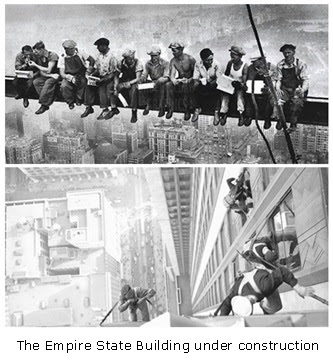
Today, The Grandma wants to commemorate a wonderful event, the 92nd anniversary of the officially opening of the Empire State Building in Manhattan, New York City.
 
This construction was opening on a day like today in 1931.

The Empire State Building is a 102-story Art Deco skyscraper in Midtown Manhattan in New York City. It was designed by Shreve, Lamb & Harmon and built from 1930 to 1931.

Its name is derived from Empire State, the nickname of the state of New York. The building has a roof height of 380 m and stands a total of 443.2 m tall, including its antenna.

The Empire State Building stood as the world's tallest building until the construction of the World Trade Center in 1970; following its collapse in 2001, the Empire State Building was again the city's tallest skyscraper until 2012.

As of 2020, the building is the seventh-tallest building in New York City, the ninth-tallest completed skyscraper in the United States, the 49th-tallest in the world, and the sixth-tallest free-standing structure in the Americas.

The site of the Empire State Building, in Midtown South on the west side of Fifth Avenue between West 33rd and 34th Streets, was developed in 1893 as the Waldorf–Astoria Hotel.

In 1929, Empire State Inc. acquired the site and devised plans for a skyscraper there. The design for the Empire State Building was changed fifteen times until it was ensured to be the world's tallest building.

Construction started on March 17, 1930, and the building opened thirteen and a half months afterward on May 1, 1931. Despite favourable publicity related to the building's construction, because of the Great Depression and World War II, its owners did not make a profit until the early 1950s.

The building's Art Deco architecture, height, and observation decks have made it a popular attraction. Around four million tourists from around the world annually visit the building's 86th- and 102nd-floor observatories; an additional indoor observatory on the 80th floor opened in 2019.

More information: ESBNYC

The Empire State Building is an American cultural icon: it has been featured in more than 250 TV shows and movies since the film King Kong was released in 1933. The building's size has become the global standard of reference to describe the height and length of other structures.

A symbol of New York City, the building has been named as one of the Seven Wonders of the Modern World by the American Society of Civil Engineers. It was ranked first on the American Institute of Architects' List of America's Favourite Architecture in 2007.

Additionally, the Empire State Building and its ground-floor interior were designated city landmarks by the New York City Landmarks Preservation Commission in 1980, and were added to the National Register of Historic Places as a National Historic Landmark in 1986.

The Empire State Building is located on the west side of Fifth Avenue in Manhattan, between 33rd Street to the south and 34th Street to the north.

Tenants enter the building through the Art Deco lobby located at 350 Fifth Avenue. Visitors to the observatories use an entrance at 20 West 34th Street; prior to August 2018, visitors entered through the Fifth Avenue lobby.
Although physically located in South Midtown, a mixed residential and commercial area, the building is so large that it was assigned its own Postcode, as of 2012, it is one of 43 buildings in New York City that have their own Postcodes.

The areas surrounding the Empire State Building are home to other major points of interest, including Macy's at Herald Square on Sixth Avenue and 34th Street, Koreatown on 32nd Street between Madison and Sixth Avenues, Penn Station and Madison Square Garden on Seventh Avenue between 32nd and 34th Streets, and the Flower District on 28th Street between Sixth and Seventh Avenues. The nearest New York City Subway stations are 34th Street-Penn Station at Seventh Avenue, two blocks west; 34th Street-Herald Square, one block west; and 33rd Street at Park Avenue, two blocks east. There is also a PATH station at 33rd Street and Sixth Avenue.

To the east of the Empire State Building is Murray Hill, a neighbourhood with a mix of residential, commercial, and entertainment activity. The block directly to the northeast contains the B. Altman and Company Building, which houses the City University of New York's Graduate Center, while the Demarest Building is directly across Fifth Avenue to the east.

The site was previously owned by John Jacob Astor of the prominent Astor family, who had owned the site since the mid-1820s.

In 1893, John Jacob Astor Sr.'s grandson William Waldorf Astor opened the Waldorf Hotel on the site; four years later, his cousin, John Jacob Astor IV, opened the 16-story Astoria Hotel on an adjacent site. The two portions of the Waldorf-Astoria hotel had 1,300 bedrooms, making it the largest hotel in the world at the time. After the death of its founding proprietor, George Boldt, in early 1918, the hotel lease was purchased by Thomas Coleman du Pont.

By the 1920s, the old Waldorf-Astoria was becoming dated and the elegant social life of New York had moved much farther north than 34th Street. The Astor family decided to build a replacement hotel further uptown, and sold the hotel to Bethlehem Engineering Corporation in 1928 for $14–16 million. The hotel closed shortly thereafter, on May 3, 1929.

More information: History

The Empire State Building officially opened on May 1, 1931, forty-five days ahead of its projected opening date, and eighteen months from the start of construction. The opening was marked with an event featuring United States President Herbert Hoover, who turned on the building's lights with the ceremonial button push from Washington, D.C.

Over 350 guests attended the opening ceremony, and following luncheon, at the 86th floor including Jimmy Walker, Governor Franklin D. Roosevelt, and Al Smith. An account from that day stated that the view from the luncheon was obscured by a fog, with other landmarks such as the Statue of Liberty being lost in the mist enveloping New York City.

The Empire State Building officially opened the next day. Advertisements for the building's observatories were placed in local newspapers, while nearby hotels also capitalized on the events by releasing advertisements that lauded their proximity to the newly opened building.

According to The New York Times, builders and real estate speculators predicted that the 380 m Empire State Building would be the world's tallest building for many years, thus ending the great New York City skyscraper rivalry.

At the time, most engineers agreed that it would be difficult to build a building taller than 370 m, even with the hardy Manhattan bedrock as a foundation. Technically, it was believed possible to build a tower of up to 610 m, but it was deemed uneconomical to do so, especially during the Great Depression.

As the tallest building in the world, at that time, and the first one to exceed 100 floors, the Empire State Building became an icon of the city and, ultimately, of the nation.

More information: Time

 
 That New York energy,
when you've got the benefit of great weather,
it really is terrific.
You look up at that skyline,
and the Empire State Building is literally in your eyesight
-there's nothing like that.

Justin Hartley

Saturday, 18 March 2023

THE CHRYSLER BUILDING, ENJOYING ART DECO IN NYC

Today, The Grandma has visited the Chrysler Building, an Art Deco skyscraper on the East Side of Manhattan, and one of the most popular icons of New York City.

The Chrysler Building is an Art Deco skyscraper in the Turtle Bay neighbourhood on the East Side of Manhattan, New York City, at the intersection of 42nd Street and Lexington Avenue in Midtown Manhattan.

At 319 m, it is the tallest brick building in the world with a steel framework, and was the world's tallest building for 11 months after its completion in 1930.

As of 2019, the Chrysler is the 11th-tallest building in the city, tied with The New York Times Building.

Originally a project of real estate developer and former New York State Senator William H. Reynolds, the building was constructed by Walter Chrysler, the head of the Chrysler Corporation. The construction of the Chrysler Building, an early skyscraper, was characterized by a competition with 40 Wall Street and the Empire State Building to become the world's tallest building.

Although the Chrysler Building was built and designed specifically for the car manufacturer, the corporation did not pay for its construction and never owned it; Walter Chrysler decided to fund the entire cost personally so his children could inherit it. An annex was completed in 1952, and the building was sold by the Chrysler family the next year, with numerous subsequent owners.

More information: Chrysler Building

When the Chrysler Building opened, there were mixed reviews of the building's design, ranging from views of it as inane and unoriginal to the idea that it was modernist and iconic. Perceptions of the building have slowly evolved into its now being seen as a paragon of the Art Deco architectural style; and in 2007, it was ranked ninth on the List of America's Favorite Architecture by the American Institute of Architects.

The building was designated a New York City landmark in 1978, and was added to the National Register of Historic Places.

The land was donated to The Cooper Union for the Advancement of Science and Art in 1902. The site is roughly a trapezoid with a 61 m frontage on Lexington Avenue; a 51 m frontage on 42nd Street; and a 62 m frontage on 43rd Street.

The site bordered the old Boston Post Road, which predated, and ran aslant of, the Manhattan street grid established by the Commissioners' Plan of 1811. As a result, the east side of the building's base is similarly aslant.

The Grand Hyatt New York hotel and the Graybar Building are across Lexington Avenue, while the Socony-Mobil Building is across 42nd Street.

In addition, the Chanin Building is to the southwest, diagonally across Lexington Avenue and 42nd Street. National Historic Landmark in 1976.

The Chrysler Building was designed by William Van Alen in the Art Deco style and is named for one of its original tenants, automotive executive Walter Chrysler.

More information: Classic New York History

It is constructed of a steel frame infilled with masonry, with areas of decorative metal cladding. The structure contains 3,862 exterior windows. Approximately fifty metal ornaments protrude at the building's corners on five floors reminiscent of gargoyles on Gothic cathedrals.

The 31st-floor contains gargoyles as well as replicas of the 1929 Chrysler radiator caps, and the 61st-floor is adorned with eagles as a nod to America's national bird.

In the mid-1920s, New York's metropolitan area surpassed London's as the world's most populous metropolitan area and its population exceeded ten million by the early 1930s.

The era was characterized by profound social and technological changes. Consumer goods such as radio, cinema, and the automobile became widespread.

In 1927, Walter Chrysler's automotive company, the Chrysler Corporation, became the third-largest car manufacturer in the United States, behind Ford and General Motors. The following year, Chrysler was named Time magazine's Person of the Year.

The economic boom of the 1920s and speculation in the real estate market fostered a wave of new skyscraper projects in New York City.

The Chrysler Building was built as part of an ongoing building boom that resulted in the city having the world's tallest building from 1908 to 1974.

More information: Town and Country


 I like to build things. I like to do things.

Walter Chrysler

Tuesday, 28 June 2022

CHELSEA, THE LGTBQ+ COMMUNITY & PRIDE DAY IN NYC

Today, The Grandma has been visiting Chelsea in Manhattan.

Meanwhile, The Newtons have continued preparing their Cambridge Exam. They have studied Past Continuous.

More info: Past Continuous 

Chelsea is a neighbourhood on the West Side of the borough of Manhattan in New York City.

The area's boundaries are roughly 14th Street to the south, the Hudson River and West Street to the west, and Sixth Avenue to the east, with its northern boundary variously described as near the upper 20s or 34th Street, the next major crosstown street to the north.

To the northwest of Chelsea is the neighbourhood of Hell's Kitchen, as well as Hudson Yards; to the northeast are the Garment District and the remainder of Midtown South; to the east are NoMad and the Flatiron District; to the southwest is the Meatpacking District; and to the south and southeast are the West Village and the remainder of Greenwich Village. 

Chelsea is named after the Royal Hospital Chelsea in London, England.

Chelsea contains the Chelsea Historic District and its extension, which were designated by the New York City Landmarks Preservation Commission in 1970 and 1981 respectively. The district was added to the National Register of Historic Places in 1977, and expanded in 1982 to include contiguous blocks containing particularly significant examples of period architecture.

The neighbourhood is primarily residential, with a mix of tenements, apartment blocks, city housing projects, townhouses, and renovated rowhouses, but its many retail businesses reflect the ethnic and social diversity of the population.  

The area has a large LGBTQ population.

Chelsea is also known as one of the centers of the city's art world, with over 200 galleries in the neighbourhood. As of 2015, due to the area's gentrification, there is a widening income gap between the wealthy living in luxury buildings and the poor living in housing projects, who are, at times, across the street from each other.

More information: The High Line

Chelsea takes its name from the estate and Georgian-style house of retired British Major Thomas Clarke, who obtained the property when he bought the farm of Jacob Somerindyck on August 16, 1750.

The land was bounded by what would become 21st and 24th Streets, from the Hudson River to Eighth Avenue. Clarke chose the name Chelsea after the Royal Hospital Chelsea in London, England. Clarke passed the estate on to his daughter, Charity, who, with her husband Benjamin Moore, added land on the south of the estate, extending it to 19th Street. The house was the birthplace of their son, Clement Clarke Moore, who in turn inherited the property. Moore is generally credited with writing A Visit From St. Nicholas and was the author of the first Greek and Hebrew lexicons printed in the United States.

In 1827, Moore gave the land of his apple orchard to the Episcopal Diocese of New York for the General Theological Seminary, which built its brownstone Gothic, tree-shaded campus south of the manor house. Despite his objections to the Commissioner's Plan of 1811, which ran the new Ninth Avenue through the middle of his estate, Moore began the development of Chelsea with the help of James N. Wells, dividing it up into lots along Ninth Avenue and selling them to well-heeled New Yorkers.

Covenants in the deeds of sale specified what could be built on the land -stables, manufacturing and commercial uses were forbidden- as well as architectural details of the buildings.

The new neighbourhood thrived for three decades, with many single family homes and rowhouses, in the process expanding past the original boundaries of Clarke's estate, but an industrial zone also began to develop along the Hudson.

In 1847 the Hudson River Railroad laid its freight tracks up a right-of-way between Tenth and Eleventh Avenues, separating Chelsea from the Hudson River waterfront. By the time of the Civil War, the area west of Ninth Avenue and below 20th Street was the location of numerous distilleries making turpentine and camphene, a lamp fuel. In addition, the huge Manhattan Gas Works complex, which converted bituminous coal into gas, was located at Ninth Avenue and 18th Street.

The industrialization of western Chelsea brought immigrant populations from many countries to work in the factories, including a large number of Irish immigrants, who dominated work on the Hudson River piers that lined the nearby waterfront and the truck terminals integrated with the freight railroad spur.

As well as the piers, warehouses and factories, the industrial area west of Tenth Avenue also included lumberyards and breweries, and tenements built to house the workers. With the immigrant population came the political domination of the neighbourhood by the Tammany Hall machine, as well as festering ethnic tensions: around 67 people died in a riot between Irish Catholics and Irish Protestants on July 12, 1871, which took place around 24th Street and Eighth Avenue.

More information: The Bowery Boys History

The social problems of the area's workers provoked John Lovejoy Elliot to form the Hudson Guild in 1897, one of the first settlement houses -private organizations designed to provide social services.

A theater district had formed in the area by 1869, and soon West 23rd Street was the center of American theater, led by Pike's Opera House (1868, demolished 1960), on the northwest corner of Eighth Avenue. Chelsea was an early center for the motion picture industry before World War I. Some of Mary Pickford's first pictures were made on the top floors of an armory building at 221 West 26th Street, while other studios were located on 23rd and 21st Streets.

London Terrace was one of the world's largest apartment blocks when it opened in 1930, with a swimming pool, solarium, gymnasium, and doormen dressed as London bobbies. Other major housing complexes in the Chelsea area are Penn South, a 1962 cooperative housing development sponsored by the International Ladies Garment Workers' Union, and the New York City Housing Authority-built and -operated Fulton Houses and Chelsea-Elliot Houses.

The massive 23-story Art Deco Walker Building, which spans the block between 17th and 18th Streets just off of Seventh Avenue, was built in the early 1930s. It typifies the real estate activity of the district, as it has been converted in 2012 to residential apartments on the top 16 floors, with Verizon retaining the lower seven floors.

In the early 1940s, tons of uranium for the Manhattan Project were stored in the Baker & Williams Warehouse at 513-519 West 20th Street. The uranium was removed and a decontamination project at the site was completed during the early 1990s.

People of many different cultures live in Chelsea.  

Chelsea is famous for having a large LGBTQ population, with one of Chelsea's census tracts reporting that 22% of its residents were gay couples, and is known for its social diversity and inclusion.

Eighth Avenue is a center for LGBT-oriented shopping and dining, and from 16th to 22nd Streets between Ninth and Tenth Avenues, mid-nineteenth-century brick and brownstone townhouses are still occupied, a few even restored to single family use.

More information: Triplemint


I saw 'Brokeback Mountain' in a packed house in Chelsea,
New York, when I was filming a Bollywood film there.
Chelsea, being a predominately gay neighbourhood,
had the most euphoric reaction.
I saw couples holding hands and crying at the end.
It was the most heartening viewing
I have ever been to.

Karan Johar

Tuesday, 14 June 2022

THE CHRYSLER BUILDING, ART DECO IN MANHATTAN

Today, The Newtons & The Grandma have visited the Chrysler Building, an Art Deco skyscraper on  the East Side of Manhattan, and one of the most popular icons of New York City. Before arriving, they have been studying The Superlative and Present Simple.

The Chrysler Building is an Art Deco skyscraper in the Turtle Bay neighbourhood on the East Side of Manhattan, New York City, at the intersection of 42nd Street and Lexington Avenue in Midtown Manhattan.

At 319 m, it is the tallest brick building in the world with a steel framework, and was the world's tallest building for 11 months after its completion in 1930.

As of 2019, the Chrysler is the 11th-tallest building in the city, tied with The New York Times Building.

More information: The Superlative

More information: Adverbs of Frequency

Originally a project of real estate developer and former New York State Senator William H. Reynolds, the building was constructed by Walter Chrysler, the head of the Chrysler Corporation. The construction of the Chrysler Building, an early skyscraper, was characterized by a competition with 40 Wall Street and the Empire State Building to become the world's tallest building.

Although the Chrysler Building was built and designed specifically for the car manufacturer, the corporation did not pay for its construction and never owned it; Walter Chrysler decided to fund the entire cost personally so his children could inherit it. An annex was completed in 1952, and the building was sold by the Chrysler family the next year, with numerous subsequent owners.

More information: Chrysler Building

When the Chrysler Building opened, there were mixed reviews of the building's design, ranging from views of it as inane and unoriginal to the idea that it was modernist and iconic. Perceptions of the building have slowly evolved into its now being seen as a paragon of the Art Deco architectural style; and in 2007, it was ranked ninth on the List of America's Favorite Architecture by the American Institute of Architects.

The building was designated a New York City landmark in 1978, and was added to the National Register of Historic Places.

The land was donated to The Cooper Union for the Advancement of Science and Art in 1902. The site is roughly a trapezoid with a 61 m frontage on Lexington Avenue; a 51 m frontage on 42nd Street; and a 62 m frontage on 43rd Street.

The site bordered the old Boston Post Road, which predated, and ran aslant of, the Manhattan street grid established by the Commissioners' Plan of 1811. As a result, the east side of the building's base is similarly aslant.

The Grand Hyatt New York hotel and the Graybar Building are across Lexington Avenue, while the Socony-Mobil Building is across 42nd Street.

In addition, the Chanin Building is to the southwest, diagonally across Lexington Avenue and 42nd Street. National Historic Landmark in 1976.

The Chrysler Building was designed by William Van Alen in the Art Deco style and is named for one of its original tenants, automotive executive Walter Chrysler.

More information: Classic New York History

It is constructed of a steel frame infilled with masonry, with areas of decorative metal cladding. The structure contains 3,862 exterior windows. Approximately fifty metal ornaments protrude at the building's corners on five floors reminiscent of gargoyles on Gothic cathedrals.

The 31st-floor contains gargoyles as well as replicas of the 1929 Chrysler radiator caps, and the 61st-floor is adorned with eagles as a nod to America's national bird.

In the mid-1920s, New York's metropolitan area surpassed London's as the world's most populous metropolitan area and its population exceeded ten million by the early 1930s.

The era was characterized by profound social and technological changes. Consumer goods such as radio, cinema, and the automobile became widespread.

In 1927, Walter Chrysler's automotive company, the Chrysler Corporation, became the third-largest car manufacturer in the United States, behind Ford and General Motors. The following year, Chrysler was named Time magazine's Person of the Year.

The economic boom of the 1920s and speculation in the real estate market fostered a wave of new skyscraper projects in New York City.

The Chrysler Building was built as part of an ongoing building boom that resulted in the city having the world's tallest building from 1908 to 1974.

More information: Town and Country

I like to build things. I like to do things.

Walter Chrysler

Tuesday, 7 June 2022

ANNIE HALL & MANHATTAN, THE WOODY ALLEN'S WORKS

Today, The Newtons & The Grandma have visited Woody Allen, the American film director, writer, actor, and comedian, whose filmography is full of masterpieces like Annie Hall or ManhattanThey have spent a nice morning with the actor asking him lots of questions about his plans of future.

Before visiting Allen, The Newtons have studied English grammar. They have chosen Future Continuous.

 
Heywood Woody Allen (born Allan Stewart Konigsberg, November 30, 1935) is an American film director, writer, actor, and comedian whose career spans more than six decades and multiple Academy Award-winning films.

He began his career writing material for television in the 1950s, mainly Your Show of Shows (1950-1954) working alongside Mel Brooks, Carl Reiner, Larry Gelbart, and Neil Simon. He also published several books featuring short stories and wrote humor pieces for The New Yorker.

In the early 1960s, he performed as a stand-up comedian in Greenwich Village alongside Lenny Bruce, Elaine May, Mike Nichols, and Joan Rivers. There he developed a monologue style (rather than traditional jokes) and the persona of an insecure, intellectual, fretful nebbish.

He released three comedy albums during the mid to late 1960s, earning a Grammy Award for Best Comedy Album nomination for his 1964 comedy album entitled simply, Woody Allen.

In 2004, Comedy Central ranked Allen fourth on a list of the 100 greatest stand-up comedians, while a UK survey ranked Allen the third-greatest comedian.

More information: Woody Allen

By the mid-1960s, Allen was writing and directing films, first specializing in slapstick comedies such as Take the Money and Run (1969), Bananas (1971), Sleeper (1973), and Love and Death (1975), before moving into dramatic material influenced by European art cinema during the late 1970s with Interiors (1978), Manhattan (1979), and Stardust Memories (1980), and alternating between comedies and dramas to the present.

Allen is often identified as part of the New Hollywood wave of filmmakers of the mid-1960s to late 1970s such as Martin Scorsese, Robert Altman, and Sidney Lumet.

He often stars in his films, typically in the persona he developed as a standup. His film Annie Hall (1977), a romantic comedy featuring Allen and his frequent collaborator Diane Keaton, won four Academy Awards, including Best Picture, Best Director, Best Original Screenplay, and Best Actress for Keaton.

Critics have called his work from the 1980s his most developed period. Those films include Zelig (1983), Broadway Danny Rose (1984), The Purple Rose of Cairo (1985), Hannah and Her Sisters (1986), Radio Days (1987), Another Woman (1988), and Crimes and Misdemeanors (1989).

In the 21st century, many of Allen's films have been set and shot in Europe, including Match Point (2005), Vicky Cristina Barcelona (2008), Midnight in Paris (2011), and To Rome with Love (2012). Allen returned to America gaining acclaim for Blue Jasmine (2013) and Cafe Society (2016).

More information: The Woody Allen Pages

In 1979, Allen began a professional and personal relationship with actress Mia Farrow, and over a decade-long period they collaborated on 13 films. They separated after Allen began a relationship with Mia's and Andre Previn's adopted daughter Soon-Yi Previn.During the separation, Allen was publicly accused of sexually abusing his daughter, the seven-year-old Dylan. The allegation gained substantial media attention, but Allen was never charged or prosecuted, and he vehemently denied the allegation. Allen married Previn in 1997, and they adopted two children.

Allen has received many accolades and honors, including the most nominations for the Academy Award for Best Original Screenplay, with 16. He has won four Academy Awards, one for Best Director, and three for Best Original Screenplay. He also garnered nine British Academy Film Awards.

In 1997, Allen was awarded the BAFTA Fellowship by the British Academy of Film and Television Arts. In 2014, he received the Golden Globe Cecil B. DeMille Award for Lifetime Achievement and a Tony Award nomination for Best Book of a Musical for Bullets over Broadway.

In 2011, PBS televised the film biography Woody Allen: A Documentary on its series American Masters.

In 2015, the Writers Guild of America named his screenplay for Annie Hall first on its list of the 101 Funniest Screenplays.

More information: Variety

Woody Allen was the reason
I wanted to move to New York City
and one of the reasons I wanted to make films.
I felt that I understood his films, and I love them so much.
When you're starting out, certainly,
you have this sense of wanting to talk back to people
who have influenced you,
and I always wanted to talk back to Woody Allen.

Greta Gerwig


Annie Hall is a 1977 American satirical romantic comedy-drama film directed by Woody Allen from a screenplay he co-wrote with Marshall Brickman, and produced by Allen's manager, Charles H. Joffe. 

The film stars Allen as Alvy Singer, who tries to figure out the reasons for the failure of his relationship with the eponymous female lead, played by Diane Keaton in a role written specifically for her.

Principal photography for the film began on May 19, 1976, on the South Fork of Long Island, and continued periodically for the next ten months. Allen has described the result, which marked his first collaboration with cinematographer Gordon Willis, as a major turning point, in that unlike the farces and comedies that were his work to that point, it introduced a new level of seriousness. Academics have noted the contrast in the settings of New York City and Los Angeles, the stereotype of gender differences in sexuality, the presentation of Jewish identity, and the elements of psychoanalysis and modernism.

Annie Hall was screened at the Los Angeles Film Festival on March 27, 1977, before its official release in the United States on April 20, 1977. The film was highly praised, was nominated for the Big Five Academy Awards, winning four: the Academy Award for Best Picture, two for Allen (Best Director and, with Brickman, Best Original Screenplay), and Best Actress for Keaton.

The film additionally won four BAFTA awards and a Golden Globe, the latter being awarded to Keaton. The film's North American box office receipts of $38,251,425 are fourth-best of Allen's works when not adjusted for inflation.

Ranking among the best films ever made, it ranks 31st on AFI's List of the greatest films in American cinema, 4th on their list of greatest comedy films and 28th on Bravo's 100 Funniest Movies. Film critic Roger Ebert called it just about everyone's favorite Woody Allen movie. The film's screenplay was also named the funniest ever written by the Writers Guild of America in its list of the 101 Funniest Screenplays.

In 1992, the United States Library of Congress selected the film for preservation in the National Film Registry as being culturally, historically, or aesthetically significant.

More information: Roger Ebert


 Woody Allen's movies are so much a part of me.
I grew up watching them over and over
and would read all his comic pieces for the New Yorker.
In some ways, his influence is so much there
that I can't even locate it any more.

Noah Baumbach


Manhattan is a 1979 American romantic comedy-drama film directed by Woody Allen and produced by Charles H. Joffe. 

The screenplay was written by Allen and Marshall Brickman. Allen co-stars as a twice-divorced 42-year-old comedy writer who dates a 17-year-old girl (Mariel Hemingway) but falls in love with his best friend (Michael Murphy)'s mistress (Diane Keaton). Meryl Streep and Anne Byrne also star.

Manhattan was Allen's first movie filmed in black-and-white, and was shot in 2.35:1 widescreen. It features music by George Gershwin, including Rhapsody in Blue, which inspired the film. Allen described the film as a combination of Annie Hall and Interiors.

The film received critical acclaim and was nominated for the Academy Award for Best Supporting Actress for Hemingway and Best Writing, Screenplay Written Directly for the Screen for Allen and Brickman. Its North American box-office receipts of $39.9 million made it Allen's second biggest box-office hit, adjusted for inflation. Often considered one of his best films, it ranks 46th on AFI's 100 Years...100 Laughs list and number 63 on Bravo's 100 Funniest Movies.

In 2001, the United States Library of Congress deemed the film culturally, historically, or aesthetically significant and selected it for preservation in the National Film Registry.

More information: Roger Ebert


 I don't want to achieve immortality through my work.
I want to achieve it through not dying.

Woody Allen

Saturday, 14 May 2022

THE BROOKLYN BRIDGE, CROSSING THE EAST RIVER

Today, The Grandma has visited one of her favourite places in New York, the Brooklyn Bridge. She loves this place, and she visits it as many times as she can.

The Brooklyn Bridge is a hybrid cable-stayed suspension bridge in New York City, spanning the East River between the boroughs of Manhattan and Brooklyn. Opened on May 24, 1883, the Brooklyn Bridge was the first fixed crossing of the East River

It was also the longest suspension bridge in the world at the time of its opening, with a main span of 1,595.5 feet (486.3 m) and a deck 127 ft (38.7 m) above mean high water. The span was originally called the New York and Brooklyn Bridge or the East River Bridge but was officially renamed the Brooklyn Bridge in 1915.

Proposals for a bridge connecting Manhattan and Brooklyn were first made in the early 19th century, which eventually led to the construction of the current span, designed by John A. Roebling.

The project's chief engineer, his son Washington Roebling, contributed further design work, assisted by the latter's wife, Emily Warren Roebling. Construction started in 1870, with the Tammany Hall-controlled New York Bridge Company overseeing construction, although numerous controversies and the novelty of the design prolonged the project over thirteen years. Since opening, the Brooklyn Bridge has undergone several reconfigurations, having carried horse-drawn vehicles and elevated railway lines until 1950. 

To alleviate increasing traffic flows, additional bridges and tunnels were built across the East River. Following gradual deterioration, the Brooklyn Bridge has been renovated several times, including in the 1950s, 1980s, and 2010s.

The Brooklyn Bridge is the southernmost of the four toll-free vehicular bridges connecting Manhattan Island and Long Island, with the Manhattan Bridge, the Williamsburg Bridge, and the Queensboro Bridge to the north. Only passenger vehicles and pedestrian and bicycle traffic are permitted.

A major tourist attraction since its opening, the Brooklyn Bridge has become an icon of New York City. Over the years, the bridge has been used as the location of various stunts and performances, as well as several crimes and attacks.

The Brooklyn Bridge has been designated a National Historic Landmark, a New York City landmark, and a National Historic Civil Engineering Landmark.

More information: Experience First


One of the reasons I moved back to Brooklyn is to get to hang out
with the guys I've known since we were 12, 13 years old.
Having that sense of community is incredibly important to me.

Romany Malco

Saturday, 1 May 2021

1931, THE EMPIRE STATE BUILDING IS DEDICATED IN NYC

Today, The Grandma wants to commemorate a wonderful event, the 90th anniversary of the officially opening of the Empire State Building in Manhattan, New York City.
 
This construction was opening on a day like today in 1931.

The Empire State Building is a 102-story Art Deco skyscraper in Midtown Manhattan in New York City. It was designed by Shreve, Lamb & Harmon and built from 1930 to 1931.

Its name is derived from Empire State, the nickname of the state of New York. The building has a roof height of 380 m and stands a total of 443.2 m tall, including its antenna.

The Empire State Building stood as the world's tallest building until the construction of the World Trade Center in 1970; following its collapse in 2001, the Empire State Building was again the city's tallest skyscraper until 2012.

As of 2020, the building is the seventh-tallest building in New York City, the ninth-tallest completed skyscraper in the United States, the 49th-tallest in the world, and the sixth-tallest free-standing structure in the Americas.

The site of the Empire State Building, in Midtown South on the west side of Fifth Avenue between West 33rd and 34th Streets, was developed in 1893 as the Waldorf–Astoria Hotel.

In 1929, Empire State Inc. acquired the site and devised plans for a skyscraper there. The design for the Empire State Building was changed fifteen times until it was ensured to be the world's tallest building.

Construction started on March 17, 1930, and the building opened thirteen and a half months afterward on May 1, 1931. Despite favourable publicity related to the building's construction, because of the Great Depression and World War II, its owners did not make a profit until the early 1950s.

The building's Art Deco architecture, height, and observation decks have made it a popular attraction. Around four million tourists from around the world annually visit the building's 86th- and 102nd-floor observatories; an additional indoor observatory on the 80th floor opened in 2019.

More information: ESBNYC

The Empire State Building is an American cultural icon: it has been featured in more than 250 TV shows and movies since the film King Kong was released in 1933. The building's size has become the global standard of reference to describe the height and length of other structures.

A symbol of New York City, the building has been named as one of the Seven Wonders of the Modern World by the American Society of Civil Engineers. It was ranked first on the American Institute of Architects' List of America's Favourite Architecture in 2007.

Additionally, the Empire State Building and its ground-floor interior were designated city landmarks by the New York City Landmarks Preservation Commission in 1980, and were added to the National Register of Historic Places as a National Historic Landmark in 1986.

The Empire State Building is located on the west side of Fifth Avenue in Manhattan, between 33rd Street to the south and 34th Street to the north.

Tenants enter the building through the Art Deco lobby located at 350 Fifth Avenue. Visitors to the observatories use an entrance at 20 West 34th Street; prior to August 2018, visitors entered through the Fifth Avenue lobby.

Although physically located in South Midtown, a mixed residential and commercial area, the building is so large that it was assigned its own Postcode, as of 2012, it is one of 43 buildings in New York City that have their own Postcodes.

The areas surrounding the Empire State Building are home to other major points of interest, including Macy's at Herald Square on Sixth Avenue and 34th Street, Koreatown on 32nd Street between Madison and Sixth Avenues, Penn Station and Madison Square Garden on Seventh Avenue between 32nd and 34th Streets, and the Flower District on 28th Street between Sixth and Seventh Avenues. The nearest New York City Subway stations are 34th Street-Penn Station at Seventh Avenue, two blocks west; 34th Street-Herald Square, one block west; and 33rd Street at Park Avenue, two blocks east. There is also a PATH station at 33rd Street and Sixth Avenue.

To the east of the Empire State Building is Murray Hill, a neighbourhood with a mix of residential, commercial, and entertainment activity. The block directly to the northeast contains the B. Altman and Company Building, which houses the City University of New York's Graduate Center, while the Demarest Building is directly across Fifth Avenue to the east.

The site was previously owned by John Jacob Astor of the prominent Astor family, who had owned the site since the mid-1820s.

In 1893, John Jacob Astor Sr.'s grandson William Waldorf Astor opened the Waldorf Hotel on the site; four years later, his cousin, John Jacob Astor IV, opened the 16-story Astoria Hotel on an adjacent site. The two portions of the Waldorf-Astoria hotel had 1,300 bedrooms, making it the largest hotel in the world at the time. After the death of its founding proprietor, George Boldt, in early 1918, the hotel lease was purchased by Thomas Coleman du Pont.

By the 1920s, the old Waldorf-Astoria was becoming dated and the elegant social life of New York had moved much farther north than 34th Street. The Astor family decided to build a replacement hotel further uptown, and sold the hotel to Bethlehem Engineering Corporation in 1928 for $14–16 million. The hotel closed shortly thereafter, on May 3, 1929.

More information: History

The Empire State Building officially opened on May 1, 1931, forty-five days ahead of its projected opening date, and eighteen months from the start of construction. The opening was marked with an event featuring United States President Herbert Hoover, who turned on the building's lights with the ceremonial button push from Washington, D.C.

Over 350 guests attended the opening ceremony, and following luncheon, at the 86th floor including Jimmy Walker, Governor Franklin D. Roosevelt, and Al Smith. An account from that day stated that the view from the luncheon was obscured by a fog, with other landmarks such as the Statue of Liberty being lost in the mist enveloping New York City.

The Empire State Building officially opened the next day. Advertisements for the building's observatories were placed in local newspapers, while nearby hotels also capitalized on the events by releasing advertisements that lauded their proximity to the newly opened building.

According to The New York Times, builders and real estate speculators predicted that the 380 m Empire State Building would be the world's tallest building for many years, thus ending the great New York City skyscraper rivalry.

At the time, most engineers agreed that it would be difficult to build a building taller than 370 m, even with the hardy Manhattan bedrock as a foundation. Technically, it was believed possible to build a tower of up to 610 m, but it was deemed uneconomical to do so, especially during the Great Depression.

As the tallest building in the world, at that time, and the first one to exceed 100 floors, the Empire State Building became an icon of the city and, ultimately, of the nation.

More information: Time


That New York energy,
when you've got the benefit of great weather,
it really is terrific.
You look up at that skyline,
and the Empire State Building is literally in your eyesight
-there's nothing like that.

Justin Hartley

Wednesday, 27 December 2017

CAROL BEAN: A HEART IN NY, BAREFOOT IN THE PARK

Barefoot in the park poster with Carol Bean
Carol Bean had a dream. She wanted to visit Central Park and today her dream has come true. Carol has visited this wonderful place accompanied by her family. All together have spent a nice day in the park visiting the real places where Robert Redford and Jane Fonda filmed Barefoot in the park in 1967 and have assisted to the Simon & Garfunkel Concert.

Central Park is an urban park in Manhattan, New York City. It comprises 341 ha between the Upper West Side and Upper East Side, roughly bounded by Fifth Avenue on the east, Central Park West (Eighth Avenue) on the west, Central Park South (59th Street) on the south, and Central Park North (110th Street) on the north. Central Park is the most visited urban park in the United States, with 40 million visitors in 2013, and one of the most filmed locations in the world.

More information: Central Park Conservancy
The park was established in 1857 on 315 ha of land acquired by the city. In 1858, landscape architect Frederick Law Olmsted and architect/landscape designer Calvert Vaux won a design competition to improve and expand the park with a plan they titled the Greensward Plan

The Beans in Central Park, New York City
Construction began the same year, and the park's first area was opened to the public in the winter of 1858. Construction north of the park continued during the American Civil War in the 1860s, and the park was expanded to its current size in 1873. 

After a period of decline in the early 20th century, Robert Moses started a program to clean up Central Park. Another decline in the late 20th century spurred the creation of the Central Park Conservancy in 1980, which refurbished many parts of the park during the 1980s and 1990s.

Central Park was designated a National Historic Landmark by the U.S. Department of the Interior in 1962, which in April 2017 placed it on the tentative list for UNESCO World Heritage Sites

More information: Central Park

The park, managed for decades by the New York City Department of Parks and Recreation, is currently managed by the Central Park Conservancy under contract with the municipal government in a public-private partnership. The Conservancy is a non-profit organization that contributes 75 percent of Central Park's $65 million annual budget and is responsible for all basic care of the 341 ha park.


New York, lookin' down on Central Park
Where they say you should not wander after dark.

New York, like a scene from all those movies
but you're real enough to me, but there's a heart,
a heart that lives in New York.

Simon & Garfunkel

Tuesday, 26 December 2017

THE BEANS IN NEW YORK CITY: A STATE OF MIND

The Beans arriving to the Bryant Park Hotel
After a long transoceanic flight, The Beans arrived to New York City with time enough to celebrate Christmas in the capital of the world.

They went to check in their hotel, The Bryant Park Hotel and they started to enjoy their suites. The Bryant Hotel is a very comfortable modern New Yorker-style hotel located in Manhattan near the business district and the most important sights of the city.

More information: The Bryant Park Hotel

During these days, The Beans are going to enjoy the city. Their agendas are full of proposals and activities and they're going to spend some unforgettable days in the city of the skyscrapers.
The Grandma watching Star Trek in her suite

The Grandma has her own agenda and she wants to watch a New York Knicks match and the Barbra Streisand's concert on New Eve's Day in the Madison Square Garden. 

She also wants to visit an exposition about Salvador Dalí in the Metropolitan Museum and have a meeting with old friends like Richard Castle and the members of the CSI team in New York City.


Come on Beans, enjoy one of the most beautiful cities around the world, and the most important, enjoy its people and its culture and remember that New York is a state of mind.


It comes down to reality, and it's fine with me cause I've let it slide
I don't care if it's Chinatown or on Riverside
I don't have any reasons I left them all behind
I'm in a New York state of mind

 
Billy Joel

Thursday, 17 August 2017

ROBERT DE NIRO: ONCE UPON A TIME IN MANHATTAN

Robert Anthony De Niro
Robert Anthony De Niro (born August 17, 1943) is an American actor, producer, and director who holds both American and Italian citizenship.

Robert Anthony De Niro was born in the Greenwich Village area of Manhattan, New York, the son of painters Virginia Admiral and Robert De Niro Sr. He is of Irish and Italian descent on his father's side, while his mother had Dutch, English, French, and German ancestry.

De Niro was cast as the young Vito Corleone in the 1974 film The Godfather Part II, for which he won the Academy Award for Best Supporting Actor. His longtime collaboration with director Martin Scorsese earned him the Academy Award for Best Actor for his portrayal of Jake LaMotta in the 1980 film Raging Bull. He received the AFI Life Achievement Award in 2003, the Golden Globe Cecil B. DeMille Award in 2010, and the Presidential Medal of Freedom from President Barack Obama in 2016.

More information: Biography.com

De Niro's first major film roles were in the sports drama, Bang the Drum Slowly (1973) and Scorsese's crime film Mean Streets (1973). He earned Academy Award nominations for the psychological thrillers Taxi Driver (1976) and Cape Fear (1991), both directed by Scorsese. De Niro received additional nominations for Michael Cimino's Vietnam war drama, The Deer Hunter (1978), Penny Marshall's drama Awakenings (1990), and David O. Russell's romantic comedy-drama, Silver Linings Playbook (2012). His portrayal of gangster Jimmy Conway in Scorsese's crime film Goodfellas (1990), and his role as Rupert Pupkin in the black comedy film The King of Comedy (1983), earned him BAFTA Award nominations.

Robert De Niro in 1974
De Niro has earned four nominations for the Golden Globe Award for Best Actor Motion Picture Musical or Comedy, for his work in the musical drama New York, New York (1977), the action comedy Midnight Run (1988), the gangster comedy Analyze This (1999), and the comedy Meet the Parents (2000). 

Other notable performances include roles in Once Upon a Time in America (1984), Brazil (1985), The Mission (1986), The Untouchables (1987), Heat (1995), and Casino (1995). He has directed and starred in films such as the crime drama A Bronx Tale (1993) and the spy film The Good Shepherd (2006).

De Niro received an Italian passport in 2006. His Italian citizenship was granted by the Prime Minister despite strong opposition by the Sons of Italy, who believe that De Niro damaged the public image of Italians by portraying criminals.

More information: Getty Images


One of the things about acting is it allows you to live other people's lives without having to pay the price. 

Robert De Niro