Showing posts with label MJ. Show all posts

Monday, 23 March 2026

THE MORGANS & THE GRANDMA, ADVENTURE IS COMING

Today, The Grandma has started a new work and educational project in Sant Boi de Llobregat. MJ has called her to start to work with another family, The Morgans.

MJ and The Grandma have received the new members of this new family in this amazing place and after a long session of bureaucracy The Grandma has been able to start to know her new family. 

Tomorrow, they are going to start with their new manuals and they are going to share lots of hours of effort, knowledge and hard work with the goal of improving their English, having the chance of passing an important exam, and finding a job.

More information: The ABC

English is a West Germanic language that was first spoken in early medieval England and eventually became a global lingua franca.

It is named after the Angles, one of the Germanic tribes that migrated to the area of Great Britain that later took their name, as England.

Both names derive from Anglia, a peninsula in the Baltic Sea. The language is closely related to Frisian and Low Saxon, and its vocabulary has been significantly influenced by other Germanic languages, particularly Norse (a North Germanic language), and to a greater extent by Latin and French.

English has developed over the course of more than 1,400 years. The earliest forms of English, a group of West Germanic (Ingvaeonic) dialects brought to Great Britain by Anglo-Saxon settlers in the 5th century, are collectively called Old English.

Middle English began in the late 11th century with the Norman conquest of England; this was a period in which the language was influenced by French.

Early Modern English began in the late 15th century with the introduction of the printing press to London, the printing of the King James Bible and the start of the Great Vowel Shift.

Modern English has been spreading around the world since the 17th century by the worldwide influence of the British Empire and the United States.

Through all types of printed and electronic media of these countries, English has become the leading language of international discourse and the lingua franca in many regions and professional contexts such as science, navigation and law.

English is the largest language by number of speakers, and the third most-spoken native language in the world, after Standard Chinese and Spanish. It is the most widely learned second language and is either the official language or one of the official languages in almost 60 sovereign states.

There are more people who have learned it as a second language than there are native speakers. It is estimated that there are over 2 billion speakers of English. English is the majority native language in the United States, the United Kingdom, Canada, Australia, New Zealand and the Republic of Ireland, and it is widely spoken in some areas of the Caribbean, Africa and South Asia.

More information:  English Club

It is a co-official language of the United Nations, the European Union and many other world and regional international organisations. It is the most widely spoken Germanic language, accounting for at least 70% of speakers of this Indo-European branch. English has a vast vocabulary, though counting how many words any language has is impossible. English speakers are called Anglophones.

Modern English grammar is the result of a gradual change from a typical Indo-European dependent marking pattern, with a rich inflectional morphology and relatively free word order, to a mostly analytic pattern with little inflection, a fairly fixed subject–verb–object word order and a complex syntax.

Modern English relies more on auxiliary verbs and word order for the expression of complex tenses, aspect and mood, as well as passive constructions, interrogatives and some negation. The variation among the accents and dialects of English used in different countries and regions -in terms of phonetics and phonology, and sometimes also vocabulary, idioms, grammar, and spelling-can often be understood by speakers of different dialects, but in extreme cases can lead to confusion or even mutual unintelligibility between English speakers.

The earliest form of English is called Old English or Anglo-Saxon (c. 550–1066 CE). Old English developed from a set of North Sea Germanic dialects originally spoken along the coasts of Frisia, Lower Saxony, Jutland, and Southern Sweden by Germanic tribes known as the Angles, Saxons, and Jutes.

From the 5th century CE, the Anglo-Saxons settled Britain as the Roman economy and administration collapsed. By the 7th century, the Germanic language of the Anglo-Saxons became dominant in Britain, replacing the languages of Roman Britain, a Celtic language, and Latin, brought to Britain by the Roman occupation. England and English (originally Ænglaland and Ænglisc) are named after the Angles.

Old English was divided into four dialects: the Anglian dialects (Mercian and Northumbrian) and the Saxon dialects, Kentish and West Saxon. Through the educational reforms of King Alfred in the 9th century and the influence of the kingdom of Wessex, the West Saxon dialect became the standard written variety.

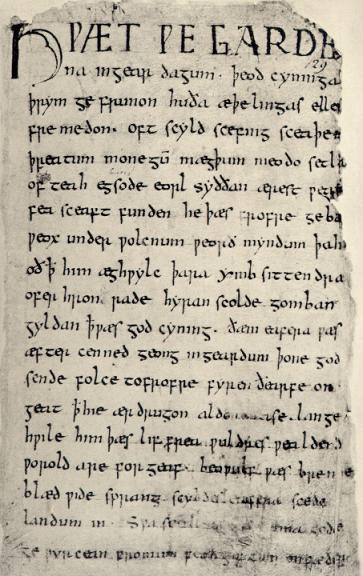
The epic poem Beowulf is written in West Saxon, and the earliest English poem, Cædmon's Hymn, is written in Northumbrian. Modern English developed mainly from Mercian, but the Scots language developed from Northumbrian. A few short inscriptions from the early period of Old English were written using a runic script. By the 6th century, a Latin alphabet was adopted, written with half-uncial letterforms.

Old English is essentially a distinct language from Modern English and is virtually impossible for 21st-century unstudied English speakers to understand. Its grammar was similar to that of modern German, and its closest relative is Old Frisian.

More information: BBC

Nouns, adjectives, pronouns, and verbs had many more inflectional endings and forms, and word order was much freer than in Modern English. Modern English has case forms in pronouns (he, him, his) and has a few verb inflections (speak, speaks, speaking, spoke, spoken), but Old English had case endings in nouns as well, and verbs had more person and number endings.

From the 8th to the 12th century, Old English gradually transformed through language contact into Middle English. Middle English is often arbitrarily defined as beginning with the conquest of England by William the Conqueror in 1066, but it developed further in the period from 1200–1450.

The next period in the history of English was Early Modern English (1500–1700). Early Modern English was characterised by the Great Vowel Shift (1350–1700), inflectional simplification, and linguistic standardisation.

By the late 18th century, the British Empire had spread English through its colonies and geopolitical dominance. Commerce, science and technology, diplomacy, art, and formal education all contributed to English becoming the first truly global language. English also facilitated worldwide international communication.

More information: Mental Floss
 
 
 Viewed freely, the English language is the accretion
and growth of every dialect, race, and range of time,
and is both the free and compacted composition of all.

Walt Whitman

Tuesday, 21 January 2025

THE WINSORS & THE GRANDMA, ADVENTURE IS COMING

Today, The Grandma has started to Sant Boi de Llobregat urgently because MJ has called her to start to work with another family, The Winsors.

MJ and The Grandma have received the new members of the family in the emplacement in Sant Boi de Llobregat and after a long session of bureaucracy The Grandma has been able to start to know her new family. Tomorrow, they are going to start with their new manuals and they are going to share lots of hours of effort, knowledge and hard work with the goal of improving English and having the chance of passing an important exam.

More information: The ABC

English is a West Germanic language that was first spoken in early medieval England and eventually became a global lingua franca.

It is named after the Angles, one of the Germanic tribes that migrated to the area of Great Britain that later took their name, as England.

Both names derive from Anglia, a peninsula in the Baltic Sea. The language is closely related to Frisian and Low Saxon, and its vocabulary has been significantly influenced by other Germanic languages, particularly Norse (a North Germanic language), and to a greater extent by Latin and French.

English has developed over the course of more than 1,400 years. The earliest forms of English, a group of West Germanic (Ingvaeonic) dialects brought to Great Britain by Anglo-Saxon settlers in the 5th century, are collectively called Old English.

Middle English began in the late 11th century with the Norman conquest of England; this was a period in which the language was influenced by French.

Early Modern English began in the late 15th century with the introduction of the printing press to London, the printing of the King James Bible and the start of the Great Vowel Shift.


Modern English has been spreading around the world since the 17th century by the worldwide influence of the British Empire and the United States.

Through all types of printed and electronic media of these countries, English has become the leading language of international discourse and the lingua franca in many regions and professional contexts such as science, navigation and law.

English is the largest language by number of speakers, and the third most-spoken native language in the world, after Standard Chinese and Spanish. It is the most widely learned second language and is either the official language or one of the official languages in almost 60 sovereign states.

There are more people who have learned it as a second language than there are native speakers. It is estimated that there are over 2 billion speakers of English. English is the majority native language in the United States, the United Kingdom, Canada, Australia, New Zealand and the Republic of Ireland, and it is widely spoken in some areas of the Caribbean, Africa and South Asia.

More information:  English Club

It is a co-official language of the United Nations, the European Union and many other world and regional international organisations. It is the most widely spoken Germanic language, accounting for at least 70% of speakers of this Indo-European branch. English has a vast vocabulary, though counting how many words any language has is impossible. English speakers are called Anglophones.

Modern English grammar is the result of a gradual change from a typical Indo-European dependent marking pattern, with a rich inflectional morphology and relatively free word order, to a mostly analytic pattern with little inflection, a fairly fixed subject–verb–object word order and a complex syntax.

Modern English relies more on auxiliary verbs and word order for the expression of complex tenses, aspect and mood, as well as passive constructions, interrogatives and some negation. The variation among the accents and dialects of English used in different countries and regions -in terms of phonetics and phonology, and sometimes also vocabulary, idioms, grammar, and spelling-can often be understood by speakers of different dialects, but in extreme cases can lead to confusion or even mutual unintelligibility between English speakers.

The earliest form of English is called Old English or Anglo-Saxon (c. 550–1066 CE). Old English developed from a set of North Sea Germanic dialects originally spoken along the coasts of Frisia, Lower Saxony, Jutland, and Southern Sweden by Germanic tribes known as the Angles, Saxons, and Jutes.


From the 5th century CE, the Anglo-Saxons settled Britain as the Roman economy and administration collapsed. By the 7th century, the Germanic language of the Anglo-Saxons became dominant in Britain, replacing the languages of Roman Britain, a Celtic language, and Latin, brought to Britain by the Roman occupation. England and English (originally Ænglaland and Ænglisc) are named after the Angles.

Old English was divided into four dialects: the Anglian dialects (Mercian and Northumbrian) and the Saxon dialects, Kentish and West Saxon. Through the educational reforms of King Alfred in the 9th century and the influence of the kingdom of Wessex, the West Saxon dialect became the standard written variety.

The epic poem Beowulf is written in West Saxon, and the earliest English poem, Cædmon's Hymn, is written in Northumbrian. Modern English developed mainly from Mercian, but the Scots language developed from Northumbrian. A few short inscriptions from the early period of Old English were written using a runic script. By the 6th century, a Latin alphabet was adopted, written with half-uncial letterforms.

Old English is essentially a distinct language from Modern English and is virtually impossible for 21st-century unstudied English speakers to understand. Its grammar was similar to that of modern German, and its closest relative is Old Frisian.

More information: BBC

Nouns, adjectives, pronouns, and verbs had many more inflectional endings and forms, and word order was much freer than in Modern English. Modern English has case forms in pronouns (he, him, his) and has a few verb inflections (speak, speaks, speaking, spoke, spoken), but Old English had case endings in nouns as well, and verbs had more person and number endings.

From the 8th to the 12th century, Old English gradually transformed through language contact into Middle English. Middle English is often arbitrarily defined as beginning with the conquest of England by William the Conqueror in 1066, but it developed further in the period from 1200–1450.

The next period in the history of English was Early Modern English (1500–1700). Early Modern English was characterised by the Great Vowel Shift (1350–1700), inflectional simplification, and linguistic standardisation.

By the late 18th century, the British Empire had spread English through its colonies and geopolitical dominance. Commerce, science and technology, diplomacy, art, and formal education all contributed to English becoming the first truly global language. English also facilitated worldwide international communication.

More information: Mental Floss
 
 
 Viewed freely, the English language is the accretion
and growth of every dialect, race, and range of time,
and is both the free and compacted composition of all.

Walt Whitman

Wednesday, 31 January 2024

THE FOSTERS & THE GRANDMA, ADVENTURE IS COMING

Today, The Grandma has started to Sant Boi de Llobregat urgently because MJ has called her to start to work with another family, The Fosters.

MJ and The Grandma have received the new members of the family in the emplacement in Sant Boi de Llobregat and after a long session of bureaucracy The Grandma has been able to start to know her new family. Tomorrow, they are going to start with their new manuals and they are going to share lots of hours of effort, knowledge and hard work with the goal of improving English and having the chance of passing an important exam.

More information: The ABC

English is a West Germanic language that was first spoken in early medieval England and eventually became a global lingua franca.

It is named after the Angles, one of the Germanic tribes that migrated to the area of Great Britain that later took their name, as England.

Both names derive from Anglia, a peninsula in the Baltic Sea. The language is closely related to Frisian and Low Saxon, and its vocabulary has been significantly influenced by other Germanic languages, particularly Norse (a North Germanic language), and to a greater extent by Latin and French.

English has developed over the course of more than 1,400 years. The earliest forms of English, a group of West Germanic (Ingvaeonic) dialects brought to Great Britain by Anglo-Saxon settlers in the 5th century, are collectively called Old English.

Middle English began in the late 11th century with the Norman conquest of England; this was a period in which the language was influenced by French.

Early Modern English began in the late 15th century with the introduction of the printing press to London, the printing of the King James Bible and the start of the Great Vowel Shift.


Modern English has been spreading around the world since the 17th century by the worldwide influence of the British Empire and the United States.

Through all types of printed and electronic media of these countries, English has become the leading language of international discourse and the lingua franca in many regions and professional contexts such as science, navigation and law.

English is the largest language by number of speakers, and the third most-spoken native language in the world, after Standard Chinese and Spanish. It is the most widely learned second language and is either the official language or one of the official languages in almost 60 sovereign states.

There are more people who have learned it as a second language than there are native speakers. It is estimated that there are over 2 billion speakers of English. English is the majority native language in the United States, the United Kingdom, Canada, Australia, New Zealand and the Republic of Ireland, and it is widely spoken in some areas of the Caribbean, Africa and South Asia.

More information:  English Club

It is a co-official language of the United Nations, the European Union and many other world and regional international organisations. It is the most widely spoken Germanic language, accounting for at least 70% of speakers of this Indo-European branch. English has a vast vocabulary, though counting how many words any language has is impossible. English speakers are called Anglophones.

Modern English grammar is the result of a gradual change from a typical Indo-European dependent marking pattern, with a rich inflectional morphology and relatively free word order, to a mostly analytic pattern with little inflection, a fairly fixed subject–verb–object word order and a complex syntax.

Modern English relies more on auxiliary verbs and word order for the expression of complex tenses, aspect and mood, as well as passive constructions, interrogatives and some negation. The variation among the accents and dialects of English used in different countries and regions -in terms of phonetics and phonology, and sometimes also vocabulary, idioms, grammar, and spelling-can often be understood by speakers of different dialects, but in extreme cases can lead to confusion or even mutual unintelligibility between English speakers.

The earliest form of English is called Old English or Anglo-Saxon (c. 550–1066 CE). Old English developed from a set of North Sea Germanic dialects originally spoken along the coasts of Frisia, Lower Saxony, Jutland, and Southern Sweden by Germanic tribes known as the Angles, Saxons, and Jutes.


From the 5th century CE, the Anglo-Saxons settled Britain as the Roman economy and administration collapsed. By the 7th century, the Germanic language of the Anglo-Saxons became dominant in Britain, replacing the languages of Roman Britain, a Celtic language, and Latin, brought to Britain by the Roman occupation. England and English (originally Ænglaland and Ænglisc) are named after the Angles.

Old English was divided into four dialects: the Anglian dialects (Mercian and Northumbrian) and the Saxon dialects, Kentish and West Saxon. Through the educational reforms of King Alfred in the 9th century and the influence of the kingdom of Wessex, the West Saxon dialect became the standard written variety.

The epic poem Beowulf is written in West Saxon, and the earliest English poem, Cædmon's Hymn, is written in Northumbrian. Modern English developed mainly from Mercian, but the Scots language developed from Northumbrian. A few short inscriptions from the early period of Old English were written using a runic script. By the 6th century, a Latin alphabet was adopted, written with half-uncial letterforms.

Old English is essentially a distinct language from Modern English and is virtually impossible for 21st-century unstudied English speakers to understand. Its grammar was similar to that of modern German, and its closest relative is Old Frisian.

More information: BBC

Nouns, adjectives, pronouns, and verbs had many more inflectional endings and forms, and word order was much freer than in Modern English. Modern English has case forms in pronouns (he, him, his) and has a few verb inflections (speak, speaks, speaking, spoke, spoken), but Old English had case endings in nouns as well, and verbs had more person and number endings.

From the 8th to the 12th century, Old English gradually transformed through language contact into Middle English. Middle English is often arbitrarily defined as beginning with the conquest of England by William the Conqueror in 1066, but it developed further in the period from 1200–1450.

The next period in the history of English was Early Modern English (1500–1700). Early Modern English was characterised by the Great Vowel Shift (1350–1700), inflectional simplification, and linguistic standardisation.

By the late 18th century, the British Empire had spread English through its colonies and geopolitical dominance. Commerce, science and technology, diplomacy, art, and formal education all contributed to English becoming the first truly global language. English also facilitated worldwide international communication.

More information: Mental Floss
 
 
 Viewed freely, the English language is the accretion
and growth of every dialect, race, and range of time,
and is both the free and compacted composition of all.

Walt Whitman

Monday, 25 September 2023

HOGWARTS CASTLE, THE FINAL BATTLE PREPARATION

The Weasleys are spending their last days in Hogwarts. The Grandma continues offering them Cambridge Exam Models because she thnks it is the best way to review and to learn how is this kind of exam and what Cambridge examinators expect about us. Today, she has offered them another example.

After this, The Weasleys and The Grandma have visited all hidden places of Hogwarts Castle. They want to know as things as they could about Hogwarts before leaving there.

Hogwarts is an ancient castle with centuries of history and beautiful hidden places to visit and discover.


The Battle of Hogwarts was the final conflict of the Second Wizarding War. It took place within the castle and on the grounds of Hogwarts School of Witchcraft and Wizardry in the mountainous region of Scotland.

When the Dark Wizard Lord Voldemort learned that his archenemy Harry Potter had secretly ventured into the castle to locate and destroy one of his final Horcruxes, he ordered every single Death Eater and dark creature that had ever pledged loyalty to him to launch a massive attack on the school.

Dumbledore's Army then communicated the need to fight to The Order of the Phoenix and their other allies within the British Ministry Of Magic, leading to a large-scale battle.

Lord Voldemort led his forces from the Shrieking Shack in Hogsmeade; while Harry Potter, Kingsley Shacklebolt and Minerva McGonagall led the defenders of Hogwarts.

Lord Voldemort also announced that he wanted Harry Potter to surrender himself by midnight.

More information: Wizarding World I & II

Hogwarts Castle is a large, seven-story high building supported by magic, with a hundred and forty two staircases throughout its many towers and turrets and very deep dungeons. The castle was built in the late Early Middle Ages (c. 993) by a wizard architect and the four most celebrated wizards of the age: Godric Gryffindor, Helga Hufflepuff, Rowena Ravenclaw and Salazar Slytherin.

The castle is the main building of Hogwarts School of Witchcraft and Wizardry, regarded as the finest wizarding school in the world.

Hogwarts is built in a valley area -surrounding mountains are part of the landscape- with the fairly large Great Lake to the south of the main building. The huge main oak front doors leading into the Entrance Hall face the west, and open up to sloping lawns. The deep Forbidden Forest extends around to the west of the castle. There are also exterior greenhouses and vegetable patches on the school grounds.

Hogwarts is located in the Scottish Highlands, near the all-wizard village of Hogsmeade and not far from Dufftown, in Banffshire, and Achintee, in Lochaber.

It was the setting of the final battle of the Second Wizarding War, the Battle of Hogwarts, which resulted in the deaths of several witches and wizards who fought in defence of the castle, including Remus Lupin, Nymphadora Tonks, Fred Weasley, Colin Creevey, Lavender Brown, and Severus Snape.

The castle was badly damaged in the battle, but ultimately The Order of the Phoenix won when Harry Potter defeated his nemesis, Lord Voldemort, in the Great Hall.

Due to its extremely advanced age and the sheer amount of magic present in or around it, the castle is implied to have developed some form of sentience or awareness, such as when it sealed the Headmaster's Tower against Dolores Umbridge, and the various trick steps and false doors.

More information: Screen Rant I & II

The castle is supported by magic unable to be maintained or constructed by any other means, a good example being the moving staircases, a feature contributed by one of the four Hogwarts founders, Rowena Ravenclaw.

Hogwarts is also protected by numerous ancient spells, such as the Anti-Disapparition Jinx; this can, however, be overridden by the Headmaster and Dumbledore's phoenix, Fawkes when necessary. It is also unplottable and has been bewitched so that, if Muggles approach the castle, all they will see is a mouldering ruin with a sign warning them to keep out and that it is unsafe. The protective magic over Hogwarts is not only strong enough to apparently resist the dispelling effects of the Taboo but also to repel even talented dark wizards.

Rubeus Hagrid claimed that Hogwarts is the safest place in there is, even more so than Gringotts Wizarding Bank, a reason why the Philosopher's Stone was sent to the castle for protection.


After the Ministry finally admitted that Lord Voldemort had returned, the castle's defences were further increased, much of them were cast by Albus Dumbledore himself, such as gates being locked with spells that can only be undone by teachers, and spells to prevent entrance via broomsticks.

All of the secret passageways that were previously allegedly unknown were given more protection. Additionally, with members of The Order of the Phoenix and Aurors placed as guards, and Caretaker Argus Filch checking all incoming and outgoing students for dangerous materials, intrusion seemed completely impossible.

However, Draco Malfoy utilised a pair of Vanishing Cabinets as a passageway, which none of the castle's defences could negate, to allow Death Eaters into the castle. This devastatingly horrified the wizarding community, as they realise that Hogwarts, the most powerful and reputably safest magical stronghold in the entire wizarding world, has been breached, much less by a student from the inside, meaning there is no longer anywhere safe from Voldemort and his Death Eaters.

As a result of all the magic that occurs on premises, both from learning students, magical artefacts therein and the enchantments cast over the building itself, a magical atmosphere pervades the entire structure, causing any technology that is not adapted to run off of it to fail. This is presumably why candles and lanterns are still in use.

Mechanical things like watches seem to do all right, as Colin Creevey's -traditional, Muggle- camera seems to have worked until it was destroyed by the Basilisk's eyes. Colin mentions that another student told him that he could develop the pictures in a potion so that they moved. One of his pictures shows Harry Potter trying to escape a picture of him and Gilderoy Lockhart.

More information: Wizarding World

The Chamber of Secrets was allegedly created deep under the dungeons of Hogwarts Castle during the Medieval times by Salazar Slytherin, who disagreed with the other Hogwarts Founders on the merits of blood purity. 

The Chamber of Secrets was home to an ancient Basilisk, which was intended to be used to purge the school of Muggle -born students. The entrance can be found in Moaning Myrtle's bathroom on the second floor.

In order to gain entrance one must say open in Parseltongue and a sink will open into a slide. While falling down the large, dark pipe, one can see hundreds of other pipes leading off. At the end of the pipe, one is launched into a damp, stone chamber. This room is stated to be miles beneath the school and under the Lake. This is where Tom Marvolo Riddle used his ability to speak parseltongue and attack Harry Potter.


The Hufflepuff Basement is the common room for Hufflepuff students at Hogwarts. The entrance to the Hufflepuff Basement is hidden behind a stack of barrels. 
 
It can be entered by tapping a certain rhythm on the barrels. It is located near the kitchens. The cellar is decorated with yellow hangings and filled with fat armchairs.

Underground tunnels lead off to the students' dormitories and all the doors are perfectly circular, like barrel tops. This is the only common room Harry Potter does not enter at some point during his years at Hogwarts.

The Hogwarts Entrance Hall is located on the ground floor of Hogwarts School of Witchcraft and Wizardry, with a wide marble staircase opposite the oak doors. Double doors to the right lead into the Great Hall. The basement, the kitchens, the dungeons, and the Grand Staircase can also be accessed via the Entrance Hall. There is also an annexe off the hall where Professor McGonagall speaks to the first years before the Sorting ceremony at the beginning of each school year.

The Great Hall in Hogwarts is the main gathering area in the school. Students eat their meals, receive daily owl posts, and have certain special events. The Great Hall is a large hall that can easily hold all of the school's students, staff and guests. It has tall walls that reach up to the ceiling, which is enchanted to look like the sky above.

More information: Screen Rant I & II

It was the scene of Harry Potter and Lord Voldemort's final showdown, which was the Dark Lord's ultimate defeat. This was because the Elder Wand refuse to kill its true master, so Harry Potter was not killed. Since Lord Voldemort was now a mortal man, the curse rebounded on him, killing Tom Marvolo Riddle once and for all.

The Grand Staircase is a massive structure in Hogwarts Castle, mainly used to access each floor of the castle, including the dungeons. There are hundreds of Portraits covering the walls in this tower, some of which conceal secret passages to other areas within the school. The multiple staircases in the Grand Staircase lead from platform to platform and go as high as the seventh floor where they come to an end.


The Hospital wing was run by Poppy Pomfrey. Students who suffer mishaps during the school year are sent or brought to the hospital wing for treatment. The hospital wing is well equipped to deal with all manner of magical and mundane injuries, from broken limbs to regrowing lost bones.

Only in the most severe cases are students sent to St Mungo's Hospital for Magical Maladies and Injuries for further treatment, such as when Katie Bell touched a cursed Opal necklace.

The Astronomy Tower is the tallest tower at Hogwarts Castle surrounded by a parapet and turret. It is where students study the stars and planets through their telescopes in Astronomy lessons with Professor Aurora Sinistra.


This is usually done at midnight where the stars are best seen. The tower is usually out-of-bounds except for classes. All the way down from the boathouse you can see the huge window of the Astronomy Tower.

More information: CBR

Located within this tower is the Astronomy Corridor, Astronomy reading room, Astronomy classroom, Astronomy stairwell, Astronomy department and the Astronomy Room. Hogwarts' headmaster, Albus Dumbledore was killed here on this tower by his eventual successor, Severus Snape.

However, it was planned between Albus Dumbledore and Severus Snape to spare Draco Malfoy being a murderer and spare the headmaster from a slow painful death. This was because Albus Dumbledore's hand was poisoned by a dangerous curse created by Tom Marvolo Riddle, to protect his Horcrux, Marvolo Gaunt's ring.

The Clock Tower does not begin at the Ground Floor level. Because it is placed on top of a hill, the Tower begins at the Third Floor level. When you enter the Tower, there is a huge space, like an Entrance Hall with flights of wooden stairs at the right and left side. The first landing is at the Fourth Floor level. It is at this landing that are the clock's gears and face.

This same corridor connects the Tower to the remaining castle. If you go up another flight of wooden stairs, you will get to another landing, this time at the Fifth Floor level. It is in this landing that are the clock's bells; some massive gold and copper bells. There is another corridor at this landing; like the other, it links the Tower to the main castle.

More information: Ranker


He was standing at the end of a long, dimly lit chamber.
Towering stone pillars entwined with more serpents,
rose to a ceiling lost in darkness, casting long,
black shadows through the odd,
greenish gloom that filled the place.

J.K. Rowling

Wednesday, 14 October 2020

THE STONES HAVE TO PREPARE THEIR CAMBRIDGE EXAM

Today, The Stones and The Grandma have talked with MJ by Google Meet. They are in Honolulu and MJ is in Sant Boi de Llobregat preparing their A2 Cambridge Exam documentation.

The family is preparing this important exam in Hawaii without interferences and surrounded by a wonderful an amazing environment that helps them to study and understand all the English grammar that they are discovering.

They have reviewed Modal Verbs (Have to/Don't have to); Countable and Uncountable (Some/Any) and they have started to prepare their own stories to pass their Cambridge speaking.

The University of Cambridge, legal name The Chancellor, Masters, and Scholars of the University of Cambridge, is a collegiate research university in Cambridge, England.

Founded in 1209 and granted a royal charter by King Henry III in 1231, Cambridge is the second-oldest university in the English-speaking world and the world's fourth-oldest surviving university.

The university grew out of an association of scholars who left the University of Oxford after a dispute with the townspeople. The two English ancient universities share many common features and are often referred to jointly as Oxbridge.

Cambridge is formed from a variety of institutions which include 31 semi-autonomous constituent colleges and over 150 academic departments, faculties and other institutions organised into six schools.

All the colleges are self-governing institutions within the university, each controlling its own membership and with its own internal structure and activities.

More information: Have to/Don't have to

All students are members of a college. Cambridge does not have a main campus, and its colleges and central facilities are scattered throughout the city. Undergraduate teaching at Cambridge is organised around weekly small-group supervisions in the colleges –a feature unique to the Oxbridge system. These are supported by classes, lectures, seminars, laboratory work and occasionally further supervisions provided by the central university faculties and departments. Postgraduate teaching is provided predominantly centrally.

Cambridge University Press, a department of the university, is the oldest university press in the world and currently the second largest university press in the world.

Cambridge Assessment, also a department of the university, is one of the world's leading examining bodies and provides assessment to over eight million learners globally every year.

The university also operates eight cultural and scientific museums, including the Fitzwilliam Museum, as well as a botanic garden. Cambridge's libraries, of which there are 116, hold a total of around 16 million books, around nine million of which are in Cambridge University Library, a legal deposit library.

The university is home to, but independent of, the Cambridge Union -the world's oldest debating society. The university is closely linked to the development of the high-tech business cluster known as Silicon Fen. It is the central member of Cambridge University Health Partners, an academic health science centre based around the Cambridge Biomedical Campus.

Cambridge has educated many notable alumni, including eminent mathematicians, scientists, politicians, lawyers, philosophers, writers, actors, monarchs and other heads of state.

More information: Some/Any

As of October 2020, 121 Nobel laureates, 11 Fields Medalists, 7 Turing Award winners and 14 British prime ministers have been affiliated with Cambridge as students, alumni, faculty or research staff. University alumni have won 194 Olympic medals.

By the late 12th century, the Cambridge area already had a scholarly and ecclesiastical reputation, due to monks from the nearby bishopric church of Ely. However, it was an incident at Oxford which is most likely to have led to the establishment of the university: three Oxford scholars were hanged by the town authorities for the death of a woman, without consulting the ecclesiastical authorities, who would normally take precedence and pardon the scholars in such a case, but were at that time in conflict with King John.

Fearing more violence from the townsfolk, scholars from the University of Oxford started to move away to cities such as Paris, Reading, and Cambridge. Subsequently, enough scholars remained in Cambridge to form the nucleus of a new university when it had become safe enough for academia to resume at Oxford.

In order to claim precedence, it is common for Cambridge to trace its founding to the 1231 charter from King Henry III granting it the right to discipline its own members (ius non-trahi extra) and an exemption from some taxes; Oxford was not granted similar rights until 1248.

A bull in 1233 from Pope Gregory IX gave graduates from Cambridge the right to teach everywhere in Christendom. After Cambridge was described as a studium generale in a letter from Pope Nicholas IV in 1290, and confirmed as such in a bull by Pope John XXII in 1318, it became common for researchers from other European medieval universities to visit Cambridge to study or to give lecture courses.

More information: University of Cambridge


Cambridge is one of the best universities in the world,
especially in my field.

Stephen Hawking

Thursday, 28 May 2020

HOGWARTS CASTLE, THE FINAL BATTLE PREPARATION

Hogwarts Castle
The Stones are spending their last days in Hogwarts. MJ has announced them that classes have been cancelled finally until September. They have decided to stay some days in Hogwarts before returning home. 

Flights are restrictred and Europe is still under the consequences of the terrible virus. When borders will be opened again, they will returned to stay at home, to rest and to prepare their return to class with more energy.

The Grandma continues offering them Cambridge Exam Models because she thnks it is the best way to review and to learn how is this kind of exam and what Cambridge examinators expect about us. Today, she has offered them another example.

After this, The Stones and The Grandma have visited all hidden places of Hogwarts Castle. They want to know as things as they could about Hogwarts before leaving there.

Hogwarts is an ancient castle with centuries of history and beautiful hidden places to visit and discover.


The Battle of Hogwarts was the final conflict of the Second Wizarding War. It took place within the castle and on the grounds of Hogwarts School of Witchcraft and Wizardry in the mountainous region of Scotland.

When the Dark Wizard Lord Voldemort learned that his archenemy Harry Potter had secretly ventured into the castle to locate and destroy one of his final Horcruxes, he ordered every single Death Eater and dark creature that had ever pledged loyalty to him to launch a massive attack on the school.

Dumbledore's Army then communicated the need to fight to The Order of the Phoenix and their other allies within the British Ministry Of Magic, leading to a large-scale battle.

Lord Voldemort led his forces from the Shrieking Shack in Hogsmeade; while Harry Potter, Kingsley Shacklebolt and Minerva McGonagall led the defenders of Hogwarts.

Lord Voldemort also announced that he wanted Harry Potter to surrender himself by midnight.

More information: Wizarding World I & II

Hogwarts Castle is a large, seven-story high building supported by magic, with a hundred and forty two staircases throughout its many towers and turrets and very deep dungeons. The castle was built in the late Early Middle Ages (c. 993) by a wizard architect and the four most celebrated wizards of the age: Godric Gryffindor, Helga Hufflepuff, Rowena Ravenclaw and Salazar Slytherin.

The castle is the main building of Hogwarts School of Witchcraft and Wizardry, regarded as the finest wizarding school in the world.

The Stones are visiting Hogwarts
Hogwarts is built in a valley area -surrounding mountains are part of the landscape- with the fairly large Great Lake to the south of the main building. The huge main oak front doors leading into the Entrance Hall face the west, and open up to sloping lawns. The deep Forbidden Forest extends around to the west of the castle. There are also exterior greenhouses and vegetable patches on the school grounds.

Hogwarts is located in the Scottish Highlands, near the all-wizard village of Hogsmeade and not far from Dufftown, in Banffshire, and Achintee, in Lochaber.

It was the setting of the final battle of the Second Wizarding War, the Battle of Hogwarts, which resulted in the deaths of several witches and wizards who fought in defence of the castle, including Remus Lupin, Nymphadora Tonks, Fred Weasley, Colin Creevey, Lavender Brown, and Severus Snape.

The castle was badly damaged in the battle, but ultimately The Order of the Phoenix won when Harry Potter defeated his nemesis, Lord Voldemort, in the Great Hall.

Due to its extremely advanced age and the sheer amount of magic present in or around it, the castle is implied to have developed some form of sentience or awareness, such as when it sealed the Headmaster's Tower against Dolores Umbridge, and the various trick steps and false doors.

More information: Screen Rant I & II

The castle is supported by magic unable to be maintained or constructed by any other means, a good example being the moving staircases, a feature contributed by one of the four Hogwarts founders, Rowena Ravenclaw.

Hogwarts is also protected by numerous ancient spells, such as the Anti-Disapparition Jinx; this can, however, be overridden by the Headmaster and Dumbledore's phoenix, Fawkes when necessary. It is also unplottable and has been bewitched so that, if Muggles approach the castle, all they will see is a mouldering ruin with a sign warning them to keep out and that it is unsafe. The protective magic over Hogwarts is not only strong enough to apparently resist the dispelling effects of the Taboo but also to repel even talented dark wizards.

Rubeus Hagrid claimed that Hogwarts is the safest place in there is, even more so than Gringotts Wizarding Bank, a reason why the Philosopher's Stone was sent to the castle for protection.

Arriving to Hogwarts
Hogwarts at day
The Great Hall, Hogwarts
After the Ministry finally admitted that Lord Voldemort had returned, the castle's defences were further increased, much of them were cast by Albus Dumbledore himself, such as gates being locked with spells that can only be undone by teachers, and spells to prevent entrance via broomsticks.

All of the secret passageways that were previously allegedly unknown were given more protection. Additionally, with members of The Order of the Phoenix and Aurors placed as guards, and Caretaker Argus Filch checking all incoming and outgoing students for dangerous materials, intrusion seemed completely impossible.

However, Draco Malfoy utilised a pair of Vanishing Cabinets as a passageway, which none of the castle's defences could negate, to allow Death Eaters into the castle. This devastatingly horrified the wizarding community, as they realise that Hogwarts, the most powerful and reputably safest magical stronghold in the entire wizarding world, has been breached, much less by a student from the inside, meaning there is no longer anywhere safe from Voldemort and his Death Eaters.

As a result of all the magic that occurs on premises, both from learning students, magical artefacts therein and the enchantments cast over the building itself, a magical atmosphere pervades the entire structure, causing any technology that is not adapted to run off of it to fail. This is presumably why candles and lanterns are still in use.

Mechanical things like watches seem to do all right, as Colin Creevey's -traditional, Muggle- camera seems to have worked until it was destroyed by the Basilisk's eyes. Colin mentions that another student told him that he could develop the pictures in a potion so that they moved. One of his pictures shows Harry Potter trying to escape a picture of him and Gilderoy Lockhart.

More information: Wizarding World

The Chamber of Secrets was allegedly created deep under the dungeons of Hogwarts Castle during the Medieval times by Salazar Slytherin, who disagreed with the other Hogwarts Founders on the merits of blood purity. 

The Chamber of Secrets was home to an ancient Basilisk, which was intended to be used to purge the school of Muggle -born students. The entrance can be found in Moaning Myrtle's bathroom on the second floor.

In order to gain entrance one must say open in Parseltongue and a sink will open into a slide. While falling down the large, dark pipe, one can see hundreds of other pipes leading off. At the end of the pipe, one is launched into a damp, stone chamber. This room is stated to be miles beneath the school and under the Lake. This is where Tom Marvolo Riddle used his ability to speak parseltongue and attack Harry Potter.

Inside Hogwarts Castle
The Hufflepuff Basement is the common room for Hufflepuff students at Hogwarts. The entrance to the Hufflepuff Basement is hidden behind a stack of barrels. It can be entered by tapping a certain rhythm on the barrels. It is located near the kitchens. The cellar is decorated with yellow hangings and filled with fat armchairs.

Underground tunnels lead off to the students' dormitories and all the doors are perfectly circular, like barrel tops. This is the only common room Harry Potter does not enter at some point during his years at Hogwarts.

The Hogwarts Entrance Hall is located on the ground floor of Hogwarts School of Witchcraft and Wizardry, with a wide marble staircase opposite the oak doors. Double doors to the right lead into the Great Hall. The basement, the kitchens, the dungeons, and the Grand Staircase can also be accessed via the Entrance Hall. There is also an annexe off the hall where Professor McGonagall speaks to the first years before the Sorting ceremony at the beginning of each school year.

The Great Hall in Hogwarts is the main gathering area in the school. Students eat their meals, receive daily owl posts, and have certain special events. The Great Hall is a large hall that can easily hold all of the school's students, staff and guests. It has tall walls that reach up to the ceiling, which is enchanted to look like the sky above.

More information: Screen Rant I & II

It was the scene of Harry Potter and Lord Voldemort's final showdown, which was the Dark Lord's ultimate defeat. This was because the Elder Wand refuse to kill its true master, so Harry Potter was not killed. Since Lord Voldemort was now a mortal man, the curse rebounded on him, killing Tom Marvolo Riddle once and for all.

The Grand Staircase is a massive structure in Hogwarts Castle, mainly used to access each floor of the castle, including the dungeons. There are hundreds of Portraits covering the walls in this tower, some of which conceal secret passages to other areas within the school. The multiple staircases in the Grand Staircase lead from platform to platform and go as high as the seventh floor where they come to an end.

Albus Dumbledore & The Grandma in Hogwarts
The Hospital wing was run by Poppy Pomfrey. Students who suffer mishaps during the school year are sent or brought to the hospital wing for treatment. The hospital wing is well equipped to deal with all manner of magical and mundane injuries, from broken limbs to regrowing lost bones.

Only in the most severe cases are students sent to St Mungo's Hospital for Magical Maladies and Injuries for further treatment, such as when Katie Bell touched a cursed Opal necklace.

The Astronomy Tower is the tallest tower at Hogwarts Castle surrounded by a parapet and turret. It is where students study the stars and planets through their telescopes in Astronomy lessons with Professor Aurora Sinistra.


This is usually done at midnight where the stars are best seen. The tower is usually out-of-bounds except for classes. All the way down from the boathouse you can see the huge window of the Astronomy Tower.

More information: CBR

Located within this tower is the Astronomy Corridor, Astronomy reading room, Astronomy classroom, Astronomy stairwell, Astronomy department and the Astronomy Room. Hogwarts' headmaster, Albus Dumbledore was killed here on this tower by his eventual successor, Severus Snape.

However, it was planned between Albus Dumbledore and Severus Snape to spare Draco Malfoy being a murderer and spare the headmaster from a slow painful death. This was because Albus Dumbledore's hand was poisoned by a dangerous curse created by Tom Marvolo Riddle, to protect his Horcrux, Marvolo Gaunt's ring.

The Clock Tower does not begin at the Ground Floor level. Because it is placed on top of a hill, the Tower begins at the Third Floor level. When you enter the Tower, there is a huge space, like an Entrance Hall with flights of wooden stairs at the right and left side. The first landing is at the Fourth Floor level. It is at this landing that are the clock's gears and face.

This same corridor connects the Tower to the remaining castle. If you go up another flight of wooden stairs, you will get to another landing, this time at the Fifth Floor level. It is in this landing that are the clock's bells; some massive gold and copper bells. There is another corridor at this landing; like the other, it links the Tower to the main castle.

More information: Ranker


He was standing at the end of a long, dimly lit chamber.
Towering stone pillars entwined with more serpents,
rose to a ceiling lost in darkness, casting long,
black shadows through the odd,
greenish gloom that filled the place.

J.K. Rowling