Showing posts with label Kennedy Space Center. Show all posts

Wednesday, 24 July 2024

1969, APOLLO 11 SPLASHES DOWN IN THE PACIFIC OCEAN

Today, The Grandma has been reading about Apolo 11, the American spaceflight that splashed down safely in the Pacific Ocean, on a day like today in 1969.

Apollo 11 (July 16-24, 1969) was the American spaceflight that first landed humans on the Moon

Commander Neil Armstrong and Lunar Module Pilot Buzz Aldrin landed the Apollo Lunar Module Eagle on July 20, 1969, at 20:17 UTC, and Armstrong became the first person to step onto the Moon's surface six hours and 39 minutes later, on July 21 at 02:56 UTC.

Aldrin joined him 19 minutes later, and they spent about two and a quarter hours together exploring the site they had named Tranquility Base upon landing. Armstrong and Aldrin collected 21.5 kg of lunar material to bring back to Earth as pilot Michael Collins flew the Command Module Columbia in lunar orbit, and were on the Moon's surface for 21 hours, 36 minutes before lifting off to rejoin Columbia.

Apollo 11 was launched by a Saturn V rocket from Kennedy Space Center on Merritt Island, Florida, on July 16 at 13:32 UTC, and it was the fifth crewed mission of NASA's Apollo program.

The Apollo spacecraft had three parts: a command module (CM) with a cabin for the three astronauts, the only part that returned to Earth; a service module (SM), which supported the command module with propulsion, electrical power, oxygen, and water; and a lunar module (LM) that had two stages -a descent stage for landing on the Moon and an ascent stage to place the astronauts back into lunar orbit.

After being sent to the Moon by the Saturn V's third stage, the astronauts separated the spacecraft from it and traveled for three days until they entered lunar orbit. Armstrong and Aldrin then moved into Eagle and landed in the Sea of Tranquility on July 20. The astronauts used Eagle's ascent stage to lift off from the lunar surface and rejoin Collins in the command module. They jettisoned Eagle before they performed the maneuvers that propelled Columbia out of the last of its 30 lunar orbits onto a trajectory back to Earth. They returned to Earth and splashed down in the Pacific Ocean on July 24 after more than eight days in space.

Armstrong's first step onto the lunar surface was broadcast on live TV to a worldwide audience. He described the event as one small step for a man, one giant leap for mankind.

Apollo 11 effectively proved U.S. victory in the Space Race to demonstrate spaceflight superiority, by fulfilling a national goal proposed in 1961 by President John F. Kennedy, before this decade is out, of landing a man on the Moon and returning him safely to the Earth.

Project Apollo was abruptly halted by the Apollo 1 fire on January 27, 1967, in which astronauts Gus Grissom, Ed White, and Roger B. Chaffee died, and the subsequent investigation.

In October 1968, Apollo 7 evaluated the command module in Earth orbit, and in December Apollo 8 tested it in lunar orbit.

In March 1969, Apollo 9 put the lunar module through its paces in Earth orbit, and in May Apollo 10 conducted a dress rehearsal in lunar orbit. By July 1969, all was in readiness for Apollo 11 to take the final step onto the Moon.

The Soviet Union appeared to be winning the Space Race by beating the US to firsts, but its early lead was overtaken by the US Gemini program and Soviet failure to develop the N1 launcher, which would have been comparable to the Saturn V.

The Soviets tried to beat the US to return lunar material to the Earth by means of uncrewed probes. On July 13, three days before Apollo 11's launch, the Soviet Union launched Luna 15, which reached lunar orbit before Apollo 11. During descent, a malfunction caused Luna 15 to crash in Mare Crisium about two hours before Armstrong and Aldrin took off from the Moon's surface to begin their voyage home. The Nuffield Radio Astronomy Laboratories radio telescope in England recorded transmissions from Luna 15 during its descent, and these were released in July 2009 for the 40th anniversary of Apollo 11.

More information: NASA


That's one small step for a man,
one giant leap for mankind.
 
Neil Armstrong

Tuesday, 7 February 2023

ATLANTIS, CARRYING THE DESTINY MODULE TO THE ISS

Today, The Grandma has been reading about Space Shuttle Atlantis, that was launched on mission STS-98, carrying the Destiny laboratory module to the International Space Station, on a day like today in 2001.
 
Space Shuttle Atlantis (Orbiter Vehicle designation: OV‑104) is a Space Shuttle orbiter vehicle which belongs to NASA, the spaceflight and space exploration agency of the United States.
 
Atlantis was manufactured by the Rockwell International company in Southern California and was delivered to the Kennedy Space Center in Eastern Florida in April 1985. 
 
Atlantis is also the fourth operational and the second-to-last Space Shuttle built. Its maiden flight was STS-51-J made from October 3 to 7, 1985.

Atlantis embarked on its 33rd and final mission, also the final mission of a space shuttle, STS-135, on July 8, 2011. STS-134 by Endeavour was expected to be the final flight before STS-135 was authorized in October 2010.

STS-135 took advantage of the processing for the STS-335 Launch on Need mission that would have been necessary if STS-134's crew became stranded in orbit.
 
Atlantis landed for the final time at the Kennedy Space Center on July 21, 2011.
 
More information: Kennedy Space Center

By the end of its final mission, Atlantis had orbited the Earth a total of 4,848 times, traveling nearly 203,000,000 km, which is more than 525 times the distance from the Earth to the Moon.

Atlantis is named after RV Atlantis, a two-masted sailing ship that operated as the primary research vessel for the Woods Hole Oceanographic Institution from 1930 to 1966.

NASA initially planned to withdraw Atlantis from service in 2008, as the orbiter would have been due to undergo its third scheduled OMDP; the timescale of the final retirement of the shuttle fleet was such that having the orbiter undergo this work was deemed uneconomical.

It was planned that Atlantis would be kept in near-flight condition to be used as a spares source for Discovery and Endeavour. However, with the significant planned flight schedule up to 2010, the decision was taken to extend the time between OMDPs, allowing Atlantis to be retained for operations.
 
Atlantis was subsequently swapped for one flight of each Discovery and Endeavour in the flight manifest. Atlantis had completed what was meant to be its last flight, STS-132, prior to the end of the shuttle program, but the extension of the Shuttle program into 2011 led to Atlantis being selected for STS-135, the final Space Shuttle mission in July 2011.
 
Atlantis display at the Kennedy Space Center Visitor Complex on June 10, 2013.

Atlantis is currently displayed at the Kennedy Space Center Visitor Complex. NASA Administrator Charles Bolden announced the decision at an employee event held on April 12, 2011, to commemorate the 30th anniversary of the first shuttle flight: First, here at the Kennedy Space Center where every shuttle mission and so many other historic human space flights have originated, we'll showcase my old friend, Atlantis.

The Visitor Complex displays Atlantis with payload bay doors opened mounted at a 43.21° angle to give the appearance of being in orbit around the Earth. The mount angle pays tribute to the countdown that preceded every shuttle launch at KSC. A multi-story digital projection of Earth rotates behind the orbiter in a 5,900 m2 indoor facility. Ground breaking of the facility occurred in 2012.

The exhibit opened on June 29, 2013.

A total of 156 individuals flew with Space Shuttle Atlantis over the course of its 33 missions. Because the shuttle sometimes flew crew members arriving and departing Mir and the ISS, not all of them launched and landed on Atlantis.
 
More information: NASA
 

I fundamentally believed in the NASA mission
of advancing our space frontier,
all the while developing innovations
and new technologies
that would benefit all of humankind.

Jonny Kim

Thursday, 28 October 2021

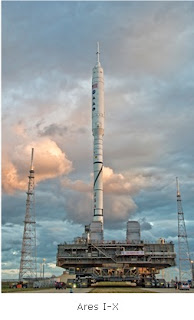
ARES I-X, A LAUNCH SYSTEM FOR HUMAN SPACEFLIGHT

Today, The Grandma has received the wonderful visit of one of her closest friends, Joseph de Ca'th Lon. Joseph loves Science, and they have been talking about Ares I-X, the NASA's prototype that was launched on a day like today in 2009.

Ares I-X was the first-stage prototype and design concept demonstrator of Ares I, a launch system for human spaceflight developed by the National Aeronautics and Space Administration (NASA).

Ares I-X was successfully launched on October 28, 2009. The project cost was $445 million.

The Ares I-X vehicle consisted of a functional four-segment solid rocket booster (SRB) stage, a fifth segment mass simulator, an upper-stage simulator (USS), which was similar in shape and heavier than the actual upper stage, as well as a simulated Orion crew module (CM) and launch abort system (LAS).

Since the actual upper-stage hardware could not be produced in time for the flight test, the upper-stage mass simulator allowed the booster to fly approximately the same trajectory through the first stage of flight. The USS and the CM/LAS mass simulators launched by the Ares I-X were not recovered and fell into the Atlantic Ocean. The first stage, including the fifth segment mass simulator, was recovered to retrieve flight data recorders and reusable equipment.

The Ares I-X vehicle used in the test flight was similar in shape, mass, and size to the planned configuration of later Ares I vehicles, but had largely dissimilar internal hardware, consisting of only one powered stage.

Ares I vehicles were intended to launch Orion crew exploration vehicles. Along with the Ares V launch system and the Altair lunar lander, Ares I and Orion were part of NASA's Constellation program, which was developing spacecraft for U.S. human spaceflight after the Space Shuttle retirement.

More information: Space Center

Ares I-X was the only test flight of a launch vehicle like the Ares I. The test flight objectives included:

-Demonstrating control of a dynamically similar vehicle using control algorithms similar to those used for Ares I.

-Performing an in-flight separation/staging event between an Ares I-similar First Stage and a representative Upper Stage.

-Demonstrating assembly and recovery of an Ares I-like First Stage at Kennedy Space Center (KSC).

-Demonstrating First Stage separation sequencing, and measuring First Stage atmospheric entry dynamics, and parachute performance.

-Characterizing the magnitude of integrated vehicle roll torque throughout First Stage flight.

The flight also had several secondary objectives, including:

-Quantifying the effectiveness of the first-stage booster deceleration motors.

-Characterizing induced environments and loads on the vehicle during ascent.

-Demonstrating a procedure for determining the vehicle's position to orient the flight control system.

-Characterize induced loads on the Flight Test Vehicle while on the launch pad.

-Assess potential Ares I access locations in the VAB and on the Pad.

-Assess First Stage electrical umbilical performance.

More information: NASA

The Ares I-X flight profile closely approximated the flight conditions that the Ares I would expect to experience through Mach 4.5, at an altitude of about 39,600 m and through a maximum dynamic pressure, Max Q, of approximately 38 kPa.

The Ares I-X flight profile resembled the uncrewed Saturn I flights of the 1960s, which tested the Saturn propulsion concept.

By flying the vehicle through first-stage separation, the test flight also verified the performance and dynamics of the Ares I solid rocket booster in a single stick arrangement, which is different from the solid rocket booster's then-current double-booster configuration alongside the external tank on the space shuttle.

Ares I-X had been scheduled for launch on October 27, 2009, the 48th anniversary of the first Saturn I launch. The launch attempt was delayed due to weather plus other last-minute concerns.

The ground crew experienced difficulty removing a protective cover from an important nose-mounted five-port sensor package.

A private watercraft had blundered into the restricted downrange safety zone and had to be chased away. Launching through the day's high cirrus clouds could have caused triboelectrification, potentially interfering with range safety communication and hampering the RSO's ability to issue the self-destruction command. Launch Director Ed Mango repeatedly delayed resumption of the countdown from the planned hold point at T-00:04:00.

Ultimately, constraints of the 4-hour launch window, coupled with high clouds and other last-minute concerns, caused the mission to be scrubbed for the day at 15:20 UTC on October 27, 2009. Launch was rescheduled for a four-hour window opening at 12:00 UTC on October 28, 2009.

Ares I-X launched on October 28, 2009 at 11:30 EDT (15:30 UTC) from Kennedy Space Center LC-39B, successfully completing a brief test flight. The vehicle's first stage ignited at T-0 seconds and Ares I-X lifted off from Launch Complex 39B.

The first stage separated from the upper-stage simulator and parachuted into the Atlantic Ocean roughly 240 km downrange of the launch site. The maximum altitude of the rocket was not immediately known, but had been expected to be 45 km.

The launch accomplished all primary test objectives, and many lessons were learned in preparing and launching a new vehicle from Kennedy Space Center.

More information: Space


 When you launch in a rocket,
you're not really flying that rocket.
You're just sort of hanging on.

Michael P. Anderson

Sunday, 11 April 2021

APOLLO 13 IS LAUNCHED, 'HOUSTON WE HAVE A PROBLEM'

Today, The Grandma has received the wonderful visit of one of her greatest friends, Joseph de Ca'th Lon.

Joseph likes Science, and they have been talking about Apollo 13, the seventh crewed mission in the Apollo space program and the third meant to land on the Moon well-known by the famous sentence Houston, we have a problem, that was launched on a day like today in 1970.

Apollo 13 was the seventh crewed mission in the Apollo space program and the third meant to land on the Moon.

The craft was launched from Kennedy Space Center on April 11, 1970, but the lunar landing was aborted after an oxygen tank in the service module (SM) failed two days into the mission.

The crew instead looped around the Moon, and returned safely to Earth on April 17. The mission was commanded by Jim Lovell with Jack Swigert as command module (CM) pilot and Fred Haise as Apollo Lunar Module (LM) pilot. Swigert was a late replacement for Ken Mattingly, who was grounded after exposure to rubella.

A routine stir of an oxygen tank ignited damaged wire insulation inside it, causing an explosion that vented the contents of both of the SM's oxygen tanks to space. Without oxygen, needed for breathing and for generating electric power, the SM's propulsion and life support systems could not operate. The CM's systems had to be shut down to conserve its remaining resources for reentry, forcing the crew to transfer to the LM as a lifeboat. With the lunar landing canceled, mission controllers worked to bring the crew home alive.

Although the LM was designed to support two men on the lunar surface for two days, Mission Control in Houston improvised new procedures, so it could support three men for four days. The crew experienced great hardship caused by limited power, a chilly and wet cabin and a shortage of potable water. There was a critical need to adapt the CM's cartridges for the carbon dioxide scrubber system to work in the LM; the crew and mission controllers were successful in improvising a solution. The astronauts' peril briefly renewed public interest in the Apollo program; tens of millions watched the splashdown in the South Pacific Ocean on television.

More information: NASA

An investigative review board found fault with preflight testing of the oxygen tank and the fact that Teflon was placed inside it. The board recommended changes, including minimizing the use of potentially combustible items inside the tank; this was done for Apollo 14.

The story of Apollo 13 has been dramatized several times, most notably in the 1995 film Apollo 13 -based on the 1994 memoir co-authored by Lovell Lost Moon- and an episode of the 1998 miniseries From the Earth to the Moon.

In 1961, U.S. President John F. Kennedy challenged his nation to land an astronaut on the Moon by the end of the decade, with a safe return to Earth. 

NASA worked towards this goal incrementally, sending astronauts into space during Project Mercury and Project Gemini, leading up to the Apollo program.

The goal was achieved with Apollo 11, which landed on the Moon on July 20, 1969. Neil Armstrong and Buzz Aldrin walked on the lunar surface while Michael Collins orbited the Moon in Command Module Columbia. The mission returned to Earth on July 24, 1969, fulfilling Kennedy's challenge.

NASA had contracted for fifteen Saturn V rockets to achieve the goal; at the time no one knew how many missions this would require. Since success was obtained in 1969 with the sixth Saturn V on Apollo 11, nine rockets remained available for a hoped-for total of ten landings.

After the excitement of Apollo 11, the general public grew apathetic towards the space program and Congress continued to cut NASA's budget; Apollo 20 was canceled. Despite the successful lunar landing, the missions were considered so risky that astronauts could not afford life insurance to provide for their families if they died in space.

More information: Smithsonian National Air and Space Museum

The Apollo 13 mission insignia depicts the Greek god of the Sun, Apollo, with three horses pulling his chariot across the face of the Moon, and the Earth seen in the distance.

This is meant to symbolize the Apollo flights bringing the light of knowledge to all people. The mission motto, Ex luna, scientia, appears. In choosing it, Lovell adapted the motto of his alma mater, the Naval Academy, Ex scientia, tridens.

On the patch, the mission number appeared in Roman numerals as Apollo XIII. It did not have to be modified after Swigert replaced Mattingly as it is one of only two Apollo mission insignia -the other being Apollo 11- not to include the names of the crew.

The Saturn V rocket used to carry Apollo 13 to the Moon was numbered SA-508, and was almost identical to those used on Apollo 8 through 12

Including the spacecraft, the rocket weighed in at 2,949,136 kilograms. The S-IC stage's engines were rated to generate 440,000 newtons less total thrust than Apollo 12's, though they remained within specifications. Extra propellant was carried as a test since future J missions to the Moon would require more propellant for their heavier payloads. This made the vehicle the heaviest yet flown by NASA and Apollo 13 was visibly slower to clear the launch tower than earlier missions.

The Apollo 13 spacecraft consisted of Command Module 109 and Service Module 109 (together CSM-109), called Odyssey, and Lunar Module 7 (LM-7), called Aquarius. Also considered part of the spacecraft was the launch escape system which would propel the command module (CM) to safety in the event of a problem during liftoff, and the Spacecraft–LM Adapter, numbered as SLA-16, which housed the lunar module (LM) during the first hours of the mission.

The mission was launched at the planned time, 2:13:00 pm EST (19:13:00 UTC) on April 11.

An anomaly occurred when the second-stage, center (inboard) engine shut down about two minutes early. This was caused by severe pogo oscillations. Starting with Apollo 10, the vehicle's guidance system was designed to shut the engine down in response to chamber pressure excursions.

More information: Planetary


For some time, I thought Apollo 13 was a failure.
I was disappointed I didn't get to land on the moon.
But actually, it turned out to be the best thing
that could have happened.

Jim Lovell

Wednesday, 24 July 2019

1950, CAPE CANAVERAL STATION BEGINS OPERATIONS

First Launch from Cape Canaveral
Today, The Grandma has received the wonderful visit of her closer friend Joseph de Ca'th Lon who is a fan of History, Science and Astronomy.

They have been talking about Cape Canaveral, the American Air Force Station that began operations on a day like today in 1950.

Before the arrival of Joseph de Ca'th Lon, The Grandma has studied her interesting course of Ms. Excel.

Chapter 7. Cell Format (I) (Spanish Version)

Cape Canaveral Air Force Station (CCAFS), known as Cape Kennedy Air Force Station from 1963 to 1973, is an installation of the United States Air Force Space Command's 45th Space Wing.

CCAFS is headquartered at the nearby Patrick Air Force Base, and located on Cape Canaveral in Brevard County, Florida, CCAFS. The station is the primary launch head of America's Eastern Range with three launch pads currently active, Space Launch Complexes 37B, 40, and 41.

Popularly known as Cape Kennedy from 1963 to 1973, and as Cape Canaveral from 1949 to 1963 and from 1973 to the present, the facility is south-southeast of NASA's Kennedy Space Center on adjacent Merritt Island, with the two linked by bridges and causeways. The Cape Canaveral Air Force Station Skid Strip provides 3,000 m runway close to the launch complexes for military airlift aircraft delivering heavy and outsized payloads to the Cape.

More information: Kennedy Space Center

A number of American space exploration pioneers were launched from CCAFS, including the first U.S. Earth satellite in 1958, first U.S. astronaut (1961), first U.S. astronaut in orbit (1962), first two-man U.S. spacecraft (1965), first U.S. unmanned lunar landing (1966), and first three-man U.S. spacecraft (1968). It was also the launch site for all of the first spacecraft to, separately, fly past each of the planets in the Solar System (1962–1977), the first spacecraft to orbit Mars (1971) and roam its surface (1996), the first American spacecraft to orbit and land on Venus (1978), the first spacecraft to orbit Saturn (2004), and to orbit Mercury (2011), and the first spacecraft to leave the Solar System (1977). Portions of the base have been designated a National Historic Landmark for their association with the early years of the American space program.

The CCAFS area had been used by the United States government to test missiles since 1949, when President Harry S. Truman established the Joint Long Range Proving Ground at Cape Canaveral.

The location was among the best in the continental United States for this purpose, as it allowed for launches out over the Atlantic Ocean, and is closer to the equator than most other parts of the United States, allowing rockets to get a boost from the Earth's rotation. 

Cape Canaveral, 1959
On June 1, 1948, the United States Navy transferred the former Banana River Naval Air Station to the United States Air Force, with the Air Force renaming the facility the Joint Long Range Proving Ground (JLRPG) Base on June 10, 1949.

On October 1, 1949, the Joint Long Range Proving Ground Base was transferred from the Air Materiel Command to the Air Force Division of the Joint Long Range Proving Ground.

On May 17, 1950, the base was renamed the Long Range Proving Ground Base but three months later was renamed Patrick Air Force Base, in honor of Army Maj. Gen. Mason Patrick. In 1951, the Air Force established the Air Force Missile Test Center.

Early American sub-orbital rocket flights were achieved at Cape Canaveral in 1956. These flights occurred shortly after sub-orbital flights launched from White Sands Missile Range, such as the Viking 12 sounding rocket on February 4, 1955. Following the Soviet Union's successful Sputnik 1, launched on October 4, 1957, the United States attempted its first launch of an artificial satellite from Cape Canaveral on December 6, 1957. However, the rocket carrying Vanguard TV3 exploded on the launch pad.

NASA was founded in 1958, and Air Force crews launched missiles for NASA from the Cape, known then as Cape Canaveral Missile Annex. Redstone, Jupiter, Pershing 1, Pershing 1a, Pershing II, Polaris, Thor, Atlas, Titan and Minuteman missiles were all tested from the site, the Thor becoming the basis for the expendable launch vehicle (ELV) Delta rocket, which launched Telstar 1 in July 1962. The row of Titan (LC-15, 16, 19, 20) and Atlas (LC-11, 12, 13, 14) launch pads along the coast came to be known as Missile Row in the 1960s.

More information: City of Cape Canaveral

Of the launch complexes built since 1950, several have been leased and modified for use by private aerospace companies. Launch Complex SLC-17 was used for the Delta II Heavy variant, through 2011. Launch Complexes SLC-37 and SLC-41 were modified to launch EELV Delta IV and Atlas V launch vehicles, respectively. These launch vehicles replaced all earlier Delta, Atlas, and Titan rockets. Launch Complex SLC-47 is used to launch weather sounding rockets. Launch Complex SLC-46 is reserved for use by Space Florida.

Launch Complex SLC-40 hosted the first launch of the SpaceX Falcon 9 in June 2010. Falcon 9 launches continued from this complex through 2015, consisting of unmanned Commercial Resupply Services missions for NASA to the International Space Station as well as commercial satellite flights.

SpaceX has also leased Launch Complex 39A from NASA and has completed modifying it to accommodate Falcon Heavy and Commercial Crew manned spaceflights to the ISS with their Crew Dragon spacecraft in 2018 or 2019. SpaceX Landing Zone 1 and 2, used to land first stages of the Falcon 9 and the side boosters of the Falcon Heavy, are located at the site of the former LC-13.

On September 16, 2015, NASA announced that Blue Origin has leased Launch Complex 36 and will modify it as a launch site for their next-generation launch vehicles.

In the case of low-inclination, geostationary, launches the location of the area at 28°27'N put it at a slight disadvantage against other launch facilities situated nearer the equator. The boost eastward from the Earth's rotation is about 406 m/s at Cape Canaveral, but 463 m/s at the European Guiana Space Centre in French Guiana.

In the case of high-inclination polar launches, the latitude does not matter, but the Cape Canaveral area is not suitable, because inhabited areas underlie these trajectories; Vandenberg Air Force Base, Cape Canaveral's West coast counterpart, or the smaller Kodiak Launch Complex in Alaska are used instead.

The Air Force Space and Missile Museum is located at LC-26. Hangar AE, located in the CCAFS Industrial Area, collects telemetry from launches all over the United States.

NASA's Launch Services Program has three Launch Vehicle Data Centers (LVDC) within that display telemetry real-time for engineers.

More information: NASA


We choose to go to the moon.

John F. Kennedy

Monday, 29 January 2018

CAPE CANAVERAL: EXPLORING THE SPACE FROM FLORIDA

Natalia Bean at Kennedy Space Center
Today, The Beans have visited Cape Canaveral in Florida. After leaving Washington D.C., the family has travelled to the south to visit this important place, headquarter of the Kennedy Space Center.  

Natalia Bean, who is the astronaut of the family, has enjoyed this trip especially and she has been talking to her family about the importance of the occupational hazards in this difficult profession where they have to do some routines and activities to be ready to drive into space.

Cape Canaveral, from the Spanish Cabo Cañaveral, is a cape in Brevard County, Florida, near the center of the state's Atlantic coast. Known as Cape Kennedy from 1963 to 1973, it lies east of Merritt Island, separated from it by the Banana River. It was discovered by the Spanish conquistador Juan Ponce de León in 1513.

It is part of a region known as the Space Coast, and is the site of the Cape Canaveral Air Force Station. Since many U.S. spacecraft have been launched from both the station and the Kennedy Space Center on adjacent Merritt Island, the two are sometimes conflated with each other. In homage to its spacefaring heritage, the Florida Public Service Commission allocated area code 321, as in a launch countdown, to the Cape Canaveral area.


The Beans visit the Kennedy Space Center
Other features of the cape include the Cape Canaveral lighthouse and Port Canaveral, one of the busiest cruise ports in the world. 

The city of Cape Canaveral lies just south of the Port Canaveral District. 

Mosquito Lagoon, the Indian River, Merritt Island National Wildlife Refuge and Canaveral National Seashore are also features of this area.

Cape Canaveral became the test site for missiles when the legislation for the Joint Long Range Proving Ground was passed by the 81st Congress and signed by President Harry Truman on May 11, 1949. Work began on May 9, 1950, under a contract with the Duval Engineering Company of Jacksonville, Florida, to build the Cape's first paved access road and its first permanent launch site.

More information: Kennedy Space Center

The first rocket launched at the Cape was a V-2 rocket named Bumper 8 from Launch Complex 3 on July 24, 1950. On February 6, 1959, the first successful test firing of a Titan intercontinental ballistic missile was accomplished. NASA's Project Mercury and Gemini space flights were launched from Cape Canaveral, as were Apollo flights using the Saturn I and Saturn IB rockets.

Cape Canaveral was chosen for rocket launches to take advantage of the Earth's rotation. The linear velocity of the Earth's surface is greatest towards the equator; the relatively southerly location of the cape allows rockets to take advantage of this by launching eastward, in the same direction as the Earth's rotation.


More information: NASA

An astronaut in a space mission
It is also highly desirable to have the downrange area sparsely populated, in case of accidents; an ocean is ideal for this. The east coast of Florida has logistical advantages over potential competing sites. The Spaceport Florida Launch Complex 46 of the Cape Canaveral Air Force Station is the easternmost near the tip of the cape.

From 1963 to 1973, the area had a different name when President Lyndon Johnson by executive order renamed the area Cape Kennedy after President John F. Kennedy, who had set the goal of landing on the moon. After Kennedy's assassination in November 1963, his widow, Jacqueline Kennedy, suggested to President Johnson that renaming the Cape Canaveral facility would be an appropriate memorial. Johnson recommended the renaming of the entire cape, announced in a televised address six days after the assassination, on Thanksgiving evening.

More information: Space Coast Launches

Accordingly, Cape Canaveral was officially renamed Cape Kennedy. Kennedy's last visit to the space facility was on November 16, six days before his death; the final Mercury mission had concluded six months earlier.


Science has not yet mastered prophecy. We predict too much for the next year and yet far too little for the next 10. 

Neil Armstrong

Saturday, 5 August 2017

NEIL ALDEN ARMSTRONG: A SUCCESSFUL LIFE IN SPACE

Neil Alden Armstrong
Joseph de Ca'th Lon is in Florida, where he's visiting the Kennedy Space Center in Titusville and Cape Canaveral. Joseph, who is a person very interested in science, wants to talk us about one of the most important astronauts around the world: Neil Armstrong, the man who  took the first step onto the Moon.

Neil Alden Armstrong (August 5, 1930-August 25, 2012) was an American astronaut, engineer, and the first person to walk on the Moon. He was also an aerospace engineer, naval aviator, test pilot, and university professor. 

Before becoming an astronaut, Armstrong was an officer in the U.S. Navy and served in the Korean War. After the war, he earned his bachelor's degree at Purdue University and served as a test pilot at the National Advisory Committee for Aeronautics (NACA) High-Speed Flight Station, where he logged over 900 flights. He later completed graduate studies at the University of Southern California.

More information: NASA

A participant in the U.S. Air Force's Man in Space Soonest and X-20 Dyna-Soar human spaceflight programs, Armstrong joined the NASA Astronaut Corps in 1962. He made his first space flight as command pilot of Gemini 8 in March 1966, becoming NASA's first civilian astronaut to fly in space. He performed the first docking of two spacecraft, with pilot David Scott. This mission was aborted after Armstrong used some of his reentry control fuel to prevent a dangerous spin caused by a stuck thruster, in the first in-flight space emergency.


More information: Kennedy Space Center

Joseph de Ca'th Lon in Cape Canaveral
Armstrong's second and last spaceflight was as commander of Apollo 11, the first manned Moon landing mission in July 1969. 

Armstrong and Lunar Module pilot Buzz Aldrin descended to the lunar surface and spent two and a half hours outside the spacecraft, while Michael Collins remained in lunar orbit in the Command/Service Module. 

Along with Collins and Aldrin, Armstrong was awarded the Presidential Medal of Freedom by President Richard Nixon. President Jimmy Carter presented Armstrong the Congressional Space Medal of Honor in 1978. Armstrong and his former crewmates received the Congressional Gold Medal in 2009.

Armstrong died in Cincinnati, Ohio on August 25, 2012, at the age of 82, after complications from coronary artery bypass surgery.


Mystery creates wonder and wonder is the basis of man's desire to understand. 

Neil Armstrong

Friday, 21 July 2017

JULY, 21 1969: APOLLO 11, MAN WALKS ON THE MOON

Apollo 11 Command Module
Apollo 11 was the spaceflight that landed the first two humans on the Moon. Mission commander Neil Armstrong and pilot Buzz Aldrin, both American, landed the lunar module Eagle on July 20, 1969, at 20:18 UTC.  

Armstrong became the first to step onto the lunar surface six hours later on July 21 at 02:56:15 UTC; Aldrin joined him about 20 minutes later. They spent about two and a quarter hours together outside the spacecraft, and collected 21.5 kg of lunar material to bring back to Earth. Michael Collins piloted the command module Columbia alone in lunar orbit while they were on the Moon's surface. Armstrong and Aldrin spent just under a day on the lunar surface before rendezvousing with Columbia in lunar orbit.

More information: NASA

Apollo 11 was launched by a Saturn V rocket from Kennedy Space Center in Merritt Island, Florida, on July 16, and was the fifth manned mission of NASA's Apollo program. The Apollo spacecraft had three parts: a command module with a cabin for the three astronauts, and the only part that landed back on Earth; a service module, which supported the command module with propulsion, electrical power, oxygen, and water; and a lunar module that had two stages, a lower stage for landing on the Moon, and an upper stage to place the astronauts back into lunar orbit. 

More information: NASA

Aldrin bootprint on the Moon
After being sent toward the Moon by the Saturn V's upper stage, the astronauts separated the spacecraft from it and traveled for three days until they entered into lunar orbit. Armstrong and Aldrin then moved into the lunar module Eagle and landed in the Sea of Tranquility

They stayed a total of about 21.5 hours on the lunar surface. The astronauts used Eagle's upper stage to lift off from the lunar surface and rejoin Collins in the command module. 

They jettisoned Eagle before they performed the maneuvers that blasted them out of lunar orbit on a trajectory back to Earth. They returned to Earth and landed in the Pacific Ocean on July 24.

More information: NASA

Broadcast on live TV to a worldwide audience, Armstrong stepped onto the lunar surface and described the event as one small step for [a] man, one giant leap for mankind. Apollo 11 effectively ended the Space Race and fulfilled a national goal proposed in 1961 by U.S. President John F. Kennedy: before this decade is out, of landing a man on the Moon and returning him safely to the Earth.


Here men from the planet Earth first set foot upon the Moon. 
July 1969 AD. We came in peace for all mankind. 

Neil Armstrong