Showing posts with label Jamaica. Show all posts

Monday, 11 October 2021

THE MORANT BAY REBELLION, THE JAMAICAN UPRISING

Today is Columbus Day in most places of the American continent. It is urgent that we stop commemorating genocides, and we start to honour Native American peoples, who suffered the actions and effects of colonialism and slavery.

The Grandma has been reading about the Morant Bay Rebellion, a protest march in Jamaica that meant the end of slavery in this country, on a day like today in 1865.

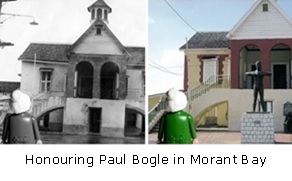
The Morant Bay Rebellion (11 October 1865) began with a protest march to the courthouse by hundreds of people led by preacher Paul Bogle in Morant Bay, Jamaica.

Some were armed with sticks and stones. After seven men were shot and killed by the volunteer militia, the protesters attacked and burned the courthouse and nearby buildings. A total of 25 people died. Over the next two days, poor freedmen, many ex-slaves, rose in rebellion across most of St. Thomas-in-the-East parish.

The Jamaicans were protesting injustice and widespread poverty. Most freedmen were prevented from voting by high poll taxes, and their living conditions had worsened following crop damage by floods, cholera and smallpox epidemics, and a long drought. A few days before the march, when police tried to arrest a man for disrupting a trial, a fight broke out against them by spectators. Officials then issued a warrant for the arrest of preacher Bogle, who had called for reforms, and was charged with inciting to riot.

Governor Edward John Eyre declared martial law in the area, ordering in troops to hunt down the rebels. They killed many innocent black individuals, including women and children, with an initial death toll of more than 400. Troops arrested more than 300 persons, including Bogle. Many of these were also innocent, but were quickly tried and executed under martial law; both men and women were punished by whipping and long sentences.

This was the most severe suppression of unrest in the history of the British West Indies.

More information: Medium

The governor had George William Gordon, a mixed-race representative of the parish in the House of Assembly, arrested in Kingston and brought back to Morant Bay, where he tried the politician under martial law. Gordon was quickly convicted and executed.

The violent suppression and numerous executions generated a fierce debate in England, with some protesting about the unconstitutional actions of the governor John Eyre, and others praising him for his response to a crisis. The rebellion and its suppression remain controversial, and it is frequently debated by specialists in black and colonial studies.

Slavery in Jamaica was abolished on 1 August 1834 with the passage of the Slavery Abolition Act. 

The act also stipulated that all formerly enslaved persons in Jamaica over the age of six would work as apprentices for a period of four to six years for their former enslavers, though British abolitionists protested against the apprenticeship system, and it was fully abolished by 1 August 1838.

This date marked the start of Jamaicans formerly in the apprenticeship system being allowed to choose their employer and profession; though they also gained the right to vote, most Jamaicans could not afford to pay the poll tax required to participate in Jamaica's political system. The poll tax was introduced by the colonial government to disfranchise the majority of emancipated Jamaicans, being fearful of causing an anti-colonial uprising (such as the Haitian Revolution) if they granted too much political power.

More information: Branch

A few days later on 11 October, Paul Bogle with hundreds of Jamaican peasant-labourers, again marched to Morant Bay. The marchers had taken oaths, to cleave to the black and leave the white, a sign that they were preparing for insurrection, or so Gad Heuman argues, indicating that oath taking in African tradition was a way to bring the group together and prepare for war.

When the group arrived at the courthouse in Morant Bay, they were met by local officials and a small and inexperienced volunteer militia, gathered from personnel from the plantations. The crowd began pelting the militia with rocks and sticks, and the militia opened fire on the protesters. This angered the crowd, who reacted violently, burning the courthouse and nearby buildings.
More than 25 people were killed on both sides, before the militia retreated. For the next two days, the mass of rebellious black peasants took over the parish of St. Thomas-in-the-East. 

In response, Governor John Eyre sent government troops, under Brigadier-General Alexander Nelson, to hunt down the poorly armed rebels and bring Bogle back to Morant Bay for trial. The troops met with no organized resistance, but they killed blacks indiscriminately, most of whom had not been involved in either the riot at the courthouse or the later rebellion. Heuman has described it as a reign of terror.

The Jamaican Maroons of Moore Town, under the command of former Charles Town superintendent Alexander Fyfe, committed a number of atrocities and extrajudicial murders before they captured and arrested Bogle, and delivered him to the colonial authorities.

Believing that the blacks could not have planned such events themselves, as he shared the widespread white assumption of the time that they were not capable of it, Governor John Eyre had representative George William Gordon arrested. The mixed-race Jamaican businessman and politician was wealthy and well-known; he was openly critical of the governor and his policies. Eyre believed that Gordon had been behind the rebellion. Despite having very little to do with it, Gordon was quickly convicted and executed. Though he was arrested in Kingston, where martial law had not been declared, Eyre had him transferred to Morant Bay, where he could be tried under martial law.

The trial and execution of Gordon via martial law, following the excesses of suppressing the rebellion, added to the outrage felt by many in Britain. 

They felt there were serious constitutional issues by Eyre's bringing Gordon under martial law. They were concerned about whether British dependencies should be ruled under the government of law, or through military licence. With a speedy trial, Gordon was convicted quickly and hanged on 23 October, just two days after his trial had begun.

More information: The Voice

On 25 October, Paul Bogle was hanged alongside 14 others, including his brother Moses.

Other punishments included flogging of more than 600 men and women, including some pregnant women, and long prison sentences.

The soldiers burned thousands of homes belonging to black Jamaicans without any justifiable reason, leaving families homeless throughout the parish. This was the most severe suppression of unrest in the history of the British West Indies, exceeding incidents during slavery years.

Eyre was replaced as governor by John Peter Grant who arrived in August 1866.

Since the 1830s free people of colour, like Gordon, Edward Jordon, and Robert Osborn, had been elected to the Jamaican House of Assembly in increasing numbers, and that alarmed the colonial authorities. In the wake of the Morant Bay Rebellion, Eyre, with the support of the Colonial Office, persuaded the Assembly to renounce its charter, thus ending two centuries of elected representation in the Colony of Jamaica.

White planters were appointed by the governor. However, this move deprived the black majority of a voice in the colony's government, and it was condemned by Jordon and Osborn.

Jamaica became a Crown Colony, under direct rule from London.

In 1969, Paul Bogle and George William Gordon were among several men who were named as Jamaican National Heroes, the highest honour in the nation.

More information: National Library of Jamaica

Jamaica is more than just the 'brand' the world recognizes so well;
it's a place of pride for the people who live here,
its educational institutions, its sports achievements,
its science and technology growth.

Portia Simpson-Miller

Monday, 23 September 2019

BOB MARLEY, JAMAICAN REGGAE & RASTAFARIANISM

Bob Marley
Today, The Grandma has gone to the library to borrow Les Elegies de Bierville, a wonderful compilation of poems written by the Catalan writter Carles Riba during his exile in Montpellier, Occitania.

The Grandma has wanted to remember Riba, who was born on a day like today in 1893, rereading this work that is a masterpiece and a must.

After borrowing the book, The Grandma has gone to the music section to search some works of Bob Marley, the Jamaican singer and songwriter who offered his last concert in Pittsburgh, Pennsylvania, on a day like today in 1980. Marley was an icon in music but also a great defender of African countries and culture.

Robert Nesta Marley (6 February 1945-11 May 1981) was a Jamaican singer and songwriter. Considered one of the pioneers of reggae, his musical career was marked by blending elements of reggae, ska, and rocksteady, as well as forging a smooth and distinctive vocal and songwriting style. Marley's contributions to music increased the visibility of Jamaican music worldwide, and made him a global figure in popular culture for over a decade.

Born in Nine Mile, British Jamaica, Marley began his professional musical career in 1963, after forming Bob Marley and the Wailers. The group released its debut studio album The Wailing Wailers in 1965, which contained the single One Love/People Get Ready; the song was immensely popular, peaking in the top five on worldwide music charts, and established the group as a rising figure in reggae.

More information: Bob Marley

The Wailers subsequently released eleven further studio albums; while initially employing louder instrumentation and singing, the group began engaging in rhythmic-based song construction in the late 1960s and early 1970s, which coincided with the singer's conversion to Rastafarianism. During this period Marley relocated to London, and the group typified their musical shift with the release of the album The Best of The Wailers (1971).

The group attained international success after the release of the albums Catch a Fire and Burnin' (both 1973), and forged a reputation as touring artists. A year later the Wailers disbanded, and Marley went on to release his solo material under the band's name.

Bob Marley
His debut studio album Natty Dread (1974) received positive reception, as did its follow-up Rastaman Vibration (1976). A few months after the album's release Marley survived an assassination attempt at his home in Jamaica, which prompted him to permanently relocate to London soon afterward. There he recorded the album Exodus (1977); it incorporated elements of blues, soul, and British rock, enjoyed widespread commercial success, and is widely considered one of the best albums of all time.

Over the course of his career Marley became known as a Rastafari icon, and the singer sought to infuse his music with a sense of spirituality. He is also considered a global symbol of Jamaican culture and identity, and was controversial in his outspoken support for the legalization of marijuana, while he also advocated for Pan-Africanism.

In 1977, Marley was diagnosed with acral lentiginous melanoma; he died as a result of the illness in 1981. His fans around the world expressed their grief, and he received a state funeral in Jamaica. The greatest hits album Legend was released in 1984, and subsequently became the best-selling reggae album of all-time. Marley also ranks as one of the best-selling music artists of all-time, with estimated sales of more than 75 million records worldwide, while his sound and style have influenced artists of various genres. He was posthumously honored by Jamaica soon after his death, as he was designated the nation's Order of Merit award.

More information: Bob Marley Foundation

Bob Marley was born on 6 February 1945 at the farm of his maternal grandfather in Nine Mile, Saint Ann Parish, Jamaica, to Norval Sinclair Marley and Cedella Booker. Norval Marley was a white Jamaican originally from Sussex, who claimed to have been a captain in the Royal Marines; at the time of his marriage to Cedella Booker, an Afro-Jamaican then 18 years old, he was employed as a plantation overseer.

Bob Marley's full name is Robert Nesta Marley, though some sources give his birth name as Nesta Robert Marley, with a story that when Marley was still a boy a Jamaican passport official reversed his first and middle names because Nesta sounded like a girl's name. Norval provided financial support for his wife and child but seldom saw them as he was often away. Bob Marley attended Stepney Primary and Junior High School which serves the catchment area of Saint Ann. In 1955, when Bob Marley was 10 years old, his father died of a heart attack at the age of 70. Marley's mother went on to marry Edward Booker, a civil servant from the United States, giving Marley two half-brothers: Richard and Anthony.

Bob Marley
In February 1962, Marley recorded four songs, Judge Not, One Cup of Coffee, Do You Still Love Me? and Terror, at Federal Studios for local music producer Leslie Kong. Three of the songs were released on Beverley's with One Cup of Coffee being released under the pseudonym Bobby Martell.

In 1963, Bob Marley, Bunny Wailer, Peter Tosh, Junior Braithwaite, Beverley Kelso, and Cherry Smith were called the Teenagers. They later changed the name to the Wailing Rudeboys, then to the Wailing Wailers, at which point they were discovered by record producer Coxsone Dodd, and finally to the Wailers.

In 1966, Marley married Rita Anderson, and moved near his mother's residence in Wilmington, Delaware in the United States for a short time, during which he worked as a DuPont lab assistant and on the assembly line at a Chrysler plant in nearby Newark, under the alias Donald Marley.

Though raised as a Catholic, Marley became interested in Rastafari beliefs in the 1960s, when away from his mother's influence. After returning to Jamaica, Marley formally converted to Rastafari and began to grow dreadlocks.

More information: Bob Marley Museum

In 1972, Bob Marley signed with CBS Records in London and embarked on a UK tour with soul singer Johnny Nash.

The Wailers disbanded in 1974, with each of the three main members pursuing a solo career.

In 1975, Marley had his international breakthrough with his first hit outside Jamaica, No Woman, No Cry, from the Natty Dread album. This was followed by his breakthrough album in the United States, Rastaman Vibration (1976), which reached the Top 50 of the Billboard Soul Charts.

Marley left Jamaica at the end of 1976, and after a month-long recovery and writing sojourn at the site of Chris Blackwell's Compass Point Studios in Nassau, Bahamas, arrived in England, where he spent two years in self-imposed exile.

Bob Marley
Whilst in England, he recorded the albums Exodus and Kaya. Exodus stayed on the British album charts for 56 consecutive weeks. It included four UK hit singles: Exodus, Waiting in Vain, Jamming, and One Love (a rendition of Curtis Mayfield's hit, People Get Ready). During his time in London, he was arrested and received a conviction for possession of a small quantity of cannabis.

Survival, a defiant and politically charged album, was released in 1979. Tracks such as Zimbabwe, Africa Unite, Wake Up and Live, and Survival reflected Marley's support for the struggles of Africans.

In July 1977, Marley was found to have a type of malignant melanoma under the nail of a toe.

The album Uprising was released in May 1980. The band completed a major tour of Europe, where it played its biggest concert to 100,000 people in Milan. After the tour, Marley went to the United States, where he performed two shows at Madison Square Garden in New York City as part of the Uprising Tour.

Marley's last concert occurred at the Stanley Theater, now called The Benedum Center For The Performing Arts, in Pittsburgh, Pennsylvania, on 23 September 1980. Just two days earlier he had collapsed during a jogging tour in Central Park and was brought to the hospital where he learned that his cancer had spread to his brain.

More information: The New Yorker

While Marley was flying home from Germany to Jamaica, his vital functions worsened. After landing in Miami, Florida, he was taken to the hospital for immediate medical attention.

Marley died on 11 May 1981 at Cedars of Lebanon Hospital in Miami, now University of Miami Hospital, aged 36. The spread of melanoma to his lungs and brain caused his death. His final words to his son Ziggy were Money can't buy life.

Marley was a Pan-Africanist and believed in the unity of African people worldwide.

His beliefs were rooted in his Rastafari religious beliefs. He was substantially inspired by Marcus Garvey, and had anti-imperialist and pan-Africanist themes in many of his songs, such as Zimbabwe, Exodus, Survival, Blackman Redemption, and Redemption Song.

Redemption Song draws influence from a speech given by Marcus Garvey in Nova Scotia, 1937.

Marley held that independence of African countries from European domination was a victory for all those in the African diaspora. In the song Africa Unite, he sings of a desire for all peoples of the African diaspora to come together and fight against Babylon; similarly, in the song Zimbabwe, he marks the liberation of the whole continent of Africa, and evokes calls for unity between all Africans, both within and outside Africa.

Marley considered cannabis a healing herb, a sacrament, and an aid to medication; he supported the legalisation of the drug.

More information: African News


The greatness of a man is not in how much wealth he acquires,
but in his integrity and his ability to affect those around him positively.

Bob Marley