Showing posts with label France. Show all posts

Sunday, 22 February 2026

ENJOYING NEUVILE-ASK & SIX NATIONS CHAMPIONSHIP

Today, The Grandma got up early so as not to miss the plane that took her to Brussels where Joseph de Ca'th Lon was waiting for her to drive to Neuville-Ask where they plan to attend the France-Italy Six Nations match this afternoon.

It has been an intense morning of accumulated sleep and coffees, but now they will rest a little at the hotel, write this new post, watch the first half of the FA Women's Cup match between Manchester United and Chelsea, and Joseph will give her a summary (if possible) of their stay at the Olympic Games. Then, they will go to the Stade Pierre Mauroy where they hope to experience a great rugby spectacle, possibly the most honest sport and with the fairest play in the entire sports panorama.

Joseph is a fan of Ireland and The Grandma of the U.E. Santboiana where she has great friends like Toni, Susanna, Àngels or Mima, who have made her enjoy this spectacular sport. If you like rugby, any Six Nations match should be watched, and if possible, lived.

Tomorrow they will make a quick visit to Lile before returning to Basel and Barcelona, where both must continue with their respective lives.

Neuvile-Ask is a very beautiful city, where Picard is historically spoken, with a great sporting tradition where its women's basketball team stands out, but it is also one of the headquarters of the French national rugby team when it plays in the Six Nations

Neuvile-Ask in Picard or Villeneuve-d'Ascq in French  is a commune in the Nord department in northern France. With more than 60,000 inhabitants and 50,000 students, it is one of the main cities of the Lille metropolitan area (Métropole Européenne de Lille) and the largest in area after the city of Lille itself. It is also one of the main cities of the Hauts-de-France region.

Built up owing to the merger between the former communes of Ascq, Annappes and Flers-lez-Lille, Neuvile-Ask is a new town and the cradle of the first automatic metro system in the world (VAL).

Neuvile-Ask is nicknamed the 'green technopole' thanks to the implantation of many researchers, including two campuses of the University of Lille and many graduate engineering schools, and companies in a pleasant living environment. Owing to its activity centres, its Haute Borne European scientific park and two shopping malls, Neuvile-Ask is one of the main economic spots of the Hauts-de-France region; multinational corporations such as Bonduelle, Cofidis and Decathlon have their head office there.

Outside its academic, scientific and business facilities, Neuvile-Ask is known for its sporting events, boasting two stadiums (Stade Pierre-Mauroy and Stadium Lille Métropole), some top division sports teams, its museums, its green spaces, and its facilities for disabled people.

Its name means new city of Ascq in French. Ascq is possibly derived from the Dutch word for ash. The name of the city is generally written without the customary (official) hyphen.

The city counts approximately 10 km2 of greenspace, lakes, forests and arable lands. It is located between Lille and Roubaix, at the crossroads of the principal freeways towards Paris, Ghent, Antwerp and Brussels.

Development on what is now Neuvile-Ask can be traced back to the Celtic Gaul era, and are anchored in two feudal mounds, a Gallo-Roman site and a Carolingian one.

The area was selected in the 1960s to accommodate a new town then designated the name Lille-Est, which was to channel the growth of the agglomeration of Lille city and development of institutions based in the area. The commune of Neuvile-Ask was created in 1970 by the amalgamation of the communes of Ascq, Annappes and Flers. Its name evokes at the same time the new (neuve) and the old: former commune Ascq and its memory as martyr town of 1 April 1944, date on which the Nazis massacred 86 men (Ascq massacre).

The city's merger with Lille was contentious and failed twice (1972 and 1976). The Hôtel de Ville was completed in 1977.

The Stade Pierre-Mauroy, also known as the Decathlon Arena-Stade Pierre-Mauroy for sponsorship reasons, is a multi-use retractable roof stadium in Neuvile-Ask, Metropolis of Lille, Northern France, that opened in August 2012. With a seating capacity of 50,186, it is the fourth-largest sports stadium in France and the home of French professional football club Lille.

Initially named Grand Stade Lille Métropole, the stadium was renamed on 21 June 2013, after the death of the former Mayor of Lille and former Prime Minister of France Pierre Mauroy (1928–2013).

The stadium, which hosted UEFA Euro 2016 and 2023 Rugby World Cup, can also be turned into an adjustable arena being expandable to 30,000 seats where indoor sports games and concerts take place. Therefore, multiple Davis Cup events, EuroBasket 2015 and 2024 Summer Olympics basketball and handball tournaments matches have been held in the building.

More information: Six Nations Rugby


 Rugby is a game that's constant. 
If you are not growing with it, 
you get left behind.

Owen Farrell

Saturday, 15 March 2025

WALES VS ENGLAND, THE SIX NATIONS CHAMPIONSHIP

After reading the complete Arthurian saga, The Grandma wants to visit Wales, where all the Arthurian legend began.

She has decided to visit Cardiff, the capital of Wales to assist to The Six Nations Championship in Stadiwm y Mileniwm.

Wales vs England is one of the best rugby matches that you can enjoy nowadays.

The Six Nations Championship (known as the Six Nations, branded as Guinness M6N) is an annual international rugby union competition between the teams of England, France, Ireland, Italy, Scotland and Wales

It is the oldest sports tournament contested by the Home Nations. The championship holders are Ireland, who won the 2024 tournament.

The tournament is organised by the unions of the six participating nations under the banner of Six Nations Rugby, which is responsible for the promotion and operation of the men's, women's and under-20s tournaments, and the Autumn International Series, as well as the negotiation and management of their centralised commercial rights.

The Six Nations is the successor to the Home Nations Championship (1883-1909 and 1932-39), played between teams from England, Ireland, Scotland, and Wales, which was the first international rugby union tournament. With the addition of France, this became the Five Nations Championship (1910-31 and 1947-99), which in turn became the Six Nations Championship with the addition of Italy in 2000.

England and Wales have won the championship the most times, both with 39 titles, but England have won the most outright titles with 29 (28 for Wales). Since the Six Nations era started in 2000, only Italy and Scotland have failed to win the Six Nations title.

The women's tournament started as the Women's Home Nations in the 1996 season. The men's Six Nations Under 20s Championship is the successor to the Under 21s tournament which began in 2004.

The tournament was first played in 1883 as the Home Nations Championship among the then four Home Nations of the United Kingdom -England, Ireland, Scotland, and Wales. However, England was excluded from the 1888 and 1889 tournaments due to their refusal to join the International Rugby Football Board. The tournament then became the Five Nations Championship in 1910 with the addition of France. The tournament was expanded in 2000 to become the Six Nations Championship with the addition of Italy.

Following the relative success of the Tier 2 nations in the 2015 Rugby World Cup, there were calls by Octavian Morariu, the president of Rugby Europe, to let Georgia and Romania join the Six Nations due to their consistent success in the European Nations Cup and ability to compete in the Rugby World Cup.

The tournament begins on the first weekend in February and culminates on the second or third Saturday in March. Each team plays every other team once (a total of 15 matches), with home ground advantage alternating from one year to the next. Before the 2017 tournament, two points were awarded for a win, one for a draw and none for a loss. Unlike many other rugby union competitions, a bonus point system had not previously been used.

A bonus point system was first used in the 2017 Championship. The system is similar to the one used in most rugby championships (0 points for a loss, 2 for a draw, 4 for a win, 1 for scoring four or more tries in a match, and 1 for losing by 7 points or fewer). The only difference is that a team that wins all their games (a Grand Slam) are automatically awarded 3 extra points -to ensure they cannot be overtaken by a defeated team on bonus points.

Before 1994, teams equal on match points shared the championship. Since then, ties have been broken by considering the points difference (total points scored minus total points conceded) of the teams. The rules of the championship further provide that if teams tie on both match points and points difference, the team that scored the most tries wins the championship. Were this decider to be a tie, the tying teams would share the championship. To date, however, match points and points difference have been sufficient to decide the championship.

The Wooden Spoon is a metaphorical award given to the team that finishes in last place; a team which loses all their matches is said to have been whitewashed. Since the inaugural Six Nations tournament in 2000, only England and Ireland have avoided finishing last. Italy have finished last 18 times in the Six Nations era, and have lost all their matches in 12 tournaments.

More information: Six Nations Rugby


Rugby is a game that's constant.
If you are not growing with it, you get left behind.

Owen Farrell

Tuesday, 16 July 2024

THE MONT BLANC TUNNEL, LINKING FRANCE & ITALY

Today, The Grandma has been talking about the Montblanc Tunnel that joins France and Italy, and that was opened on a day like today in 1965.

The Mont Blanc Tunnel is a highway tunnel between France and Italy, under Mont Blanc in the Alps

It links Chamonix, Haute-Savoie, France with Courmayeur, Aosta Valley, Italy, via the French Route Nationale 205 and the Italian Traforo T1 (forming the European route E25), in particular the motorways serving Geneva (A40 of France) and Turin (A5 of Italy). The passageway is one of the major trans-Alpine transport routes, particularly for Italy, which relies on this tunnel for transporting as much as one-third of its freight to northern Europe. It reduces the route from France to Turin by 50 kilometres and to Milan by 100 km. Northeast of Mont Blanc's summit, the tunnel is about 15 km southwest of the tripoint with Switzerland, near Mont Dolent.

The agreement between France and Italy on building a tunnel was signed in 1949. Two operating companies were founded, each responsible for one half of the tunnel: the French Autoroutes et tunnel du Mont-Blanc (ATMB), founded on 30 April 1958, and the Italian Società italiana per azioni per il Traforo del Monte Bianco (SITMB), founded on 1 September 1957. Drilling began in 1959 and was completed in 1962; the tunnel was opened to traffic on 19 July 1965.

The tunnel is 11.611 km in length, 8.6 m in width, and 4.35 m in height. The passageway is not horizontal, but in a slightly inverted "V", which assists ventilation. The tunnel consists of a single gallery with a two-lane dual direction road. At the time of its construction, it was twice as long as any existing highway tunnel.

The tunnel passes almost exactly under the summit of the Aiguille du Midi. At this spot, it lies 2,480 metres beneath the surface, making it the world's second deepest operational tunnel after the Gotthard Base Tunnel.

The Mont Blanc Tunnel was originally managed by the two building companies. Following a fire in 1999 in which 39 people died, which showed how lack of coordination could hamper the safety of the tunnel, all the operations are managed by a single entity: MBT-EEIG, controlled by both ATMB and SITMB together, through a 50–50 shares distribution.

An alternative route for road traffic between France to Italy is the Fréjus Road Tunnel. Road traffic grew steadily until 1994, even with the opening of the Fréjus tunnel. Since then, the combined traffic volume of the former has remained roughly constant.

The idea of building a tunnel underneath Mont Blanc to avoid the need for long journeys dates back to the nineteenth century during the heyday of the railway. However, the idea did not receive widespread attention until 1907, when Francesco Farinet, a Member of Parliament of the Aosta Valley, advocated constructing of the tunnel.

In 1908, a first design was presented by French engineer Arnold Monod, to much interest from Italian and French politicians.

Due to political turmoil and World War I and World War II, the project did not start until 1959, when excavations on the tunnel officially began. This was preceded by the signing of a national charter for the tunnel construction, ratified by the parliaments of France (1957) and Italy (1954). That same year, the STMB (Société du tunnel du Mont Blanc) was formed, which became ATMB (Autoroutes et Tunnel du Mont Blanc) in 1996.

In 1962, the French and Italian drilling teams met on 4 August. The opening was successful, with an axis variation of less than 13 centimetres.

The tunnel was inaugurated by the French president, Charles de Gaulle, and the Italian President, Giuseppe Saragat on 16 July 1965

The tunnel opened to traffic on 19 July. Surveillance cameras were installed in 1978.

More information: Tunnel MB


 Manufacturing is more than just putting parts together.
It's coming up with ideas, testing principles
and perfecting the engineering, as well as final assembly.

James Dyson

Sunday, 26 December 2021

THE PARIS-DAKAR RALLY, ADVENTURE & BIG CRITICISM

Today, The Grandma has been reading about the Paris-Dakar, a controversial rally whose first race started on a day like today in 1979.

The Dakar Rally or simply The Dakar; formerly known as the Paris–Dakar Rally is an annual rally raid organised by the Amaury Sport Organisation.

Most events since the inception in 1978 were staged from Paris, France, to Dakar, Senegal, but due to security threats in Mauritania, which led to the cancellation of the 2008 rally, events from 2009 to 2019 were held in South America. Since 2020, the race has been entirely in Saudi Arabia. The rally is open to amateur and professional entries, amateurs typically making up about eighty per cent of the participants.

The rally is an off-road endurance event. The terrain that the competitors traverse is much tougher than that used in conventional rallying, and the vehicles used are typically true off-road vehicles and motorcycles, rather than modified on-road vehicles.

Most of the competitive special sections are off-road, crossing dunes, mud, camel grass, rocks, and erg among others. The distances of each stage covered vary from short distances up to 800–900 kilometres per day.

The race originated in December 1977, a year after Thierry Sabine got lost in the Ténéré desert whilst competing in the 1975 Côte-Côte Abidjan-Nice rally and decided that the desert would be a good location for a regular rally, on the lines of the 1974 London-Sahara-Munich World Cup Rally, the first automobile race to cross the Sahara Desert.

In 1971, ex-Cream drummer Ginger Baker used the unproven Range Rover to drive from Algeria to Lagos, Nigeria to set up a recording studio and jam with Fela Kuti. Predating the Paris-Dakar Rally the subsequent documentary is replete with such terrain, and documents the vehicle's endurance.

More information: Dakar

182 vehicles took the start of the inaugural rally in Paris, with 74 surviving the 10,000-kilometre trip to the Senegalese capital of Dakar. Cyril Neveu holds the distinction of being the event's first winner, riding a Yamaha motorcycle. The event rapidly grew in popularity, with 216 vehicles taking the start in 1980 and 291 in 1981.

The privateer spirit of early racers defying the desert with limited resources encouraged such entrants as Thierry de Montcorgé in a Rolls-Royce and Formula 1 driver Jacky Ickx with actor Claude Brasseur in a Citroën CX, in the 1981 race won by two-time winner Hubert Auriol.

In 1982, there were 382 racers, more than double the amount that took the start in 1979.

The 2008 event, due to start in Lisbon, was cancelled on 4 January 2008 amid fears of terrorist attacks in Mauritania following the 2007 killing of four French tourists. Chile and Argentina offered to host subsequent events, which were later accepted by the ASO for the 2009 event.

The ASO also decided to establish the Dakar Series competition, whose first event was the 2008 Central Europe Rally, located in Hungary and Romania, which acted as a replacement for the cancelled 2008 edition of the Dakar.

The 2009 event, the first held in South America with a respectable 501 competitors, saw Volkswagen take its first win in the Dakar as a works entrant courtesy of Giniel de Villiers.

The rally is held in Saudi Arabia since 2020.

When the race was held in Africa, it was subject to criticism from several sources, generally focusing on the race's impact on the inhabitants of the African countries through which it passed. Some African residents along the race's course in previous years have said they saw limited benefits from the race; that race participants spent little money on the goods and services local residents can offer. The racers produced substantial amounts of dust along the course, and were blamed for hitting and killing livestock, in addition to occasionally injuring or killing people.

More information: Hi Consumption

After the 1988 race, when three Africans were killed in collisions with vehicles involved in the race, PANA, a Dakar-based news agency, wrote that the deaths were insignificant for the [race's] organisers. The Vatican City newspaper L'Osservatore Romano called the race a vulgar display of power and wealth in places where men continue to die from hunger and thirst.

During a 2002 protest at the race's start in Arras, France, a Green Party of France statement described the race as colonialism that needs to be eradicated.

The rally was criticised before 2000 for crossing through the disputed territory of Western Sahara, which has been occupied by Morocco since 1975, without the approval of the Polisario Front independence movement, which considers itself the representative of the indigenous Sahrawi people. After the race officials gained formal permission from the Polisario from 2000 onwards this ceased to be an issue.

The environmental impact of the race has been another area of criticism. This criticism of the race is the topic of the song 500 connards sur la ligne de départ, 500 Arseholes at the Starting Line, on the 1991 album Marchand de cailloux by French singer Renaud.

In 2014, the Dakar rally was criticized for damage done to archaeological sites in Chile.

The move to Saudi Arabia for the 2020 Dakar Rally was under heavy criticism because of the situation of Human rights in Saudi Arabia and the position of women in that country.

Despite the criticism from human rights organizations against the choice of host country for the 2020 season, the Dakar Rally was organized in Saudi Arabia for another consecutive year. While it was being denounced as an attempt of sportswashing by Saudi Arabia, the organizers defended the decision.

More information: Snap Lap

The Dakar is not a game of destruction...
In the Dakar, whoever wants to take a chance.

Thierry Sabine

Thursday, 6 May 2021

1994, THE CHANNEL TUNNEL JOINS THE UK & FRANCE

Today, The Grandma has been reading about one of the greatest constructions of the last century, the Channel Tunnel that connects the United Kingdom and France, that was opened on a day like today in 1994.

The Channel Tunnel, in French Le tunnel sous la Manche, also referred to as the Eurotunnel or Chunnel, is a 50.45-kilometre railway tunnel that connects Folkestone (Kent, England, UK) with Coquelles (Hauts-de-France, France) beneath the English Channel at the Strait of Dover.

It is the only fixed link between the island of Great Britain and the European mainland.

At its lowest point, it is 75 m deep below the sea bed and 115 m below sea level. At 37.9 kilometres, the tunnel has the longest underwater section of any tunnel in the world, and is the third-longestrailway tunnel in the world. The speed limit for trains through the tunnel is 160 km/h. The Channel Tunnel is owned and operated by Getlink.

The tunnel carries high-speed Eurostar passenger trains, the Eurotunnel Shuttle for road vehicles and international freight trains.

The tunnel connects end-to-end with the high-speed railway lines of the LGV Nord in France and High Speed 1 in England.

In 2017, through rail services carried 10.3 million passengers and 1.22 million tonnes of freight, and the Shuttle carried 10.4 million passengers, 2.6 million cars, 51,000 coaches, and 1.6 million lorries, equivalent to 21.3 million tonnes of freight. This compares with 11.7 million passengers, 2.6 million lorries and 2.2 million cars by sea through the Port of Dover.

More information: Eurotunnel

Plans to build a cross-Channel fixed link appeared as early as 1802, but British political and media pressure over the compromising of national security had disrupted attempts to build a tunnel. An early unsuccessful attempt at building a tunnel was made in the late 19th century, on the English side, in the hope of forcing the hand of the English Government.

The eventual successful project, organized by Eurotunnel, began construction in 1988 and opened in 1994. Valued at £5.5 billion in 1985, it was at the time the most expensive construction project ever proposed. The cost finally amounted to £9 billion, equivalent to £16 billion in 2016, well over its predicted budget.

Since its construction, the tunnel has experienced a few mechanical problems. Both fires and cold weather have temporarily disrupted its operation.

Since at least 1997, people have attempted to use the tunnel to travel illegally to the UK, causing many migrants to head towards Calais and creating ongoing issues of human rights violations, illegal immigration, diplomatic disagreement, and violence.

In 1979, the Mouse-hole Project was suggested when the Conservatives came to power in Britain. The concept was a single-track rail tunnel with a service tunnel, but without shuttle terminals. The British government took no interest in funding the project, but the British Prime Minister Margaret Thatcher did not object to a privately funded project, although she said she assumed it would be for cars rather than trains.

In 1981, Thatcher and the French president François Mitterrand agreed to establish a working group to evaluate a privately funded project. In June 1982 the Franco-British study group favoured a twin tunnel to accommodate conventional trains and a vehicle shuttle service.

More information: Euro Tunnel Freight

In April 1985 promoters were invited to submit scheme proposals. Four submissions were shortlisted:

-Channel Tunnel, a rail proposal based on the 1975 scheme presented by Channel Tunnel Group/France–Manche (CTG/F–M).

-Eurobridge, a 35 km (22 mi) suspension bridge with a series of 5 km spans with a roadway in an enclosed tube.

-Euroroute, a 21 km tunnel between artificial islands approached by bridges.

-Channel Expressway, a large diameter road tunnels with mid-channel ventilation towers.

The cross-Channel ferry industry protested under the name Flexilink. In 1975 there was no campaign protesting against a fixed link, with one of the largest ferry operators (Sealink) being state-owned. Flexilink continued rousing opposition throughout 1986 and 1987.

Public opinion strongly favoured a drive-through tunnel, but concerns about ventilation, accident management and driver mesmerization led to the only shortlisted rail submission, CTG/F-M, being awarded the project in January 1986.

Reasons given for the selection included that it caused the least disruption to shipping in the Channel, the least environmental disruption, was the best protected against terrorism, and was the most likely to attract sufficient private finance.

Under a planned legislation published on 12 February 2019, the UK and France would have had time to renegotiate the terms under which the railway service operates. Trains would have been permitted to use the Channel Tunnel for three months if the UK left the EU without a deal, under a proposed European Commission law.

The UK has since left the EU with an agreement.

More information: The Telegraph


Crossrail is a prime example of infrastructure.
It is a rather deadly word,
but I think it is exciting stuff,
the civil engineering which makes Britain tick
-the bridges, tunnels, power and water networks,
which bind us together.

Evan Davis

Wednesday, 16 December 2020

WALES & ENGLAND, THE FIRST HOME NATIONS IN 1882

Today, The Grandma has been relaxing at home. She has been reading about sports and she has paid attention about the commemoration of a great event. On a day like today in 1882, Wales and England contest the first Home Nations, now Six Nations, rugby union match.

The Six Nations Championship is an annual international men's rugby union competition between the teams of England, France, Ireland, Italy, Scotland, and Wales.

The Six Nations is the successor to the Home Nations Championship (1883-1909 and 1932-39), played between teams from England, Ireland, Scotland, and Wales, which was the first international rugby union tournament. With the addition of France, this became the Five Nations Championship (1910-31 and 1947-99), which in turn became the Six Nations Championship with the addition of Italy.

England hold the record for outright wins with 29. Since the Six Nations era started in 2000, only Italy and Scotland have failed to win the Six Nations title.

The women's tournament started as the Women's Home Nations in the 1996 season.

The tournament was first played in 1883 as the Home Nations Championship among the four Home Nations -England, Ireland, Scotland, and Wales. However, England was excluded from the 1888 and 1889 tournaments due to their refusal to join the International Rugby Football Board.

The tournament then became the Five Nations Championship in 1910 with the addition of France. The tournament was expanded in 2000 to become the Six Nations Championship with the addition of Italy.

More information: Six Nation Rugby

Following the relative success of the Tier 2 nations in the 2015 Rugby World Cup, there were calls by Octavian Morariu, the president of Rugby Europe, to let Georgia and Romania join the Six Nations due to their consistent success in the European Nations Cup and ability to compete in the Rugby World Cup.

The winners of the Six Nations are presented with the Championship Trophy. This was originally conceived by the Earl of Westmorland, and was first presented to the winners of the 1993 championship, France. It is a sterling silver trophy, designed by James Brent-Ward and made by a team of eight silversmiths from the London firm William Comyns.

It has 15 side panels representing the 15 members of the team and with three handles to represent the three officials, referee and two touch judges. The cup has a capacity of 3.75 litres -sufficient for five bottles of champagne. Within the mahogany base is a concealed drawer which contains six alternative finials, each a silver replica of one of the team emblems, which can be screwed on the detachable lid.

A new trophy was introduced for the 2015 Championship. The new trophy was designed and crafted by Thomas Lyte silversmiths and replaces the 1993 edition, which is being retired as it represented the nations that took part in the Five Nations Championship. Ireland were the last team to win the old trophy, and coincidentally, the first team to win the new one.

More information: Rugby Football History

Rugby is great.
The players don't wear helmets or padding;
they just beat the living daylights out of each other
and then go for a beer.
I love that.

Joe Theismann

Friday, 26 June 2020

LE MANS, THE FIRST GRAND PRIX MOTOR RACE IS HELD

Paris-Automobile, Le Mans (1906)
Today, The Grandma has been checking her car in the RACC technical services. For a person who dislikes driving and knows nothing about mechanics, having tis technical assistant service is a must.

Meanwhile the RACC mechanics check her car and prepare it to pass the annual revision, The Grandma has been thinking about the importance of these Automobile Clubs and she wants to talk about another important, the Automobile Club de France which organized the 1906 French Grand Prix, the motor race held on 26 and 27 June 1906 that is considered the first Grand Prix motor race. It was held at Le Mans.

The 1906 Grand Prix de l'Automobile Club de France, commonly known as the 1906 French Grand Prix, was a motor race held on 26 and 27 June 1906, on closed public roads outside the city of Le Mans. The Grand Prix was organised by the Automobile Club de France (ACF) at the prompting of the French automobile industry as an alternative to the Gordon Bennett races, which limited each competing country's number of entries regardless of the size of its industry.

France had the largest automobile industry in Europe at the time, and in an attempt to better reflect this the Grand Prix had no limit to the number of entries by any particular country.

More information: Le Mans

The ACF chose a 103.18-kilometre circuit, composed primarily of dust roads sealed with tar, which would be lapped six times on both days by each competitor, a combined race distance of 1,238.16 kilometres. Lasting for more than 12 hours overall, the race was won by Ferenc Szisz driving for the Renault team. FIAT driver Felice Nazzaro finished second, and Albert Clément was third in a Clément-Bayard.

Paul Baras of Brasier set the fastest lap of the race on his first lap. He held on to the lead until the third lap, when Szisz took over first position, defending it to the finish. Hot conditions melted the road tar, which the cars kicked up into the faces of the drivers, blinding them and making the racing treacherous. 

Punctures were common; tyre manufacturer Michelin introduced a detachable rim with a tyre already affixed, which could be quickly swapped onto a car after a puncture, saving a significant amount of time over manually replacing the tyre. This helped Nazzaro pass Clément on the second day, as the FIAT -unlike the Clément-Bayard- made use of the rims.

Le Mans, 1906
Renault's victory contributed to an increase in sales for the French manufacturer in the years following the race. Despite being the second to carry the title, the race has become known as the first Grand Prix.

The success of the 1906 French Grand Prix prompted the ACF to run the Grand Prix again the following year, and the German automobile industry to organise the Kaiserpreis, the forerunner to the German Grand Prix, in 1907.

The first French Grand Prix originated from the Gordon Bennett races, established by American millionaire James Gordon Bennett, Jr. in 1900

Intended to encourage automobile industries through sport, by 1903 the Gordon Bennett races had become some of the most prestigious in Europe; their formula of closed-road racing among similar cars replaced the previous model of unregulated vehicles racing between distant towns, over open roads.

Entries into the Gordon Bennett races were by country, and the winning country earned the right to organise the next race. Entries were limited to three per country, which meant that although the nascent motor industry in Europe was dominated by French manufacturers, they were denied the opportunity to fully demonstrate their superiority.

More informarion: Hiconsumption

Instead, the rule put them on a numerical level footing with countries such as Switzerland, with only one manufacturer, and allowed Mercedes, which had factories in Germany and Austria, to field six entries: three from each country. The French governing body, the Automobile Club de France (ACF), held trials between its manufacturers before each race; in 1904 twenty-nine entries competed for the three positions on offer.

When Léon Théry won the 1904 race for the French manufacturer Richard-Brasier, the French automobile industry proposed to the ACF that they modify the format of the 1905 Gordon Bennett race and run it simultaneously with an event which did not limit entries by nation.

The ACF accepted the proposal, but decided that instead of removing limits to entries by nation, the limits would remain but would be determined by the size of each country's industry. Under the ACF's proposal, France was allowed fifteen entries, Germany and Britain six, and the remaining countries -Italy, Switzerland, Belgium, Austria and the United States- three cars each.

Le Mans, 1906
The French proposal was met with strong opposition from governing bodies representing the other Gordon Bennett nations, and at the instigation of Germany a meeting of the bodies was organised to settle the dispute.

Although the delegates rejected the French model for the 1905 race, to avoid deadlock they agreed to use the new system of limits for the 1906 race. But when Théry and Richard-Brasier won again in 1905, and the responsibility for organising the 1906 race fell once more to the ACF, the French ended the Gordon Bennett races and organised their own event as a replacement, the Grand Prix de l'Automobile Club de France.

A combined offer from the city council of Le Mans and local hoteliers to contribute funding to the Grand Prix persuaded the ACF to hold the race on the outskirts of the city, where the Automobile Club de la Sarthe devised a 103.18-kilometre circuit.

Running through farmlands and forests, the track, like most circuits of the time, formed a triangle. It started outside the village of Montfort, and headed south-west towards Le Mans. Competitors then took the Fourche hairpin, which turned sharply left and slowed the cars to around 50 kilometres per hour, and then an essentially straight road through Bouloire south-east towards Saint-Calais.

More information: Car and Driver

The town was bypassed with a temporary wooden plank road, as the track headed north on the next leg of the triangle. Another plank road through a forest to a minor road allowed the track to bypass most of the town of Vibraye, before it again headed north to the outskirts of La Ferté-Bernard.

A series of left-hand turns took competitors back south-west towards Montfort on the last leg of the triangle, a straight broken by a more technical winding section, near the town of Connerré. Competitors lapped the circuit twelve times over two days, six times on each day, a total distance of 1,238.16 kilometres.

Roads around the track were closed to the public at 5 am on the morning of the race. A draw took place among the thirteen teams to determine the starting order, and assign each team a number. Each of a team's three entries was assigned a letter, one of A, B, or C. Two lines of cars formed behind the start line at Montfort: cars marked "A" in one line and cars marked B in the other. Cars assigned the letter C were the last away; they formed a single line at the side of the track so that any cars which had completed their first circuit of the track would be able to pass. Cars were dispatched at 90-second intervals, beginning at 6 am.

Until the First World War it was the only annual race to be called a Grand Prix (often, the Grand Prix), and is commonly known as the first Grand Prix.


Le Mans is an historic race.
The way everything works is very different from a normal race we are used to. It’s a new experience for me and I enjoyed it a lot.

Ben Hanley

Sunday, 29 March 2020

YVAN GOLL, BETWEEN EXPRESSIONISM & SURREALISM

Yvan Goll and his wife Claire Goll
Today, The Grandma has been reading one of her favourite poets Yvan Goll, the Alsasian poet who was born on a day like today in 1891.

The Grandma loves poetry and Yvan Goll is one of the best poets of the last century, a great master who knew Joan Miró and was influenced by Surrealism and Expressionism

She has advised The Watsons to read a lot of poetry, especially French authors, to get inspiration to write a beautiful song that helps Rennette Watson to win the European Song Contest. Rennete has also read Goll's poems.

Yvan Goll (29 March 1891-27 February 1950) was a French-German poet who was bilingual and wrote in both French and German. He had close ties to both German Expressionism and to French Surrealism.

Yvan Goll was born at Sankt Didel, today Saint-Dié-des-Vosges, in Alsace-Lorraine. His father was a cloth merchant from a Jewish family from Rappoltsweiler in Alsace. After his father's death when he was six years old, his mother joined relatives in Metz, then a major town of Lorraine in the 1871 German Empire after 1918 the area was claimed by France.

In this predominantly Lorraine/French-speaking western part of Alsace-Lorraine, high school education inevitably involved German. Later he went to Strasbourg and studied law at the university there, as well as in Freiburg and Munich, where he graduated in 1912.

In 1913, Goll participated in the expressionist movement in Berlin. His first published poem of note, Der Panamakanal, contrasts a tragic view of human civilization destroying nature, with an optimistic ending which evokes human brotherhood and the heroic construction of the canal. However, a later version of the poem from 1918 ends more pessimistically.

More information: Asymptote

At the outbreak of World War I he escaped to Switzerland to avoid conscription, and became friends with the dadaists of Zurich's Cabaret Voltaire, in particular Hans Arp, but also Tristan Tzara and Francis Picabia. He wrote many war poems, the most famous being 1916's Requiem for the Dead of Europe, as well as several plays, including The Immortal One (1918).

It was in 1917, while in Switzerland that Goll met German writer and journalist Klara Aischmann, better known as Claire Goll. They settled in Paris in 1919 and married in 1921.

In his essays, such as Die drei guten Geister Frankreichs, Goll promoted a better understanding between the peoples of France and Germany, even though he was personally more attracted to France by the greater liveliness of the artistic scene there.

Yvan Goll's poems with Joan Miró's drawings
It was in Paris that his Expressionist style began to develop towards Surrealism, as witnessed in drama and film scenarios he wrote there, such as Die Chapliniade and Mathusalem

These works blend fantasy, reality, and the absurd, continuing and extending the Expressionist program of arousing audience response by means of shock effects. They also reveal the autobiographical nature of much of Goll's writing, but also his tendency to appear in the guise of a persona rather than in the first person. 

While in Paris he also worked as a translator into German and into French for Théâtre de l'Œuvre. He formed many friendships with artists and his collection The New Orpheus was illustrated by Georg Grosz, Robert Delaunay and Fernand Léger. Marc Chagall illustrated a collection of love poems by both Golls, and Pablo Picasso illustrated Yvan's Élégie d'Ihpetonga suivi des masques de cendre.
 
Goll also published anthologies of other French and German poets, as well as translations. In 1924 he founded the magazine Surréalisme, publishing the first Manifeste du surréalisme and quarreled with André Breton and friends.

In 1927, he wrote the libretto for a surrealist opera, Royal Palace, set to music by composer Kurt Weill. He also wrote the scenario for Der Neue Orpheus, a cantata set by Weill, and the opera Mélusine, set by Marcel Mihalovici in 1920 and again, this time in German, by Aribert Reimann in 1971.

More information: Brooklyn Rail

As Nazi persecution grew in Germany during the 1930s, the theme of the wandering Jew became central to Goll's poetry. In 1936, he published an epic poem entitled La chanson de Jean Sans Terre with illustrations contributed by Marc Chagall.

Jean Sans Terre was the youngest son of Henry II of England; following the battle of Bouvines, John lost the duchy of Normandy to King Philip II of France, which resulted in the collapse of most of the Angevin Empire and contributed to the subsequent growth in power of the Capetian dynasty during the 13th century. The central figure, who wanders the earth in 69 smaller poems, belongs everywhere and nowhere. He looks for love and identity and yet the absence of these things also acts as a kind of freedom.

Yvan Goll's poems
From 1939–1947 the Golls were exiles in New York, where friends included Richard Wright, Stefan Zweig, Henry Miller, Kenneth Patchen, Piet Mondrian, and William Carlos Williams who translated some of Yvan's poems. Between 1943 and 1946, Goll edited the French-American poetry magazine Hémispheres with works by Saint-John Perse, Césaire, Breton... and young American poets.

In 1945, the year he was diagnosed with leukemia, he wrote Atom Elegy and other death-haunted poems collected in the English language volume Fruit From Saturn (1946).

This poetic language of this final phase in Goll's work is rich in chthonic forces and imagery, the disintegration of matter -inspired by the atomic bomb- alchemy, and the Kabbalah, which Goll was reading at the time. Love Poems, written with his wife Claire, appeared in 1947.

These poems, written in a pure and lucid style, speak of the poets' love and their need of each other, but also of jealousy, fear of betrayal, and a clash of temperaments. Goll's final works were written in German rather than French, and were collected by the poet under the title Traumkraut, a neologism -meaning something like Dream Weed.

Here, in his poetic testament, Goll mastered the synthesis of Expressionism and Surrealism that his work had hinted at most of his life; it was for this reason that he asked his wife to destroy all his previous work. These were eventually edited and brought to publishing by Claire.

Goll died aged 58, at Neuilly-sur-Seine, and was buried at Père Lachaise Cemetery opposite the grave of Frédéric Chopin.

In 1953 Claire confronted the poet's friend, Paul Celan with the accusation of plagiarism, unjustly claiming that Celan had copied from Yvan Goll's Traumkraut; Celan committed suicide in 1970.

Claire Goll died in 1977, and bequeathed to the town of Saint-Die-des-Vosges several French manuscripts, the couple's library, their works of art and furniture. The set -including a reconstruction of his Parisian apartment - is now on display at the Museum Pierre-Noël.


Breathe slowly you sick ones
At the wounded wall
Birds from ashes settle themselves on your hands
On your fragile fingers
The last day crumbles.

 
 Yvan Goll

Thursday, 9 January 2020

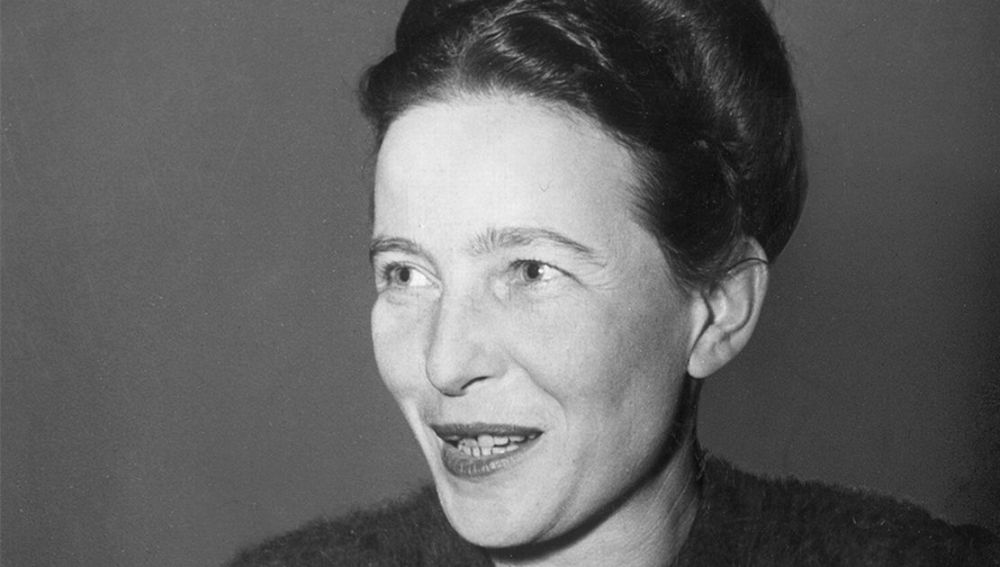
SIMONE DE BEAUVOIR, EXISTENTIALISM IN PHILOSOPHY

Simone de Beauvoir
Today, The Grandma has gone to the library to search more information about Simone de Beauvoir, the French writer and existentialist philosopher.

Beauvoir was a political activist and she is a great reference thanks to her ideas about feminist and social theories. She was a controversial person.

Simone de Beauvoir was born on a day like today in 1908 and The Grandma considers that the best homage that she can do to her is talking about her life, her ideas and her legacy.


Simone Lucie Ernestine Marie Bertrand de Beauvoir (9 January 1908-14 April 1986) was a French writer, intellectual, existentialist philosopher, political activist, feminist and social theorist.

Though she did not consider herself a philosopher, she had a significant influence on both feminist existentialism and feminist theory.

De Beauvoir wrote novels, essays, biographies, autobiography and monographs on philosophy, politics, and social issues. She was known for her 1949 treatise The Second Sex, a detailed analysis of women's oppression and a foundational tract of contemporary feminism; and for her novels, including She Came to Stay and The Mandarins. She was also known for her open, lifelong relationship with French philosopher Jean-Paul Sartre.

More information: The Culture Trip

Simone de Beauvoir was born on 9 January 1908 into a bourgeois Parisian family in the 6th arrondissement. Her parents were Georges Bertrand de Beauvoir, a legal secretary who once aspired to be an actor, and Françoise de Beauvoir, a wealthy banker's daughter and devout Catholic. Simone's sister, Hélène, was born two years later.

The family struggled to maintain their bourgeois status after losing much of their fortune shortly after World War I, and Françoise insisted that the two daughters be sent to a prestigious convent school. De Beauvoir herself was deeply religious as a child, at one point intending to become a nun. She shed her faith in her early teens and remained an atheist for the rest of her life.

Simone de Beauvoir
De Beauvoir was intellectually precocious, fueled by her father's encouragement; he reportedly would boast, Simone thinks like a man!

Because of her family's straitened circumstances, de Beauvoir could no longer rely on her dowry, and like other middle-class girls of her age, her marriage opportunities were put at risk. De Beauvoir took this opportunity to take steps towards earning a living for herself.

After passing baccalaureate exams in mathematics and philosophy in 1925, she studied mathematics at the Institut Catholique de Paris and literature/languages at the Institut Sainte-Marie. She then studied philosophy at the Sorbonne and after completing her degree in 1928, she wrote her diplôme d'études supérieures. De Beauvoir was only the ninth woman to have received a degree from the Sorbonne at the time, due to the fact that French women had only recently been allowed to join higher education.

De Beauvoir first worked with Maurice Merleau-Ponty and Claude Lévi-Strauss, when all three completed their practice teaching requirements at the same secondary school. Although not officially enrolled, she sat in on courses at the École Normale Supérieure in preparation for the agrégation in philosophy, a highly competitive postgraduate examination which serves as a national ranking of students.

More information: Open Culture

It was while studying for the agrégation that she met École Normale students Jean-Paul Sartre, Paul Nizan, and René Maheu, who gave her the lasting nickname Castor, or beaver. The jury for the agrégation narrowly awarded Sartre first place instead of de Beauvoir, who placed second and, at age 21, was the youngest person ever to pass the exam.

Writing of her youth in Memoirs of a Dutiful Daughter she said: ...my father's individualism and pagan ethical standards were in complete contrast to the rigidly moral conventionalism of my mother's teaching. This disequilibrium, which made my life a kind of endless disputation, is the main reason why I became an intellectual.

From 1929 to 1943, de Beauvoir taught at the lycée level until she could support herself solely on the earnings of her writings. She taught at the Lycée Montgrand in Marseille, the Lycée Jeanne-d'Arc in Rouen, and the Lycée Molière on Paris (1936–39).

Simone de Beauvoir & Jean-Paul Sartre
During October 1929, Jean-Paul Sartre and de Beauvoir became a couple and, after they were confronted by her father, Sartre asked her to marry him on a provisional basis: one day while they were sitting on a bench outside the Louvre, he said, Let's sign a two-year lease. Though de Beauvoir is quoted as saying, Marriage was impossible. I had no dowry, scholars point out that her ideal relationships described in The Second Sex and elsewhere bore little resemblances to the marriage standards of the day. Instead, they entered into a lifelong soul partnership, which was sexual but not exclusive, nor did it involve living together.

Sartre and de Beauvoir always read each other's work. Debate continues about the extent to which they influenced each other in their existentialist works, such as Sartre's Being and Nothingness and de Beauvoir's She Came to Stay and Phenomenology and Intent. However, recent studies of de Beauvoir's work focus on influences other than Sartre, including Hegel and Leibniz. The Neo-Hegelian revival led by Alexandre Kojève and Jean Hyppolite in the 1930s inspired a whole generation of French thinkers, including de Beauvoir and Sartre, to discover Hegel's Phenomenology of Spirit.

More information: The New Yorker

De Beauvoir's prominent open relationships at times overshadowed her substantial academic reputation. A scholar lecturing with de Beauvoir chastised their distinguished Harvard audience because every question asked about Sartre concerned his work, while all those asked about Beauvoir concerned her personal life.

Beginning in 1929, de Beauvoir and Jean-Paul Sartre were partners and remained so for fifty-one years, until his death in 1980.

De Beauvoir chose never to marry or set up a joint household and she never had children. This gave her the time to advance her education and engage in political causes, to write and teach, and to have lovers.

Perhaps her most famous lover was American author Nelson Algren whom she met in Chicago in 1947, and to whom she wrote across the Atlantic as my beloved husband

Simone de Beauvoir
Algren won the National Book Award for The Man with the Golden Arm in 1950, and in 1954, de Beauvoir won France's most prestigious literary prize for The Mandarins in which Algren is the character Lewis Brogan. Algren vociferously objected to their intimacy becoming public. Years after they separated, she was buried wearing his gift of a silver ring. However, she lived with Claude Lanzmann from 1952 to 1959.

De Beauvoir was bisexual, and her relationships with young women were controversial. Former student Bianca Lamblin, originally Bianca Bienenfeld, wrote in her book Mémoires d'une jeune fille dérangée, in English Memoirs of a Disturbed Young Lady, that, while she was a student at Lycée Molière, she had been sexually exploited by her teacher de Beauvoir, who was in her 30s at the time.

In 1943, de Beauvoir was suspended from her teaching job, due to an accusation that she had seduced her 17-year-old lycée pupil Natalie Sorokine in 1939. Sorokine's parents laid formal charges against de Beauvoir for debauching a minor and as a result she had her licence to teach in France revoked.

More information: Lirecrire

In 1977, de Beauvoir, Sartre, Roland Barthes, Michel Foucault, Jacques Derrida and much of the era's intelligentsia signed a petition seeking to abrogate the age of consent in France.

De Beauvoir wrote popular travel diaries about time spent in the United States and China and published essays and fiction rigorously, especially throughout the 1950s and 1960s. She published several volumes of short stories, including The Woman Destroyed, which, like some of her other later work, deals with aging.

1980 saw the publication of When Things of the Spirit Come First, a set of short stories centred around and based upon women important to her earlier years. Though written long before the novel She Came to Stay, de Beauvoir did not at the time consider the stories worth publishing, allowing some forty years to pass before doing so.

Sartre and Merleau-Ponty had a longstanding feud, which led Merleau-Ponty to leave Les Temps Modernes. De Beauvoir sided with Sartre and ceased to associate with Merleau-Ponty. In de Beauvoir's later years, she hosted the journal's editorial meetings in her flat and contributed more than Sartre, whom she often had to force to offer his opinions.

Simone de Beauvoir
De Beauvoir also wrote a four-volume autobiography, consisting of: Memoirs of a Dutiful Daughter; The Prime of Life; Force of Circumstance, sometimes published in two volumes in English translation After the War and Hard Times; and All Said and Done.

In 1964 De Beauvoir published a novella-length autobiography, A Very Easy Death, covering the time she spent visiting her ageing mother, who was dying of cancer. The novella brings up questions of ethical concerns with truth-telling in doctor-patient relationships.

In the 1970s de Beauvoir became active in France's women's liberation movement. She wrote and signed the Manifesto of the 343 in 1971, a manifesto that included a list of famous women who claimed to have had an abortion, then illegal in France. Some argue most of the women had not had abortions, including Beauvoir. Signatories were diverse as Catherine Deneuve, Delphine Seyrig, and de Beauvoir's sister Poupette. In 1974, abortion was legalised in France.

Her 1970 long essay La Vieillesse, The Coming of Age, is a rare instance of an intellectual meditation on the decline and solitude all humans experience if they do not die before about the age of 60.

In an interview with Betty Friedan, de Beauvoir said: No, we don’t believe that any woman should have this choice. No woman should be authorised to stay at home to bring up her children. Society should be totally different. Women should not have that choice, precisely because if there is such a choice, too many women will make that one. It is a way of forcing women in a certain direction.

More information: The Guardian

In about 1976 de Beauvoir and Sylvie Le Bon made a trip to New York City in the United States to visit Kate Millett on her farm.

In 1981 she wrote La Cérémonie Des Adieux, A Farewell to Sartre, a painful account of Sartre's last years. In the opening of Adieux, de Beauvoir notes that it is the only major published work of hers which Sartre did not read before its publication.

She contributed the piece Feminism -alive, well, and in constant danger to the 1984 anthology Sisterhood Is Global: The International Women's Movement Anthology, edited by Robin Morgan.

After Sartre died in 1980, de Beauvoir published his letters to her with edits to spare the feelings of people in their circle who were still living. After de Beauvoir's death, Sartre's adopted daughter and literary heir Arlette Elkaïm would not let many of Sartre's letters be published in unedited form. Most of Sartre's letters available today have de Beauvoir's edits, which include a few omissions but mostly the use of pseudonyms. De Beauvoir's adopted daughter and literary heir Sylvie Le Bon, unlike Elkaïm, published de Beauvoir's unedited letters to both Sartre and Algren.

De Beauvoir died of pneumonia on 14 April 1986 in Paris, aged 78. She is buried next to Sartre at the Montparnasse Cemetery in Paris.


I wish that every human life
might be pure transparent freedom.

Simone de Beauvoir