Wednesday, 22 December 2021

THE LIBRARY OF CONGRESS IN WASHINGTON, D.C. BURNS

Today, The Grandma has been reading about the Library of Congress, one of the most interesting cultural places that you can visit and enjoy in Washington, D.C., and a place that burnt on a day like today in 1851.

The Library of Congress (LC) is the research library that officially serves the United States Congress and is the de facto national library of the United States. It is the oldest federal cultural institution in the United States.

The library is housed in three buildings on Capitol Hill in Washington, D.C.; it also maintains a conservation center in Culpeper, Virginia.

The library's functions are overseen by the Librarian of Congress, and its buildings are maintained by the Architect of the Capitol.

The Library of Congress is one of the largest libraries in the world. Its collections are universal, not limited by subject, format, or national boundary, and include research materials from all parts of the world and in more than 450 languages.

Congress moved to Washington, D.C., in 1800 after holding sessions for 11 years in the temporary national capitals in New York City and Philadelphia. In both cities, members of the U.S. Congress had access to the sizable collections of the New York Society Library and the Library Company of Philadelphia.

The small Congressional Library was housed in the United States Capitol for most of the 19th century until the early 1890s.

Most of the original collection was burnt by the British during the War of 1812, with the library beginning efforts to restore its collection in 1815.

The library purchased Thomas Jefferson's entire personal collection of 6,487 books, and its collection slowly expanded in the following years, although it suffered another fire in its Capitol chambers in 1851. This destroyed a large amount of the collection, including many of Jefferson's books.

More information: Library of Congress

After the American Civil War, the importance of the Library of Congress increased with its growth, and there was a campaign to purchase replacement copies for volumes that had been burned. The library received the right of transference of all copyrighted works to deposit two copies of books, maps, illustrations, and diagrams printed in the United States. It also began to build its collections.

Its development culminated between 1888 and 1894 with the construction of its own separate, large library building across the street from the Capitol. Two additional buildings have been constructed nearby to hold collections and provide services, one in the 1930s and one in the 1970s.

The library's primary mission is to research inquiries made by members of Congress, which is carried out through the Congressional Research Service. It also houses and oversees the United States Copyright Office. The library is open to the public for research, although only high-ranking government officials and library employees may check out books and materials.

James Madison of Virginia is credited with the idea of creating a congressional library, first making such a proposition in 1783.

The Library of Congress was subsequently established on April 24, 1800, when President John Adams signed an act of Congress also providing for the transfer of the seat of government from Philadelphia to the new capital city of Washington.
Part of the legislation appropriated $5,000 for the purchase of such books as may be necessary for the use of Congress... and for fitting up a suitable apartment for containing them.
 
Books were ordered from London, and the collection consisted of 740 books and three maps, which were housed in the new United States Capitol.

President Thomas Jefferson played an important role in establishing the structure of the Library of Congress.

On January 26, 1802, he signed a bill that allowed the president to appoint the librarian of Congress and establishing a Joint Committee on the Library to regulate and oversee it. The new law also extended borrowing privileges to the president and vice president.

In August 1814, after routing an American militia at Bladensburg, the British bloodlessly occupied Washington, D.C. In retaliation for the American destruction of Port Dover, the British ordered the destruction of numerous public buildings in the city.

British troops burned the Library of Congress, including its collection of 3,000 volumes. These volumes had been held in the Senate wing of the Capitol. One of the few congressional volumes to survive was a government account book of receipts and expenditures for 1810. It was taken as a souvenir by British naval officer Sir George Cockburn, whose family returned it to the United States government in 1940.

On December 24, 1851, the largest fire in the library's history destroyed 35,000 books, about two–thirds of the library's collection and two-thirds of Jefferson's original transfer. 

Congress appropriated $168,700 to replace the lost books in 1852 but not to acquire new materials. By 2008, the librarians of Congress had found replacements for all but 300 of the works that had been documented as being in Jefferson's original collection.

More information: Pentagram

In 1859, Congress transferred the library's public document distribution activities to the Department of the Interior and its international book exchange program to the Department of State.

The Library of Congress contents:

-American Memory created in 1990, which became The National Digital Library in 1994. It provides free access online to digitized American history and culture resources, including primary sources, with curatorial explanations to support use in K-12 education.

-thomas.gov website launched in 1994 to provide free public access to U.S. federal legislative information with ongoing updates; and congress.gov website to provide a state-of-the-art framework for both Congress and the public in 2012;

-The National Book Festival, founded in 2000 with First Lady Laura Bush, has attracted more than 1000 authors and a million guests to the National Mall and the Washington Convention Center to celebrate reading. With a major gift from David Rubenstein in 2013, the library established the Library of Congress Literacy Awards to recognize and support achievements in improving literacy in the U.S. and abroad;

-The Kluge Center, started with a grant of $60 million from John W. Kluge in 2000, this brings international scholars and researchers to use library resources and to interact with policymakers and the public. It hosts public lectures and scholarly events, provides endowed Kluge fellowships, and awards The Kluge Prize for the Study of Humanity (now worth $1.5 million), the first Nobel-level international prize for lifetime achievement in the humanities and social sciences (subjects not included in the Nobel awards);

-Open World Leadership Center, established in 2000, by 2015 this program administered 23,000 professional exchanges for emerging post-Soviet leaders in Russia, Ukraine, and other successor states of the former USSR. Open World began as a Library of Congress project, and later was established as an independent agency in the legislative branch.

-The Veterans History Project, congressionally mandated in 2000 to collect, preserve, and make accessible the personal accounts of American war veterans from WWI to the present day;

-The National Audio-Visual Conservation Center opened in 2007 at a 45-acre site in Culpeper, Virginia, established with a gift of more than $150 million by the Packard Humanities Institute, and $82.1 million in additional support from Congress.

Since 1988, the library has administered the National Film Preservation Board. Established by congressional mandate, it selects American films annually for preservation and inclusion in the new National Registry, a collection of American films.

The library has made these available on the Internet for free streaming.

More information: Twitter-Library of Congress

By 2015, the librarian had named 650 films to the registry. The films in the collection date from the earliest to ones produced more than ten years ago; they are selected from nominations submitted to the board.

-The Gershwin Prize for Popular Song, was launched in 2007 to honor the work of an artist whose career reflects lifetime achievement in song composition. Winners have included Paul Simon, Stevie Wonder, Paul McCartney, Burt Bacharach and Hal David, Carole King, Billy Joel, and Willie Nelson, as of 2015. The library also launched the Living Legend Awards in 2000 to honor artists, activists, filmmakers, and others who have contributed to America's diverse cultural, scientific, and social heritage;

-The Fiction Prize, now the Library of Congress Prize for American Fiction, was started in 2008 to recognize distinguished lifetime achievement in the writing of fiction.

-The World Digital Library, established in association with UNESCO and 181 partners in 81 countries in 2009, makes copies of professionally curated primary materials of the world's varied cultures freely available online in multiple languages.

-National Jukebox, launched in 2011, provides streaming free online access to more than 10,000 out-of-print music and spoken word recordings.

-BARD was started in 2013; it is a digital, talking books mobile app for Braille and Audio Reading Downloads, in partnership with the library's National Library Service for the blind and physically handicapped. It enables free downloads of audio and Braille books to mobile devices via the Apple App Store.

More information: USG

A library is the delivery room for the birth of ideas,
a place where history comes to life.

Norman Cousins

Tuesday, 21 December 2021

CHRIS M. EVERT LLOYD, THE AMERICAN 'ICE PRINCESS'

Today, The Grandma has been watching TV. She loves tennis and she has chosen some classic matches played by Chris Evert, the American former world No. 1 tennis player, who was born on a day like today in 1954.

Christine Marie Evert (born December 21, 1954), known as Chris Evert Lloyd from 1979 to 1987, is an American former world No. 1 tennis player.

Evert was born in 1954 in Fort Lauderdale, Florida, to Colette (née Thompson) and Jimmy Evert, and raised in a devout Catholic family. She is a 1973 graduate of St. Thomas Aquinas High School in Ft. Lauderdale.

She won 18 Grand Slam singles championships and three doubles titles. She was the year-end world no. 1 singles player in 1974, 1975, 1976, 1977, 1978, 1980, and 1981. Overall, Evert won 157 singles titles and 32 doubles titles.

Evert reached 34 Grand Slam singles finals, more than any other player in the history of professional tennis. She holds the record of most consecutive years (13) of winning at least one Major title.

In singles, Evert reached the semifinals or better in 52 of the 56 Grand Slams she played, including the semifinals or better of 34 consecutive Grand Slams entered from the 1971 US Open through the 1983 French Open.

Evert never lost in the first or second round of a Grand Slam singles tournament and lost in the third round only twice. In Grand Slam women's singles play, Evert won a record seven titles at the French Open and a co-record six championships at the US Open, tied with Serena Williams.

Evert's career winning percentage in singles matches of 90.00% (1309-146) is the fifth highest in the history of tennis, for men or women. On clay courts, her career winning percentage in singles matches of 94.55% (382-22) remains a WTA record.

More information: Chris Evert

Evert served as president of the Women's Tennis Association for eleven calendar years, 1975-76 and 1983-91. She was awarded the Philippe Chatrier award and inducted into the Hall of Fame.

In later life, Evert was a coach and is now an analyst for ESPN, and has a line of tennis and active apparel.

Evert began taking tennis lessons from her father Jimmy Evert when she was five years old. He was a professional tennis coach who had won the men's singles title at the Canadian Championships in 1947.

Evert was voted the Associated Press Female Athlete of the Year on four occasions and was the first female athlete to be Sports Illustrated magazine's sole recipient of Sportswoman of the Year award in 1976.

In April 1985, she was voted the Greatest Woman Athlete of the Last 25 Years by the Women's Sports Foundation. Evert served as president of the Women's Tennis Association during 1975–76, and from 1983 to 1991.

In 1995, she was the fourth player ever to be unanimously elected into the International Tennis Hall of Fame following a worldwide ballot of 185 sports journalists.

In 1997, the International Tennis Federation (ITF) presented her with its highest accolade -the Philippe Chatrier Award- for her contributions to tennis, whilst 1999 saw Evert rated No. 50 among ESPN's Greatest North American athletes of the 20th century. Evert was awarded the International Club's prestigious Jean Borotra Sportsmanship Award in 2001.

In 2005, Tennis named her fourth on its list of 40 Greatest Players of the Tennis era.

In 2012, Tennis Channel conducted a poll of players and experts to determine the 100 Greatest Players of all-time, in which Evert ranked ninth overall, and fourth highest among women finishing behind Graf, Navratilova, and Court in that order.

In June 2013, Evert was awarded a special merit from the International Tennis Hall of Fame. They presented her their gold ring in recognition of her outstanding achievements both on and off the tennis court.

Evert was a baseline player, who is credited with revolutionising the sport of tennis. She was known for her consistent, counterpunching game, with her being described retrospectively by the International Tennis Hall of Fame as a human backboard.

More information: Twitter-Chris Evert

Evert was one of the first players to play exclusively from the baseline, typically approaching the net to retrieve short balls only; towards the end of her career, however, Evert would approach the net to end points more frequently.

Evert's forehand was hit flat, with consistent depth and power, penetrating deep into the court; towards the end of her career with the development of graphite technology, she would begin to apply more topspin to her forehand.

Evert was one of the first exponents of the double-handed backhand on the WTA tour, which, whilst not having the variety and flexibility that a one-handed backhand afforded, provided power and consistency that was previously unseen on the tour, and would later become the norm for female tennis players. She was adept at absorbing and redirecting power with both her forehand and her backhand, being able to create sharp angles and hit winners from any position on the court; despite this, Evert would not typically hit large numbers of winners, instead predicating her game on the retrieval of balls with devastating accuracy, and keeping unforced errors to a minimum.

Evert did not possess a powerful serve, however, it was reliable and accurate.

Evert possessed delicate touch, and had one of the most effective drop shots at the time. Playing in an era where serve and volleying was the dominant style of play, Evert was able to hit difficult passing shots with ease, pushing her opponents behind the baseline, and preventing them from rushing the net.

Evert's greatest strengths on court were her speed, detailed footwork, court coverage, fitness, consistency, and mental fortitude. Despite having success on all surfaces, Evert's favourite surface was clay, where the high bounce and slower speed afforded by the surface allowed her to execute her measured, defensive style of play with tremendous success; this is highlighted by her career 382-22 (94.6%) winning record on the surface. Due to her composure, mental toughness, and elegant style of play, Evert was known as the Ice Princess.

More information: Instagram-Chris Evert


You've got to take the initiative and play your game.
In a decisive set, confidence is the difference.

Chris Evert

Monday, 20 December 2021

ALAN PARSONS, RECORDING & PRODUCING GREAT MUSIC

Today, The Grandma has been listening to some music. She has chosen Alan Parsons's themes, the English songwriter and musician, who was born on a day like today in 1948.

Alan Parsons (born 20 December 1948) is an English audio engineer, songwriter, musician, and record producer.

Parsons's father was Parsons Code developer Alexander Denys Herbert (Denys) Parsons; his mother was Jane Kelty (Kelty) MacLeod. Parsons was born in Willesden, London.

Parsons was involved with the production of several albums, including the Beatles' Abbey Road (1969) and Let It Be (1970), Pink Floyd's The Dark Side of the Moon (1973), and the eponymous debut album by Ambrosia in 1975. 

Parsons's own group, The Alan Parsons Project, as well as his subsequent solo recordings, have also been commercially successful. He has been nominated for 13 Grammy Awards, with his first win occurring in 2019 for Best Immersive Audio Album for Eye in the Sky (35th Anniversary Edition).

In October 1967, at the age of 18, Parsons went to work as an assistant engineer at Abbey Road Studios, where he earned his first credit on the LP Abbey Road. He became a regular there, engineering such projects as Wings' Wild Life and Red Rose Speedway, five albums by the Hollies, and Pink Floyd's The Dark Side of the Moon, for which he received his first Grammy Award nomination. He was known for doing more than what would normally be considered the scope of a recording engineer's duties.

Parsons considered himself to be a recording director, likening his contribution to recordings to what Stanley Kubrick contributed to film. This is apparent in his work with Al Stewart's Year of the Cat, where Parsons added the saxophone part and transformed the original folk concept into the jazz-influenced ballad that put Stewart onto the charts.

Parsons also produced three albums by Pilot, a Scottish pop rock band, whose hits included January and Magic. He also mixed the debut album by the American band Ambrosia and produced their second album, Somewhere I've Never Travelled. Parsons was nominated for a Grammy Award for both albums. 

More information: Alan Parsons

In 1975, he declined Pink Floyd's invitation to work on the follow-up for Dark Side, Wish You Were Here, and instead initiated the Alan Parsons Project with producer, songwriter, and occasional singer Eric Woolfson, whom he had met at Abbey Road. The Project consisted of a revolving group of studio musicians and vocalists, most notably the members of Pilot and, on the first album, the members of Ambrosia. Unlike most rock groups, the Alan Parsons Project never performed live during its heyday, although it did release several music videos.

Its only live performance during its original incarnation was in 1990. It released ten albums, the last in 1987. The Project terminated in 1990 after Parsons and Woolfson split, with the Project's intended 11th album released that year as a Woolfson solo album. Parsons continued to release work in his own name and in collaboration with other musicians. Parsons and his band regularly toured many parts of the world.

Although an accomplished vocalist, keyboardist, bassist, guitarist, and flautist, Parsons only sang infrequent and incidental parts on his albums, such as the background vocals on Time.

While his keyboard playing was very audible on the Alan Parsons Project albums, very few recordings feature his flute. He briefly returned to run Abbey Road Studios in its entirety. Parsons also continued with his selective production work for other bands. 

Of all his collaborators, guitarist Ian Bairnson worked with Parsons the longest, including Parsons' post-Project albums, Try Anything Once, On Air, The Time Machine, and The Secret.

In 1998, Parsons became Vice-President of EMI Studios Group, including the Abbey Road Studios. He soon left the post, deciding to return to more creative endeavours. Parsons remained as a creative consultant and associate producer for the group. As well as receiving gold and platinum awards from many nations, Parsons has received thirteen Grammy Award nominations.

In 2006, he received a nomination for Best Surround Sound Album for A Valid Path.

In 2018, he finally won his first Grammy Award for Best immersive Audio Album for his remastered 35th anniversary edition of Eye in the Sky.

Beginning in 2001 and extending for four years, Parsons led a Beatles tribute show called A Walk Down Abbey Road featuring a group of headlining performers such as Todd Rundgren, Ann Wilson of Heart, John Entwistle of the Who, and Jack Bruce of Cream. The show structure included a first set where all musicians assembled to perform each other's hits, and a second set featuring all Beatles songs.

Since 1999, he has toured as the Alan Parsons Live Project, with Woolfson's permission. The band currently features lead singer P. J. Olsson, guitarist Jeff Kollman, drummer Danny Thompson, keyboardist Tom Brooks, bass guitarist Guy Erez, vocalist and saxophonist Todd Cooper, guitarist and vocalist Dan Tracey, along with Parsons on rhythm guitar, keyboards, and vocals. This band performed live in Medellín, Colombia in 2013 as Alan Parsons Symphonic Project in a performance recorded for Colombian television.

In May 2005, Parsons appeared at the Canyon Club in Agoura Hills, California, to mix front-of-house sound for Southern California-based Pink Floyd tribute band Which One's Pink? and their performance of the Dark Side of the Moon in its entirety.

In 2010, Parsons released his single All Our Yesterdays through Authentik Artists. Parsons also launched a DVD educational series in 2010, titled the Art and Science of Sound Recording (ASSR) on music production and the complete audio recording process. The single All Our Yesterdays was written and recorded during the making of ASSR. The series, narrated by Billy Bob Thornton, gives detailed tutorials on virtually every aspect of the sound recording process.

More information: Twitter-Alan Parsons

During 2010, several media reports,  one of which included a quote from a representative of Parsons, alleged that the song Need You Now by country music group Lady Antebellum used the melody and arrangement of Eye in the Sky.

Parsons produced Jake Shimabukuro's album Grand Ukulele, which was released on 2 October 2012. Also in 2012, he contributed lead vocals and performed keyboards and guitar on the track Precious Life by German electronic music duo Lichtmond, and appeared with many other noted progressive-rock musicians on the Prog Collective album by Billy Sherwood, singing lead on the Technical Divide.

Parsons engineered the third solo album by Steven Wilson, The Raven that Refused to Sing (And Other Stories), released on 25 February 2013.

In late 2013, a live album recorded on tour in Germany and Austria with the title LiveSpan was released, accompanied by a single called Fragile with Simon Philips on drums.

Legacy Recordings, the catalogue division of Sony Music Entertainment, celebrated the 35th anniversary of Eye in the Sky, with the worldwide release of a definitive deluxe collector's box set, featuring rare and unreleased material, on 17 November 2017.

On 19 July 2018, Parsons and engineer Noah Bruskin opened a new recording studio, ParSonics. ParSonics was used in the recording of Alan Parsons' most recent album The Secret.

On 26 April 2019, Parsons released a new studio album, The Secret, his first album in 15 years.

More information: Instagram-Alan Parsons


I started in a research lab for TV cameras,
then I worked at a tape duplication facility.
That was the first introduction for me to recorded music and hi-fi.

Alan Parsons

Sunday, 19 December 2021

LA MARATÓ DE TV3, THIRTY YEARS OF GREAT SOLIDARITY

Today, The Grandma and her friends Claire Fontaine, Jordi Santanyí, Josep de Ca'th Lon, Tina Picotes and Tonyi Tamaki want to talk about La Marató de TV3, a Catalan public television program that raises funds for medical research and which has reached its 30th edition, this year dedicated to mental health diseases.

Mental health is a serious issue that affects a very high percentage of our society, while being highly stigmatized. The two main objectives of this Marató are to raise funds to research and raise awareness about the medical issues covered. It is a very significant day for Catalans, because they show one of the pillars of their idiosyncrasy, solidarity. No nation can move forward without solidarity and without a strong sense of community.

During the days leading up to the Marató de TV3, thousands of events are held throughout Catalonia, the Balearic Islands and Andorra where anonymous people work together to raise funds which will then be donated to La Marató. Dances, popular culture, bingo, sports events, art exhibitions, concerts ... everything is worth it to be able to come together to make this joint effort a reality: to work together to be able to finance projects that improve everyone's quality of life.

Congratulations on these 30 years of solidarity. Congratulations to the Catalan public television (TV3) and to all the people who participate from the Catalan Countries or from other parts of the world.

More information: La Marató de TV3

La Marató de TV3, or La Marató, is a solidarity gala or telemarathon held annually by TV3 on the Sunday before Christmas and promoted by Televisió de Catalunya and the Fundació La Marató de TV3.

The first edition was held in 1992 and each year funds are raised for research on a type of disease; each year a different type of disease. An average of seven million euros is raised each year.

Its main purpose is to raise funds for research and dissemination of a disease or group of diseases. Over the years, it has grown in prestige and donations to the point of creating in 1996 the Fundació La Marató de TV3, which is responsible for managing the funds, the selection of the best scientific projects for funding and the campaigns of relevant awareness.

To raise money for the fund of the Marató, a thousand events are organized all over the Catalan Countries. Since 2005 it has had the Marató record, which is sold to the main newspapers in Catalonia. Before the start of the 2013 edition, the Marató has allocated more than 119 million euros in 607 years to 607 biomedical research projects.

For the 2020 edition, the Foundation's board of trustees has focused its attention on COVID-19, moving the topic of Mental Illness to the 2021 edition, which will be the 30th edition of the Marató.

More information: Twitter-La Marató

There is no standard normal. Normal is subjective.
There are seven billion versions of normal on this planet.

Matt Haig

Saturday, 18 December 2021

SCORE, THE WORLD'S FIRST COMMUNICATIONS SATELLITE

Today, The Grandma has received the wonderful visit of one of her closest friends, Joseph de Ca'th Lon. 

Joseph loves Astronomy, and they have been talking about SCORE, the world's first purpose-built communications satellite, that was launched on a day like today in 1958.

SCORE (Signal Communications by Orbiting Relay Equipment) was the world's first purpose-built communications satellite.

Launched aboard an American Atlas rocket on December 18, 1958, SCORE provided the second test of a communications relay system in space, the first having been provided by the USAF/NASA's Pioneer 1, the first broadcast of a human voice from space, and the first successful use of the Atlas as a launch vehicle. It captured world attention by broadcasting a Christmas message via shortwave radio from U.S. President Dwight D. Eisenhower through an on-board tape recorder. The satellite was popularly dubbed The Talking Atlas.

SCORE, as a geopolitical strategy, placed the United States at an even technological par with the Soviet Union as a highly functional response to the Sputnik 1 and Sputnik 2 satellites.

The six-month effort was the first endeavor of the then-new Advanced Research Projects Agency (ARPA) headed by Roy Johnson, and proved that a small, highly focused and versatile research group with appropriate resources was an ideal method to achieve the scientific and technological advances necessary to succeed in the emerging global space race.

SCORE's technical objectives were two-fold. In addition to showing that an Atlas missile was capable of satellite payload launch, the payload itself was a hundred times more massive than any previous US satellite. The program demonstrated the feasibility of transmitting messages through the upper atmosphere from one ground station to one or more ground stations.

The result of the program, which used both real-time and store and forward techniques, was a major scientific breakthrough which proved that active communications satellites could provide a means of transmitting messages from one point to any other on Earth.

More information: NASA

The SCORE (Signal Communication by Orbiting RElay) satellite of US ARMY was an 24.3 metres of long, and 3.1 metres of diameter Atlas missile used as a platform for the communications relay experiment. The spacecraft body served as antennae. This satellite was to demonstrate the feasibility and explore problems associated with, operation of a satellite communication system. It carried messages on a tape recorder which was used at one point to carry a Christmas greeting from President Eisenhower.

The performance was nominal with experiment operation for 12 days, planned orbit lifetime 20 days, actual orbit lifetime 34 days. The tracking beacon operated at 108 MHz.

The SCORE communications package was designed and built by Kenneth Masterman-Smith, a military communication research engineer, along with other personnel with the U.S. Army Signal Research and Development Laboratory (SRDL) at Fort Monmouth, New Jersey.

The overall program was conducted in such secrecy that only 88 people were aware of its existence. Before the date of the SCORE launch, 53 of the 88 people had been told the program had been canceled and they were not to mention to anyone that it had ever existed. That left only 35 people who knew of the mission of Atlas 10B with the rest of the engineering crew, including the launch crew, under the impression that they were working solely on a test launch of the rocket.
The night before launch, however, Rear Adm. John E. Clark, deputy director of ARPA, was asked at a news conference whether he could deny that Eisenhower's voice was on the recorder. He replied, No, and news reports that day suggested the voice might well be the president's.

The payload weighed 68 kilograms, and was built into the fairing pods of the Atlas missile. Combined weight of the total on-orbit package was 3,980 kilograms.

More information: NASA

SCORE was launched into an orbit with a perigee of 185 kilometres, an apogee of 1,484 kilometres from LC-11 at Cape Canaveral Missile Test Annex, Florida, inclined at 32.3°, with a period of 101.4 minutes. Its batteries lasted 12 days and it reentered the atmosphere on 21 January 1959.

The communications repeater installed on the missile would receive a signal, amplify it, and then retransmit it. Two redundant sets of equipment were mounted in the nose of the SCORE missile. Four antennas were mounted flush with the missile surface, two for transmission and two for reception.

SCORE's other equipment included two tape recorders, each with a four-minute capacity. Any of four ground stations in the southern United States could command the satellite into playback mode to transmit the stored message or into record mode to receive and store a new message. These redundancies proved invaluable as one of the tape recorders malfunctioned and was rendered inoperable during the 12-day mission.

According to an official history of the Advanced Research Projects Agency (ARPA), SCORE was originally programmed to broadcast a voice message from Army Secretary Wilber M. Brucker. When the President learned this fact, hours before lift-off, he said he would like to provide the message. His tape-recording was hand-carried to Cape Canaveral, but by then the payload was locked and ready for launch.

The ARPA program director decided to launch with the Army message, then erase it while in space, and upload the President's message to replace it. This effort was successful, and accordingly SCORE's transmitted message from space to Earth was as follows:

This is the President of the United States speaking. Through the marvels of scientific advance, my voice is coming to you from a satellite circling in outer space. My message is a simple one: Through this unique means I convey to you and to all mankind, America's wish for peace on Earth and goodwill toward men everywhere.

The broadcast signal for Eisenhower's greeting was fairly weak, and only very sensitive radio receivers were able to detect it. Most Americans heard the message as it was rebroadcast on commercial news programs.

More information: Spaceline


Satellite communications connect television screens in Japan
with television cameras in England,
and the distance of half a world loses its meaning.

Robert Kennedy

Friday, 17 December 2021

PROJECT BLUE BOOK, A STUDY ABOUT UFOS IN THE USA

Today, The Grandma has received the wonderful visit of two of her closest friends, Fox Mulder and Dana Scully. They have been talking about Project Blue Book, the systematic study of unidentified flying objects by the United States Air Force from March 1952 to its termination on a day like today in 1969.

Project Blue Book was the code name for the systematic study of unidentified flying objects by the United States Air Force from March 1952 to its termination on December 17, 1969.

The project, headquartered at Wright-Patterson Air Force Base, Ohio, was initially directed by Captain Edward J. Ruppelt and followed projects of a similar nature such as Project Sign established in 1947, and Project Grudge in 1948. 

Project Blue Book had two goals, namely, to determine if UFOs were a threat to national security, and to scientifically analyze UFO-related data.

Thousands of UFO reports were collected, analyzed, and filed. As a result of the Condon Report, which concluded that the study of UFOs was unlikely to yield major scientific discoveries, and a review of the report by the National Academy of Sciences, Project Blue Book was terminated in 1969. The Air Force supplies the following summary of its investigations:

-No UFO reported, investigated, and evaluated by the Air Force was ever an indication of threat to our national security;

-There was no evidence submitted to or discovered by the Air Force that sightings categorized as unidentified represented technological developments or principles beyond the range of modern scientific knowledge; and

-There was no evidence indicating that sightings categorized as unidentified were extraterrestrial vehicles.

More information: Archives

By the time Project Blue Book ended, it had collected 12,618 UFO reports, and concluded that most of them were misidentifications of natural phenomena (clouds, stars...) or conventional aircraft.

According to the National Reconnaissance Office a number of the reports could be explained by flights of the formerly secret reconnaissance planes U-2 and A-12.

701 reports were classified as unexplained, even after stringent analysis. The UFO reports were archived and are available under the Freedom of Information Act, but names and other personal information of all witnesses have been redacted.

Public USAF UFO studies were first initiated under Project Sign at the end of 1947, following many widely publicized UFO reports. Project Sign was initiated specifically at the request of General Nathan Twining, chief of the Air Force Materiel Command at Wright-Patterson Air Force Base. Wright-Patterson was also to be the home of Project Sign and all subsequent official USAF public investigations.

More information: NSA

Project Sign was officially inconclusive regarding the cause of the sightings. However, according to US Air Force Captain Edward J. Ruppelt (the first director of Project Blue Book), Sign's initial intelligence estimate (the so-called Estimate of the Situation) written in the late summer of 1948, concluded that the flying saucers were real craft, were not made by either the Soviet Union or United States, and were likely extraterrestrial in origin. 

This was subsequently rejected by Gen. Hoyt Vandenberg, USAF Chief of Staff, citing a lack of physical proof. Vandenberg subsequently dismantled Project Sign.

 Project Sign was succeeded at the end of 1948 by Project Grudge, which was criticized as having a debunking mandate. Ruppelt referred to the era of Project Grudge as the dark ages of early USAF UFO investigation.

Grudge concluded that all UFOs were natural phenomena or other misinterpretations, although it also stated that 23 percent of the reports could not be explained.

 More information: National Archives Foundation

Below is the United States Air Force's official statement regarding UFOs, as noted in USAF Fact Sheet 95-03:

-From 1947 to 1969, the Air Force investigated Unidentified Flying Objects under Project Blue Book. The project, headquartered at Wright-Patterson Air Force Base, Ohio, was terminated on December 17, 1969. Of a total of 12,618 sightings reported to Project Blue Book, 701 remained unidentified.

-The decision to discontinue UFO investigations was based on an evaluation of a report prepared by the University of Colorado entitled, Scientific Study of Unidentified Flying Objects; a review of the University of Colorado's report by the National Academy of Sciences; previous UFO studies and Air Force experience investigating UFO reports during 1940 to 1969.

-As a result of these investigations, studies and experience gained from investigating UFO reports since 1948, the conclusions of Project Blue Book were:

-No UFO reported, investigated, and evaluated by the Air Force has ever given any indication of threat to our national security.

-There has been no evidence submitted to or discovered by the Air Force that sightings categorized as unidentified represent technological developments or principles beyond the range of present-day scientific knowledge.

-There has been no evidence indicating the sightings categorized as unidentified are extraterrestrial vehicles.

More information: BBC

With the termination of Project Blue Book, the Air Force regulation establishing and controlling the program for investigating and analyzing UFOs was rescinded. Documentation regarding the former Blue Book investigation was permanently transferred to the Modern Military Branch, National Archives and Records Service, and is available for public review and analysis.

Since the termination of Project Blue Book, nothing has occurred that would support a resumption of UFO investigations by the Air Force.

There are a number of universities and professional scientific organizations that have considered UFO phenomena during periodic meetings and seminars. A list of private organizations interested in aerial phenomena may be found in Encyclopaedia of Associations, published by Gale Research.

Interest in and timely review of UFO reports by private groups ensures that sound evidence is not overlooked by the scientific community. Persons wishing to report UFO sightings should be advised to contact local law enforcement agencies.

More information: Popular Mechanics

I examined a lot of CIA declassified UFO files,
which are fascinating,
because there was a huge UFO craze going on in America.
There still is today, but it certainly started in '47.
And by the '50s, it was in full force.

Annie Jacobsen

Thursday, 16 December 2021

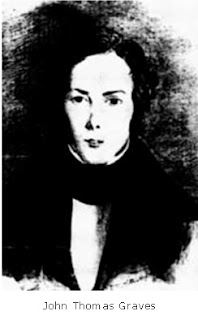
JOHN THOMAS GRAVES DISCOVERS THE OCTONIONS

Today, The Grandma has been reading about the octonions, a normed division algebra over the real numbers, a kind of hypercomplex number system discovered by John Thomas Graves on a day like today in 1843.

John Thomas Graves (4 December 1806-29 March 1870) was an Irish jurist and mathematician.

He was a friend of William Rowan Hamilton, and is credited both with inspiring Hamilton to discover the quaternions in October 1843 and then discovering their generalization the octonions himself, he called them octaves, later that same year. He was the brother of both the mathematician and bishop Charles Graves and the writer and clergyman Robert Perceval Graves.

Born in Dublin 4 December 1806, he was son of John Crosbie Graves, barrister, grandnephew of Richard Graves, D.D., and cousin of Robert James Graves, M.D. He was sent to school in England, in the parish of Westbury-on-Trym, then a village outside Bristol, under the Rev. Samuel Feild, later vicar of Hatherleigh.

Feild has been described as a prominent second generation evangelical Anglican; he was one of two curates in the parish, under Richard Carrow, the parish priest, as perpetual curate.

Graves was an undergraduate at Trinity College, Dublin, where he distinguished himself in both science and classics, and was a class-fellow and friend of William Rowan Hamilton, graduating B.A. in 1827. He then moved to Oxford, where he became an incorporated member of Oriel College, 11 November 1830.

Graves proceeded M.A. at Oxford in 1831, and at Dublin in 1832.

Having in 1830 entered the King's Inns, Dublin, Graves was called to the English bar in 1831, as a member of the Inner Temple. For a short time he went the Western circuit. In 1839 he was appointed professor of jurisprudence in London University College in a delayed succession to John Austin. Not long after, he was elected an examiner in laws in the University of London.

More information: Math-University of California

Graves was one of the committee of the Society for the Diffusion of Useful Knowledge.

In 1839, he was elected as a Fellow of the Royal Society, and he subsequently sat on its council. He was also a member of the Philological Society and of the Royal Society of Literature.

In 1846, Graves was appointed an assistant poor-law commissioner, and in the next year, under the new Poor Law Act, one of the poor-law inspectors of England and Wales.

In 1846, Graves married Amelia Tooke, a daughter of William Tooke, and died without issue on 29 March 1870 at Cheltenham.

In his twentieth year (1826) Graves engaged in researches on the exponential function and the complex logarithm; they were printed in the Philosophical Transactions for 1829 under the title An Attempt to Rectify the Inaccuracy of some Logarithmic Formulæ. Alexandre-Joseph-Hidulphe Vincent claimed to have arrived in 1825 at similar results, which, however, were not published by him till 1832. The conclusions announced by Graves were not at first accepted by George Peacock, who referred to them in his Report on Algebra, nor by Sir John Herschel. Graves communicated to the British Association in 1834 (Report for that year) on his discovery.

In the same report is a supporting paper by Hamilton, On Conjugate Functions or Algebraic Couples, as tending to illustrate generally the Doctrine of Imaginary Quantities, and as confirming the Results of Mr. Graves respecting the existence of Two independent Integers in the complete expression of an Imaginary Logarithm. It was an anticipation, as far as publication was concerned, of an extended memoir, which had been read by Hamilton before the Royal Irish Academy on 24 November 1833, On Conjugate Functions or Algebraic Couples, and subsequently published in the seventeenth volume of the Transactions of the Royal Irish Academy.

To this memoir were prefixed A Preliminary and Elementary Essay on Algebra as the Science of Pure Time, and some General Introductory Remarks. In the concluding paragraphs of each of these three papers Hamilton acknowledges that it was in reflecting on the important symbolical results of Mr. Graves respecting imaginary logarithms, and in attempting to explain to himself the theoretical meaning of those remarkable symbolisms, that he was conducted to the theory of conjugate functions, which, leading on to a theory of triplets and sets of moments, steps, and numbers were foundational for his own work, culminating in the discovery of quaternions.

For many years Graves and Hamilton maintained a correspondence on the interpretation of imaginaries.

In 1843 Hamilton discovered the quaternions, and it was to Graves that he made on 17 October his first written communication of the discovery. In his preface to the Lectures on Quaternions and in a prefatory letter to a communication to the Philosophical Magazine for December 1844 are acknowledgments of his indebtedness to Graves for stimulus and suggestion. Immediately after the discovery of quaternions, before the end of 1843, Graves successfully extended to eight squares Euler's four-square identity, and went on to conceive a theory of octaves, now called octonions, analogous to Hamilton's theory of quaternions, introducing four imaginaries additional to Hamilton's i, j and k, and conforming to the law of the modulus.

Octonions are a contemporary if abstruse area of contemporary research of the Standard Model of particle physics.

Graves devised also a pure-triplet system founded on the roots of positive unity, simultaneously with his brother Charles Graves, the bishop of Limerick. He afterwards stimulated Hamilton to the study of polyhedra, and was told of the discovery of the icosian calculus.

Graves contributed also to the Philosophical Magazine for April 1836 a paper On the lately proposed Logarithms of Unity in reply to Professor De Morgan, and in the London and Edinburgh Philosophical Magazine for the same year a postscript entitled Explanation of a Remarkable Paradox in the Calculus of Functions, noticed by Mr. Babbage.

More information: nLab

To the same periodical he contributed in September 1838 A New and General Solution of Cubic Equations; in 1839 a paper On the Functional Symmetry exhibited in the Notation of certain Geometrical Porisms, when they are stated merely with reference to the arrangement of points; and in April 1845 a paper on the Connection between the General Theory of Normal Couples and the Theory of Complete Quadratic Functions of Two Variables.

A subsequent number contains a contribution On the Rev. J. G. MacVicar's Experiment on Vision, on the work of John Gibson Macvicar; and the Report of the Cheltenham meeting in 1856 of the British Association contains abstracts of papers communicated by him On the Polyhedron of Forces and On the Congruence nx ≡ n + 1 (mod. p.).

For many years he collected mathematical works. This portion of his library, more than ten thousand books and about five thousand pamphlets he bequeathed to University College, London.

In mathematics, the octonions are a normed division algebra over the real numbers, a kind of hypercomplex number system.

The octonions are usually represented by the capital letter O, using boldface O or blackboard bold O {\displaystyle \mathbb {O} } \mathbb {O}.

Octonions have eight dimensions; twice the number of dimensions of the quaternions, of which they are an extension. They are noncommutative and nonassociative, but satisfy a weaker form of associativity; namely, they are alternative. They are also power associative.

Octonions are not as well known as the quaternions and complex numbers, which are much more widely studied and used.

Octonions are related to exceptional structures in mathematics, among them the exceptional Lie groups.

Octonions have applications in fields such as string theory, special relativity and quantum logic. Applying the Cayley–Dickson construction to the octonions produces the sedenions.

The octonions were discovered in 1843 by John T. Graves, inspired by his friend William Rowan Hamilton's discovery of quaternions. Graves called his discovery octaves, and mentioned them in a letter to Hamilton dated 26 December 1843.

He first published his result slightly later than Arthur Cayley's article. The octonions were discovered independently by Cayley and are sometimes referred to as Cayley numbers or the Cayley algebra. Hamilton described the early history of Graves' discovery.

More information: Alberto Elduque-Universitat de Zaragoza

You know, people think mathematics is complicated.
Mathematics is the simple bit.
It's the stuff we can understand.

John H. Conway