Sunday, 16 October 2016

THE SUPERMOON FROM PALOMAR OBSERVATORY, CA

Joseph de Ca'th Lon with the Hale Telescope
Today, Joseph de Ca'th Lon is in Palomar Observatory, in San Diego, California

He's following an Eli Poppins proposal: watching the supermoon tonight, and the best place to do it is in an astronomical observatory.

If he chose the Montsec Observatory in Àger to see The Draconids, now he has decided to travel to the West Coast of the United and honour an important astronomer, George E. Hale
 
A supermoon is the coincidence of a full moon or a new moon with the closest approach the Moon makes to the Earth on its elliptical orbit, resulting in the largest apparent size of the lunar disk as seen from Earth. The technical name is the perigee-syzygy of the Earth-Moon-Sun system.
 
The term supermoon is not astronomical, but originated in modern astrology. The association of the Moon with both oceanic and crustal tides has led to claims that the supermoon phenomenon may be associated with increased risk of events such as earthquakes and volcanic eruptions, but the evidence of such a link is widely held to be unconvincing.
The supermoon behind The Parthenon, Athens

The Moon's distance varies each month between approximately 357,000 kilometers and 406,000 km due to its elliptical orbit around the Earth, distances given are centre-to-centre.
 
A full moon at perigee is visually larger up to 14% in diameter, or about 30% in area, and shines 30% more light than one at its farthest point, or apogee.

More information: Time and Date

The full moon cycle is the period between alignments of the lunar perigee with the sun and the earth, which is about 13.9443 synodic months, about 411.8 days. Thus approximately every 14th full moon will be a supermoon. However, halfway through the cycle the full moon will be close to apogee, and the new moons immediately before and after can be supermoons. Thus there may be as many as three supermoons per full moon cycle.

More information: The Supermoon Patterns
 
The Supermoon in New York City
Palomar Observatory is an astronomical observatory located in San Diego County, California, The United States, 145 kilometers southeast of Los Angeles, California, in the Palomar Mountain Range.
 
It is owned and operated by the California Institute of Technology (Caltech) located in Pasadena, California.
 
Research time is granted to Caltech and its research partners, which include the Jet Propulsion Laboratory (JPL) and Cornell University.
 
The observatory operates several telescopes, including the famous 200-inch Hale Telescope and the 48-inch Samuel Oschin Telescope. In addition, other instruments and projects have been hosted at the observatory, such as the Palomar Testbed Interferometer and the historic 18-inch Schmidt telescope, Palomar Observatory's first telescope, dating from 1936.


George Ellery Hale (1868-1938) was an American solar astronomer, best known for his discovery of magnetic fields in sunspots, and as the leader or key figure in the planning or construction of several world-leading telescopes; namely, the 40-inch refracting telescope at Yerkes Observatory, 60-inch Hale reflecting telescope at Mount Wilson Observatory, 100-inch Hooker reflecting telescope at Mount Wilson, and the 200-inch Hale reflecting telescope at Palomar Observatory.
 
More information: Amazing Space 


Like buried treasures, the outposts of the universe have beckoned to the adventurous from immemorial times. Princes and potentates, political or industrial, equally with men of science, have felt the lure of the uncharted seas of space, and through their provision of instrumental means the sphere of exploration has made new discoveries and brought back permanent additions to our knowledge of the heavens. 

George E. Hale

Saturday, 15 October 2016

RUFUS WAINWRIGHT & CLAIRE: COMPLAINTE DE LA BUTTE

Rufus Wainwright
It is a great pleasure for The Grandma to introduce Claire Fontaine, a new friend from Québec, who is going to talk us about music, fashion, marketing and trends.

Today, Claire assists to a Rufus Wainwright’s Concert in Sant Cugat del Vallès. She’s a great fan of this fantastic and enjoyable artist who sings beautiful songs in English and French because he lives in California but he spent his youth in Montréal, Québec, hometown of her mother.

Rufus is Kate McGarrigle's son; Anne McGarrigle's niece and Martha Wainright's brother and his oeuvre contains several recurring themes: opera, literature, pop culture, politics, and love. Kate and Anne McGarrigle are the members of The Garrigles, the famous folk duo.


He has recorded seven albums of original music and numerous tracks on compilations and film soundtracks. He has also written a classical opera and set Shakespeare sonnets to music.

Rufus became interested in opera during his adolescent years, and the genre strongly influences his music. For instance, the song Barcelona features lyrics from the libretto of Giuseppe Verdi's opera, Macbeth. During this time, he became interested in Édith Piaf, Al Jolson, and Judy Garland.


 In the present world, this technological, psychotic, politicised, nonsensical world, you have to believe that the good guys are going to win! That evil will be banished somehow!
Rufus Wainwright

Friday, 14 October 2016

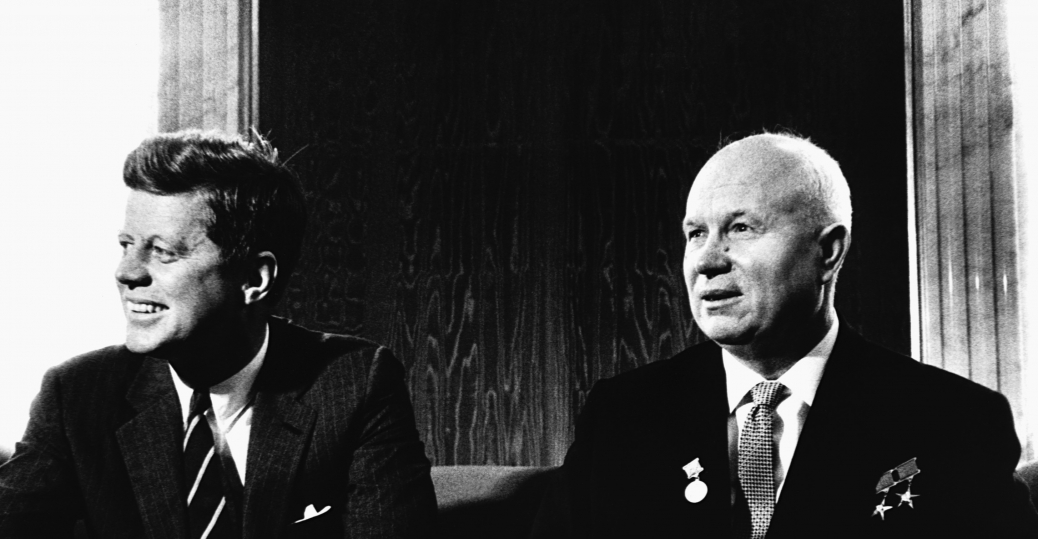
OCTOBER, 14 1962: THE CUBAN MISSILE CRISIS STARTS

John F.Kennedy and Nikita Khrushchev
The Cuban Missile Crisis was a 13-day (October 16–28, 1962) confrontation between the United States and the Soviet Union concerning Soviet ballistic missile deployment in Cuba. It was the closest the Cold War came to escalating into a full-scale nuclear war.


In response to the failed Bay of Pigs Invasion of 1961, and the presence of American Jupiter ballistic missiles in Italy and Turkey, Soviet leader Nikita Khrushchev decided to agree to Cuba's request to place nuclear missiles in Cuba to deter future harassment of Cuba. An agreement was reached during a secret meeting between Khrushchev and Fidel Castro in July 1962 and construction of a number of missile launch facilities started later that summer.

Washington-Moscow hotline
The 1962 midterm elections were under way in the United States and the White House had denied charges that it was ignoring dangerous Soviet missiles 90 miles from Florida. 

These missile preparations were confirmed when an Air Force U-2 spy plane produced clear photographic evidence of medium-range (SS-4) and intermediate-range (R-14) ballistic missile facilities on October 14

The United States established a military blockade to prevent further missiles from entering Cuba. It announced that they would not permit offensive weapons to be delivered to Cuba and demanded that the weapons already in Cuba be dismantled and returned to the USSR.

More information: JFK Library

After a long period of tense negotiations, an agreement was reached between President John F. Kennedy and Khrushchev. Publicly, the Soviets would dismantle their offensive weapons in Cuba and return them to the Soviet Union, subject to United Nations verification, in exchange for a U.S. public declaration and agreement never to invade Cuba again without direct provocation. Secretly, the United States also agreed that it would dismantle all U.S. -built Jupiter MRBMs, which were deployed in Turkey and Italy against the Soviet Union but were not known to the public.

Spy photo. San Cristóbal, Cuba. 14 October 1962
When all offensive missiles and Ilyushin Il-28 light bombers had been withdrawn from Cuba, the blockade was formally ended on November 20, 1962. The negotiations between the United States and the Soviet Union pointed out the necessity of a quick, clear, and direct communication line between Washington and Moscow.

As a result, the Moscow Washington hotline was established. A series of agreements sharply reduced U.S.-Soviet tensions during the following years.

The United States was concerned about an expansion of Communism, and a Latin American country allying openly with the USSR was regarded as unacceptable, given the U.S.–Soviet enmity since the end of World War II. Such an involvement would also directly defy the Monroe Doctrine, a U.S. policy which, while limiting the United States' involvement in European colonies and European affairs, held that European powers ought not to have involvement with states in the Western Hemisphere.


The great enemy of the truth is very often not the lie, deliberate, contrived and dishonest, but the myth, persistent, persuasive and unrealistic. 
   
John F. Kennedy

BOB DYLAN: THE TIMES THEY ARE A-CHANGIN'

Bob Dylan
The Grandma is still in Venice enjoying this beautiful city. Today, she has received fantastic news: Bob, an old friend, was the new Nobel Prize in Literature. Thanks, Bob. Thanks for dignifying music and lyrics. You're the Original Soundtrack of millions of people's lives. The times they are a-changin' really, dear friend.
 
I want to talk to you a little about Bob with the reading of a Wikipedia post.
Bob Dylan (born Robert Allen Zimmerman, Shabtai Zisl ben Avraham in Hebrew, May 24, 1941) is an American songwriter, singer, artist, and writer. He has been influential in popular music and culture for more than five decades. Much of his most celebrated work dates from the 1960s when his songs chronicled social unrest, although Dylan repudiated suggestions from journalists that he was a spokesman for his generation. 

Nevertheless, early songs such as Blowin' in the Wind and The Times They Are a-Changin became anthems for the American civil rights and anti-war movements. Leaving behind his initial base in the American folk music revival, his six-minute single Like a Rolling Stone, recorded in 1965, enlarged the range of popular music. Dylan's mid-1960s recordings reached the top end of the United States music charts, but were criticized by others in the folk movement for their use of rock music accompaniments.

More information: The Official Bob Dylan Site

Bob Dylan
Dylan's lyrics incorporate a wide range of political, social, philosophical, and literary influences. They defied existing pop music conventions and appealed to the burgeoning counterculture. Initially inspired by the performances of Little Richard and the songwriting of Woody Guthrie, Robert Johnson, and Hank Williams, Dylan has amplified and personalized musical genres. 

His recording career, spanning more than 50 years, has explored the traditions in American song—from folk, blues, and country to gospel, rock and roll, and rockabilly to English, Scottish, and Irish folk music, embracing even jazz and the Great American Songbook. Dylan performs with guitar, keyboards, and harmonica. Backed by a changing lineup of musicians, he has toured steadily since the late 1980s on what has been dubbed the Never Ending Tour. His accomplishments as a recording artist and performer have been central to his career, but songwriting is considered his greatest contribution.

Dylan received the Nobel Prize in Literature for having created new poetic expressions within the great American song tradition.


Take care of all your memories. For you cannot relive them.

Bob Dylan

Wednesday, 12 October 2016

RETURN TO VENICE: ASUN, BELÉN, EVA & HUGO PRATT

The Grandma ready to sail by gondola
The Grandma is in Venice. She's travelling across the channels enjoying the Venetian culture and the hospitality of its inhabitants. She arrived from Milan on The Orient Express and its first stop has been in the capital of Veneto, where local people celebrated La Biennale last September.

The Grandma loves Venice. She visits this city as times as she can because the city is full of history, art and wonderful people like Asun Holmes, Belén Collins, Eva Collins-Maltese, Marco Polo, Hugo Pratt and Corto Maltese.

Let's go to know a little more about Venice and Hugo Pratt...

The name of the city, deriving from Latin forms Venetia and Venetiae, is most likely taken from Venetia et Histria, the Roman name of Regio X of Roman Italy, but applied to the coastal part of the region that remained under Roman Empire outside of Gothic, Lombard, and Frankish control. The name Venetia, however, derives from the Roman name for the people known as the Veneti, and called by the Greeks Eneti (Ἐνετοί).
The meaning of the word is uncertain, although there are other Indo-European tribes with similar-sounding names, such as the Celtic Veneti, Baltic Veneti, and the Slavic Wends.

Hugo Pratt and Corto Maltese
The Grandma is a fan of Hugo Pratt's comics, especially Corto Maltese. She wants to talk about an old friend, Hugo, and her memories with him. They shared incredible moments when they travelled around the world.

Hugo Eugenio Pratt (1927-1995) was an Italian comic book creator who was known for combining strong storytelling with extensive historical research on works such as Corto Maltese.

Born in Rimini, Hugo Pratt spent most of his childhood in Venice in a very cosmopolitan family environment. His paternal grandfather Joseph was of English origin. In 1937, Hugo Pratt moved with his mother to Abyssinia (Ethiopia). Pratt's father, a professional Italian soldier, was captured in 1941 by British troops and in late 1942, died from disease as a prisoner of war. The same year, Hugo Pratt and his mother were interned in a prison camp at Dirédaoua, where he would buy comics from guards, and later was sent back to Italy by the Red Cross. In 1944, he was at risk of being executed as SS troops had mistaken him for a South African spy.

More information: Commune di Venezia

After the war, Pratt moved to Venice where he organized entertainment for the Allied troops. Later Pratt joined the Venice Group with other Italian cartoonists, including Alberto Ongaro and Mario Faustinelli. His character Asso di Picche (Ace of Spades) was a success.

Inside Ponte di Sospiri
In the late 1940s, he moved to Buenos Aires. He often travelled to South American destinations like the Amazon and Mato Grosso. During that period he produced his first comic book as a complete author, both writing and illustrating Anna della jungla (Ann of the Jungle).

He moved again to Italy in 1962 where he started a collaboration with the children's comic book magazine Il Corriere dei Piccoli, for which he adapted several classics of adventure literature, including Treasure Island and Kidnapped by Robert Louis Stevenson.

In 1967, Pratt met Florenzo Ivaldi, and with him created a comics magazine named after his character, Il Sergente Kirk, the hero first written by Héctor Oesterheld. In the first issue, Pratt's most famous story was published: Una ballata del mare salato (A Ballad of the Salt Sea), which introduced his best known character, Corto Maltese.

Corto's series continued three years later in the French magazine Pif gadget. Due to his rather mixed family ancestry, Pratt had learned snippets of things like kabbalism and lots of history. Many of his stories are placed in real historical eras and deal with real events: the 1755 war between French and British colonists in Ticonderoga or colonial wars in Africa and both World Wars. Pratt did exhaustive research for factual and visual details, and some characters are real historical figures or loosely based on them, like Corto's main friend/enemy, Rasputin. Many of the minor characters cross over into other stories in a way that places all of Pratt’s stories into the same continuum.

Pratt's main series in the second part of his career include Gli scorpioni del deserto (five stories) and Jesuit Joe.

The Grandma inside Palazzo Ducale
From 1970 to 1984, Pratt lived mainly in France where Corto Maltese, a psychologically very complex character resulting from the travel experiences and the endless inventive capacity of his author, became the main character of a comics series. Initially published from 1970 to 1973 by the magazine Pif gadget, it brought him much popular and critical success. Later published in album format, this series was eventually translated into fifteen languages.

From 1984 to 1995 Pratt lived in Switzerland where the international success that Corto Maltese sparked continued to grow. Hugo Pratt continued to travel from Canada to Patagonia, from Africa to the Pacific area. He died of bowel cancer on 20 August 1995.

Pratt has cited authors like Robert Louis Stevenson, James Oliver Curwood, Zane Grey, Kenneth Roberts, Joseph Conrad, Fenimore Cooper, Herman Melville and Jack London as influences, along with cartoonists Lyman Young, Will Eisner, and especially Milton Caniff.


More information: Venice Carnival 2017


Venice is the perfect place for a phase of art to die. No other city on earth embraces entropy quite like this magical floating mall.
 
Jerry Saltz

Tuesday, 11 October 2016

APOLLO 7: A CREW INTO SPACE FOR FIRST TIME

Apollo 7 Spacecraft
Apollo 7 was a 1968 human spaceflight mission carried out by the United States. It was the first mission in the United States' Apollo program to carry a crew into space. It was also the first U.S. spaceflight to carry astronauts since the flight of Gemini XII in November 1966. 

The AS-204 mission, also known as Apollo 1, was intended to be the first manned flight of the Apollo program. It was scheduled to launch in February 1967, but a fire in the cabin during a January 1967 test killed the crew. 

Manned flights were then suspended for 21 months, while the cause of the accident was investigated and improvements made to the spacecraft and safety procedures, and unmanned test flights of the Saturn V rocket and Apollo Lunar Module were made. Apollo 7 fulfilled Apollo 1's mission of testing the Apollo Command/Service Module (CSM) in low Earth orbit.

The Apollo 7 crew was commanded by Walter M. Schirra, with senior pilot/navigator Donn F. Eisele, and pilot/systems engineer R. Walter Cunningham. Their mission was Apollo's 'C' mission, an 11-day Earth-orbital test flight to check out the redesigned Block II CSM with a crew on board.


First Crew of the Apollo 7
It was the first time a Saturn IB vehicle put a crew into space; Apollo 7 was the first three-person American space mission, and the first to include a live TV broadcast from an American spacecraft. It was launched on October 11, 1968, from what was then known as Cape Kennedy Air Force Station, Florida.

Despite tension between the crew and ground controllers, the mission was a complete technical success, giving NASA the confidence to send Apollo 8 into orbit around the Moon two months later. 

The flight would prove to be the final space flight for all of its three crew members, and the only one for both Cunningham and Eisele, when it splashed down in the Atlantic Ocean on October 22, 1968. It was also the final manned launch from Cape Kennedy.

The Apollo program had its best success with the Apollo 11, which was the first spaceflight that landed humans on the Moon.


There are extraordinary men and women and extraordinary moments when history leaps forward on the backs of these individuals that what can be imagined can be achieved that you must dare to dream but that there's no substitute for perseverance and hard work and teamwork because no one gets there alone and that, while we commemorate the greatness of these events and the individuals who achieve them, we cannot forget the sacrifice of those who make these achievements and leaps possible. 

Dana Scully talks about Apollo 11, The X Files, Max

Monday, 10 October 2016

MERCÈ RODOREDA i GURGUÍ, 'WAR SO MUCH WAR'

Mercè Rodoreda i Gurguí
Mercè Rodoreda i Gurguí (October 10, 1908 – April 13, 1983) was a Catalan novelist, who wrote in Catalan.

She is considered by many to be the most important
novelist of the postwar period. Her novel La plaça del diamant translated as The Time of the Doves, 1962 has become the most acclaimed Catalan novel of all time and since the year it was published for the first time, it has been translated into over 30 languages.

She was born at 340 carrer de Balmes, Barcelona, in 1908. In 1928, just 20 years old, she married her uncle Joan Gurguí, 14 years her senior, and in 1929 she had her only child, Jordi. She began her writing career with short stories in magazines, as an escape from her unhappy marriage.


She then wrote psychological novels, but even with the success this novel enjoyed, Rodoreda decided to remake and republish it some years later since she was not fully satisfied with this period of her life and her works at that time.

At the start of the Spanish Civil War, she worked for the Generalitat de Catalunya, the autonomous Government of Catalonia.


Rodoreda in La Plaça del Diamant
She was exiled in France and later Switzerland, where in 1957 she broke her silence with the publication of her book Vint-i-dos històries curtes (Twenty-Two short stories) and El Carrer de les Camèlies (Camelia Street) in  1966.

In the 1970s, she returned to Romanyà de la Selva in Girona and finished the novel Mirall trencat (Broken Mirror) in 1974.

Amongst other works came Viatges i flors (Travels and flowers) and Quanta, quanta guerra (How much War) in 1980, which was also the year in which she won the Premi d'Honor de les Lletres Catalanes. During the last period of her lifetime, her works developed from her usual psychologic style to become more akin to symbolism in its more cryptic form.

She died in Girona and was buried in the cemetery of Romanyà.


The time that rolls on and on in people's hearts and makes them roll along with it and gradually changes us inside and out and makes us what we'll be on our dying day.
 
Mercè Rodoreda